ChatGPT
 Perplexity
 Claude
 Grok
Grok Google AI Mode
Which popup best practices hold up in the data?
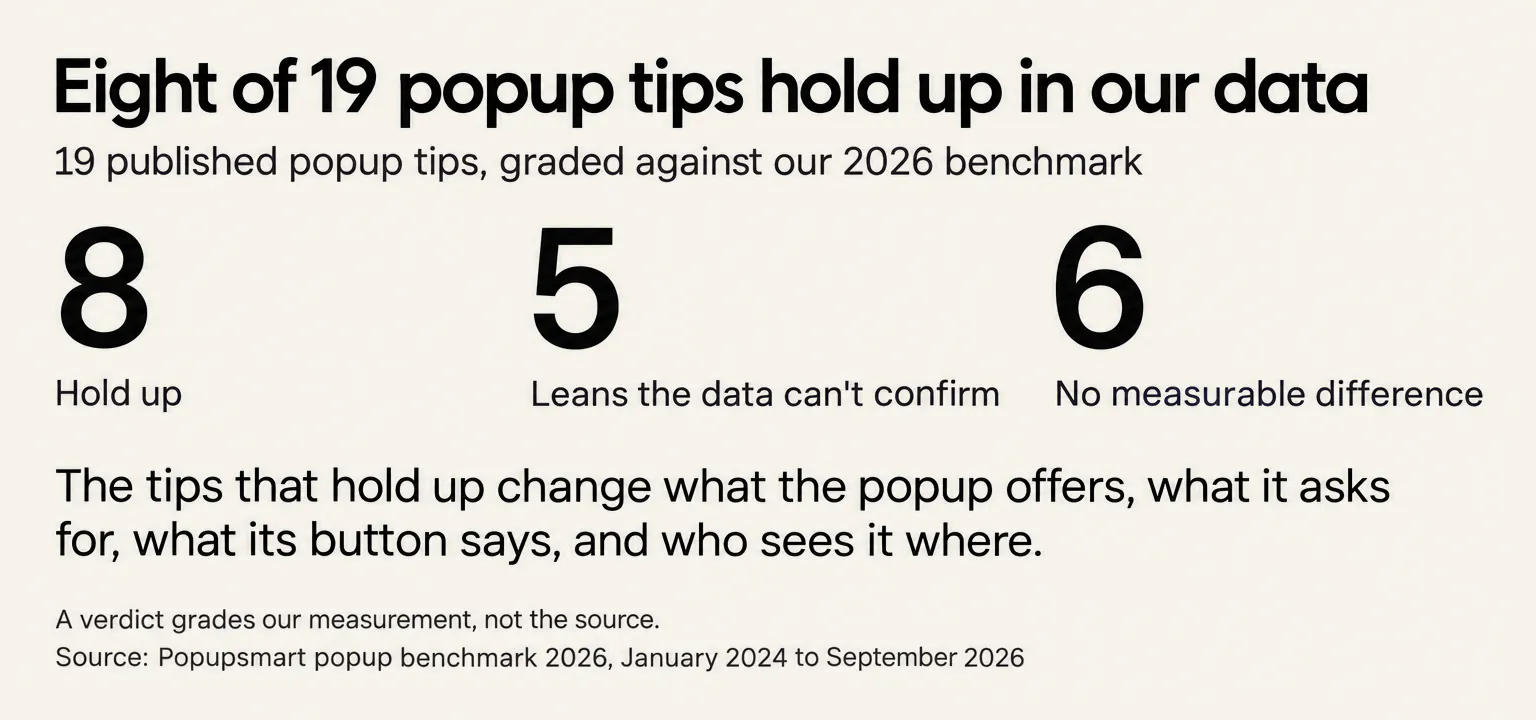
Eight of the 19 tips hold up as a reliable gap, five are leans the data can't confirm, and six show no measurable difference. Each row starts with the tip as a named source publishes it, then gives the matching statement from our benchmark word for word, its verdict and the campaigns it rests on. A verdict grades our measurement, not the source: a tip with no measurable difference behind it may still work on your site, but our campaigns can't show it.
How to read the verdicts: ✅ holds up means the gap passed every check in the benchmark's method, including a correction for testing many comparisons at once. 🟡 lean means the gap points one way but fails one of those checks, so it may be chance. ⛔ no measurable difference means the data can't tell the two groups apart, which isn't proof that they're equal. All of them compare campaigns that already ran, not controlled tests.
| # | The tip, as published | What Popupsmart's 2026 data shows | Verdict | Base |
|---|---|---|---|---|
| 1 | Don't show it on page load. Nielsen Norman Group: "never show a popup before users can glean value from your website or application." | Popups that wait before appearing convert 0.83% vs 0.61% for popups shown the instant the page loads (median campaign); the direction holds in every year of data but the difference is not statistically reliable, so treat it as a lean, not a rule. | 🟡 Lean | 1,159 vs 557 campaigns |
| 2 | Wait a set time. Wisepops: "Wait 10–50 seconds before showing your first popup" | The exact delay length (0–5 seconds vs 21–60 seconds) makes no measurable difference to conversion. | ⛔ No measurable difference | Median campaign* |
| 3 | Use exit intent. Digioh: exit-intent offers help "recover 10–20% of otherwise lost shoppers." | Exit intent shows no statistically reliable advantage: popups on the most sensitive exit-intent setting converted 1.10% vs 0.78% without exit intent (median campaign), a gap that could be chance. | 🟡 Lean | Median campaign* |
| 4 | Pick the time of day. No common tip found. | Popups convert better in the morning (06:00–11:59 visitor time) than at night or in the evening: the same popup converts better in the morning than between midnight and 6 a.m. in 69% of campaigns. | ✅ Holds up | Same popup compared with itself* |
| 5 | Mind the weekend. No common tip found. | Weekend visitors show no measurable difference in popup conversion from weekday visitors once each popup is compared with itself (2,333 campaigns). | ⛔ No measurable difference | 2,333 paired campaigns |
| 6 | Offer a discount. Omnisend: "Welcome discounts (e.g., “Get 10% off your first order!”) help overcome initial buying reluctance" | Signup popups that offer a discount code convert 1.46% vs 0.75% for signup popups without one. | ✅ Holds up | Median campaign* |
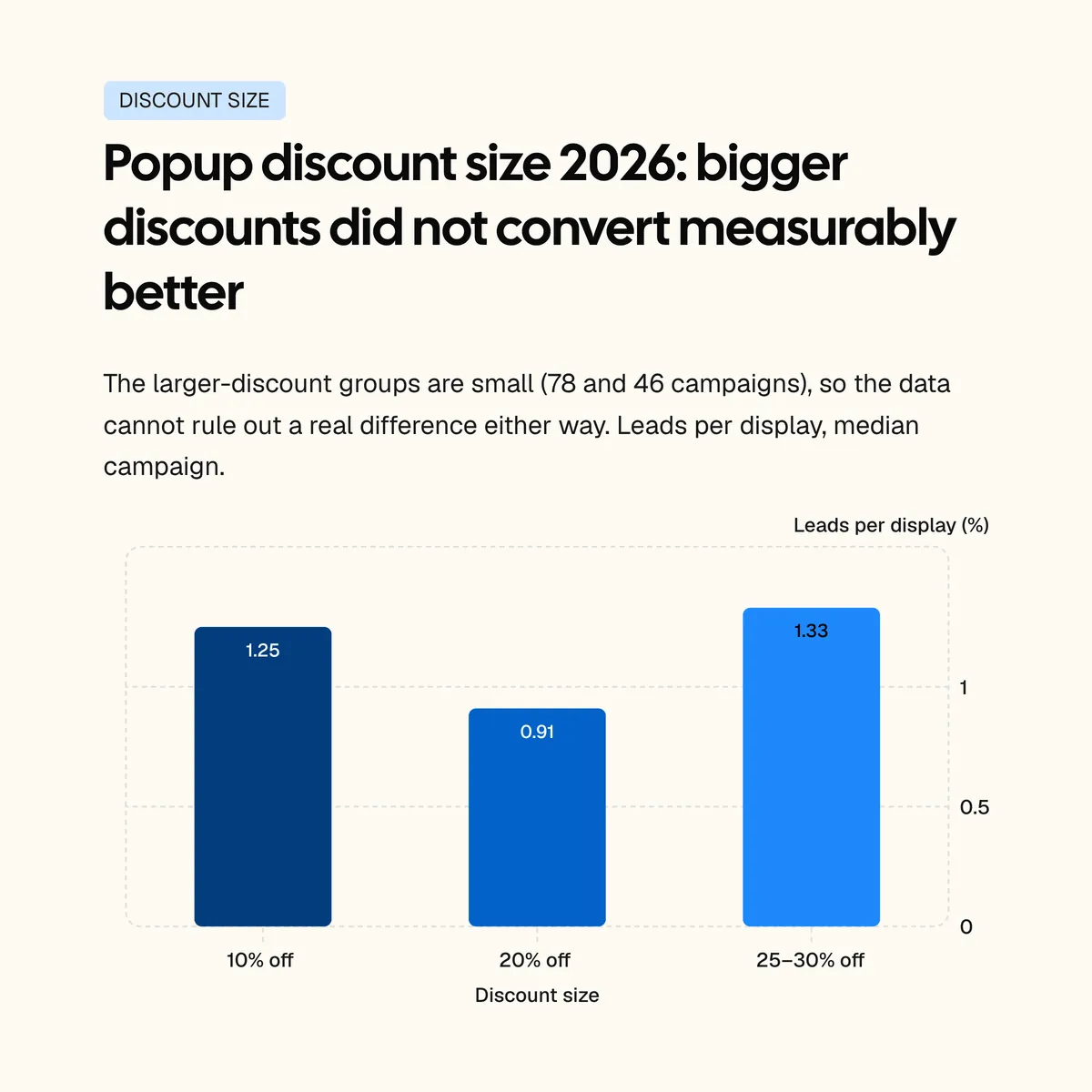
| 7 | Size the discount to the visitor. Wisepops: "Offer 10–15% discount or free shipping" to new visitors and "Offer 15–20% discount or free-shipping incentive" to returning ones. | Bigger discounts did not convert measurably better: 10% off converted 1.25%, 20% off 0.91% and 25–30% off 1.33%, but the larger-discount samples are small (78 and 46 campaigns), so the data cannot rule out a real difference either way. | ⛔ No measurable difference | 515, 78 and 46 campaigns |
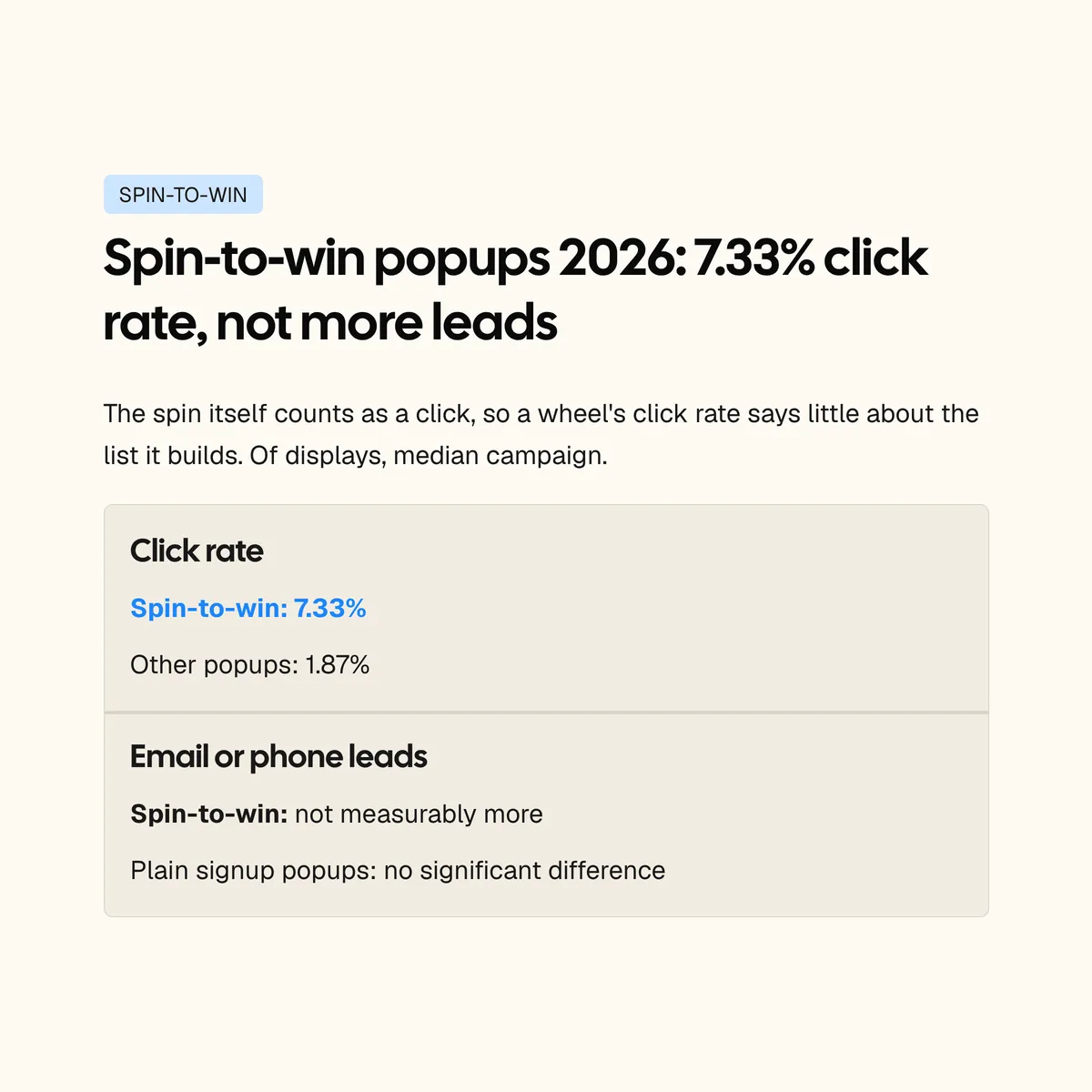
| 8 | Gamify it. Omnisend: gamified popups "tap into a user’s curiosity and create a fun experience." | Spin-to-win and other gamified popups get far more clicks (7.33% vs 1.87% of displays, median campaign; the spin itself counts as a click), but do not collect measurably more email or phone leads than plain signup popups. | ⛔ No measurable difference in leads | Median campaign* |
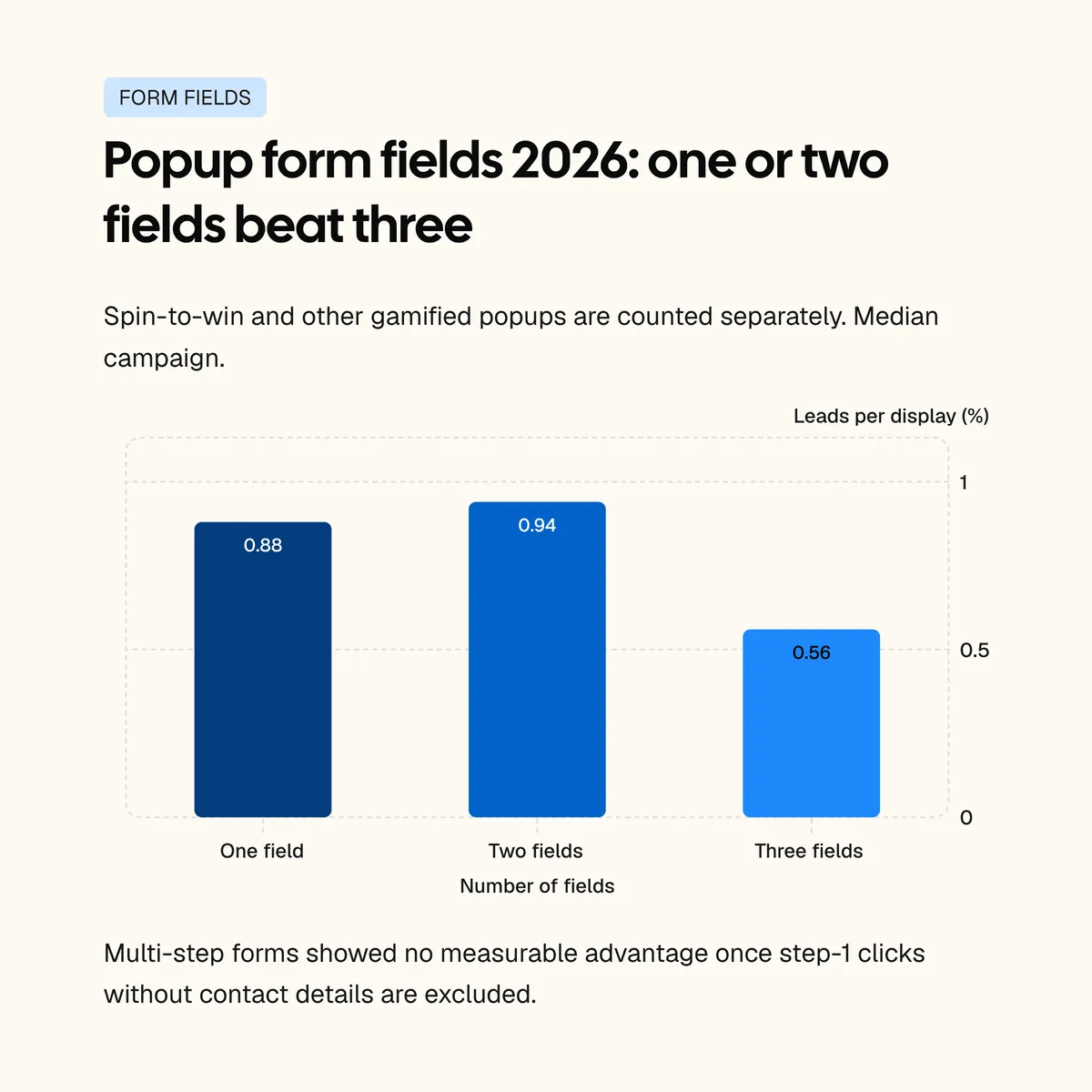
| 9 | Cut the fields. Wisepops: "Reduce form fields to email only" | Popups asking for one or two fields convert 0.88% and 0.94%, against 0.56% for three fields (median campaign; spin-to-win and other gamified popups are counted separately). | ✅ Holds up | 1,224 and 736 vs 493 campaigns |
| 10 | Ask for a name. No common tip found. | Adding a name field alongside the email shows no reliable effect: the overall gap in its favour (1.25% vs 0.88% for email only) reverses among campaigns whose form rarely changed (0.74% vs 0.79%). | 🟡 Lean, reverses | Median campaign* |
| 11 | Go two-step. Wisepops: "Micro-commitment popups increased interactions by 8–9x and doubled signups while keeping bounce rates stable." | Multi-step forms show no measurable conversion advantage over single-step forms once step-1 clicks without contact details are excluded. | ⛔ No measurable difference | Median campaign* |
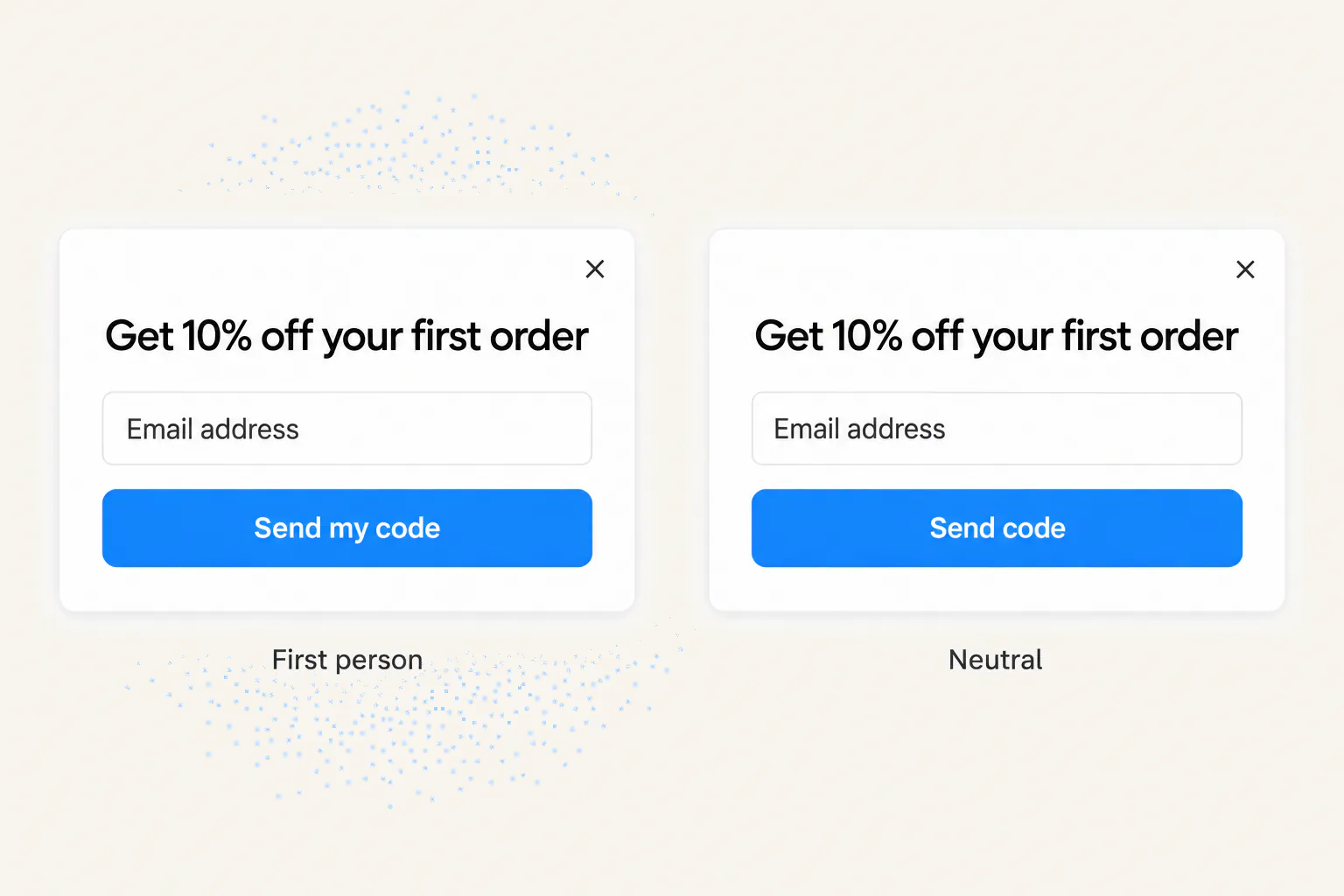
| 12 | Write in the first person. Omnisend lists "Unlock my 10% off" as a CTA example. | First-person buttons ("Send my code") convert 1.18% vs 0.80% for neutral wording (English popups, median campaign). | ✅ Holds up | English popups, median campaign* |
| 13 | Use action verbs. Omnisend: "Generic CTAs like “Submit” or “Sign up” can fail to motivate action." | CTA buttons that promise value ("Get", "Claim", "Unlock") look stronger than "Subscribe" / "Join" buttons (1.06% vs 0.77%, English popups, median campaign), but the gap is not statistically reliable. | 🟡 Lean | English popups, median campaign* |
| 14 | Add emoji. No common tip found. | Emoji in the headline or button come with a slightly higher click rate (2.76% vs 2.20%) … the click difference is not statistically reliable. | 🟡 Lean, clicks only | Median campaign* |
| 15 | Add urgency; open with a question. Omnisend: "Create a sense of urgency without being pushy". Chronos: "High-performing examples frequently open with prompts such as" "Shopping for yourself or someone else?" | Button colour, dark vs light popup backgrounds, urgency words and question headlines show no measurable effect on conversion; the data are too noisy to rule out modest effects. | ⛔ No measurable difference | Median campaign* |
| 16 | Treat new visitors differently. Digioh: "Display different offers to new and returning visitors" | Popups targeted at new visitors only convert 1.13% vs 0.77% for popups shown to everyone. | ✅ Holds up | Median campaign* |
| 17 | Segment. Wisepops: "Not every visitor should see the same popup." | Popups set up with three targeting rules convert 1.09% vs 0.71% for popups with none or one (median campaign): a correlation, since marketers who target carefully may also write better offers. | ✅ Holds up, a correlation | Median campaign* |
| 18 | Choose the page. Unbounce, on Canvas Factory: "a certain popup’s conversion rate on blog posts was just 0.18% compared to 11% on product pages." | Popups on cart and checkout pages convert 4.57% vs 1.07% on the home page (median campaign); blog pages convert 0.23%. | ✅ Holds up | 90 vs 2,138 campaigns; blog 364 |
| 19 | Cap the frequency. Digioh: "Don’t show the same popup to the same person more than once using frequency capping, or more than 4 times over the lifetime of the visitor." | The first two times a visitor sees a popup in a week convert at similar rates (1.33% and 1.22% of displays, pooled); from the third view conversion falls, and from the sixth view it is 0.41%, 31% of the first-view rate. | ✅ Holds up from the third view | All displays pooled |
*The benchmark's public files don't carry a campaign count for this comparison yet; we'll add it here when they do. Rows 5 and 17 are in the downloadable benchmark data and will join the report in its next update.
When should a popup appear?
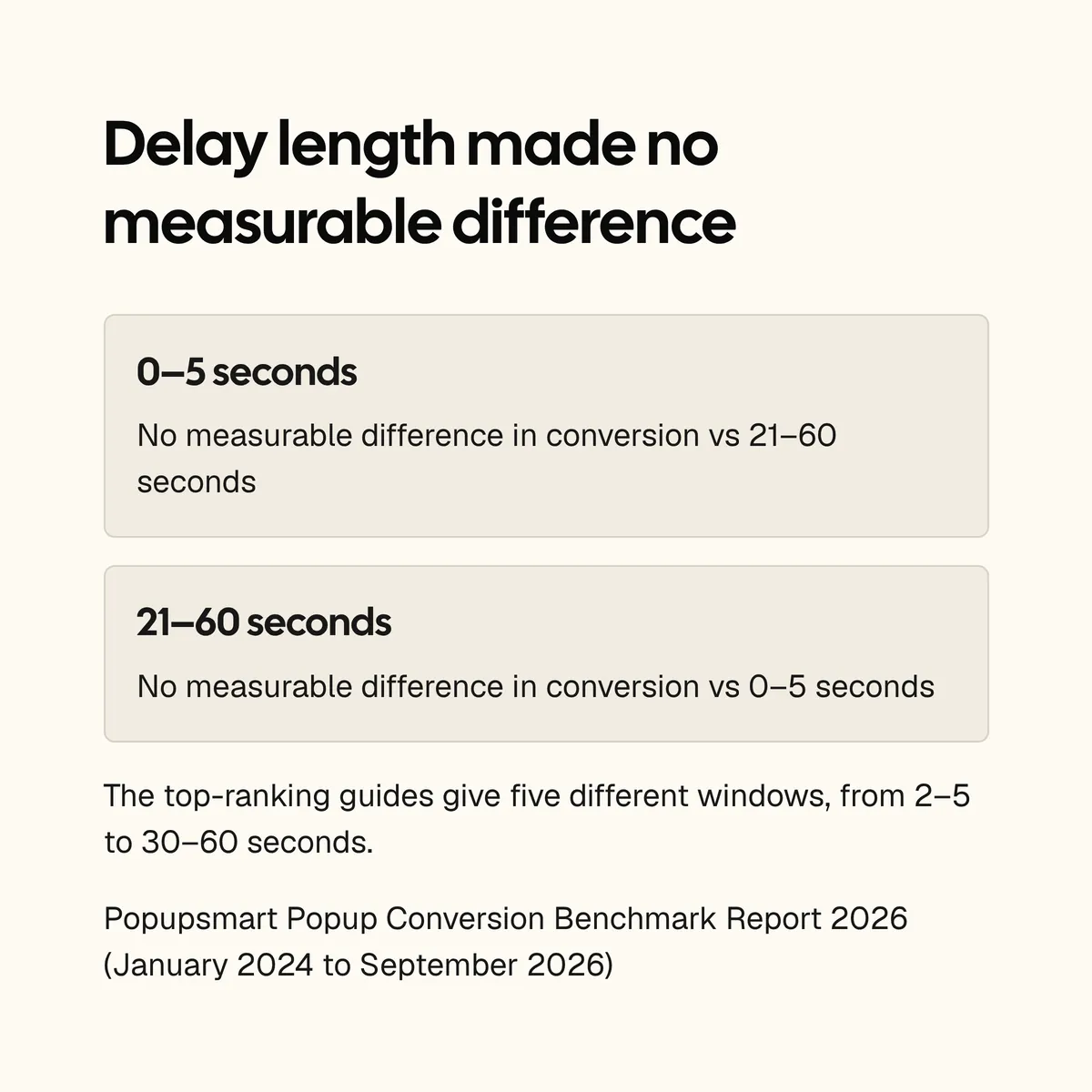
Timing tips are usually more precise than the evidence behind them. Popups that wait before appearing convert 0.83% vs 0.61% for popups shown the instant the page loads (median campaign); the direction holds in every year of data but the difference is not statistically reliable, so treat it as a lean, not a rule. The length of the wait matters even less. The exact delay length (0–5 seconds vs 21–60 seconds) makes no measurable difference to conversion. The pages ranking for "pop up best practices" don't agree on the window either: Digioh says "2-5 seconds", PageCloud "between three and 30 seconds", Omnisend "10-30 seconds", Wisepops "10–50 seconds" and Eleken "30–60 seconds". Only one cites data for its window: Eleken, quoting Wisepops data for "between 15 and 30 seconds", a different range from the one on Wisepops' own guide. Omnisend's own statistics page says "a delay of 6-10 seconds yields the best conversion rates", while its best-practices list says 10-30.
Exit intent sits in the same place. Popups on the most sensitive exit-intent setting converted 1.10% vs 0.78% without exit intent (median campaign), a gap that could be chance, so treat it as a trigger to test rather than a default. Our exit-intent benchmark post walks through that comparison and its settings.
The clock matters more than the stopwatch. Popups convert better in the morning (06:00–11:59 visitor time) than at night or in the evening: the same popup converts better in the morning than between midnight and 6 a.m. in 69% of campaigns. Weekends don't: weekend visitors show no measurable difference in popup conversion from weekday visitors once each popup is compared with itself (2,333 campaigns). For the settings behind each trigger, see our popup timing guide.
Does a discount help, and how big should it be?
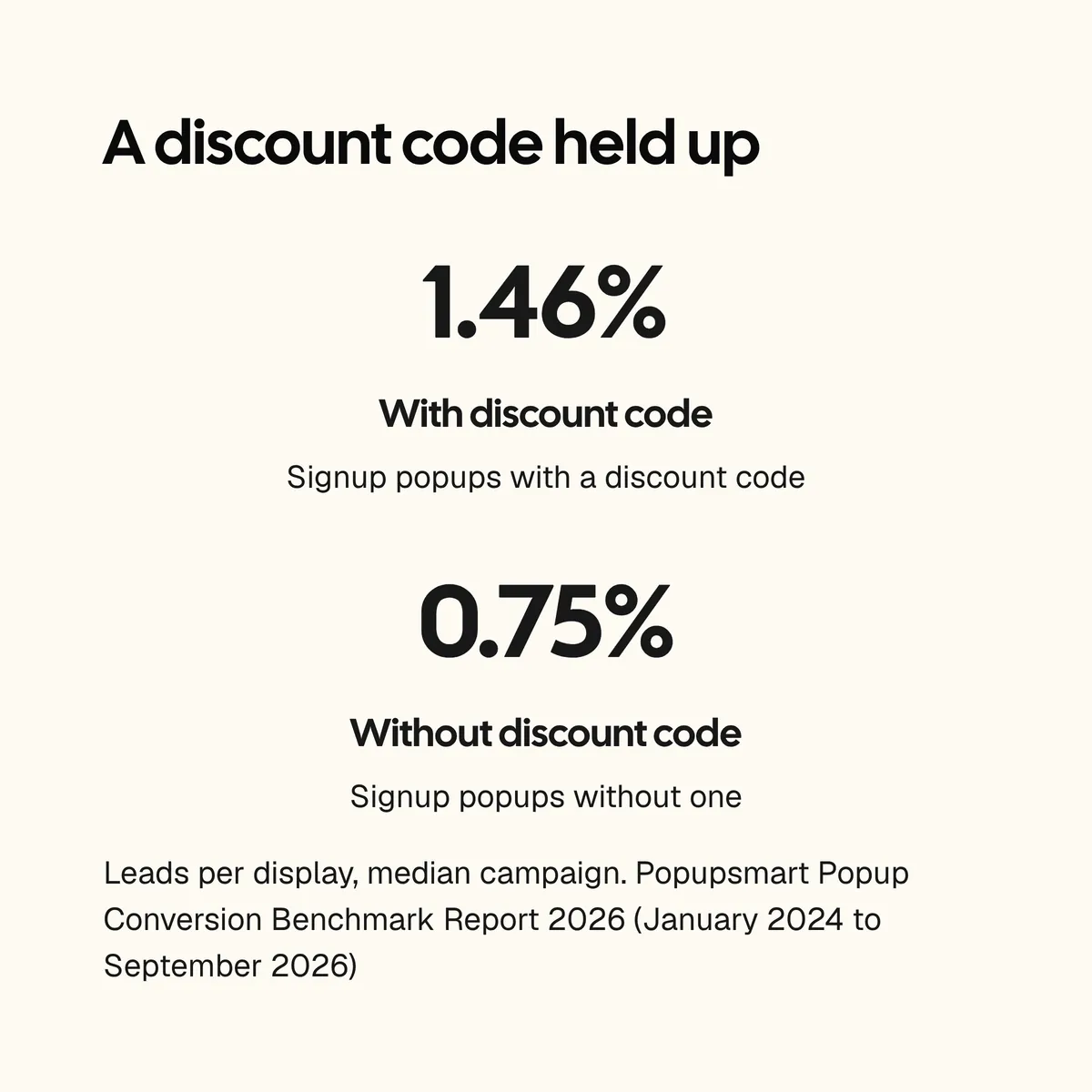
A discount code helps, and a bigger one didn't measurably help more. Signup popups that offer a discount code convert 1.46% vs 0.75% for signup popups without one, and popups stating 10% off convert 1.25% vs 0.67% for popups that state no discount. Past that, the size stops showing up in the numbers. Bigger discounts did not convert measurably better: 10% off converted 1.25%, 20% off 0.91% and 25–30% off 1.33%, but the larger-discount samples are small (78 and 46 campaigns), so the data cannot rule out a real difference either way. Wisepops suggests 10–15% for new visitors and 15–20% for returning ones. Our data can't show that the bigger number earns more signups, and it can't rule that out.
That leaves the size to your margin, not to a rule of thumb. Work out what a first order is worth to you after the discount, using your own average order value and margin, and start from the smallest code you're comfortable offering. Our discount popup examples show how stores word and design the offer.
Do spin-to-win popups collect more emails?
Not in our data. Spin-to-win and other gamified popups get far more clicks (7.33% vs 1.87% of displays, median campaign; the spin itself counts as a click), but do not collect measurably more email or phone leads than plain signup popups. Omnisend's list says gamified popups "tap into a user’s curiosity and create a fun experience", and Unbounce guesses that a spin wheel's "click-through rate is likely sky high". On clicks, our data agrees. Popupsmart's builder includes a spin-to-win element, and this is still what our campaigns show: a wheel earns attention, and whether it earns more email addresses is unproven.
How many form fields should a popup have?
One or two fields beat three in our data. Popups asking for one or two fields convert 0.88% and 0.94%, against 0.56% for three fields (median campaign; spin-to-win and other gamified popups are counted separately). Wisepops goes further and advises email only, reporting that "Removing non-essential form fields boosted sign-ups by 2-3× with no bounce change" in its own data. Our statement compares one and two fields with three; it doesn't rank one field against two.
A name field is the usual third question, and the evidence for it doesn't survive a closer look. Adding a name field alongside the email shows no reliable effect: the overall gap in its favour (1.25% vs 0.88% for email only) reverses among campaigns whose form rarely changed (0.74% vs 0.79%). Ask for a name only if you'll use it in the first email.
Splitting the form into steps doesn't rescue a long one either. Multi-step forms show no measurable conversion advantage over single-step forms once step-1 clicks without contact details are excluded. That's the opposite of the ranking advice. Wisepops reports that "Micro-commitment popups increased interactions by 8–9x and doubled signups while keeping bounce rates stable", and Omnisend's list recommends two-step popups "for higher conversions". Part of the gap is what gets counted: a yes/no click is an interaction, and our benchmark counts only submissions that contain an email address or phone number. Chronos reports a client test where the submit rate rose from 2.64% to 4.40%, but that test changed the popup to full page and added the first question at the same time. Our guide to multi-step forms on Shopify covers the cases where a second step still earns its place, such as quizzes that segment the list.
What should the button and headline say?
Write the button in the visitor's voice. First-person buttons ("Send my code") convert 1.18% vs 0.80% for neutral wording (English popups, median campaign). Omnisend lists "Unlock my 10% off" as a CTA example without data, and here our data backs it. Value verbs look good but aren't proven: CTA buttons that promise value ("Get", "Claim", "Unlock") look stronger than "Subscribe" / "Join" buttons (1.06% vs 0.77%, English popups, median campaign), but the gap is not statistically reliable.
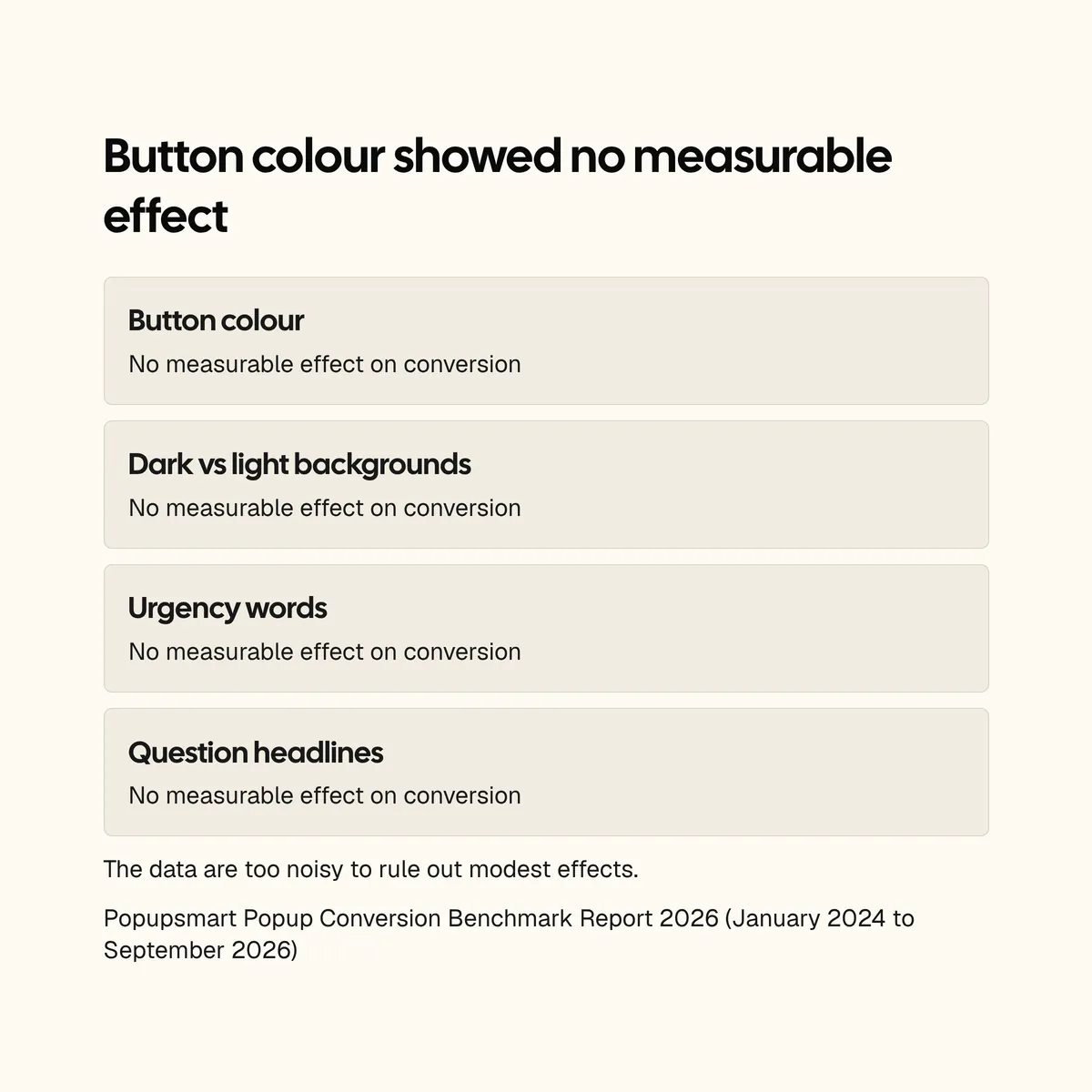
Styling is where the common advice and our data part ways most clearly. Button colour, dark vs light popup backgrounds, urgency words and question headlines show no measurable effect on conversion; the data are too noisy to rule out modest effects. Omnisend tells readers to "Create a sense of urgency without being pushy", and Chronos says "High-performing examples frequently open with prompts such as" a question. Neither page shows data for it, and ours finds no measurable effect. Emoji move clicks a little at most. Emoji in the headline or button come with a slightly higher click rate (2.76% vs 2.20%) … the click difference is not statistically reliable.
What visitors do give the copy is very little time. 71% of visitors who close a popup do so within 5 seconds of it appearing, and 61% of popup leads are submitted within 30 seconds of the popup appearing. Put the offer in the headline, where it's read in those first seconds. For visual design choices our data doesn't grade, see our popup design best practices.
Who should see the popup, and on which pages?
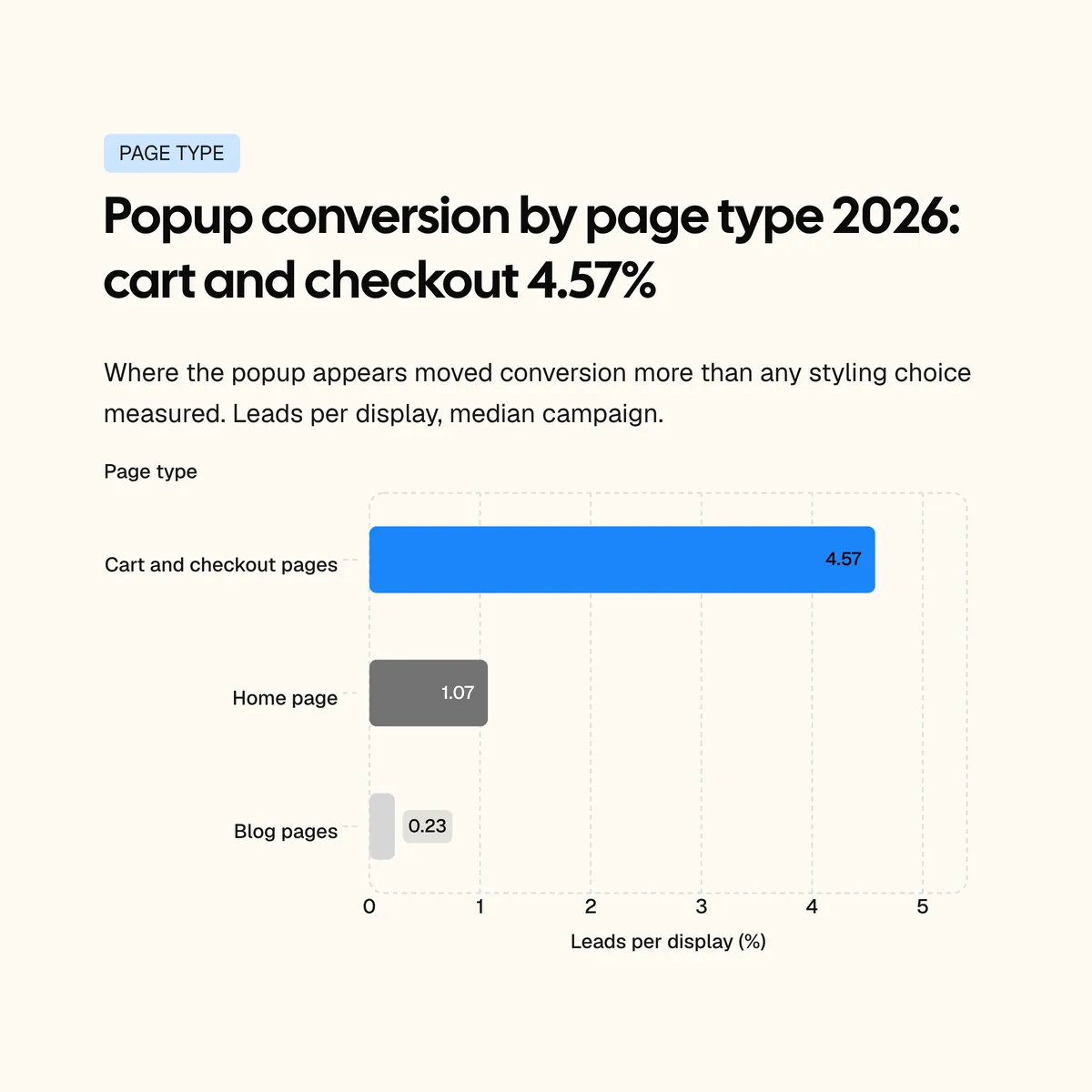
Placement moves conversion more than any styling choice we measured. Popups on cart and checkout pages convert 4.57% vs 1.07% on the home page (median campaign); blog pages convert 0.23%. Unbounce's Canvas Factory example points the same way, and Wisepops calls the homepage the page where "Visitor intent is lowest." If most of your traffic lands on articles, judge a blog popup against that 0.23%, not against the site-wide median.
New visitors are the better audience. Popups targeted at new visitors only convert 1.13% vs 0.77% for popups shown to everyone. The same pattern shows up inside each popup. New visitors convert on popups more often than visitors who were on the site in the previous 7 days: the same popup converts better for new visitors in 75% of campaigns (median gap 0.30 percentage points; pooled 1.28% vs 0.54% of displays). Digioh and Omnisend both advise different offers for new and returning visitors; our data adds that new visitors are also the ones who convert more often.
Careful targeting goes with better results, though we can't say it causes them. Popups set up with three targeting rules convert 1.09% vs 0.71% for popups with none or one (median campaign): a correlation, since marketers who target carefully may also write better offers.
How often should the same visitor see a popup?
A second view showed no measurable cost; the decline starts at the third. The first two times a visitor sees a popup in a week convert at similar rates (1.33% and 1.22% of displays, pooled); from the third view conversion falls, and from the sixth view it is 0.41%, 31% of the first-view rate. Showing a popup a second time caused no measurable drop in conversion within the same campaign; the decline begins with the third showing. The caps on the ranking pages are stricter than that. Digioh says not to show the same popup to the same person "more than once", Omnisend says "Limit one popup per session", and Wisepops suggests "once per session, then once every 7 days if the visitor doesn't sign up."
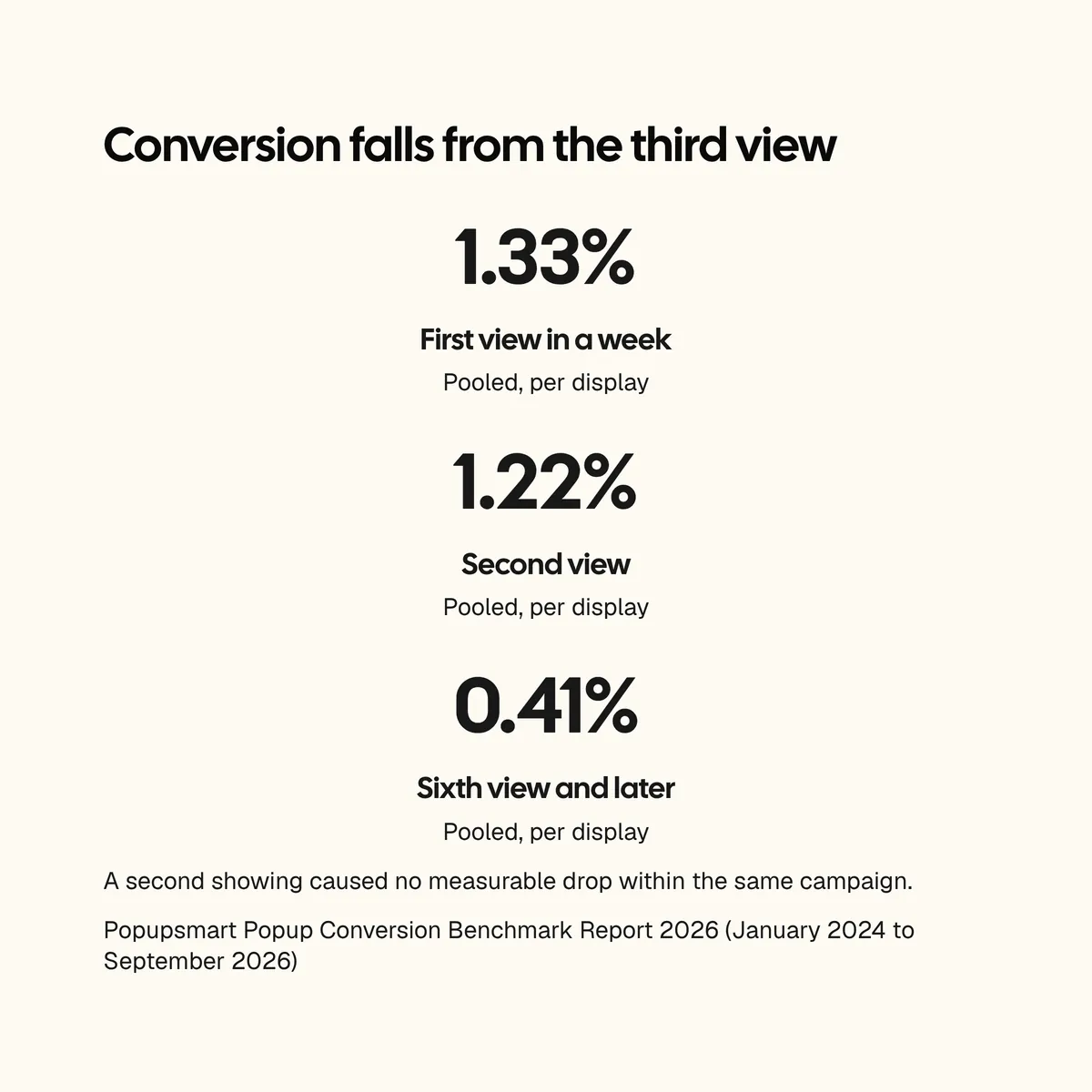
We don't turn that curve into a cap, and here's why. The visitors who see a popup for the sixth time are mostly visitors who didn't convert on the first five, and comparing views within the same campaign doesn't remove that. Part of the fall is who's left, not only fatigue. Use the curve to decide how hard a later view has to work, and stop showing the popup once someone has signed up.
What can't our data grade yet?
Some common tips fall outside what the benchmark measures, and one sits just outside what we publish.
- Popup format. Center modal vs corner box is a gap that passes our tests, but narrowly. Our rule is to publish a narrow result with its confidence interval, and the public data files don't carry that interval yet, so the format row waits.
- Mobile. Mobile visitors convert on popups at 1.02% vs 0.57% on desktop, and click at 2.99% vs 1.34% (median campaign). That describes your visitors rather than a setting you choose, so it isn't graded. Our mobile popup design guide covers the design side, and our note on Google's popup rules covers intrusive interstitials.
- Tips the benchmark doesn't measure. Free gifts vs percentage discounts (Wisepops reports that "Free-gift incentives captured emails 59% more effectively than 5% discounts for the first order"), countdown timers, images, close buttons and click or scroll triggers aren't covered by a published statement, so we don't grade them.
How do other vendors' popup numbers compare?
Four other companies that sell popups or signup forms publish numbers from their own platforms. Each one counts differently, so their rates and ours don't belong in the same column. Here's what each measures.
| Data | What it counts | Base and window | How ours differs |
|---|---|---|---|
| Omnisend, email popup statistics | Emails collected over popup displays, as an average: 26.4M emails from 1.24B displays | Popup forms with at least 1,000 yearly views, 2025 | We count email or phone leads and report the median campaign, January 2024 to September 2026 |
| Wisepops, popup statistics | "the number of emails collected divided by the number of displays", email signup popups only, as an average | "1B Displays"; no window stated | We state the window, a minimum of 1,000 displays and 14 active days per campaign, and a significance test per comparison |
| Wisepops, A/B testing report | How much a winning version beat its baseline, as a median | 5,710 A/B tests from 894 businesses, January 2024 to June 2026 | Nearly the same window, but it measures test wins, not a lead rate |
| Klaviyo, sign-up form examples | "Median submission rate" | "a recent analysis of Klaviyo brands"; no count or window given | Medians and significance labels like ours, but no published base |
Where the practices overlap, the other data mostly points our way. Wisepops' A/B report says "A guaranteed fixed discount repeatedly beat a gamified spin-the-wheel, though gamification still beats a plain form." Klaviyo shows email multi-step forms at 2.85% against 2.27% for single-step, "though not at the level of statistical significance." One finding cuts against us: the same Wisepops report says "An immediate first-page trigger beat a 20-second delay", which is one more reason our wait-before-showing row stays a lean.
Methodology: how we graded these tips
How the tips were chosen
I read the pages on the first page of Google's US results for "pop up best practices" (Ahrefs, September 26, 2026), and wrote down every tip that one of our benchmark statements speaks to. Eight pages made that set: Nielsen Norman Group, PageCloud, Chronos, Unbounce, Digioh, Wisepops, Omnisend and Eleken. I left out the tenth result, Userpilot's guide to survey popups, because it covers in-app surveys. Four of the eight come from companies that, like us, sell popup or signup-form software: Unbounce, Digioh, Wisepops and Omnisend. Where no page gave a tip on a topic our data covers, the row says "no common tip found". Each row then quotes the matching statement from Popupsmart's 2026 benchmark word for word, with its qualifiers.
Scope
The dataset covers 1.98 billion page views, 499.6 million popup displays and 1.84 million leads: 28,674 campaigns from 11,533 businesses that ran a popup with Popupsmart between January 2024 and September 2026. The window runs from 1 January 2024 to 23 September 2026. Benchmark rates use a stricter set: 10,768 campaigns with at least 1,000 displays and 14 active days, from 4,559 businesses. Lead-rate medians use the 3,034 of those popups that ask for an email or phone number.
Definitions
- Display: a popup shown to a visitor. A teaser impression also counts as a display.
- Click: a click on a popup element set to count as an interaction, plus teaser clicks.
- Lead: a popup submission that contains an email address or phone number, counted once per campaign per page load. Spins, coupon reveals and step-1 clicks without contact details are not leads.
- Lead conversion rate: leads divided by displays, for popups that ask for an email or phone number, reported as the median campaign.
- Median vs pooled: a median takes the per-campaign rates and finds the middle, so every campaign counts once. A pooled rate divides the sum of leads by the sum of displays, so big sites dominate it. Each row says which one it uses.
- "The same popup": where a statement says this, the comparison was made within campaigns, each popup compared with itself.
How the verdicts were decided
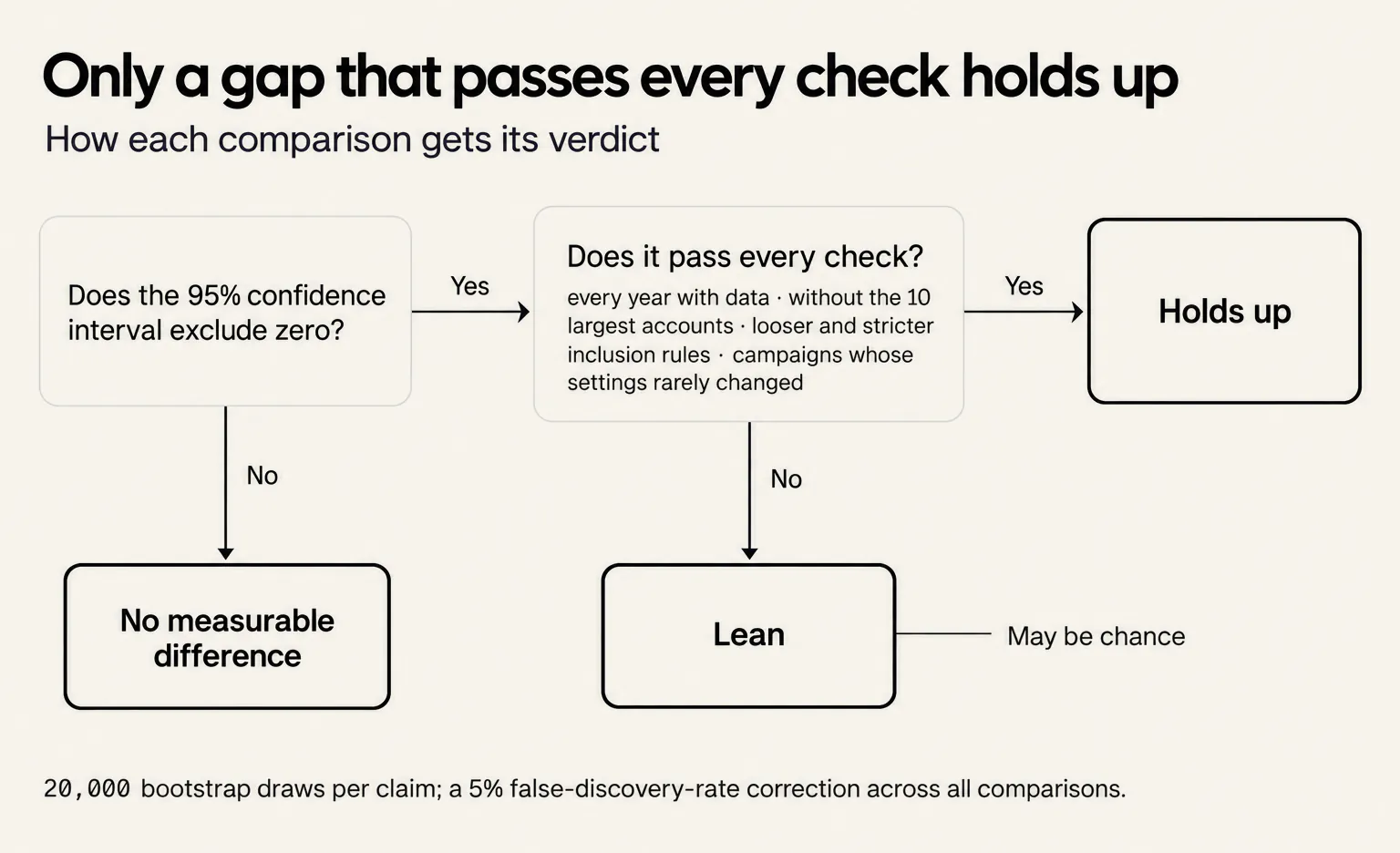
Each comparison went through a bootstrap test (20,000 draws per claim) across years and inclusion rules, with a 5% false-discovery-rate correction across all the comparisons tested at once. A gap holds up when its 95% confidence interval excludes zero and it passes every check: it keeps its direction in every year with data, without the 10 largest accounts, under looser and stricter inclusion rules, and among campaigns whose settings rarely changed. A lean is a gap whose interval excludes zero but that fails one of those checks, so it may be chance. No measurable difference means the interval includes zero: the data can't tell the groups apart, which isn't proof that they're equal. A gap that passes narrowly is published only with its confidence interval, which is why the popup-format row waits.
Cleaning and privacy
Bot user agents are removed, and templates, internal accounts and suspended accounts are excluded. Every figure was recomputed independently and spot-checked against raw production records, and rerunning the pipeline on the same raw data gives identical output. Every published segment covers a minimum number of campaigns and accounts, and a segment is hidden when its value could be worked out by subtracting visible ones. No single customer can be identified from these figures.
Limitations
- The data covers only websites that run Popupsmart, so it describes those sites, not the whole web.
- Rates are per display, not per visitor. A visitor who sees a popup three times counts three times.
- Most comparisons are between different campaigns, not A/B tests, so a gap can reflect who uses a setting as well as the setting itself.
- Some dimensions are settings the marketer chose (trigger, targeting, form fields); others are observed behaviour (device, page type, time of day). A setting records what the marketer chose, not what every visitor experienced.
- Creative features such as discount size, button wording, emoji and colour are read from each popup's main page. The button-wording results cover English popups.
How to cite and reuse the data
Popupsmart, "Popup best practices: we analyzed 1.98 billion page views and 28,674 Popupsmart campaigns" (data January 2024 to September 2026), https://popupsmart.com/blog/popup-best-practices. The statements, metrics and breakdowns behind it are free to reuse under CC BY 4.0 with credit to Popupsmart: download the benchmark data as JSON or the benchmark data as CSV.
Frequently asked questions
What are the popup best practices that actually work?
In Popupsmart's 2026 benchmark, the tips that hold up change the offer, the form, the button and the audience. Signup popups that offer a discount code convert 1.46% vs 0.75% for signup popups without one. Popups asking for one or two fields convert 0.88% and 0.94%, against 0.56% for three fields (median campaign; spin-to-win and other gamified popups are counted separately). First-person buttons ("Send my code") convert 1.18% vs 0.80% for neutral wording (English popups, median campaign). Popups on cart and checkout pages convert 4.57% vs 1.07% on the home page (median campaign); blog pages convert 0.23%.
How long should a popup wait before it appears?
Long enough not to fire on page load; the exact wait matters less than most guides suggest. In Popupsmart's 2026 benchmark, popups that wait before appearing convert 0.83% vs 0.61% for popups shown the instant the page loads (median campaign); the direction holds in every year of data but the difference is not statistically reliable, so treat it as a lean, not a rule. The exact delay length (0–5 seconds vs 21–60 seconds) makes no measurable difference to conversion.
Do spin-to-win popups collect more emails?
Not in Popupsmart's 2026 benchmark. Spin-to-win and other gamified popups get far more clicks (7.33% vs 1.87% of displays, median campaign; the spin itself counts as a click), but do not collect measurably more email or phone leads than plain signup popups. Judge a wheel by the email addresses and phone numbers it collects, divided by its displays.
How big should a popup discount be?
Big enough to exist; our data can't say that bigger is better. In Popupsmart's 2026 benchmark, popups stating 10% off convert 1.25% vs 0.67% for popups that state no discount. Bigger discounts did not convert measurably better: 10% off converted 1.25%, 20% off 0.91% and 25–30% off 1.33%, but the larger-discount samples are small (78 and 46 campaigns), so the data cannot rule out a real difference either way.
Should a popup ask for a name as well as an email?
Only if you'll use it. In Popupsmart's 2026 benchmark, adding a name field alongside the email shows no reliable effect: the overall gap in its favour (1.25% vs 0.88% for email only) reverses among campaigns whose form rarely changed (0.74% vs 0.79%).
Does button colour change popup conversion?
Not measurably in Popupsmart's 2026 benchmark. Button colour, dark vs light popup backgrounds, urgency words and question headlines show no measurable effect on conversion; the data are too noisy to rule out modest effects. The button's wording did show up: first-person buttons ("Send my code") convert 1.18% vs 0.80% for neutral wording (English popups, median campaign).
How often should a popup show to the same visitor?
In Popupsmart's 2026 benchmark, the first two times a visitor sees a popup in a week convert at similar rates (1.33% and 1.22% of displays, pooled); from the third view conversion falls, and from the sixth view it is 0.41%, 31% of the first-view rate. We don't turn that curve into a cap: the visitors who see a popup for the sixth time are mostly visitors who didn't convert on the first five. Stop showing the popup once someone has signed up.
Do exit-intent popups convert better?
Not reliably. In Popupsmart's 2026 benchmark, exit intent shows no statistically reliable advantage: popups on the most sensitive exit-intent setting converted 1.10% vs 0.78% without exit intent (median campaign), a gap that could be chance. Treat exit intent as a trigger to test, not a default.