ChatGPT
 Perplexity
 Claude
 Grok
Grok Google AI Mode
Below, I walk through 9 popup survey examples with ready-to-use questions, the survey templates and question elements you can build them with, and what our own 2026 popup data says about timing, length and frequency.
You can build every one of them for free, and the setup steps are further down.
What Are Popup Surveys and Why Do They Work?
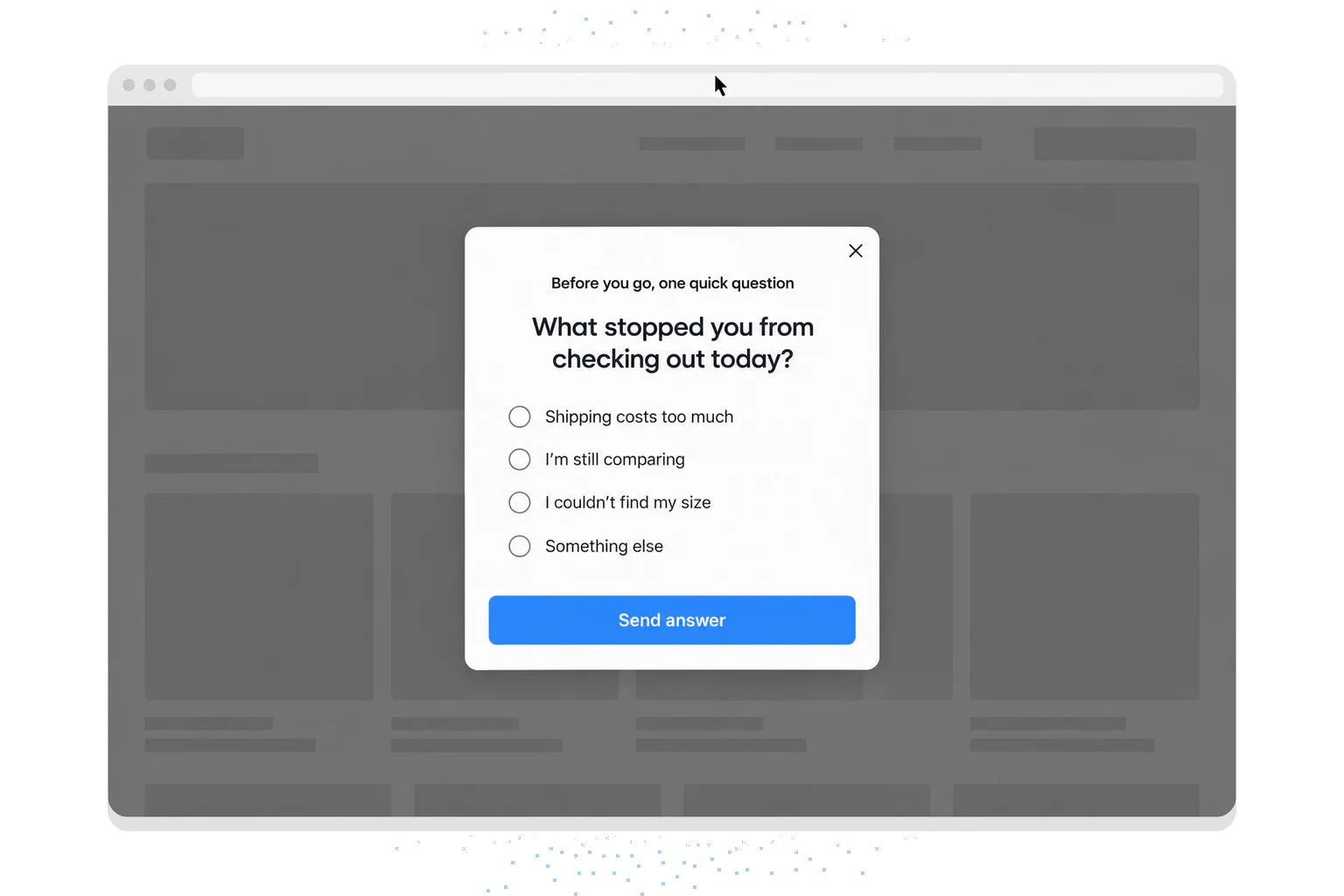
Popup surveys are brief, interactive questionnaires that appear directly on a webpage as an overlay or slide-in widget. Unlike email surveys that sit unread in inboxes for days, popup surveys catch visitors while they're actively browsing your site. That difference in timing matters more than it sounds.
A popup survey removes the friction of switching contexts. Your visitor doesn't need to open a new tab, remember why they visited, or reconstruct their experience from memory. They answer while the experience is still happening.
Quick overview of all 9 popup survey examples:
1. Satisfaction (CSAT) Surveys: measure how happy customers are with one touchpoint, so you know what to fix to keep them
2. NPS Popup Surveys: sort promoters from detractors with a single-question loyalty score
3. Feedback Popup Surveys: collect open-ended opinions about products, features or the site itself
4. UX Popup Surveys: find navigation pain points and usability friction with multi-step forms
5. Exit-Intent Surveys: ask leaving visitors why they're going before they're gone
6. Preference Surveys: segment users by product taste and communication preferences for personalized marketing
7. Demographic Surveys: build audience profiles from age, location and occupation data
8. Post-Purchase Surveys: get feedback on the shopping experience while it's still fresh
9. Lead Generation Surveys: trade something of value (discounts, early access) for contact information and qualifying data
So why use a popup instead of an email survey?
• You control the moment. Trigger the survey on scroll depth, time on page, exit intent or a specific page visit. A visitor who just spent 4 minutes reading your pricing page gives very different feedback than one who bounced from the homepage.
• More people finish. The survey shows up inside the browsing flow, so nobody has to switch context, and fewer visitors drop off than with email surveys or external survey links.
• Answers arrive as they happen. You can spot a broken checkout, a confusing pricing tier or missing feature documentation within hours instead of weeks.
• Different visitors can get different questions. Audience targeting with smart segments lets first-time visitors see onboarding questions while returning customers get a satisfaction check.
• It costs next to nothing. No printing, no postage, no manual data entry. One popup survey campaign can run indefinitely with zero marginal cost per response.
The numbers in this guide come from our 2026 popup benchmark. The dataset covers 1.98 billion page views, 499.6 million popup displays and 1.84 million leads: 28,674 campaigns from 11,533 businesses that ran a popup with Popupsmart between January 2024 and September 2026. The benchmark measures leads (a popup submission that contains an email address or phone number) divided by popup displays, not survey answers, so this guide quotes it only where it carries over to surveys: timing, form length, frequency and targeting.
9 popup survey examples with questions to ask
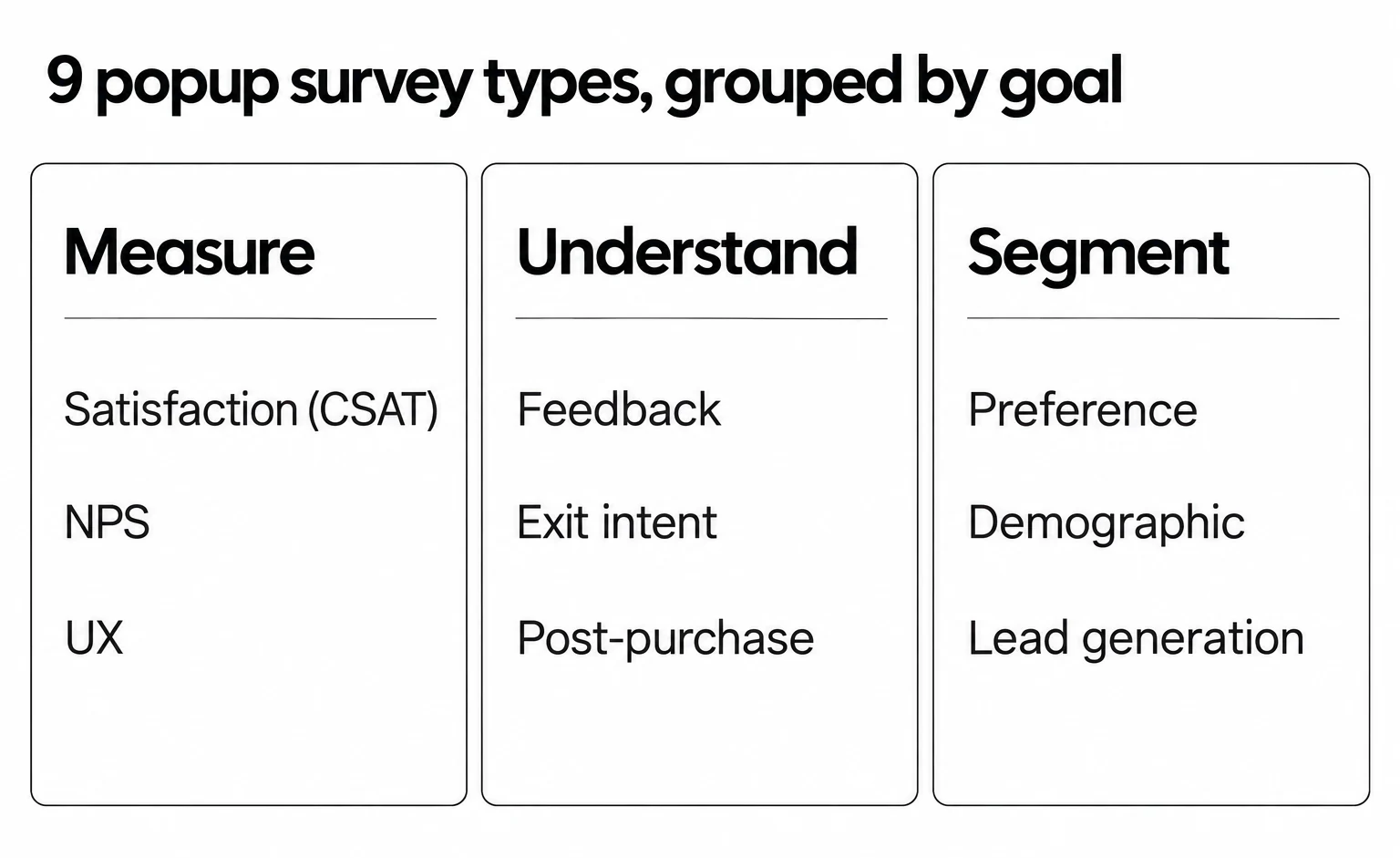
The nine types fall into three goals. Satisfaction (CSAT), NPS and UX surveys measure an experience. Feedback, exit-intent and post-purchase surveys help you understand why visitors act the way they do. Preference, demographic and lead generation surveys segment your audience. A survey is one job a popup can do; the other formats are in types of popups.
1. Satisfaction (CSAT) Popup Surveys: Measure What Customers Actually Feel
Customer satisfaction surveys (often called CSAT surveys) measure how visitors rate a specific interaction, product, or experience on your site. They differ from NPS surveys by focusing on a particular touchpoint rather than overall brand loyalty. A CSAT popup might ask about your checkout flow, your support chat, or a specific product page.
A satisfaction popup survey with rating scale and follow-up question, built in Popupsmart
How to implement:
1. Pick the specific touchpoint you want to measure. "Overall satisfaction" sounds useful but produces vague data. Instead, target post-checkout, post-support-chat, or post-feature-use moments.
2. Use a 1-5 or 1-10 numeric scale as your primary question. Numeric scales give you scores you can track over time, and visitors can answer them at a glance. In Popupsmart, the Opinion Scale element offers 1 to 3, 1 to 5 and 1 to 10 scales, and the Rating element uses stars, hearts or emoji.
3. Add one optional open-text follow-up: "What's the main reason for your score?" This captures the why behind the number without making the survey feel long.
4. Trigger the popup 3-5 seconds after the target action completes. If you trigger immediately, visitors haven't processed the experience yet. Wait too long, and they've moved on mentally.
5. Set a frequency cap of one impression per visitor per 30 days to avoid survey fatigue.
Questions you can use:
On a scale from 1-10, how satisfied are you with our website?
How satisfied are you with the speed and performance of our website?
How well do our products meet your expectations? (1-10)
How satisfied are you with the customer support you received?
Best timing: Show CSAT popups after purchase completion, following support interactions, or when a user finishes a key task on your site.
2. NPS Popup Surveys: Identify Your Promoters and Detractors
Net Promoter Score popups ask one core question: "How likely are you to recommend us to a friend or colleague?" scored 0-10. That one question is the whole survey, and the simplicity is the point. Respondents fall into three buckets: Promoters (9-10), Passives (7-8), and Detractors (0-6). That single number gives you a pulse check on customer loyalty that you can track month over month.
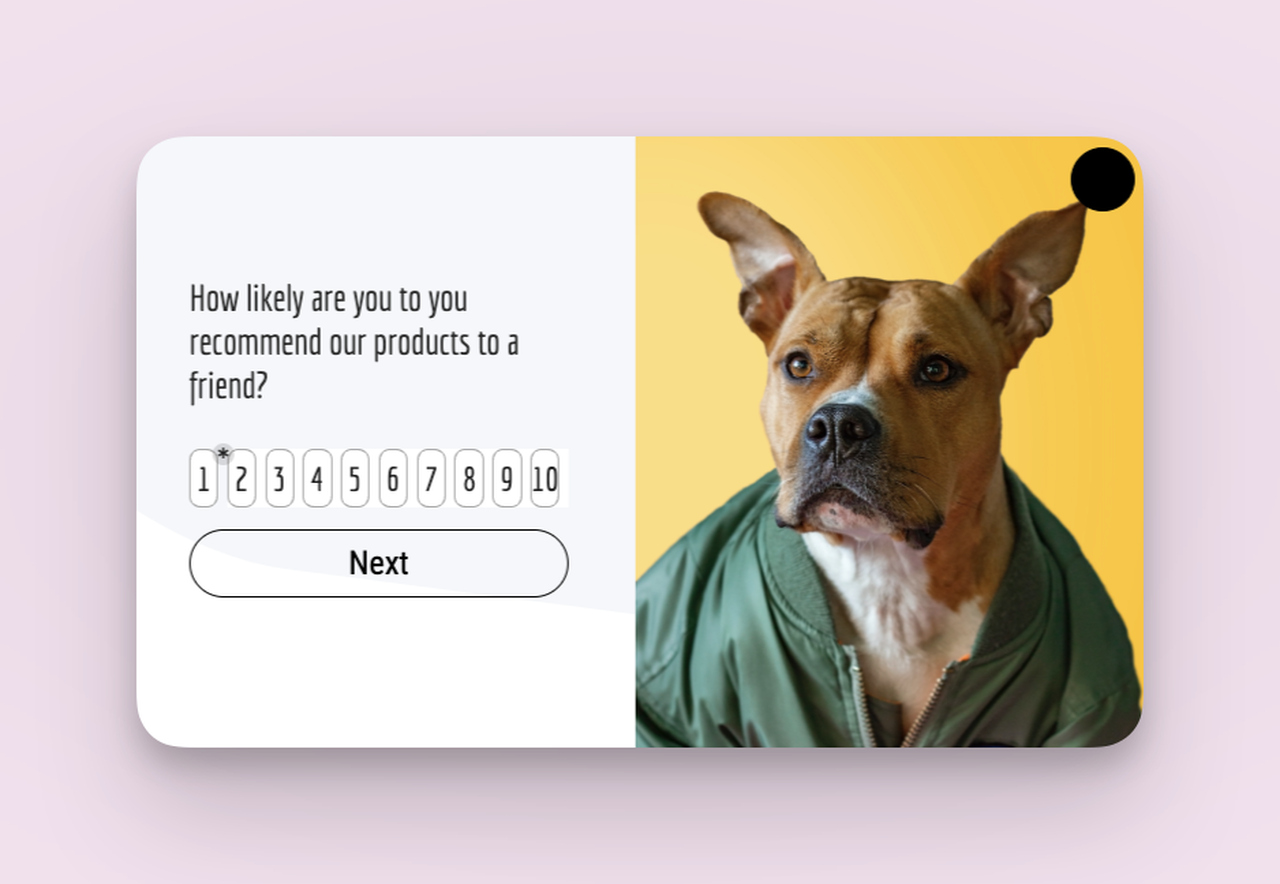
NPS popup survey with 0-10 scale and follow-up question field
How to implement:
1. Start with the standard NPS question as the first screen. Don't rephrase it heavily. Consistency in wording lets you benchmark against industry NPS benchmarks.
2. Branch the follow-up question based on the score. For Promoters (9-10): "What do we do well?" For Detractors (0-6): "What can we improve?" Each group gets a question it can answer, and you get feedback you can act on. Popupsmart's Rating element lets you set an action for each rating, so a low score and a high score can lead to different follow-ups.
3. Target returning users who've had enough exposure to form an opinion. Showing NPS to first-time visitors produces noise, not signal.
4. Run NPS surveys quarterly as a baseline tracker. Monthly is too frequent for the same audience; annually misses trends.
Questions for your NPS popup:
On a scale from 0-10, how likely would you recommend our website/product to a friend?
What is the primary reason for your score?
What could we do to improve your experience?
Is there anything missing that would make you more likely to recommend us?
Read the open-text follow-up more closely than the score. The NPS number itself is a lagging indicator, but the qualitative comments surface product gaps you'd never find in analytics alone. Read them in batches after each round and tag them by theme, so a recurring complaint turns into a fix instead of a statistic.
Best timing: Post-trial completion, after a user upgrade, after using a core feature for the first time, or at usage milestones like 30/60/90 days.
3. Feedback Popup Surveys: Get Unfiltered Opinions on Your Product
General feedback popups are your open-ended catch-all. While CSAT and NPS give you structured scores, feedback popups let visitors tell you what's on their mind in their own words. They're good at surfacing problems you didn't know to ask about.
That's the reason to run one.
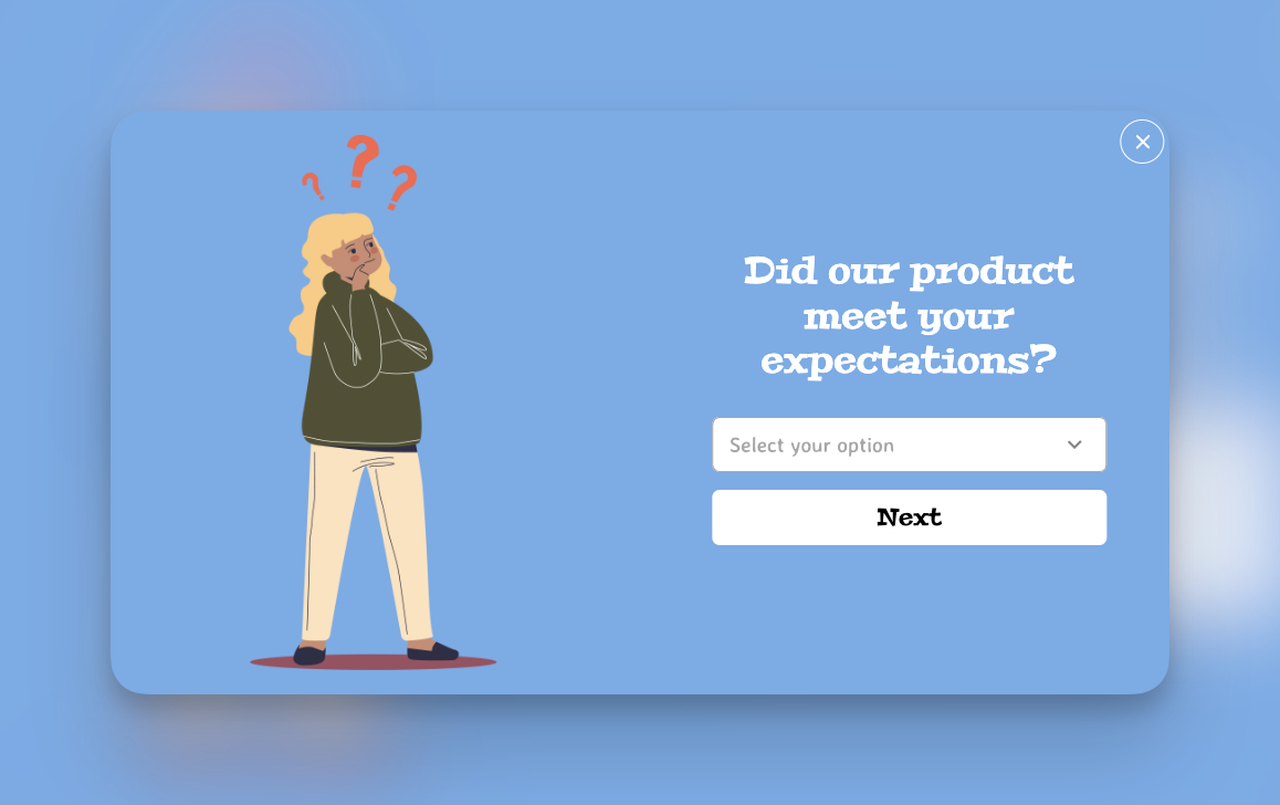
A feedback popup survey combining rating scale with open-ended text input
How to implement:
1. Keep feedback popups to 2 questions maximum. A rating scale (How would you rate your experience?) plus one open text field (What's one thing we could improve?). Three or more questions kill completion rates.
2. Place them on high-traffic pages where users spend the most time. Your blog, documentation, and product pages are better candidates than your homepage.
3. Use a slide-in popup format rather than a center-screen modal. Slide-ins feel less intrusive for feedback requests and don't block the content the visitor came for.
4. Tag responses by page URL automatically so you can filter feedback by section of your site when analyzing.
Questions to include:
Do you have any recommendations for improving our website?
What feature did you find most useful during your visit?
Could you provide specific feedback on our checkout process?
What's one thing we could do to make our website more useful?
Open-ended feedback popups usually produce fewer responses than structured surveys, but more detail per response. The tradeoff is worth it when you need the reason behind a problem, not another score.
Best timing: After extended site visits (3+ minutes), after content consumption, before a site redesign, or following customer support resolution.
4. User Experience (UX) Popup Surveys: Diagnose Navigation and Usability Issues
UX popup surveys assess how easy (or frustrating) it is to use your website or app. They target specific usability dimensions: navigation clarity, information findability, checkout flow, and mobile responsiveness. Unlike general feedback popups, UX surveys focus on the how of the experience rather than the what.
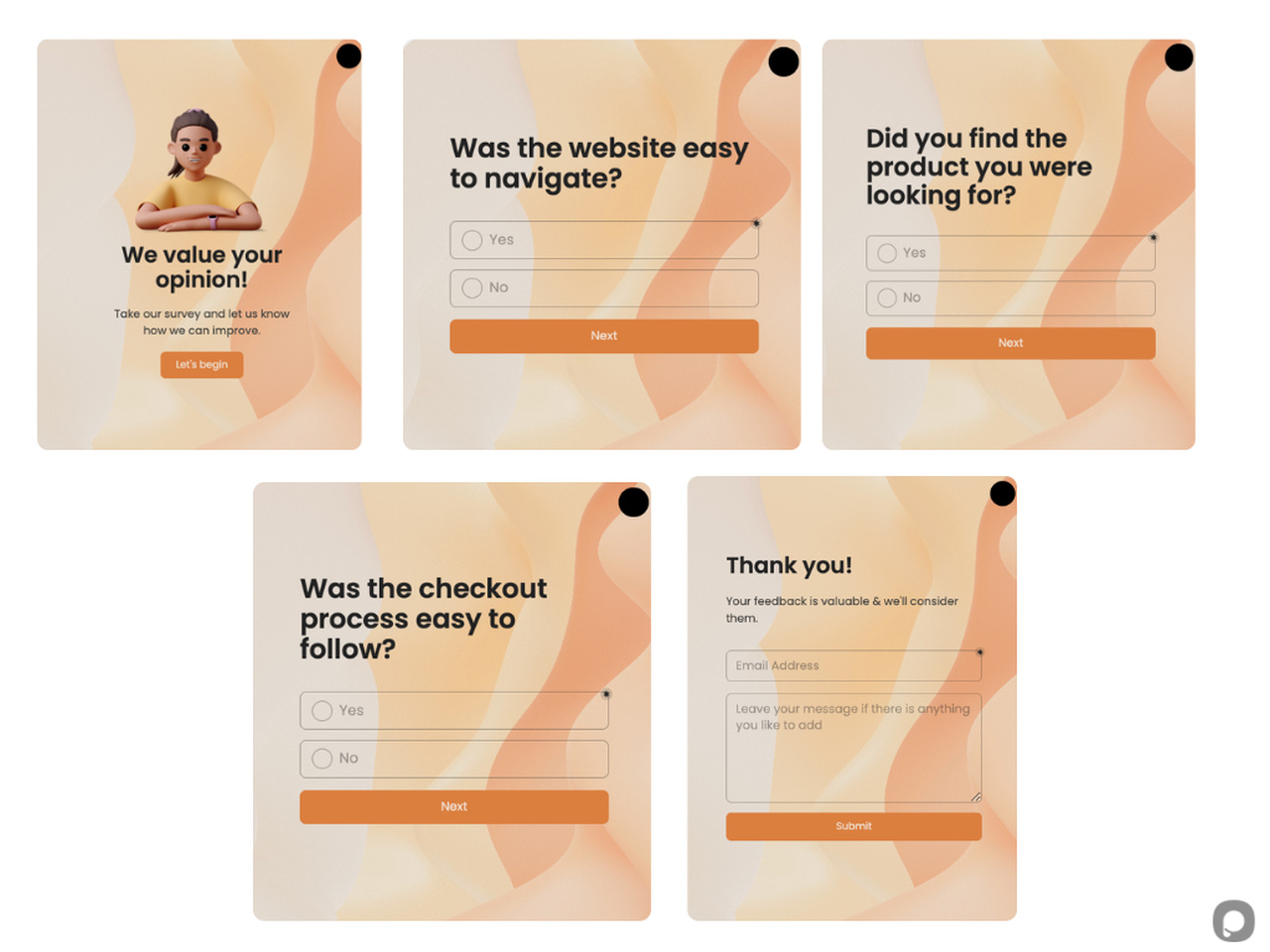
A multi-step UX survey popup covering navigation, product search, and checkout
How to implement:
1. Use multi-step popups that break the survey into 2-3 screens. Each screen covers one usability dimension (navigation, search, checkout). Multi-step surveys feel shorter than single-page forms with the same number of questions. Use steps to organize the questions, not as a trick: for lead capture, multi-step forms show no measurable conversion advantage over single-step forms once step-1 clicks without contact details are excluded.
2. Ask task-specific questions: "Were you able to find what you were looking for?" is better than "How was your experience?" because it measures findability directly.
3. Trigger UX surveys after users complete specific tasks (finished a search, used the filter, attempted checkout) rather than at random intervals.
4. Include a single ease question: "How easy was it to complete your task today?" on a 1-5 scale. Asking the same question after every site change lets you track usability improvements over time.
Questions you can use:
Were you able to find the information you were looking for easily?
How easy was it to navigate our site on your mobile device?
Did you encounter any issues while making a purchase?
How clear are our product descriptions and instructions?
Best timing: After users complete basic actions, following site updates or redesigns, and after any negative usability signals like repeated back-button clicks.
5. Exit-Intent Popup Surveys: Understand Why Visitors Leave
Exit-intent popup surveys trigger when a visitor's cursor moves toward the browser's close button or address bar. They catch people at the moment of abandonment, so they're the most direct way to ask why a conversion didn't happen. And you aren't interrupting anyone engaged: these visitors have already decided to leave.
An exit-intent survey asking visitors why they're leaving with checkbox options
How to implement:
1. Use checkbox-style answer options, not open text. Leaving visitors won't write paragraphs. Give them 4-6 predefined reasons (too expensive, missing feature, just browsing, found a better option) plus an "Other" field.
2. Target exit-intent surveys to high-value pages: pricing pages, cart pages, and product pages. Exit surveys on blog posts rarely produce useful data because "I finished reading" gives you nothing to fix.
3. Keep the survey to a single question. Two or more questions on an exit popup feel like you're holding visitors hostage.
4. On mobile, use scroll-up intent detection instead of cursor tracking (mobile devices don't have a cursor). Trigger the survey when the user scrolls rapidly back toward the top of the page.
5. Set frequency to once per visitor per 14 days. Showing exit-intent popups on every page exit trains visitors to ignore them.
Questions to include:
What's stopping you from making a purchase today?
Were you looking for something you didn't find?
Would you like us to contact you with more information?
Is there anything we could offer to encourage you to stay?
Best timing: During cart abandonment, on pricing pages, on high-exit-rate pages, and after prolonged browsing without conversion.
6. Preference Popup Surveys: Segment Users for Personalized Marketing
Preference popups ask visitors about their tastes, product interests, communication preferences, and content needs. The data they collect feeds directly into segmentation. Instead of treating all visitors the same, you can show different offers, content, and product recommendations based on stated preferences.
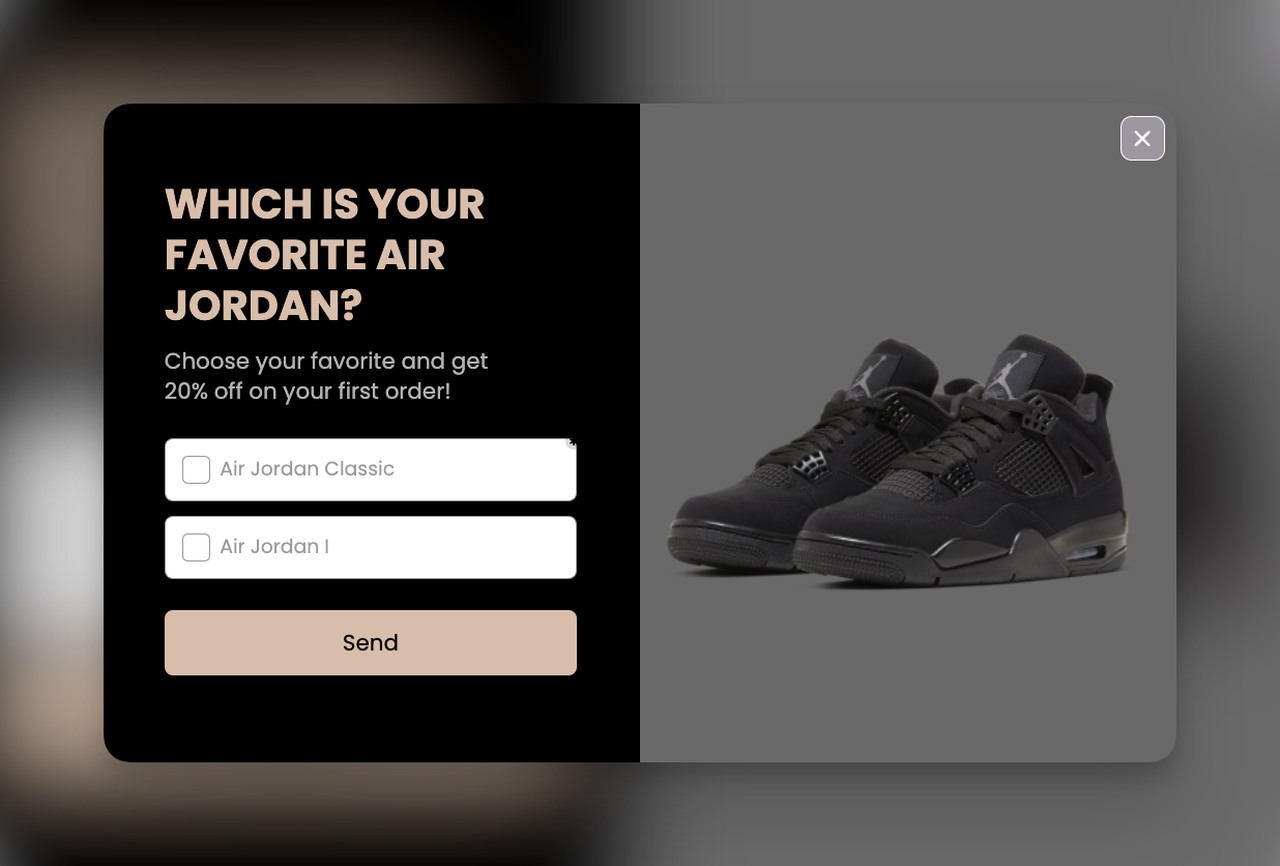
Preference survey popup asking visitors which product categories interest them
How to implement:
1. Use multiple-choice or single-choice elements rather than open text. Structured preference data integrates directly with your email marketing and CRM segmentation. Open text requires manual categorization.
2. Ask about one preference dimension per popup. "What product category interests you most?" is better than a multi-part questionnaire about categories, budget, and buying timeline.
3. Connect survey responses to your email platform. Popupsmart integrates with email marketing and CRM tools, so a visitor who selects "Enterprise software" can automatically enter a different nurture sequence than one who picks "Small business tools."
4. Offer an immediate payoff based on their preference. "Select your interest and we'll show you our top recommendations" gives visitors a reason to answer honestly.
Questions to use:
Which of our product categories interests you most?
What factors influence your purchasing decisions?
Do you prefer our new product line or the classic ones?
Which type of promotional offers are most appealing to you?
Best timing: After user registration, during product browsing, when signing up for newsletters, and during checkout for delivery and payment preferences. If you run a Shopify store, pair this with your Shopify checkout optimization strategy.
7. Demographic Popup Surveys: Build Accurate Audience Profiles
Demographic popups collect data about who your visitors are: age range, location, occupation, industry, company size. This information builds audience personas grounded in real data instead of guesswork. For B2B SaaS companies, demographic data helps you understand whether your actual visitors match your target ICP.
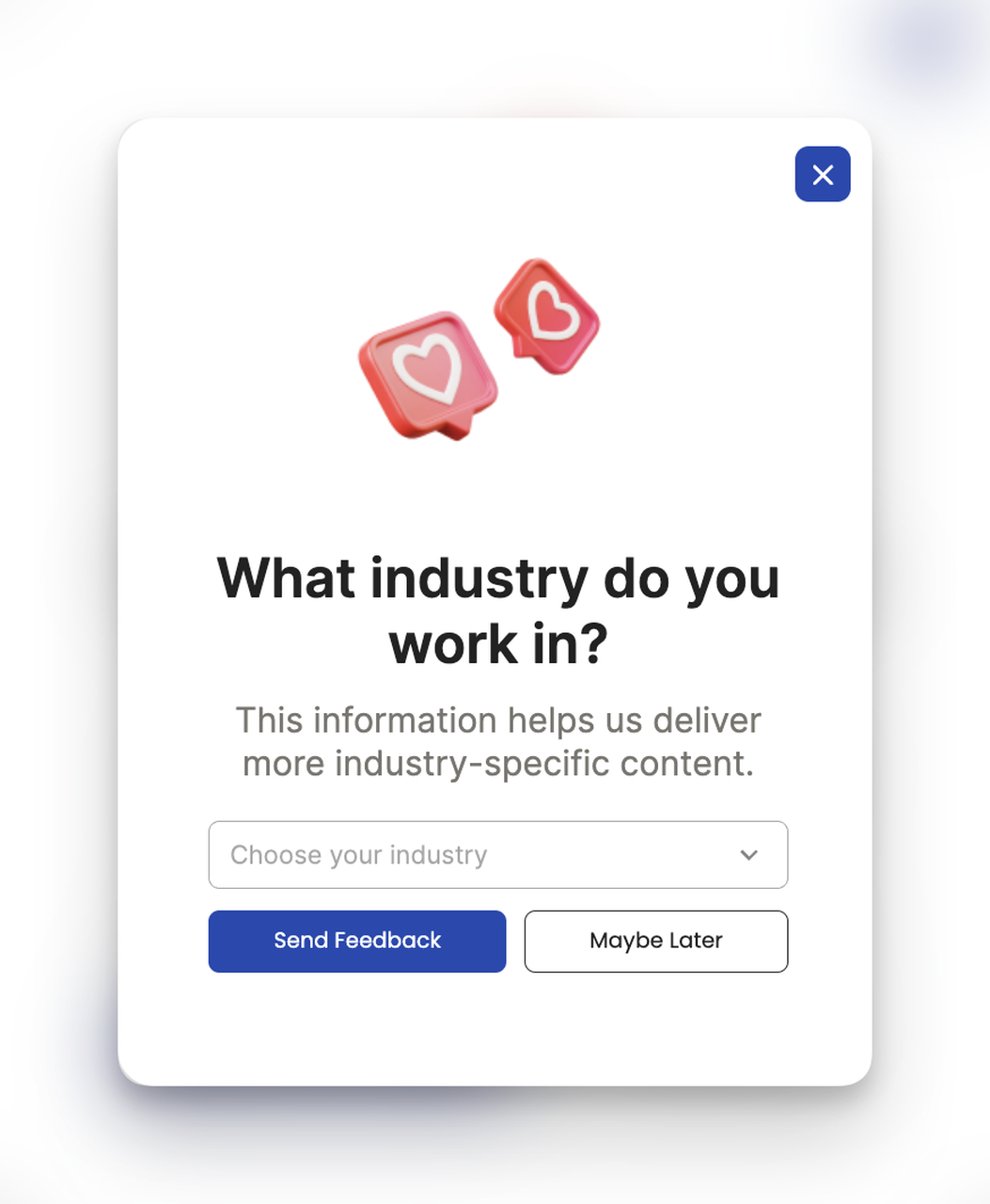
Demographic survey popup collecting occupation and location data
How to implement:
1. Limit demographic popups to 3 questions maximum, and fewer if you can. Every field costs something: in our benchmark, popups asking for one or two fields convert 0.88% and 0.94%, against 0.56% for three fields (median campaign; spin-to-win and other gamified popups are counted separately). Pick the data points most useful for your marketing.
2. Use dropdown selectors or radio buttons for standard demographic fields. Don't make visitors type "Marketing Manager" when you can give them a list of 8 job function categories to choose from.
3. Frame questions around value: "Help us tailor content to your role" works better than "Tell us about yourself" because it signals a payoff for the visitor.
4. Consider GDPR and privacy regulations. Include a brief note about data usage and don't collect demographic data you won't actually use for segmentation or product decisions.
Questions to include:
What is your age range?
Which region or country are you browsing from?
What is your occupation? This helps us tailor content and offers.
Demographic popups work better after a visitor has interacted with your content than on the first page load. A visitor who just read your blog post or explored your features page has established some trust. Cold demographic requests on arrival feel intrusive and get dismissed. After the second or third page view is a fair compromise: the visitor trusts you a little more, and the data is still fresh.
Best timing: During registration, after 2-3 page views, or after the visitor has shown interest through content consumption. Never on page load.
8. Post-Purchase Popup Surveys: Capture Feedback While Experience Is Fresh
Post-purchase surveys appear on the order confirmation or thank-you page, right after a customer completes a transaction. That's on purpose. The shopping experience is still vivid, and the customer has just shown commitment by buying. You tend to get more detailed, more honest answers here than from a follow-up email survey sent days later.
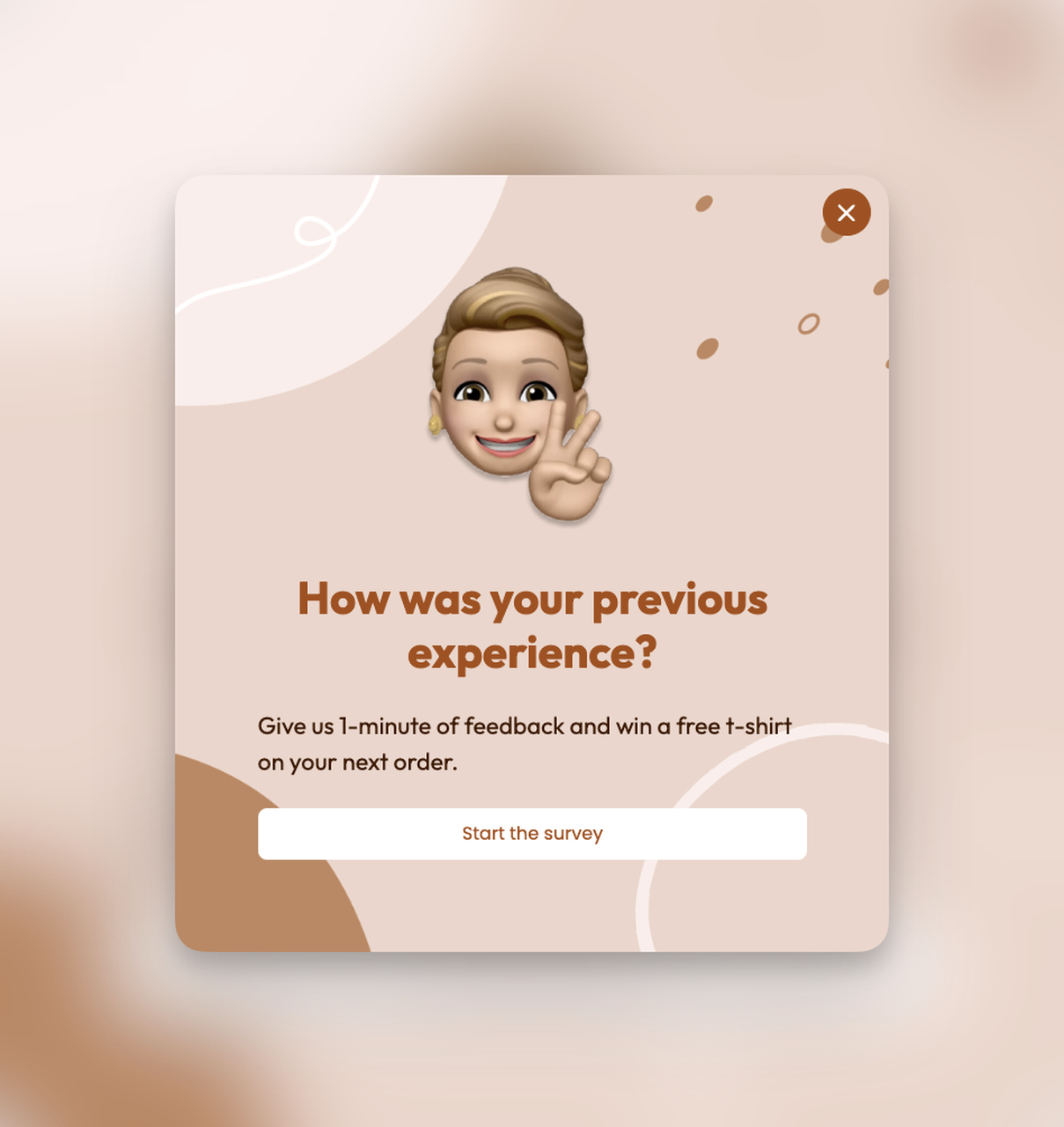
Post-purchase popup offering a reward in exchange for shopping experience feedback
How to implement:
1. Trigger on the confirmation/thank-you page only. Don't show post-purchase surveys on product pages or during checkout because that adds friction to the buying process.
2. Ask about the buying experience, not the product itself. The customer hasn't used the product yet. "How was your shopping experience?" and "Was checkout smooth?" are valid. "How's the product quality?" isn't answerable yet.
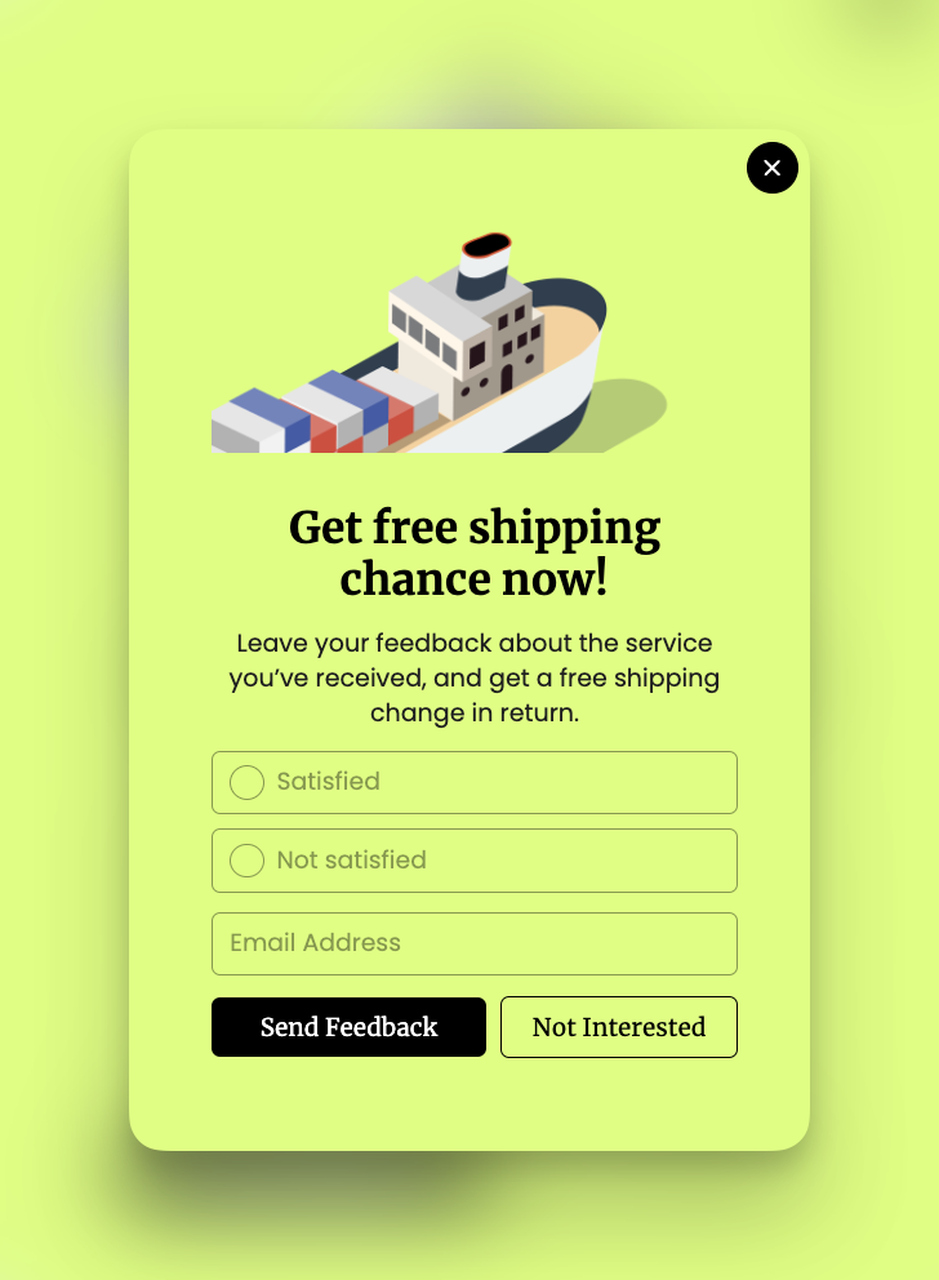
3. Offer a small reward: a free shipping code on the next order, loyalty points, or entry into a monthly giveaway. An incentive fits well here, since the customer is already in a spending mindset.
4. Keep it to 2-3 questions max. The customer just completed a multi-step checkout. Their attention budget is nearly spent.
Questions to include:
How would you rate your overall shopping experience? (1-5)
Was checkout smooth and easy to complete?
How did you first hear about us?
How likely are you to purchase from us again?
One of these questions is worth more than it looks: "How did you hear about us?" It's one of the most valuable attribution data points you can collect, and post-purchase is the one natural place to ask it. Customers name channels your analytics can't see. Word of mouth, podcast mentions and social media recommendations often get the credit they deserve only through self-reported answers like these.
Best timing: Immediately after purchase on the confirmation page, or 7-14 days post-delivery to capture product quality feedback.
9. Lead Generation Popup Surveys: Exchange Value for Contact Information
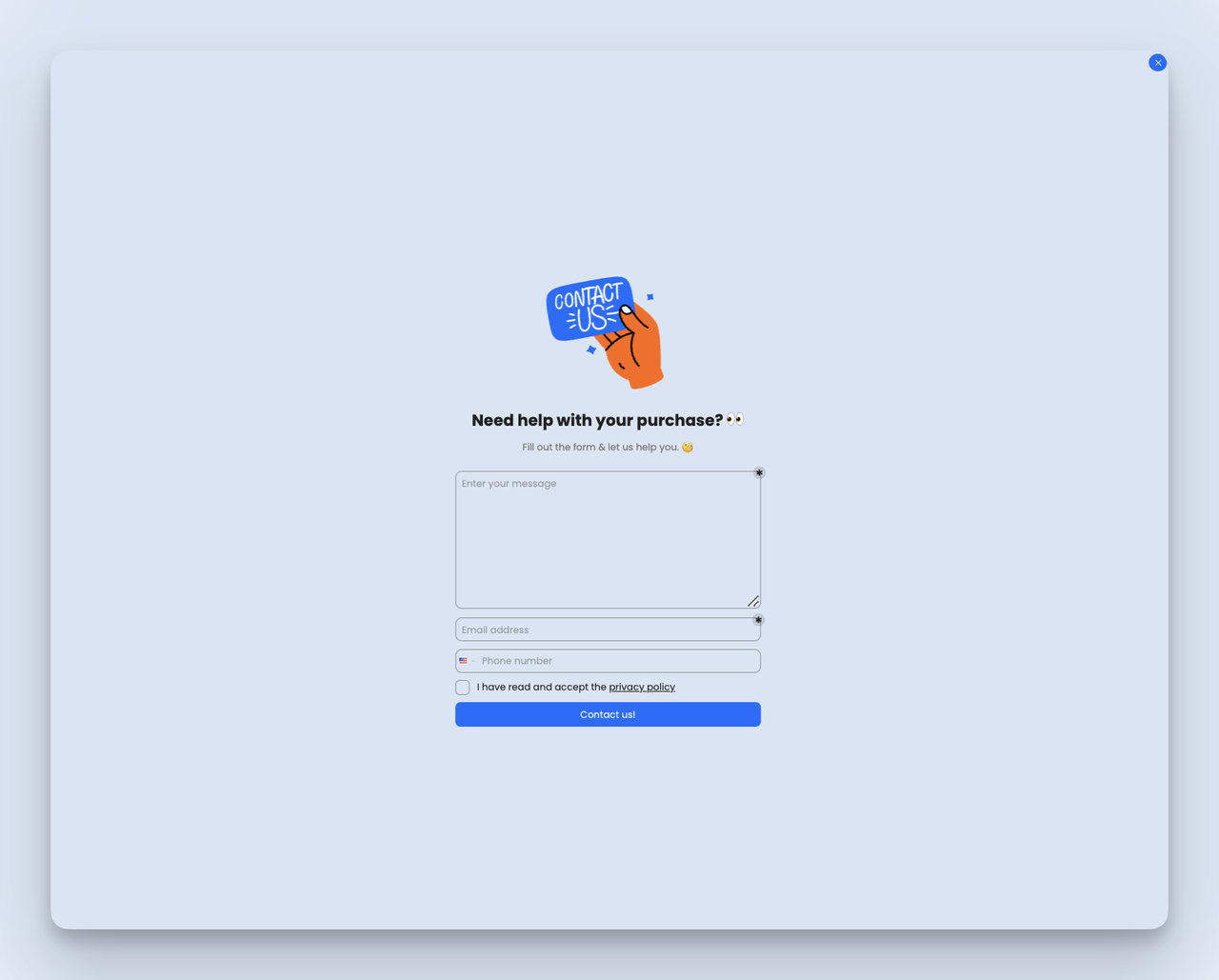
Lead generation surveys blend data collection with lead capture. Instead of a standard "Enter your email" popup, you ask 1-2 qualifying questions alongside the email field. The questions do two jobs. They give you segmentation data, and they make the exchange feel fairer than a plain email grab.
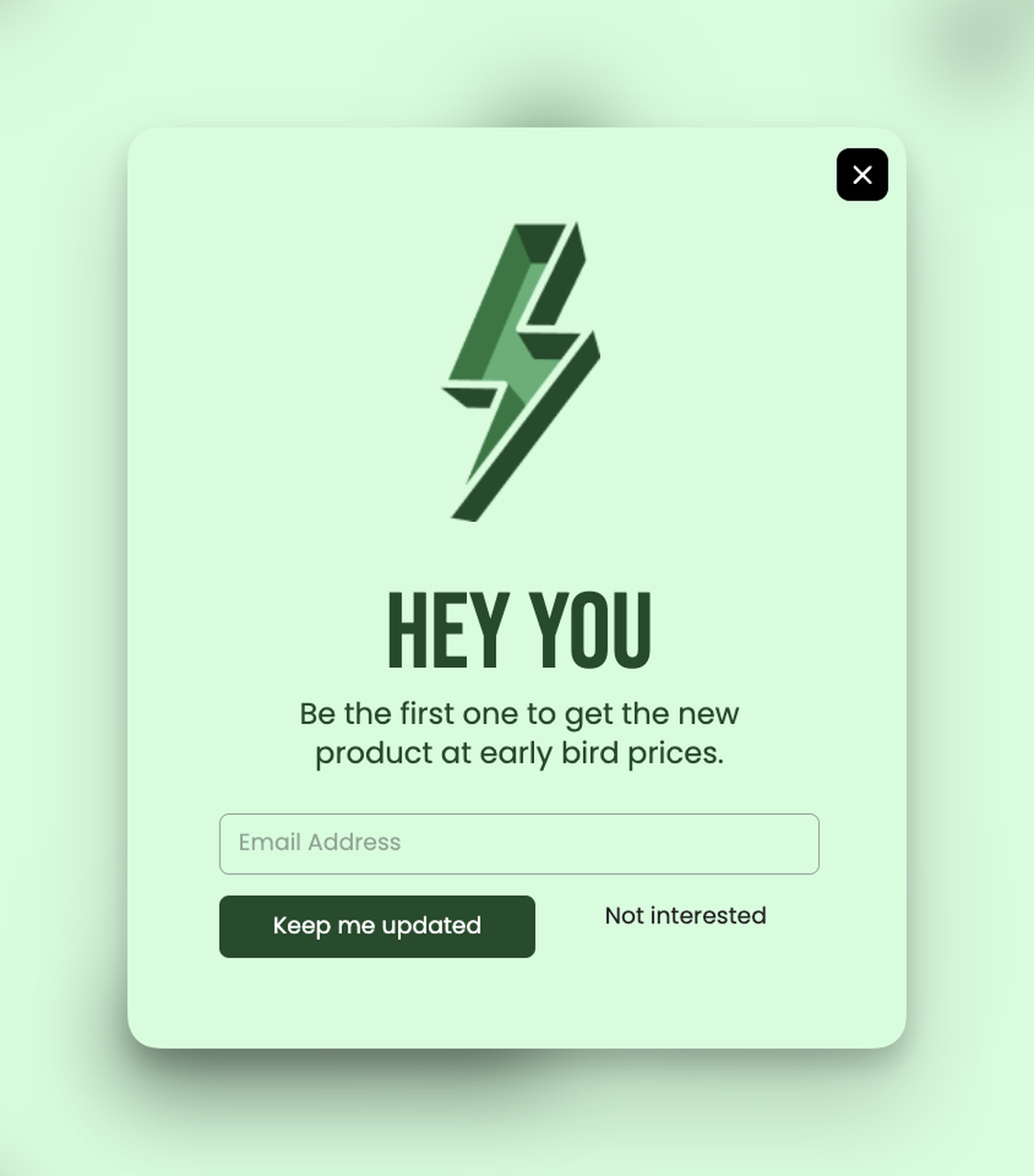
Lead generation survey offering early-bird pricing in exchange for contact details
How to implement:
1. Lead with the value proposition, not the ask. "Get early access to our 2026 product launch" converts better than "Sign up for our newsletter." The offer justifies the information exchange.
2. Ask one qualifying question before the email field: "What's your biggest challenge with [topic]?" or "What's your team size?" This pre-qualifies leads so your sales team doesn't waste time on poor-fit prospects.
3. Use email list growth popups with a clear privacy note. Mentioning "No spam, unsubscribe anytime" below the email field tells visitors what they're signing up for.
4. A/B test discount-based versus content-based offers. For e-commerce, discounts are the usual starting point. For B2B SaaS, content offers (guides, templates, calculators) are often the better test because B2B buyers don't make impulse purchases.
Questions to include:
What's your biggest challenge with [topic area]?
What's your team size?
Which product features matter most to you?
Best timing: After significant time on site (2+ minutes), on returning visits, after consuming valuable content (blog posts, case studies), and on pricing pages for B2B sites.
How to Create Your Popup Survey in 5 Steps
You don't need to code, or a developer, to set up a popup survey. With a no-code popup survey builder you can go from a new account to a live survey in one sitting.
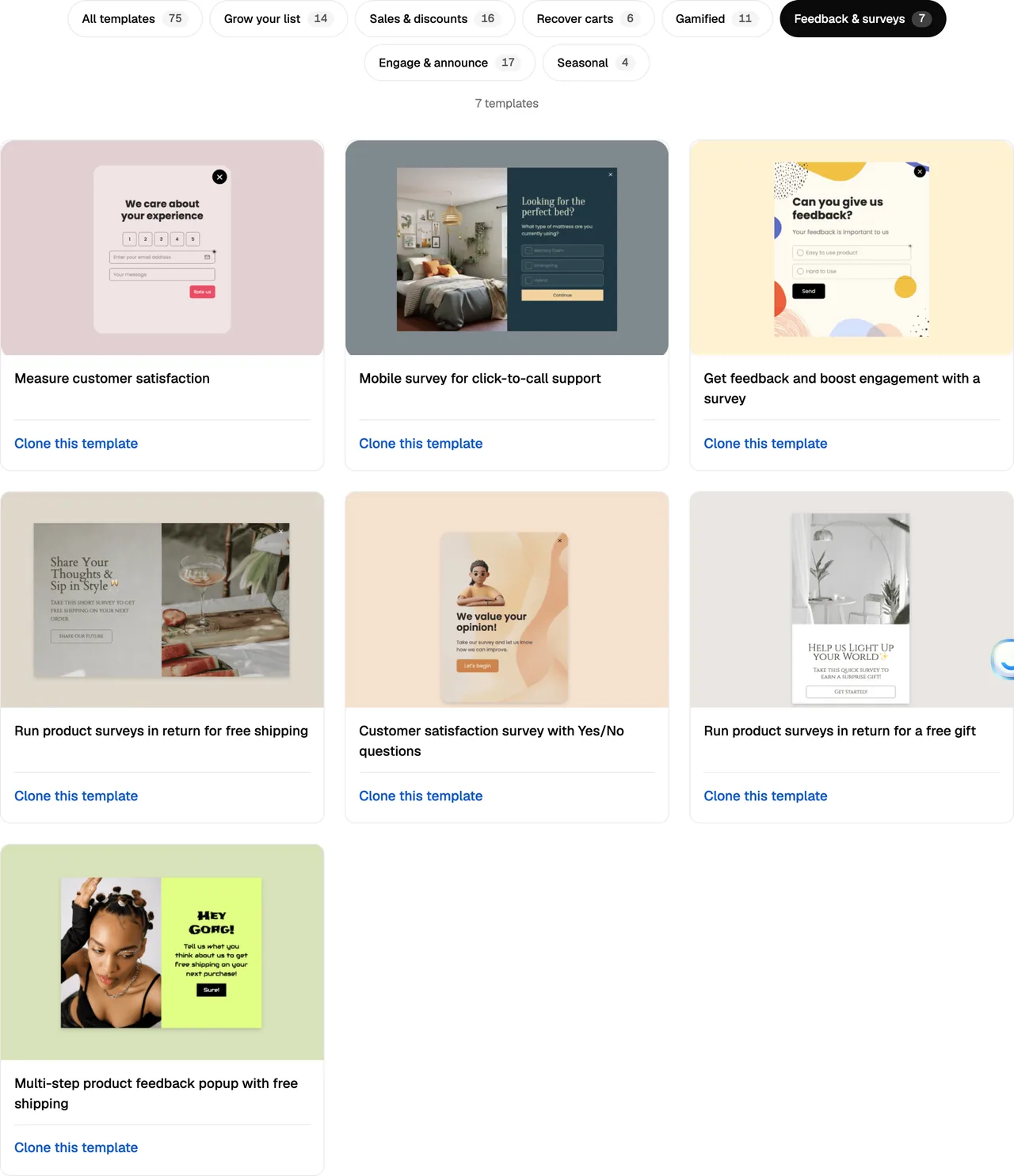
Start from a template. Popupsmart's public popup template gallery has a Feedback & surveys filter with seven survey templates as of 1 October 2026: Measure customer satisfaction, Mobile survey for click-to-call support, Get feedback and boost engagement with a survey, Run product surveys in return for free shipping, Customer satisfaction survey with Yes/No questions, Run product surveys in return for a free gift, and Multi-step product feedback popup with free shipping.
The steps in Popupsmart:
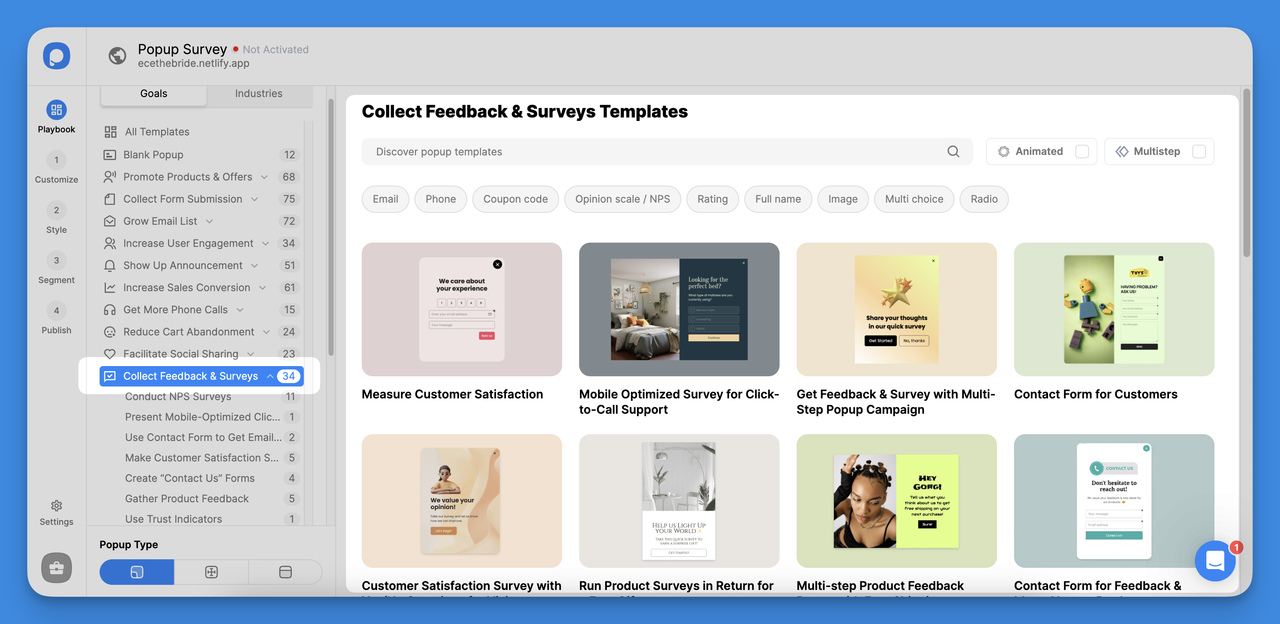
Step 1: Pick a survey template. After creating a free account, click "New Campaign" and filter templates with the "Collect Feedback & Surveys" tag. Pick a template that matches your survey type (CSAT, NPS, feedback, etc.).
Step 2: Add form elements. Use the "Add a new element" button to customize your popup with form elements like Rating scales, Opinion Scales, Multiple-choice, and Single-choice inputs. The full set of elements you can add to a popup also includes Dropdown, Date, Short Text and Long Input fields.
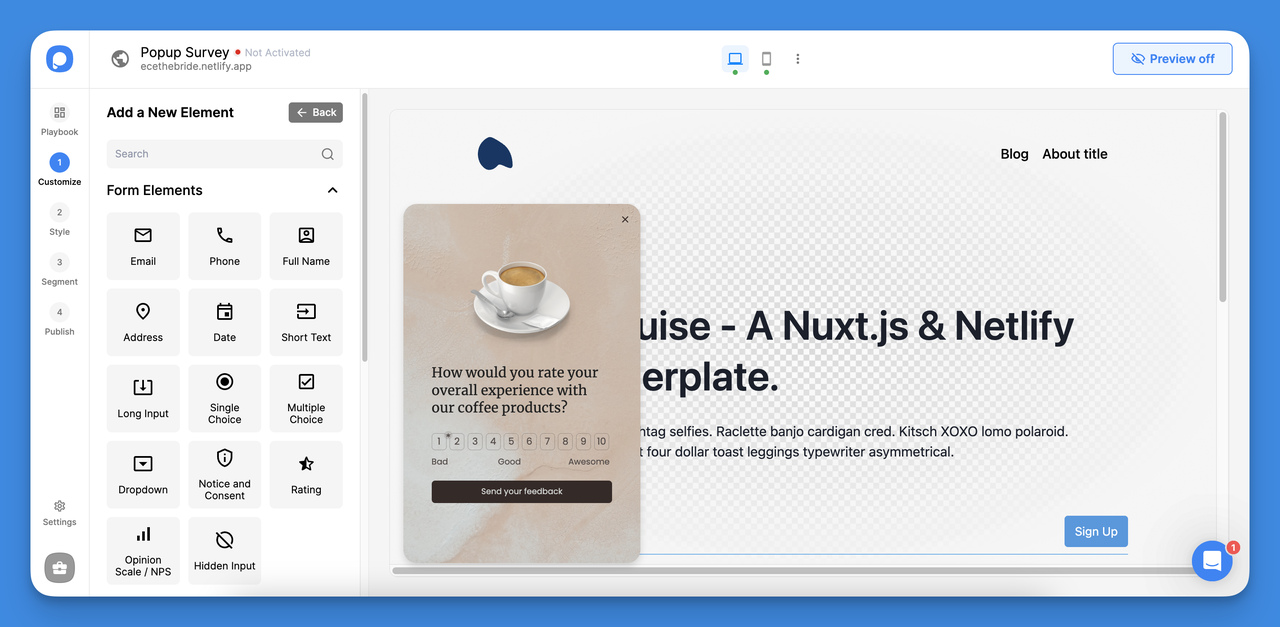
| Survey question | Popupsmart element | Options |
|---|---|---|
| Rate an experience | Rating | Stars, hearts or emoji; an action per rating |
| Score on a scale (CSAT, NPS-style) | Opinion Scale | 1 to 3, 1 to 5 or 1 to 10, with guide labels |
| Pick one answer | Single Choice | Dot, tick or A/B style |
| Pick several answers | Multiple-Choice | Checkbox or A/B style |
| Choose from a long list | Dropdown | Your own options |
| Write an answer | Short Text & Long Input | Placeholder text, required or optional |
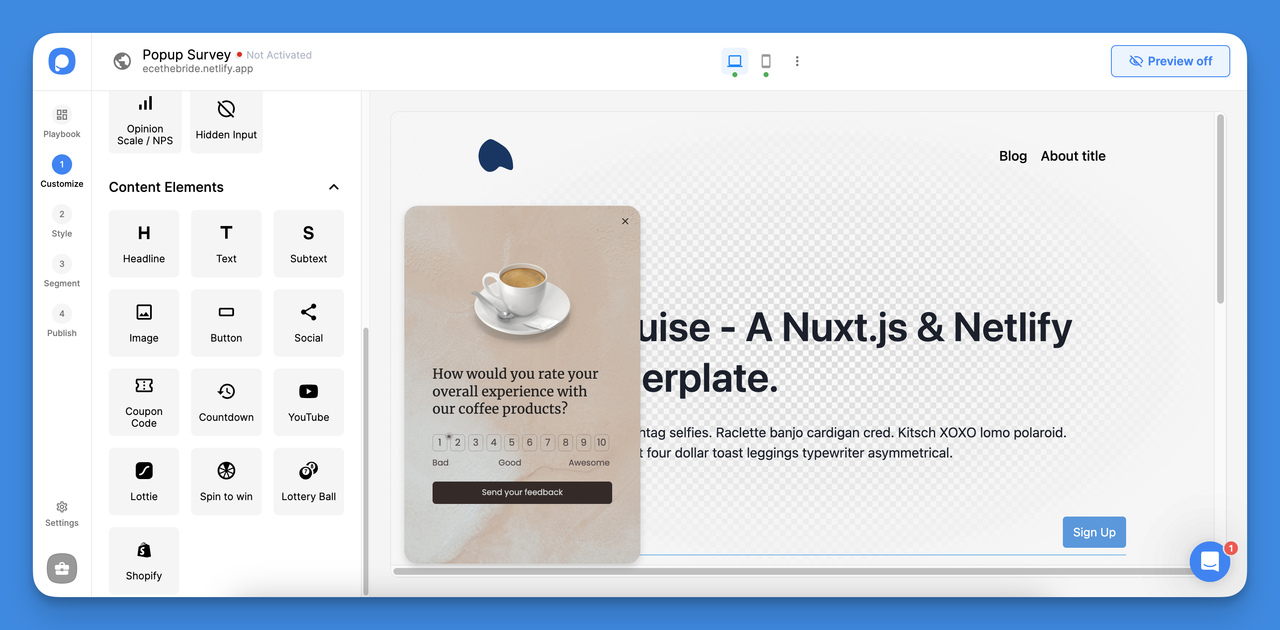
Step 3: Add engaging content. Include content elements like coupon codes, images, or custom descriptions. A coupon gives visitors a reason to answer, and more of them finish.
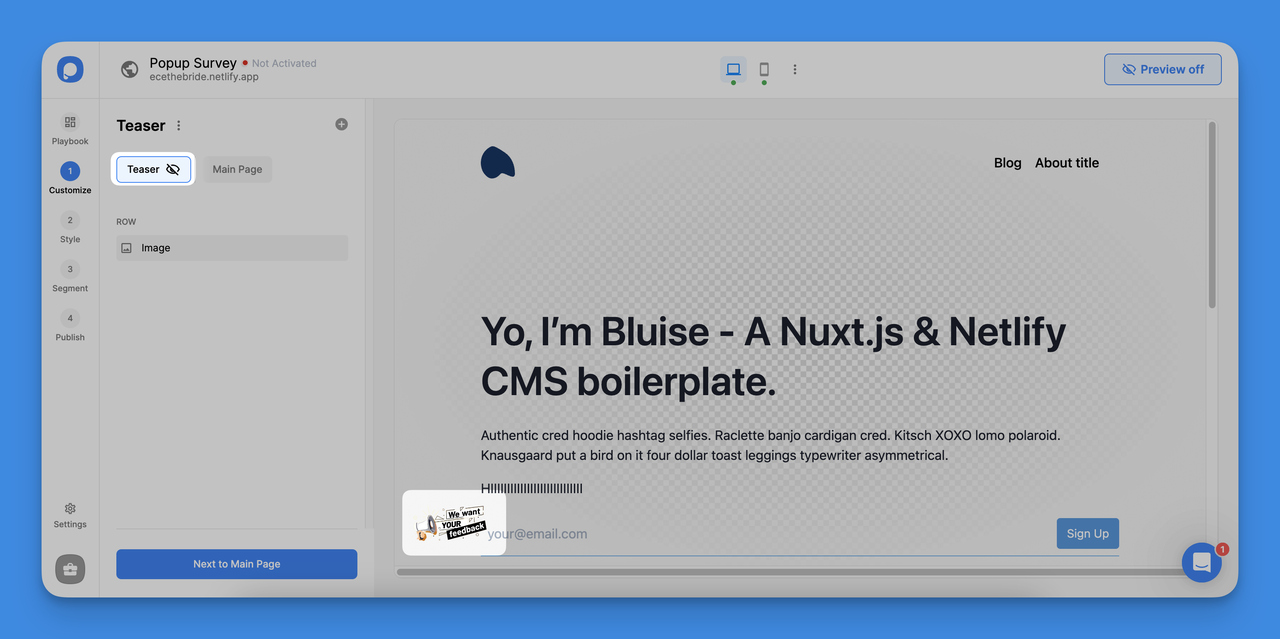
Step 4 (Optional): Enable the teaser. If you want a less intrusive first impression, toggle the "Teaser" option to show a small notification bar that expands into the full survey on click.
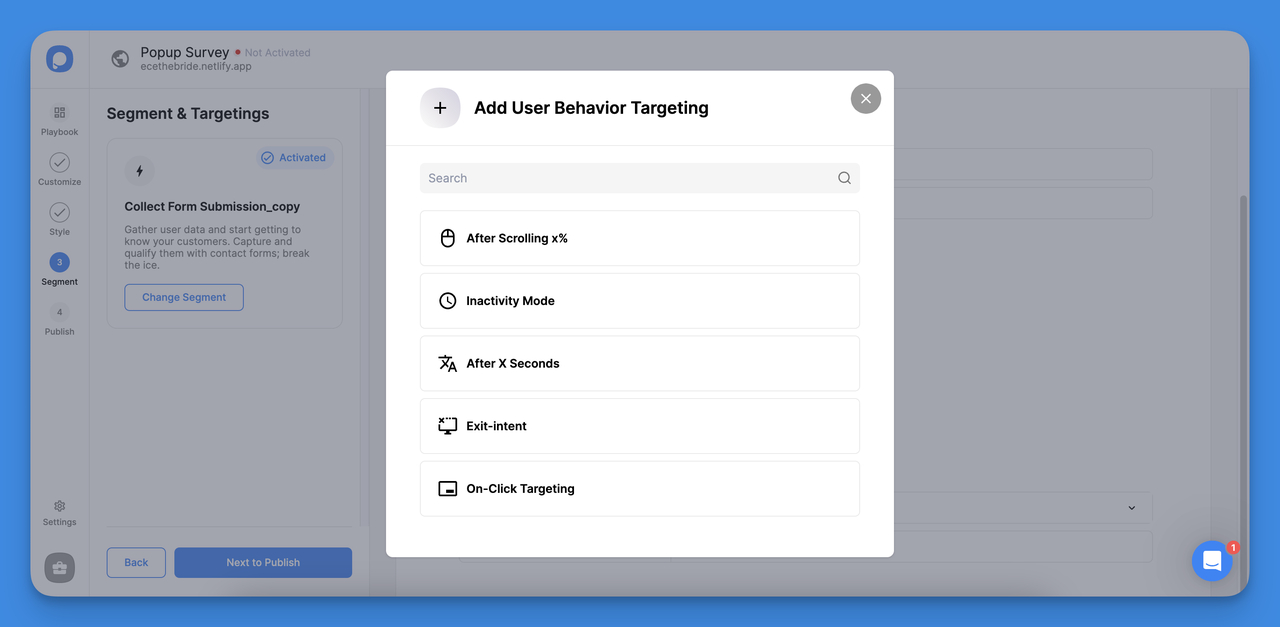
Step 5: Set targeting rules. Choose when and to whom your popup survey appears. Pick a predefined audience segment, or build custom rules based on page URL, time on site, scroll depth, device type, and visitor behavior.
Save and publish your campaign, and responses start flowing in immediately. Answers land in the Leads section of your Popupsmart dashboard, where you can filter them by date and export them as CSV, PDF or XLS, or send them to a connected email or CRM tool.
Popup survey best practices and 7 ways to get more answers
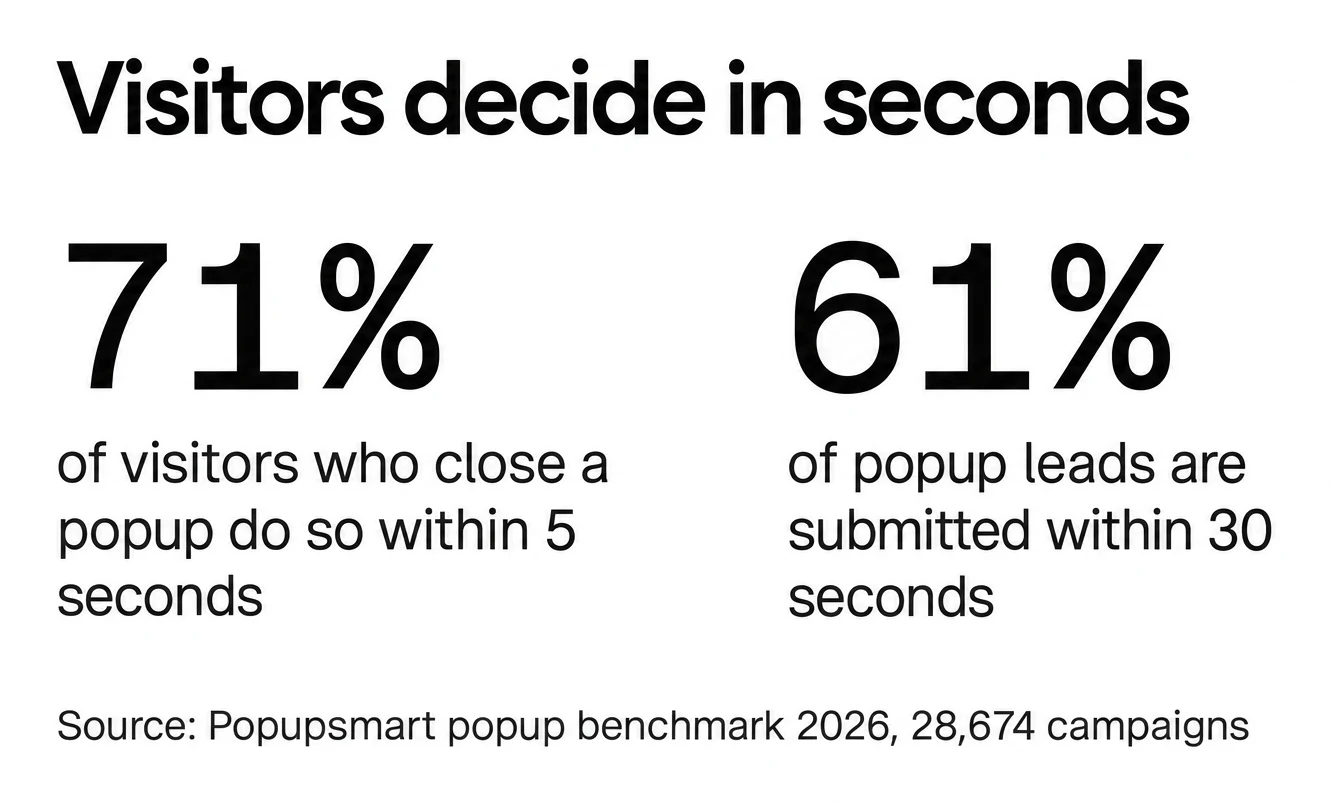
Showing a survey is the easy part. Getting it answered is harder, because visitors decide fast: 71% of visitors who close a popup do so within 5 seconds of it appearing, and 61% of popup leads are submitted within 30 seconds of the popup appearing. A survey question has to be readable at a glance. These are the practices that separate surveys people answer from ones they close (the general rules are in popup best practices):
• Keep surveys under 3 questions. If you need more data, run multiple targeted surveys across different pages rather than one long survey.
• Don't fire on page load by reflex. Popups that wait before appearing convert 0.83% vs 0.61% for popups shown the instant the page loads (median campaign); the direction holds in every year of data but the difference is not statistically reliable, so treat it as a lean, not a rule. The exact delay length (0-5 seconds vs 21-60 seconds) makes no measurable difference, so tie the trigger to an action rather than a stopwatch.
• Target by behavior, not just demographics. A visitor who viewed 3 product pages and spent 4 minutes on your site is a better survey candidate than a random first-time visitor. Popups set up with three targeting rules convert 1.09% vs 0.71% for popups with none or one (median campaign): a correlation, since marketers who target carefully may also write better offers.
• Mobile-optimize every survey. 63% of popup displays happen on mobile, and mobile visitors convert on popups at 1.02% vs 0.57% on desktop (median campaign). Design for thumb-friendly interaction with large tap targets. More on that in our mobile popup guide.
• Set frequency caps. Show the same popup over and over and answers drop while visitors get annoyed with the brand. In our data, the first two times a visitor sees a popup in a week convert at similar rates (1.33% and 1.22% of displays, pooled); from the third view conversion falls, and from the sixth view it is 0.41%, 31% of the first-view rate. A cap of one or two showings per visitor, then a pause of 7-14 days, fits that curve.
• A/B test popup formats. Slide-ins, center modals, bottom bars, and full-screen overlays each perform differently depending on your audience. Test one variable at a time and run tests for at least 14 days or 1,000 impressions before deciding.
• Close the feedback loop. If someone reports a problem in your survey, fix it and let them know. Even a simple "We heard you and made X change" follow-up email builds trust and encourages future participation.
1. Offer Discounts or Gifts in Exchange
Incentivized surveys consistently outperform non-incentivized ones. The trade is straightforward: the visitor gives you data, you give them tangible value in return.
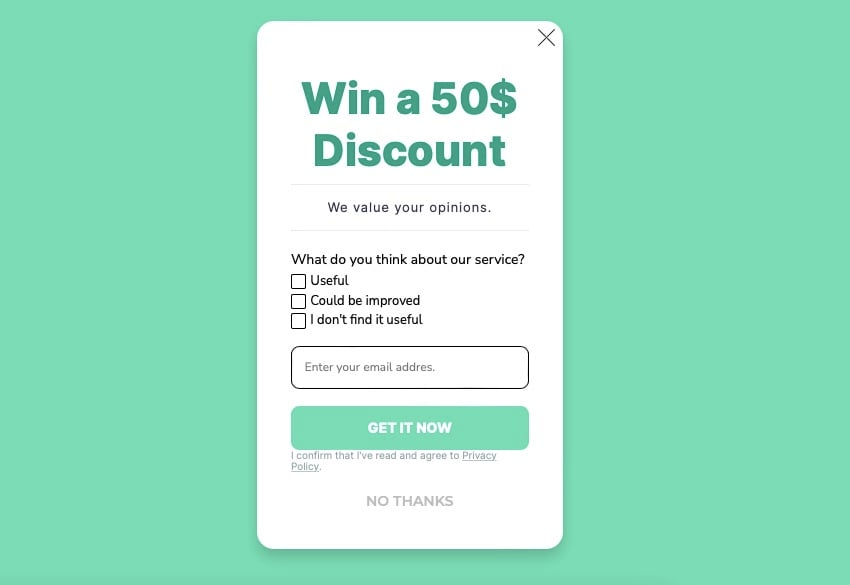
This popup uses "Win a $50 Discount" as the headline, immediately communicating value. The description "We value your opinions" reinforces that the survey is a genuine feedback request, not just a data grab. Short checkbox answers keep the time commitment low.
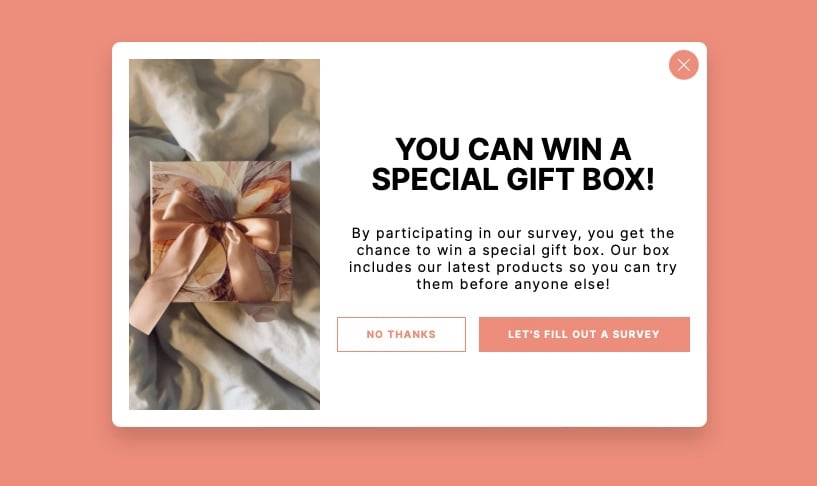
Giveaway-style popups work particularly well for e-commerce. "You can win a special gift box!" combined with "try them before anyone else" creates urgency without being pushy. Include an email field at the end to grow your email list alongside collecting survey data.
2. Write Witty Headlines That Break the Pattern
Most survey popups use generic headlines like "We'd love your feedback." That's forgettable. A headline like "Your chance to roast us" signals that you're open to criticism, which makes visitors more willing to participate.
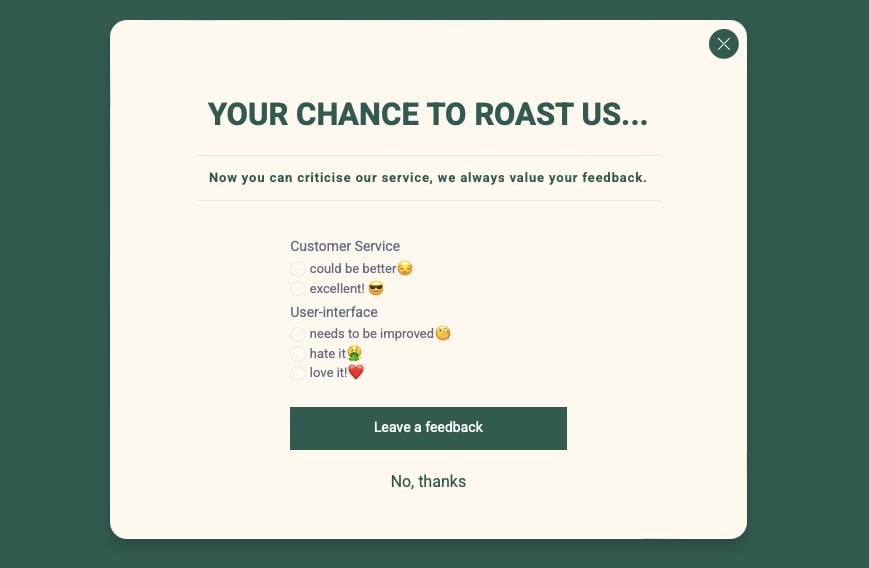
The best survey headlines feel conversational and slightly unexpected. They interrupt the scroll and make the visitor curious for a second. Avoid puns that don't relate to your brand voice, but don't be afraid to show personality.
3. Use Engaging Images That Draw Attention
Visual elements increase popup engagement. Product images, brand mascots, or even a well-chosen stock photo can stop the scroll and buy you a few extra seconds of attention.
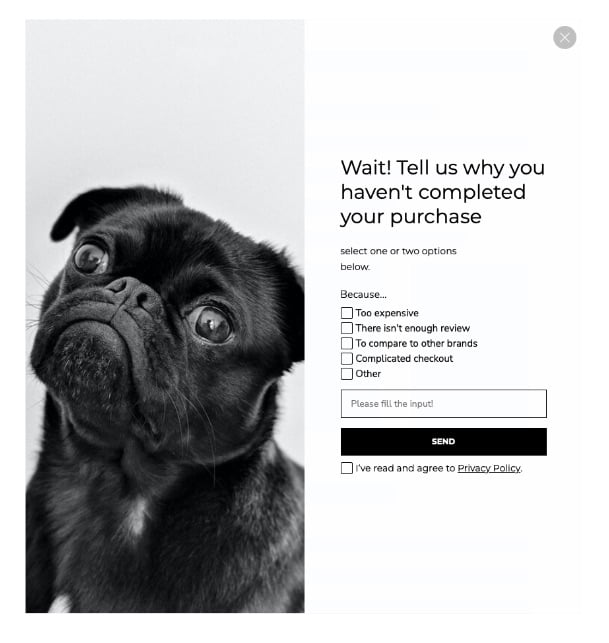
This exit-intent survey pairs a cute dog image with "Wait! Tell us why you haven't completed your purchase." The image softens the interruption, and the question is direct and answerable. Try a few image styles and keep the one your audience responds to.
4. Personalize with Smart Tags
Dynamic personalization makes popup surveys feel like one-on-one conversations rather than mass broadcasts. Smart tags pull data from JavaScript API and URL parameters to insert the visitor's name, location, or other known attributes.
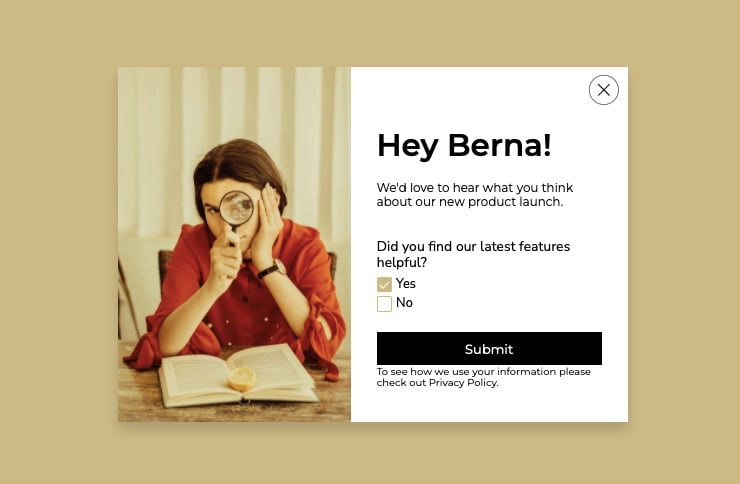
"Hey Berna!" is far more engaging than "Dear valued customer." Beyond name tags, you can use language, country, region, city, or date tags to tailor the survey experience. A visitor from France might see questions in French. A returning visitor might see a different question set than a first-timer.
5. Show Quick Rating Scales Instead of Long Forms
A single-question rating popup ("How likely are you to recommend us? 1-5") takes a moment to answer. The bar is so low that visitors who'd never finish a multi-question survey will still tap a star rating.
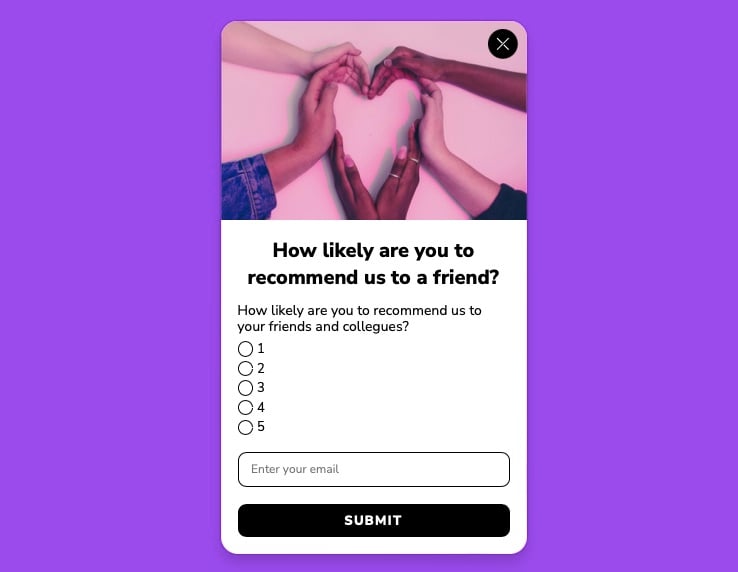
Rating popups work best as always-on passive collectors. Run them continuously and track the average score weekly. Any sudden drops signal an issue worth investigating.
6. Use Exit-Intent Targeting for Leaving Visitors
Exit intent targeting catches visitors at the moment they're about to leave. You aren't interrupting engaged users, and the answers tell you why your site lost that particular visitor.
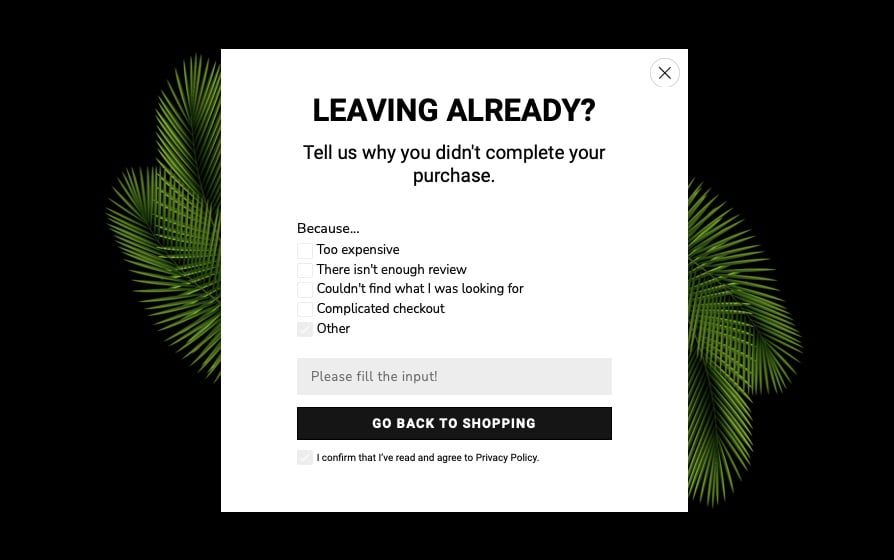
Pair exit-intent survey popups with cart abandonment popups on checkout pages to understand why shoppers leave without buying. The checkbox format shown above keeps feedback structured and easy to analyze at scale.
7. Add Location-Based Survey Popups
Geo-targeted popup surveys let you ask location-specific questions. A visitor from Paris gets questions about European shipping preferences. A visitor from New York sees questions about US-specific payment options. Questions that fit where someone is get more answers, because they feel written for that person.
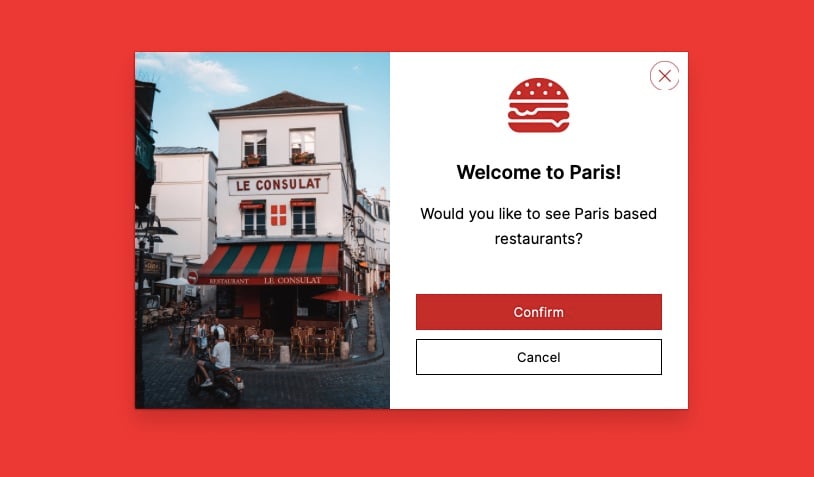
Location-based popups are especially useful for businesses expanding into new markets. You can collect region-specific feedback about product preferences, delivery expectations, and local competition without running separate survey campaigns for each geography.
Where to Start with Popup Surveys
The survey types differ in how much setup they need and how much they pay off. If I were starting from zero, this is the order I'd go in:
| Priority | Survey Type | Effort | Impact | Best For |
|---|---|---|---|---|
| 1 | CSAT (Satisfaction) | Low | High | Any site wanting quick feedback on specific touchpoints |
| 2 | Exit-Intent | Low | High | E-commerce and SaaS sites with conversion drop-offs |
| 3 | NPS | Low | Medium | SaaS products tracking loyalty over time |
| 4 | Post-Purchase | Low | Medium | E-commerce stores wanting purchase experience data |
| 5 | Feedback | Medium | Medium | Sites planning redesigns or feature launches |
| 6 | Lead Generation | Medium | High | B2B SaaS collecting qualified leads |
| 7 | Preference | Medium | Medium | E-commerce personalizing product recommendations |
| 8 | UX | High | High | Products with known usability issues |
| 9 | Demographic | Medium | Low | Brands building audience personas from scratch |
Start with CSAT and exit-intent surveys. Both take little setup, and between them you get a baseline for how customers feel and why they drop off, in data you can act on right away. Once those are running, layer in NPS for longitudinal tracking and lead generation surveys for pipeline growth. A survey is one of many jobs a popup can do; the others are in popup use cases.
Popup surveys work because they ask while the experience is still fresh. Between them, the nine types above cover most feedback jobs: measuring satisfaction, tracking loyalty, diagnosing UX problems, understanding abandonment and qualifying leads.
My recommendation if you're starting from scratch: launch a CSAT survey on your most important conversion page today. Keep it to one rating question and one open-text follow-up. Trigger it after a meaningful action on the page, with a frequency cap of once per visitor per 14 days. Small as it is, that setup should give you feedback worth acting on within the first week.
Once you see the value of in-context feedback, expand to exit-intent surveys on high-drop-off pages and NPS surveys for your existing customer base. You can build all of these in Popupsmart's popup builder, and the free plan ($0, up to 5,000 pageviews a month) covers your initial testing.
Frequently Asked Questions About Popup Surveys
What is a popup survey?
A popup survey is a short questionnaire that appears as an overlay on a web page and asks visitors one to three questions while they browse. Businesses use popup surveys to measure satisfaction (CSAT and NPS), find out why visitors leave, and segment visitors by preference. Most work best as a single screen triggered by what the visitor does.
How do popup surveys improve customer engagement?
Popup surveys improve engagement by creating a two-way interaction between your website and its visitors. Instead of passively browsing, visitors actively participate by sharing opinions. This participation builds a sense of involvement with your brand. The data you collect also enables personalized follow-up. If a visitor tells you they're interested in a specific product category, you can show them relevant content and offers on future visits, which keeps engagement high across sessions.
What are the best practices for popup surveys?
The most impactful practices are keeping surveys under 3 questions, triggering based on behavior rather than time alone, mobile-optimizing all surveys, setting frequency caps, and offering value in exchange for responses. In Popupsmart's 2026 benchmark, the first two times a visitor sees a popup in a week convert at similar rates, and conversion falls from the third view, so cap how often a survey shows. Timing matters more than design: 71% of visitors who close a popup do so within 5 seconds of it appearing.
What questions should I ask in a popup survey?
Match your questions to your survey goal. For satisfaction: "How would you rate your experience? (1-5)" plus one open-text follow-up. For exit-intent: "What's stopping you from [action]?" with checkbox options. For NPS: the standard "How likely are you to recommend us? (0-10)." Avoid open-ended questions as your primary input unless you specifically need qualitative insights. Structured questions (scales, checkboxes, dropdowns) produce analyzable data and take less visitor effort.
Can I create a popup survey for free?
Yes. Popupsmart has a free plan at $0 a month for up to 5,000 pageviews, and its template gallery has a Feedback & surveys filter with ready-made survey popups you can clone. Survey questions are built from form elements such as Rating, Opinion Scale, Single Choice, Multiple Choice, Dropdown and text inputs.
Further reading:
• Top 13 Popup Use Cases to Increase Conversions
• Types of Popups for Every Goal