ChatGPT
 Perplexity
 Claude
 Grok
 Google AI Mode

I'd read these as matched pairs. They don't add up to a ranking of every channel. Each rate is the median campaign's leads, meaning popup submissions with an email address or phone number, divided by its popup displays. AI assistant referrals get their own section below: our data shows no statistically reliable advantage for them over organic search, and the gap could be chance.
Below I go through each pair: what I think explains it and where site-wide channel benchmarks disagree. Then I show how to give each traffic source its own popup.

Which traffic source converts best on popups?
I wouldn't name a single winner from our data. The table holds the comparisons our benchmark statements make, each a pair of medians with its verdict.
| Visitors arriving from | Popup conversion rate | Compared with | What our data supports |
|---|---|---|---|
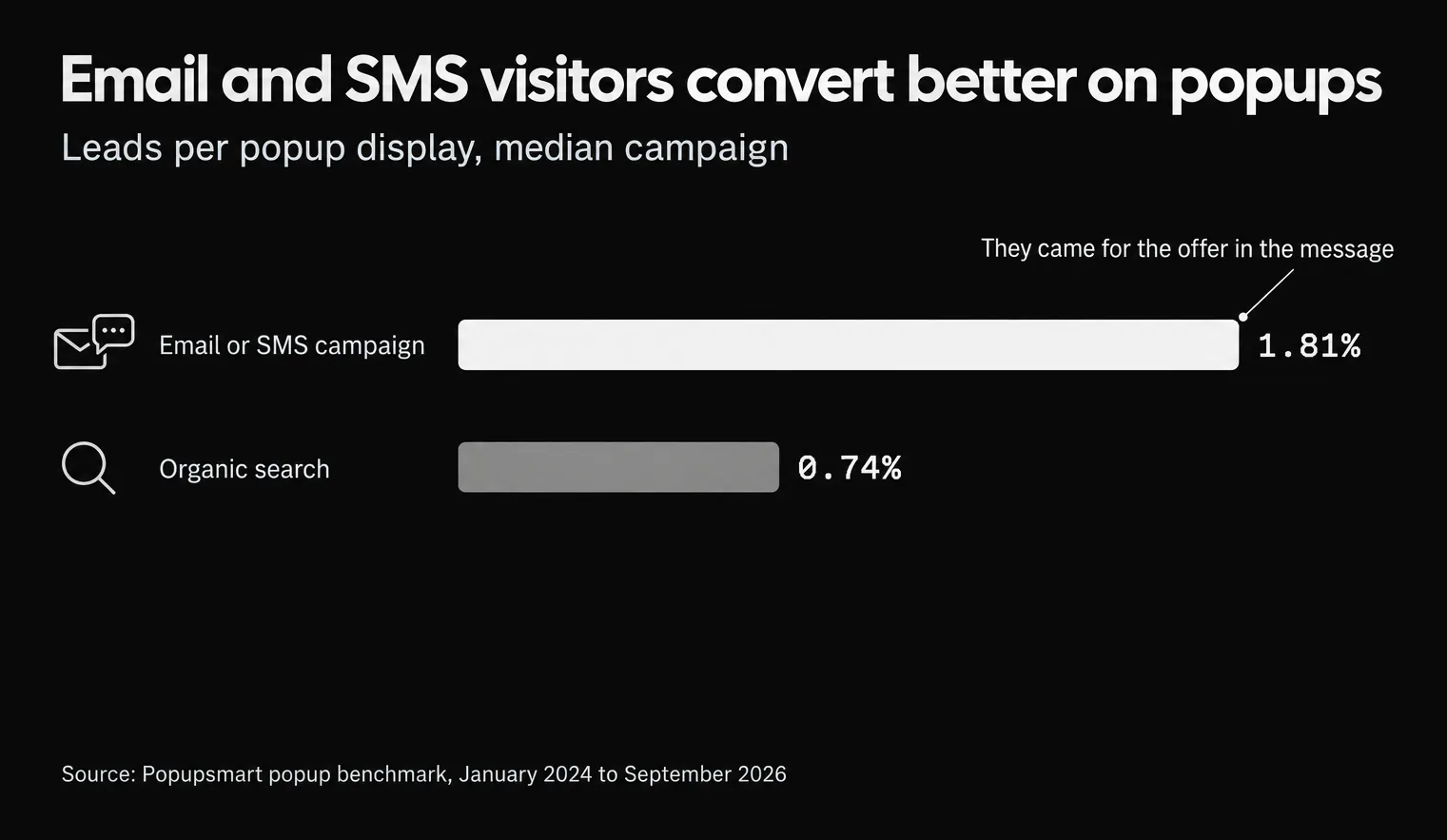
| An email or SMS campaign | 1.81% | 0.74% for organic search visitors | Higher than organic search |
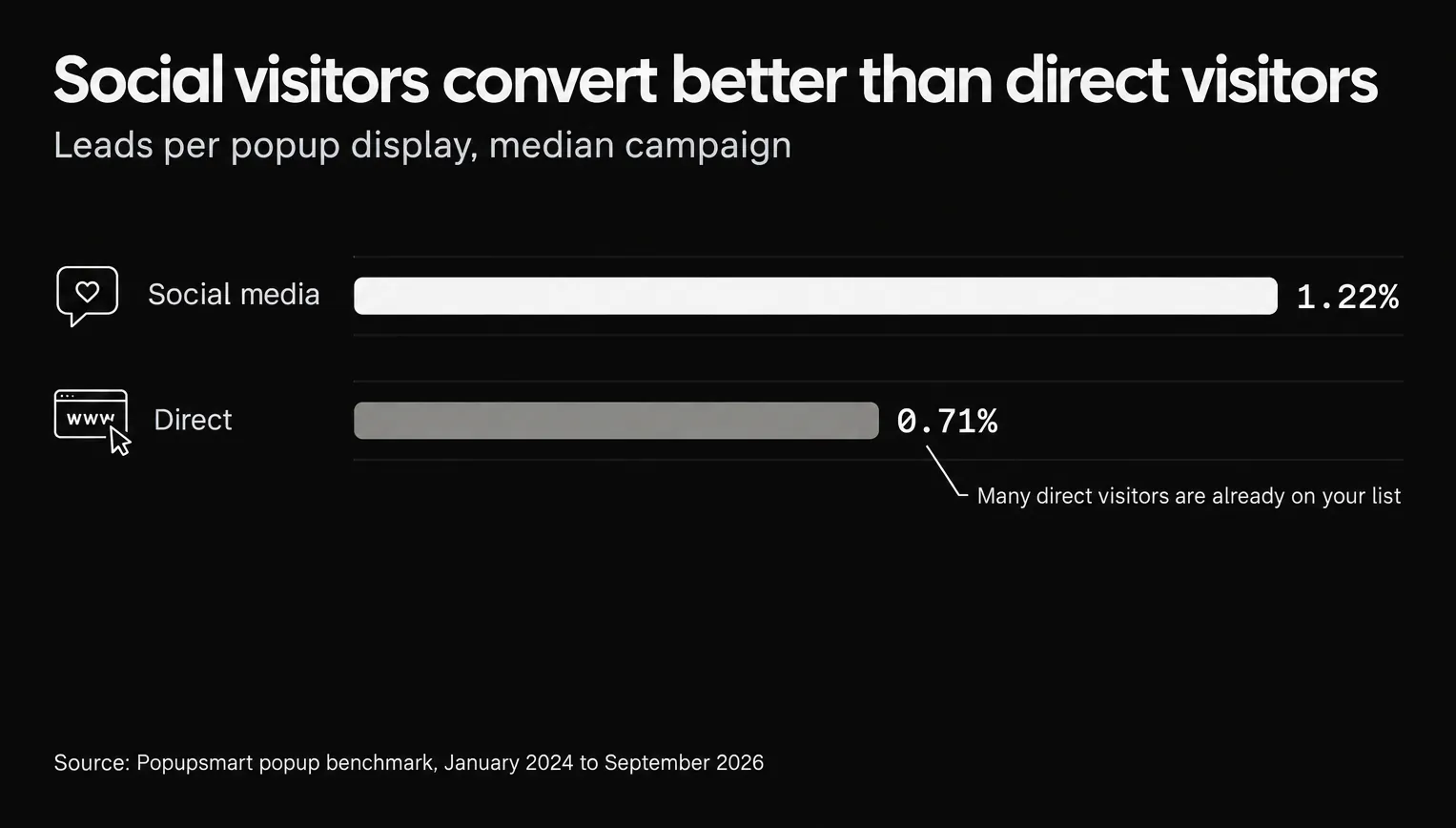
| Social platforms | 1.22% | 0.71% for direct visitors | Higher than direct |
| AI assistants (ChatGPT, Gemini, Claude, Perplexity, Copilot) | 1.14% | 0.74% for organic search visitors | No statistically reliable advantage: only 91 campaigns had enough AI-referred traffic, so the gap could be chance |
Each rate is the median campaign's leads ÷ popup displays. Source: Popupsmart popup benchmark, January 2024 to September 2026.
If you came looking for an email traffic conversion rate or a social media traffic conversion rate for popups, those are the email and social rows, each beside the source it was tested against. Read each row as a pair; rates in different rows aren't compared with each other.
Jordan Glickman's channel analysis makes the standard case for splitting by source: a blended conversion rate hides the variation between channels. That holds for popups too, though not in the order you'd expect. In our data, visitors from email or SMS campaigns convert on popups at a higher rate than visitors from organic search. In the same data, direct visitors convert on popups at a lower rate than visitors from social media.
My inference, which the benchmark didn't measure: email and direct visitors both tend to know you already, one through your emails and texts, the other well enough to type your URL. So familiarity on its own doesn't tell you who'll fill in a popup.
How did we measure popup conversion by traffic source?
We count a lead only when a popup submission contains an email address or phone number, divide leads by popup displays and report the median campaign, not an average.
Our popup benchmark covers 28,674 campaigns run on Popupsmart between January 2024 and September 2026. To measure popup conversion rate by traffic source, we use a narrower set:
- Popups that ask for an email or phone number, since only those can produce a lead.
- Campaigns that ran long enough to clear the benchmark's minimums for displays and active days.
For AI assistants, only 91 campaigns had enough AI-referred traffic, so the AI gap could be chance. For a reference point across every source, the median popup that asks for an email or phone number converts 0.83% of its displays, across 3,034 such popups.
A median ranks campaigns by their own rate and takes the middle one, so a single huge store can't drag it. Our rates tell you how often a shown popup produced a lead, not what share of your visitors became leads.
We state a comparison as a difference only when it passes every statistical check in our validation; a weaker result stays a lean. See our benchmark data page for the statements behind these numbers.
Limits, in my words: the campaigns come only from sites that run Popupsmart popups. And where the next sections say why a source converts the way it does, that's my reading, not a finding.
Do email and SMS visitors convert better than organic search visitors?
Yes. In our popup benchmark, visitors arriving from an email or SMS campaign convert on popups at 1.81% vs 0.74% for visitors from organic search.

Site-wide data points the same way. Email has the highest rate in the business-to-consumer column of First Page Sage's traffic source benchmarks, at 2.8%. First Page Sage segments its conversion rate benchmarks by the traffic sources in Google Analytics. Our popup rates count leads per popup display, so I wouldn't set the two side by side.
My reading of the email result: someone who clicks through from your email or text came for something specific, usually the offer in the message. A popup that completes that offer (the code, early access, a restock alert) asks for another step on a path they already chose.
There's a catch in our own definition, though. A lead is any popup submission with an email address or phone number, so nothing in the count separates an existing subscriber who types their address again from a new one.
If the new ask is a phone number, Popupsmart collects it for your SMS tool: the number and its SMS consent can be mapped to Klaviyo, Mailchimp or HubSpot in the integration's Match Fields step.
Does social traffic convert worse than direct traffic on popups?
No. Visitors arriving from social media convert on popups at 1.22% vs 0.71% for direct visitors (median campaign).
Site-wide ranges usually point the other way. Glickman's table of typical conversion rate ranges by traffic source ties the row he labels Direct to returning customers and branded recall and gives it 3.0% to 6.0%. He calls these directional ranges, not targets, since a brand's own numbers depend on its price point, site experience and offer, and he gives TikTok, which he describes as discovery traffic with the lowest purchase intent on arrival, 0.3% to 1.2%.
On popups the order flips, and I think the reason is what a popup asks for. This is my interpretation, not something the benchmark measured:
- Direct visitors have often given you their email already. People who type your URL or use a bookmark tend to be returning customers, and many are on your list, so a signup popup has little left to ask them for.
- Social visitors are often new to you. Someone who taps through from a post or an ad usually hasn't seen your popup yet, and a first offer is what a signup popup is built for.
The new-visitor result in our data fits that reading: popups targeted at new visitors only convert 1.13% vs 0.77% for popups shown to everyone.
Keep the pairs apart: I'd compare email with search and social with direct, and I wouldn't rank email against social. With social traffic, I'd keep the popup on and make the first offer count. Direct traffic is the opposite case, and there I'd show visitors who are already on your list something other than the signup offer.
Do visitors from ChatGPT and other AI assistants convert better?
Not reliably on popups, in our data. Visitors referred by AI assistants (ChatGPT, Gemini, Claude, Perplexity, Copilot) show no statistically reliable advantage over organic search: popups converted 1.14% vs 0.74% (median campaign), but only 91 campaigns had enough AI-referred traffic, so the gap could be chance.
Published AI traffic conversion rate figures lean the other way, and they measure other actions. Microsoft Clarity's study of AI traffic covered publisher and news sites. On those sites, Clarity's table of conversion rates by channel gives visitors from LLMs a Sign-Up CTR of 1.66%, against 0.15% for search visitors. In Conductor's guide to AI referral traffic, the company reports that on its own site, AI-referred visitors convert to free-trial sign-ups at 2x the rate of its best-performing channel, organic search. Conductor's explanation is that AI referral traffic arrives further along in the funnel, because these visitors have already received an answer from an AI before they click through.
Those studies don't contradict our own line, a gap that could be chance. Clarity's figures are a Sign-Up CTR and a Subscription CTR, on publisher and news sites. Conductor's figure comes from its own site, where AI referrals are a small share of traffic. We counted email and phone leads per popup display across Popupsmart campaigns.
Sample size is the bigger limit. On the publisher sites Clarity studied, AI referrals still accounted for less than 1% of overall traffic. If AI is a similarly thin slice on most stores, that would explain why only 91 of our campaigns had enough AI-referred traffic, and why that gap could be chance.
If AI assistants already send you visible traffic, a separate popup for those visitors is a cheap test rather than a proven win. Keep your organic-search popup running beside it, and judge the AI version on your own numbers once it has enough displays to mean something.
Why don't site-wide channel benchmarks match popup data?
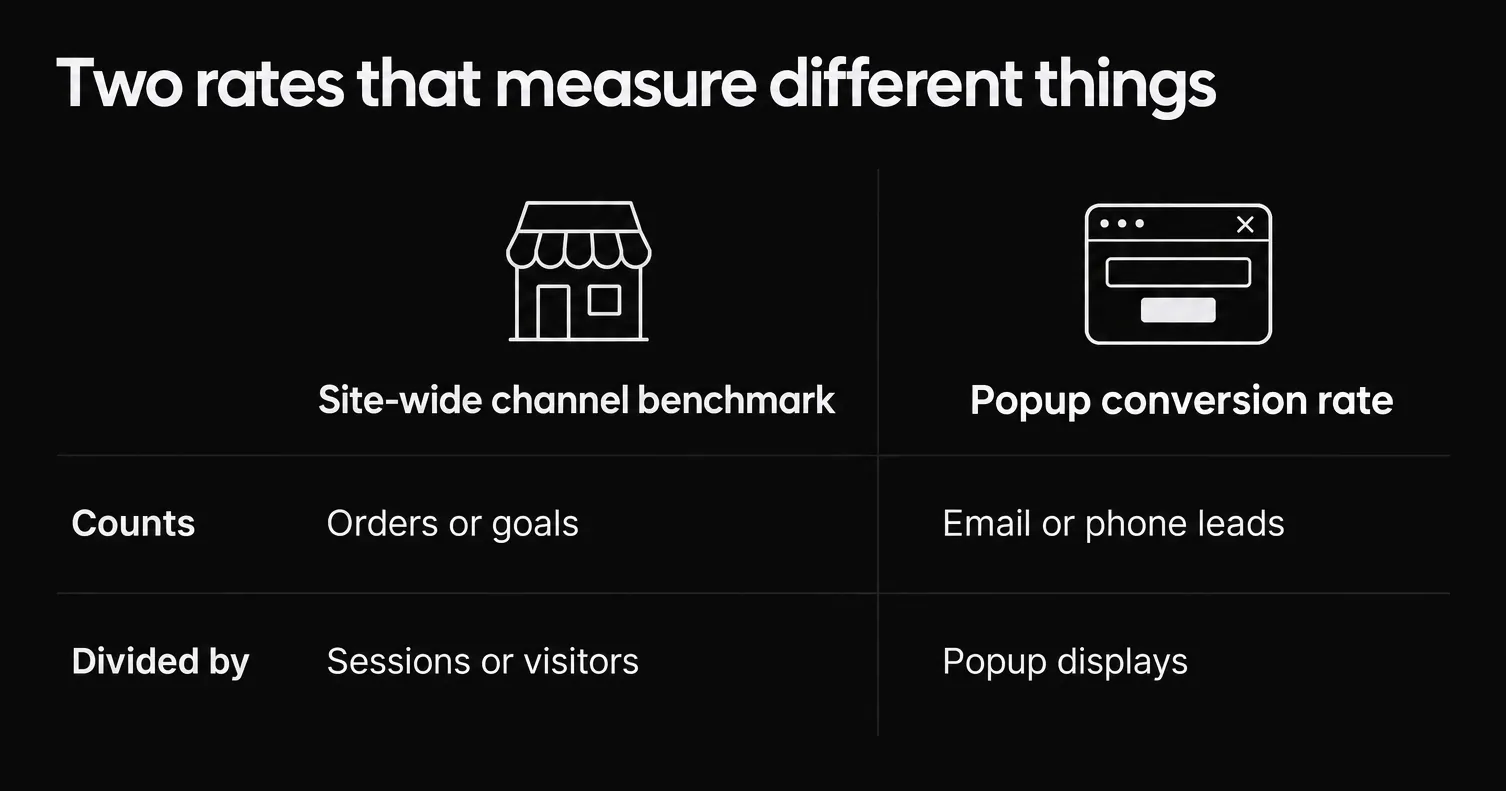
Because they count a different outcome, over a different base, on different sites. Glickman calls his own figures directional ranges, not targets, and that's the right way to hold any site-wide benchmark next to a popup rate. Check these first:
- Outcome. Glickman's ranges are on-site conversion rates to a purchase. Our popup rate counts leads that contain an email address or phone number.
- Base. Site rates divide by sessions or visitors. Popup rates divide by popup displays, not by visitors.
- Statistic. First Page Sage's figures are averages taken from 150+ client accounts from 2018 to 2023, last updated on October 4, 2023. Our popup rates are medians per campaign.
- Sites. Our campaigns all ran on sites that use Popupsmart.
The benchmarks don't agree with each other either. First Page Sage's table splits on the very pair our data answers for popups: organic social converts at 2.4% vs 1.6% for direct in its business-to-consumer column, and at 1.7% vs 1.9% in its business-to-business column.
For whole-site figures, our guide to website conversion rates by channel collects the benchmarks. Judge your popups against popup figures, and your store against store figures.
How do you target popups by traffic source?
Read where your visitors come from, then give each source its own popup with Popupsmart's traffic source targeting.
To read the source, open the Traffic acquisition report in GA4, which breaks visits down by session source/medium. For AI assistants, Semrush's guide to AI referral traffic filters that report with a regex matching chatgpt.com, perplexity.ai, claude.ai, gemini.google.com, copilot.microsoft.com and a few more. Tag the links in your own emails and texts with UTM parameters, so your analytics can credit those visits to the campaign.
Then set up the popup in Popupsmart. The traffic source targeting guide in the help center covers the same steps:
Open the campaign's segment
In the popup builder, go to the Segment section and click Edit Segment. For a new campaign, choose a predefined segment or build one from scratch in My Segment.
Add a traffic source rule
Click Add audience targeting under Audience, then click Add next to Traffic Source.
Set the URL rule
Choose whether to include or exclude the URLs you want to target. With Contains followed by a Facebook URL, the popup shows only to visitors who come from Facebook.
Publish and check the summary
Repeat the rule for each extra source, then go to the Publish step to see your Targeting Summary.
Which popup for which source is your call. Here's where I'd start, as advice rather than benchmark results:
- Email or SMS campaign visitors: finish the offer they clicked, such as the code or early access, or ask existing subscribers for an SMS opt-in.
- Social visitors: a first-visit welcome offer, short enough to read at a glance.
- Organic search visitors: an offer that matches the page they landed on, such as a guide on a blog post.
- Direct visitors: a message for returning customers instead of the signup offer.
Targeting more carefully goes with higher rates in our data: popups set up with three targeting rules convert 1.09% vs 0.71% for popups with none or one (median campaign), a correlation, since marketers who target carefully may also write better offers.
To try it, copy one of the popup templates once per source and change only the offer, so you can tell which change mattered. Device is another split worth adding later, and our mobile vs desktop popup data covers it.
Questions about popup conversion by traffic source
What is a good popup conversion rate?
For a popup that asks for an email or phone number, anything above 0.83% of its displays beats the median across 3,034 such popups in our benchmark; the top 25% reach 1.96% and the top 10% reach 3.87%. By traffic source, compare like with like: a popup shown to email or SMS traffic and one shown to organic search traffic start from different medians.
Does organic search traffic convert worse on popups?
Compared with email traffic, yes: visitors arriving from an email or SMS campaign convert on popups at 1.81% vs 0.74% for visitors from organic search. Page type matters as well: popups on cart and checkout pages convert 4.57% vs 1.07% on the home page (median campaign); blog pages convert 0.23%. If most of your search visitors land on blog posts, judge that organic traffic conversion rate against the blog figure.
Do visitors from ChatGPT and other AI assistants convert better on popups?
Not reliably, in our data. Visitors referred by AI assistants (ChatGPT, Gemini, Claude, Perplexity, Copilot) show no statistically reliable advantage over organic search: popups converted 1.14% vs 0.74% (median campaign), but only 91 campaigns had enough AI-referred traffic, so the gap could be chance. Microsoft Clarity's study reports a higher Sign-Up CTR for visitors from LLMs than for search visitors.
How do I see AI referral traffic in GA4?
Open Reports, then Acquisition, then Traffic acquisition, and filter session source/medium with a regex that matches AI domains such as chatgpt.com, perplexity.ai, claude.ai and gemini.google.com, as Semrush's guide to AI referral traffic shows. Expect an undercount: Contentsquare notes that AI platforms don't always pass on referrer information, so some AI visits show up as direct or unassigned.
What does AI referral traffic mean?
Conductor defines AI referral traffic as the audience segment that arrives on your website after clicking a link or citation within an AI-generated response. Referral traffic in general is a visit that arrives through a link on another site, so AI referral traffic is the share whose link sat in an answer from an assistant such as ChatGPT, Perplexity, Gemini, Claude or Copilot.
Can I show a different popup to visitors from email, social or search?
Yes. In Popupsmart, add a Traffic Source rule under audience targeting and include or exclude visitors by the URL they came from: a rule with Contains followed by a Facebook URL shows the popup only to visitors who come from Facebook. Repeat the rule to target several sources. Copy one popup per source and change only the offer, so you can tell which change mattered.
How much data do you need before comparing traffic sources?
Enough that a single busy week can't decide it. Our benchmark only counts campaigns that clear minimums for displays and active days. Even so, only 91 campaigns had enough AI-referred traffic, so the AI gap could be chance. On your own site, compare sources over the same period and treat a small gap between small samples as noise until it holds up for several weeks.
How do you calculate popup conversion rate?
Divide the popup's leads by its displays. Count a lead only when a submission contains an email address or phone number, and count every time the popup was shown. Our benchmark computes leads per display for each campaign, then reports the median campaign. A rate that divides by visitors, sessions or clicks measures something else, so check what your tool divides by before you compare.