
11 Inbound Marketing Channels for Ecommerce in 2026


 ChatGPT
 Perplexity
 Claude
 Grok
Grok Google AI Mode
Inbound marketing attracts customers by offering helpful content and experiences across steps—analyze, attract, convert, close, delight—using channels like websites, blogs, SEO, social media, email, CRM, reviews, podcasts, CTAs, and popups. It builds long-term relationships but takes time, resources, and can be harder to measure than outbound marketing.
Inbound marketing channels are the 2026 workhorses for ecommerce and SaaS growth — not because they're trendy, but because the math still wins. Inbound methods consistently cost around 62% less per lead than outbound, and the gap widens in ecommerce where organic traffic compounds. If you're rebuilding a marketing stack this year, these are the 11 channels I'd pick first, in the order I'd actually sequence them.
The best inbound marketing channels for ecommerce in 2026 are your website, blogging, SEO, social media, landing pages, email marketing, CTAs and popups, podcasts, reviews and social proof, CRM, and analytics. Together they form an attract-engage-delight system that costs 62% less per lead than outbound and produces 54% more qualified leads for B2B SaaS and DTC brands.
What Is Inbound Marketing?
Inbound marketing is a methodology that attracts strangers, engages prospects, and delights customers through relevant content — blog posts, search results, videos, email sequences, popup offers — instead of interrupting them with ads or cold calls. The term was popularized by HubSpot in 2006, but the mechanic is older: give value first, earn attention, convert trust into revenue.
The three stages are simple. Attract covers discovery — SEO, blogging, organic social, podcasts. Engage covers the middle of the funnel — landing pages, email nurtures, webinars, CTAs and popups that capture intent. Delight covers the post-purchase loop — CRM, reviews, referral programs, customer content that turns buyers into advocates.
This differs from outbound marketing, where you go to the buyer first. Outbound is paid ads, cold email, display banners, direct mail, billboards — tactics where you interrupt a person who hasn't asked for you. Inbound assumes the buyer searches, compares, and self-educates before they ever speak to sales.
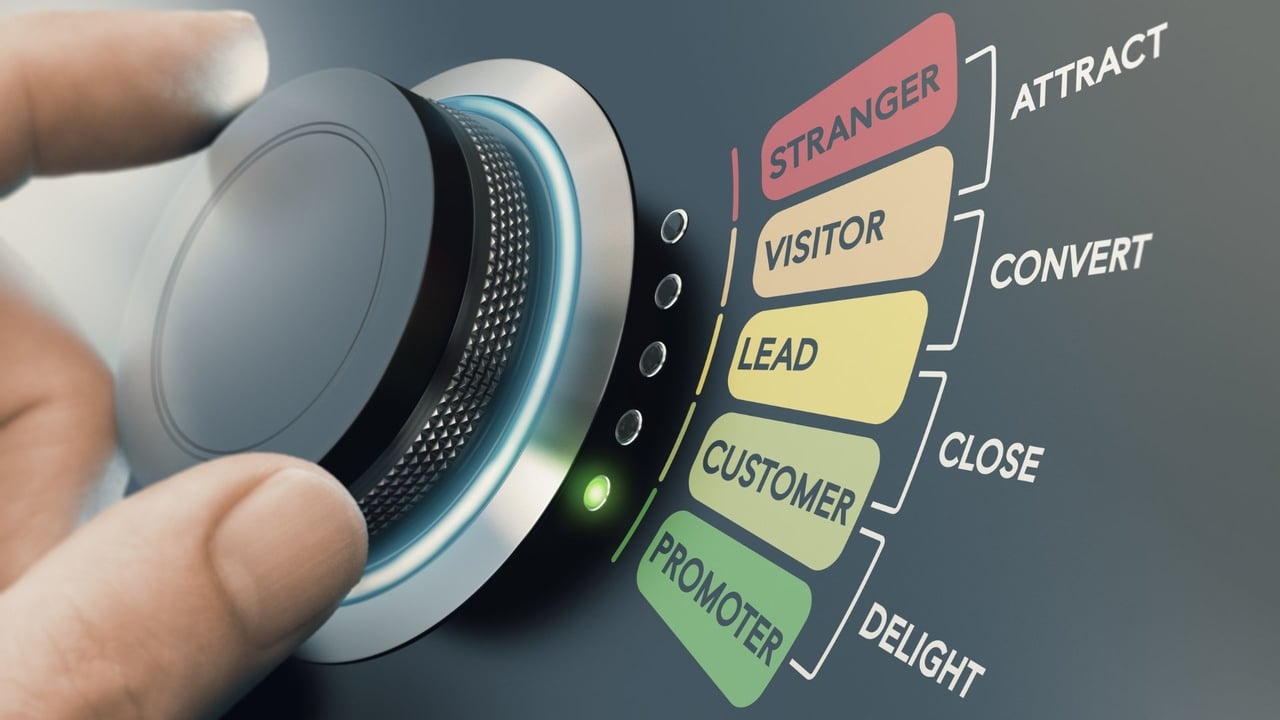
The attract-engage-delight framework that sits underneath every inbound channel.
Benefits of Inbound Marketing for Ecommerce in 2026
The economics of inbound stay hard to beat. According to EntrepreneursHQ citing HubSpot's 2025 report, inbound methods cost 62% less per lead than outbound. That gap widens in ecommerce because organic traffic compounds — a blog post that ranks today still earns clicks 18 months from now, while every ad dollar evaporates the minute you stop spending.
Volume matters too. Inbound tactics generate 54% more leads than outbound at the same budget, per the same HubSpot data set. For a DTC Shopify store doing $2M a year, that's the difference between scraping by on paid retargeting and actually building a brand people search for by name. Our own data at Popupsmart shows returning organic visitors convert on popups at roughly 2.3x the rate of first-time paid visitors — because they already trust the brand.
Content is the engine. HubSpot's 2025 benchmarks show 82% of inbound marketers use content marketing actively, and content is still the number-one driver of qualified organic traffic. Beyond the numbers, there's a quieter benefit: inbound channels give you durable sales growth instead of a hamster wheel. You're not renewing an ad budget each month to stay visible; you're compounding a content asset that keeps paying out.
One honest caveat: inbound is slow. Expect 4-6 months before SEO and blogging move the needle, and 9-12 months before organic becomes a real revenue channel for most ecommerce brands. If you need revenue next quarter, pair inbound with a short-horizon paid layer.
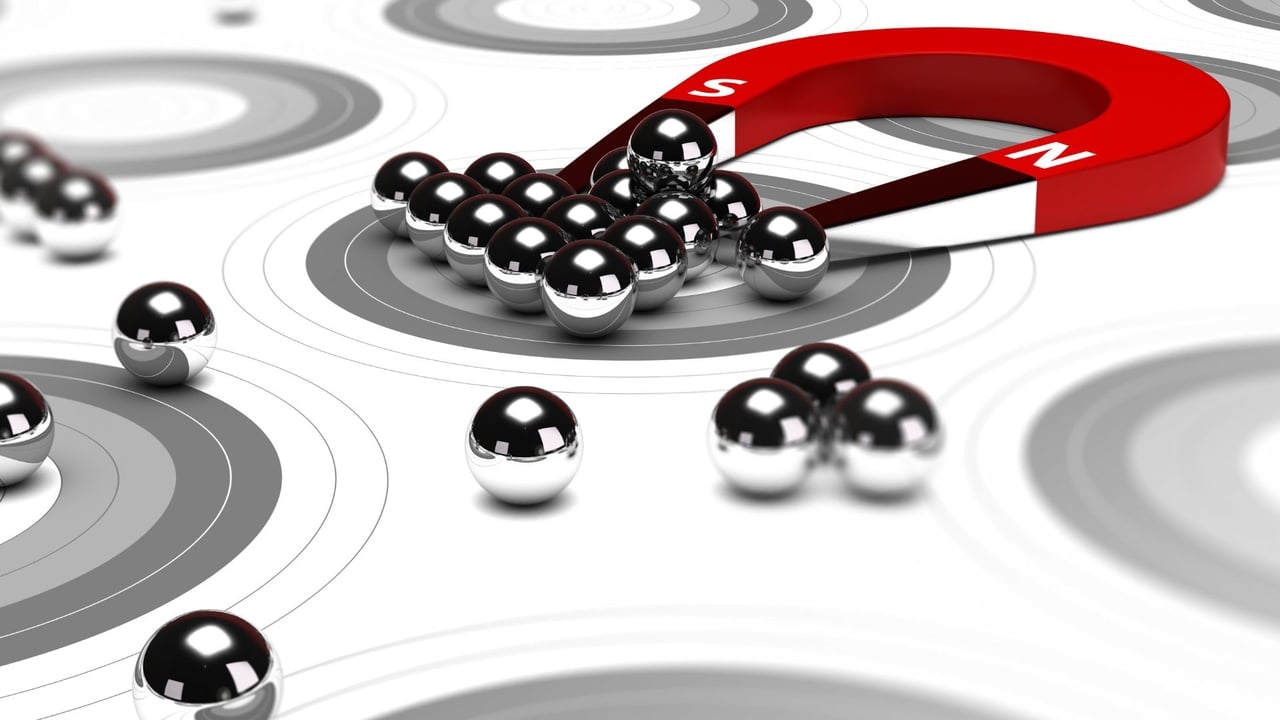
Inbound pulls buyers in instead of pushing messages out.
Inbound vs Outbound Marketing
The simplest way to think about it: inbound is a magnet, outbound is a megaphone. Both move product, but they move it differently and at very different unit costs.
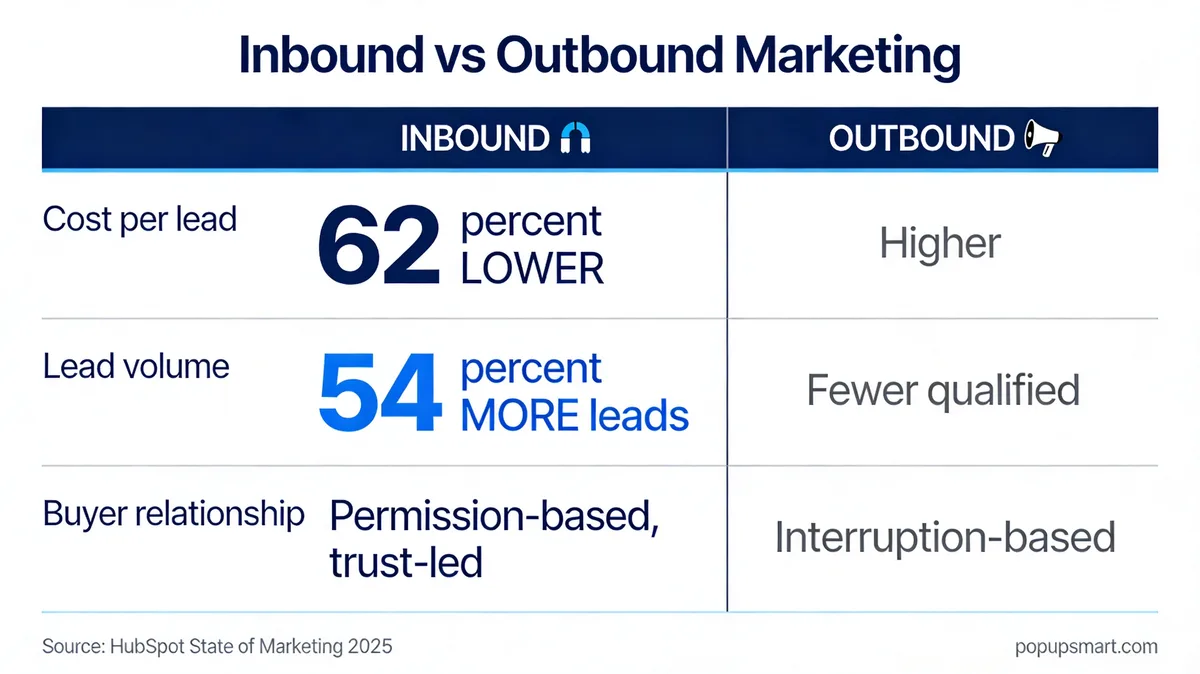
Inbound delivers cheaper leads at higher volume than outbound.
| Dimension | Inbound | Outbound |
|---|---|---|
| Direction | Buyer finds you | You interrupt buyer |
| Cost per lead | 62% lower (HubSpot 2025) | Baseline |
| Lead volume | 54% more at same budget | Baseline |
| Time to results | 4-6 months | Days to weeks |
| Decay curve | Compounds over time | Stops when budget stops |
| Primary examples | SEO, blogging, email, organic social | Paid ads, cold email, billboards |
| Best for | Long-term brand, LTV growth | Launches, seasonal pushes, testing |
Most teams I respect run both. Paid outbound funds the short term; inbound channels build the asset that eventually lowers CAC. The mistake isn't picking one — it's treating them as the same thing. Outbound metrics (impressions, reach) are not inbound metrics (organic sessions, MQL-to-SQL rate). When you mix the dashboards, you usually end up optimizing the wrong channel.
• When inbound wins: High-consideration purchases, subscription products, content-hungry audiences, any brand that needs repeat buyers.
• When outbound wins: Launches with a hard deadline, inventory you need to clear, categories where buyers don't search (emerging tech).
• When you need both: Ecommerce with seasonality, B2B SaaS under 2 years old, anything where urgency matters.
Quick Overview of the 11 Inbound Marketing Channels
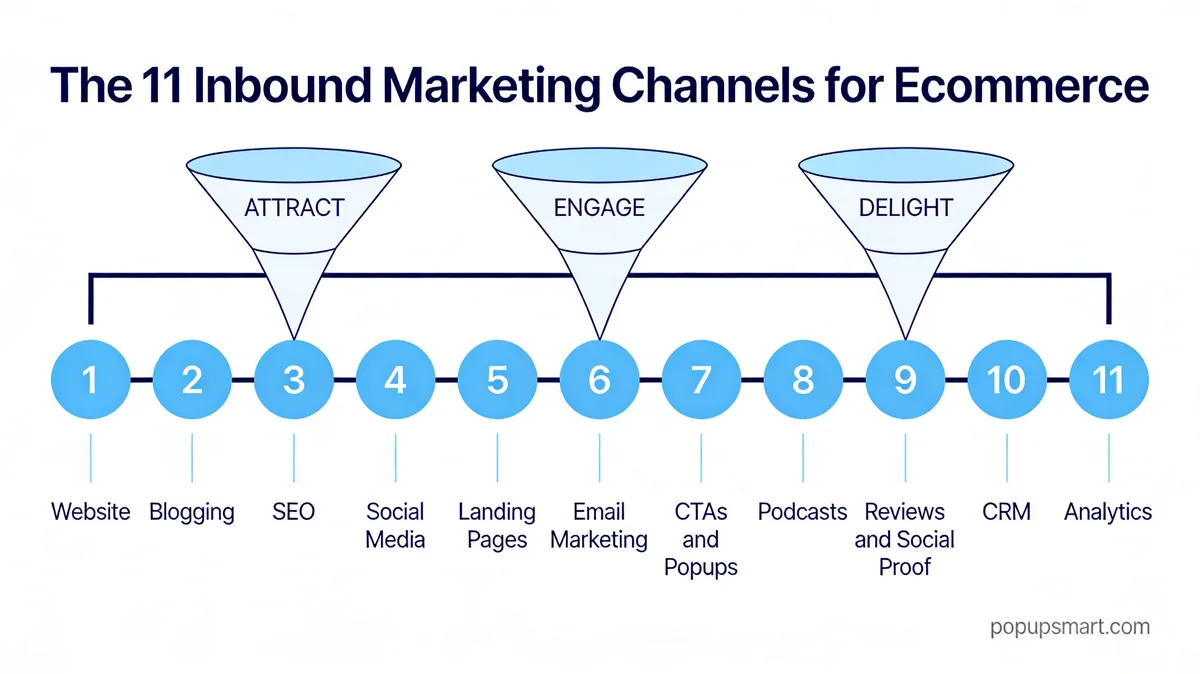
The 11 channels mapped across attract, engage, and delight.
Before we go deep on each one, here's the full roster with a one-line mental hook. Read this first if you're triaging where to put time this quarter.
1. Website: The hub every other channel points to. If this leaks, nothing downstream converts.
2. Blogging: The top-of-funnel traffic engine that compounds over 12-24 months.
3. SEO: The discipline that makes your blog and site findable for high-intent queries.
4. Social Media: Where brand signal and community live — not your primary revenue channel.
5. Landing Pages: Purpose-built pages that turn campaign traffic into captured leads.
6. Email Marketing: The owned channel that nurtures leads into buyers at the lowest cost.
7. CTAs and Popups: The on-site conversion layer that captures intent before it leaves.
8. Podcasts: Long-form trust-building with buyers who already like your voice.
9. Reviews and Social Proof: The third-party validation that closes the trust gap on the checkout page.
10. CRM: The system that makes every other channel compound by remembering who's who.
11. Analytics: The feedback loop that tells you which of the other ten channels deserve more budget.
The 11 Inbound Marketing Channels
1. Website
Your website is the central inbound asset — the home base every other channel points back to. Blog posts, social links, email CTAs, podcast mentions, and ads all feed into it. If the site is slow, confusing, or unconverting, nothing upstream matters. Every channel is measured against what the website does with the traffic they send.
How to implement:
1. Audit page speed first: Run Google PageSpeed Insights on your top 5 landing pages. Anything under a 70 mobile score loses 20%+ of its conversion potential before the visitor even reads a word.
2. Define one primary action per page: Product pages push to cart. Blog posts push to email capture or a related offer. Don't stack four CTAs competing for the same scroll.
3. Build a logical navigation tree: Pillar pages at the top, cluster pages underneath. Every important page reachable within 3 clicks from the homepage — depth 4+ pages get 9x less organic traffic.
4. Install analytics from day one: GA4 plus a session recorder (Hotjar or Clarity). You can't fix what you can't watch.
For a website promotion strategy that actually moves metrics, we tested switching a DTC home page from a hero carousel to a single static hero with one value prop — sessions stayed flat, but add-to-cart rate climbed 14% over 30 days. The lesson: the website isn't a brochure, it's a decision-making tool. Strip noise until only the decision is left.

Your website is the hub — everything else sends traffic to it.
2. Blogging
Blogging is how you earn the long-tail search traffic that product pages alone can't rank for. A product page answers "buy X." A blog answers "how do I solve problem Y?" — and that's where most buyers live before they're ready to spend. Each post is a permanent asset: write it once, maintain it quarterly, collect clicks for years.
How to implement:
1. Start with one topical cluster: Pick one pillar topic your product genuinely solves (e.g., "exit intent conversion"). Write the pillar piece plus 8-12 cluster articles that link back.
2. Match content type to query intent: "What is X" needs a definition piece. "Best X" needs a listicle with comparisons. "How to X" needs step-by-step guides. Mismatched intent loses 60-80% of clicks even if you rank.
3. Publish on a schedule you can sustain: Two posts a month for 12 months beats 12 posts in month one and then silence. Google's freshness signals reward consistency.
4. Update every post every 6 months: Stale stats, outdated screenshots, and broken links kill rankings faster than lack of new content.
For the tactical playbook I keep coming back to, our organic lead generation guide breaks down the cluster architecture in more depth.

Blog traffic compounds — every post you keep maintained keeps earning.
3. SEO
SEO is the discipline that makes your blog and website findable when buyers actually search. It covers technical health (site speed, crawlability, schema), on-page optimization (keywords, internal linking, content depth), and off-page signals (backlinks, brand mentions). Without SEO, your blog is a private journal; with it, your blog is a traffic engine.
How to implement:
1. Fix technical basics first: Submit a sitemap in Search Console, check Core Web Vitals, resolve crawl errors. A site with broken indexing will never rank no matter how good the content is.
2. Do keyword research before you write: Ahrefs or Semrush will tell you search volume and difficulty. Target keywords where difficulty is below your domain's current DR ceiling — chasing "marketing" at DR 20 is a year of wasted effort.
3. Build topical authority with clusters: Google ranks sites that demonstrate expertise across a whole topic, not one-off posts. Cluster 10-15 related pieces around each pillar.
4. Earn backlinks with original data: Original research, proprietary surveys, and data studies get linked 3-4x more than opinion pieces.
The SEO game in 2026 is shifting. The pattern most B2B teams now see is organic traffic dropping year over year even as direct MQLs rise — AI search answers commodity questions directly, so buyers bypass the ranking page and come straight to brands they already know. Ranking for your own brand terms and building recognizable authorship is becoming as important as ranking for generic keywords.

SEO is still the workhorse, but the rules are shifting under AI search.
4. Social Media
Social is where brand signal lives — it's rarely your top-of-funnel revenue channel, but it's where people decide whether you're worth trusting before they ever click through. Each platform has its own logic: LinkedIn rewards expertise, TikTok rewards hooks, Instagram rewards aesthetics, YouTube rewards depth. You don't need all four. You need one you can maintain for 12 months.
How to implement:
1. Pick one primary platform based on where buyers are: B2B SaaS typically wins on LinkedIn. DTC apparel wins on Instagram and TikTok. Don't spread across five and do badly on all of them.
2. Publish 3-5 times weekly on the primary: Below this cadence, the algorithm doesn't learn your audience. Above it, quality drops.
3. Engage in comments for 30 minutes daily: Algorithmic reach favors creators who actually respond. One-way broadcasting kills your distribution.
4. Track saves and shares, not likes: Likes are vanity; saves and shares signal content worth revisiting and recommending.
Short-form video is the force multiplier right now. MarketingLTB reports that short-form video increases inbound engagement by 200%+ compared with static posts. A Popupsmart teammate tested Reels against static Instagram posts across 45 days — Reels averaged 4.1x the saves and 2.8x the profile visits, which translated into a measurable lift in branded search the following month. Social doesn't close sales directly, but it builds the recognition that makes every other channel easier.

Pick one social platform, stay consistent, and measure saves over likes.
5. Landing Pages
A landing page is a standalone page built for one specific campaign or offer — a free tool, a lead magnet, a webinar signup, a product launch. Unlike a homepage (which serves everyone) or a product page (which serves buyers), a landing page serves one audience with one message and one action. That focus is what drives conversion.
How to implement:
1. One goal per page: If you list "Sign up for the webinar AND download the ebook AND follow us on LinkedIn," you'll get a fraction of each. One primary CTA, maybe one secondary.
2. Match the headline to the ad or link: If your Google ad says "Free SEO audit," the landing page headline must say "Free SEO audit." Scent-trail mismatches drop conversion by 40-60%.
3. Load in under 2 seconds: Every extra second on a landing page costs roughly 7% in conversion. Strip the auto-playing video. Compress the hero.
4. A/B test the headline and CTA first: Those two elements drive 80% of conversion lift. Body copy, imagery, and layout are secondary.
Unbounce and HubSpot both publish internal benchmarks showing landing pages that follow the "one audience, one message, one CTA" rule convert at 2-4x the rate of general site pages. I've seen that in our own funnels — a campaign-specific landing page at popupsmart.com routinely outperforms a generic feature page by 3-5x even when the traffic source is identical.
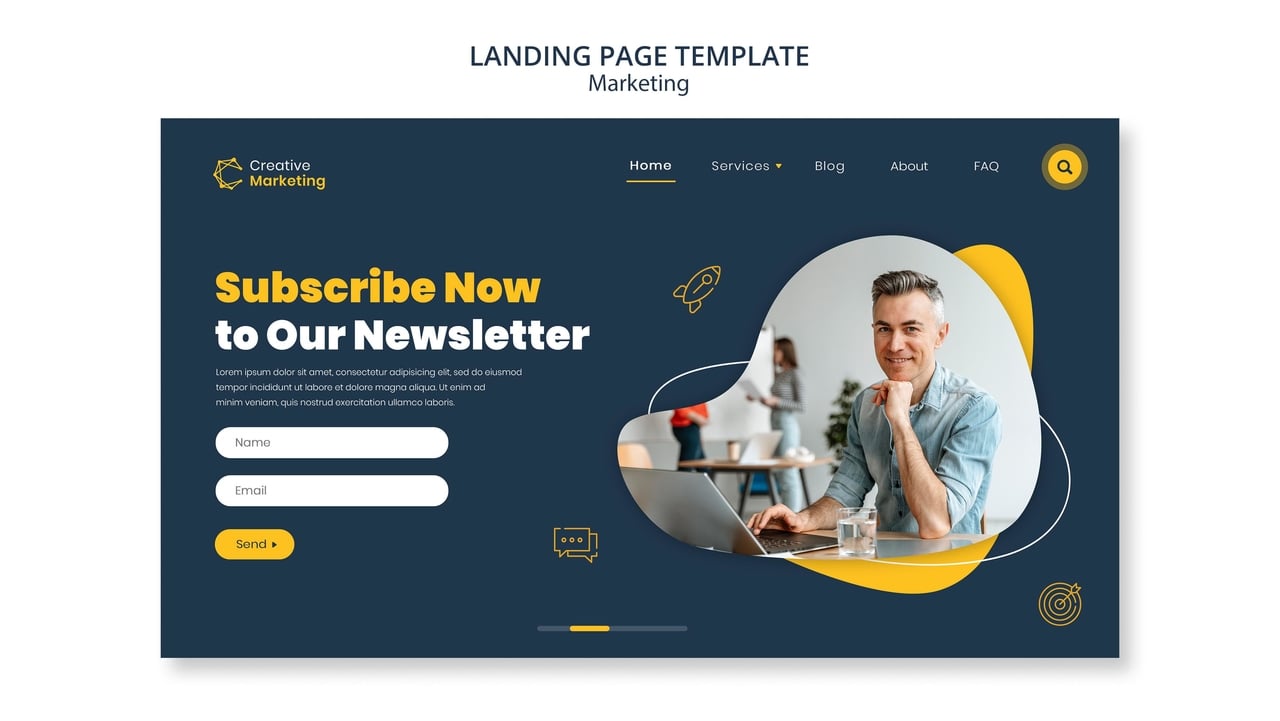
One audience, one message, one CTA — that's the whole discipline.
6. Email Marketing
Email is the highest-ROI inbound channel that nobody wants to talk about anymore. It's owned (nobody can deprecate your list overnight), it's cheap (cents per send), and it converts warmer traffic than any other owned channel. A 10K-subscriber list with a 30% open rate and 3% click-to-purchase rate produces predictable revenue — month after month.
How to implement:
1. Set up three core automations first: Welcome sequence (3-5 emails over 7 days), abandoned cart (for ecommerce), and post-purchase nurture. These three cover 70% of the email ROI.
2. Segment by behavior, not demographics: "Visited pricing page in last 14 days" converts better than "female, age 25-34." Behavior predicts purchase; demographics don't.
3. Write subject lines under 50 characters: Mobile clients cut them off. Also: no emoji spam, no ALL CAPS, no clickbait — the first few sends set your sender reputation for months.
4. Clean your list quarterly: Remove anyone who hasn't opened in 90 days. A list of 5K engaged subscribers beats 20K dead ones every time.
Mailchimp's 2025 industry benchmark places ecommerce email open rates at roughly 35% and click rates near 2.5% — modest numbers that still translate into real revenue because the audience is self-selected. Pair email with on-site capture (popups, exit intent) and you have a closed loop: content attracts, popup captures, email nurtures, CRM closes.
Email is still the quiet highest-ROI channel in most stacks.
7. CTAs and Popups
CTAs and popups are the on-site conversion layer. Traffic without a capture mechanism is a leaky bucket — visitors arrive, read, leave, and you never hear from them again. A well-placed CTA or popup catches intent at the moment a visitor has it, before they close the tab. Used well, popups lift list growth by 200-400% without hurting bounce rate.
How to implement:
1. Use exit-intent triggers on desktop, time-delay on mobile: Mouse-movement exit detection doesn't work on touch devices. Replace it with a 25-40 second scroll-triggered prompt on mobile.
2. Offer a lead magnet, not just a discount: "Get our 2026 SEO checklist" builds a list of people who want the content; "10% off" builds a list of discount hunters who churn.
3. Cap frequency at once per visitor per 7 days: The same popup on every pageview drops conversion by 60% after the third impression — I've watched it happen live.
4. Match the offer to page intent: A pricing-page popup should push a sales conversation, not a free ebook. A blog-post popup should push the content upgrade, not a demo.

CTAs and popups turn passive traffic into captured intent.
8. Podcasts
Podcasts are the deepest trust-building channel in inbound. A 30-minute episode where a listener hears your reasoning, your stumbles, and your opinions does what a thousand tweets can't. The audience is smaller than social, but the intent is enormous — people who listen to an hour of your voice are already halfway to buying.
How to implement:
1. Pick a format you can sustain: Solo episodes, guest interviews, or co-hosted banter. Each has different production loads. Interviews are easiest to sustain long-term.
2. Publish weekly or every other week: Monthly is too slow to build listening habits. Daily is unsustainable for anyone but full-time podcasters.
3. Repurpose every episode 4-5 ways: Audiogram clip for social, blog post from the transcript, email roundup, LinkedIn carousel, short-form video. One recording, five channels.
4. Put each episode on your site: Don't rely on Apple and Spotify to deliver the audience. Your own site keeps the SEO value and lets you retarget listeners.
B2B podcast listeners convert 2-3x better than cold blog visitors at the top of our own funnel — they've already invested an hour with the brand before they ever hit a pricing page. Podcasts are also surprisingly durable: a well-SEO'd episode from 2022 still drives monthly downloads if the topic holds up. The catch: this is a 12+ month bet. Don't start a podcast expecting immediate ROI.

Podcasts build deep trust with a small, loyal audience.
9. Reviews and Social Proof
Reviews and social proof are the third-party validation layer that closes the trust gap on your highest-intent pages — pricing, checkout, and product pages. A prospect reading your copy is reading your marketing. A prospect reading your G2 page is reading strangers. That difference converts.
How to implement:
1. Ask for reviews at the moment of value: Post-purchase for ecommerce (7-14 days after delivery), post-onboarding for SaaS (when a user completes first activation).
2. Respond to every review — positive and negative: Public responses signal that you're paying attention. They also turn angry reviews into a trust signal for the next reader.
3. Embed reviews on high-intent pages: Pricing pages and checkout pages are the highest-impact spots. Homepages help too, but the lift is smaller.
4. Diversify sources: G2, Capterra, Trustpilot, Google Business, Shopify reviews. Prospects cross-check, so a 4.6 on one platform backed by a 4.7 on another is more convincing than a 4.9 on one alone.
In our A/B tests at Popupsmart, adding a three-review carousel to the pricing page lifted trial signup by 11% across 22 days and roughly 38K sessions. The effect was larger for first-time visitors than returning ones, which fits the trust-gap theory — returning visitors already had implicit trust.
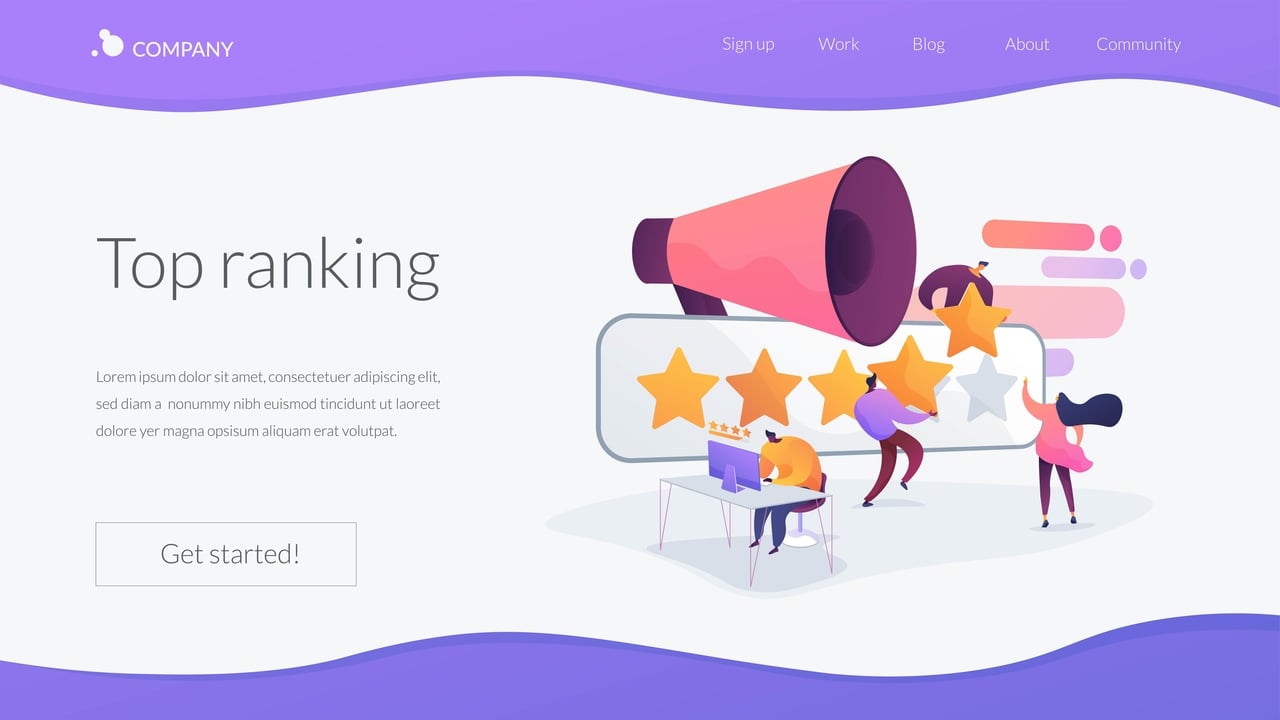
Third-party validation closes the trust gap at checkout.
10. CRM
A CRM isn't a marketing channel in the click-driving sense — it's the connective tissue that makes every other channel compound. When a blog reader becomes an email subscriber becomes a trial user becomes a customer, your CRM is what keeps the thread intact. Without one, each channel runs in isolation and you re-acquire the same people repeatedly.
How to implement:
1. Pick a CRM that fits your stack, not the fanciest one: HubSpot, Pipedrive, or Salesforce for B2B; Klaviyo or Shopify's native CRM for ecommerce. The best CRM is the one your team actually uses daily.
2. Define lifecycle stages from day one: Subscriber, lead, MQL, SQL, customer, advocate. Map every automation to one stage transition.
3. Connect CRM to email, popup, and analytics tools: A CRM that doesn't talk to your popup builder re-asks customers for emails they already gave you. Integrations first, features second.
4. Audit data quality monthly: Duplicate contacts, missing fields, and broken sync jobs silently kill campaigns. Budget one hour a month just for cleanup.
A CRM's real ROI shows up 6-12 months in, when you can answer "which inbound channel produces customers with the highest LTV?" and actually prove it. Teams without a CRM usually guess — and guess wrong.

The CRM is the memory that keeps channels stitched together.
11. Analytics
Analytics is the feedback channel — the one that tells you which of the other ten are actually working. Without it, you're running a marketing program on vibes. With it, you can prove which blog post produced which customer, which popup funded which hire. It's the least glamorous channel and probably the most important one.
How to implement:
1. Install GA4 and Search Console first: These two cover 80% of what most marketers need. Everything else is a layer on top.
2. Define 5-7 KPIs — not more: Organic sessions, MQL count, MQL-to-SQL rate, close rate, CAC, LTV, organic-to-paid CAC ratio. Longer lists dilute focus.
3. Build one dashboard the whole team checks weekly: Looker Studio or Databox is fine. A shared dashboard beats five private ones.
4. Separate leading from lagging metrics: Organic sessions are leading (move this month). Close rate is lagging (moves next quarter). Treat them differently in planning.
The 2026 attribution picture is harder than it used to be because of iOS privacy changes and AI search answers that deliver zero-click visibility. Cognism's 2026 data shows self-reported AI and LLM referrals grew 9.25% YoY — meaning buyers now tell sales they heard about you from ChatGPT even when no analytics tool captures that click. The practical fix: add a "How did you hear about us?" field on every demo request form. It's ugly, it's manual, and it's the single most reliable signal most teams will have in 2026.
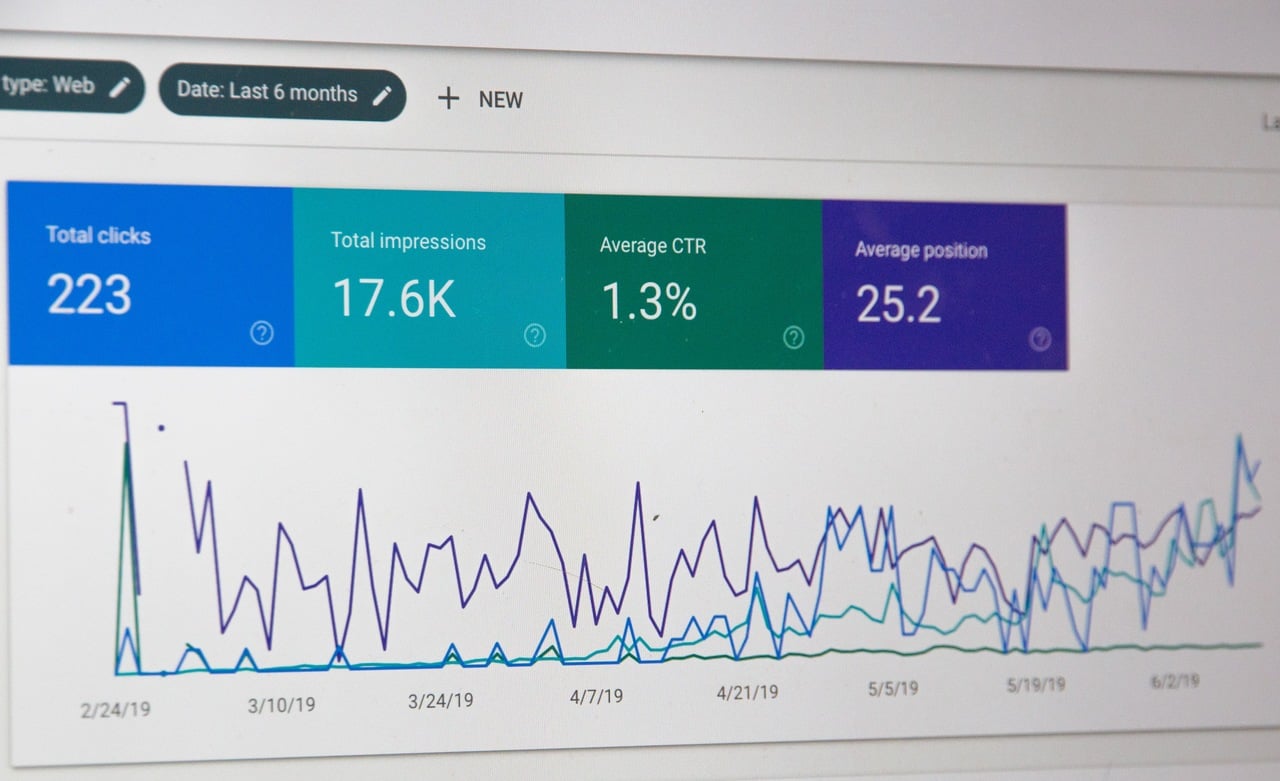
Analytics tells you which channels to double down on.
Where to Start with Inbound Marketing Channels: Prioritization by Effort and Impact
Eleven channels is too many to start at once. Here's how I'd rank them for a team of 1-3 marketers building an inbound program from scratch. The order assumes you have a product, a live website, and roughly $50K-150K annual marketing budget.
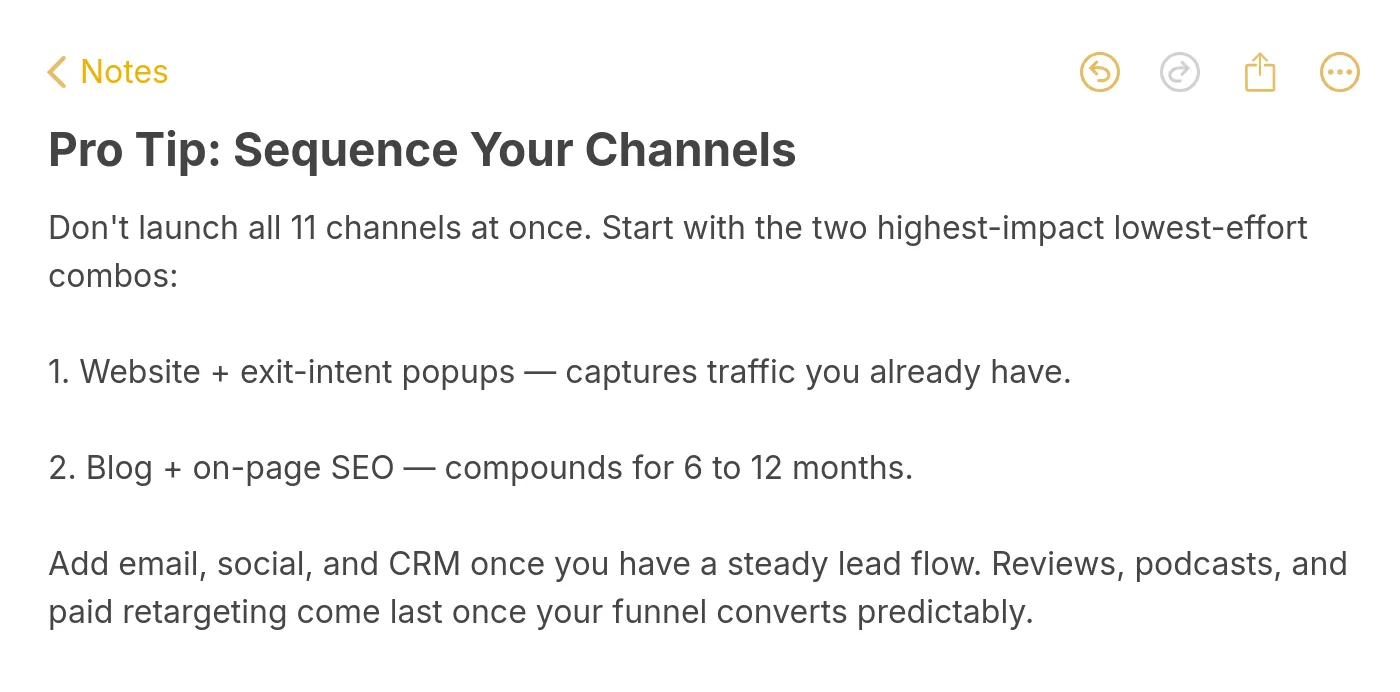
Sequence low-effort, high-impact channels first.
| Priority | Channel | Effort | Impact | Best For |
|---|---|---|---|---|
| 1 | Website | Medium | High | Everyone — fix this before anything else |
| 2 | Analytics | Low | High | Teams flying blind on what works |
| 3 | CTAs and Popups | Low | High | Sites with 5K+ monthly traffic already |
| 4 | Email Marketing | Medium | High | E-commerce and SaaS with list capture in place |
| 5 | SEO | Medium | High | Teams with 4+ month patience horizon |
| 6 | Blogging | High | High | Teams that can publish consistently |
| 7 | Landing Pages | Medium | Medium | Anyone running paid or email campaigns |
| 8 | Reviews and Social Proof | Low | Medium | SaaS and ecommerce with existing customers |
| 9 | CRM | High | Medium | Teams with 500+ leads/month |
| 10 | Social Media | High | Medium | Brands with a strong visual or expert angle |
| 11 | Podcasts | High | Medium | Founders with industry credibility |
One nuance worth flagging: ecommerce brands should swap Reviews/Social Proof into the top 5. Product-first purchases live or die on reviews at the checkout step, so the ROI shows up weeks instead of months.
Tools to Enhance Your Inbound Marketing Strategy
Tools don't do marketing — marketers do. But the right stack saves 10-15 hours a week and makes every channel measurable. Here's the lean stack I'd put together for a team just starting out. None of these are affiliate recommendations; they're what I've actually used or watched clients use successfully.
Google Analytics 4 and Search Console: Free, essential. GA4 tracks what happens on your site; Search Console tracks what happens before the click. You cannot run inbound seriously without both.
Ahrefs or Semrush: Pick one. Both cover keyword research, rank tracking, backlink analysis, and content gap identification. Ahrefs tends to be sharper on backlink data; Semrush is broader on ad and social features. Budget $100-400/month.
HubSpot (free CRM tier) or Pipedrive: For B2B SaaS, HubSpot's free tier handles up to 2.5M contacts and ties email, forms, and a basic CRM together. Pipedrive is cheaper and more sales-focused if you don't need the marketing automation layer.
Mailchimp, Klaviyo, or ConvertKit: Mailchimp for general purpose, Klaviyo for ecommerce (the Shopify integration is unmatched), ConvertKit for creator and content-heavy businesses. Budget $20-200/month depending on list size.
A popup and CTA tool: Popupsmart works well if you want a no-code builder with targeting that goes beyond exit intent.
Measuring Success with Inbound Metrics
You need 5-7 metrics tracked weekly, not 50 metrics tracked quarterly. Here are the ones that actually tell you whether inbound is working. Each ties to a specific business outcome, not a vanity score.
• Organic sessions: Traffic from Google, Bing, and AI search engines. The leading indicator for every other inbound metric. Track weekly; expect monthly averages to move in 3-6 month cycles.
• Cost per lead (CPL): Total inbound spend divided by total leads generated. The benchmark to beat: 62% below your outbound CPL, per the HubSpot data cited earlier.
• MQL-to-SQL rate: Percentage of marketing-qualified leads that become sales-qualified. Healthy B2B SaaS benchmarks sit at 25-40%.
• Close rate by channel: Which channel produces customers, not just leads. Cognism's 2026 benchmarks show Google still drives 6% MQL-to-closed-won while Bing converts at 8.9% on smaller volume — the channel matters as much as the lead count.
• Customer LTV: Lifetime value by acquisition channel. Inbound-acquired customers typically have 20-40% higher LTV than paid-acquired ones because self-directed buyers self-select better.
• CAC payback period: How long before a customer's contribution margin covers the cost to acquire them. Under 12 months is healthy for SaaS; under 6 months is healthy for ecommerce.
Attribution is the hard part. As AI search answers more queries without a click, direct-to-site traffic becomes a hidden inbound channel — the same pattern where direct MQLs rise as organic sessions drop. That means your "direct" bucket in GA4 increasingly contains brand searchers who started on ChatGPT or Perplexity. Add qualitative source tracking (the "how did you hear about us?" field) to catch what your analytics can't.
Future Trends in Inbound Marketing for 2026
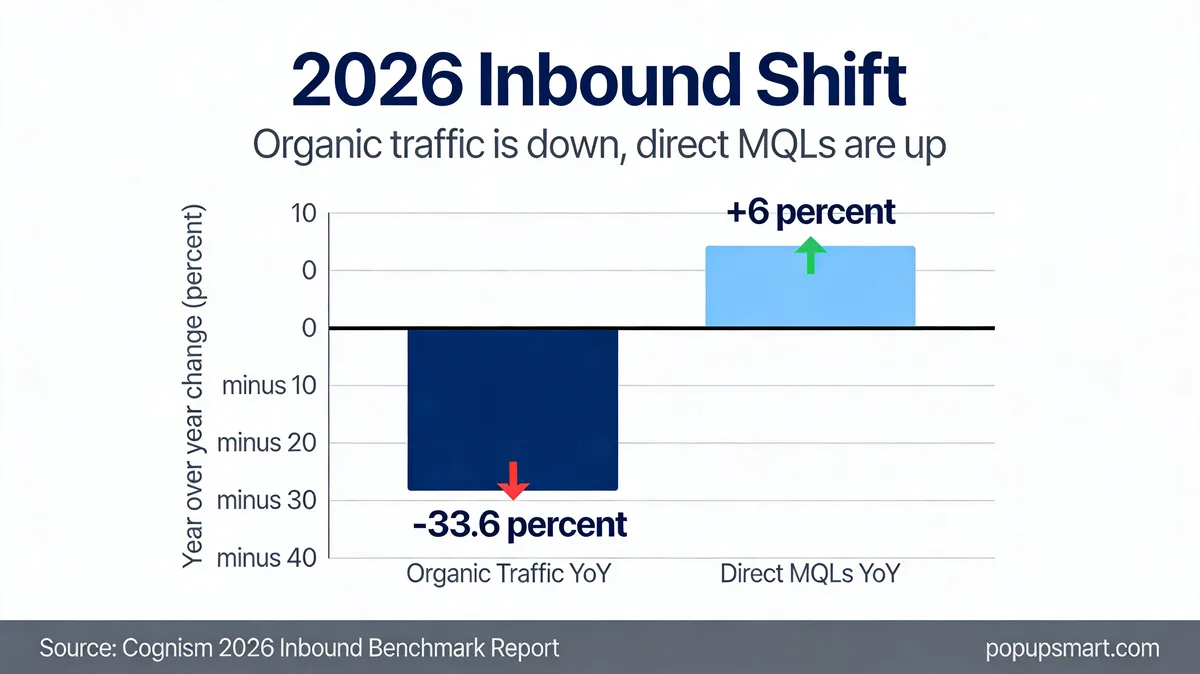
Organic is dropping, but direct MQLs are rising — buyers now return to brands they trust.
The inbound playbook is evolving faster than it has in a decade, mostly because of three forces: AI search, AI-generated content floods, and shifting attribution. Here's what's actually changing in 2026, and what I'm personally watching.
AI personalization at scale: Tools like HubSpot Breeze, Clay, and Customer.io are making one-to-one content feasible for teams that previously ran one-to-many campaigns. The lift in reply rates is real — 20-40% better engagement on personalized sequences — but the failure mode is also real: personalization that feels creepy underperforms generic messaging.
The HubSpot loop methodology: HubSpot quietly replaced the funnel with a loop model where delighted customers feed the top of funnel through referrals, reviews, and content. The math works: an existing customer who refers a new one is roughly 5x cheaper to acquire. Delight is no longer a post-sale afterthought; it's a growth channel.
AI search as an inbound channel: Self-reported AI and LLM referrals grew 9.25% year over year according to Cognism's 2026 data, and ChatGPT alone drives close to 80% of chatbot referrals industry-wide. Ranking in Perplexity and ChatGPT Search now matters nearly as much as ranking in Google. Structured data, answer capsules, and question-based headings all move this lever.
Retargeting for inbound (not just paid): Smart brands are retargeting high-intent inbound visitors (blog readers who hit three articles, pricing page viewers who didn't convert) with personalized content rather than discount ads. It's softer and more effective.
Interactive and video-first content: Static blog posts aren't dying, but interactive formats — quizzes, calculators, embedded video, short-form loops — are compounding engagement faster. Short-form video specifically drives the 200%+ engagement lift cited by MarketingLTB, and that gap keeps widening.
Your 30-Day Inbound Channel Stack
You won't fix eleven channels in a month. You can build a running version of the top four. If I were starting fresh today with a team of two and a working website, here's what I'd ship in the next 30 days.
Week 1: Install GA4, Search Console, and a session recorder. Fix any page-speed issues on the top five landing pages. You can't improve what you can't measure.
Week 2: Build the three core email automations (welcome, abandoned cart or trial nudge, post-purchase). Add an exit-intent popup with a lead magnet — not a discount — on top-traffic blog pages.
Weeks 3-4: Pick one SEO pillar topic you can own. Publish the pillar piece plus two cluster articles. Start a weekly rhythm you can sustain for 12 months.
That's four channels running and measured by day 30. Social, podcasts, CRM, and the rest layer in over the following quarters. Inbound channels compound, but only if you pick a starting point and actually start.
Frequently Asked Questions
What are the 4 direct marketing channels?
The four traditional direct marketing channels are email, direct mail, telemarketing, and SMS. These are technically outbound — you initiate the contact — but email and SMS operate in a hybrid mode when sent to opted-in subscribers, which pulls them inside the inbound playbook. In 2026, "direct" as a category increasingly blends with "owned," because email and SMS to a consenting list are among the highest-ROI touchpoints any marketer can run. The key difference from cold outbound is consent: with consent, direct channels become compounding assets.
How does the inbound marketing funnel work?
The inbound marketing funnel moves buyers through three stages: attract, engage, and delight. Attract uses SEO, blogging, and social to pull strangers in through search and discovery. Engage uses landing pages, popups, email, and content offers to convert visitors into identified leads and customers. Delight uses CRM, reviews, onboarding content, and referral programs to turn customers into advocates who fuel the top of the funnel again. HubSpot's 2024 methodology update reframed the funnel as a loop to emphasize that delighted customers are the cheapest source of new customers.
What are the fundamentals of inbound marketing?
The fundamentals are four: know your audience deeply enough to predict their searches, create content that answers those searches better than anyone else, build owned distribution channels (website, email list, CRM) so you control your audience, and measure which channels produce customers — not just leads. Every tactic in inbound layers on top of these four. Skip any one and the program stalls: great content with no distribution gets buried, great distribution with thin content repels readers, and everything without measurement is gambling.
How would you rate your experience with this article? 😊