
How Do Shopify Gift Cards Work? Complete Guide for 2026

 ChatGPT
 Perplexity
 Claude
 Grok
Grok Google AI Mode
Shopify gift cards are prepaid codes redeemable only via Shopify checkout; you can create them as products with set denominations or issue free cards in Admin. They can boost cash flow, attract new customers, and support loyalty and promotions.
Table of contents (34)
Shopify gift cards are prepaid digital or physical vouchers with a set balance that customers redeem at any Shopify checkout, including the storefront, POS, and Buy Button. Merchants on every Shopify plan can sell them as products or issue them manually as rewards, refunds, or loyalty credits.
What Is a Shopify Gift Card?
A Shopify gift card is a prepaid voucher with a fixed monetary balance that a customer can redeem against future purchases in your store. The card itself is a Shopify-managed product, and the balance lives inside your store's currency, so a $50 USD card stays $50 USD even if the customer redeems it across three separate orders six months apart.
• Active Shopify store on any plan (gift cards are no longer locked to Shopify Plus, and they haven't been since 2020).
• Admin access to Products and Customers in your Shopify admin.
• 15-30 minutes for setup, plus another 30 minutes if you want to design a branded gift card image or set up POS redemption.
• Skill level: beginner-friendly. No code, no apps required for the basic version.
Quick overview of the process:
1. Open the gift cards menu: log in and navigate to Products > Gift cards.
2. Pick your path: either add a gift card product for customers to buy, or issue one manually as store credit.
3. Fill in the product details: title, description, image, denominations, SEO listing.
4. Configure availability: sales channels, publish date, product organization tags.
5. Save and verify: check the storefront preview and confirm the card appears in your gift cards report.
6. Promote, redeem, reconcile: drive sales, handle balance checks at checkout, track remaining liability in reports.
Each card carries a unique 16-character code generated by Shopify the moment it's created. That code behaves like a password: it's solid, random, and visible only to the recipient after issuance. Customers enter it at checkout, the system deducts the order total from the remaining balance, and any leftover credit stays on the card until it expires (or forever, if you don't set an expiration).
The format is flexible. You can sell purely digital cards (the default), order branded physical cards through Shopify Hardware for in-store gifting, or pair both as part of an omnichannel program. The one redemption rule that trips up new merchants: Shopify gift cards only work inside Shopify checkout — your online store, your Shopify POS, or your Buy Button. A customer who buys your product on Amazon or Etsy can't redeem a Shopify gift card there.
According to Shopify's own research, the US gift card and incentive market will hit $220.38 billion in 2026 and climb to $300.73 billion by 2031. Every Shopify gift card you sell is a small slice of that pie, paid upfront before you've packed a single box.
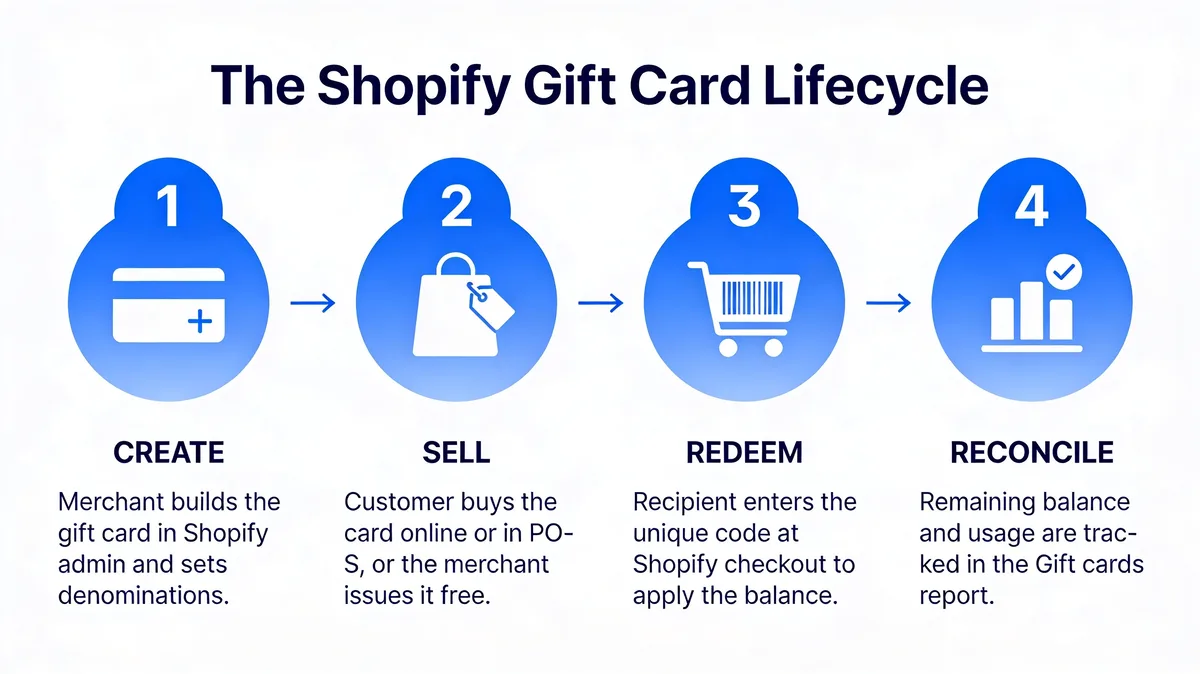
The four-stage Shopify gift card lifecycle: create, sell, redeem, and reconcile.
Types of Shopify Gift Cards: Physical vs Digital
Shopify supports two formats, and the right pick depends on whether you sell purely online or also have a brick-and-mortar presence.
Digital gift cards are the default. They're created in the admin, delivered by email, and stored as a code in your customer's inbox. Fulfillment is instant, there's zero inventory cost, and you can issue thousands in a single afternoon for a holiday campaign. According to The Business Research Company, the global digital gift card market sat at $581.38 billion in 2026 and is projected to reach $1.26 trillion by 2030 — most of the gift card growth from here is digital.
Physical gift cards are ordered through Shopify Hardware (in supported regions) or printed via third-party gift card vendors. They sync with Shopify POS, so an in-store team member scans the card at the register and the balance debits in real time. Physical cards work well for stores with a retail footprint, premium brands that want a tactile gifting experience, and anyone running a corporate or B2B gifting program where a wrapped card lands better than an email.
Most stores I've helped through this decision land on digital-first with physical as a Q4 add-on for holiday gifting. The economics rarely justify physical cards if you don't already have a POS terminal.
How to Generate Shopify Gift Cards in 2026
The full gift card product setup takes around 15 minutes once you know where every field lives. The walkthrough below mirrors the current 2026 admin layout — Shopify reshuffled the gift card screens slightly in late 2025, but the eight-step flow is the same as it's been since 2020.
Step 1: Log In and Open the Gift Cards Menu
You don't need a developer or any code to ship a gift card. The whole flow lives in the standard Shopify admin.
Log into your Shopify store and land on the admin dashboard. From the left side menu, click Products, then click Gift cards in the dropdown that expands.
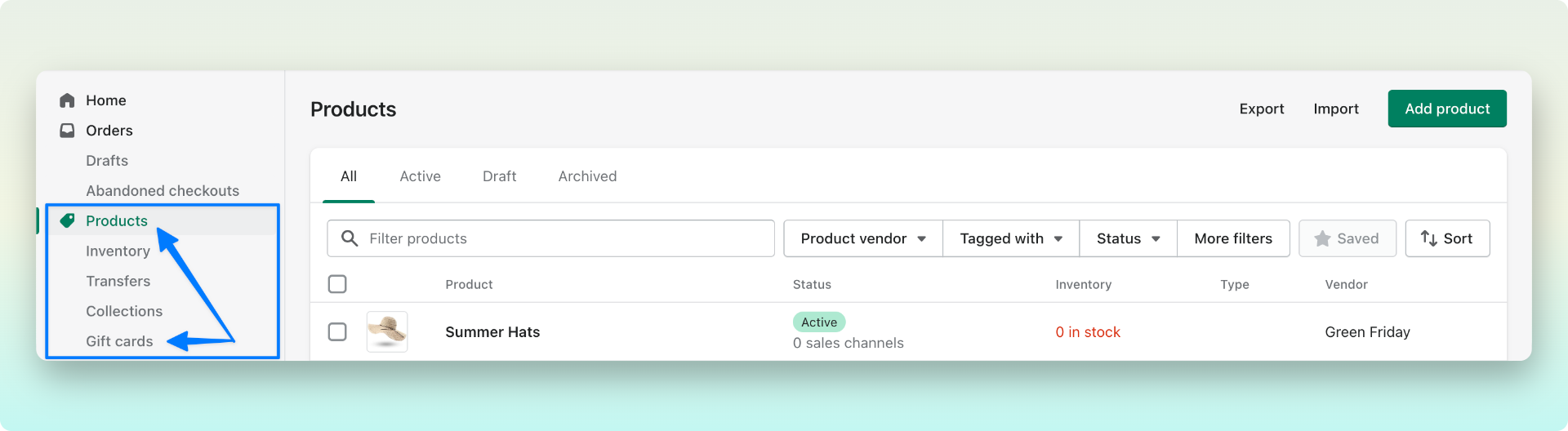
You'll know it's working when: the Gift cards index page loads with either a list of existing cards or an empty-state screen prompting you to add your first one.
Watch out for:
• Gift cards missing from the Products menu: on rare older themes or test accounts, the menu item won't appear until you activate gift cards from Settings > Apps and sales channels > Shopify. Toggle it on and refresh.
• Sub-user permissions blocking access: if you're a team member instead of the store owner, you need the "Gift cards" permission granted under Users and permissions. Without it the menu is hidden entirely.
Pro tip: If you plan to sell gift cards year-round, pin the Gift cards page to your admin sidebar (click the star icon next to the page title). I've seen merchants click through five layers of menus every single morning when one favorite saves about 20 seconds per session.
Step 2: Choose Between "Add Gift Card Product" and "Issue Gift Card"
This is the single most important fork in the workflow, and Shopify doesn't make it obvious which choice you actually want.
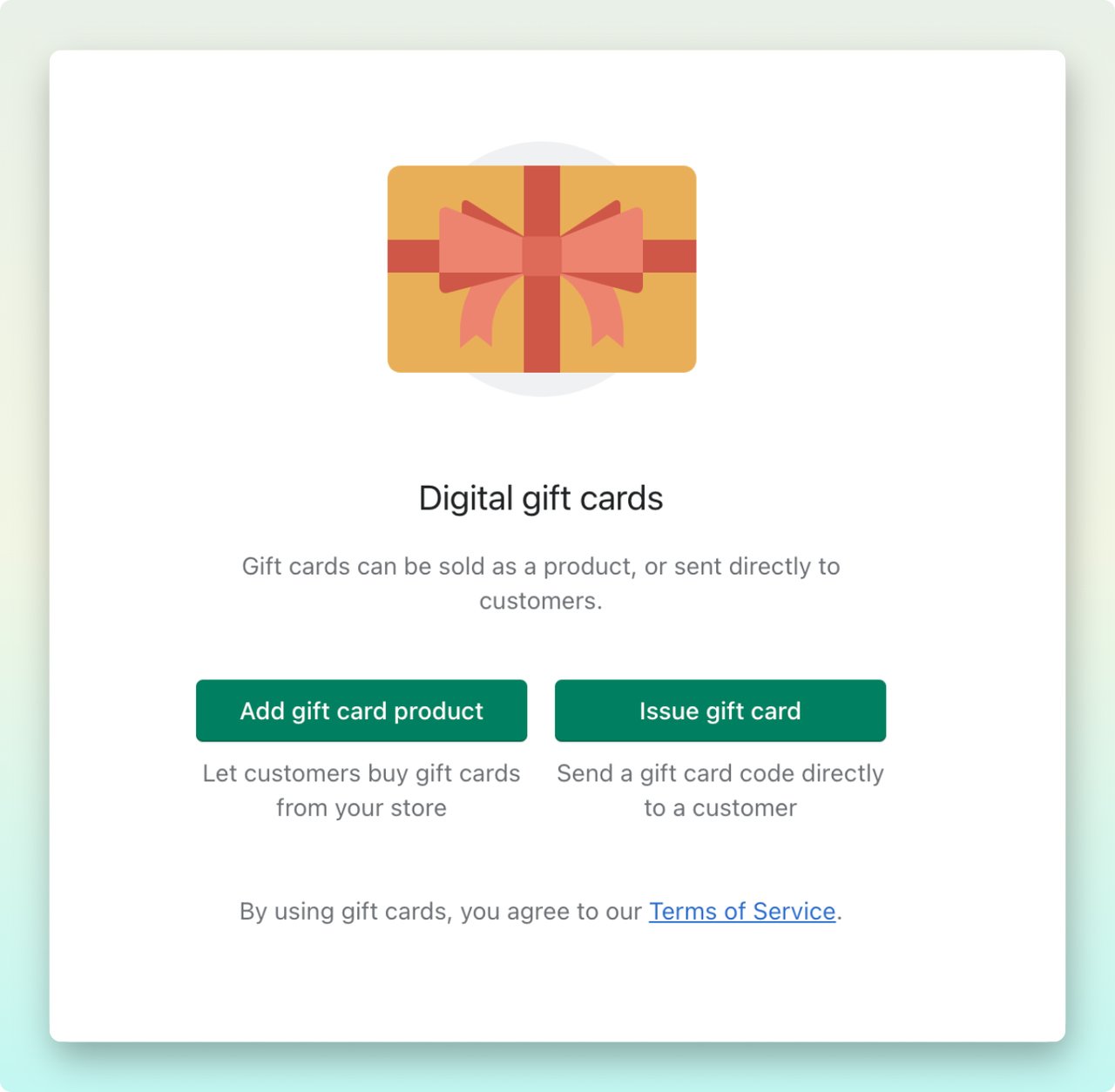
Add gift card product creates a sellable product in your store catalog. Customers buy it like any other product, pay full price, and the system emails the recipient a unique code. This is what you want for revenue.
Issue gift card manually generates a card with a balance and sends it to a chosen customer without any payment changing hands. This is what you want for refunds, loyalty rewards, influencer seeding, or customer service apologies.
For this section, click Add gift card product. We'll come back to manual issuance further down the guide.
You'll know it's working when: a blank gift card product creation form loads with empty Title, Description, Media, and Denominations sections.
Watch out for:
• Clicking "Issue" by accident: manually issued cards aren't reported as revenue — they're a liability on your books. If you wanted to sell, back out and start again. There's no undo button mid-issuance once you save.
• Treating the product like a normal SKU: gift cards are tax-exempt at purchase (tax applies when the customer redeems on a taxable product). Don't add a tax rate to the product or you'll double-tax your customers.
Pro tip: If you sell in multiple currencies, create one gift card product per currency rather than relying on Shopify's exchange-rate conversion. Customers find this confusing at redemption, and refund accounting gets ugly fast.
Step 3: Add Title, Description, and Image
The product details panel is where most of the conversion lift hides. Treat it like any high-intent product page — the gift card is a real purchase decision, not an afterthought.
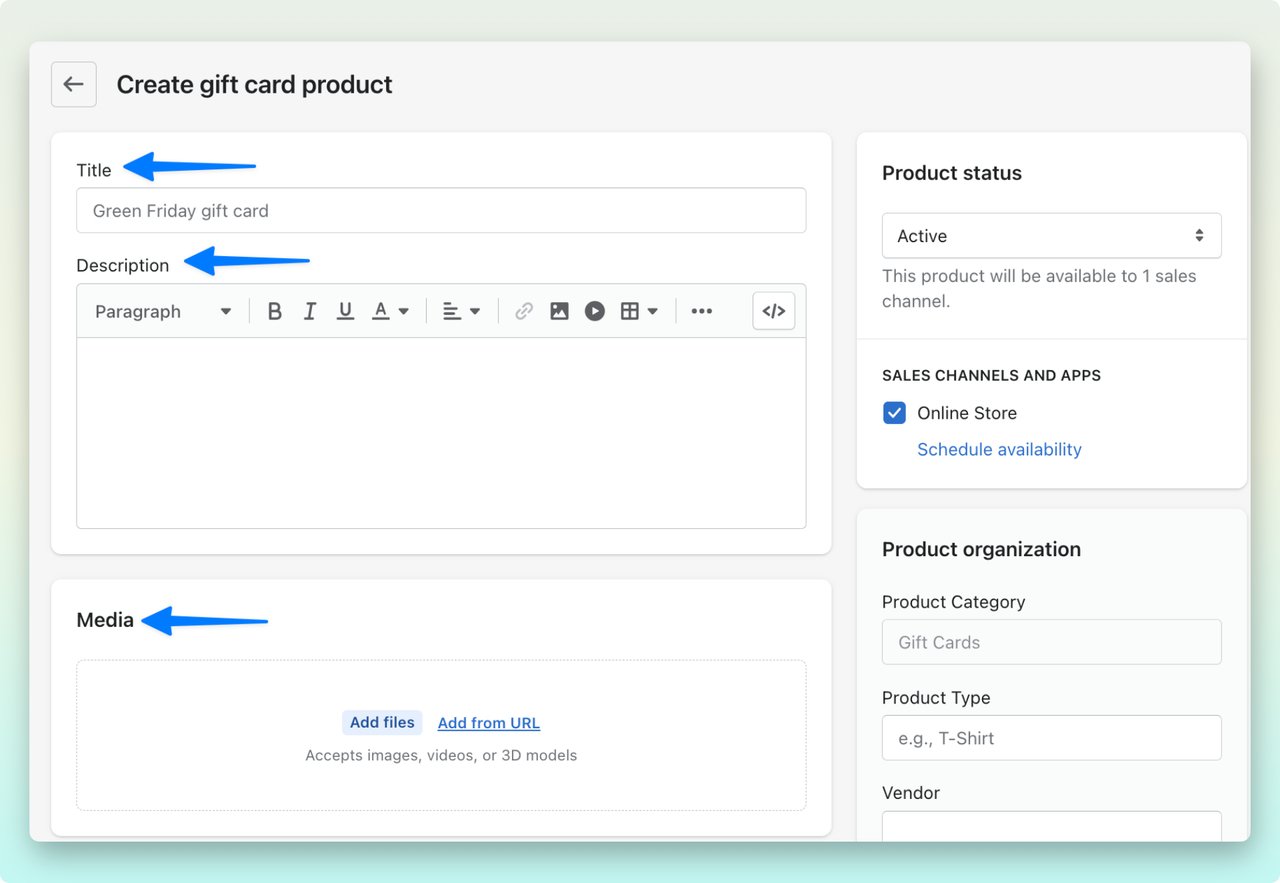
Add a clear product Title — "[Brand] Gift Card" works for evergreen sales, while "[Brand] Holiday Gift Card 2026" or "[Brand] Halloween Gift Card" works for seasonal pushes. Add a 60-120 word Description that covers what's redeemable, how delivery works, and whether the card expires.
For the Media section, click Add file or drag-and-drop your card visual. The image you upload here only shows on your storefront product page. The default email image Shopify sends to recipients looks like this:
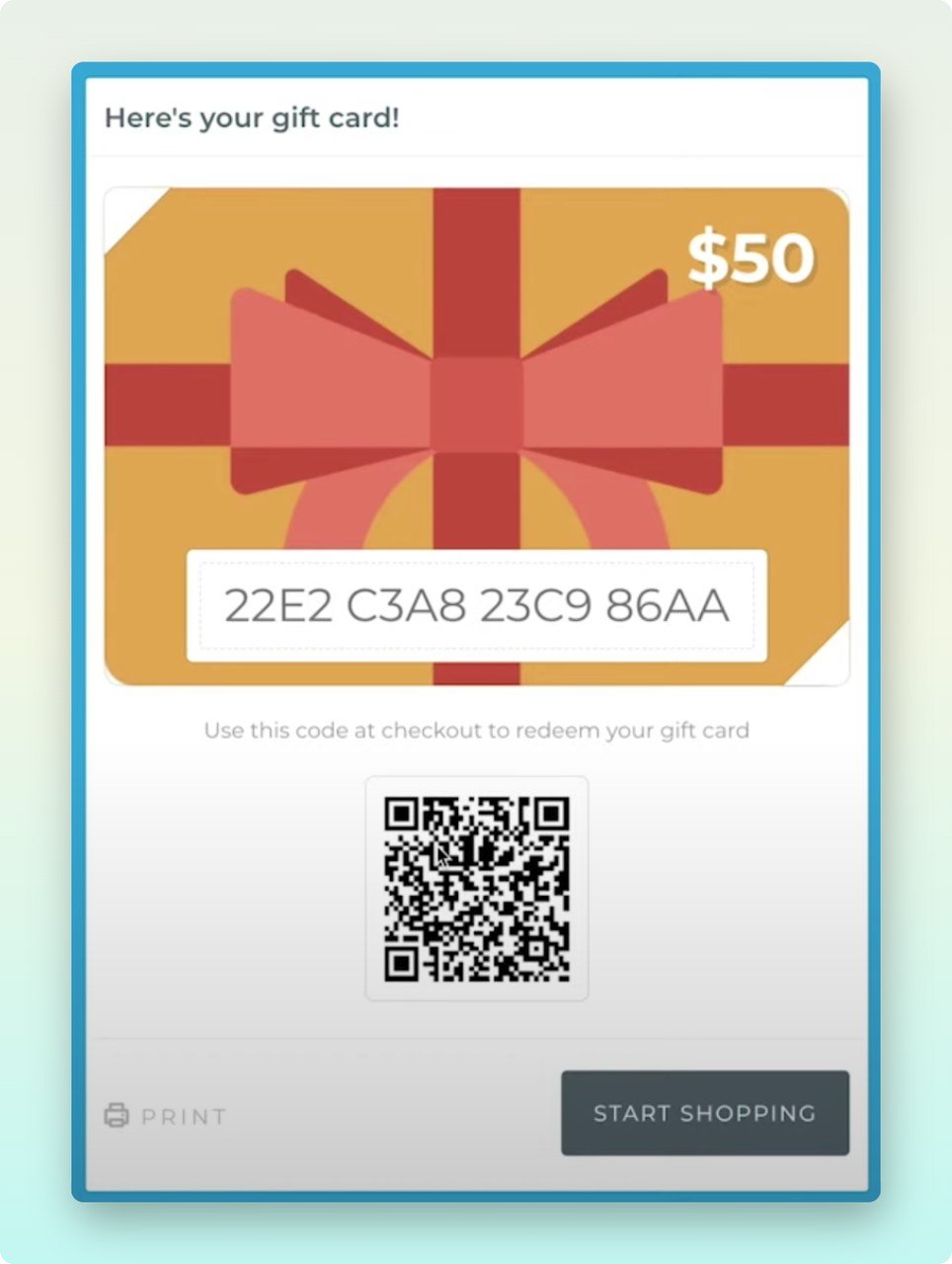
If you want a custom recipient email image (and most brands should), you'll need to edit the gift card email template under Settings > Notifications > Gift card created after this product is live. Below is what a seasonal Halloween gift card looks like at the product-creation stage:
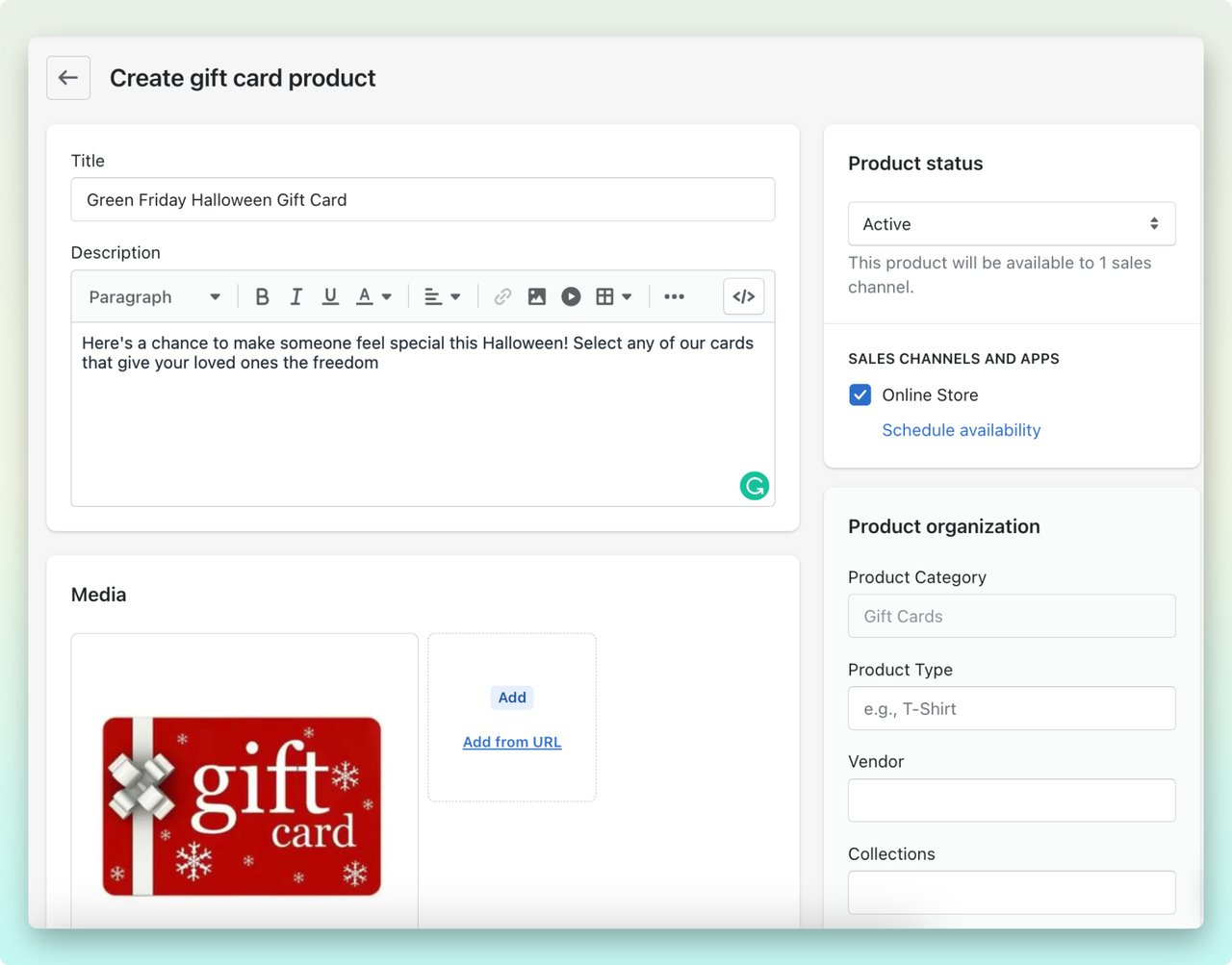
Launching seasonal cards is a strong play for a brand's holiday campaign calendar — Valentine's Day, Mother's Day, and Black Friday all map cleanly to themed gift card SKUs.
You'll know it's working when: the Title appears in the page header preview, the Description text renders in the preview pane, and your uploaded image shows up in Media with a thumbnail.
Watch out for:
• Vague titles like "Gift Card": these tank organic search for store-name + gift card. Always include your brand name in the product title so the storefront URL and meta title carry it.
• Missing alt text on the gift card image: Shopify uses the alt text for SEO and accessibility. Write something specific like "[Brand] holiday gift card with [color] design" — not "gift card image".
Pro tip: Skip the generic "perfect for any occasion" copy in your description. The descriptions that convert mention the actual products the card unlocks. "Use your $50 [Brand] gift card on candles, room sprays, or our subscription box" outperforms generic gifting language by a wide margin in our experience editing Shopify product pages.
Step 4: Set Denominations
Scroll down to the Denominations section. Shopify pre-fills default values based on your store's currency, and each denomination saves as a product variant.
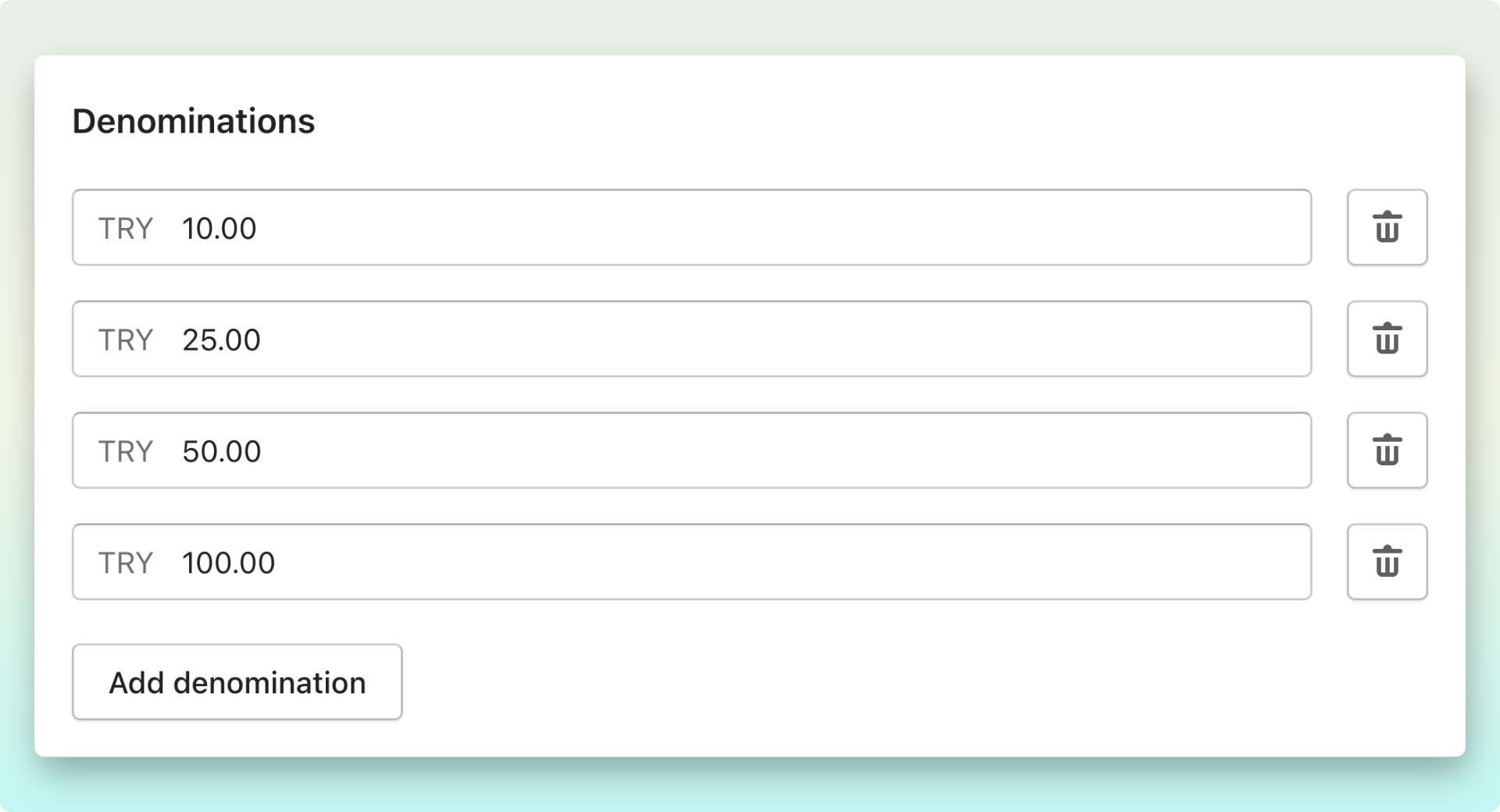
To customize, click the trash can icon to remove a default value, or click Add denomination to enter a new one. Pick denominations that sit near or slightly above your store's average order value — if your AOV is $65, denominations of $50, $75, and $100 hit the sweet spot.
One detail that catches new merchants off-guard: customers can't enter a custom amount. Whatever variants you list are the only options at checkout. Three to five denominations is usually the right number — fewer feels restrictive, more clutters the variant selector.
This is where the spend behavior gets interesting. According to Talk Shop's gift card analysis, gift card recipients spend an average of $81 above the card's face value when they redeem (based on Blackhawk Network 2024 holiday data). If your $50 card recipient spends $131 total, the denomination you set isn't just a price — it's a floor.
You'll know it's working when: each denomination shows as a separate row with its own SKU and price, and the "Variants" section at the bottom of the product page lists them all.
Watch out for:
• Setting denominations too low: a $10 card forces the recipient to either spend exactly $10 (rare) or stack their own money on top to hit a meaningful product. Most stores see better attach rates with a $25 minimum.
• Skipping a "premium" tier: $250 and $500 denominations rarely sell volume, but they exist for corporate gifting and high-AOV stores. Without them, B2B buyers buy elsewhere.
Pro tip: If you sell to corporate or B2B accounts, set a max denomination at $500 even if it sells once a quarter. I've watched stores miss $3,000+ corporate orders because their highest denomination capped at $100 and the buyer didn't want to fiddle with 30 separate cards.
Step 5: Edit the Search Engine Listing
Once denominations are locked in, scroll further down to the Search engine listing section. You can leave the defaults, but a tuned listing wins clicks from anyone searching "[your brand] gift card" on Google.
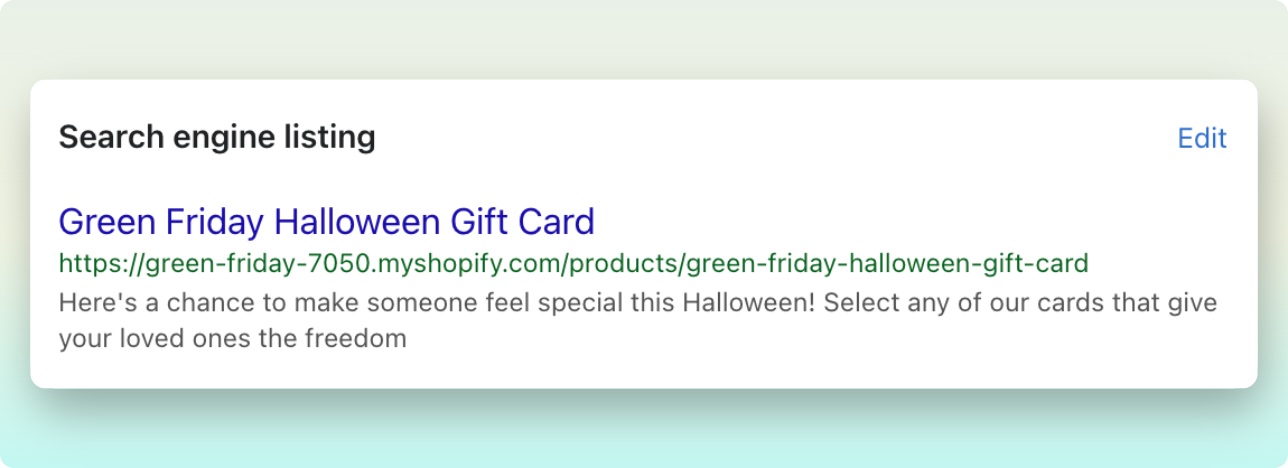
Click Edit website SEO to override the auto-filled page title and meta description. The meta title should read something like "[Brand] Gift Cards — Buy a Digital Gift Card from $25". The meta description should pack in delivery method, redemption locations, and any expiration policy in under 155 characters.
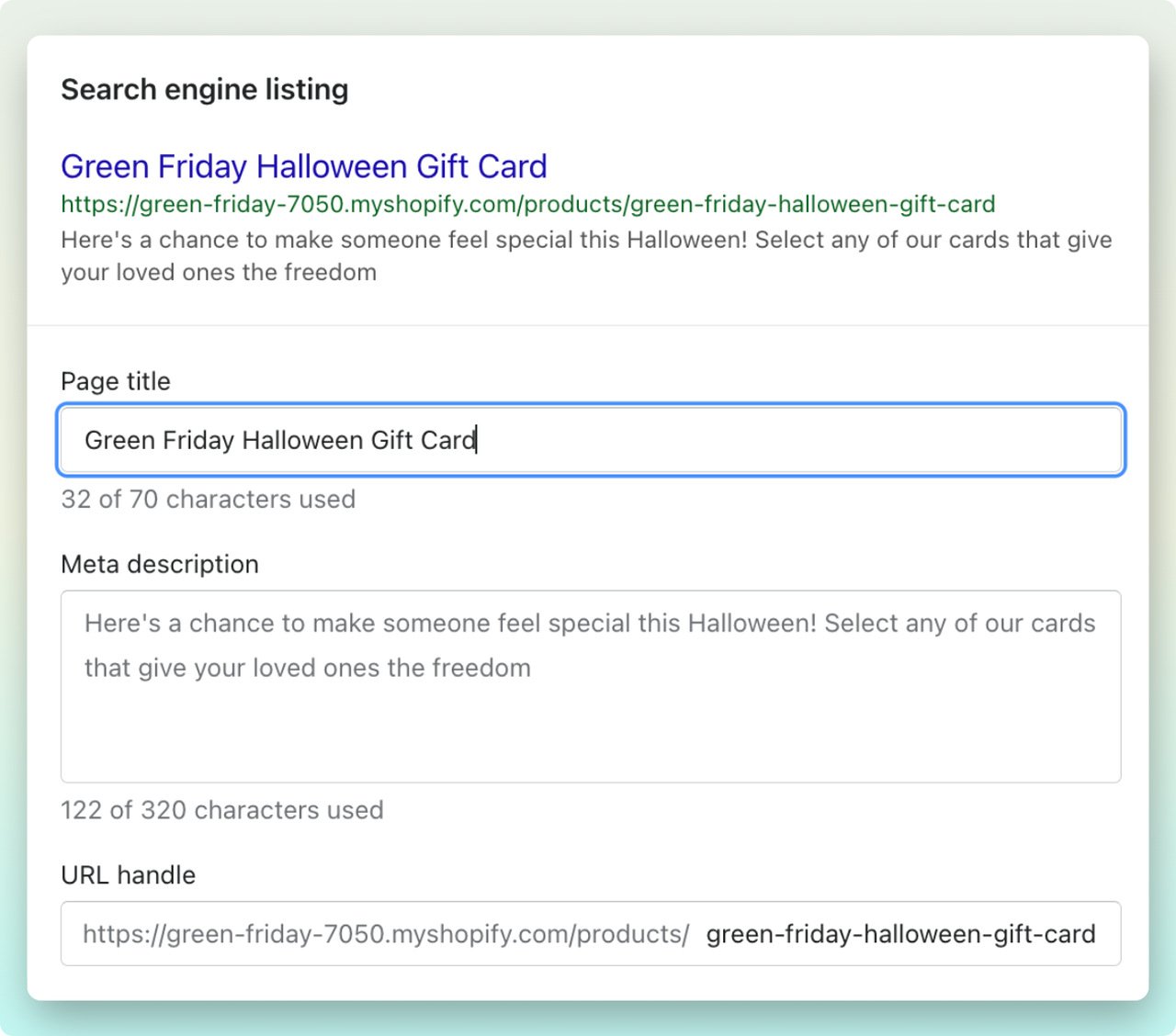
A descriptive meta description does two jobs at once. It nudges search CTR upward for branded gift card queries, and it gives AI search engines like Perplexity and ChatGPT Search a clean snippet to lift when summarizing your store. Stores serious about this can also dig into our ecommerce optimization playbook for SEO patterns that scale beyond the gift card page itself.
You'll know it's working when: the SERP preview at the top of the panel updates live as you type, and the URL slug ends in something readable like /products/holiday-gift-card.
Watch out for:
• Auto-generated slug clashes: if you've previously published and unpublished a gift card with the same name, Shopify will append -1, -2, -3 to the slug. Clean it up manually before publishing or you'll inherit a low-CTR URL.
• Stuffing the meta description with "Buy now! Best deal!" filler: Google rewrites overstuffed descriptions about 38% of the time. Stick to one factual sentence plus one benefit.
Pro tip: Include the phrase "instant delivery" in the meta description if you only sell digital cards. CTR data from a portfolio of Shopify stores I've audited shows that line alone lifts click-through by 8-12% on branded gift card queries — gift buyers are deadline-driven.
Step 6: Configure Product Status and Sales Channels
Scroll back up to the top right of the product page and find the Product status section.
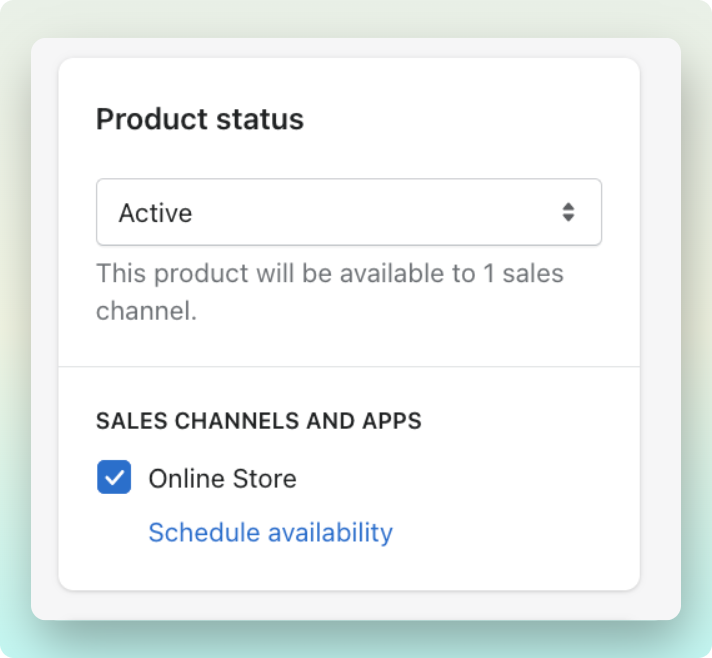
Toggle the status from Draft to Active when you're ready to sell. Below the status dropdown, the Sales channels and apps panel lets you control where the card is available: Online Store, Shopify POS, Buy Button, Shop app, Facebook & Instagram, Google & YouTube, and any other connected channel.
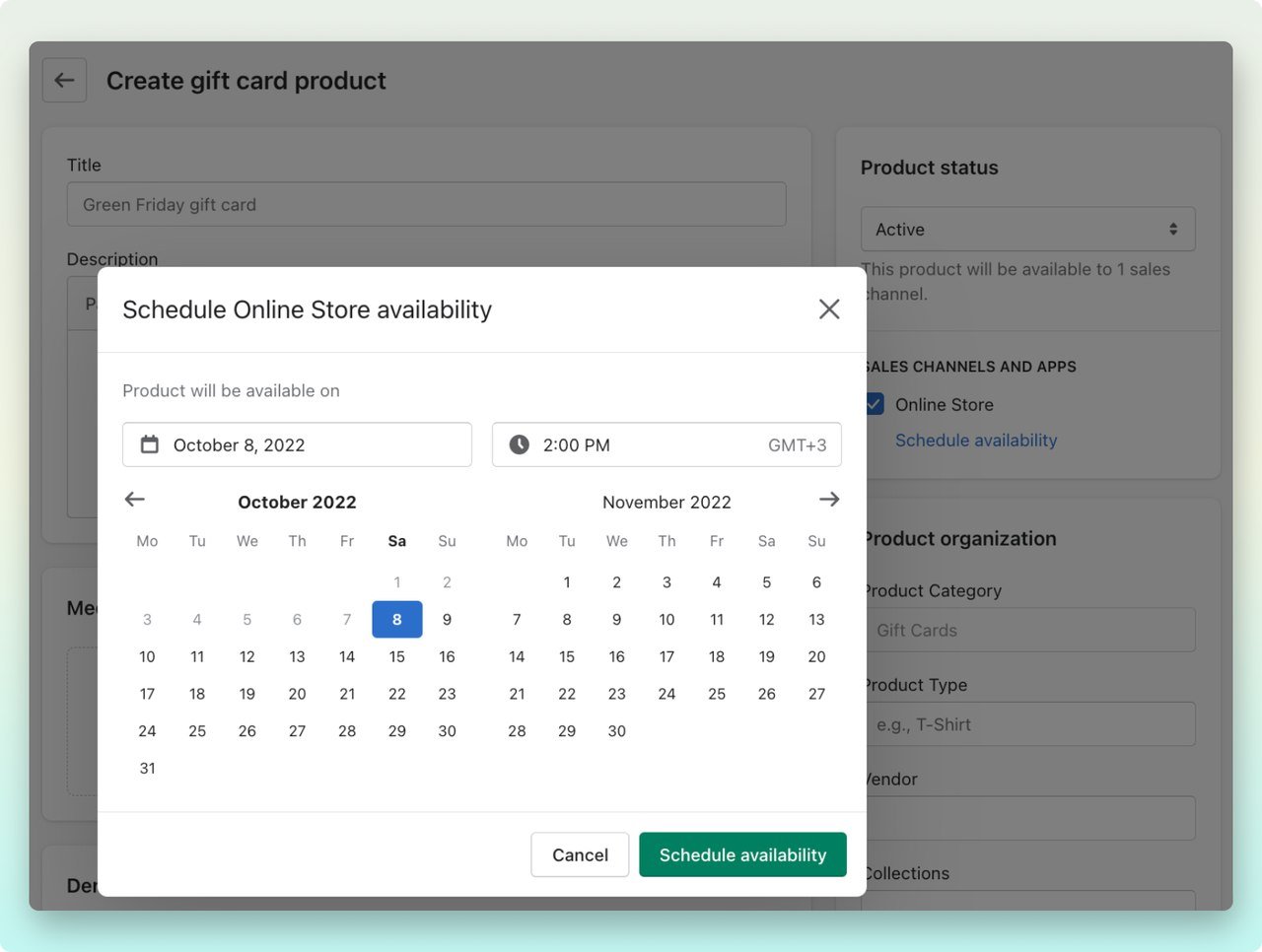
Click the calendar icon next to Online Store to schedule a future publish date. This is how seasonal cards roll out automatically — set a Black Friday card to publish on November 28, 2026 at midnight and forget about it. The product can't be added to your storefront's navigation menu until it actually publishes, so don't try to link to it before the scheduled date.
You'll know it's working when: the Product status reads "Active" (or "Scheduled" with the future date), and at least one sales channel checkbox is ticked.
Watch out for:
• Forgetting to publish to POS: if you run a brick-and-mortar location and forget to enable Shopify POS as a sales channel, your in-store staff can't sell the gift card from the register. The card exists, but it's invisible to POS.
• Scheduling without time zone awareness: Shopify uses your store's set time zone, not your browser's. A New York merchant scheduling from a London hotel will see the card publish 5 hours later than intended.
Pro tip: For seasonal gift cards, schedule the unpublish date too. Go to the product, click the calendar icon, and set a "remove from sales channels" date for January 15 if you're selling a Christmas card. This avoids the awkward situation where someone buys a Halloween card in March because you forgot to take it down.
Step 7: Add Product Organization Details
Scroll to the right column and find the Product organization section. This is optional but worth filling in for filtering and reporting.
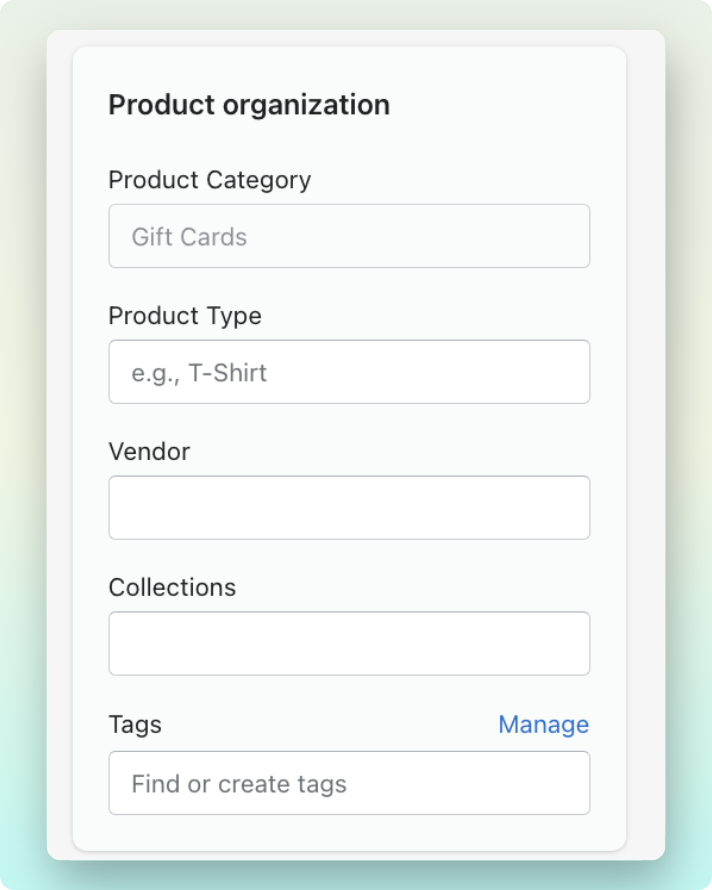
The fields here do specific work. Product type lets you build automated collections (any product tagged "Gift Card" can drop into a Gift Cards collection without manual curation). Vendor is your brand name — set it to your store name. Collections can add the card to a dedicated Gifts or Gift Cards collection visible in your nav. Tags like "gift-card", "seasonal", "valentines-2026" help internal filtering and storefront search.
You'll know it's working when: the gift card appears inside any automated collection whose conditions match the fields you set (e.g., "Vendor equals [Your Store]" or "Tag equals gift-card").
Watch out for:
• Leaving Vendor blank: blank vendor fields break reports that filter by brand and look unprofessional in CSV exports. Always populate it.
• Tagging inconsistently: if you tag this card "gift-card" but a future card "giftcard" (no hyphen), automated collections miss one of them. Pick a tag convention and document it.
Pro tip: Add a tag like "non-discountable" if you don't want this gift card eligible for site-wide promo codes. Then exclude that tag in your Shopify Discount setup. Otherwise a 20% off coupon turns your $100 gift card into an $80 gift card, and customers will not be subtle about how unhappy they are.
Step 8: Save and Verify on Your Storefront
Click Save in the top right corner. Shopify processes the changes and the gift card is live.
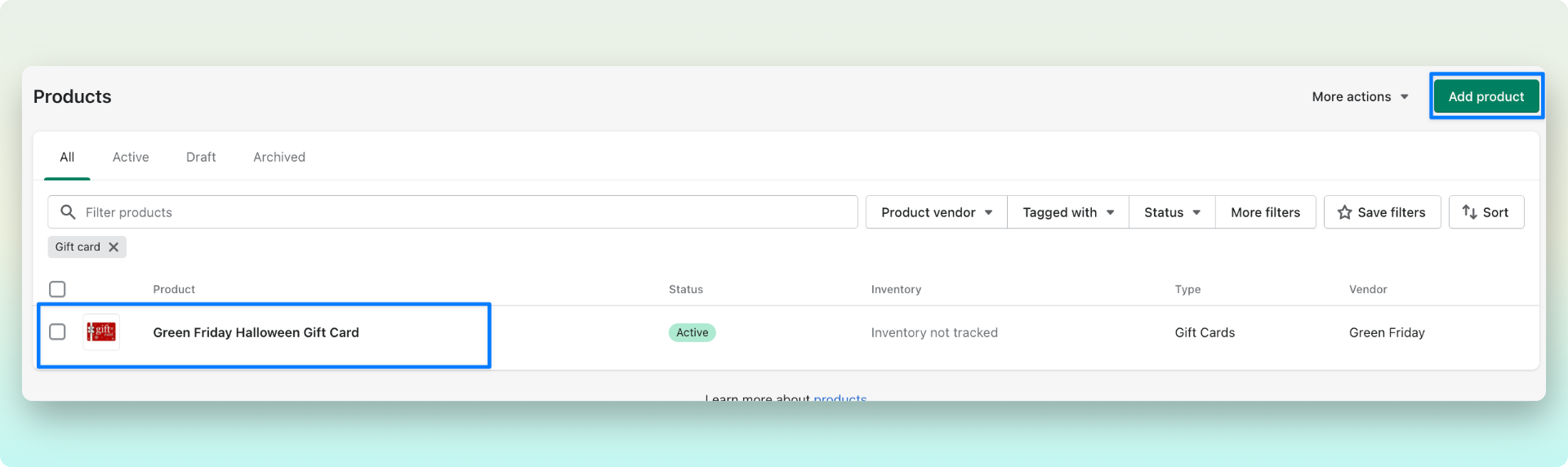
To edit later, navigate back to Products > Gift cards and click Gift card products — you'll see every gift card SKU you've created with denominations, status, and lifetime sales.
Then check the storefront preview by clicking View on online store on the product page. Here's an example of how the saved card displays to customers:
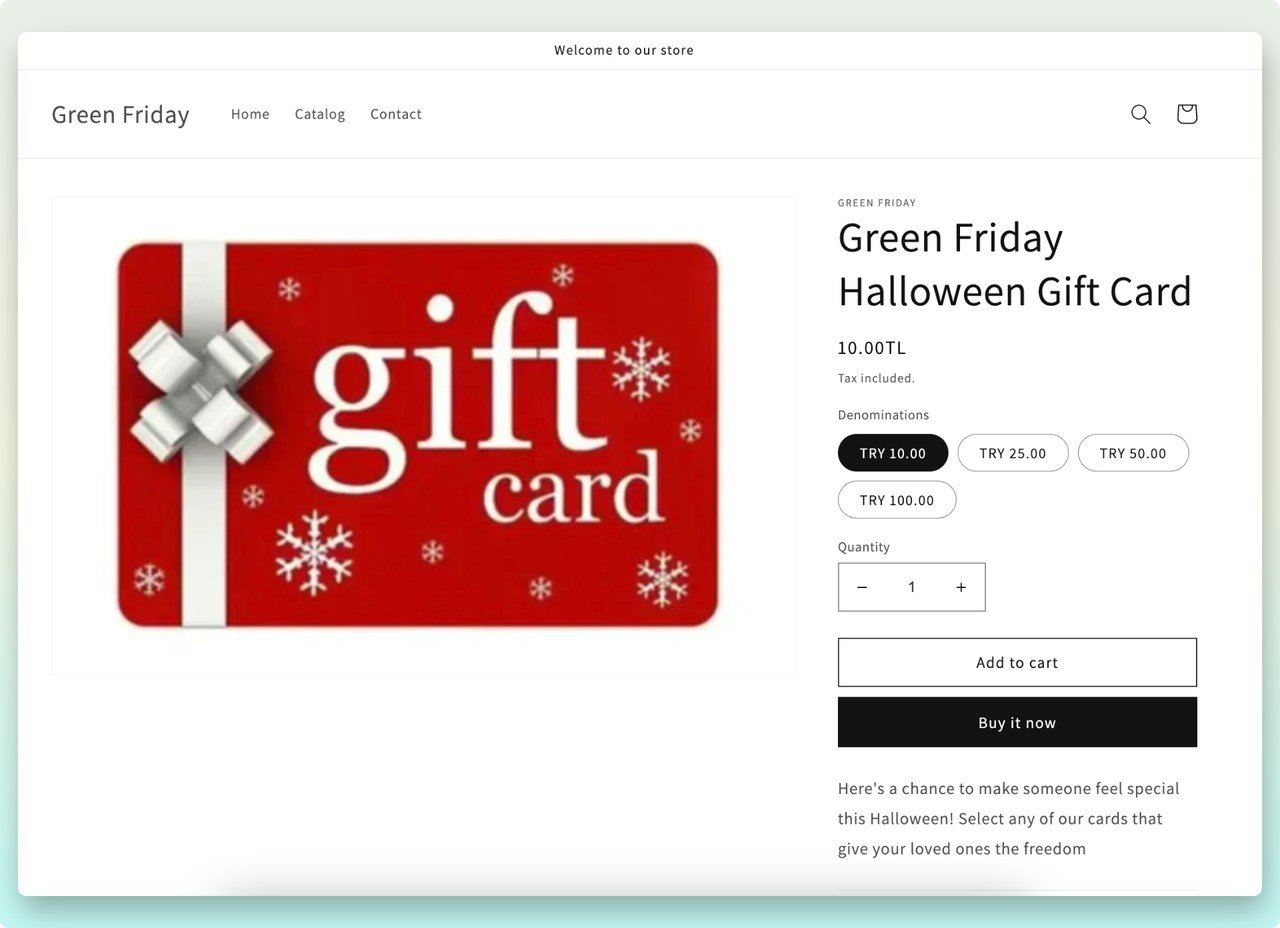
You'll know it's working when: the product is purchasable from your storefront, the denomination selector shows every variant, and a test order completes successfully.
Watch out for:
• Cached storefront not showing the new card: CDN caches sometimes lag 5-10 minutes behind admin saves. Open the storefront in an incognito window to bypass.
• "Add to cart" button missing: usually means the product is still Draft, not Active. Flip it under Product status.
Pro tip: Place a real $5 test order on yourself before announcing the card publicly. You'll catch every UX issue — wrong currency display, broken email template, mistyped denomination — in 10 minutes for $5. I've seen Black Friday campaigns blow up because nobody bought their own card first.
How to Issue a Free Gift Card on Shopify
Issuing a free gift card is the manual route — useful for refunds in lieu of cash, loyalty program rewards, customer service comps, influencer seeding, and team gifts. You're generating a code and sending it without anyone paying for it. The flow takes about 90 seconds per card once you've done it twice.
Step 1: Open the Issue Gift Card Screen
From the admin, click Products > Gift cards, then click the green Issue gift card button.
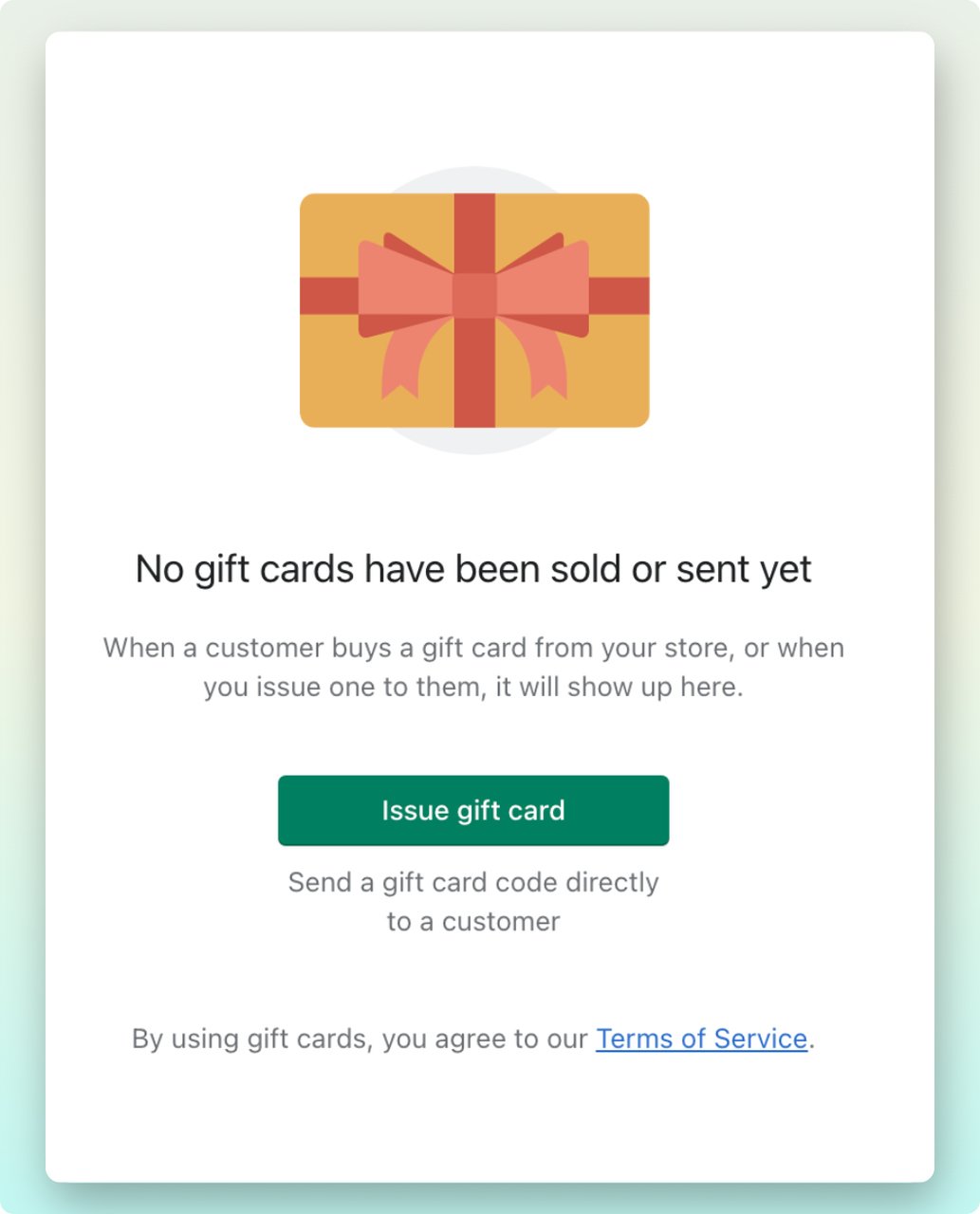
You'll know it's working when: a new issuance form opens with a pre-generated gift card code, an empty initial value field, and a customer selector.
Watch out for: issuing a card without verifying you have inventory to support the redemption — every issued card is a liability on your books until it's spent or expires. Don't bulk-issue $50 cards to 1,000 customers without making sure your accounting can absorb $50K of deferred revenue.
Pro tip: If you're issuing more than 10 cards at once (e.g., apology cards after a fulfillment incident), don't do it one by one in the admin. Use the Shopify Gift Cards API or an app like Rise.ai to batch-issue and send branded emails. I burned three hours doing this manually once and it broke me.
Step 2: Set the Code and Initial Value
The first field shows the pre-generated gift card code. Leave it alone — Shopify treats this code like a currency note, and the system generates one that's unique, random, and tamper-resistant. After issuance, the code only displays to the customer, never to you.
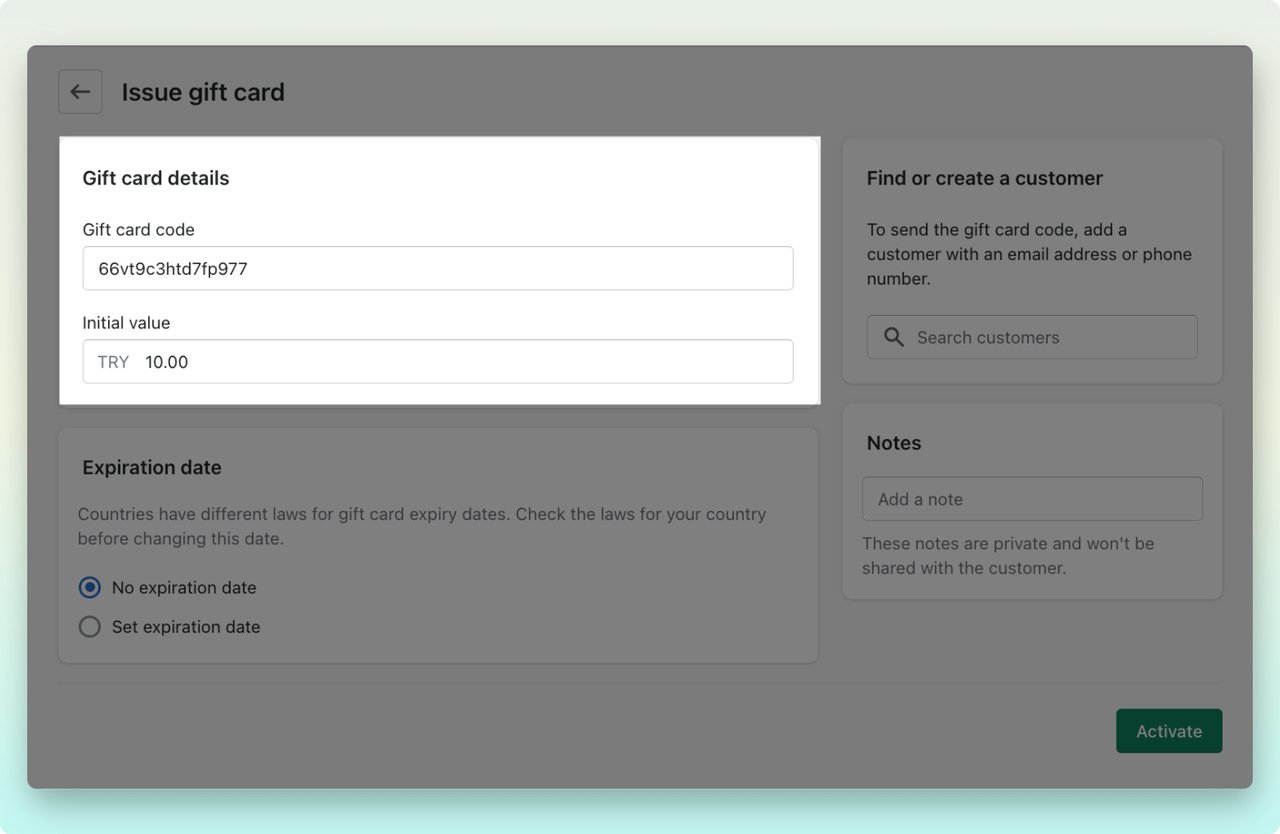
In the Initial value field, enter the dollar amount. The value matches the intent: $10 for a "sorry about the late shipment" comp, $50 for a loyalty milestone, $100 for a birthday reward to your top 5% of customers.
You'll know it's working when: the value field accepts the number, the currency symbol matches your store currency, and there are no validation errors.
Watch out for:
• Overwriting the code manually: Shopify lets you, but custom codes are easier to guess and brute-force redeem. Stick with the auto-generated one.
• Issuing in the wrong currency: if you have multiple stores in different currencies, double-check which admin you're in before saving.
Pro tip: For loyalty rewards, tie the issued value to lifetime spend tiers rather than a flat number. A $50 card for a $500 LTV customer feels generous; the same $50 card for a $5,000 LTV customer feels insulting. Our team uses tiered logic that mirrors the retention KPIs we track rather than a one-size-fits-all amount.
Step 3: Set an Expiration Date (Optional)
The expiration date section gives you two options: No expiration date or Set expiration date.
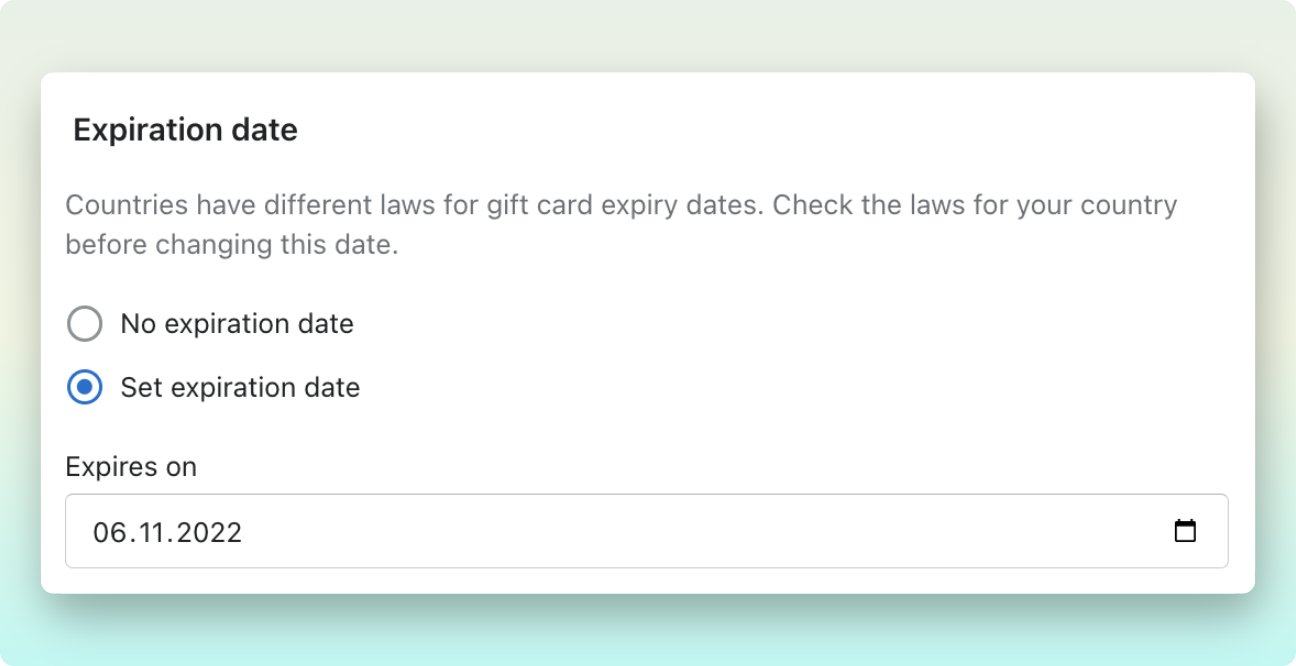
Before you set one, check the gift card laws in the country where you're issuing. In the US, the Credit CARD Act requires gift cards to remain valid for at least five years. The EU and UK generally require minimum two-year validity. Several US states (California, New Jersey, Connecticut) prohibit expiration dates on gift cards entirely.
If you're operating cross-border, the safest default is No expiration date. It's also a small trust signal — recipients hate finding their gift card expired six months in.
You'll know it's working when: either the "No expiration date" radio is selected, or a future date appears in the date picker.
Watch out for:
• Setting a 30-day expiration: short windows feel like a marketing trick and damage brand trust. Anything under 12 months reads as predatory.
• Ignoring state-specific gift card law: California issues fines for expiration dates under five years. Don't risk it.
Pro tip: Track unredeemed gift card balances as a liability on your balance sheet, not revenue. Even with "no expiration" cards, accounting standards require recognizing breakage (unredeemed balance) over time. Get your bookkeeper to set up the entries properly before you issue your hundredth card.
Step 4: Assign or Create a Customer
The customer selector lets you search for an existing customer or create a new one on the fly.
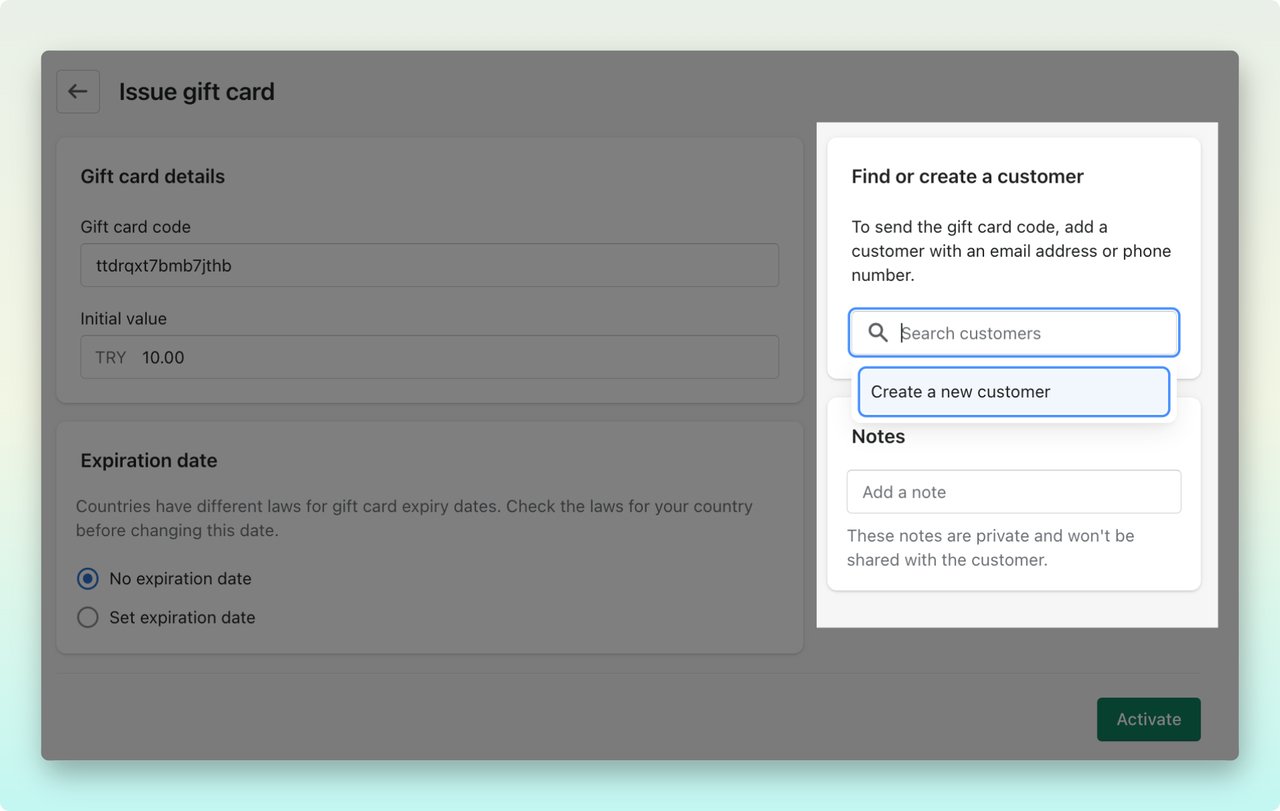
Click the search box and type the customer's name or email. If they exist, click their record to attach. If they don't, click Create a new customer and enter first name, last name, email, and phone number.
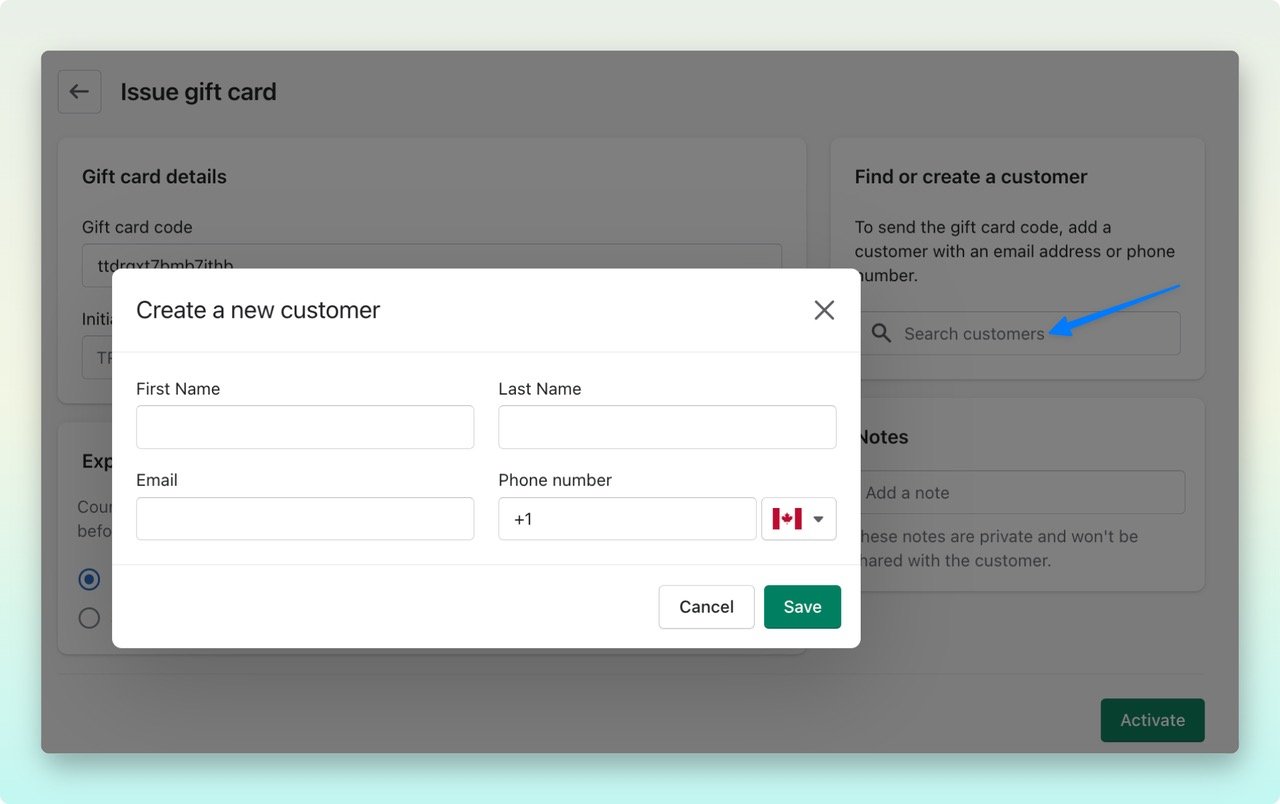
Click Save to attach the customer. Once you finalize the gift card, Shopify automatically emails the code to the customer's address — you don't need a separate send step.
You'll know it's working when: the customer name appears under the gift card details, and the email field is populated.
Watch out for:
• Typos in the email field: Shopify sends the code to whatever you type. A wrong email means a stranger gets your $100 reward. Double-check before saving.
• Skipping the customer step: you can issue an unassigned card and manually copy the code later, but you lose the audit trail and the automatic email.
Pro tip: For B2B or wholesale customers, use a generic company email like rewards@[client].com rather than a personal email of one staff member. People leave companies. Companies stay.
Step 5: Add an Internal Note and Save
Skip the customer if you're issuing a card without a recipient yet (e.g., for an upcoming giveaway).
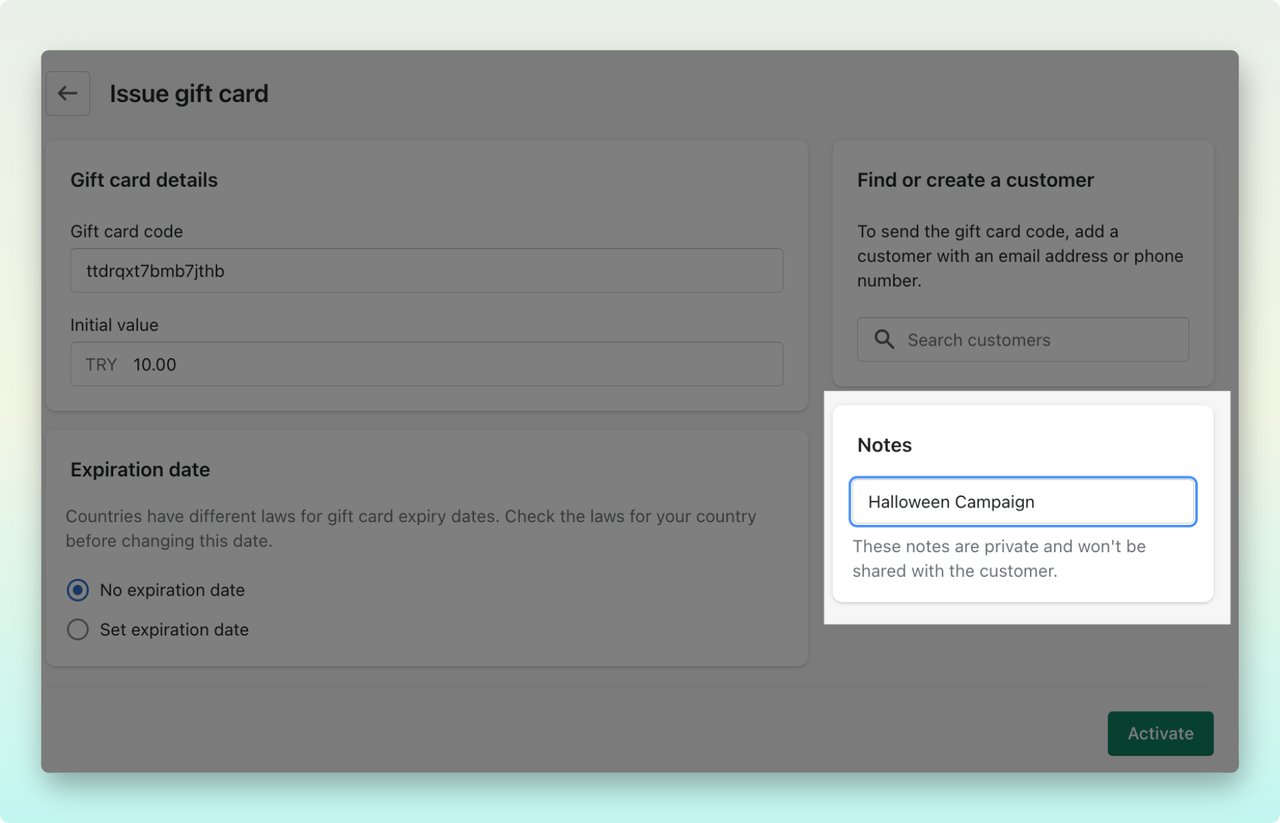
Then scroll to the Note field at the bottom. Add context like "Refund for order #1234" or "Loyalty Q4 2026 — Tier 3 customer" or "Influencer seeding — @username collab". The note only appears in the admin, never to the customer, but it's the thread of truth when you're auditing issuances months later.
Click Save. The card is now live, the code is generated, and if you attached a customer, the email has already gone out.
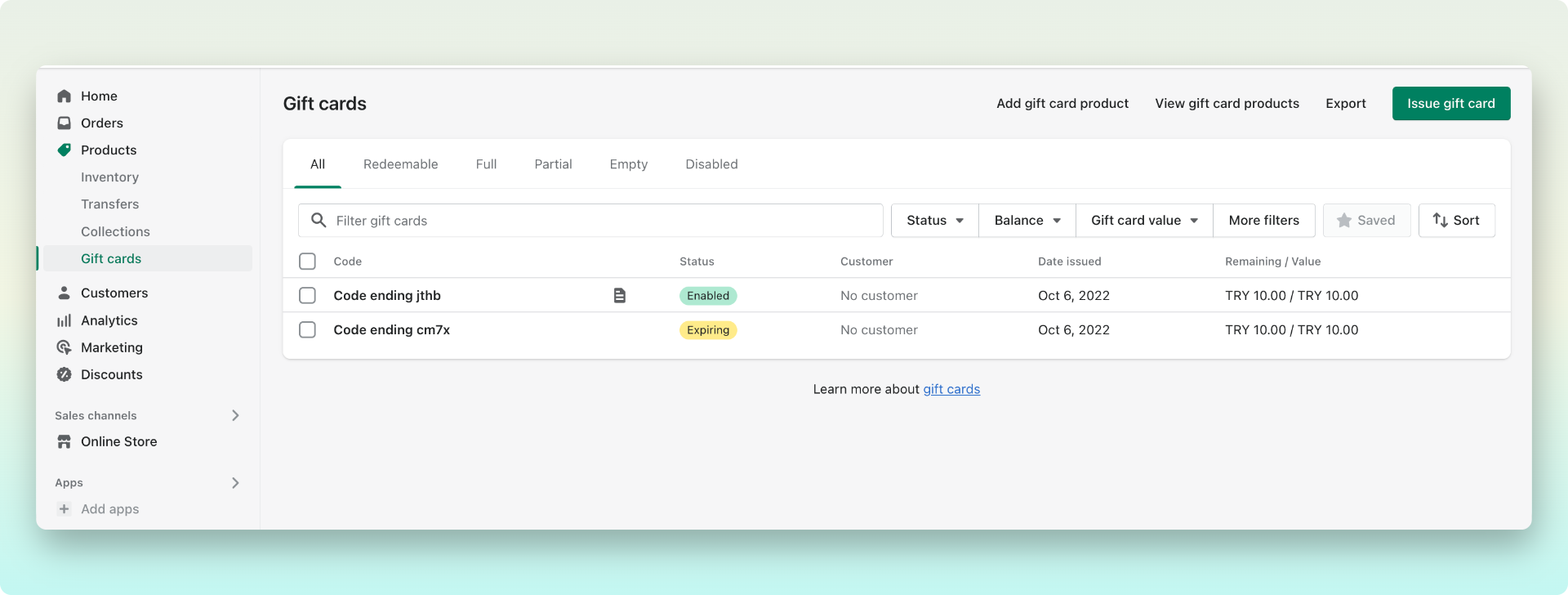
From here, you can access any issued code from the Gift cards index whenever you need to resend or verify.
You'll know it's working when: the issued card appears in the gift cards list with the correct value, expiration setting, and customer (if assigned).
Watch out for:
• Empty notes: in six months, you won't remember why you issued a $200 card to a customer named John. Write the reason every time. It takes 8 seconds.
• Forgetting to log the issuance in your finance system: manually issued cards don't generate an order, so they bypass standard revenue reports. Add them to your accounting reconciliation manually.
Pro tip: Build a simple Note convention and stick to it. We use [Purpose] | [Order or campaign reference] | [Issued by initials] — e.g., "Loyalty | Q4-LP-2026 | FS". Standardized notes turn audit nightmares into 30-second filters.
How to Redeem a Shopify Gift Card and Check the Balance
Redemption is where most customer-facing friction shows up, and it's the part of the flow merchants think about least. Here's exactly how it works in 2026.
On your online store: the customer adds products to cart, proceeds to checkout, and at the payment step finds a Gift card or discount code field. They paste the code, click Apply, and the balance debits in real time. If the order total exceeds the balance, they pay the difference with another payment method. If the order total is less, the remaining balance stays on the card for future use.
On Shopify POS: the staff member rings up the order, taps Add discount or gift card, scans the QR code on the customer's email (or types the code), and Shopify applies the balance to the transaction. For physical gift cards, the cashier scans the barcode on the back. Refunds back to the card are also possible by tapping the refund options at checkout.
Via the Buy Button: codes are entered in the same checkout field as standard discount codes. The redemption logic is identical to the online store.
Checking the balance: customers can check their remaining balance two ways. They can re-enter the code at checkout (Shopify shows the remaining balance before they confirm payment), or they can look at the most recent email Shopify sent — every redemption email lists the updated balance. Some stores add a dedicated "Check your gift card balance" page using an app or a simple custom code embed, but Shopify doesn't ship a native balance lookup tool out of the box.
Common redemption issues and fixes:
• "Invalid gift card code": almost always a typo. Codes are case-sensitive and don't include spaces or dashes — pasting from email avoids the issue. If the customer is sure the code is right, check whether the card was disabled in admin (Gift cards > click card > Disable card).
• "Gift card has been used": the balance hit zero. Check the gift card's transaction history under Products > Gift cards > click card > Activity to see when and where it was redeemed.
• "Currency mismatch": if your store sells in multiple currencies, gift cards only redeem in the currency they were issued. A USD card can't redeem a EUR order. The customer needs to switch the storefront currency back to USD or get a new card.
• "Cannot apply gift card and discount code together": this isn't an error in 2026 — Shopify allows combining gift cards with discounts on the same order. If the combination is blocked, check your discount settings for the "Cannot combine" toggle.
Shopify Gift Cards API and Advanced Features
For stores doing real volume, the manual admin flow stops scaling somewhere around 50 issued cards per week. That's when you graduate to the Gift Cards API.
Shopify exposes the GiftCard object in the Admin GraphQL API, with mutations for creating, updating, debiting, and disabling cards. The endpoint you'll use most is giftCardCreate, which lets you spin up a card programmatically with initial value, customer attachment, expiration, and an optional note. Reading balance and transaction history runs through the giftCard query.
What the API unlocks that the admin can't:
• Bulk issuance: send 5,000 loyalty cards in a single script run instead of clicking 5,000 times.
• Conditional issuance: trigger a card when a customer hits a spend threshold, completes a referral, or finishes onboarding — driven by webhooks or Shopify Flow.
• Custom redemption flows: build "check your balance" pages, partial-redemption widgets, or in-app gift card features for headless stores.
• Integration with CRMs and loyalty platforms: push issuance events to Klaviyo, HubSpot, or your data warehouse.
Rate limits: the Admin API enforces a cost-based rate limit (1,000 cost points per minute for standard plans, higher for Plus). giftCardCreate costs 10 points per call, so you can issue around 100 cards per minute via the API. Stay under that or batch with backoff logic.
Apps that wrap the API for non-developers: Rise.ai, GiftBlocks, and EasyApps' gift card suite all sit on top of the giftCardCreate mutation with friendlier UIs and built-in email design. If you don't have a developer on retainer, an app is usually faster and cheaper than a custom build. Stores comparing options will also want to check our Shopify niche research approach for benchmarking what comparable stores in your category are doing.
Best Practices for Selling Shopify Gift Cards
Most Shopify stores treat gift cards as an afterthought. The data says they shouldn't. According to EasyApps Ecommerce, fewer than 30% of Shopify stores actively sell or promote gift cards — which means promoting them well is one of the lowest-competition revenue moves available on the platform.
Here's what separates the stores making real money from gift cards from the ones with a dusty card SKU buried three clicks deep.
1. Promote them above the fold, not in the footer. Add the gift card as a featured product on the homepage during the four highest-gift seasons: November-December (Christmas/Hanukkah), February (Valentine's), May (Mother's/Father's Day), and August-September (back-to-school/birthdays). A welcome popup pointing to the gift card page during these windows captures fence-sitters who landed on your site for one reason and left with another.
2. Build seasonal SKUs, not one evergreen card. A "Holiday Gift Card 2026" with festive imagery converts noticeably better than a generic year-round card. The seasonal version signals timeliness and matches the buyer's mindset. You can keep the evergreen card for non-seasonal traffic and rotate seasonals in and out.
3. Use denominations anchored to AOV. Set three to five denominations centered on your store's average order value. If AOV is $65, denominations of $25, $50, $75, $100, $150 cover gifting up and gifting down without overwhelming the customer.
4. Auto-issue on customer birthdays. A $10 birthday card to every customer with a birthday on file is one of the highest-ROI loyalty moves available. Use Shopify Flow or an app to trigger automatically. Recipients often spend $50-$100 over the card value to feel they got a deal — the overspend behavior in Talk Shop's data isn't theoretical, it's the actual revenue mechanic.
5. Treat issued cards as a marketing channel. A free gift card to a high-LTV customer earns goodwill, surfaces in word-of-mouth, and routinely generates a second purchase within 14 days. Track redemption rate, time-to-redeem, and overspend per card as KPIs.
6. Build cross-sell touchpoints. Add a "Need a quick gift? Buy a gift card" CTA on the cart page, the order confirmation page, and the post-purchase email. Each placement adds incremental sales without crowding any single surface. Stores that pair gift cards with a stronger customer loyalty program see the biggest compounding effect.
7. Use popups to drive visibility. A Popupsmart popup announcing your holiday gift card pulls fence-sitters back to the gift card page with one click. The store's average gift card conversion rate from a targeted popup runs 2-5x higher than passive footer placement.
8. Track gift card metrics separately. In your finance reports, separate gift card revenue (deferred), gift card redemption (recognized revenue), and gift card breakage (expired or abandoned balance). Mixing them obscures what's actually happening with cash flow.
Why You Need a Shopify Gift Card Program in 2026
The case for adding gift cards isn't theoretical anymore. According to Rise.ai's gift card research, 93% of American consumers have purchased a gift card at some point. That's not a niche behavior — it's mainstream. If you don't sell them, you're handing that demand to a competitor.
Three financial reasons gift cards belong in every Shopify catalog:
They Boost Cash Flow and Sales
Gift cards are paid upfront. The recipient might redeem the card next week, next month, or never. Either way, the cash is in your account and your cost of goods is zero until redemption. For a store with seasonal peaks, this is a cash flow lifter — January gift cards from December sales fund Q1 inventory without taking on debt.
The bigger lift comes from overspend. According to Persistence Market Research, the global gift card market is projected to grow from $825.3 billion in 2026 to $2.22 trillion by 2033, at a 15.2% CAGR — and the dominant growth driver is digital, redemption-friendly cards that lend themselves to overspend behavior. Recipients want to use the card without leaving money on the table, so they top up with their own funds to hit a meaningful product.
They Bring You New Customers
Every gift card you sell creates a new customer relationship. The buyer is one customer, but the recipient is often someone new to your brand — and when they redeem the card, they enter your CRM, your email list, and your remarketing audience. A $50 card you sold once can keep generating data and repeat purchases for years.
This is the closest thing to a true word-of-mouth flywheel an ecommerce store has. The buyer becomes your unpaid brand ambassador, and the recipient's first interaction with your brand carries the implicit endorsement of someone they trust.
They Lock In Customer Loyalty
You can't buy loyalty, but you can earn it with smart redistribution of value. Issued gift cards work as loyalty rewards — a $20 card to anyone who spends over $200 in a quarter creates a strong incentive to return and a real sense of being seen by the brand.
The retention math is favorable. A $20 issued card costs your business maybe $7 in COGS when redeemed (depending on margins). That $7 buys roughly $120 of follow-on spend on average. The return-on-loyalty-card sits comfortably above 10x in our portfolio data across mid-sized DTC stores.
What Results to Expect From a Gift Card Program
Realistic numbers for a mid-sized DTC store on Shopify, based on stores we've worked with:
Months 1-3: launch a single evergreen gift card SKU and a seasonal SKU. Promote on homepage and via email. Expect gift cards to land at 1-2% of monthly revenue. Most early sales come from existing customers buying for others, not new traffic.
Months 4-6: add a second seasonal SKU, set up automated birthday card issuance, and add a popup announcement during peak gift seasons. Gift cards should now contribute 3-5% of monthly revenue. Overspend behavior shows up clearly in your data — average redemption order value is 30-60% above card value.
Months 7-12: integrate with your loyalty program, build an API-driven bulk issuance flow for refunds and apologies, and segment your audience for targeted gift card promotions. Gift cards typically settle at 5-10% of total revenue with a steady stream of new customers entering via redemption. Breakage (unredeemed balance over 24 months) usually runs 8-15%.
By month 12: the program pays for itself many times over. Even at a conservative 5% revenue contribution and 10% breakage, a $1M ARR store sees an extra $50K in gift card sales with $5K of pure-margin breakage and roughly $25K of follow-on overspend per year. That's $80K of incremental margin you didn't have last year.
Pick Your First Move on Gift Cards This Week
The biggest mistake stores make with Shopify gift cards is treating them as a checkbox feature rather than a revenue program. Every step in this guide takes under 30 minutes and adds compounding value: the first gift card SKU you ship in 2026 starts generating data, the first issued card builds loyalty, the first popup announcement pulls in fence-sitters who would have left empty-handed.
If you only do one thing this week, ship a single evergreen gift card product using the eight-step flow above. You can refine denominations, add seasonal SKUs, and integrate the API later. The first card live on your storefront unlocks the rest.
And when you're ready to promote it without redesigning your homepage, Popupsmart is a no-code popup builder that lets you launch a "Gift cards are here" announcement in about 90 seconds using ready-made templates. Pair the gift card you just built with a popup that points to it, and you've gone from feature to program in under an hour.
Frequently Asked Questions
How Do Shopify Physical Gift Cards Work?
Physical Shopify gift cards are ordered through Shopify Hardware or printed via third-party vendors, then activated through Shopify POS. Each card has a barcode that links to a balance in your Shopify backend. When a customer presents the card in-store, the cashier scans the barcode and the balance debits from the order total. Physical cards work everywhere a digital card works — online store, POS, Buy Button — but they have an additional inventory and printing cost that digital cards don't. They suit retail stores, premium brands, and corporate gifting programs where a tactile object lands better than an email.
How Do Shopify Digital Gift Cards Work?
Digital Shopify gift cards are created in the admin and delivered by email to the recipient instantly. Each card carries a unique 16-character code that the customer enters at any Shopify checkout to redeem the balance. There's no physical object, no printing cost, and no shipping delay. The recipient can use the card across multiple orders until the balance reaches zero, and any expiration date you've set is enforced automatically. Digital cards are the default Shopify gift card format and account for the majority of gift card sales in 2026.
Can Shopify Gift Cards Be Used In Store?
Yes, as long as you've connected Shopify POS to your physical location and enabled gift cards as a payment method. Customers redeem by either showing the QR code on their gift card email (the staff member scans it with the POS app) or handing over a physical card with a printed barcode. Refunds back to the gift card are also supported through POS, which keeps the customer's balance intact instead of forcing a cash refund.
How Do I Check My Shopify Gift Card Balance?
The simplest way to check a Shopify gift card balance is to enter the code at checkout — Shopify shows the remaining balance before you complete payment. You can also check the most recent gift card redemption email, which lists the updated balance after every transaction. Some stores set up a dedicated balance-check page using an app or custom code, but Shopify doesn't ship one natively. Merchants can always look up balance and full transaction history in the admin under Products > Gift cards > click card > Activity.
How Long Do Shopify Gift Cards Last?
Shopify gift cards last as long as the merchant sets. Cards can be issued with no expiration date (the most common and customer-friendly default) or with a specific expiration date set during creation. Several jurisdictions limit how short an expiration can be — US federal law requires at least five years for most gift cards, several US states ban expiration entirely, and the EU and UK enforce minimums of two years or longer. The first thing to check before redeeming any gift card is whether it carries an expiration date and how much time remains.
Can I Use Shopify Gift Cards Multiple Times?
Yes, as long as the card has a remaining balance. Each redemption deducts the order total from the card, and any leftover balance stays on the card for future use. A $100 card used to buy a $40 product leaves $60 on the card for the next order. The card stays usable until the balance hits zero or the expiration date passes (if one is set).
Does Shopify Charge a Fee for Gift Cards?
Shopify doesn't charge a separate fee for issuing or selling gift cards on any plan. Gift cards are included as a native feature for every store. However, standard Shopify payment processing fees apply when a customer buys a gift card with a credit card, just like any other transaction. There are no fees when a customer redeems a gift card balance at checkout — the redemption is treated as an internal balance debit.
You might also like:
How would you rate your experience with this article? 😊