ChatGPT
 Perplexity
 Claude
 Grok
Grok Google AI Mode
These statistics cover channels, costs, and AI-driven trends shaping modern pipelines, plus Popupsmart's own popup lead data. We checked every figure at its original publisher in October 2026 and name the source and its date next to it.
Why Do Lead Generation Statistics Matter in 2026?
Lead generation is the work of attracting potential customers and capturing their contact details, so marketing and sales can follow up with them.
Understanding where your leads come from, what they cost, and how they convert isn't optional anymore. Marketing budgets are tighter, sales teams expect better-qualified pipeline, and AI tools have rewritten the playbook on outreach. The numbers below give you a baseline to measure your own performance against.
Key findings:
- Email is used by 85.59% of B2B marketers for lead gen, with social media at 85.17% (Dux-Soup B2B Lead Generation Report 2026)
- Awareness and conversion account for 62.6% of total media spend in 2026 (Gartner, June 2026)
- A search ad lead costs $66.69 on average across industries (LocaliQ, 2026 search advertising data)
- 73% of B2B buyers actively avoid suppliers who send irrelevant outreach (Gartner, June 2025)
- 67% of B2B buyers prefer a rep-free experience (Gartner, March 2026)
- Across 3,034 Popupsmart popups that ask for an email or phone number (January 2024 – September 2026, each with at least 1,000 displays and 14 active days), the median converts 0.83% of its displays into leads; the top 25% reach 1.96% and the top 10% reach 3.87%. A lead is a popup submission that contains an email address or phone number. (Popupsmart's 2026 popup benchmark)
What Are the Top Lead Generation Priorities for Marketers?
Every year, marketing surveys ask where the money and effort go. In 2026 the answer leans toward two points in the funnel: getting noticed and getting the conversion. But the gap between "wanting leads" and "getting good ones" keeps widening.
Awareness and conversion take 62.6% of media spend
Awareness and conversion now account for 62.6% of total media spend, a rise of over 10% since 2024, while spending on customer loyalty and retention has declined 29% over the same period, to less than 15% of total media spend. (Gartner CMO Spend Survey 2026, published June 2026)
The split shows where the pressure sits. Teams fund the top of the funnel and the moment of conversion, and spend less on keeping the customers they already have. Nobody gets to throw money at the problem. Gartner's survey covered 401 CMOs and marketing leaders in North America, the United Kingdom and Europe, fielded January through March 2026.
Pro tip: Audit your current lead sources quarterly. If most of your pipeline depends on a single channel, you're exposed. Start testing two new channels this quarter, even at small scale. Popup builder tools like Popupsmart can help you capture more from your existing traffic without adding ad spend.
Content that prompts action is B2B marketers' top challenge (40%)
Asked for their top three content marketing challenges, 40% of B2B marketers named creating content that prompts a desired action, such as a conversion. Resource constraints (39%) and measuring content effectiveness (33%) follow. (Content Marketing Institute, B2B Content and Marketing Trends: Insights for 2026)
Volume isn't the problem. Most teams can generate leads. The harder part is getting a reader to act, and then getting sales to accept what marketing sends over.
Tip: Define your ideal customer profile (ICP) with sales before launching campaigns. Use behavioral scoring (page visits, content downloads, email engagement) alongside firmographic data.
How Much Are Companies Spending on Digital Lead Generation?
Ad spend tells you where the market's confidence sits. When budgets move toward a channel, it's because the data supports it.
Marketing budgets hold at 7.8% of company revenue
Marketing budgets remain effectively flat, rising only slightly to 7.8% of company revenue in 2026 from 7.7% in 2025. (Gartner 2026 CMO Spend Survey, May 2026)
Inside that flat budget, the mix keeps moving online: digital media represents more than two-thirds of total media investments in 2026, up 18% since 2024, in the same Gartner survey. Companies aren't throwing new money at lead gen ads blindly. They're optimizing existing spend.
If you're running paid lead gen campaigns, set your cost-per-lead (CPL) ceiling from your own average deal value and close rate, not from a published average. Track CPL by channel monthly and kill underperformers fast.
Lead generation pricing: cost per lead by channel
Lead generation pricing is usually quoted as cost per lead (CPL): ad spend divided by the leads it produced. Two current datasets measure it, and they measure different advertisers, so read each on its own.
In LocaliQ's 2026 data, which spans 20+ industries, a lead from search ads on Google Ads and Microsoft Ads cost $66.69 on average, and a lead from a Facebook lead campaign cost $27.39. LocaliQ reports that search cost per lead fell overall for the first time in five years.
Among B2B advertisers, the median 2025 cost per lead was $202 on LinkedIn, $145 on Facebook, $138 on Instagram and $524 on Google Ads (Metadata's 2026 B2B paid media study: medians across advertisers, built on $57.6 million of 2025 ad spend from 153 B2B advertisers).
| Channel | Cost per lead | Dataset |
|---|---|---|
| Search ads (Google Ads and Microsoft Ads) | $66.69 average | LocaliQ 2026, 20+ industries |
| Facebook lead campaigns | $27.39 average | LocaliQ 2026, 20 industries |
| $202 median | Metadata 2026, B2B advertisers, 2025 campaigns | |
| $145 median | Metadata 2026, B2B advertisers, 2025 campaigns | |
| $138 median | Metadata 2026, B2B advertisers, 2025 campaigns | |
| Google Ads | $524 median | Metadata 2026, B2B advertisers, 2025 campaigns |
Organic search has no per-click cost, which is why it rarely appears in CPL tables. That doesn't mean SEO is "cheap." It requires upfront investment in content, technical optimization, and patience. But once a page ranks, it generates leads for months or years without additional per-click costs.
What to do: Invest in bottom-of-funnel content first. Pages targeting "best [category] software" or "[competitor] alternatives" reach buyers closer to a decision than top-of-funnel educational content. Pair those pages with lead capture forms that catch visitors before they bounce.
Digital marketing statistics that shape lead generation
Digital marketing statistics describe the channels lead generation runs on: ad spend, search, social media and email. Four current figures bear directly on where leads come from:
- US digital ad revenue reached $294.6 billion in 2025, a 13.9% year-over-year increase (IAB/PwC Internet Advertising Revenue Report, April 2026).
- Search ad revenue (including AI search) reached $114.2 billion in 2025, up 11%, slower than its 15.9% growth in 2024. Social media ad revenue reached $117.7 billion, up 32.6% (IAB/PwC).
- 6.12 billion people used the internet at the start of April 2026, 73.8% of the world's population (DataReportal Digital 2026 Mid-Year Global Update).
- 79.3% of online adults say they visit search engines each month, and 74.4% use email, in GWI's survey data published in the same DataReportal report.
For lead generation, read it this way. Paid social is where ad budgets grow fastest. Search still carries a large share of spend, and email remains a monthly habit for most online adults.
Which Channels Drive the Most B2B Leads?
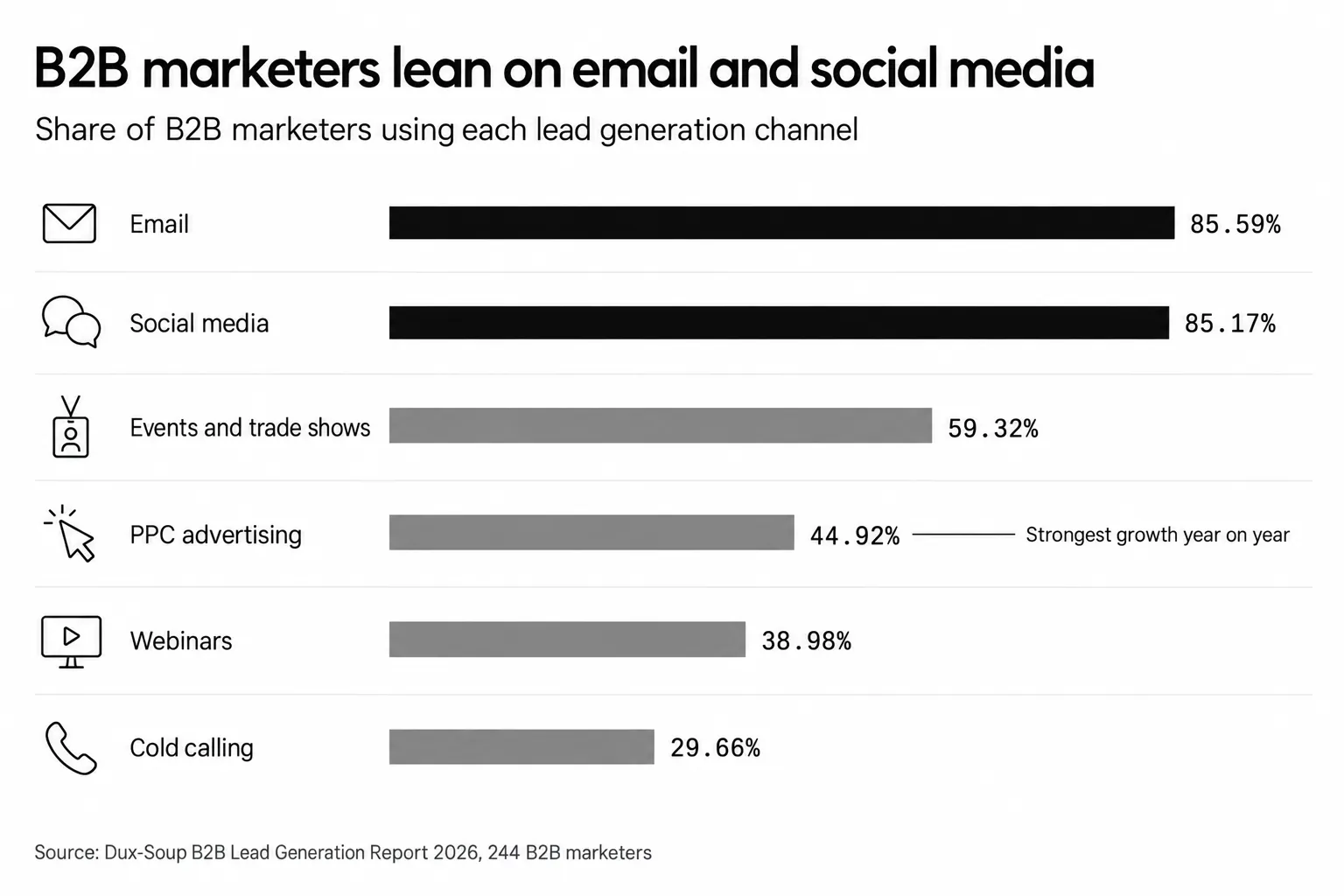
Not all channels get equal use, and the gaps are wider than most marketers expect. Here's which channels B2B teams use for lead generation in 2026, according to Dux-Soup's survey of 244 B2B marketers at the B2B Marketing Live event in London.
Email is used by 85.59% of B2B marketers for lead generation
Email (85.59%) and social media (85.17%) are the most used lead generation channels among B2B marketers, ahead of events and trade shows (59.32%), PPC advertising (44.92%) and webinars (38.98%). (Dux-Soup B2B Lead Generation Report 2026) A year earlier, in the 2025 edition, email stood at 88% and social media at 77%.
Email's lead isn't surprising. The surprise is how close social media now sits. Email holds on because of control: you own your email list, you control the timing, and you can segment precisely. Social media, by contrast, relies on algorithms you don't control.
Tip: Build email-first lead gen workflows. Use content upgrades (PDF checklists, templates, calculators) gated behind email capture forms. Segment your list by engagement level within the first 30 days. If your list is still small, start with these email list building methods.
Nearly three-quarters of B2B marketers use LinkedIn every week
LinkedIn is overwhelmingly the primary B2B social platform, with near-universal adoption, and nearly three-quarters of B2B marketers use it at least weekly. (Dux-Soup B2B Lead Generation Report 2026) The 2025 edition put LinkedIn adoption at 97% of respondents.
LinkedIn's dominance in B2B isn't new, but the rhythm is changing: Dux-Soup sees usage shifting from daily activity toward a more deliberate weekly cadence. It means if you're not active on LinkedIn, you're missing where nearly every B2B competitor is already generating leads. The platform's targeting capabilities (by job title, company size, industry) make it particularly effective for account-based marketing.
What to do: Don't just run ads. Have your sales team and founders post consistently. Combine organic content with LinkedIn lead gen forms for your highest-performing posts. In Metadata's B2B data, LinkedIn's built-in lead forms cost $193 a lead against $346 for campaigns that send people to a landing page.
Your website is the lead channel you control
91% of B2B marketers collect first-party data, and 68% of them collect it through content: gated assets, webinars and interactive tools. (Content Marketing Institute, Insights for 2026)
Your website is your most controlled lead generation asset. Unlike social platforms or ad networks, you set the rules: the offer, the form and the moment it appears.
What to do: Add a popup to your highest-traffic blog posts. Offer something specific to the page topic, not a generic newsletter signup, and start from ready-made popup templates if you don't have a designer. A blog post about marketing automation should offer a marketing automation checklist, not "subscribe to our blog." For B2B formats that work, see these B2B popup examples, and judge the results with the popup lead statistics further down this page.
How Does Content Marketing Impact Lead Generation?
Content marketing and lead generation are inseparable in B2B. But not all content performs equally. The data shows where teams struggle and what the effective ones do differently.
Only 12% of B2B marketers say they exceeded their goals
12% of B2B marketers rate their effectiveness over the last 12 months as highly effective (exceeded goals), and 47% as somewhat effective (met most goals). (Content Marketing Institute, Insights for 2026, a survey of 1,015 B2B marketers)
Asked what moved the needle, the effective teams point first to content relevance and quality (65%) and team skills and capabilities (53%). The economics are straightforward: a blog post ranks once and attracts traffic for months. A cold email sequence needs constant feeding.
Tip: Prioritize content that targets keywords with commercial intent. Informational content builds authority, but "best X software," "X pricing," and "X vs Y" pages drive actual pipeline. Map your content calendar to your sales team's most common objections and questions.
63% of B2B marketers measure thought leadership by leads and pipeline
63% of B2B marketers measure the success of their thought leadership by business impact (leads, pipeline influence), and 80% by audience engagement. (Content Marketing Institute, Insights for 2026) The channels they rate most effective for it are LinkedIn (76%), email newsletters (54%) and speaking events or webinars (52%).
The gap between "has a blog" and "has a blog that actually drives leads" is enormous. Publishing once a month without keyword research or conversion elements won't move the needle. The teams that can show leads from content are publishing targeted, optimized content with clear calls to action on every page.
Pro tip: Add a lead capture element to every blog post. This could be an inline CTA, a content upgrade, or a smart popup triggered by scroll depth. Track which posts generate the most leads (not just traffic) and double down on those topics.
What Role Does Marketing Automation Play in Lead Generation?
Automation isn't a luxury for B2B teams anymore. It's the baseline. The stats below show how much teams are putting into it, and where it backfires.
CMOs put 15.3% of marketing budgets into AI, but only 30% are ready to scale it
CMOs are allocating an average of 15.3% of marketing budgets to AI initiatives, but only 30% report mature or fully developed AI readiness capabilities. (Gartner 2026 CMO Spend Survey) In CMI's research, 95% of B2B marketers say their organizations use AI-powered applications, and 28% experiment with AI agents.
AI's impact on lead gen goes beyond chatbots. Predictive lead scoring, automated email personalization, and AI-powered ad targeting are the obvious lead gen uses. That readiness gap is the part to watch: most teams are buying before they can scale what they buy.
Tip: Start with AI-powered lead scoring before anything else. Feed your CRM data into a predictive model that identifies which lead attributes correlate with closed deals. Then use that model to prioritize follow-up.
73% of B2B buyers avoid suppliers who send irrelevant outreach
73% of B2B buyers actively avoid suppliers who send irrelevant outreach, in a Gartner survey of 632 B2B buyers conducted in August through September 2024 (published June 2025).
This explains why automation without personalization fails. Sending 10,000 identical emails isn't a strategy. It's noise. The outreach that does get engagement is personalized to the recipient's industry, role, and recent behavior.
What to do: Segment your outreach by at least three variables: industry, company size, and the specific problem your product solves for that segment. Use dynamic content blocks in your emails that swap based on these segments.
What Are the Biggest Lead Conversion Challenges?
Generating leads is only half the battle. Converting them is where most teams lose money. These benchmarks show why: buyers want to do more of the work without a salesperson.
67% of B2B buyers prefer a rep-free buying experience
67% of B2B buyers state that they prefer a rep-free experience, according to a Gartner survey of 646 B2B buyers conducted from August through September 2025 (published March 2026). Gartner's previous survey, published June 2025, put the figure at 61%.
That's how B2B buying works now: buyers research on their own and reach out late. The problem is that most teams treat lead generation and lead nurturing as separate functions. They're not. A lead that isn't ready today might be ready in 90 days, but only if you stay in front of them.
Tip: Build a 90-day nurture sequence for every lead that doesn't convert immediately. Mix educational content, case studies, and soft CTAs. The goal isn't to sell in every email. It's to be the first brand they think of when budget opens up.
More than 60% of business buyers use a trial
More than 60% of business buyers now make use of a trial, and 78% of buyers making purchases of $10 million or more engage in a trial first. (Forrester, The State of Business Buying, 2026) Procurement professionals are decision-makers in 53% of business buying cycles.
Buyers want proof before they talk. Converting more of them doesn't always require more leads. Sometimes it's about reducing friction in the funnel you already have.
What to do: Run a conversion rate audit on your top 5 lead capture pages. Test reducing form fields, adding social proof (testimonials, client logos), and using more specific CTAs ("Get your free audit" vs. "Submit"). For layouts to test, see these lead generation form examples.
How Are Organizations Measuring Lead Generation Volume?
Benchmarking your lead volume against industry averages is harder than it looks: we found no current, primary-sourced average for monthly lead volume. So benchmark the parts you can measure: who sits in the buying decision, and what each lead becomes.
A typical B2B buying decision involves 13 internal stakeholders
The typical buying decision now includes 13 internal stakeholders and nine external influencers. (Forrester, The State of Business Buying, 2026, published January 2026)
This average spans all company sizes and industries, so take it as a rough benchmark. It still changes how you count: one deal can produce several leads from the same company, and counting each as a separate win inflates your numbers. The metric that matters more than raw volume is what each lead becomes. Metadata's B2B data shows why: LinkedIn leads cost $202 at the median, yet LinkedIn cost $58,572 per customer and sourced 10.2x in pipeline per lead-generation dollar, against $31,939 and 7.97x across the whole dataset.
Tip: Stop chasing volume for its own sake. Calculate your target lead number backwards from revenue goals: Revenue target > Average deal value > Required closed deals > Required SQLs (using your SQL-to-close rate) > Required MQLs (using your MQL-to-SQL rate) > Required leads. That gives you a number that actually means something.
Popup lead statistics from Popupsmart's 2026 benchmark
Popup lead statistics measure how many popup displays turn into leads. Popupsmart's 2026 benchmark measured this across the popups we power (for the mechanics behind these numbers, see why popups convert):
Across 3,034 Popupsmart popups that ask for an email or phone number (January 2024 – September 2026, each with at least 1,000 displays and 14 active days), the median converts 0.83% of its displays into leads; the top 25% reach 1.96% and the top 10% reach 3.87%. A lead is a popup submission that contains an email address or phone number.
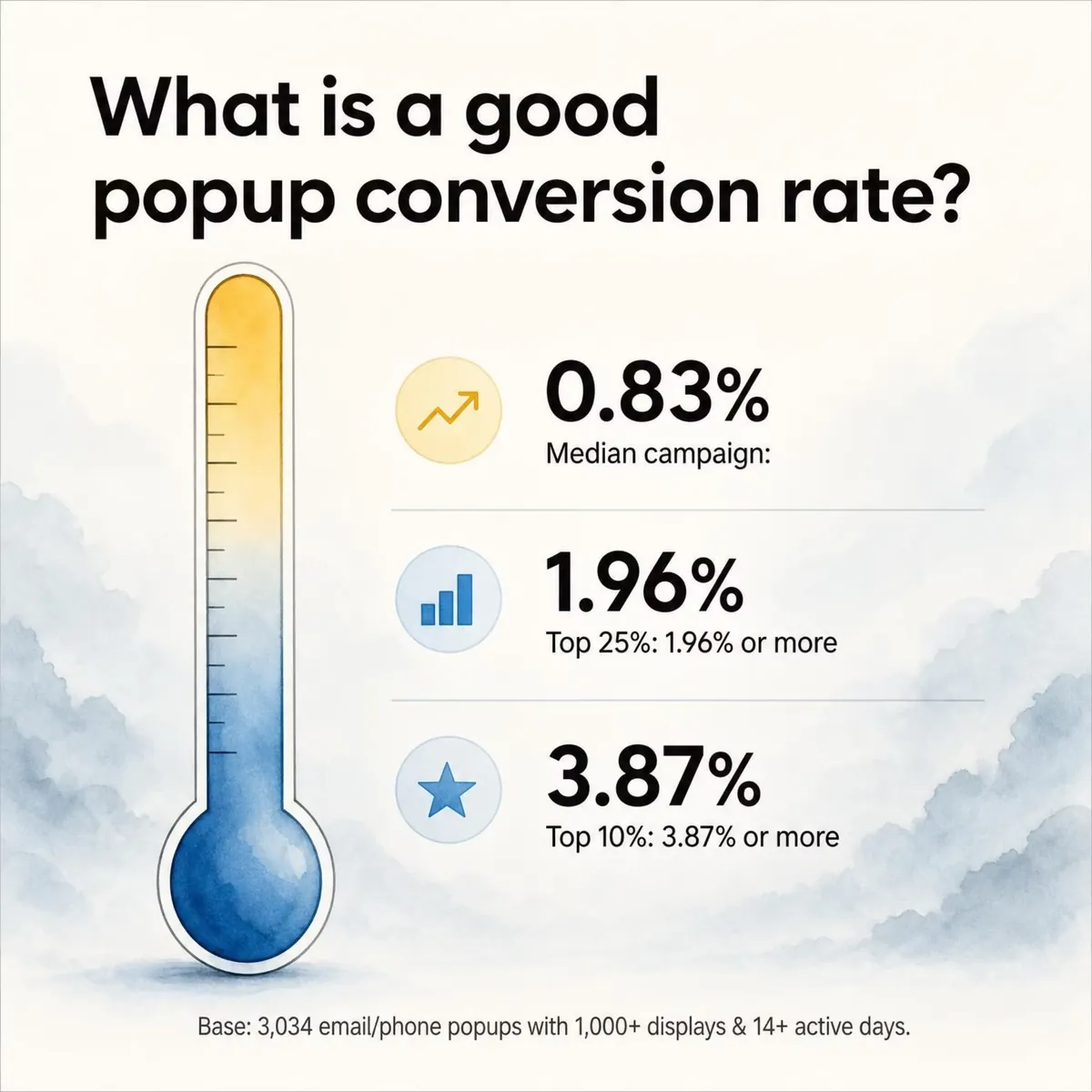
This is a rate per popup display, not per visitor, and it isn't comparable with a website or landing-page conversion rate: the numerator, the denominator and the population all differ.
For B2B teams, the kind of address matters as much as the count:
- 59% of email addresses collected by popups are Gmail addresses; 12% use a business or other domain.
- Emails collected on desktop are about twice as likely to be at a business or other non-consumer domain: 21% vs 9.5% on mobile.
- On mobile the median popup converts 1.02% vs 0.57% on desktop.
- The share of popup leads that include a phone number rose from 21.3% (2024) to 26.3% (2025) to 33.5% (2026) (all leads pooled); much of that comes from a few high-volume accounts that collect phone numbers, while most lead-collecting campaigns collect email only.
Popupsmart collects the email address or phone number and passes it to the email tool or CRM you connect; the follow-up runs there. The full method, with every statement and its base, is in Popupsmart's benchmark data.
What Does the Future of Lead Generation Look Like?
Three shifts are already reshaping how teams generate and convert leads. None of them are slowing down.
First, AI is moving from "nice-to-have" to "default," for sellers and for buyers. Gartner predicts that by 2028, 90% of B2B buying will be AI agent intermediated, pushing over $15 trillion of B2B spend through AI agent exchanges (Gartner, October 2025). If you haven't tested AI-powered scoring or content personalization yet, you're already behind the early adopters.
Second, privacy rules and browser restrictions continue to shrink the pool of third-party data available for targeting. GDPR enforcement, browser tracking limits, and platform-level tracking restrictions mean first-party data (email lists, website behavior, CRM records) is becoming more valuable each quarter. Teams that invested in owned audience building are now reaping the benefits.
Third, buyer expectations for personalization keep rising while tolerance for generic outreach keeps falling. 73% of B2B buyers already avoid suppliers who send irrelevant outreach. Segmentation, dynamic content, and context-aware messaging used to be advanced tactics. Now they're table stakes.
What to do: Build your 2026 lead gen strategy around three pillars: owned data collection, AI-powered qualification, and channel diversification. Don't let a single channel carry most of your pipeline. And if you're relying on tactics that worked in 2023 without updating them, the market has already moved on.
Lead Generation Statistics by Channel
| Channel | Key Statistic | Source |
|---|---|---|
| Email Marketing | Used by 85.59% of B2B marketers for lead generation | Dux-Soup 2026 |
| Social Media | Used by 85.17% of B2B marketers for lead generation | Dux-Soup 2026 |
| Used at least weekly by nearly three-quarters of B2B marketers; $202 median cost per lead | Dux-Soup 2026; Metadata 2026 | |
| Events / Trade Shows | Used by 59.32% of B2B marketers | Dux-Soup 2026 |
| PPC / Search Ads | Used by 44.92% of B2B marketers; $66.69 average cost per lead across industries | Dux-Soup 2026; LocaliQ 2026 |
| Facebook Ads | $27.39 average cost per lead for lead campaigns | LocaliQ 2026 |
| Webinars | Used by 38.98% of B2B marketers | Dux-Soup 2026 |
| Cold Calling | Used by 29.66% of B2B marketers, the steepest decline | Dux-Soup 2026 |
How I Compiled Lead Generation Statistics
These lead generation statistics come from industry reports published between 2025 and 2026, using primary research instead of secondhand citations. Every stat was traced back to its original publisher and checked in October 2026 against the newest edition that publisher has released:
- Dux-Soup's B2B Lead Generation Report 2026: 244 B2B marketers surveyed at B2B Marketing Live in London
- Gartner's 2026 CMO Spend Survey: 401 CMOs and marketing leaders, January through March 2026
- Gartner's B2B buyer surveys: 646 buyers in August through September 2025, and 632 buyers in August through September 2024
- The Content Marketing Institute's Insights for 2026: 1,015 B2B marketers, fielded June 24 to August 14, 2025
- Forrester's The State of Business Buying, 2026
- The IAB/PwC Internet Advertising Revenue Report for 2025
- DataReportal's Digital 2026 Mid-Year Global Update
- LocaliQ's 2026 search advertising report and LocaliQ's 2026 Facebook advertising report
- Metadata's 2026 B2B paid media study: medians among B2B advertisers, 2025 campaigns
Older statistics are noted with their original publication date.
The popup figures come from Popupsmart's own platform data. The dataset covers 1.98 billion page views, 499.6 million popup displays and 1.84 million leads: 28,674 campaigns from 11,533 businesses that ran a popup with Popupsmart between January 2024 and September 2026.
What changed in this post
Replaced the compilation-site figures with primary research in its newest edition: Dux-Soup's 2026 channel data (email 85.59%, social media 85.17%; the 88%, 77% and 97% figures came from its 2025 edition), Gartner's 2026 budget, media-spend and buyer surveys, CMI's Insights for 2026, Forrester's 2026 buying study, and LocaliQ's and Metadata's cost per lead data. Added a digital marketing statistics section and Popupsmart's 2026 popup lead data. Removed figures we couldn't trace to a current primary source: 91% of marketers ranking lead generation first, 61% calling quality leads their top challenge, 1,877 leads per month, the 50% AI lift in sales-ready leads, 90.7% using websites for lead generation, the $31, $53 and $72 costs per lead, the $3.24 billion US lead generation ad spend, content marketing's 3x leads, the 67% blogging lift, the 70% ignored outreach, 20% sales-ready leads and 12% satisfied with conversion, along with unsourced rules of thumb in the tips.
Turning Lead Generation Numbers Into Pipeline
If you've read this far, you now have the benchmarks. But benchmarks don't fill your pipeline. Execution does. Start with the channels that deliver the lowest cost per lead for your market, build nurture sequences that keep not-yet-ready leads warm, and invest in personalization, because 73% of B2B buyers avoid suppliers who send irrelevant outreach.
Your website is the one lead generation asset you fully control. Measure how many visits and popup displays turn into leads, and judge a popup against the popup benchmark, not against a website conversion rate. Test targeted popups on your top-performing pages, reduce form fields, and match your offer to the visitor's intent. Small changes compound fast when your traffic base is growing.
FAQ About Lead Generation Statistics
What are lead generation statistics in marketing?
Lead generation statistics are data points that measure how businesses attract and capture potential customer interest. They cover metrics like cost per lead, channel effectiveness, conversion rates, and pipeline volume. Marketing teams use these benchmarks to evaluate whether their campaigns perform above or below industry averages. For example, knowing that a search ad lead costs $66.69 on average across industries (LocaliQ 2026) helps you judge your own paid search cost per lead.
What are B2B lead generation statistics?
B2B lead generation statistics focus specifically on business-to-business marketing performance. Key 2026 figures include: email (85.59%) and social media (85.17%) are the most used B2B lead generation channels (Dux-Soup 2026), the typical buying decision includes 13 internal stakeholders and nine external influencers (Forrester 2026), and 67% of B2B buyers prefer a rep-free experience (Gartner 2026). B2B cycles are longer and deal values higher than B2C, which means their conversion rates differ significantly.
What are the latest digital marketing growth statistics in 2026?
Digital marketing in 2026 is defined by AI adoption, channel diversification, and rising personalization expectations. US digital ad revenue reached $294.6 billion in 2025, up 13.9% (IAB/PwC, April 2026). Social media ad revenue grew 32.6% to $117.7 billion, while search grew 11% to $114.2 billion. Marketing budgets hold at 7.8% of company revenue in 2026 (Gartner), and 6.12 billion people used the internet at the start of April 2026 (DataReportal).
What is the average cost per lead by channel?
It depends on the dataset. LocaliQ's 2026 reports put the average cost per lead at $66.69 for search ads and $27.39 for Facebook lead campaigns across industries. Among B2B advertisers, Metadata's 2026 study found median 2025 costs per lead of $202 on LinkedIn, $145 on Facebook, $138 on Instagram and $524 on Google Ads. The two sets measure different advertisers, so don't average them.
What is a good popup lead conversion rate?
Across 3,034 Popupsmart popups that ask for an email or phone number (January 2024 – September 2026, each with at least 1,000 displays and 14 active days), the median converts 0.83% of its displays into leads; the top 25% reach 1.96% and the top 10% reach 3.87%. A lead is a popup submission that contains an email address or phone number.