
Shopify for Nonprofits: Everything You Need to Know

 ChatGPT
 Perplexity
 Claude
 Grok
Grok Google AI Mode
Nonprofits are tax-exempt entities that reinvest earnings into a public mission and are funded by donations, grants, and program revenue. The text explains Shopify’s nonprofit plans (Lite $29, Full $99), signup via support with status verification, donation setup tips, and key nonprofit apps.
Table of contents (16)
Searching for a reliable partner to fuel your nonprofit's progress? Shopify has cool things to offer for nonprofits.
Shopify goes beyond merchandise sales for charities and nonprofits. It enables organizations to offer one-time and recurring donations through their online stores.
In this blog post, we delve into how Shopify's dedicated nonprofit plans provide cost-effective solutions, empowering organizations to maximize their resources and amplify their missions.
Explore the additional benefits available exclusively to nonprofits, and discover how Shopify is a game-changer for driving positive change on a budget.
Let’s begin!
What is a Nonprofit Organization?
A nonprofit organization is a business entity that operates for purposes other than making a profit. The government grants it tax-exempt status because it serves a social cause or benefits the public.
Nonprofits reinvest their earnings into their mission and cannot distribute profits to individuals or shareholders. They rely on donations, grants, and revenue from programs to fund their activities.
A nonprofit's main goal is to impact society rather than focus on financial gain positively.
Starting a nonprofit involves building a solid foundation, creating a business plan, choosing a unique name, determining the organizational structure, and officially incorporating the organization.
Other steps include
- obtaining an EIN,
- appointing a board of directors,
- drafting bylaws and conflict of interest policies,
- fundraising, building a team, launching the nonprofit,
- and implementing a marketing strategy.
The process can take several months, and it requires careful planning and compliance with legal requirements.
How to Sign Up for Shopify’s Nonprofit Plans
To sign up for one of Shopify's nonprofit plans, you'll need to connect with their live support team.
Once you connect them, keep in mind that Shopify may verify your nonprofit status to ensure you qualify for the benefits associated with these plans.
For this, you need to provide sufficient documentation/proof that your business has nonprofit status in your country.
Once the team verifies your nonprofit status in your country, they can offer the nonprofit plan to you.
The pricing plans of Shopify for nonprofit organizations are as follows:
Shopify NPO Lite Plan
For smaller nonprofits seeking an affordable solution with essential features, the NPO Lite plan is an excellent choice.
The NPO Lite plan offers additional features to the Basic Plan that are not normally available on that plan.
With a monthly cost of just $29, this plan provides numerous advantages:
- Reduced Transaction Fees: By using a third-party payment provider, you'll benefit from a lower transaction fee of 1% instead of the standard 2% charged on the Basic Plan.
- Lower Credit Card Rates: Shopify Payments, the in-house payment processor, offers lower credit card rates exclusively for NPO Lite plan users, helping you maximize the impact of your fundraising efforts.
- Accept Donations through Shopify Payments: If your nonprofit is registered as a charity in the US or Canada, you can seamlessly accept donations through Shopify Payments, simplifying the donation process for your supporters.
- Unlimited Staff Accounts: Collaboration is vital for nonprofits, and the NPO Lite plan allows you to create unlimited staff accounts, ensuring all members of your team have access to the Shopify dashboard.(instead of 2 - Plus plan feature)
- Real-time Carrier Shipping: With this feature, typically available on higher-tier plans, you can provide accurate shipping rates to your donors, enhancing the shopping experience and improving donor satisfaction.
Shopify NPO Full Plan
Nonprofits seeking more advanced features and greater flexibility may find the NPO Full Plan the ideal choice.
Priced at $99 per month, this plan includes all the benefits of the Shopify plan and offers additional exclusive features:
- No Transaction Fees: When using a third-party payment provider, you won't incur any transaction fees, allowing your organization to make the most of every donation received. (instead of 1% on the Shopify plan - better than the Advanced Shopify plan feature)
- Lower Credit Card Rates: Compared to the Shopify plan, the NPO Full plan provides lower credit card rates, ensuring a higher percentage of each donation directly supports your cause. (Advanced Plan Shopify rates)
- Unlimited Staff Accounts: With the NPO Full plan, you can create unlimited staff accounts, fostering collaboration and empowering your entire team to contribute to your organization's success. (instead of 5 on the Shopify plan - Plus plan feature)
- Accept Donations through Shopify Payments: Charities registered in the US or Canada can easily collect donations through Shopify Payments, providing a secure and convenient method for supporters to contribute to your cause.
- Real-time Carrier Shipping: Offering real-time carrier shipping enables you to provide accurate and competitive shipping rates, enhancing the overall donor experience and simplifying the purchasing process. (Advanced plan feature)
After you decide what plan you want to continue with, the rest of the process is the same as a regular Shopify store.
Setting up donations on Shopify is a straightforward process that mirrors setting up a regular product.
When creating a donation item, you can follow the same steps as you would for any other product in your store.
However, there are a few specific settings that you need to adjust to ensure the donation functions properly.
First, you can turn off inventory tracking for donations since they are not physical products with limited quantities. By disabling inventory tracking, you eliminate the need to manage stock levels for donations.
Secondly, it's essential to mark the donation item as "not a physical product" to differentiate it from tangible goods. This distinction helps supporters understand that they are making a contribution rather than purchasing a physical item.
Depending on your region and applicable tax regulations, you may also need to adjust tax settings accordingly.
In some cases, donations may be tax-exempt, while in others, taxes may apply. It's crucial to ensure the appropriate tax settings are in place to comply with local laws.
You can also add a donate button or form on your Shopify store to collect donations. Below you can see some of the most popular Shopify apps for nonprofits.
Top Shopify Apps for Nonprofits
Shopify could be an excellent choice for nonprofit organizations or charities seeking a solution to consolidate their donations in a centralized platform and enhance their brand presence.
Through Shopify's nonprofit features, you can:
- Receive donations through social media platforms
- Sell event tickets online
- Benefit from reduced or waived transaction fees
- Establish recurring monthly donation subscriptions
- Send donation links via SMS
- Initiate email marketing campaigns
- Sell merchandise both locally and internationally
- Accept in-person donations.
Now let’s see some of the top Shopify apps for nonprofits and their features for you to reach your nonprofit goal.
1. ShoppingGives
ShoppingGives is a platform that enables brands to support nonprofits while ensuring compliance with regulations.
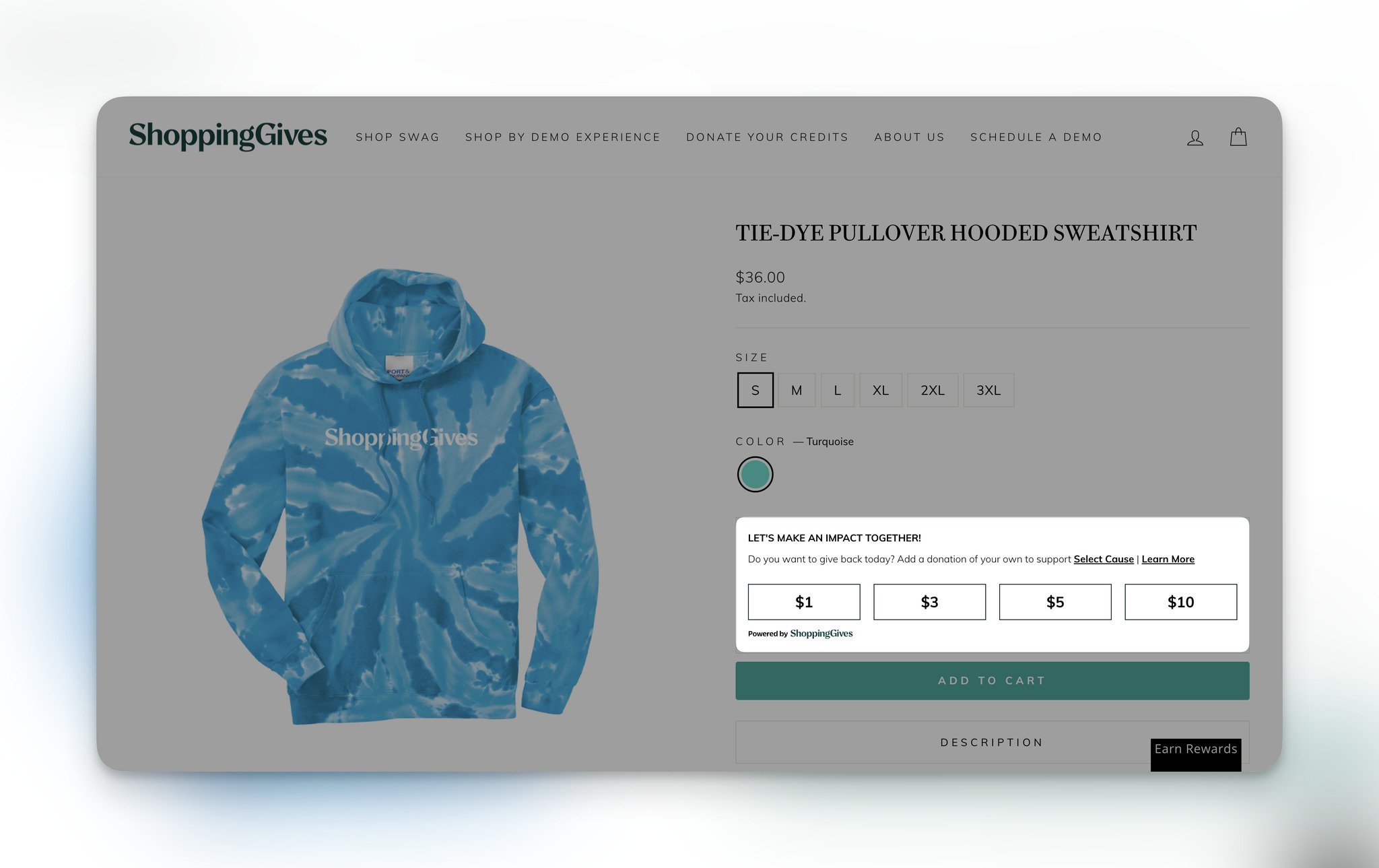
They provide a customizable social impact strategy and handle donation processing and reporting.
This allows businesses to focus on financial growth while building loyalty and trust through their philanthropic efforts.
Top Features:
- Fully managed, compliant donation process.
- 100% donation delivery to supported nonprofits.
- Actionable data for budget allocation and personalized marketing.
- Omnichannel giving with Shopify POS.
- Donation management by product SKU and variant.
Pricing: ShoppingGives provides free installation and a 7-day free trial with 20 donation credits, followed by pricing of 0.5% + $29/month.
2. Shop for Good
Shop for Good is a platform that helps businesses drive customer loyalty by integrating charitable initiatives.

It offers donation campaigns, supports trending nonprofits, and handles compliance and distribution, allowing businesses to stay relevant and engaged with customers.
Top Features:
- Round up change at the cart or checkout to donate to charity (for customers).
- Donate and receive discounts or gifts as a thank you (for customers).
- Donate a percentage of sales on specific products and collections (for merchants).
- Donate a flat or custom amount to charity during the purchase process.
- Analytics for customer engagement, increased average order value (AOV), and donation trends.
Pricing:
Startup Brands: Free to install with a 10% deduction from donations. Includes features like the portion of sales, round-up on the cart, $1 donation, and so on.
Emerging Brands: $299/month. Includes all Startup Brands features, plus custom amounts, donation tiers, donations for gifts, and so on.
Scaling Brands: $700/month. Includes all Emerging Brands features, plus custom fonts, custom branded widgets & flows, personal account manager, and more.
3. Easy Donation
Easy Donation is a Shopify app that streamlines the collection of donations from customers at your store. It integrates with Shopify and allows you to set up and manage donations easily.
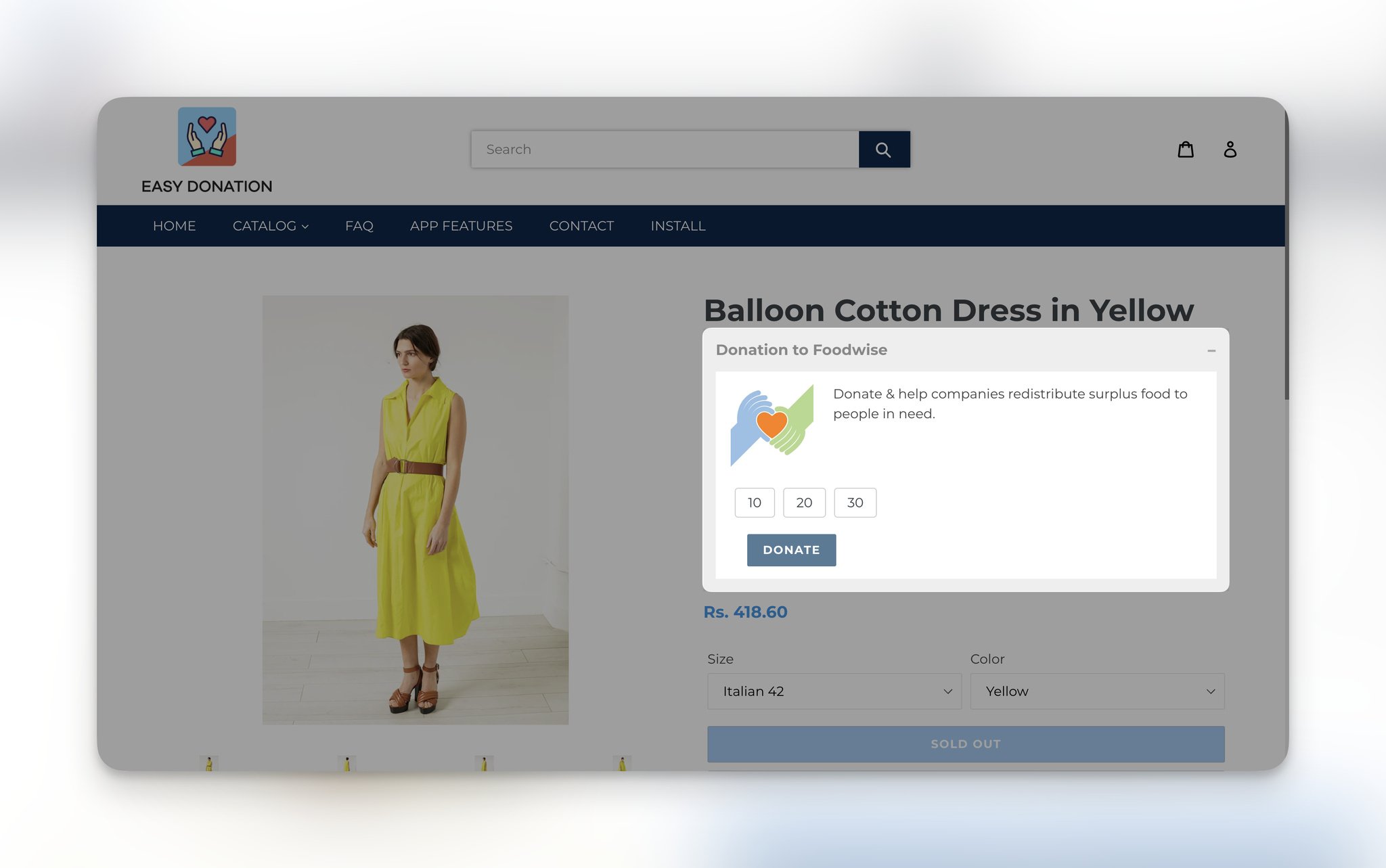
Customers can choose to donate any amount during checkout, which is added to their order total.
Top Features:
- Simplify customer donations across your website.
- Go fully digital with a donation page; no physical sales are required.
- Offer diverse donation options for users to support their chosen organization.
- Customize receipts to show appreciation and align with your brand.
- Easily track monthly/yearly donations per charity.
Pricing:
Basic Plan: $6.99/month, includes single donation widget, landing page, flexible placement, donation tracking, receipt, and no additional charges.
Advanced Plan: $9.99/month, offers multiple donations, landing pages, flexible placement, donation tracking, receipt, and no additional charges.
4. Bonus: Popupsmart
Popupsmart is a versatile, no-code popup builder perfect for Shopify stores.
With its user-friendly interface and robust features, Popupsmart empowers nonprofits to create captivating and customizable popups that effectively collect donations from their website visitors.

By leveraging Popupsmart, nonprofits can effortlessly design visually appealing popups that align with their branding and messaging.
These popups can be strategically triggered based on user behavior, ensuring maximum engagement and conversion rates.
With the ability to target specific segments of their audience, nonprofits can tailor their popups to communicate their cause and inspire visitors to contribute effectively.
Top Features:
- Precise segmentation settings.
- Ready-to-use popup templates.
- No code so that everyone can utilize it.
- Easy setup to get going quickly.
- Smart mode with AI and various platform integrations for maximum effect.
Pricing: Popupsmart offers four pricing plans:
Popupsmart Pricing
Plans are billed monthly or annually (20% off annual). Pageview quotas reset monthly.
| Plan | Price | Pageviews | Websites | Popups | Email Quota |
|---|---|---|---|---|---|
| Free | $0 | 5K Pageviews | 1 Website | 1 Live Popup | 100 Email Quota |
| Basic | $39/mo | 50K Pageviews | 3 Websites | Unlimited Popups | 1K Email Quota |
| Advanced | $69/mo | 100K Pageviews | 5 Websites | Unlimited Popups | 3K Email Quota |
| Pro | $99/mo | 250K Pageviews | 7 Websites | Unlimited Popups | 5K Email Quota |
| Expert | $159/mo | 500K Pageviews | Unlimited Websites | Unlimited Popups | 10K Email Quota |
Before You Leave…
In conclusion, Shopify offers an array of impressive features and benefits tailored specifically for nonprofit organizations.
With its dedicated nonprofit plans, Shopify empowers nonprofits to make a significant impact on a budget.
From reduced transaction fees and lower credit card rates to seamless donation acceptance and unlimited staff accounts, Shopify provides cost-effective solutions to amplify nonprofits' missions.
So, if you're a nonprofit seeking a reliable partner to fuel your progress, Shopify might be the game-changer you've been looking for.
Now it’s time to decide if you want Shopify to be your platform for driving positive change and making a difference in the world!
Frequently Asked Questions
1. What is the Difference between Nonprofit and Not-for-profit?
Nonprofit organizations are formed for purposes other than making a profit and are eligible for tax-exempt status.
They serve specific social or public causes and reinvest any surplus funds back into their mission.
Not-for-profit organizations also have a primary purpose other than generating profit, but they may not pursue tax-exempt status.
They can include clubs, associations, or cooperatives and have more flexibility in their financial activities.
In essence, nonprofits focus on serving the public good and enjoy tax benefits, while not-for-profits have a broader scope and may operate with different financial considerations.
2. Can I Sign Up for a Shopify Nonprofit Plan even if I don’t Have a Shopify Store?
Absolutely! Even if you don't have an existing store, you can still apply for an NPO plan.
All you need to do is reach out to our support team and provide the necessary documentation or proof of your nonprofit status in your country.
The team will review your application once they have received the required information.
3. What are the Benefits of Using Shopify for Nonprofits?
Using Shopify for nonprofits offers several benefits. First and foremost, it provides nonprofits with a user-friendly platform to showcase their products, share their mission, and raise funds online.
The program often includes discounted transaction fees and special pricing plans, helping organizations save money.
Additionally, nonprofits can leverage Shopify's robust features, such as
- inventory management,
- order tracking,
- and marketing tools
to streamline their operations and reach a wider audience of potential supporters.
4. Are there any Eligibility Requirements for Nonprofits to Use Shopify for Nonprofits?
Yes, there are eligibility requirements to qualify for Shopify for nonprofits.
Generally, nonprofit organizations need to provide proof of their charitable status, such as a registered nonprofit or charity number.
Check These Out!
- 8 Important Tips on How to Use Popups for Nonprofit Websites
- The 13 Best Website Builders for Nonprofit Organizations
- Does Shopify Take a Percentage of Sales?
How would you rate your experience with this article? 😊