ChatGPT
 Perplexity
 Claude
 Grok
Grok Google AI Mode
What Is the Current Chatbot Market Size?
• The global chatbot market grew from $4.7 billion in 2020 to a projected $15.5 billion by 2028 at a 23.3% CAGR — Master of Code
• 58% of B2B companies have integrated chatbots into their websites, compared to 42% of B2C companies — SEOProfy • Business leaders report a 67% increase in sales through chatbot interactions — Intercom via Spiceworks • Amtrak's chatbot achieved an 800% return on investment, saving $1 million in customer service costs annually — Overthink Group
• 87.2% of consumers rate their chatbot interactions as neutral or positive — Master of Code
• Global chatbot revenue is expected to hit $113 billion by 2034 — SEOProfy
The chatbot market has grown faster than most SaaS categories I've tracked over the past five years. Multiple research firms peg the current market between $8 billion and $15 billion, depending on how broadly they define "chatbot."
Market Valuation and Growth Rate
The chatbot market is expanding at a 23.3% CAGR and is projected to reach $15.5 billion by 2028. — Master of Code
That growth rate puts chatbots among the fastest-expanding segments in enterprise software. For context, the broader SaaS market grows at roughly 13-15% annually. Chatbots are outpacing that by a wide margin because they sit at the intersection of two buyer demands: cost reduction and instant response times.
If you're evaluating chatbot software for your site, the market's maturity means you won't be an early adopter anymore. Pricing has stabilized, and most platforms offer proven integrations with e-commerce tools and CRMs.
Long-Term Revenue Forecast
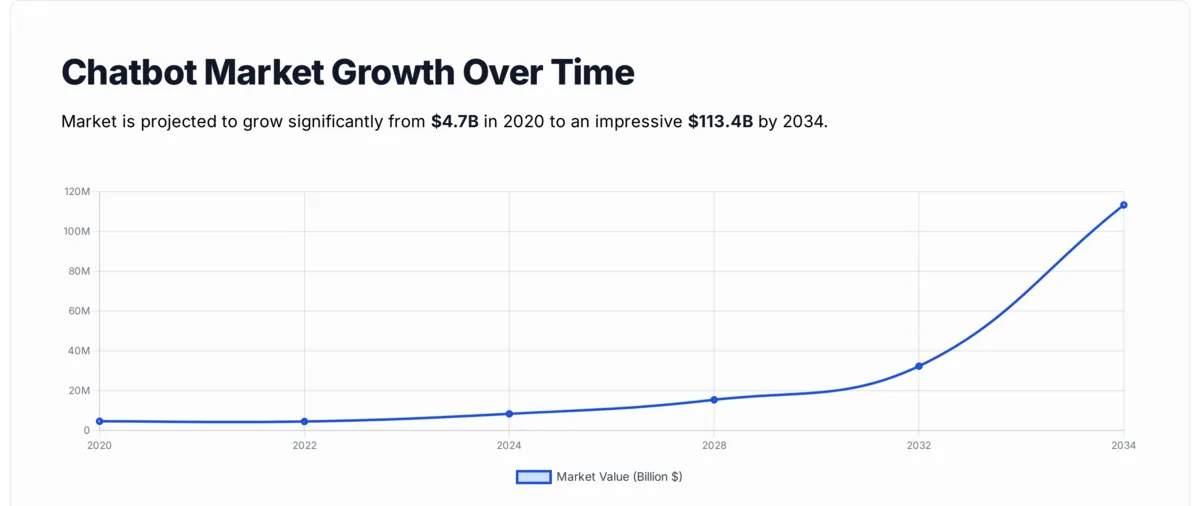
Global chatbot revenue is expected to reach $113 billion by 2034, up from $4.7 billion in 2020. — SEOProfy
A 24x increase in 14 years signals that chatbots aren't a passing trend. The acceleration comes from generative AI capabilities that make bots far more useful than the rigid, rule-based tools from 2018-2020. We've seen this firsthand at Popupsmart, where AI chatbots for SaaS businesses have gone from nice-to-have to a standard part of the conversion stack.
What to do: Budget for chatbot tooling as a recurring line item, not a one-time experiment. The companies that build chatbot capabilities now will have years of training data and customer interaction history that latecomers can't replicate.
Chatbot Market Growth Timeline 2020-2034
How Are Businesses Adopting Chatbots in 2026?
Adoption rates tell you more than market forecasts. They show what companies are actually doing right now, not what analysts predict they'll do later. The data here surprised me: B2B companies are adopting chatbots faster than B2C.
B2B vs. B2C Adoption Rates
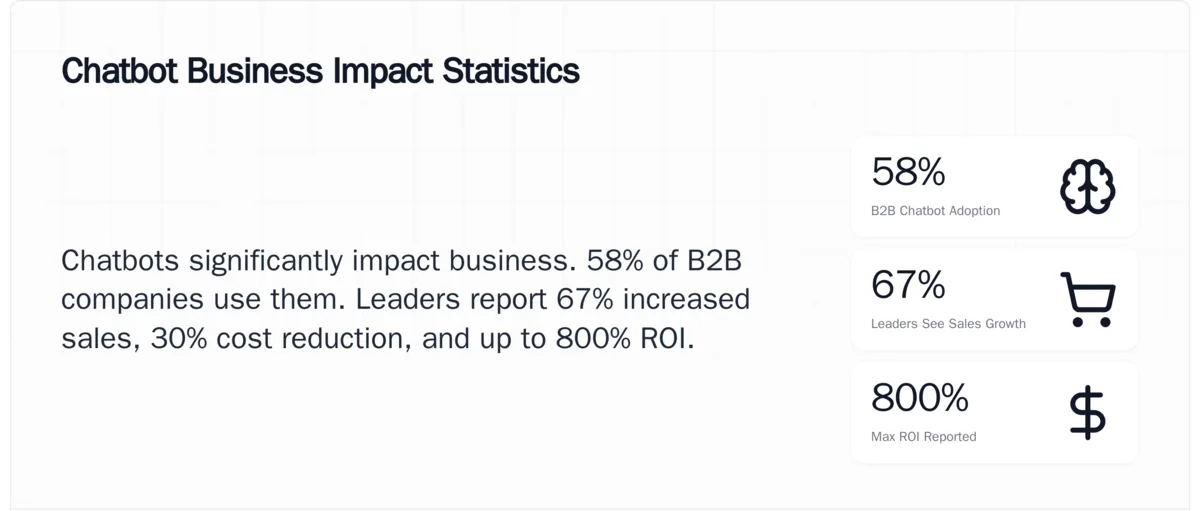
58% of B2B companies have integrated chatbots into their websites, compared to 42% of B2C companies. — SEOProfy
This gap makes sense when you think about B2B sales cycles. They're longer, involve more questions, and typically happen outside business hours across time zones. A chatbot that can qualify leads at 2 AM saves a sales team hours of manual follow-up. I've watched e-commerce managers at mid-sized Shopify stores deploy chatbot-driven lead generation and cut their response time from hours to seconds.
If you're in B2B, your competitors likely already have a chatbot. If you're in B2C, there's still a window to gain an edge by deploying one before the majority catches up.
How Business Owners View Chatbot Impact
60% of business owners believe AI chatbots can improve customer experience. — Tidio
The remaining 40% likely haven't used a modern AI chatbot yet. The gap between rule-based bots from 2020 and today's generative AI-powered assistants is enormous. Older bots frustrated users with rigid menus. Current ones hold genuine conversations, remember context, and resolve issues without human escalation.
If your team still associates "chatbot" with the clunky bots of five years ago, run a pilot with a current-generation tool. The experience shift will change internal buy-in fast.
What ROI Do Chatbots Deliver?
ROI questions come up in every chatbot budget meeting. The numbers below come from real deployments, not vendor marketing decks. They range from modest cost savings to genuinely eye-popping returns.
Sales Impact and Revenue Gains
Business leaders report a 67% increase in sales through chatbot interactions, and 26% of all sales transactions start with a bot interaction. — Intercom via Spiceworks
That 67% figure isn't about chatbots replacing sales reps. It's about bots catching leads that would otherwise bounce. A visitor who has a question at 11 PM doesn't fill out a form and wait. They leave. A chatbot that answers immediately keeps them engaged long enough to convert. For e-commerce and SaaS sites, this is the same principle behind using AI-powered tools to reduce friction at the moment of highest intent.
You need to track your chatbot's contribution to pipeline separately from other channels. Measure first-touch attribution: how many deals started with a bot conversation?
Chatbot Business Impact and ROI Metrics
The Amtrak Case Study: 800% ROI
Amtrak's chatbot "Julie" generated an 800% return on investment, saved $1 million in customer service costs in a single year, answered over 5 million questions annually, and increased bookings by 25%. — Overthink Group
Amtrak's case stands out because the ROI came from multiple channels simultaneously: direct cost savings, increased bookings, and higher revenue per booking (30% more revenue from chatbot-initiated bookings). Most chatbot ROI calculations focus only on support cost reduction, but the revenue side often delivers more.
When building your chatbot business case, model both cost savings (support ticket deflection, reduced headcount needs) and revenue gains (lead qualification, upsell opportunities, after-hours conversion). The revenue side is where the real upside lives.
What Do Consumers Think About Chatbots?
Consumer sentiment data is where chatbot statistics get interesting, because the narrative has shifted. Two years ago, most surveys showed hesitation. Now the numbers tell a different story.
Overall Satisfaction Rates
87.2% of consumers rate their interactions with chatbots as either neutral or positive. — Master of Code
That 87.2% figure would have been unthinkable in 2020, when most chatbots were glorified FAQ search bars. The jump correlates directly with generative AI improvements. When a bot can actually understand what you're asking instead of matching keywords, satisfaction goes up. I've noticed the same pattern with on-site messaging tools: the more contextual they are, the less users resent them.
If you launched a chatbot before 2024 and saw poor satisfaction scores, it's worth re-evaluating with a current AI-powered solution. The technology has changed enough that old results aren't predictive of new ones.
Chatbot vs. Waiting for Humans
82% of respondents say they'd talk to a chatbot if there was any waiting involved in speaking to a human representative. — Tidio
This is the stat that should settle internal debates about whether customers "want" chatbots. They don't want chatbots for the sake of chatbots. They want answers without waiting. The bot is a means to that end. When you frame it as "instant help vs. hold music," the preference is obvious.
You need to position your chatbot as the fast lane, not the only lane. Always offer a human handoff option. The 82% who prefer bots still want to know a person is available if the bot can't help.
How Effective Are Chatbots at Resolving Issues?
Adoption and sentiment only matter if chatbots actually solve problems. The resolution data shows they do, but with clear boundaries on what they handle well and where they still struggle.
Query Resolution Speed
90% of customer queries are resolved in fewer than 11 messages. — Tidio
Eleven messages or fewer means most conversations take under three minutes. That's dramatically faster than the average 7-minute phone call or 24-hour email response time. For live chat and chatbot deployments, this speed is the primary driver of customer satisfaction, not the sophistication of the conversation itself.
Monitor your chatbot's average conversation length. If most queries take more than 15 messages, your bot's knowledge base or conversation flow needs tuning. The 11-message benchmark is a good target.
Task-Specific Resolution Rates
Virtual assistants can handle 58% of return and cancellation cases without human intervention. — SEOProfy
Returns and cancellations are repetitive, rules-based processes. That's exactly what bots excel at. The 42% that still need humans typically involve edge cases: damaged items requiring photos, partial refunds with custom calculations, or emotionally charged situations where empathy matters. Knowing that boundary helps you set realistic expectations for your team and your customers.
Start your chatbot deployment with the most repetitive, rules-based tasks first: order tracking, return initiation, password resets, appointment scheduling. Save the complex stuff for phase two.
What Are the Chatbot Statistics for Cost Savings?
Cost reduction is the easiest chatbot benefit to quantify, which is why it shows up most often in executive presentations. The savings come from two places: deflecting support tickets and reducing average handling time.
Customer Support Cost Reduction
Chatbots can help businesses save up to 30% on their customer support costs. — According to IBM, as cited by HappyFox
A 30% cut in support costs is significant for any business, but the math varies wildly by company size. A 10-person support team spending $600K annually saves $180K. A 100-person team saves $1.8M. The savings scale linearly because chatbots handle the same repetitive questions whether you have 100 customers or 100,000. This is why marketing automation tools that include chatbot functionality have become standard in the small business stack.
Calculate your cost per support ticket (total support spend / total tickets). Multiply by the percentage of tickets that are FAQ-type questions. That's your chatbot savings ceiling.
Automating Contact Center Tasks
Chatbots can automate 30% of tasks performed by contact center staff, leading to potential savings of $23 billion in the U.S. alone. — Master of Code
The $23 billion figure is an aggregate across all U.S. contact centers. For individual companies, the takeaway is that roughly one-third of what your support team does today could be automated. That doesn't mean cutting a third of your staff. It means redeploying them to higher-value work: retention calls, upsell conversations, and complex case resolution.
Audit your support ticket categories. Identify the top 10 most frequent request types. If any of them follow a predictable script (status checks, password resets, return policies), those are your first automation candidates.
How Is AI Chatbot Market Share Distributed?
The AI chatbot market shifted dramatically in 2025-2026. ChatGPT still leads, but the gap is closing as Google and other players invest heavily in consumer-facing AI products.
ChatGPT's Dominant Position
ChatGPT reached 815 million users in February 2026, with 5.7 billion monthly visits. — First Page Sage
Those numbers make ChatGPT one of the most-visited websites on the planet. For marketers, the implication is practical: your customers are already comfortable talking to AI. That comfort transfers directly to chatbots on your website. The mental friction of "talking to a bot" has largely disappeared for the mainstream user base.
Use ChatGPT's ubiquity as a reference point when introducing your chatbot to customers. Users who interact with ChatGPT daily already expect bot conversations to feel natural. Make sure your on-site bot meets that expectation.
Daily Message Volume
In July 2025, Sam Altman confirmed that ChatGPT users send 2.5 billion messages daily. — Exploding Topics
2.5 billion daily messages means people aren't just trying AI chatbots. They're using them habitually. This behavioral shift matters for every business running a website with customer interactions.
If your visitors spend part of their day talking to ChatGPT, a static FAQ page feels outdated by comparison.
Consider how conversational interfaces could replace or supplement static content on your site. Product comparison pages, pricing calculators, and support docs can all benefit from a chatbot layer that lets visitors ask follow-up questions.
What Are the Industry-Specific Chatbot Adoption Trends?
Chatbot adoption isn't uniform across industries. Some sectors have gone all-in, while others are still testing the waters. The variation mostly tracks with how repetitive and high-volume customer interactions are.
E-commerce and Retail
34% of consumers prefer chatbots in e-commerce over any other sector, including banking. — Invesp
E-commerce leads because the questions are simple and the stakes are low. "Where's my order?" "Do you have this in blue?" "What's your return policy?" These are perfect chatbot queries.
In retail, Gartner documented that Solo Brands deployed a generative AI chatbot that resolves 75% of customer interactions, nearly doubling their previous 40% resolution rate (Gartner). For customer acquisition, bots that answer pre-purchase questions keep browsers from leaving.
If you run an e-commerce store, your chatbot should know your product catalog, shipping policies, and return process cold. These three areas account for the majority of e-commerce chatbot interactions.
Lead Generation and Marketing
55% of companies using chatbots for marketing report generating higher-quality leads. — Jotform
Higher quality, not just more volume. The distinction matters. A chatbot qualifies leads in real time by asking the right questions: budget, timeline, company size, specific needs. That's the same qualification process a lead generation automation system runs, but it happens conversationally instead of through form fields. Visitors share more information in a conversation than they do in a 10-field form.
Build your chatbot's qualification flow around the same criteria your sales team uses to score leads. If your reps need to know budget, timeline, and use case before scheduling a demo, your bot should gather those three data points first.
What Challenges Do Chatbots Still Face?
The statistics aren't all positive. Chatbots still have real limitations, and ignoring them leads to poor implementations that damage customer trust. Being honest about these gaps is more useful than pretending they don't exist.
Accuracy Concerns with AI Responses
A DW investigation found that 53% of answers from AI assistants had significant issues, with 29% containing specific factual errors. — DW
This stat applies to general-purpose AI chatbots answering open-ended questions, not to purpose-built customer service bots with curated knowledge bases. But the distinction matters for your implementation. If you deploy a chatbot that relies solely on a large language model without grounding it in your specific product data, accuracy problems are predictable.
Always ground your chatbot in verified, company-specific data. Use a retrieval-augmented generation (RAG) approach where the bot pulls answers from your knowledge base rather than generating responses from scratch.
Consumer Preference for Humans in Complex Cases
74% of internet users prefer chatbots for straightforward questions, but 60% still prefer waiting for a human agent for complex issues. — Chatbot.com
These two numbers aren't contradictory. They show that consumers are rational about when bots are useful and when they aren't. Simple questions: bot. Complicated problems requiring judgment or empathy: human.
The mistake companies make is trying to force bots into situations where humans are clearly better. That erodes trust in the bot for simple queries too.
What to do: Set clear escalation triggers. If a conversation exceeds a certain length, involves negative sentiment, or matches specific keywords (refund dispute, complaint, legal), route to a human immediately. Don't make customers ask for a person.
How Are Younger Demographics Using Chatbots?
Demographic data on chatbot usage points to where the market is heading. Younger users who grow up with AI chatbots will expect them everywhere, and that shapes how every B2B and B2C company should plan their customer interaction strategy.
Teen AI Chatbot Usage
64% of U.S. teens have used AI chatbots, and about 30% use them regularly. — The Hill, citing Pew Research Center
When 64% of teens are already comfortable with chatbots, the "will customers accept bots?" question is answered. The next generation of buyers and employees won't just accept chatbots. They'll expect them. For businesses planning their digital marketing strategy, this shifts the question from "should we add a chatbot?" to "how fast can we get one deployed?"
If your customer base skews younger (under 35), prioritize chat-first support over traditional channels. This demographic will use your chatbot before they look for a phone number or email address.
Gen Z Engagement Patterns
Nearly 35% of Gen Z users in the U.S. actively use AI chatbots on a regular basis. — Semrush
The 35% regular usage figure among Gen Z is even more telling than one-time trial numbers. Regular use means these users have integrated chatbots into their workflows, whether for research, shopping, or problem-solving. That habitual behavior carries over to every website they visit.
Design your chatbot experience for mobile-first interaction. Gen Z users predominantly access websites through smartphones, and a chatbot that's awkward on mobile will lose them immediately.
What Do Chatbot Performance Metrics Look Like?
Measuring chatbot performance goes beyond "did it work?" Good metrics reveal where your bot excels, where it fails, and what to improve next. Here are the benchmarks I've found most useful.
Executive ROI Confidence
57% of executives report that chatbots bring significant ROI with minimal investment. — HappyFox
That "minimal investment" qualifier is the key detail. Modern chatbot platforms don't require six-figure custom development projects anymore. Most SaaS chatbot tools start under $100/month and can be deployed in days, not months. The development cost ranges from $5,000 for basic implementations to over $1 million for enterprise-grade custom solutions (SEOProfy), but the middle ground is where most businesses operate.
Start with a low-cost SaaS chatbot platform for your first deployment. Prove the ROI on a small scale before committing to a custom build. Most companies never need to move beyond the SaaS tier.
CX Leader Reorganization
70% of CX leaders have restructured their customer engagement strategies around AI and chatbot capabilities. — Jotform
Restructuring isn't the same as adding a chatbot widget to a corner of your site. It means rethinking how customer interactions flow from first touch to resolution.
The companies seeing the biggest returns are those that treat chatbots as a core part of their marketing automation strategy, not an add-on.
Map your entire customer journey and identify every point where a chatbot could reduce friction or capture data. Then prioritize the top three opportunities based on volume and impact.
What Does Self-Service Data Tell Us About Chatbot Demand?
Self-service statistics explain why chatbot demand keeps growing. Customers don't want more support channels. They want fewer interactions with support altogether.
Self-Service Preference
66% of customers try to use self-service before contacting support. — LeadDesk
Two out of three customers actively try to solve their own problem first. They search your knowledge base, check your FAQ, and look for a chatbot. If they can't find an answer, then they contact support. And at that point, they're already frustrated. A chatbot that intercepts them during the self-service phase, before they give up and submit a ticket, resolves the issue faster and at lower cost.
Place your chatbot prominently on help center pages, FAQ sections, and product documentation. These are the pages where self-service seekers land first, and where a proactive bot offer converts best.
If you're already using AI-powered engagement tools, the chatbot fits naturally into that same workflow.
Purchase Behavior Shift
41.3% of buyers turned to digital assistants for purchases after 2020. — Chatbot.com
The pandemic accelerated a behavior shift that hasn't reversed. Over 40% of online buyers now use chatbots as part of their purchase process, whether that's asking product questions, getting size recommendations, or checking stock availability. This isn't a temporary spike. It's a permanent change in how people shop online.
Ensure your chatbot has access to real-time inventory and product data. A bot that can confirm "Yes, we have that in size medium, and it ships by Friday" closes sales that a static product page can't.
What Does the Future Hold for Chatbots Beyond 2026?
Projections are inherently uncertain, but the directional trends are clear. AI chatbots will handle more, cost less, and become the default interface for customer interactions across most industries.
AI-Powered Customer Interactions
78% of organizations are now using AI in at least one business function. — LinkedIn (Rob Petersen)
With 78% of companies already using AI somewhere, the question isn't whether to adopt AI-powered chatbots, but how quickly to expand their role. Customer service is the most common starting point, but the next wave will be AI in sales qualification, onboarding, and even contract negotiations.
What to do: Create a three-phase AI chatbot roadmap. Phase one: customer support. Phase two: lead qualification and sales assist. Phase three: proactive engagement based on user behavior and intent signals.
Education and Broader Adoption
55.9% of students have a positive attitude toward AI chatbots in education, though 54.2% express concerns about over-reliance. — ScienceDirect
When the education sector embraces chatbots, it validates the technology for every other industry. Students who use AI chatbots for learning will enter the workforce expecting the same tools at their jobs. The concern about over-reliance is valid and worth tracking, but it doesn't slow adoption. It shapes how organizations deploy bots: as assistants, not replacements.
What to do: Frame your chatbot as an assistant that augments human capability. Internal communications about your bot should emphasize what it enables your team to do better, not what it replaces.
Methodology & Key Takeaways from 2026 Chatbot Data
These chatbot statistics were compiled from 25+ sources including industry research firms (Gartner, Pew Research Center), technology publications (Master of Code, Tidio, SEOProfy), academic journals (ScienceDirect), and case study databases (Overthink Group). All data points are from 2024-2026, statistics from before 2024 are clearly labeled with their year. We cross-referenced overlapping claims across multiple sources and noted discrepancies where they exist.
The chatbot market is growing at 23%+ annually because generative AI has made bots genuinely useful, not because of hype cycles. Consumer acceptance has crossed a tipping point: 87% neutral-to-positive satisfaction and 82% preference over waiting for humans means the adoption barriers are mostly internal, not customer-facing. The ROI evidence is now strong enough (800% in Amtrak's case, 30% cost savings industry-wide) to justify chatbot investment at nearly any company size.
For marketing teams and e-commerce managers evaluating chatbot tools, the data says to stop deliberating and start implementing. Pick a focused use case (support deflection or lead qualification), deploy a SaaS chatbot platform, and measure results over 90 days. The companies that wait for the "perfect" solution will fall behind those that start learning from live data now. Tools like AI marketing platforms make it possible to integrate chatbot functionality alongside your existing conversion tools.
FAQ About Chatbot Statistics
What Is the Projected Chatbot Market Size in 2026?
The chatbot market is projected to be between $15.5 billion and $46.6 billion by 2028-2030, depending on the research firm and scope of measurement. According to Rev, the global AI chatbot market was valued at $15.6 billion in 2024 and is expected to reach $46.6 billion by 2030. The wide range reflects different definitions of what counts as a "chatbot" versus a broader conversational AI platform. For planning purposes, I'd use the conservative $15.5 billion figure for near-term budgeting.
Can Chatbots Answer Routine Questions?
Yes, modern AI-powered chatbots can handle 70-80% of routine customer questions without human intervention. The exact percentage depends on how well your knowledge base is structured and how narrowly you define "routine." A chatbot trained on a specific product catalog with well-documented policies will hit 80%+ resolution rates. A generic bot deployed without customization will struggle to reach 50%. The gap is entirely about implementation quality, not technology limitations.
How Do You Measure Chatbot Performance?
The five metrics that matter most are: resolution rate (percentage of conversations resolved without human handoff), customer satisfaction score (post-chat survey), average conversation length (shorter is usually better for routine queries), containment rate (percentage of users who stay in the bot without abandoning), and cost per resolution (total chatbot spend divided by resolved conversations). According to Tidio, 90% of queries resolve in under 11 messages, which gives you a useful benchmark for conversation length.
How Many Businesses Will Use Chatbots by 2027?
Tidio projects that chatbots will become a primary customer service channel for 25% of all businesses by 2027. Given that 58% of B2B companies already use chatbots on their websites and adoption is accelerating, reaching 25% as a primary channel (not just an add-on) is a conservative estimate. The real growth will come from small and mid-sized businesses adopting affordable SaaS chatbot platforms that didn't exist three years ago.