ChatGPT
 Perplexity
 Claude
 Grok
Grok Google AI Mode
Let’s assume that you are in a tech store. It is getting late. You just saw the tablet you had been looking for. And it is on sale! The price is 25% off. You are going to come back to the store the next day. The salesperson stopped you and said that that discount is ONLY valid for that specific day, you will miss it after today. What would you do?
You know you want the tablet, it is on sale. You either miss the chance of buying it at discount, or you will take it with you home.
That's a limited-time offer at work. A real deal with a real deadline, and a decision you have to make now. Below you'll find the seven common types with a worked example of each, what a flash sale is and how long one lasts, 11 limited-time offer examples, and how to create urgency without a fake countdown. Every brand example was checked on 10 October 2026.
What is a limited-time offer?
A limited-time offer (LTO) is a promotion with a stated end: a date and time, or a stock level, after which the deal is gone. The 'Limited Time Offer' (LTO) is an effective pricing strategy for companies to lift short-term sales, because a shopper who can buy later often buys later, or not at all.
Making people act is not an easy task. There are multiple types of limited-time offers out here. Limited-time offers are a great way to raise sales and, when you keep your word on the deadline, to build customer loyalty. Which limited-time offers can you use?
Time-limited offers, limited-period offers, time-sensitive offers and "while supplies last" deals are all names for the same idea. What changes from one type to the next is what ends the deal.
Types of limited-time offers
There are seven common types of limited-time offers, and they differ by what ends the deal: a short clock, a visible timer, the stock, a launch date, a single view, the retail calendar or a membership.
| Type | What ends it | Worked example: offer and deadline | Example copy |
|---|---|---|---|
| Flash sale | A short clock, a few hours to two days | 25% off all skincare for 24 hours, Friday 9 a.m. to Saturday 9 a.m. ET | "24 hours only: 25% off all skincare. Ends Saturday 9 a.m. ET." |
| Countdown deal | A visible timer to one fixed end time | A free tote with orders over $60 until Sunday at midnight | "Free tote with orders over $60. Ends Sunday at midnight." |
| Limited quantity | The stock runs out | 200 numbered prints of a new design, no restock | "200 numbered prints. No reprint." |
| Early-bird | A date before a launch or an event | 15% off preorders until the launch on 20 November | "Preorder by 19 November and save 15%. Ships 20 November." |
| One-time offer | It's shown once, usually after a purchase | A matching case for $10 on the order confirmation page | "Add the case for $10. This offer won't show again." |
| Seasonal | A date on the retail calendar | 30% off sitewide from Friday 27 to Monday 30 November 2026 | "Black Friday: 30% off everything until Monday at midnight." |
| Members-only | Membership plus a short window | 48 hours of early access for loyalty members before the public sale | "Members shop first. Early access ends Thursday at 9 a.m." |
The examples in the table are illustrations, not live offers. Swap in your own products, dates and time zone, and keep each promise the copy makes.
What is a flash sale?
A flash sale is a short, steep discount that an online store runs for a few hours to two days, usually announced with little notice and ended at a fixed time. Salesforce's commerce glossary defines it as "a time-sensitive promotion that offers steep discounts for a limited time", and adds that, unlike regular discounts, flash sales tap into the fear of missing out.
A flash sale puts more pressure on time than any other limited-time offer. The discount is the reason to buy. The short window is the reason to buy now. Example (illustration): a coffee roaster sends a 9 a.m. email for 30% off every bag until 3 p.m. the same day, then ends the sale at 3 p.m. sharp.
How long do flash sales last?
A flash sale usually runs from a few hours to 48 hours, with 24 hours a common choice. Salesforce's glossary says flash sales last "sometimes for just a day or even a few hours", puts two to four hours at the short end for VIP or online-only sales, calls 24 hours a common sweet spot and keeps 48 hours for larger promotions, after which interest tends to drop. Shopify's help center on flash sales uses a 24-hour sale as its example (both read 10 October 2026).
Shopify's page also says flash sales "can drive a high volume of sales in a short period of time". It recommends special preparation, started weeks in advance, only when you expect tens of thousands of customers to start a checkout within a few minutes. A store expecting 50,000 visitors and 1000 orders over 24 hours, in Shopify's own example, needs none.
Flash sale vs other limited-time offers
A flash sale differs from other limited-time offers in three ways: the window is shorter, it comes with little notice, and the discount is the whole point.
| Flash sale | Seasonal sale | Limited-quantity offer | One-time offer | |
|---|---|---|---|---|
| What ends it | A clock, hours to two days | A date on the calendar, days to a week | The stock | A single view |
| Notice | Little or none | Announced ahead | Often announced ahead | None |
| What drives it | The discount | The occasion | The product's scarcity | Convenience after a purchase |
Limited-Time Offer Examples
You can use urgency and scarcity to get people to convert under a limited-time special offer. By promising that the offer will expire soon or that supplies are limited, you motivate your customers to act. The benefits of using urgency and scarcity are obvious, as long as the expiry and the limit are true.
When your offer is time-sensitive, you can use urgency to set a deadline. If no deadline is offered, customers may wait before acting on your offer.
The 11 examples below mix real stores, checked on 10 October 2026, with clearly labelled illustrations.
Countdown Limited Offers
Countdown timers give prospective customers a sense of urgency, and they act fast due to fear of missing out. (FOMO)
If your offer has a real end time, a countdown timer offer puts it in front of the shopper.
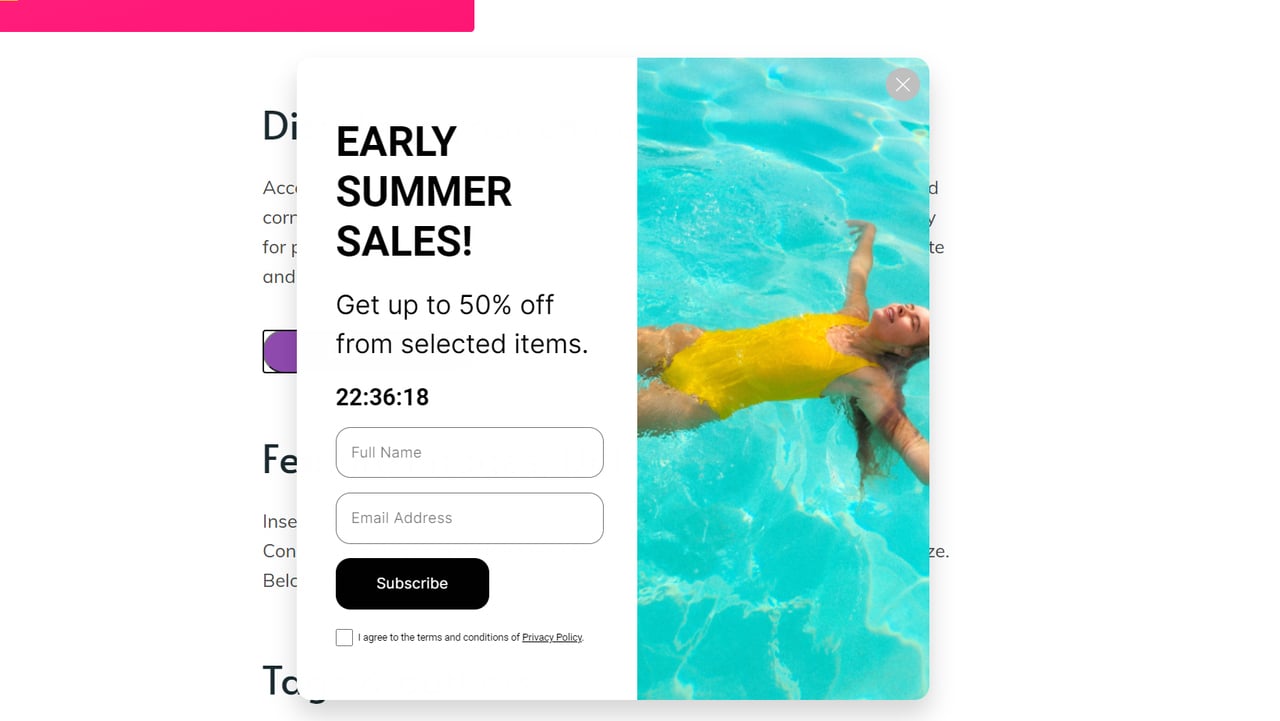
Countdown timers remind customers to buy before the sale ends. As the name suggests, the offer has a countdown timer. These offers can be the end of the deal or the beginning of the deal stating ‘offer starts in..’
Knowing that the time is ticking down, they rush to buy from you before your limited-time offer expires.
The timer has to count down to the same end time for every visitor. A timer that restarts when someone reloads the page is what the FTC's staff calls a "baseless countdown timer" in its report Bringing Dark Patterns to Light (September 2022). For timer designs that stay honest, see these countdown timer popup examples.
Limited-Period Offers for Different Product Types
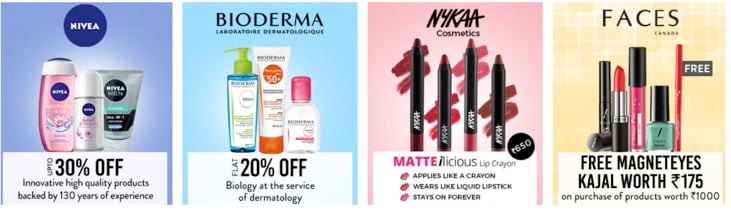
These offers are only available for a limited time, after which they will be withdrawn. The image above shows a variety of offers on a beauty retailer's site (a screenshot used in the 2023 version of this post). Each offer has a different campaign for each product type.
This way, you can show all your campaigns to your prospective customers and give a sense of urgency to each of the product types. Example (illustration): up to 30% off one brand and a flat 20% off another, both ending the same Sunday at midnight, so shoppers only have one date to remember.
Limited-Period Offers for the Entire Site
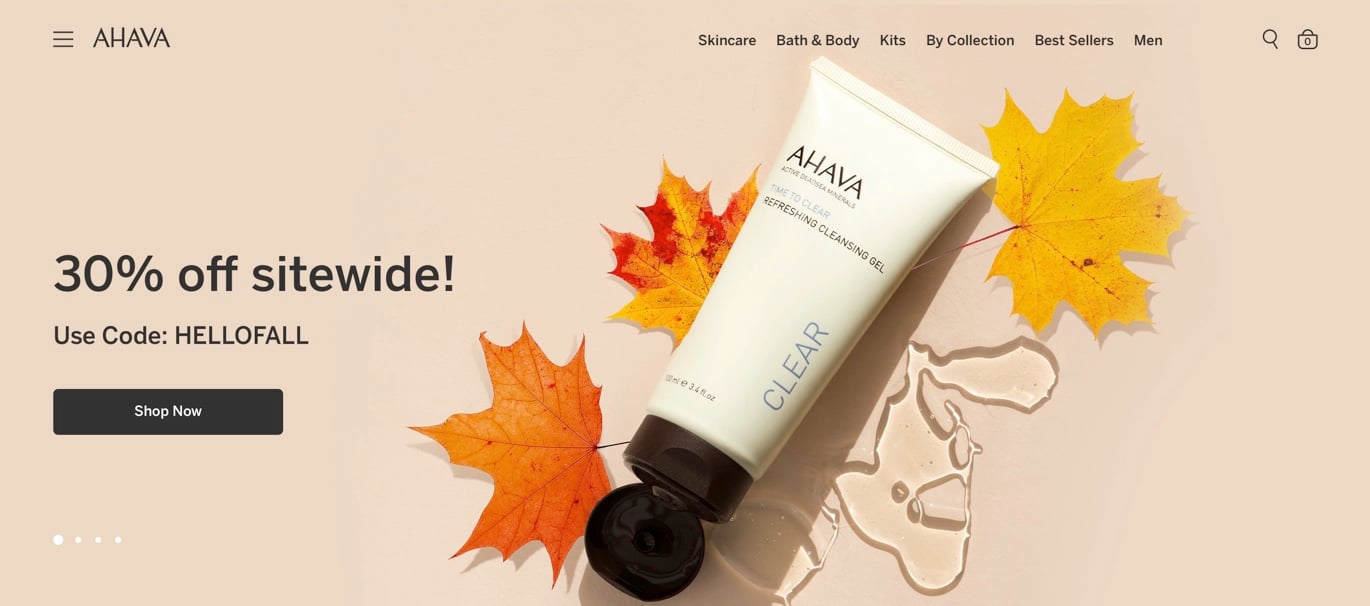
If you want to promote your site to get more sales, you may want to check out the benefits of a sitewide discount. You can add the offer to your website slider, like the Ahava example shown, or you can add the offer anywhere on your landing page. The screenshot comes from an earlier fall campaign.
Ahava still runs sitewide offers this way. On 10 October 2026 its homepage slider read "Prime in Fall Sale Is On" with 30% off and $45 gifts under the code PRIME30. Everlane's homepage the same day announced "Friends and Family 30% off sitewide", calling it "The biggest event of the season".
A landing page is a page on your website where visitors land when they click on a link from a source other than your home page, such as an advertisement or search engine.
Limited Supply Offers
This type of offer is also a very effective way of marketing for the customers. It basically means after the stocks run out, they won’t get a deal. Therefore it is their only chance! The main point is that the offer type implies scarcity, and people feel they can miss the product any second.
People are more likely to grab the opportunity of getting a good offer product when they see it is available for a limited time.
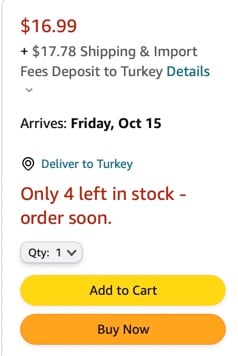
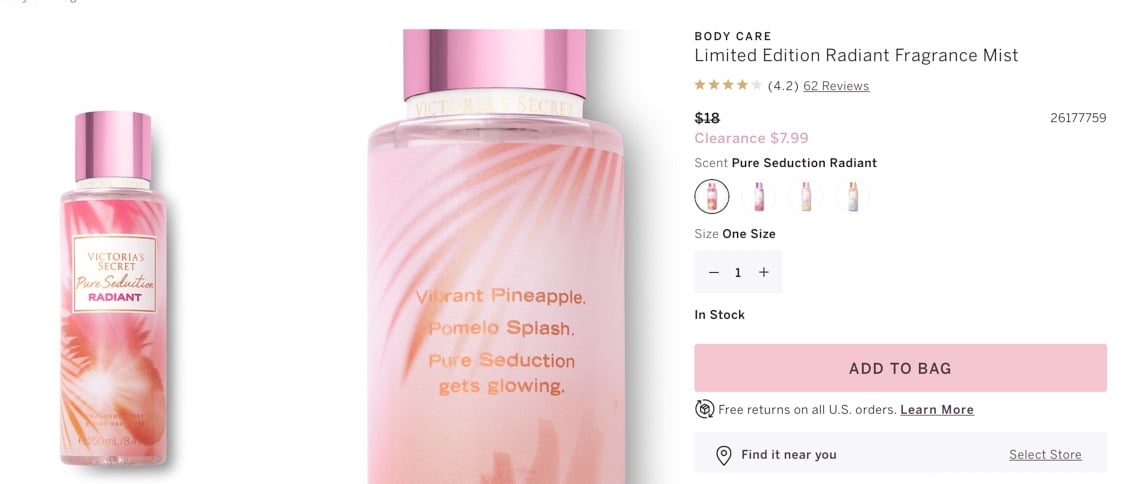
One example shown is from Amazon, showing there are only 4 items left in stock (screenshot from October 2021). Amazon still shows these lines: a search on 10 October 2026 returned "Only 2 left in stock - order soon." The other example is from Victoria’s Secret, showing the item in ‘Limited Edition’ means that the stocks are limited and the product will not be available after the stocks run out. Its beauty pages still advertise "limited edition beauty and gifts".
Early-bird offers
An early-bird offer rewards people who buy before a date: a preorder, a product launch, a course or an event ticket. The deadline is the launch or the event itself, so it's real by design.
Example (illustration): a candle brand opens preorders for a winter scent with 15% off until the launch on 20 November. The copy says "Preorder by 19 November and save 15%. Ships 20 November." On launch day the price goes to full, and the product page says what the full price is.
First-Time Purchase Offers
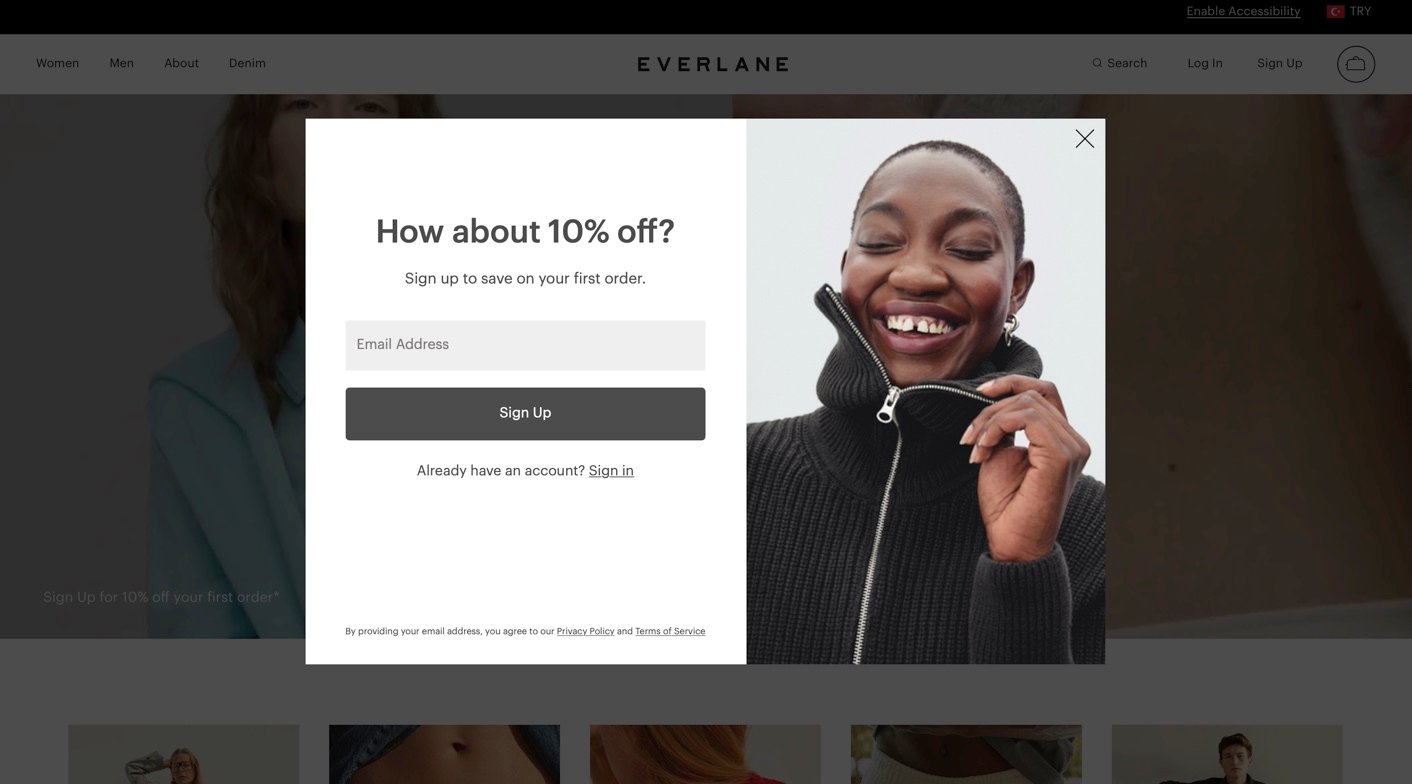
First-time purchase offers are designed to lure new customers who have never made a purchase at your store. Retailers use first-time purchase offers to increase the number of new customers who make a purchase at their store. You can also use first-time purchase discount offers as Everlane does with a popup ad.
This ad directs prospective customers to sign up to the website and that way they will get a 10 percent discount on their first purchase (a screenshot used in the 2023 version of this post). On 10 October 2026, Everlane's site offered 20% off your first order for signing up. This is both getting them to make a purchase and sign up with their email address. You can try to create one of these popups by using Popupsmart’s FREE tool.
To make a first-order offer a limited-time offer, give the code an expiry, such as seven days after signup, and say so in the email that delivers it. Our coupon code ideas show first-order code formats you can copy.
Today's consumers are bombarded with deals and promotions. You must offer deals that stand out to be noticed, or you could lose out on sales.
Members-only offers
A members-only offer limits who can buy as well as when: loyalty members, subscribers or past customers get a deal, or early access, for a short window.
Amazon's Prime Big Deal Days is the best-known version. According to Amazon's announcement of 14 September 2026, the event ran on 6 and 7 October 2026 with deals "exclusively for Prime members" in 22 countries. Its Today's Big Deals dropped three times a day and were "available only while supplies last", so the event combined a members-only window with a limited quantity.
Example (illustration): a skincare store gives loyalty members 48 hours of early access before its public sale, with the copy "Members shop first. Early access ends Thursday at 9 a.m."
Seasonal offers
Seasonal offers tie the deadline to the retail calendar, so shoppers already expect them: Black Friday on 27 November 2026, Cyber Monday on 30 November 2026, the December holidays and Valentine's Day on 14 February 2027.
Example (illustration): 30% off sitewide from Friday 27 to Monday 30 November 2026, ending at midnight on Monday. Plan the whole year with our seasonal campaign guide, and see Black Friday popups for the biggest weekend.
Shipping cut-off offers
A shipping cut-off is one of the most honest deadlines in ecommerce: order by a date and the parcel arrives before the holiday. Nobody has to invent the urgency, because the carrier sets it.
Example (illustration): "Order by Friday 18 December for delivery before 24 December", with the date taken from your carrier's published cut-offs and the banner switched to gift cards once it passes.
Beneficial Call to Action Offers
You are using CTA all the time. Call to Action (CTA) is defined as any message inviting the user to perform a specific action. What about offering a beneficial CTA? You can offer FREE shipping to get customers to register to your website using a popup.
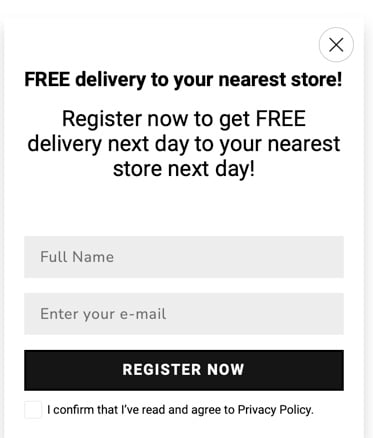
Or, you can suggest that they have products in their basket and you are offering 30% off of their next purchase if they complete their order.
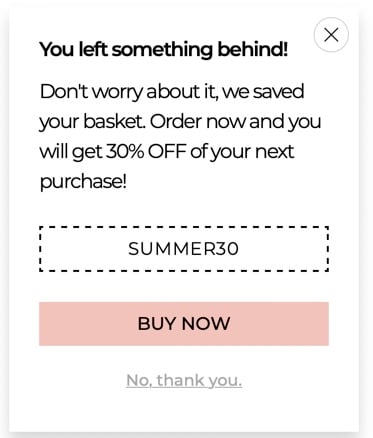
Give each of these an end date too, such as "free delivery on orders placed by Sunday". A cart offer earns its place because many shoppers leave before checkout; our cart abandonment statistics show how often that happens.
One-time Offers
Limited-time offers are designed in many ways. If the offer is not limited in time, it may be a one-time offer. This type of offer is usually accompanied by an expiration date. A one-time offer is limited by views rather than by a calendar date: the shopper sees it once, often with an expiry such as "until you leave this page".
The one-time offer is a direct way to create a sense of FOMO, the fear of missing out. Offers are typically used by businesses to encourage customers to buy more products or services after they have already made a purchase.
The most important part of a one-time offer is that the customer or potential buyer is told that he or she has only one chance to buy the product, and the purchase must be instant. So it has to be one chance. If the copy says "this offer won't show again", don't show it again.
Example (illustration): after checkout, the order confirmation page offers the matching phone case for $10 instead of $18, with one button to add it to the same order.
Scarcity, urgency and FOMO examples
Urgency limits the time to act, scarcity limits the quantity, and FOMO (fear of missing out) is the feeling both create. A sense of urgency in marketing is the reason a shopper decides now instead of later, and the honest version is always a real deadline or a real limit.
Scarcity examples in real life
Scarcity examples in real life are easy to find once you look for the limit behind the message:
- Low-stock lines. Amazon's "Only 2 left in stock - order soon." on a search results page (10 October 2026).
- Limited editions. Victoria's Secret's beauty pages advertise "limited edition beauty and gifts".
- Deal drops. Amazon's Today's Big Deals during Prime Big Deal Days 2026 were "available only while supplies last".
- Restocks. Shopify's flash sale guide describes a store with "stock selling out in minutes each time it's restocked" after a feature on a major network.
- Seats and tickets. A workshop with 40 seats, or an early-bird ticket price that ends when the first batch sells (illustrations).
In each case the limit exists before anyone writes the copy. That's the line between scarcity marketing and a false low-stock message.
FOMO marketing email examples
A FOMO marketing email tells subscribers what they'll miss and when it ends. Three examples that stay honest (illustrations):
- "Last day: 25% off ends at midnight ET", sent on the sale's final morning.
- "Your saved jacket: 3 left in medium", sent only when the stock count is real.
- "You're in early: the sale opens to everyone Thursday", sent to members before the public launch.
The same lines work as FOMO advertising examples, as long as the ad's deadline matches the one on your site.
How to create urgency in sales without faking it
You create urgency in sales by giving shoppers a real reason to decide now: a deadline you'll keep, stock you actually have, or a bonus that ends. The timer is the easy part. Keeping the deadline is the work, and these seven steps keep it honest:
-
Set one end time and keep it. Write the date, time and time zone in every place the offer appears, and end it then.
-
Make any timer count to that end time. Every visitor should see the same clock. Use a per-visitor timer only when the offer is per visitor, and say so.
-
Show stock only from your inventory. A low-stock line has to come from the real count and update as items sell.
-
Use an honest "was" price. Compare with a price you actually charged, for a real period, before the sale (see the rules below).
-
Say what happens after the deadline. "The code stops working on Monday" or "the price goes back to $48" tells shoppers the deadline means something.
-
Don't repeat the same "last chance" every week. Customers notice, and the next deadline stops working.
-
Tell people where they already are. The best way to make a limited-time offer is to get the word out to your customers that they have a short period of time in which to take advantage of the deal. That might be via email, social media, a popup on your site, or even direct mail.
Give them an expiration date and let them know what they will miss out on if they don’t act now!
Tip: Use a value word such as “Get”
Using the word ‘Get’ in your calls to action is a common choice, and Popupsmart's 2026 benchmark points the same way without settling it: CTA buttons that promise value ("Get", "Claim", "Unlock") look stronger than "Subscribe" / "Join" buttons (1.06% vs 0.77%, English popups, median campaign), but the gap is not statistically reliable.
- Get your 15% off now
- Get your discount
Tip: Build Trust
Many businesses regularly offer limited-time offers coupled with limited inventory, which drives huge interest. The strongest way to demonstrate your trustworthiness is through action. Make sure you can back up all the promises you make.
If they decide to come back to the same product and they still see the same offer which should have been ended days ago, you will lose your credibility. The effect of it also continues with your future offers and sales. Your customers will start to expect this.
You should also consider if you decide on a sitewide sale offer, everything better be on sale. Otherwise, they will simply leave your site. If some items are excluded, say which ones next to the offer.
If you are not providing users with the right type of information, you can say farewell to your website visitors.
Make sure to use a limited-time offer for a product that people actually want, make sure the time period is long enough to entice customers, and don't give away too much with your offer.
What regulators call fake urgency
Fake urgency can break consumer protection rules, and it costs trust either way. Here's what the main rules say, as read on 10 October 2026:
- US, FTC staff report (September 2022). Bringing Dark Patterns to Light lists a "baseless countdown timer" (a fake countdown clock "that just goes away or resets when it times out"), a "false limited time message" and a "false low stock message" among the dark patterns it describes.
- US, FTC Guides Against Deceptive Pricing. Under 16 CFR 233.1, a former price works as a basis for a sale price if it is "the actual, bona fide price at which the article was offered to the public on a regular basis for a reasonably substantial period of time".
- EU, Unfair Commercial Practices Directive. Annex I, point 7 bans in all circumstances "Falsely stating that a product will only be available for a very limited time" when the aim is "to elicit an immediate decision".
- EU, Price Indication Directive. Article 6a, added by the 2019 Omnibus Directive and applied since 28 May 2022, says any announcement of a price reduction must show the prior price: the lowest price the trader applied in a period of at least 30 days before the reduction.
This is a summary, not legal advice. Check the rules in each market where you sell.
How to promote a limited-time offer with a popup
A popup puts a limited-time offer in front of visitors while they're on your site, so it's a natural place to show the deadline, the code and, when the end time is fixed, a timer.
You don’t need to build a whole page to show your offer, you can easily create one online with a no-code tool.
You also don’t need to get a web developer to get started right away. You can easily create a promotion popup with Popupsmart, starting from one of its popup templates, and schedule your campaign between specific dates. Two features do the honest-urgency work:
- Schedule Date and Time targeting shows the popup only between the start and end date you set, so the offer disappears when it ends (how scheduling works).
- The countdown element adds a timer in days, hours, minutes and seconds, with an action you choose for when it runs out (how to add a countdown timer).
Try to create your own limited-time offers
You can now try what you just read in this article. You can try one of these popup types in your business today. As you work to build a profitable business, these useful tips will help you get there faster.
Check these articles out:
- How to Add a Countdown Timer to Shopify: Simple Processes, for a store on Shopify
- Exit intent popup examples, for last-chance offers shown as a visitor leaves
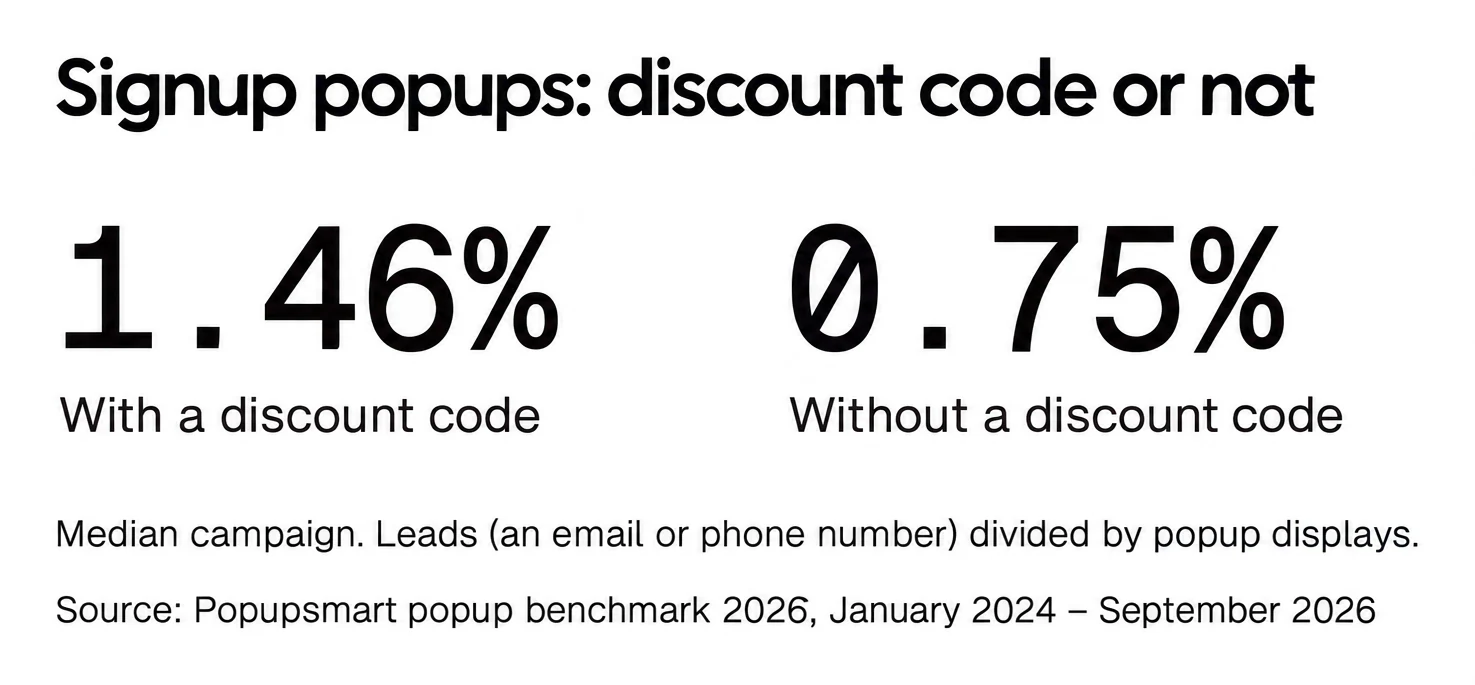
What the popup offers matters more than how loudly it says "hurry". In Popupsmart's 2026 benchmark, signup popups that offer a discount code convert 1.46% vs 0.75% for signup popups without one. The rates are leads per popup display, for the median campaign.
Frequently asked questions
What is a limited-time offer?
A limited-time offer is a discount, bonus or deal that a store makes available only until a set deadline or until a set quantity runs out. Flash sales, countdown deals, limited-stock drops, early-bird prices, one-time offers, seasonal sales and members-only events are all limited-time offers. The deadline is part of the offer's terms, so it has to be real.
How long do flash sales last?
A flash sale usually runs from a few hours to 48 hours. Salesforce's commerce glossary calls 24 hours a common sweet spot and says interest tends to drop after two days, and Shopify's help center uses a 24-hour sale as its example. Shorter windows of two to four hours suit VIP or online-only drops.
How long should a limited-time offer last?
Long enough for your audience to see the offer and act, and short enough that waiting costs them something. A flash sale runs hours to two days, a sitewide or seasonal sale a few days to a week, and an early-bird price until the launch date. Whatever you choose, state the end date, time and time zone, and end the offer then.
What is the difference between urgency and scarcity?
Urgency limits the time to act: the offer ends on a date or when a timer runs out. Scarcity limits the quantity: the offer ends when the stock, seats or codes run out. Both create FOMO, the fear of missing out, and both only work honestly when the deadline or the stock count is real.
What is a one-time offer?
A one-time offer is a deal shown once, usually right after a purchase, such as adding a matching accessory at a lower price on the order confirmation page. It is limited by views rather than by a calendar date. If the offer says it won't appear again, make sure it doesn't, or shoppers learn to ignore the claim.
Are fake countdown timers illegal?
They can be. In the EU, falsely stating that a product is available only for a very limited time to rush a decision is on the list of practices banned in all circumstances (Unfair Commercial Practices Directive, Annex I, point 7). In the US, the FTC's 2022 staff report on dark patterns lists baseless countdown timers and false limited-time messages. This is not legal advice.