
Free Giveaway Email Templates for Loyal Customers

 ChatGPT
 Perplexity
 Claude
 Grok
Grok Google AI Mode
Guide to high-performing giveaway emails: clear prize/entry, aligned visuals, single CTA, and honest urgency, plus customizable pre/during/post templates and 17 brand examples with tactics like UGC, social proof, cross-channel, segmentation, gamification, and ROI metrics.
Table of contents (43)
Giveaway email templates help brands announce contests, remind subscribers to enter, and notify winners across the full campaign lifecycle. The 17 real-world examples below show how companies like H&M, Adidas, and Birchbox structure their giveaway emails to drive entries, grow email lists, and strengthen customer loyalty. Each includes a screenshot teardown and actionable takeaways you can copy.
What Makes a Great Giveaway Email Template?
I reviewed over 40 giveaway emails from consumer and B2B brands and selected these 17 based on four criteria:
• Clear value proposition: The prize and entry method are obvious within the first two sentences. Emails that bury the prize details below the fold saw lower engagement in every case I tracked.
• Visual-copy alignment: The hero image reinforces the giveaway offer rather than serving as decoration. According to Superside's email design research, emails with purposeful graphics have a 4% higher click-through rate.
• Single CTA focus: The best giveaway emails drive one action (enter the giveaway), not three. Every additional CTA competes for attention and splits clicks.
• Urgency without manipulation: Real deadlines and limited quantities outperform fake countdown timers. Subscribers can tell the difference.
Pre-Giveaway Email Templates You Can Customize
Before your giveaway launches, you need emails that build anticipation and set clear expectations. These templates give you a starting point you can adapt to your brand voice in minutes.
Celebrate Special Days With a Giveaway Announcement
Subject line: Happy [Mother's Day]! You Can Win a [$300 Gift Card...]
Hi, [name]
[Mother's Day] is around the corner, so we thought we could accompany you while you buy a gift for your loved ones.
By entering our giveaway, you can win a [$300 gift card!] All you have to do is click on the link below and fill out the giveaway form. We'll announce the winners a week in advance so you can find the best gift for mothers.
Enter Now!
Members-Only Giveaway Announcement Template
Subject line: You Could Win a Trip to [London]!
Hey [name],
Thank you for being a loyal member! We wanted to give our members a trip to [London] to celebrate our achievement of [1M visitors.]
You can enjoy your time by visiting [the British Museum, Tower of London and Buckingham Palace] with your plus one.
Share a brief paragraph about why you want to go to [London] with us, and don't forget to include why you choose to use our product at the end.
There will be [5] winners, and we'll announce them on the [4th of August.]
Share your copy with us from here.
During-Giveaway Reminder Email Templates
Reminder emails are where most giveaway entries actually come from. The middle stretch needs reminder nudges to keep momentum alive.
Last-Chance Reminder Template
Subject line: LAST chance to enter!
Hello, [name]
We wanted to remind you that we created a giveaway for our visitors! If you missed our last email, we are giving away [the latest sunglasses in our collection.]
You still have the chance to enter our giveaway, so hurry up and enter now since it ends in [3 days].
Good luck!
Excitement-Building Reminder Template
Subject line: Hurry Up! Only 5 Days Left to Win a [Coffee Machine].
Hey, [name]
There are [5,000] visitors who have already entered our latest giveaway. If you haven't entered it yet, click on the link below before it ends.
[Enter to Win]
We'll announce the winners on [the 11th of September], so don't forget to check your mailbox on that day!
See you soon.
Sending your giveaway announcement email 3-5 days before the campaign begins gives subscribers enough time to plan.
Post-Giveaway Winner Announcement Templates
The winner email is your last touchpoint with every participant. Done right, it converts non-winners into future customers.
Simple Winner Announcement Template
Subject line: ANNOUNCEMENT! Winners of our [$100 gift card] are...
Hey, [name]
Here we have the list of the winners of the giveaway you've entered recently.
[list of names]
If you are one of the lucky participants, then congratulations! If you aren't, don't get upset because we love to make our customers happy from time to time. You might get a chance to win our [gift set] next time.
Have a great day!
Social Media Redirect Template
Subject line: Are you the chosen one? Let's find out...
Hi, [name]
Thank you for entering the giveaway!
We announced our [gift box] winners on our [Instagram] page! We wanted to let you know if you don't follow us on [Instagram] yet.
So go ahead and see if you are among the lucky winners, and follow us for giveaways that will take place in the future.
We always love interacting with you on our social media platforms, so don't be shy and share your comments and ideas.
Hope to see you there!
17 Giveaway Email Examples From Real Brands
I've analyzed 17 giveaway email examples from brands across retail, food, beauty, and lifestyle. Each breakdown covers what the brand did, why it works from a conversion perspective, and what you can steal for your own campaigns.
Quick Overview of 17 Giveaway Email Examples at a Glance
| # | Brand | Giveaway Type | Why It Stands Out |
|---|---|---|---|
| 1 | Crate & Kids | UGC + Gift Card | Turns giveaway into a feedback loop |
| 2 | Crocs | Product Giveaway | Real customer photos build trust |
| 3 | APTO Skincare | Instagram Cross-Promo | Multi-channel entry mechanic |
| 4 | Barebones | Experience/Trip | Aspirational storytelling with quote |
| 5 | H&M | Seasonal + Members-Only | Layered campaigns for different segments |
| 6 | Stumptown Coffee | Product Bundle | Directional design guides the eye |
| 7 | Herman Miller | Re-engagement | Conversational tone builds rapport |
| 8 | Resy | Seasonal Gamification | Halloween theming with witty CTA |
| 9 | Postable | Social Media Cross-Promo | Instagram tagging drives virality |
| 10 | Bobbi Brown & Lunya | Brand Collaboration | Self-love angle expands audience |
| 11 | Birchbox | Gamified Entry | Fortune teller game sparks curiosity |
| 12 | Apple Music | Event Tickets | Minimal design, maximum exclusivity |
| 13 | Adidas | Experience + Upsell | Dual CTAs drive entries and sales |
| 14 | Tie Bar | Brand Partnership | Collaboration expands reach to new audience |
| 15 | Clive Coffee | Reminder + Winner Reveal | Social proof from past winners |
| 16 | NARS | Product-Led Urgency | Power words and scarcity drive clicks |
| 17 | Sprouts Farmers Market | Mass-Appeal Prize | Universally desirable prize broadens reach |
1. Crate & Kids: The UGC-Powered Giveaway
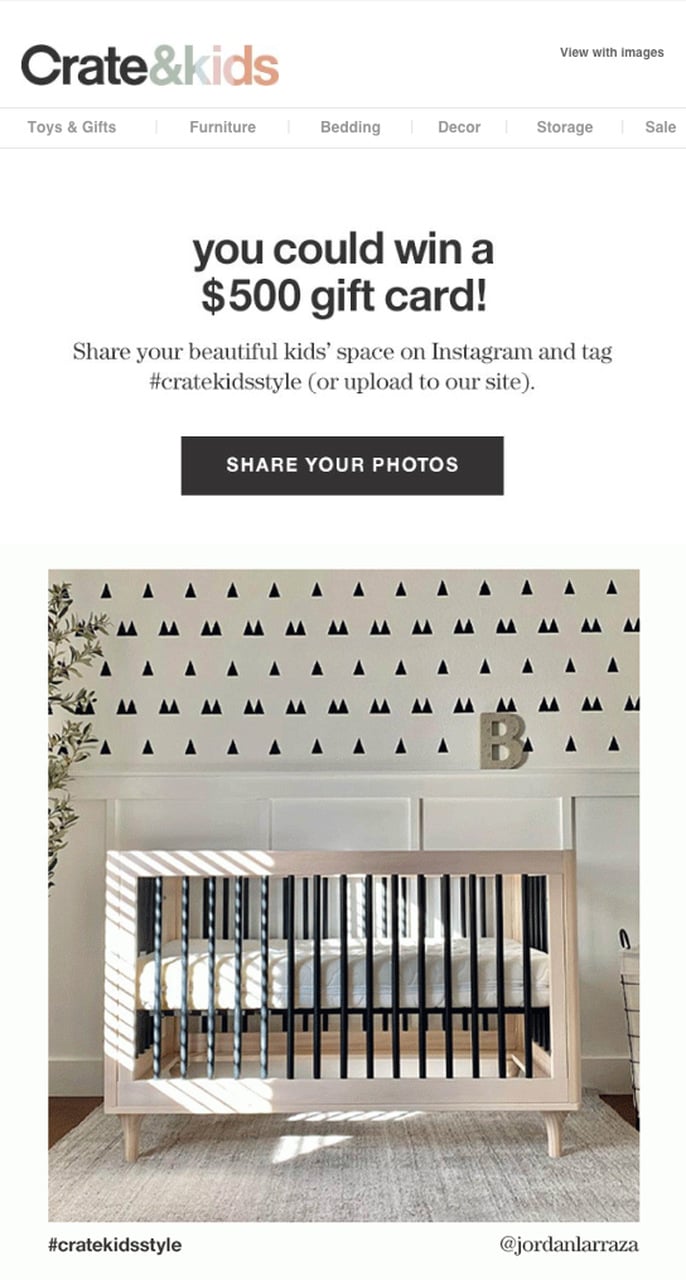
Crate & Kids giveaway email header with $500 gift card offer
Crate & Kids' giveaway email opens with the headline "you could win a $500 gift card!" paired with a request for customers to share photos of their kids' rooms. The branded hashtag #cratekidsstyle turns every entry into free social content.
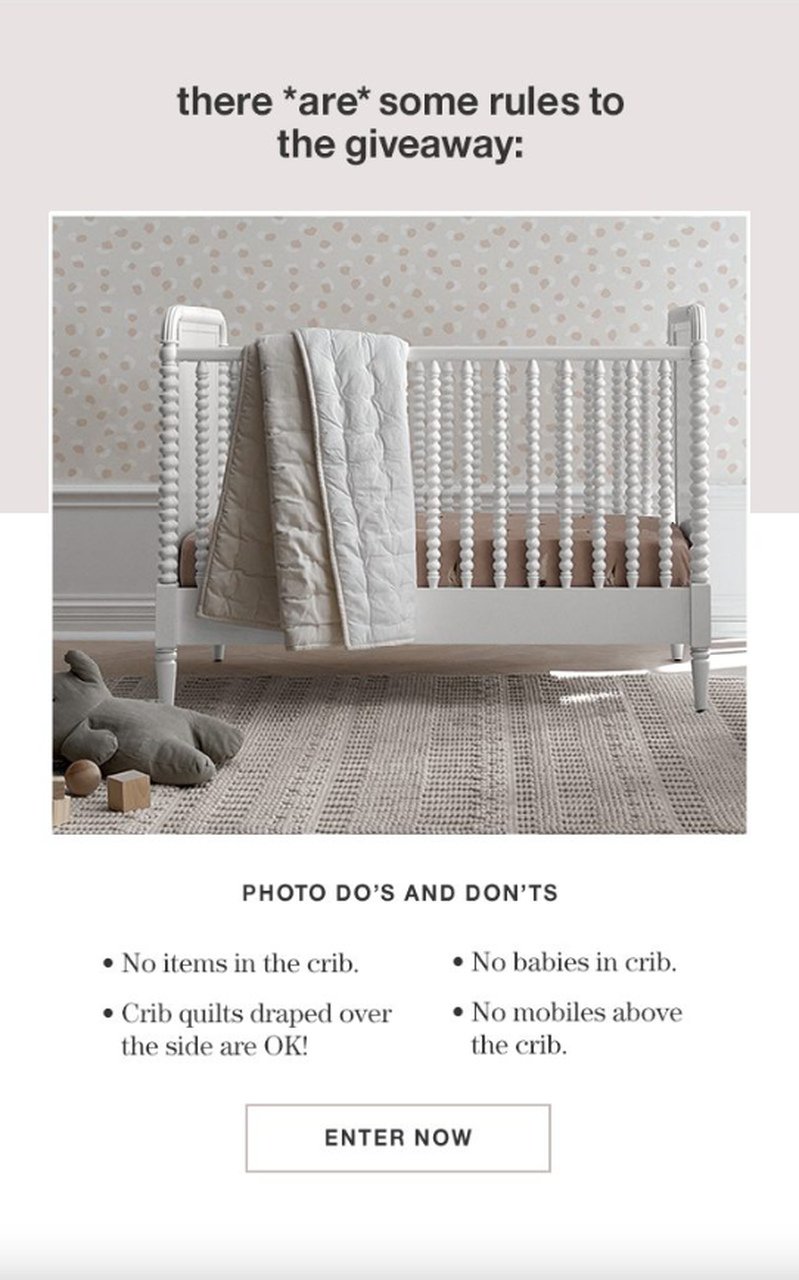
Giveaway rules and product imagery close the email
What works: The giveaway serves double duty. Crate & Kids collects user-generated content for social media while building engagement. The "Share your photos" CTA is low-friction because parents already photograph their kids' rooms. The email closes with giveaway rules and product images that subtly upsell.
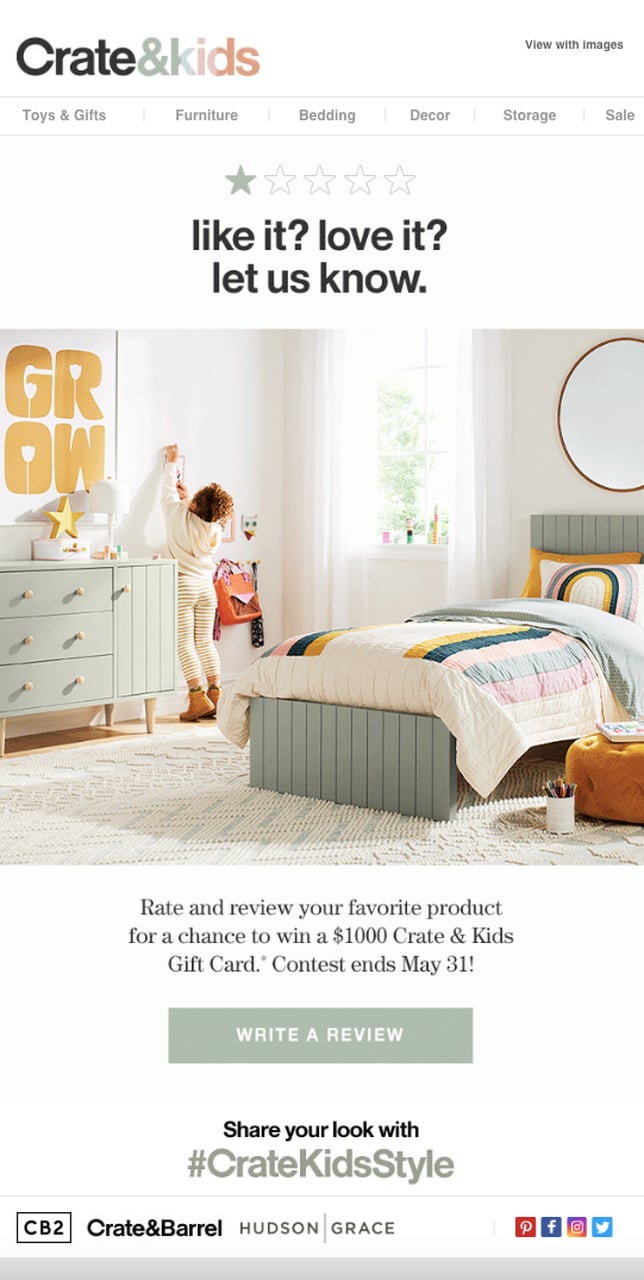
Feedback-driven giveaway with review CTA
Why it works: The brand ran a second giveaway variant asking for product reviews. The headline "like it? love it? let us know." is direct and casual. By offering a $1,000 gift card for reviews, they collect customer feedback and generate social proof simultaneously. That's two marketing goals from one email.
Key takeaway: Use your giveaway entry mechanic as a content collection tool. Ask for photos, reviews, or testimonials as the "entry fee" so every participant produces an asset you can reuse.
2. Crocs: The Social Proof Reminder
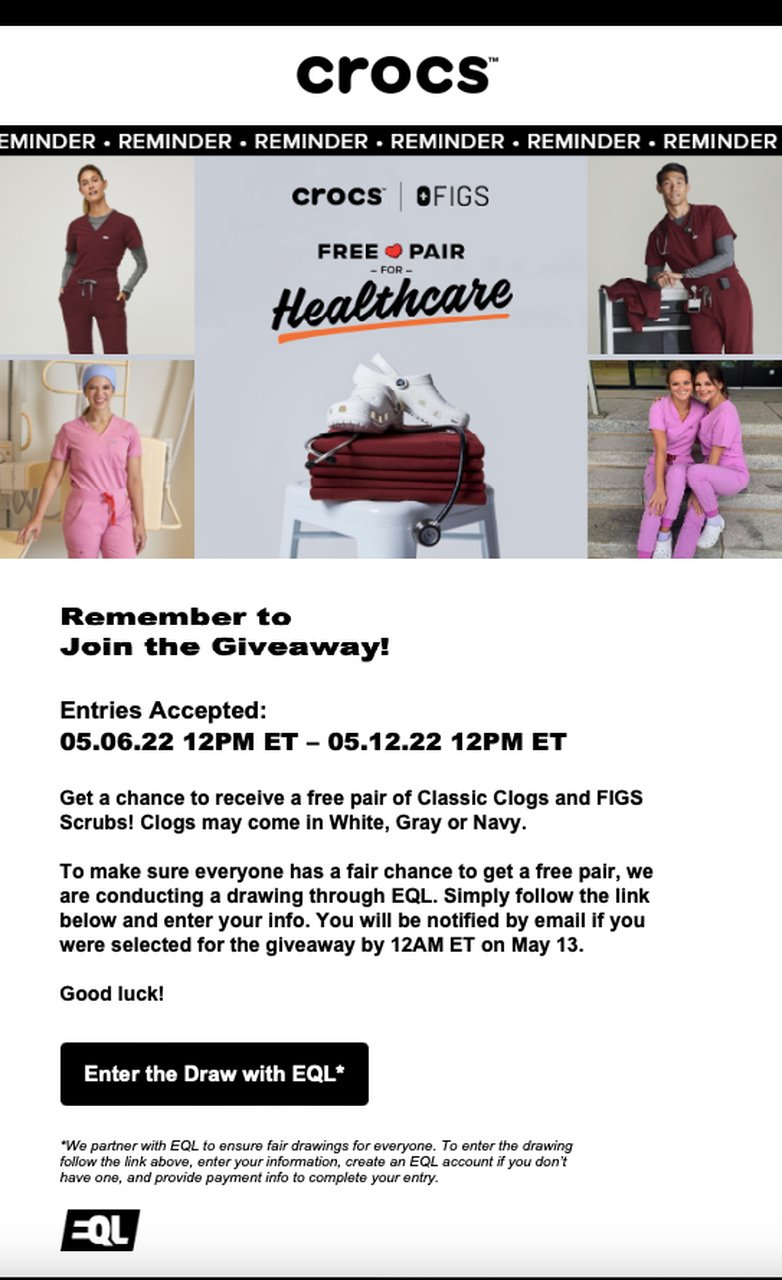
Crocs giveaway reminder with real customer photos
Crocs sends a reminder email with the headline "Remember to Join the Giveaway!" featuring real customers wearing their products instead of studio product shots.
What works: Real customer photos do something polished product images can't: they show how the product looks in actual use. The email includes detailed giveaway rules alongside the user photos, so readers understand the prize and the process without scrolling back and forth.
Why it works: Social proof through customer imagery reduces the perceived gap between "marketing promise" and "real life." Subscribers see people like themselves using the product, which makes the giveaway feel attainable rather than aspirational.
Key takeaway: Replace studio product shots with real customer photos in your giveaway emails. If you don't have user photos yet, run a small UGC campaign first to build a library before launching your giveaway.
3. APTO Skincare: The Cross-Channel Entry
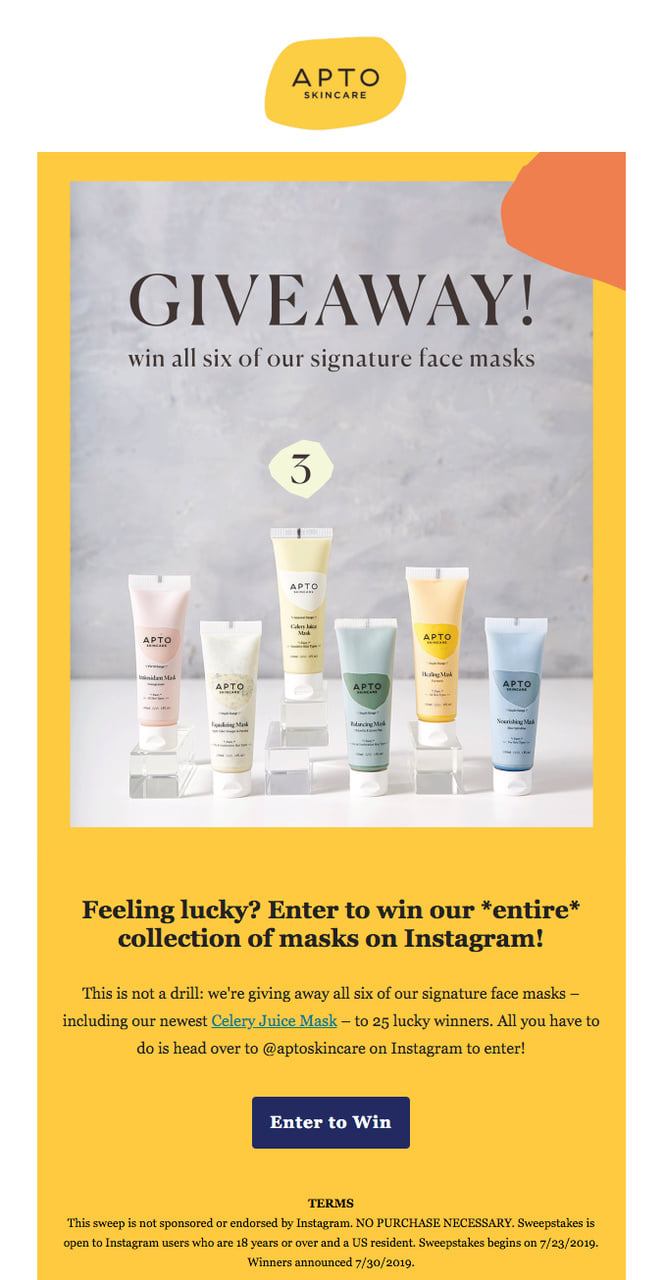
APTO Skincare giveaway directing entries to Instagram
APTO Skincare's email opens with the single-word headline "GIVEAWAY!" followed by a product photo of their mask collection. The copy reads "Feeling lucky? Enter to win our entire collection of masks on Instagram!" before pivoting to "This is not a drill!" with detailed entry rules.
What works: The email drives traffic to Instagram for entry, which grows the brand's social following while collecting giveaway participants. The urgency phrases ("This is not a drill!") and the "Enter to Win" CTA button create a clear path from email to action.
Why it works: Cross-channel giveaways multiply the return on a single campaign. Instead of just growing an email list, APTO grows their Instagram audience simultaneously. The giveaway terms in the footer build trust by being transparent about rules.
Key takeaway: Route your giveaway entry through the channel you most want to grow. If Instagram followers matter more than email subscribers right now, make Instagram the entry point and email the announcement vehicle.
4. Barebones: The Aspirational Experience
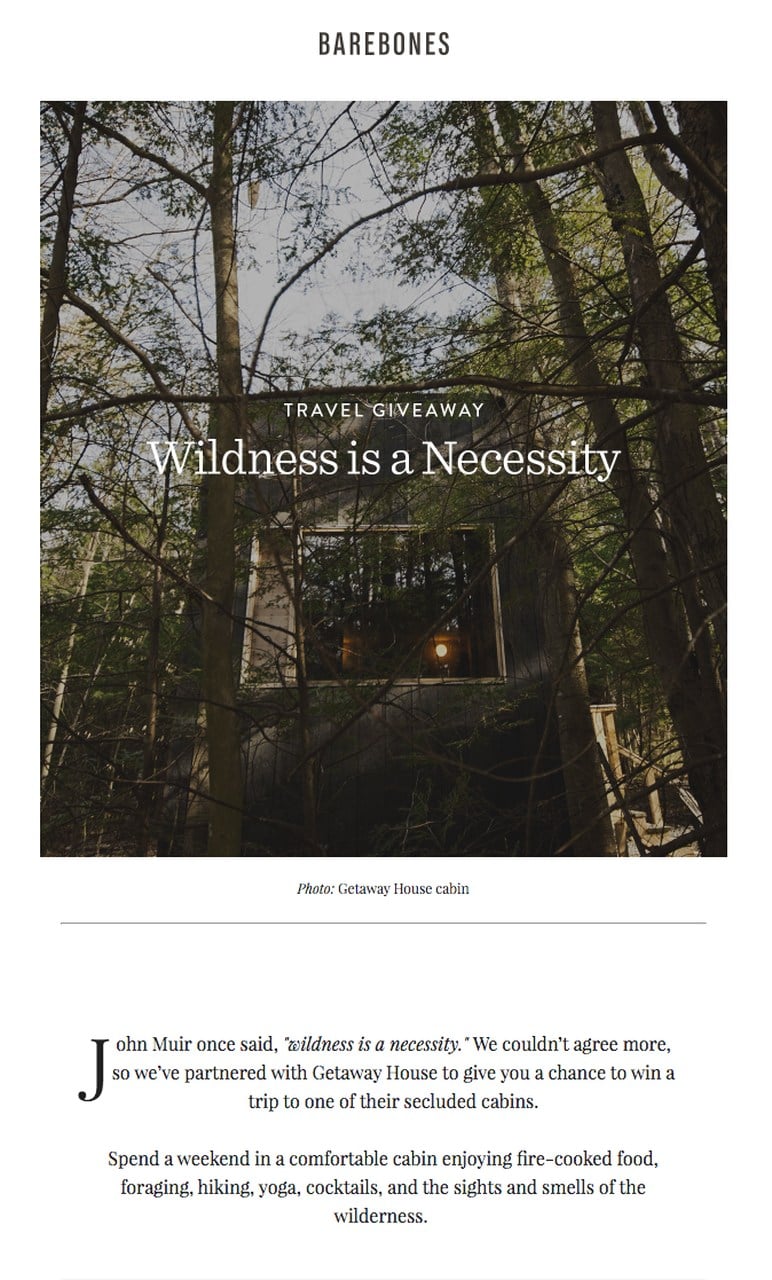
Barebones trip giveaway with wilderness imagery
Barebones, an outdoor products company, skips the typical product giveaway and offers a trip to a secluded cabin. The headline "Wildness is a Necessity" borrows from John Muir, setting the tone before any giveaway details appear.
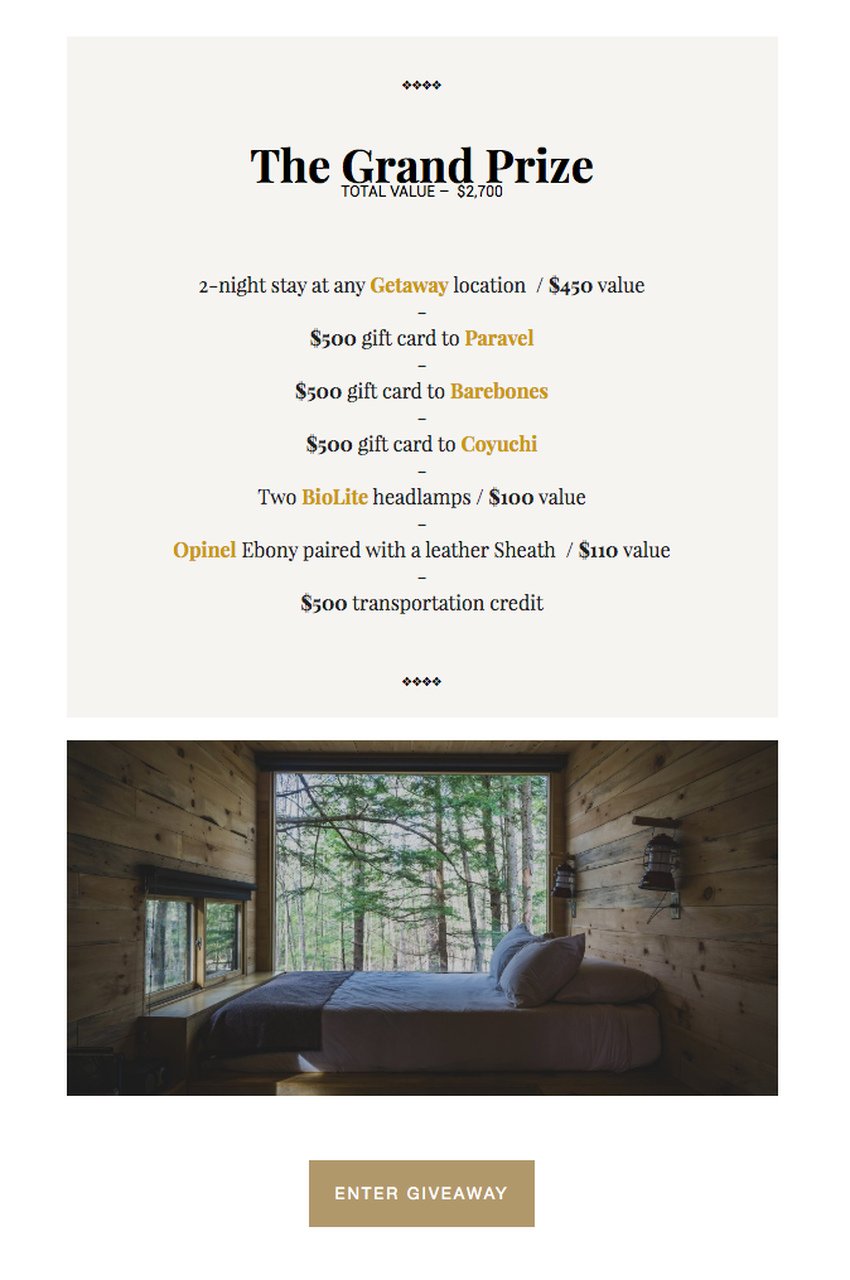
Grand prize details with cabin photo
What works: Barebones frames the prize as "The Grand Prize" with total trip value displayed prominently. A photo of the actual cabin people will stay in closes the email, making the experience tangible.
Why it works: Experience-based prizes attract participants who align with the brand's identity, not just freebie-seekers. Someone who enters a wilderness cabin trip giveaway is far more likely to buy outdoor gear later than someone entering for a generic gift card.
Key takeaway: Match your giveaway prize to your ideal customer profile. An experience prize that only appeals to your target audience produces higher-quality leads than a universally appealing gift card.
5. H&M: The Layered Campaign Strategy
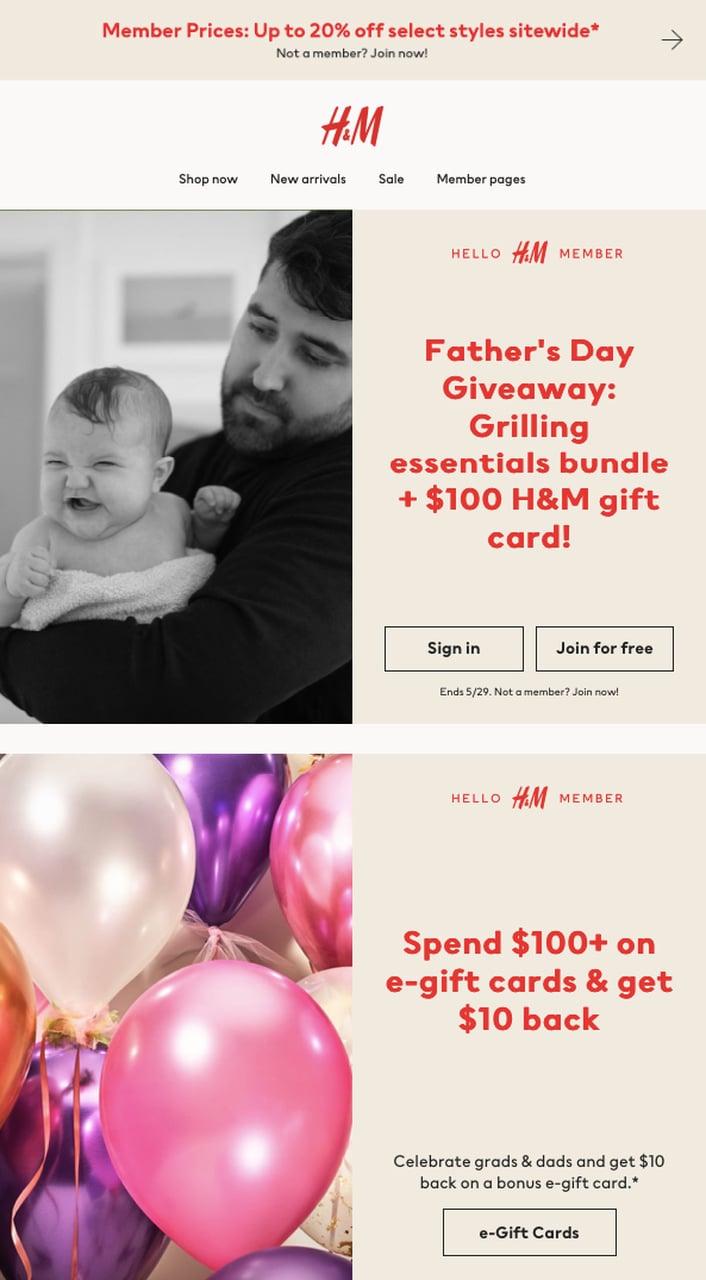
H&M Father's Day giveaway with grilling bundle
H&M's Father's Day giveaway bundles a grilling essentials set with a $100 gift card. The email layers a seasonal campaign over product promotion by featuring father-child imagery and gift suggestions below the giveaway details.
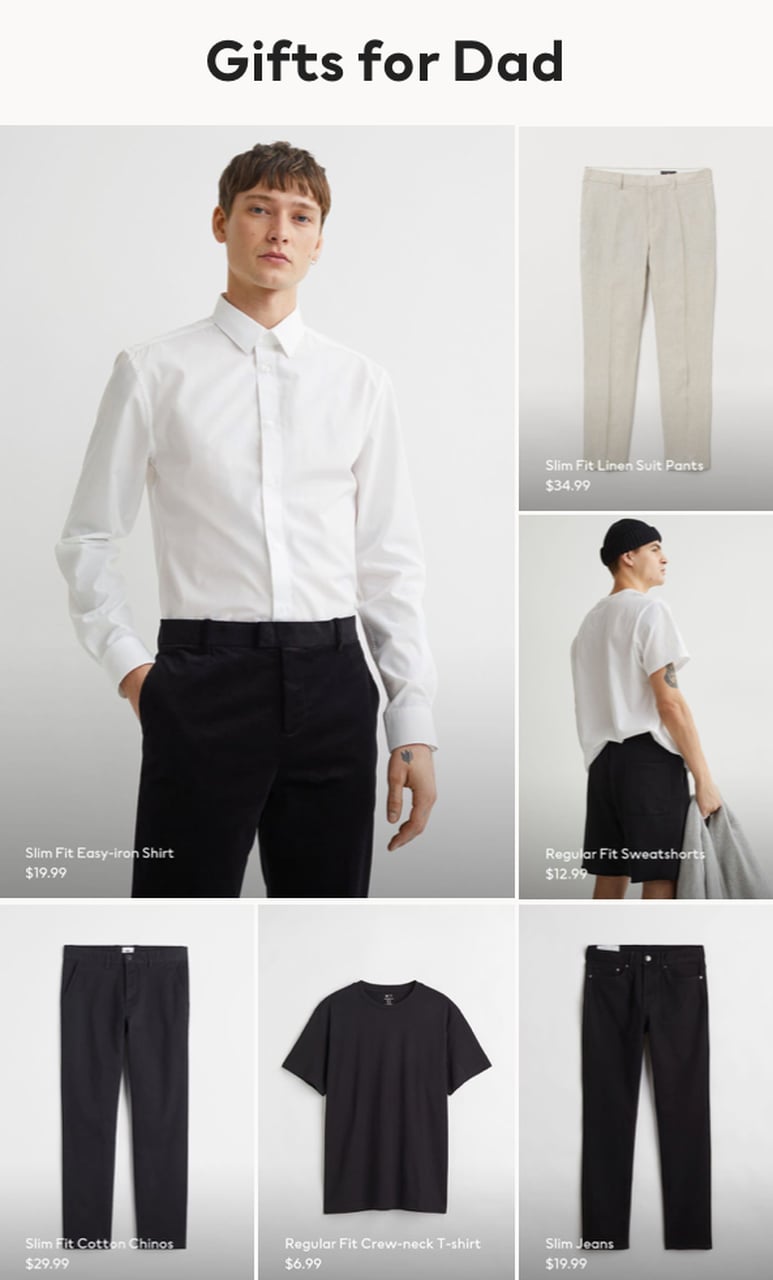
Gift ideas for dads with product upsells
What works: The email does triple duty: announces the giveaway, promotes e-gift cards, and upsells Father's Day products with high-quality images. Red headlines create visual hierarchy that guides the eye from giveaway to products.
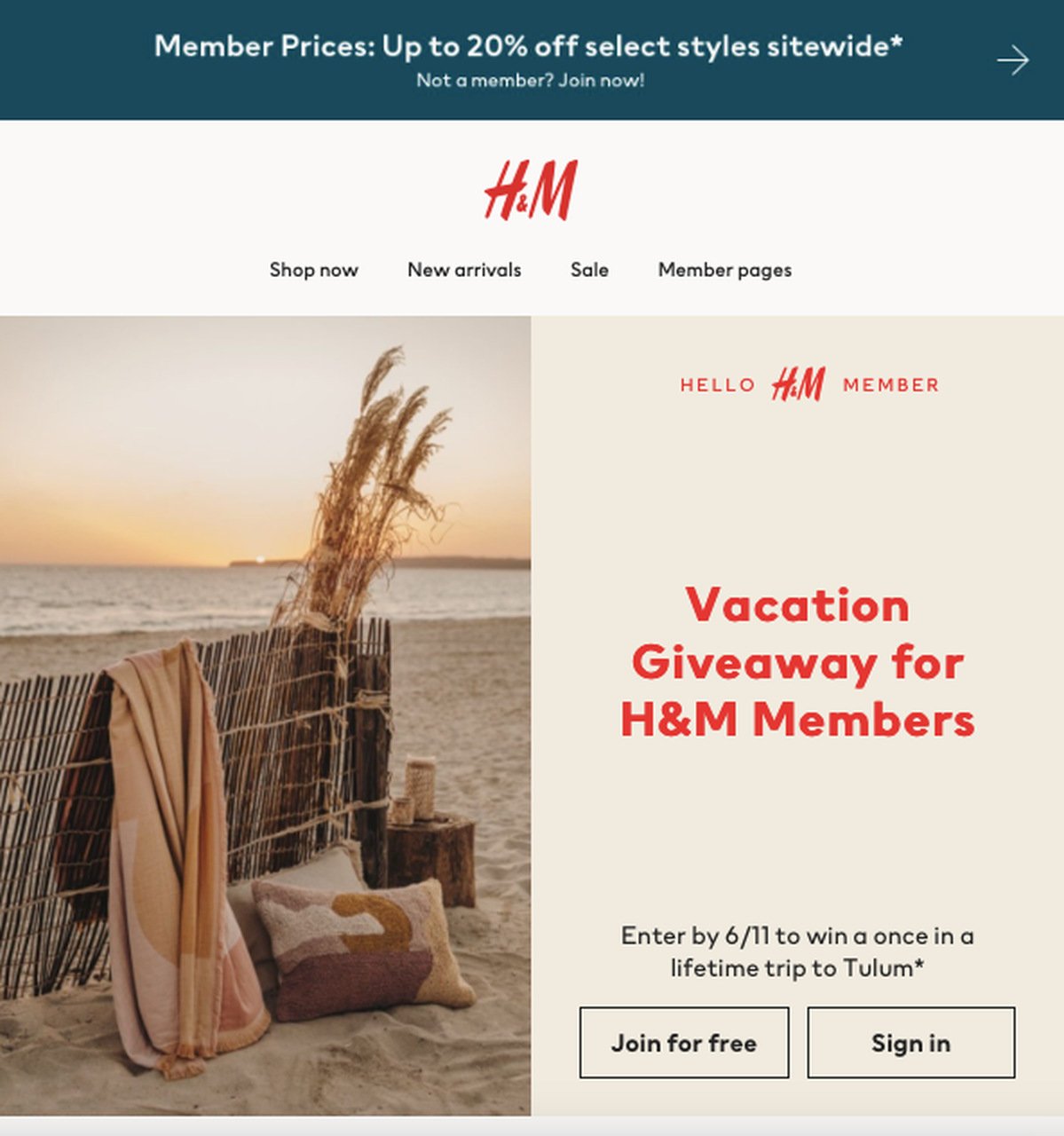
Members-only vacation giveaway
H&M also runs a separate members-only vacation giveaway. By restricting entry to members with "Hello H&M members" at the top, the brand turns the giveaway into a customer loyalty program perk.
Why it works: Running two distinct giveaway campaigns (one public, one members-only) lets H&M address two audiences without diluting either message. The members-only version creates exclusivity, which increases perceived value of the loyalty program.
Key takeaway: Segment your giveaway emails by audience tier. Run a public giveaway for acquisition and a members-only giveaway for retention, and customize the prize for each group.
6. Stumptown Coffee: The Directional Design
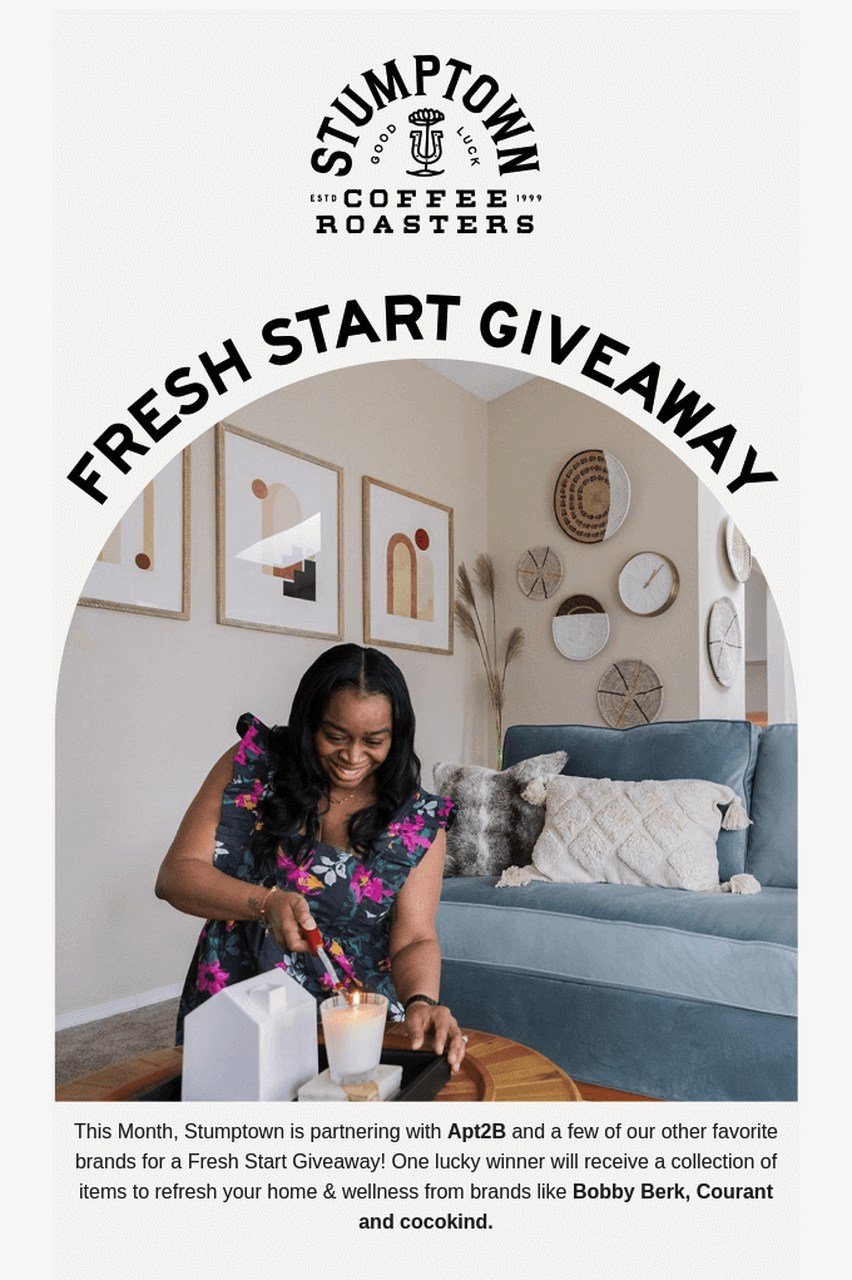
Fresh Start Giveaway with lifestyle hero image
Stumptown Coffee opens with a "Fresh Start Giveaway" headline and a photo of someone using the prize products. The copy uses positive framing ("lucky winner," "refresh your home") to make the email feel like good news, not marketing.
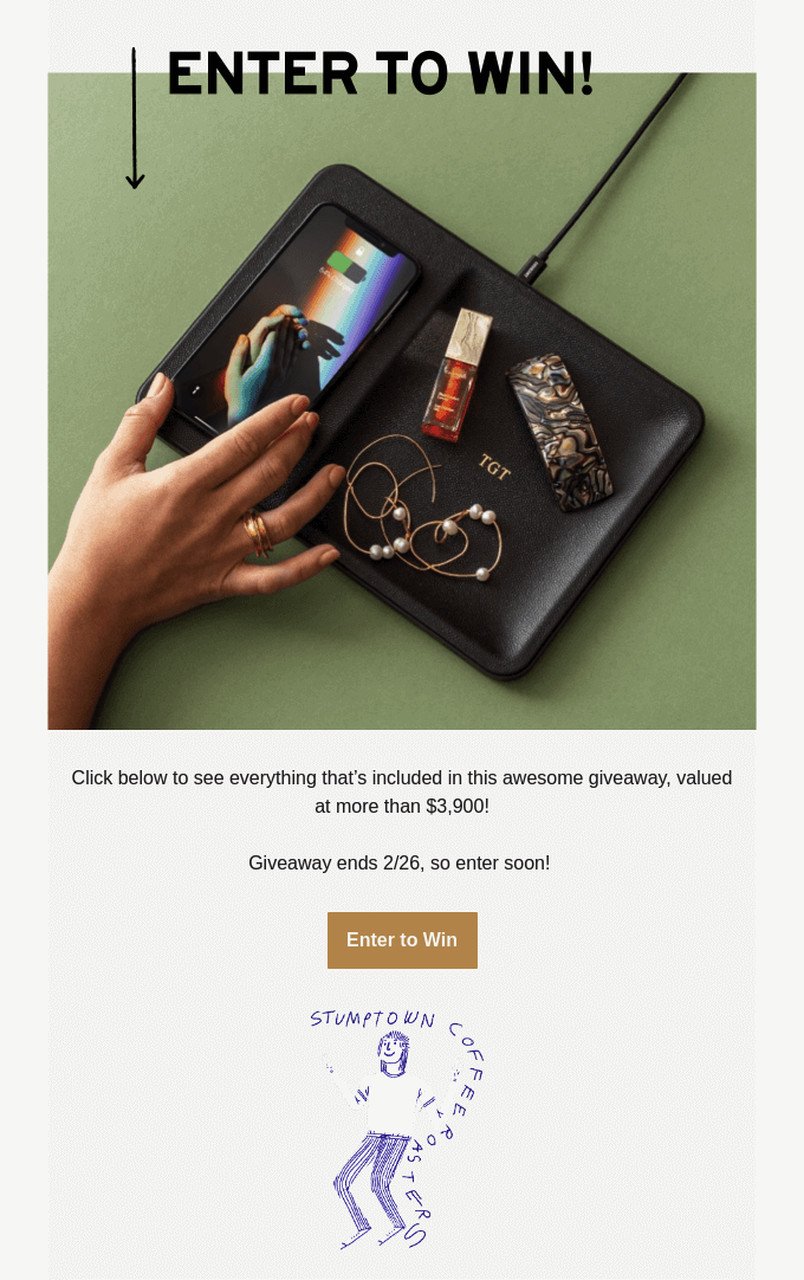
Product layout with directional arrow pointing to entry CTA
What works: An arrow graphic literally points at the prize products, guiding the reader's eye from "Enter to win!" toward the CTA. The giveaway value and deadline are stated clearly near the bottom, so anyone who scrolled this far has all the information they need to act.
Why it works: Directional cues (arrows, eye gaze, pointing fingers) in email design are one of the oldest UX tricks because they keep working. The eye follows the arrow unconsciously, and the CTA catches it at the end of that visual path.
Key takeaway: Add a directional visual cue (arrow, line, or image gaze) that points toward your CTA. It's a small design change that costs nothing and consistently lifts click-through rates.
7. Herman Miller: The Conversational Re-Engagement
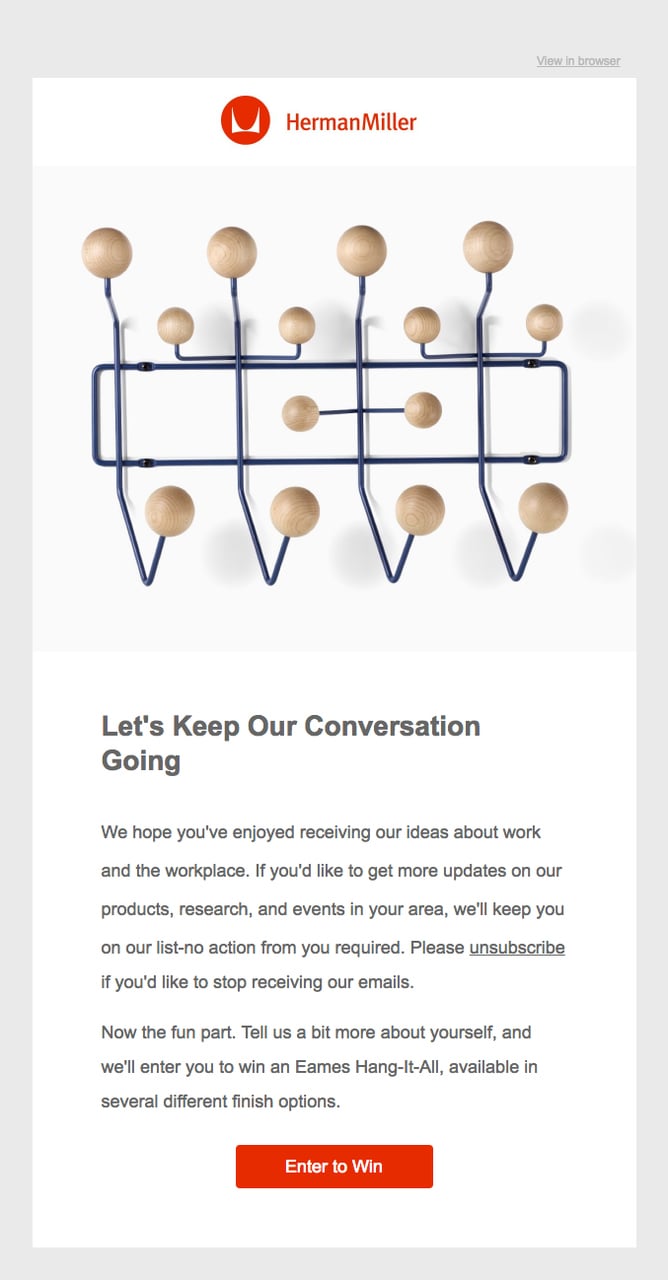
Herman Miller conversational giveaway with product image
Herman Miller opens with "Let's Keep Our Conversation Going" and a product image. Instead of jumping straight to the giveaway, the email references previous newsletters, creating a sense of continuity. They even offer an unsubscribe option mid-email before pivoting to "Now the fun part" and revealing the giveaway.
What works: Acknowledging that not everyone wants more emails (and offering a polite exit) builds trust. When the giveaway reveal comes after that honest moment, it feels like a genuine gift rather than a marketing tactic.
Why it works: Transparency about unsubscribing reduces complaint rates and improves deliverability. The subscribers who stay past the unsubscribe offer are more engaged, which means higher open rates on future sends.
Key takeaway: Add a brief "we get it if you want to unsubscribe" note before your giveaway announcement. It feels counterintuitive, but it filters your list and makes the giveaway feel more exclusive to those who stay.
8. Resy: The Seasonal Gamification
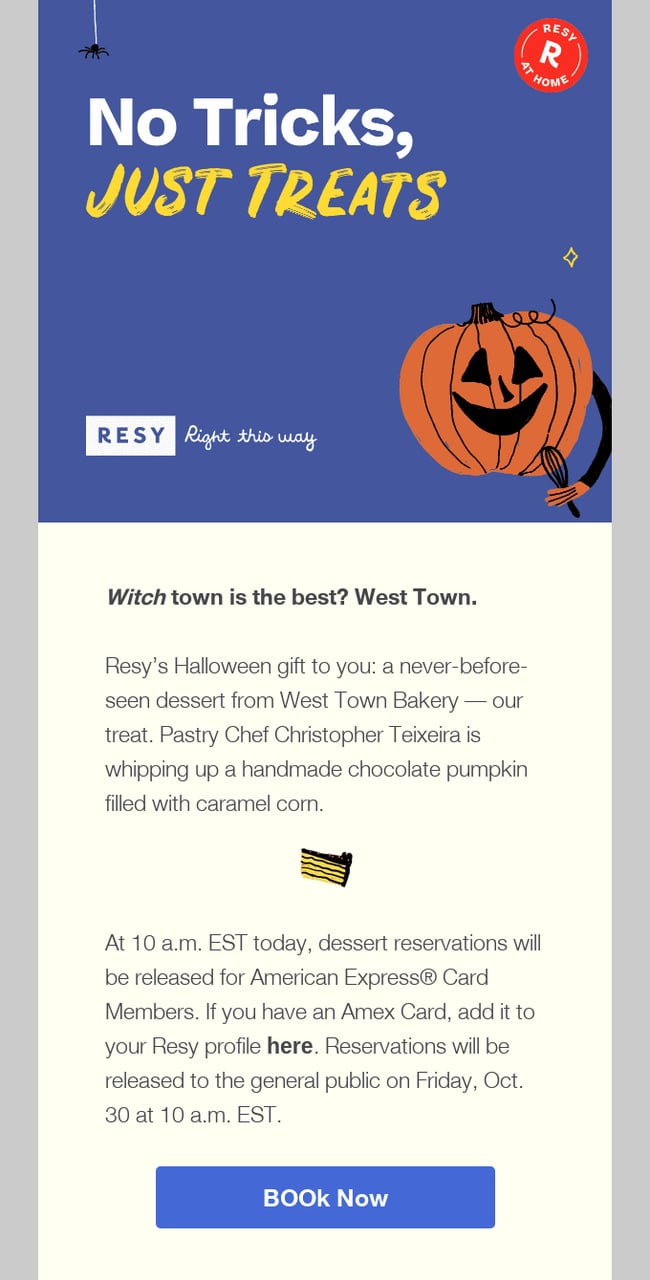
Resy's Halloween giveaway with themed food imagery
Resy's Halloween giveaway email opens with "No tricks, just treats" and a smiling pumpkin holding a whisk. The giveaway includes Halloween-themed restaurant experiences and bakery treats, tying the prize directly to Resy's core product.
What works: Every element commits to the Halloween theme: the pumpkin graphic, food-themed prizes, and the CTA "BOOk Now" (a pun on "book" and "boo"). The giveaway is members-only for American Express cardholders, adding an exclusivity layer that incentivizes card signups.
Why it works: Themed giveaways create shared cultural context that makes the email feel timely, not generic. The wordplay CTA is memorable because it rewards readers who catch the joke, creating a small moment of delight that increases click likelihood.
Key takeaway: Commit fully to a seasonal theme across your entire email, from subject line to CTA copy. Half-themed emails look lazy. Full-themed emails look fun.
9. Postable: The Social Virality Machine
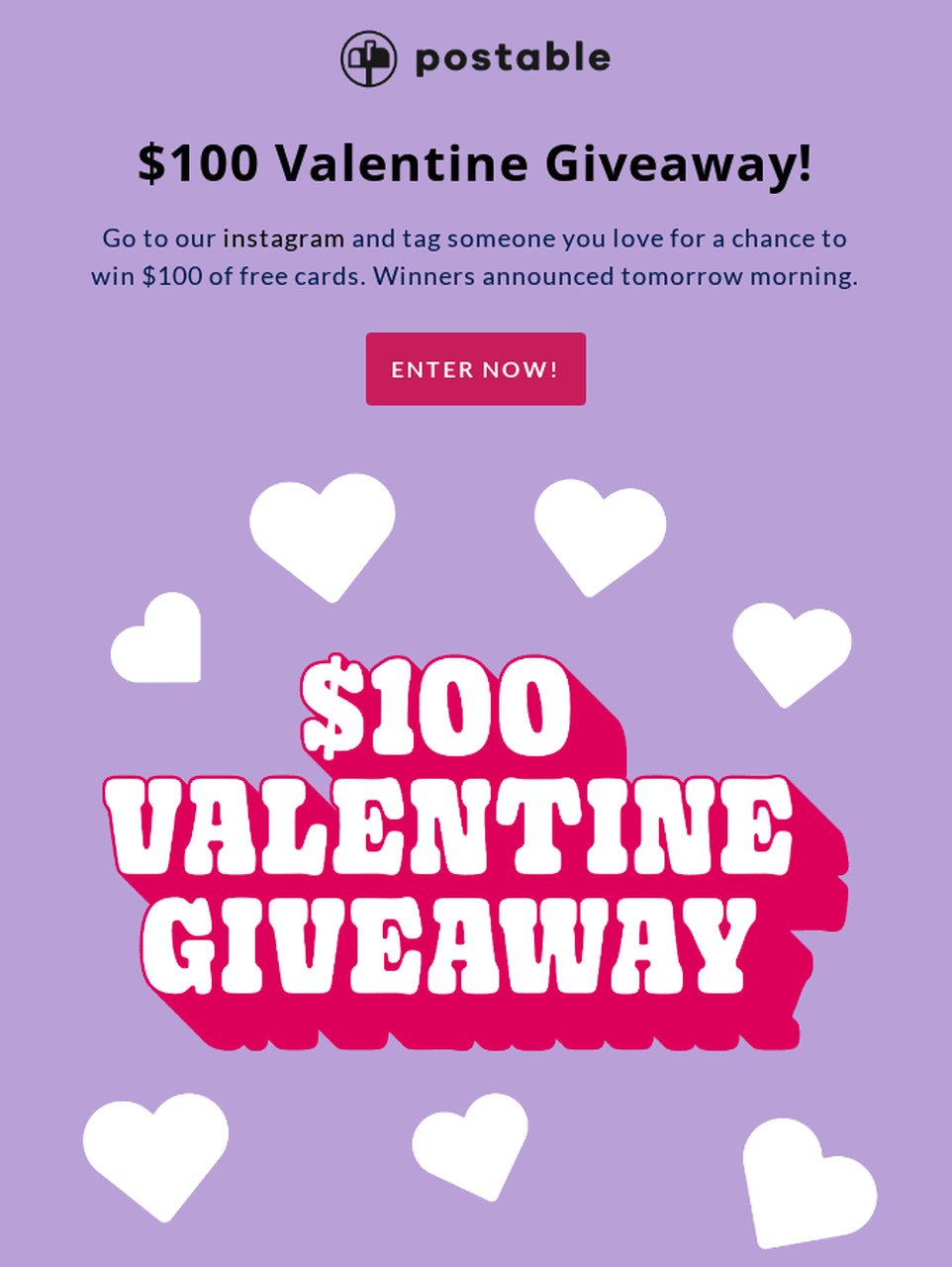
Postable's $100 Valentine giveaway announcement
Postable runs a $100 Valentine's Day giveaway where the entry method is tagging friends on their Instagram post. The headline "$100 Valentine Giveaway!" paired with heart illustrations immediately communicates the seasonal relevance.
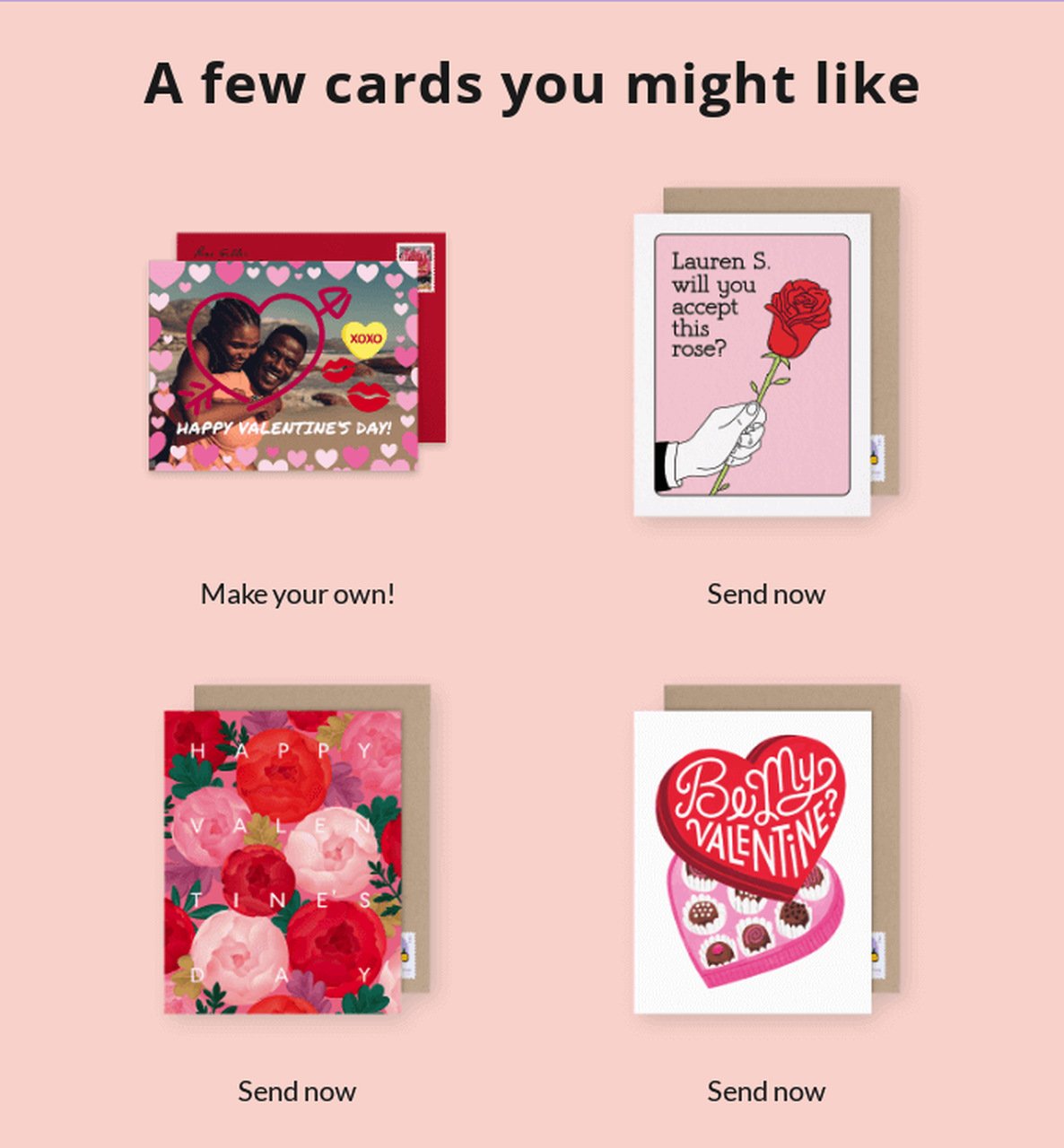
Valentine card previews with "Make your own!" prompts
What works: The tag-a-friend entry mechanic creates organic reach on Instagram. At the bottom, Valentine's Day card previews with "Make your own!" and "Send now" prompts convert giveaway browsing into product sales. The email drives entries AND revenue from the same send.
Why it works: Tag-a-friend entries are a growth loop: each participant brings at least one new person into the brand's orbit. According to VYPER's Instagram giveaway case study, Coconut Bowls collected 41,820 emails, 37,703 new followers, and 15,536 social shares from a single campaign using this approach.
Key takeaway: Make friend-tagging or sharing the entry requirement so each participant becomes a recruiting channel. Pair the giveaway with shoppable product previews to capture immediate sales from email traffic.
10. Bobbi Brown & Lunya: The Co-Branded Collaboration
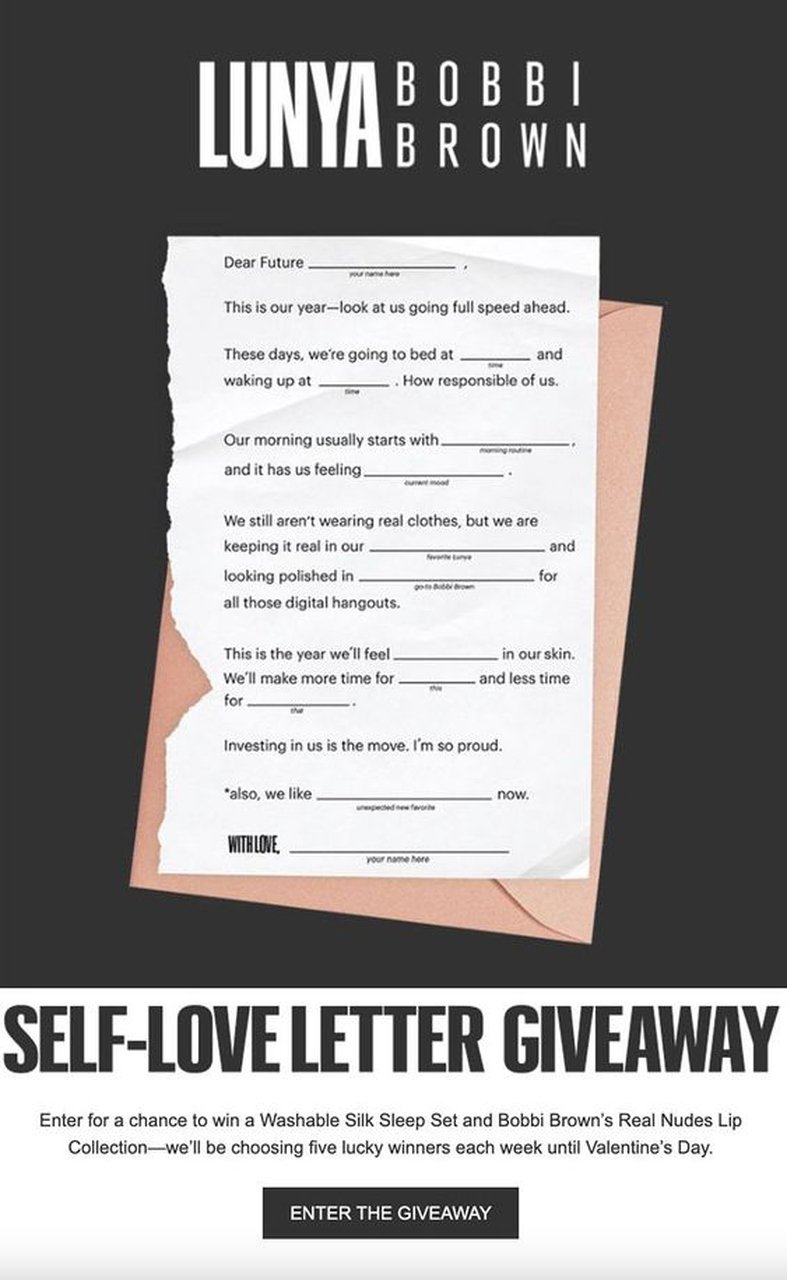
Self-Love Letter Giveaway by Bobbi Brown and Lunya
Bobbi Brown and Lunya partnered for a Valentine's Day "Self-love Letter Giveaway." Rather than the expected romantic angle, they positioned the campaign around self-care, expanding the target audience to anyone who values personal wellness.
What works: The email opens with both brand logos and a hand-written letter graphic that sets the self-love tone. Each brand contributes one product to the prize package, and five winners will be selected before Valentine's Day. The visual design feels premium without being cluttered.
Why it works: Brand collaborations pool two audiences together. Someone who follows Lunya (sleepwear) might discover Bobbi Brown (cosmetics) through this giveaway, and vice versa. The self-love positioning avoids alienating single subscribers who ignore traditional Valentine's marketing.
Key takeaway: Partner with a complementary (not competing) brand to double your giveaway's reach. Choose a partner whose audience overlaps with yours in demographics but not in product category.
11. Birchbox: The Gamified Mystery
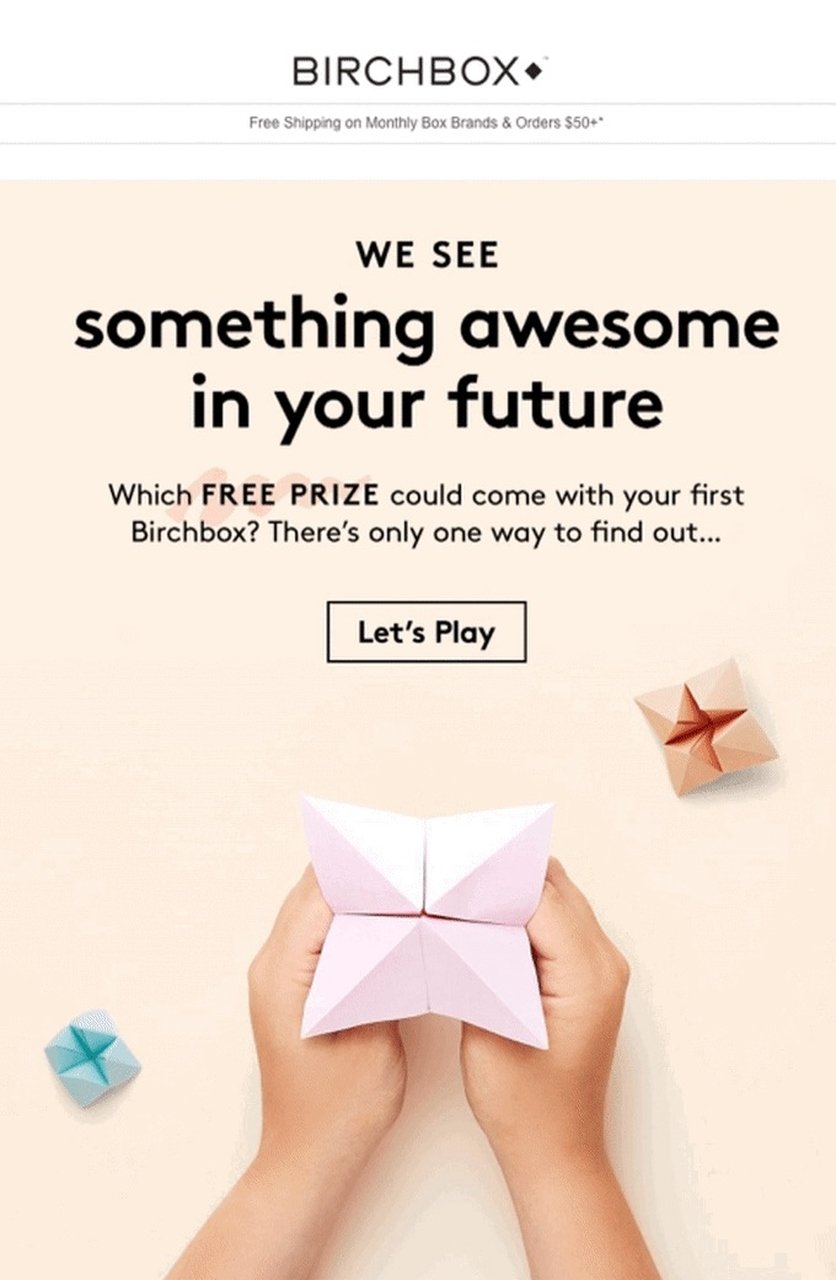
Birchbox fortune teller game giveaway email
Birchbox uses a paper fortune teller origami graphic with the headline "We see something awesome in your future." The subject line "Lucky You!: There's Still Time to Claim Your Prize" creates both urgency and positivity before the email is even opened.
What works: The fortune teller game mechanic turns a standard giveaway into an interactive experience. The copy keeps things playful ("FREE PRIZE" emphasized) and the "Let's Play" CTA button frames entry as entertainment, not a transaction.
Why it works: Gamification taps into curiosity and the desire for instant gratification. Instead of "enter to maybe win something," Birchbox says "there's a prize waiting for you." That reframe changes the email from a request to a reward notification. According to Sender's giveaway email research, giveaway emails can achieve open rates as high as 21.5% when the subject line triggers curiosity.
Key takeaway: Frame your giveaway as a game, not a raffle. Words like "play," "claim," and "your prize" shift the subscriber's mindset from "I probably won't win" to "I want to find out what I got."
12. Apple Music: The Minimal Exclusive
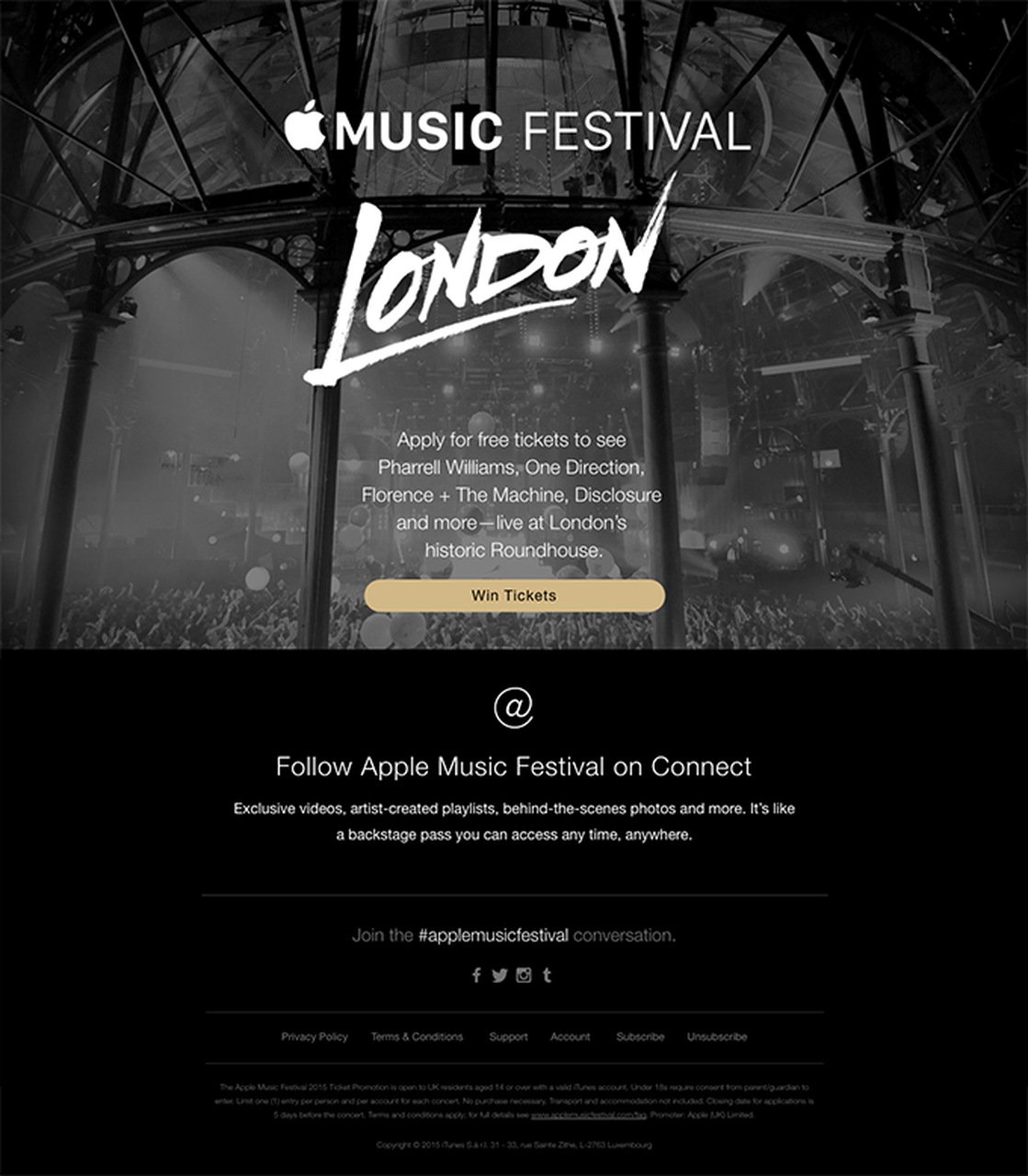
Apple Music Festival ticket giveaway email
Apple Music promotes its London festival with a ticket giveaway. The subject line "Win Tickets to Apple Music Festival in London" does all the work, and the email simply lists performing artists, a "Win Tickets" CTA, and the branded hashtag #applemusicfestival.
What works: Apple strips the email down to the essentials: who's performing, how to enter, and how to join the conversation. There's no filler copy, no decorative imagery, no secondary CTAs competing for attention. The social media icons at the bottom encourage sharing without distracting from the main action.
Why it works: Minimalism works for Apple because the brand itself is the selling point. The festival lineup is the value proposition, and the CTA is the conversion point. Nothing else is needed. This approach only works when your brand recognition is strong enough that you don't need to explain who you are.
Key takeaway: If your brand is well-known, cut your giveaway email to three elements: what you're giving away, how to enter, and one CTA. Everything else is friction.
13. Adidas: The Dual-CTA Upsell
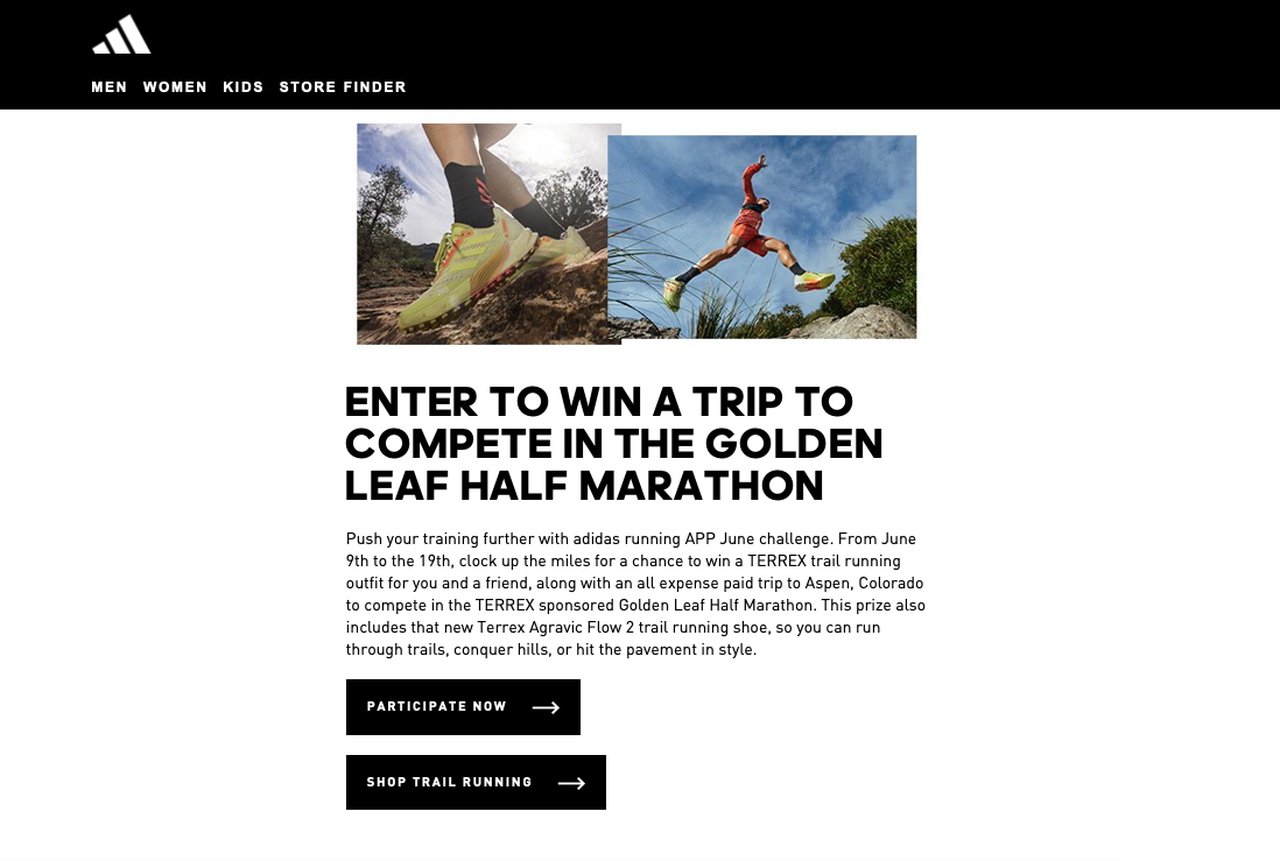
Adidas trail running challenge giveaway with dual CTAs
Adidas offers a trip to compete in the Golden Leaf Half Marathon. The subject line "Enter our trail running challenge and find your own summits" is aspirational, and the email body provides detailed trip information before presenting two CTAs: one for the giveaway and one for running products.
What works: The dual-CTA approach means every reader leaves the email with a next step, whether they enter the giveaway or browse running gear. The giveaway prize is experiential (a trip), which attracts serious runners rather than freebie-hunters.
Why it works: Adidas uses the giveaway as a top-of-funnel hook and the product CTA as a mid-funnel conversion path. Readers who don't enter the giveaway might still buy running shoes. It's a hedge that extracts value from every email open.
Key takeaway: Add a secondary "shop now" CTA below your giveaway entry button. Not everyone will enter the contest, but they might buy something if you give them the option.
14. Tie Bar: The Partnership Expansion
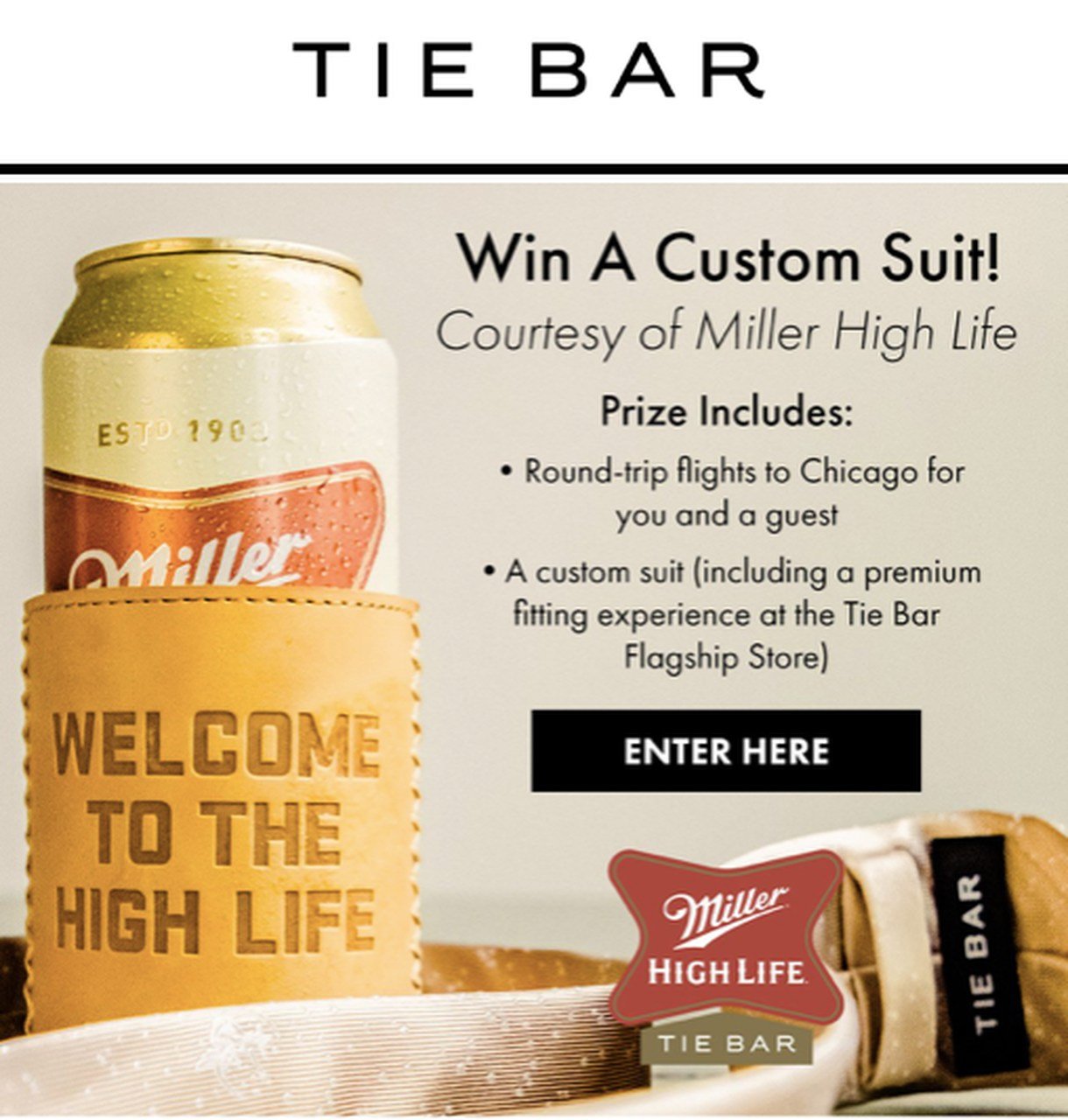
Tie Bar x Miller High Life custom suit giveaway
Tie Bar's subject line "Win A Custom Suit (For Free!)" uses trigger words to drive opens. The giveaway is a collaboration with Miller High Life, bundling a custom suit with a trip to Chicago. Giveaway details are presented in bullet points for quick scanning.
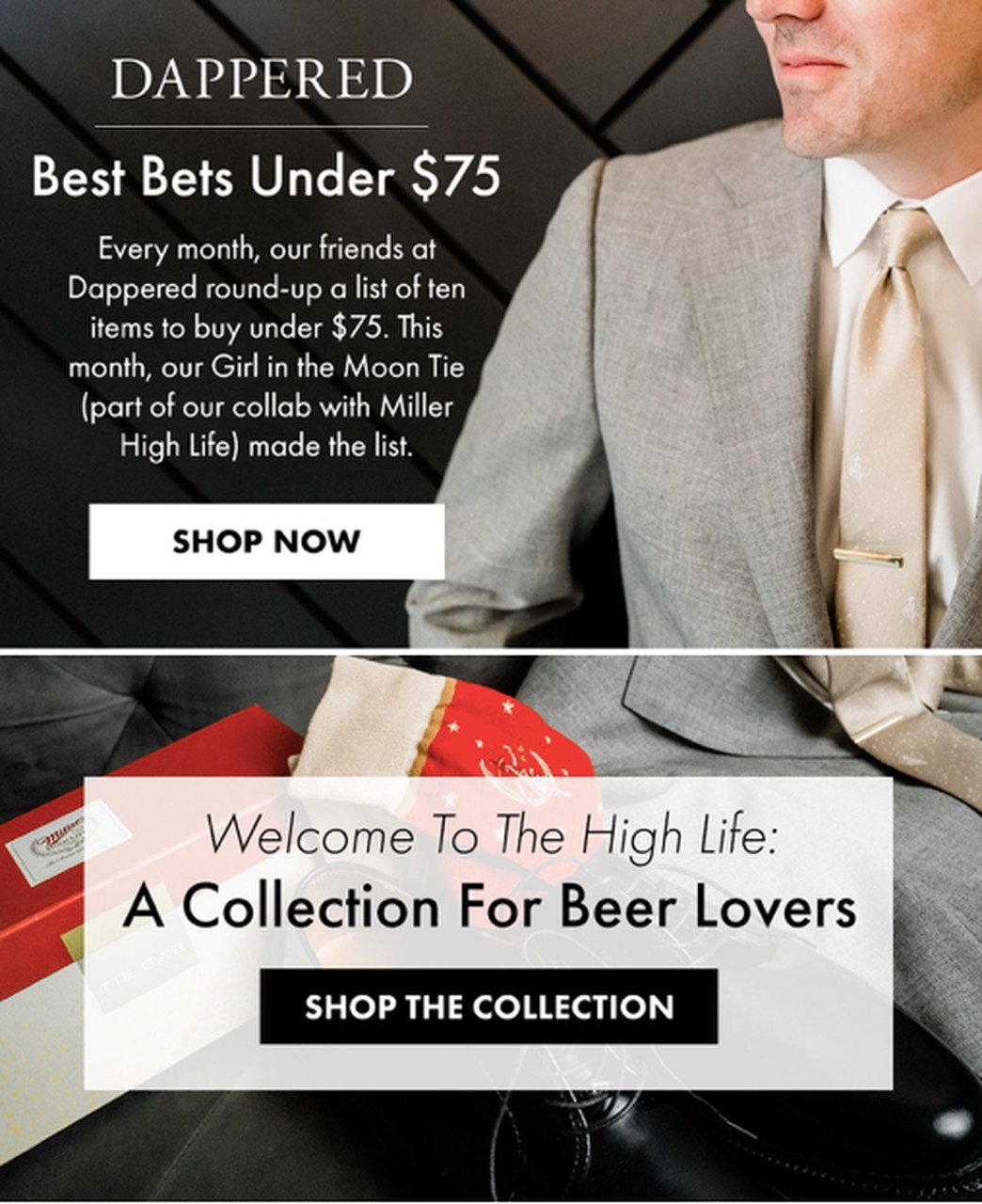
Product upsell section with "Shop Now" CTA
What works: The partnership with Miller High Life reaches beer enthusiasts who wouldn't normally encounter a menswear brand. The email closes with a product promotion section featuring a suit image and dual "Shop Now" / "Shop The Collection" CTAs, converting giveaway interest into browse behavior.
Why it works: Cross-industry partnerships introduce your brand to entirely new audience segments. A beer brand's audience overlaps with menswear in demographics (men 25-45) but not in product category, so there's no competition for spend.
Key takeaway: Partner with a brand in a different industry that shares your target demographic. The prize feels bigger, the reach doubles, and neither brand cannibalizes the other's sales.
15. Clive Coffee: The Social Proof Closer
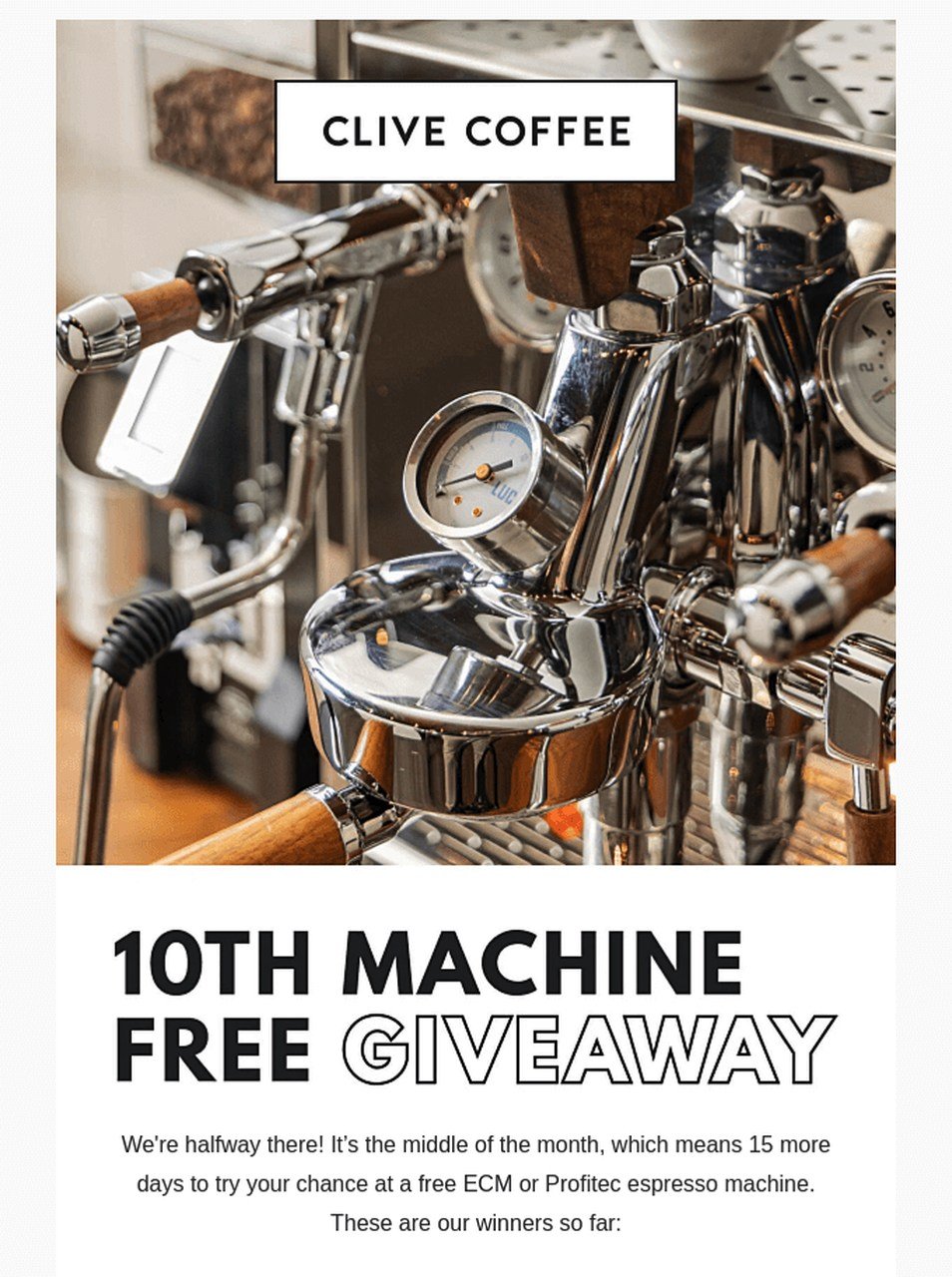
Clive Coffee 10th machine giveaway reminder
Clive Coffee puns in the subject line ("Your shot at a free ECM or Profitec espresso machine") and leads with a product image. The email serves as a 15-day-left reminder for their "10th machine free giveaway."
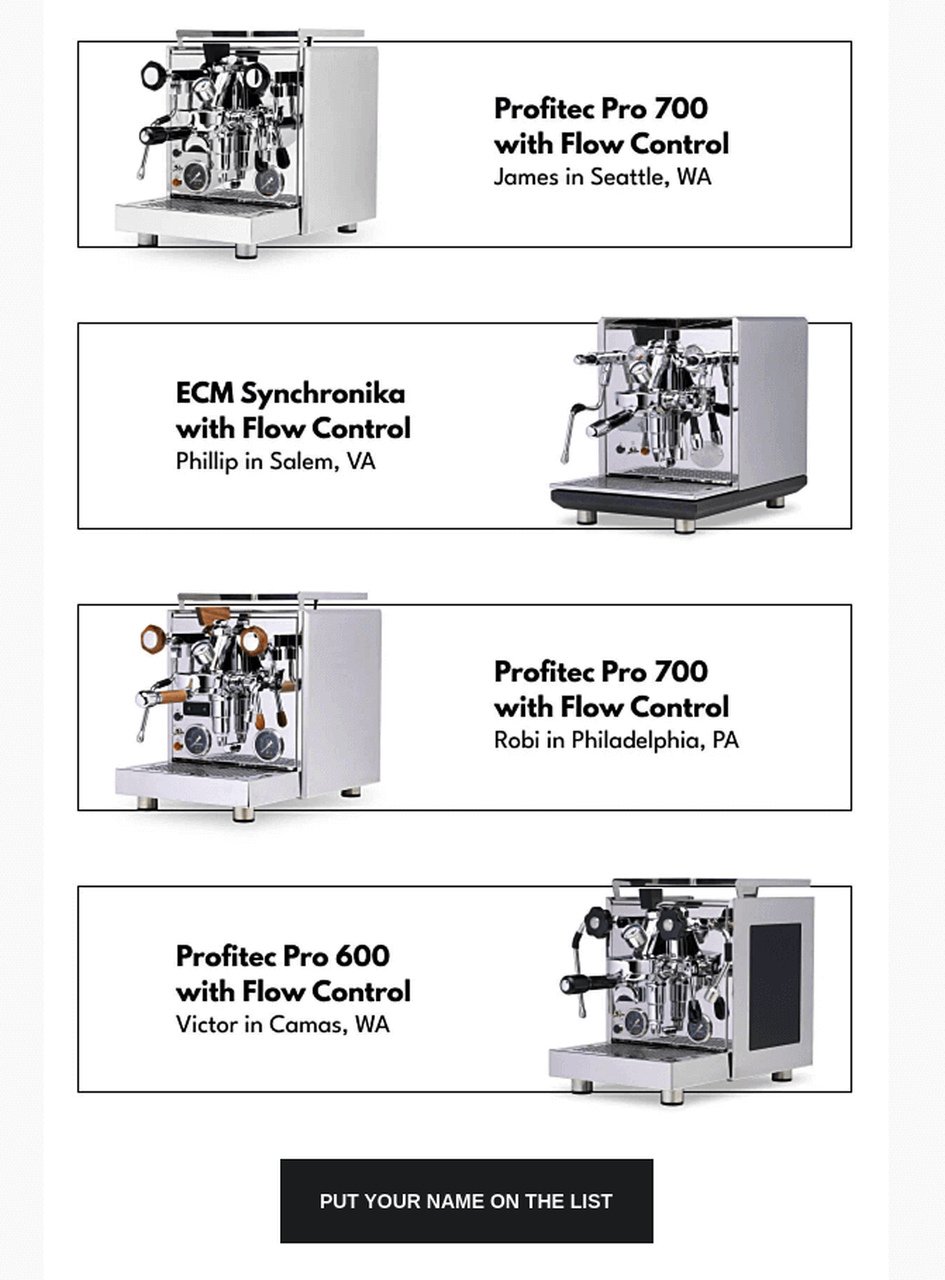
Previous winners listed with names and cities
What works: The email lists previous winners by name and city with their prize machines. This is social proof in its purest form: real people, real locations, real prizes. The "Put your name on the list" CTA becomes more persuasive when you can see who's already on it.
Why it works: Showing past winners solves the "is this giveaway even real?" skepticism that kills entry rates. Every name and city listed is proof that someone actually received the prize, which makes new entrants feel confident their effort won't be wasted.
Key takeaway: Display previous giveaway winners by name and location in your reminder emails. Nothing overcomes skepticism faster than proof that real people already won.
16. NARS: The Urgency-Driven Product Launch
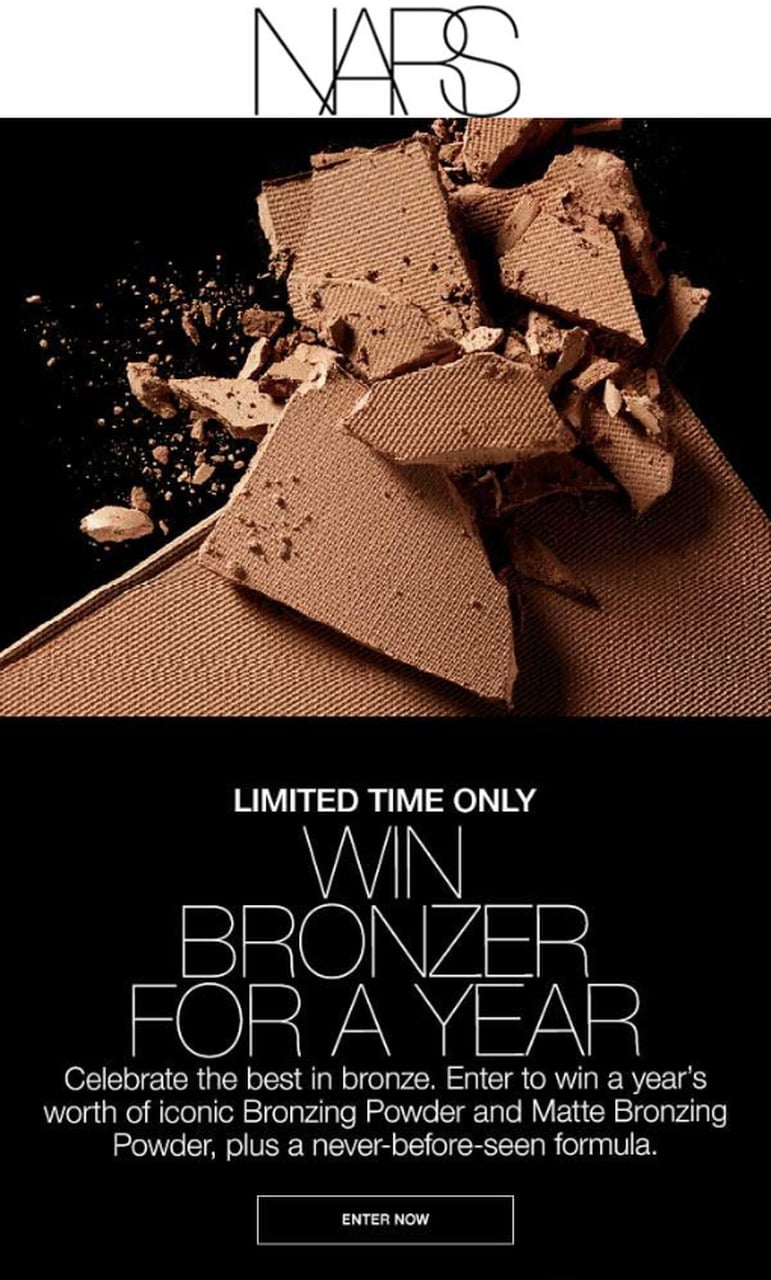
NARS "Win Bronzer for a Year" giveaway with urgency
NARS' subject line "Free bronzer. All year. Enter now." stacks three power phrases in six words. The email opens with a product image before the "Limited time only" header and "WIN BRONZER FOR A YEAR" headline create a sense of urgency.
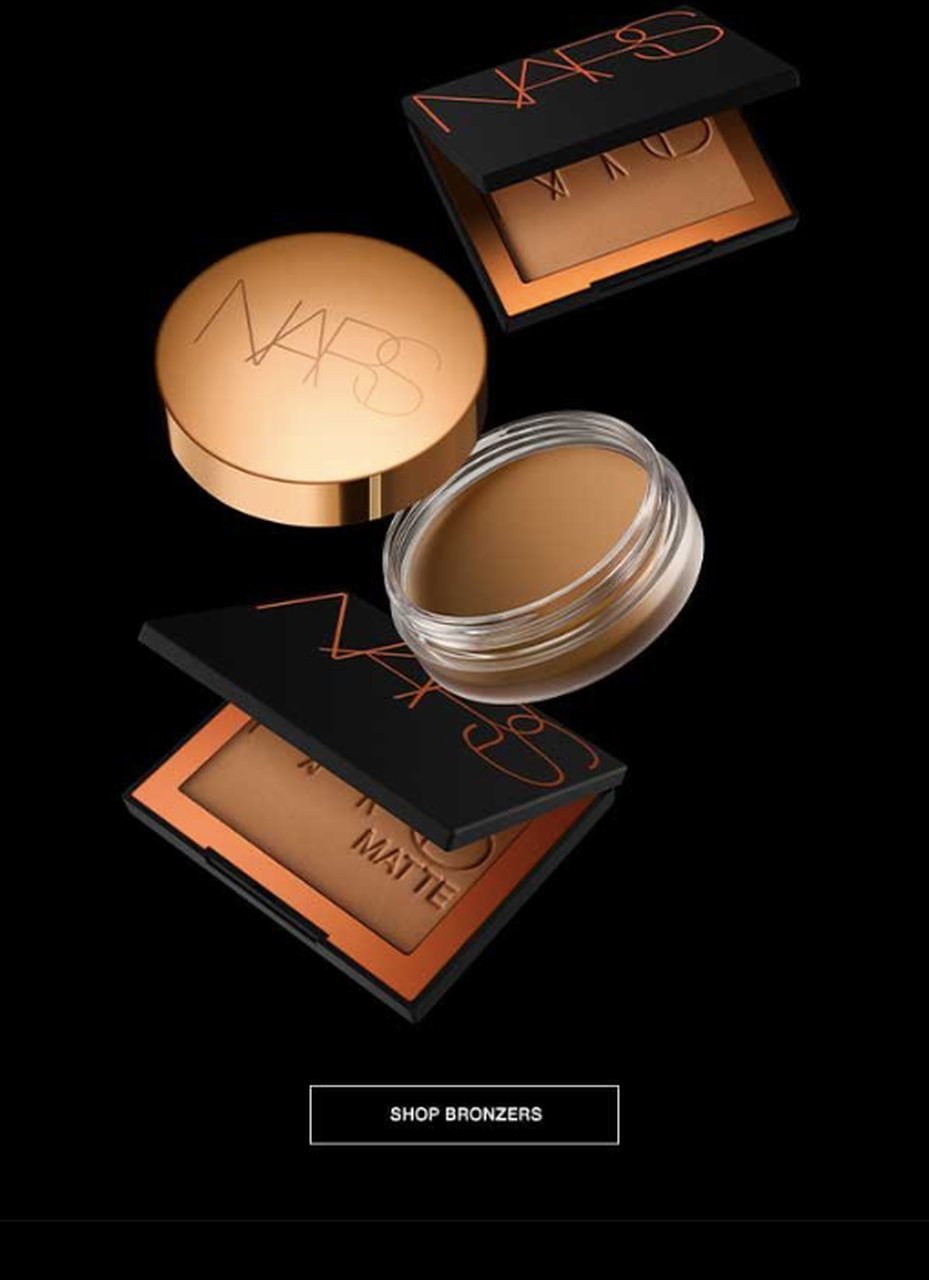
NARS product upsells below the giveaway CTA
What works: The copy includes trigger words like "best" and "never-before-seen formula" that frame the product as premium. The "Enter now" button appears immediately after the pitch, and the email closes with product recommendations that convert browsers into buyers even if they don't enter.
Why it works: NARS uses the giveaway to launch a new product line. The email introduces the bronzer formula, builds desire through scarcity ("limited time only"), and offers a chance to win it for free. By the time subscribers reach the product section below, they already want the product. The giveaway was just the hook.
Key takeaway: Time your giveaway to coincide with a product launch. Use the contest to generate awareness for the new product, then upsell it in the same email for subscribers who don't want to wait.
17. Sprouts Farmers Market: The Universal Appeal
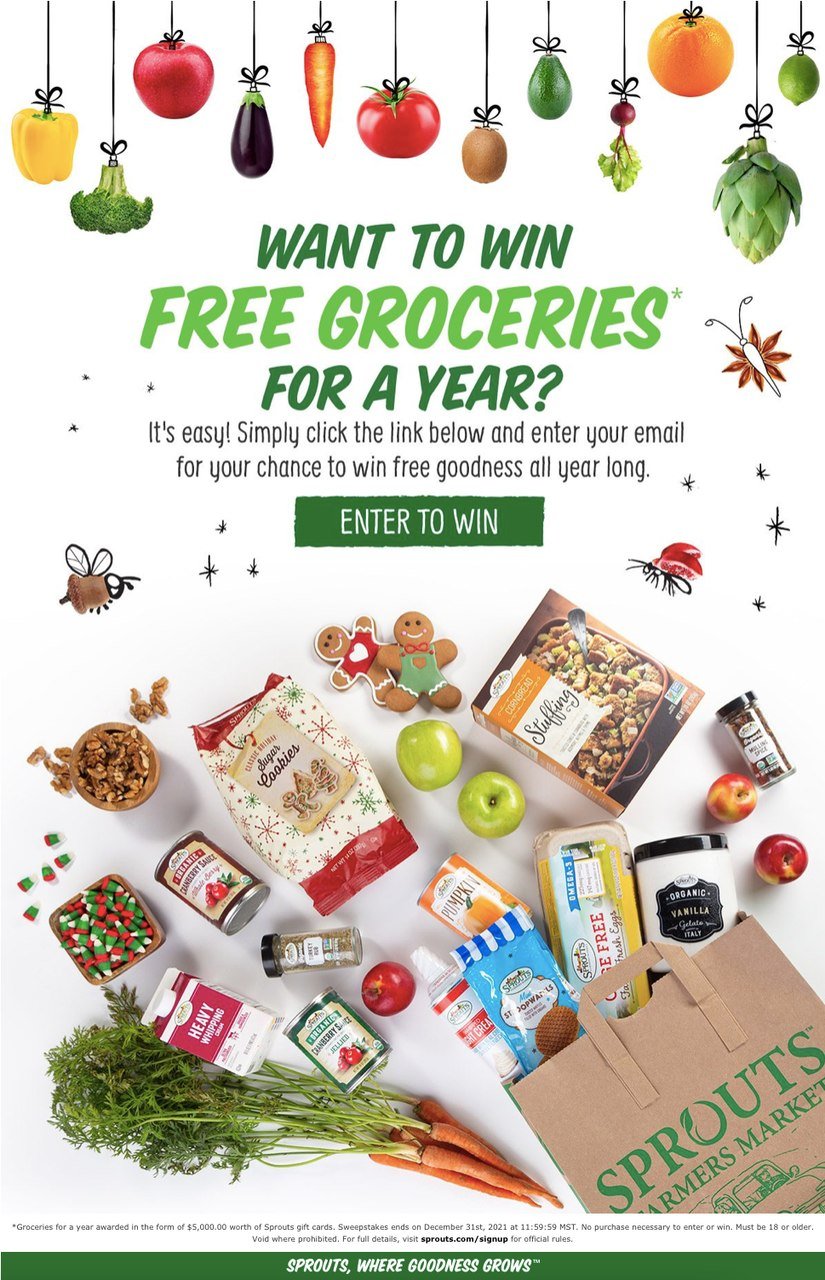
Sprouts free groceries for a year giveaway
Sprouts Farmers Market leads with "Want to win free groceries for a year?" and a colorful layout packed with produce imagery. The giveaway details fit in a single sentence. Subject line: "Have you entered our giveaway yet? Enter now!"
What works: Free groceries is a universally desirable prize. Unlike niche product giveaways, this one appeals to every subscriber on their list. The bright, colorful design matches the grocery store experience and makes the email feel inviting rather than salesy.
Why it works: Broad-appeal prizes maximize entry volume, which is ideal when the goal is list growth or brand awareness rather than targeted lead qualification. Sprouts doesn't need to attract a specific persona; everyone eats groceries.
Key takeaway: Use universally appealing prizes when your goal is maximum entries and brand awareness. Save niche prizes for campaigns where you want to qualify leads by interest level.
How to Customize Giveaway Email Templates for Your Brand
Copying a template word-for-word won't get results. Here's how to make these giveaway email examples work for your specific situation.
Match the Prize to Your Customer Profile
The prize determines who enters. If you're an e-commerce brand selling coffee equipment (like Clive Coffee), giving away an espresso machine attracts your exact buyer persona. A generic Amazon gift card attracts everyone, which sounds good until you realize 90% of entrants will never buy from you.
For SaaS companies, consider giving away an extended free trial, lifetime access to a premium tier, or a consultation session. These prizes attract people who actually need your product. If you're building a giveaway signup page, email capture popup examples can inspire how you design the entry form on your landing page.
Write Subject Lines That Create Curiosity or Urgency
The best subject lines from our examples share two traits: they're specific about the prize and they create either curiosity (Birchbox: "Lucky You!") or urgency (NARS: "Free bronzer. All year. Enter now."). Avoid vague subject lines like "Exciting news inside!" that give no reason to open.
Structure Your Email for Scanners
Most of these examples follow a similar flow: hero image, headline, 2-3 sentences of context, CTA button. Don't bury your entry link below paragraphs of rules. Put the CTA above the fold and repeat it at the bottom for subscribers who scroll.
Best Practices for Giveaway Email Success
After analyzing these 17 examples, a few patterns keep showing up in the highest-performing giveaway emails:
• Choose a prize your audience actually wants. Crate & Kids offered gift cards for their own store. Barebones offered a wilderness trip. Both prizes attracted their ideal customer.
• Send your announcement 3-5 days before launch. This gives subscribers time to plan and builds anticipation, which translates into day-one entry surges.
• Create real urgency with deadlines. Clive Coffee's "15 days left" reminder and NARS' "Limited time only" both set concrete expectations. Fake urgency ("only 2 spots left!" when there are unlimited spots) backfires.
• Add interactive elements when possible. Birchbox's fortune teller and Resy's Halloween theme both turned standard giveaways into experiences. Interactive emails stand out in crowded inboxes.
• Include one strong CTA, not three. Every example that performed well focused on a single action. Adidas was the exception with dual CTAs, but that works because each CTA serves a different conversion path.
• Personalize beyond [first name]. Members-only giveaways (H&M, Resy) use segmentation to personalize the entire offer, not just the greeting. You can use email popups to collect the data needed for this kind of segmentation during signup.
An estimated 132,200 people search for "giveaways" each month on Google. That's a huge volume of people actively looking for contests to enter, which means your giveaway email has a built-in audience if you promote it on search and social alongside email.
Post-Giveaway Follow-Up Strategies That Keep Subscribers Engaged
The giveaway ends, but your relationship with participants doesn't have to. A case study from UpViral documented a fashion brand that generated 5,580 leads and over 2,000 WhatsApp shares from a single giveaway, but the real value came from what happened after.
Thank-You Emails That Convert
Send a thank-you email within 24 hours of the giveaway ending. Include a consolation offer: a discount code, free shipping, or extended trial. This converts non-winners into customers while their brand awareness is still fresh.
Referral Loop Templates
After someone enters your giveaway, send a follow-up encouraging them to share with friends for bonus entries. This referral loop is how campaigns go viral. The "How to Move up the Leaderboard" email pattern (popularized by KickoffLabs' post-signup templates) explains referral bonuses and drives additional sharing.
Achievement Emails for Milestones
For giveaways with a referral component, send milestone notifications: "You've referred 5 friends and unlocked bonus entries!" These achievement-style emails tap into the same psychology that makes FOMO marketing emails effective. They reward participation and create an incentive to keep sharing.
If you're running giveaways regularly, having the right tools makes a huge difference. Our list of 14 best giveaway tools covers platforms that automate the entire workflow from entry collection to winner selection.
How to Measure Giveaway Email ROI
Tracking giveaway performance goes beyond counting entries. Here are the metrics that actually tell you whether the campaign was worth it:
| Metric | What It Measures | Target Benchmark |
|---|---|---|
| Email open rate | Subject line effectiveness | 20-25% for giveaway emails |
| Click-through rate | CTA and copy effectiveness | 3-5% for giveaway entries |
| Conversion rate | Entries divided by email recipients | 2-4% is strong |
| Cost per lead | Total campaign cost / new subscribers | Varies by industry |
| Post-giveaway retention | Subscribers still active after 30 days | 60%+ is healthy |
| Revenue attributed | Sales from giveaway participants within 90 days | Track via UTM parameters |
The post-giveaway retention rate is the most important number. A campaign that adds 10,000 subscribers who all unsubscribe within a month is worse than one that adds 1,000 subscribers who become repeat customers. Track your browse abandonment email performance alongside giveaway metrics to get the full picture of your email marketing funnel.
FAQ About Giveaway Email Templates
What Are the Best Giveaway Email Templates?
The best giveaway email templates include three elements: a clear prize description, a simple entry mechanic, and a prominent CTA button. Based on the 17 examples in this guide, brands that tie their prize directly to their product (Clive Coffee giving away espresso machines, NARS giving away bronzer) see higher-quality leads than those offering generic gift cards. Use the pre-giveaway, during-giveaway, and post-giveaway templates above as starting points and customize them for your audience.
How Do You Announce a Free Giveaway?
Send your announcement email 3-5 days before the giveaway starts. Use a subject line that names the prize and creates urgency ("Win a $500 Gift Card, Entries Close Friday"). Include the giveaway rules, deadline, and an "Enter Now" CTA within the first scroll of the email. Promote the giveaway simultaneously on your social channels and website. A giveaway popup on your website can capture entries from visitors who might miss the email.
How Do You Create a Giveaway Email Campaign From Scratch?
Start by defining your goal (list growth, product awareness, or social followers), then choose a prize that attracts your target audience. Plan three emails minimum: an announcement 3-5 days before launch, a reminder at the midpoint, and a winner notification after the deadline. Use a confirmation email to verify entries and set expectations about when winners will be announced. Test your subject lines against the examples in this guide and track open rates, entry rates, and post-giveaway retention to measure success.
How would you rate your experience with this article? 😊