
15 Top Price Drop Emails: Tips & Examples


 ChatGPT
 Perplexity
 Claude
 Grok
Grok Google AI Mode
Price drop emails notify subscribers when products drop in price to drive sales and retention year-round, especially around major shopping holidays. Effective ones use personalization, clear savings, urgency, smart CTAs, and avoid overwhelming choices.
Table of contents (30)
Price drop emails are a crucial part of every email marketing campaign.
It looks like almost every brand is focusing on price drops these days, and I mean, why wouldn’t they?
Price drop emails notify subscribers when products they've browsed or carted decrease in price, triggering purchases through loss aversion and deal psychology. These automated messages earn conversion rates of 5-15% according to Sequenzy's email benchmarks, making them one of the highest-performing email types for e-commerce revenue recovery.
What Is a Price Drop Email?
A price drop email is an automated or manually triggered message sent to subscribers when a product they've viewed, wishlisted, or added to their cart drops in price. Unlike generic sale announcements blasted to your entire list, price drop emails are behavior-driven: they target people who already showed interest in a specific item.

I've seen these emails work in two primary scenarios. First, as part of automated price drop flows in platforms like Klaviyo, where catalog price changes trigger sends automatically. Second, as one-off campaigns around seasonal markdowns or inventory clearance. Both approaches capitalize on a simple truth: people want the things they already wanted, just cheaper.
According to Upsellit's research on pricing psychology, price drop alerts tap directly into dopamine-driven reward pathways, creating an urgency that generic promotional emails can't match. That's why these emails consistently outperform standard discount blasts.
Why Do Price Drop Emails Work So Well?
Price drop emails outperform standard promotional messages because they combine three psychological triggers at once: personalization (the recipient already wants the item), loss aversion (the deal might disappear), and social proof (other shoppers are watching the same product).
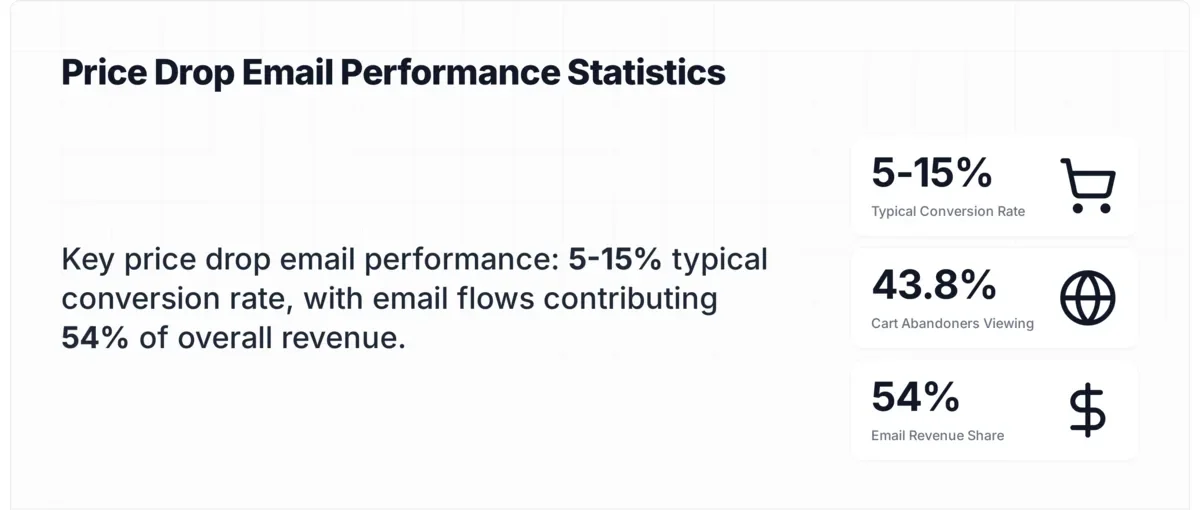
Price drop email key stats
According to Forbes reporting on 2026 consumer behavior, nearly half of surveyed consumers say inflation and rising costs are their top concerns. That price sensitivity makes discount notification emails more effective than ever.
From a revenue standpoint, price drop emails address two costly problems at once. They recover abandoned browsers and carts, and they accelerate the sell-through of discounted inventory. According to Bloomreach's automation documentation, automated price drop alerts for cart items directly increase Revenue Per Visitor and improve conversion rates by targeting shoppers who already demonstrated buying intent.
For e-commerce store owners using email capture popups on Shopify to grow their lists, price drop emails turn those subscribers into buyers faster than almost any other email type.
What Makes a Good Price Drop Email?
I've reviewed over 100 price drop emails across fashion, electronics, home goods, and SaaS. The best ones share six characteristics that separate them from forgettable discount blasts.
1. Personalization tied to browsing behavior: The email references a specific product the recipient viewed, not a random catalog item. This moves the message from "promotion" to "personal update."
2. Clear price comparison: Showing the original price struck through next to the new price gives recipients instant context. The best emails also show the dollar or percentage savings.
3. Urgency that's real, not manufactured: Statements like "price may change throughout the day" or "limited stock at this price" work because they're often true for dynamic pricing.
4. A single, prominent CTA: According to Omnisend's price drop email guide, the most effective emails keep the action path simple with one primary button rather than competing links.
5. Product recommendations that complement: The best emails include 2-3 related items below the main product, creating a cross-sell opportunity without overwhelming the reader.
6. Mobile-first design: With most email opens happening on phones, the product image, price comparison, and CTA must all be visible without scrolling past the fold.
15 Price Drop Email Examples That Drive Sales
I selected these 15 examples based on four criteria: how well they personalize the offer, whether they create real urgency, the clarity of their price presentation, and how actionable their CTAs are. Each example teaches a different tactic you can apply to your own campaigns.
| # | Brand | Key Tactic | Why It Stands Out |
|---|---|---|---|
| 1 | GoPro | Feature-led selling | Sells the product, not just the discount |
| 2 | Honey | Behavior-based personalization | Matches browsing history to offers |
| 3 | Jomashop | Product recommendations | Pairs main item with related products |
| 4 | Pink Blush | User-specific pricing | Makes recipient feel like an insider |
| 5 | UpWest | Trigger words | Emotional language drives urgency |
| 6 | DTLR | Dual CTAs | Multiple navigation paths reduce friction |
| 7 | Rainbow | Curiosity-driven copy | Conversational tone builds brand affinity |
| 8 | ShopStyle | Behavioral tracking | Curates a personalized deal roundup |
| 9 | Forever 21 | Hero product focus | Model imagery increases purchase intent |
| 10 | Columbia | Similar item cross-sell | Re-engages lapsed customers with new deals |
| 11 | NewChic | Dual discount display | Shows both percentage and dollar savings |
| 12 | Taylor Stitch | Savings emphasis | Dollar amount saved is the headline |
| 13 | WikiBuy | Daily deal digest | Habitual engagement through frequency |
| 14 | Target | Old stock clearance | Low anchor prices drive impulse purchases |
| 15 | Academy | Single product focus | Prevents choice overload |
1. GoPro: Feature-Led Price Drop
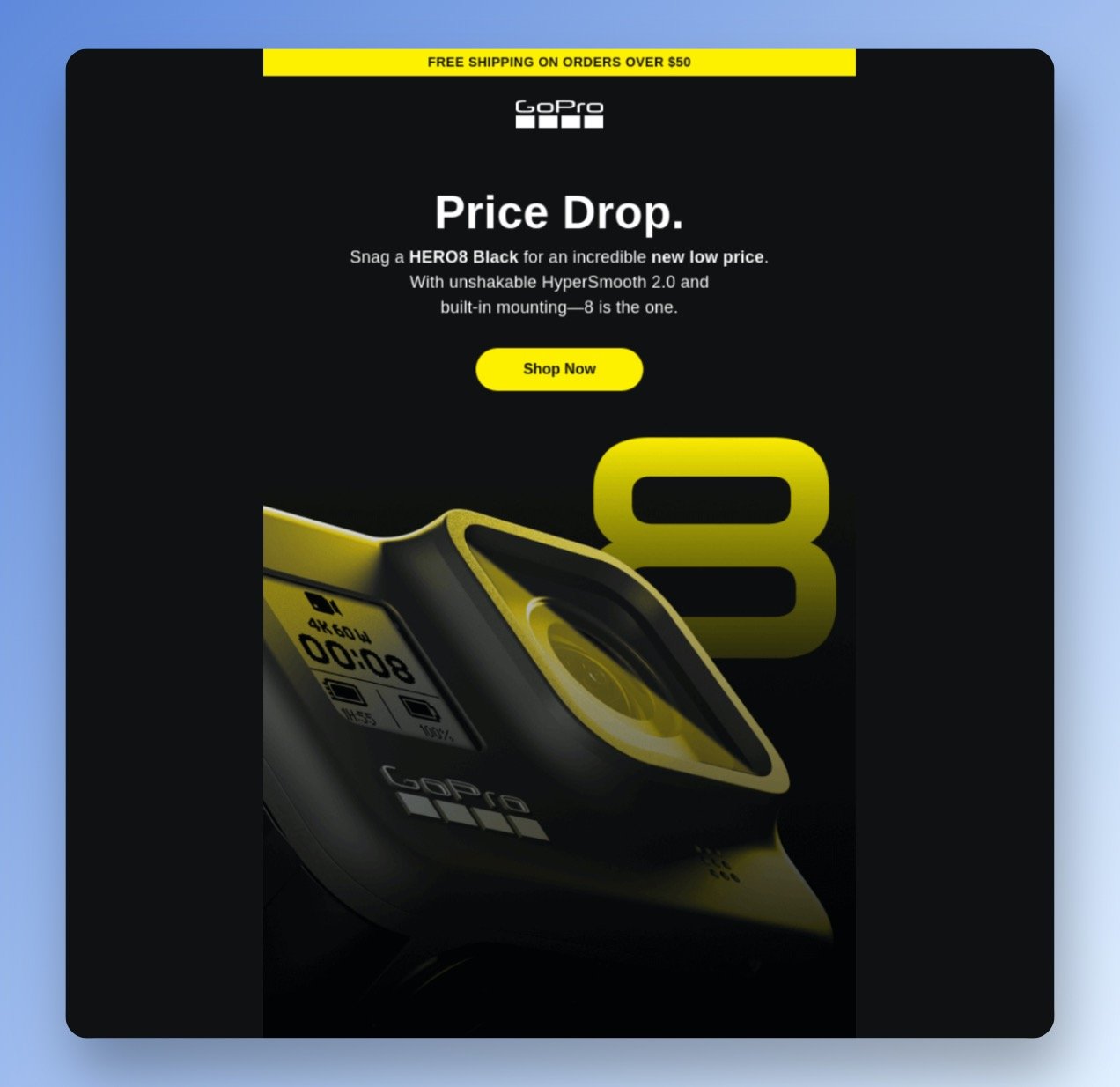
GoPro's feature-first price drop email
What works: GoPro doesn't lead with the discount amount. Instead, they remind recipients why the HERO8 Black is worth buying: waterproof to 33ft, HyperSmooth stabilization, TimeWarp video. The product features fill the email body, and "new low price" sits at the top as a trigger. For a considered purchase like an action camera, this approach is smart because the audience (camera enthusiasts) cares more about specs than savings percentages.
Why it works: Considered purchases require rational justification, not just emotional urgency. By restating the product's value proposition alongside the price reduction, GoPro gives recipients the internal logic they need to justify clicking "buy." The phrase "8 is the one" adds a subtle scarcity cue without screaming "limited time!"
Key takeaway: For high-ticket items, lead with product features and let the price drop serve as the permission to buy. The discount removes the price objection; the features handle everything else.
2. Honey: Behavior-Based Personalization
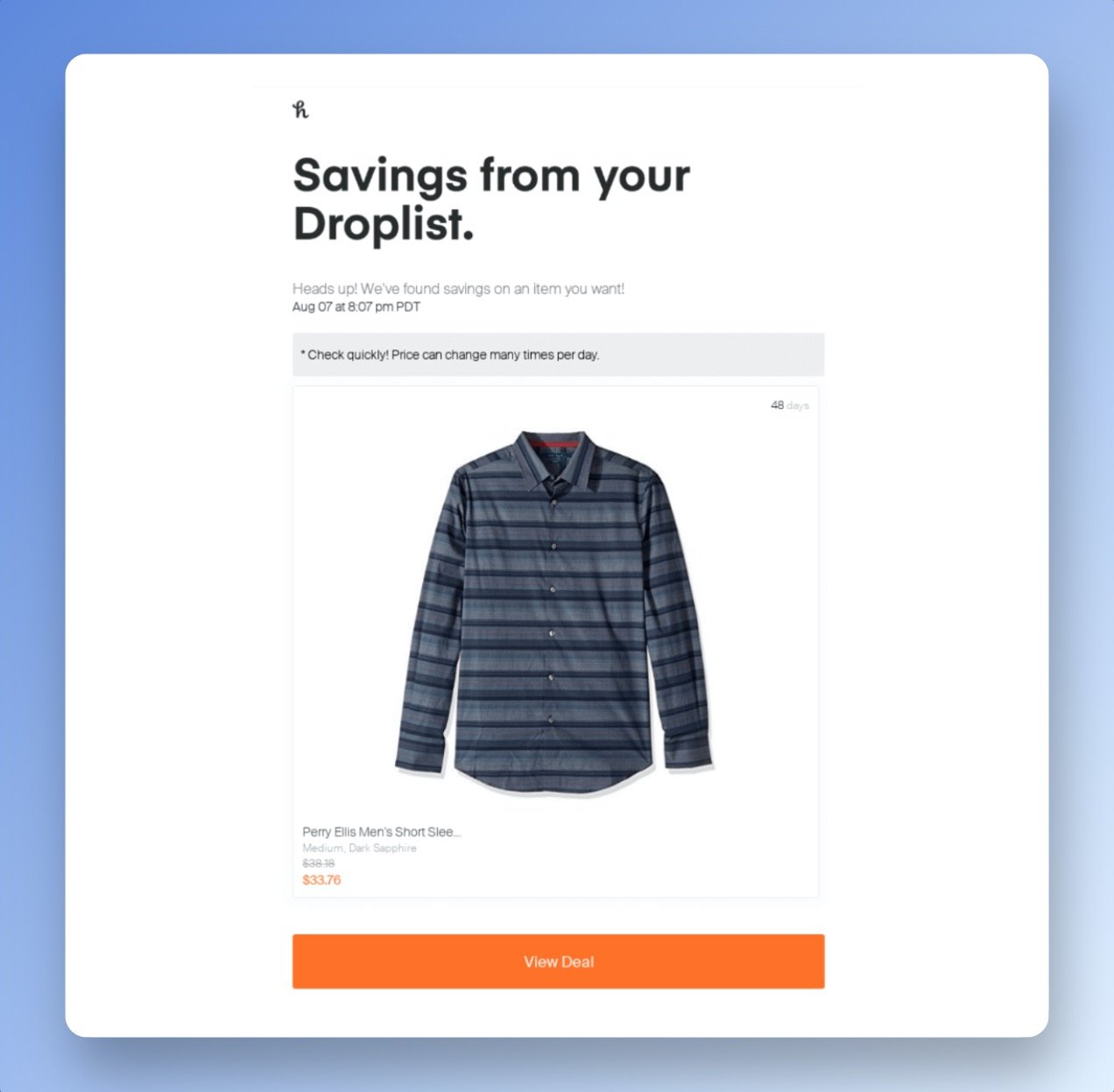
Honey's personalized droplist alert
What works: Honey's entire business model revolves around saving people money, so their price drop emails are their core product in action. The subject line "Saving From Your Droplist" immediately tells recipients this isn't a generic blast. The email shows a specific item the user saved, with the exact price reduction displayed. The line "Check quickly! Price can change many times per day" is honest because marketplace prices genuinely do fluctuate.
Why it works: This email is a textbook example of FOMO email marketing. The recipient knows Honey tracked their personal interest, which makes the notification feel like a favor rather than a sales pitch. Combining behavioral data with genuine price volatility creates urgency that doesn't feel manufactured.
Key takeaway: Build your price drop emails around items users have explicitly saved or browsed. A discount on something they already want converts far better than a surprise deal on a random product.
3. Jomashop: Product Recommendations That Cross-Sell
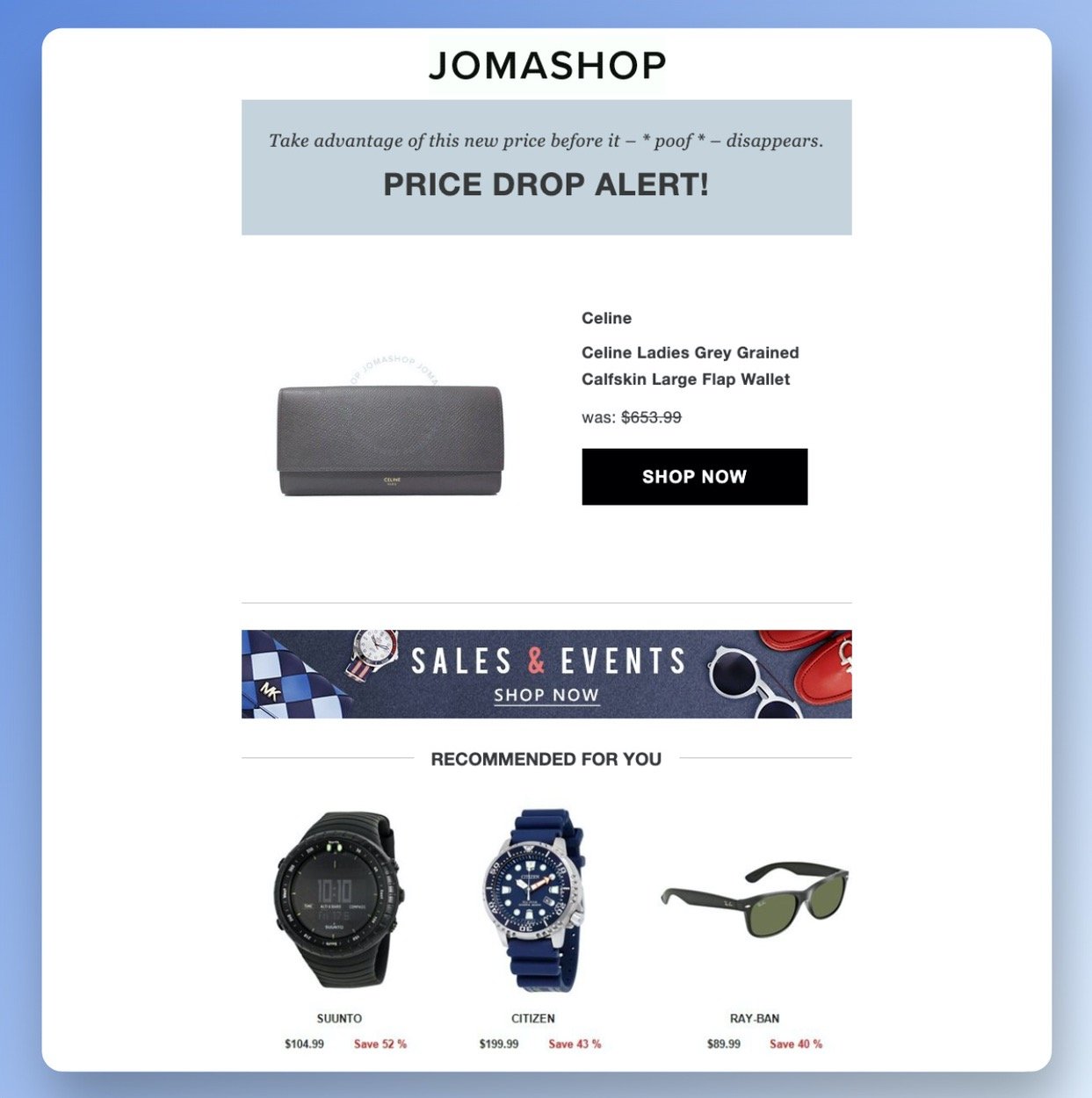
Jomashop's recommendation-driven price drop
What works: Jomashop pairs a discounted luxury item (Celine handbag) with curated product recommendations based on the recipient's shopping history. The "Drop Price Alert" subject line is direct enough to generate opens, and the email body stacks value: primary discount at top, related deals at bottom. Since Jomashop operates as a grey market dealer selling below retail, their price drops carry extra weight because the starting prices are already competitive.
Why it works: This is a well-executed product recommendation email disguised as a price alert. The primary item hooks the open, and the recommendations increase average order value. Research shows that personalized product suggestions in emails can lift revenue per email by 20-30%.
Key takeaway: Don't waste the footer of your price drop email. Add 2-3 related items at reduced prices to turn a single-product alert into a multi-item shopping opportunity.
4. Pink Blush: Insider-Feeling Personalization
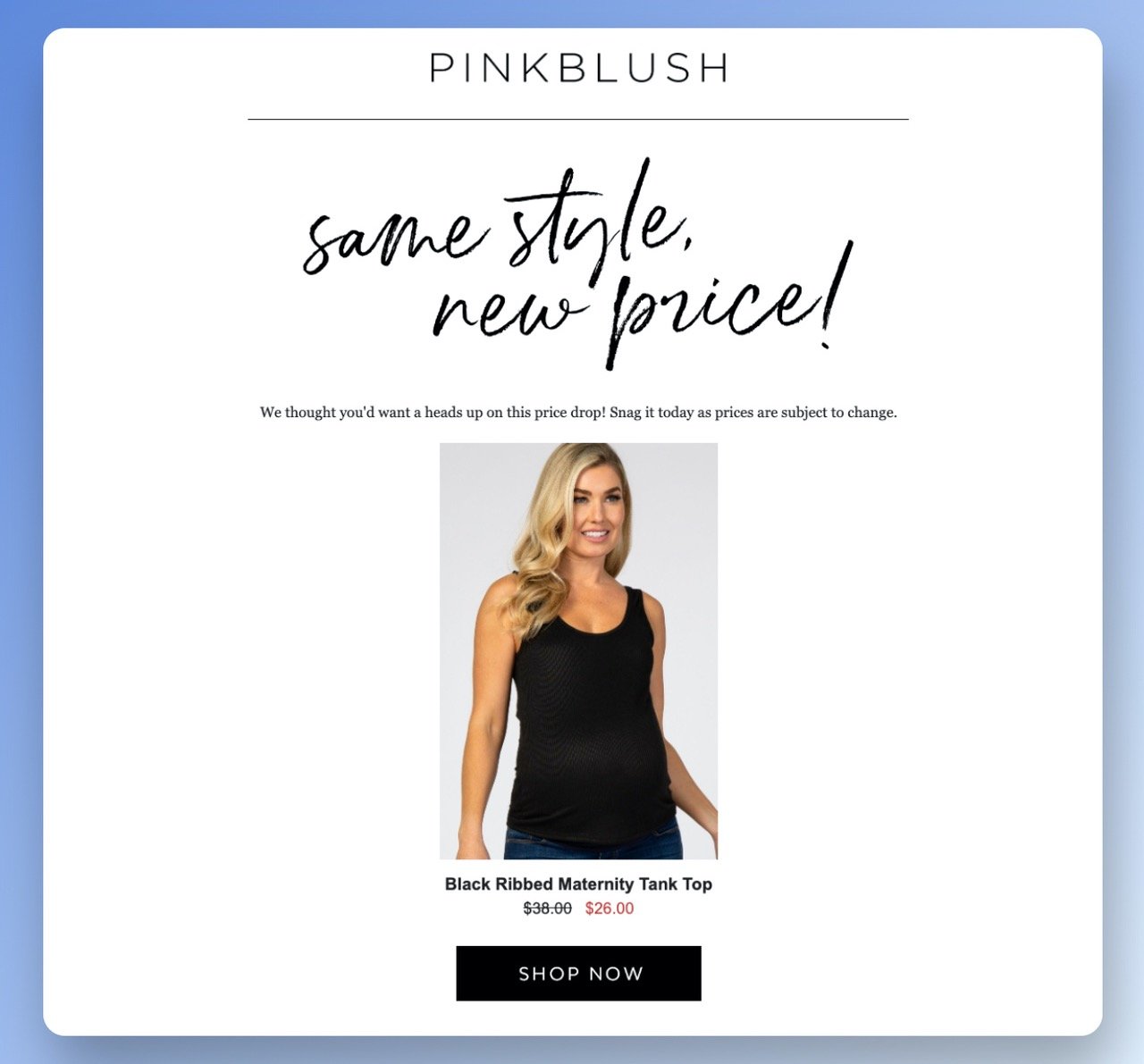
Pink Blush's personal price drop alert
What works: Pink Blush nails the emotional angle with "We thought you'd want a heads up on this price drop." That single sentence transforms a discount notification into a personal favor. The email shows the exact dollar amount of the price reduction, not just a vague "on sale now." Near the bottom, they add a time constraint with a note that the offer may end soon.
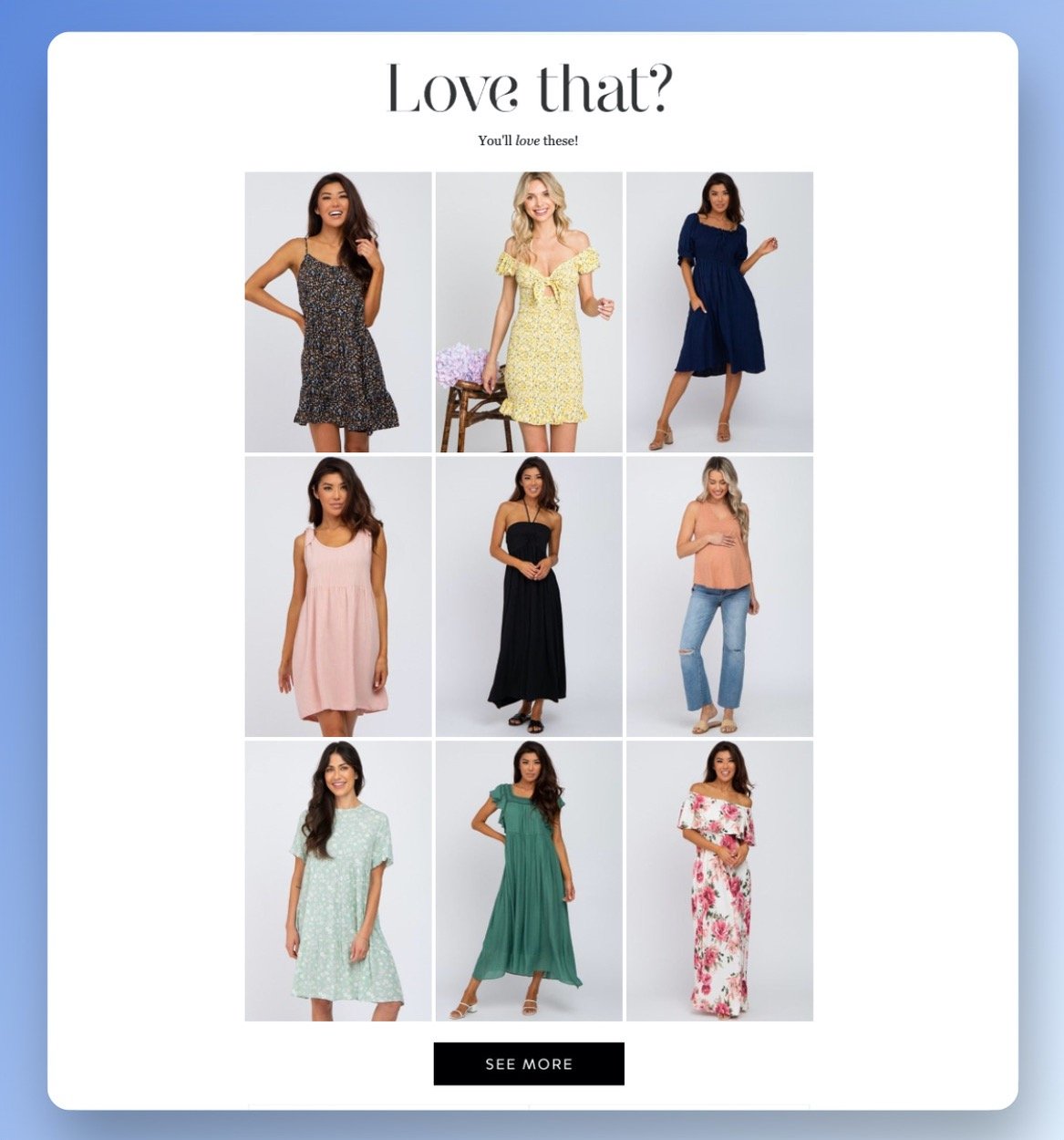
Pink Blush's cross-sell recommendations section
Why it works: The "Love That? You'll love these" recommendation section at the bottom extends the email's selling power. If the primary item doesn't convert, the related products might. The insider language ("heads up") creates a VIP feeling that builds brand loyalty beyond the transaction.
Key takeaway: Frame your price drop as a personal tip, not a mass promotion. Even a simple phrasing change from "this item is on sale" to "we thought you'd want to know" shifts the recipient's perception from target to insider.
5. UpWest: Emotional Trigger Words
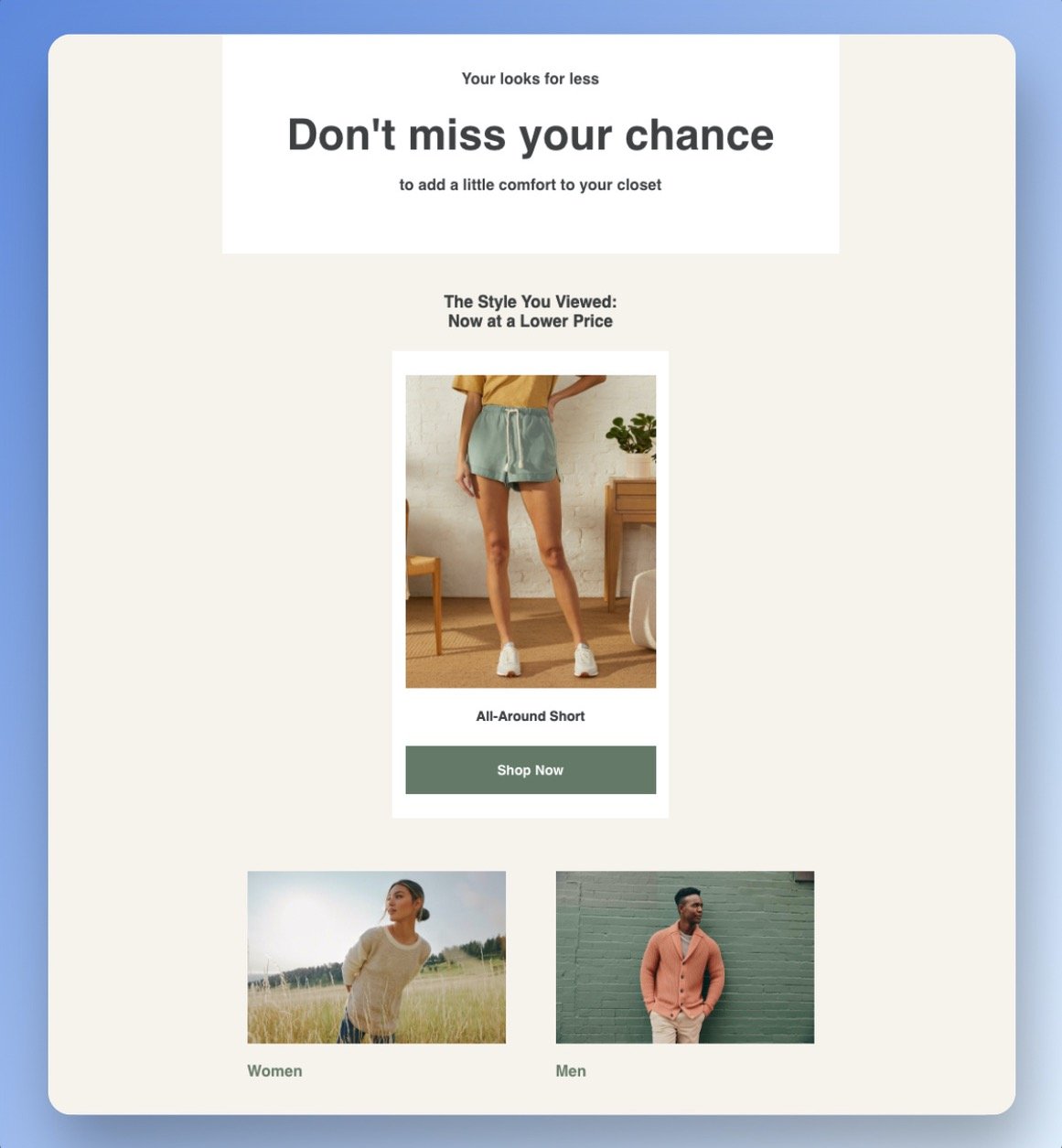
UpWest's trigger-word-driven email
What works: UpWest goes straight for the emotional gut with "Don't Miss Your Chance" as the headline and "Shop Now" as the CTA. There's no product description padding between the urgency and the action. The email is visually clean with one product, one price, one button. Phrases like "Last Chance," "Limited Offer," and "Exclusive Price Drop" signal that this deal won't last.
Why it works: Fear of missing out is a stronger motivator than desire for gain. Behavioral economics research consistently shows loss aversion outweighs potential reward by roughly 2:1. UpWest's trigger words activate this bias directly. The trick is that they keep it honest by using just two or three urgency phrases rather than stacking every power word in the playbook.
Key takeaway: Use 2-3 urgency phrases per email maximum. Stacking too many trigger words reads as desperation. Pick "don't miss," "limited," or "last chance" and commit to one theme per send.
6. DTLR: Dual CTA Navigation
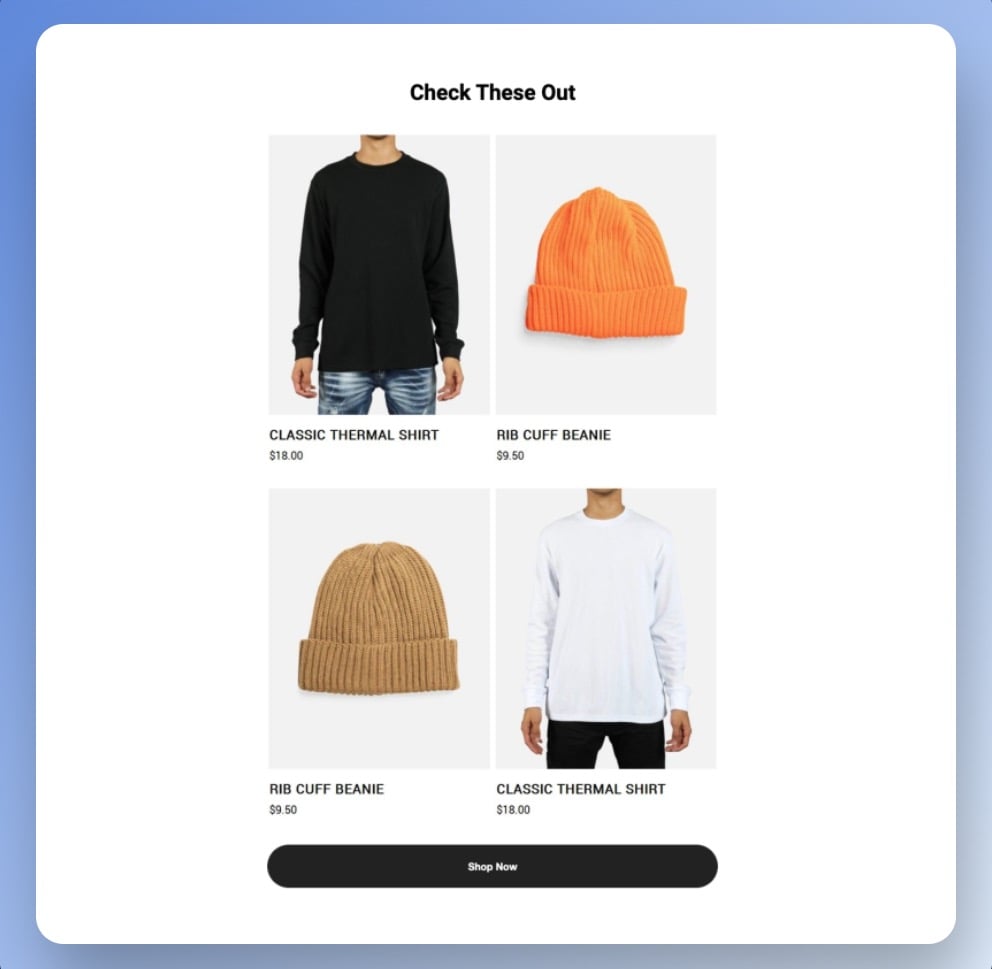
DTLR's bundled product discount email
What works: DTLR presents discounted items as a curated bundle with a "check these out" header that feels like a friend's recommendation rather than a sales pitch. But the standout element is the dual-CTA approach. Below each product, there are two buttons: "Shop Now" (direct to the product page) and "Shop DTLR" (browse the full store).
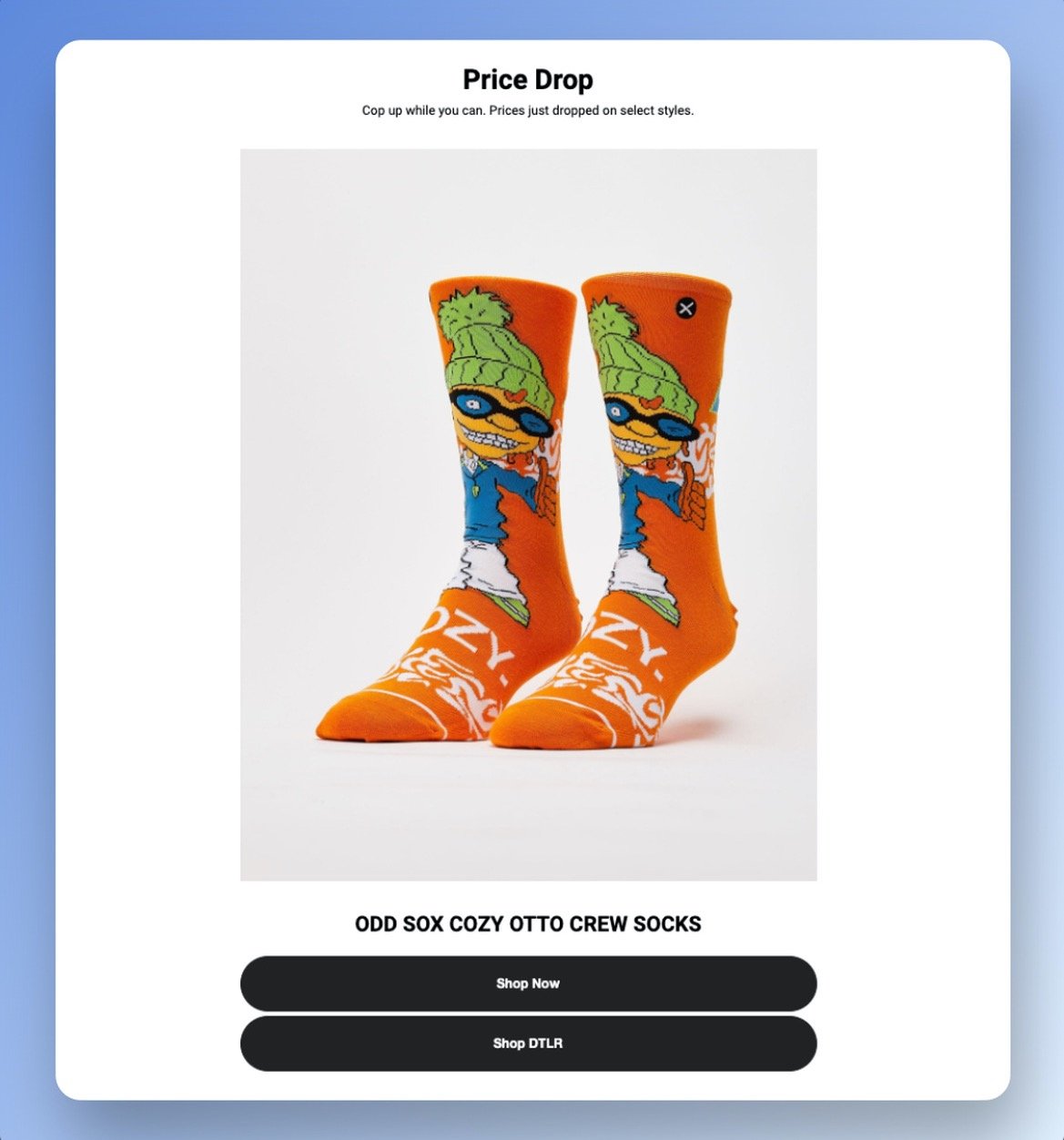
DTLR's dual-CTA price drop layout
Why it works: Two CTAs serve two intent levels. A ready-to-buy recipient clicks "Shop Now" and goes straight to checkout. A browsing recipient clicks "Shop DTLR" and finds more deals. Neither gets stuck. When your conversion path reduces friction, more recipients find what they're looking for.
Key takeaway: Offer one direct CTA for the specific product and one broader CTA for your store. You capture both high-intent buyers and casual browsers in a single email.
7. Rainbow: Curiosity-Driven Copy
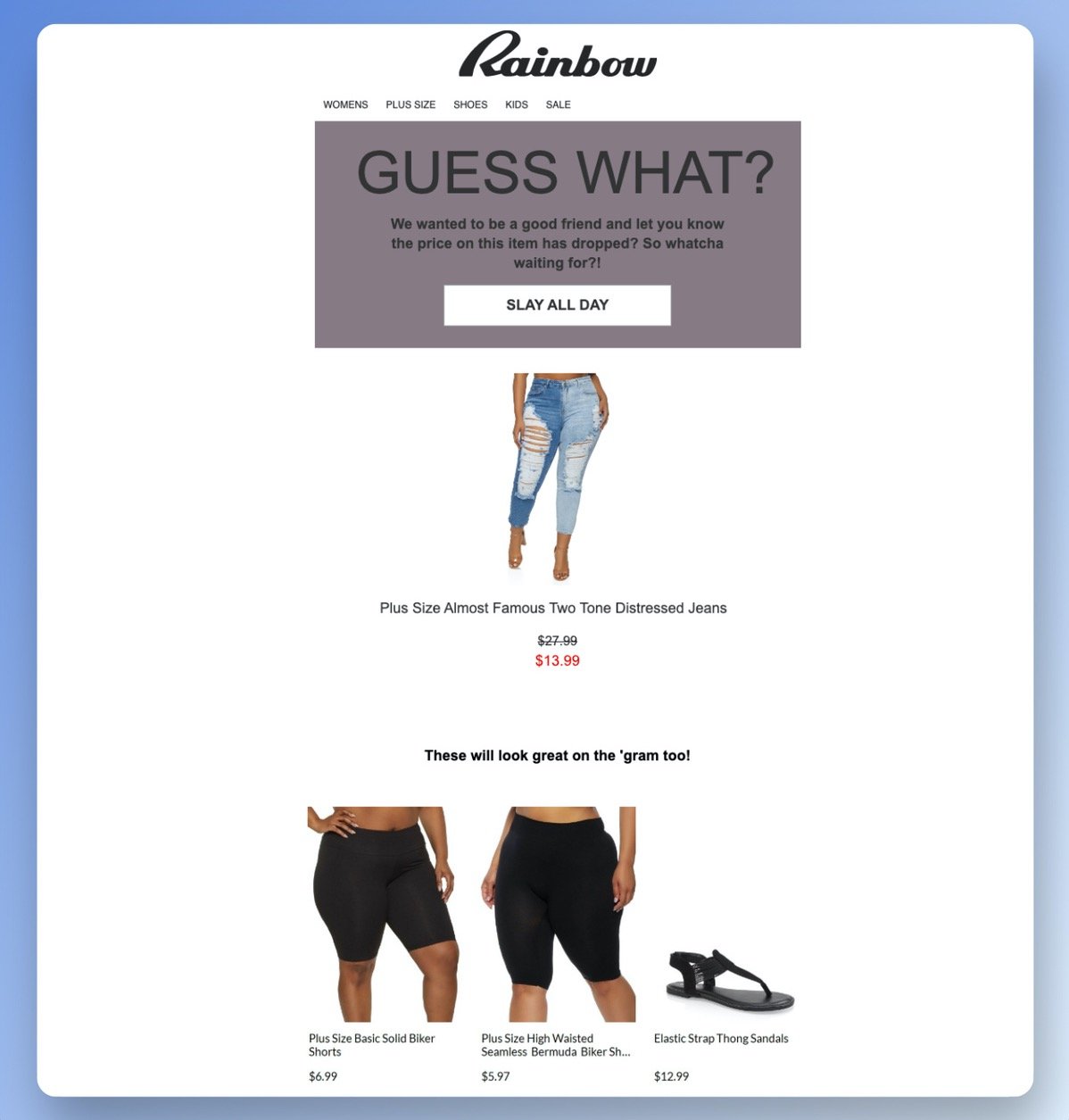
Rainbow's curiosity-sparking price drop email
What works: "Guess What?!" as a subject line is simple and effective. It doesn't reveal the offer, which drives opens out of pure curiosity. Inside, the email takes a conversational, friendly tone and presents just one discounted product. The copy reads like a text from a friend sharing a deal, not like a corporate promotion.
Why it works: By featuring a single item, Rainbow eliminates decision fatigue entirely. The recipient sees one product, one price drop, one CTA. If the discount is good enough, it actually increases the product's perceived value because the email frames it as a special opportunity rather than a clearance dump.
Key takeaway: Test single-product price drop emails against multi-product ones. For high-margin items, featuring just one deal with conversational copy often outperforms a catalog-style layout.
8. ShopStyle: Behavioral Tracking at Scale
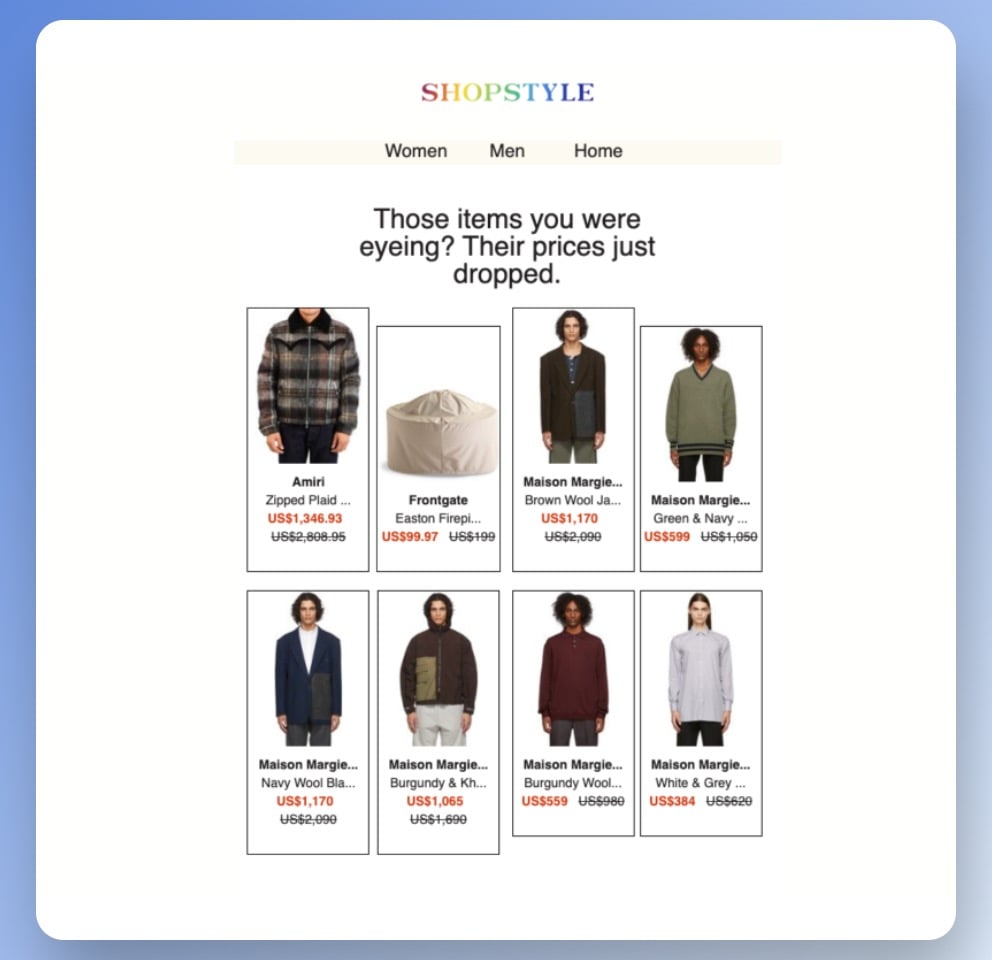
ShopStyle's behavior-tracked price drops
What works: ShopStyle takes a data-heavy approach by tracking which items each subscriber browsed, then sending a curated bundle of price drops across those categories. Every item shows both the old and new price, making the savings immediately quantifiable. The visual layout groups items by style, which reinforces the brand's position as a style authority.
Why it works: Showing old and new prices side by side activates anchoring bias. The original price sets a mental reference point that makes the reduced price feel like a genuine win. When you pair this with behavioral targeting so every item is something the recipient actually looked at, you're combining two powerful persuasion techniques in one email.
Key takeaway: Always show the original price next to the new price. Anchoring bias is one of the strongest psychological effects in pricing, and it costs you nothing to implement in your email template.
9. Forever 21: Hero Product With Model Imagery
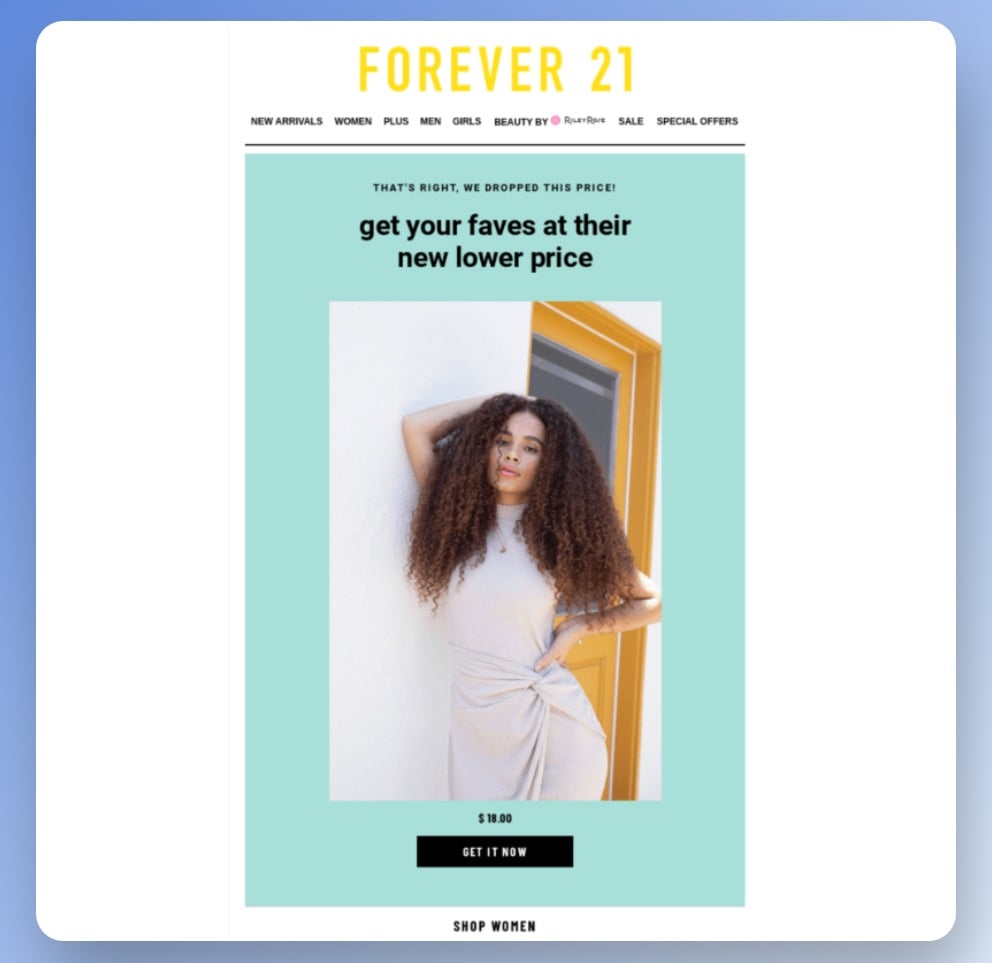
Forever 21's model-driven price drop
What works: Forever 21 leads with a model wearing the discounted product instead of a flat product image. The headline "get your faves at their new lower price" implies there are multiple deals, but the email spotlights one item. This teaser approach drives clicks because recipients want to see what else is on sale. The email is also well-optimized for mobile with a single-column layout and large CTA button.
Why it works: Model imagery outperforms flat-lay product shots in fashion email marketing because it helps recipients envision themselves wearing the item. The "your faves" language implies personalization even if the email is sent to a broad segment. Combined with mobile optimization, this email captures the attention of the majority of recipients who open on their phones.
Key takeaway: In fashion and apparel, always use model photography over flat product images in price drop emails. Recipients who see the product "in context" are more likely to click through and purchase.
10. Columbia: Re-Engagement Through Similar Items
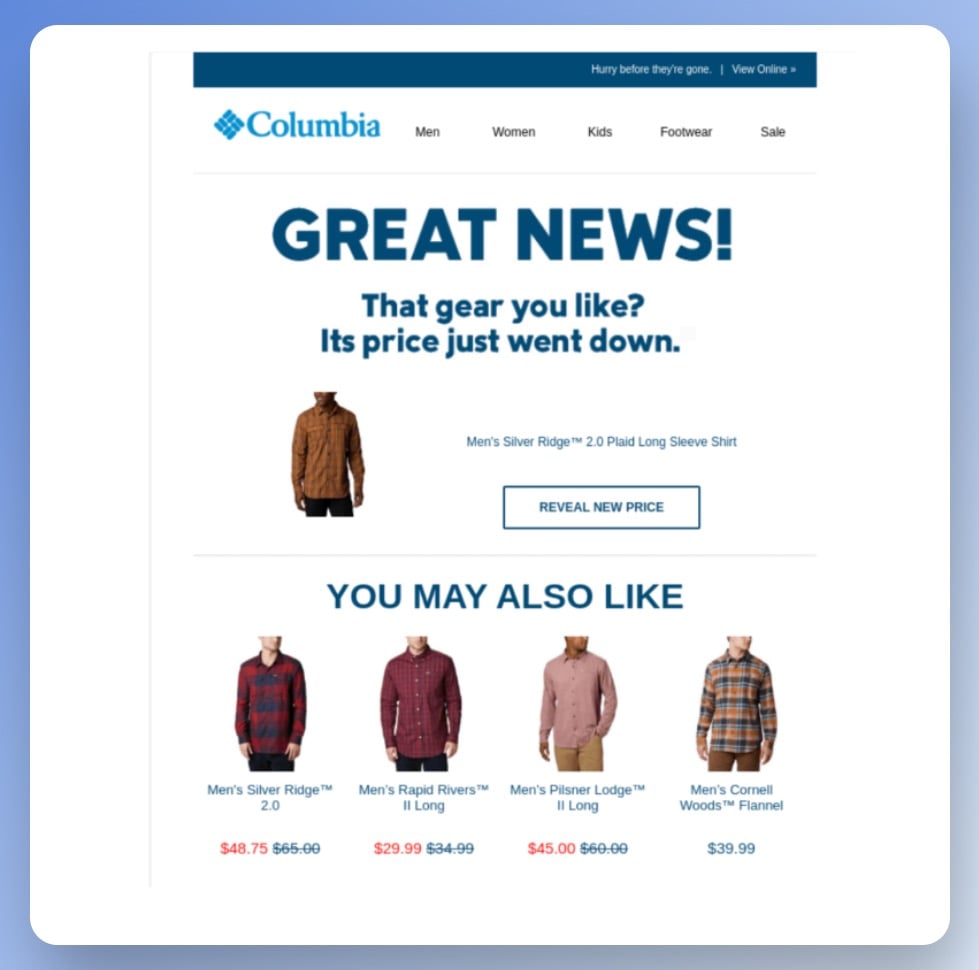
Columbia's similar-item price drop strategy
What works: Columbia lowers the price on items similar to what users already saved in their carts, not just the exact items. The "Great News" headline is warm without being pushy. Below the main product, they display related items at reduced prices, creating a browsing experience within the email itself. This approach re-engages inactive subscribers by presenting fresh deals on familiar product categories.
Why it works: Sometimes the exact item a customer saved is no longer available or no longer interesting. By expanding to similar items, Columbia casts a wider net while maintaining relevance. The machine learning-driven recommendations also signal that the brand pays attention to individual preferences, which strengthens the customer relationship.
Key takeaway: Don't limit price drop emails to the exact products users carted. Include similar items in the same category to increase the chance of a match, especially when re-engaging subscribers who've been inactive for weeks.
11. NewChic: Absolute and Relative Discounts
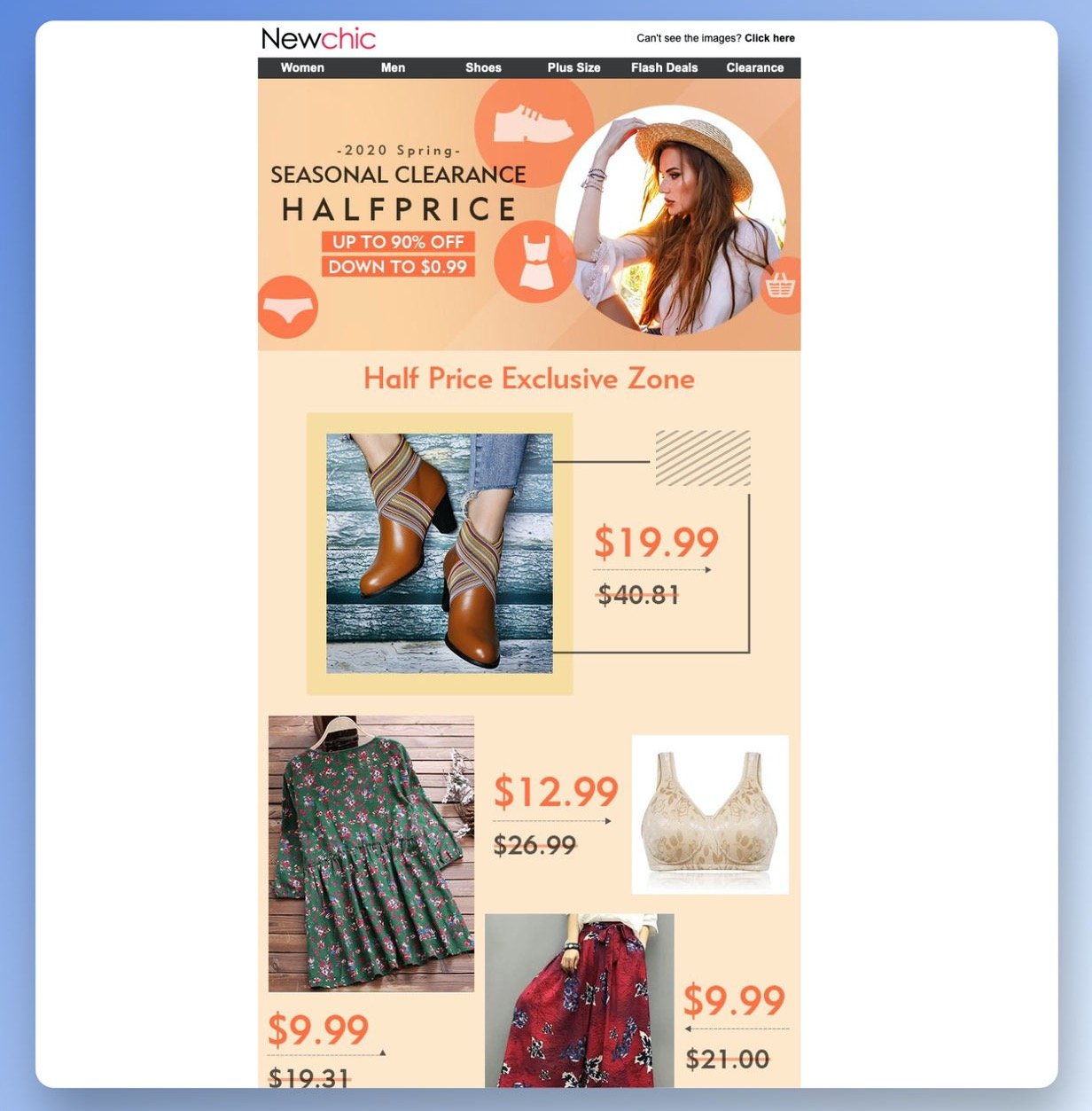
NewChic's dual-discount display
What works: NewChic captures attention with "UP to 90% off" in the subject line, then backs it up by showing both the percentage discount and the absolute dollar price next to each item. There's no ambiguity about what the recipient saves. Multiple products are displayed in a grid, each with clear old/new pricing.
Why it works: Research on price history and shopping behavior shows that consumers process discounts differently depending on the price point. For items under $100, percentage discounts feel larger (30% off sounds better than $15 off). For items over $100, absolute savings feel larger ($50 off sounds better than 15% off). NewChic covers both bases by showing both formats.
Key takeaway: Show both the percentage and dollar savings in your price drop emails. Different customers respond to different formats, and displaying both removes any need for mental math.
12. Taylor Stitch: Savings-First Headline
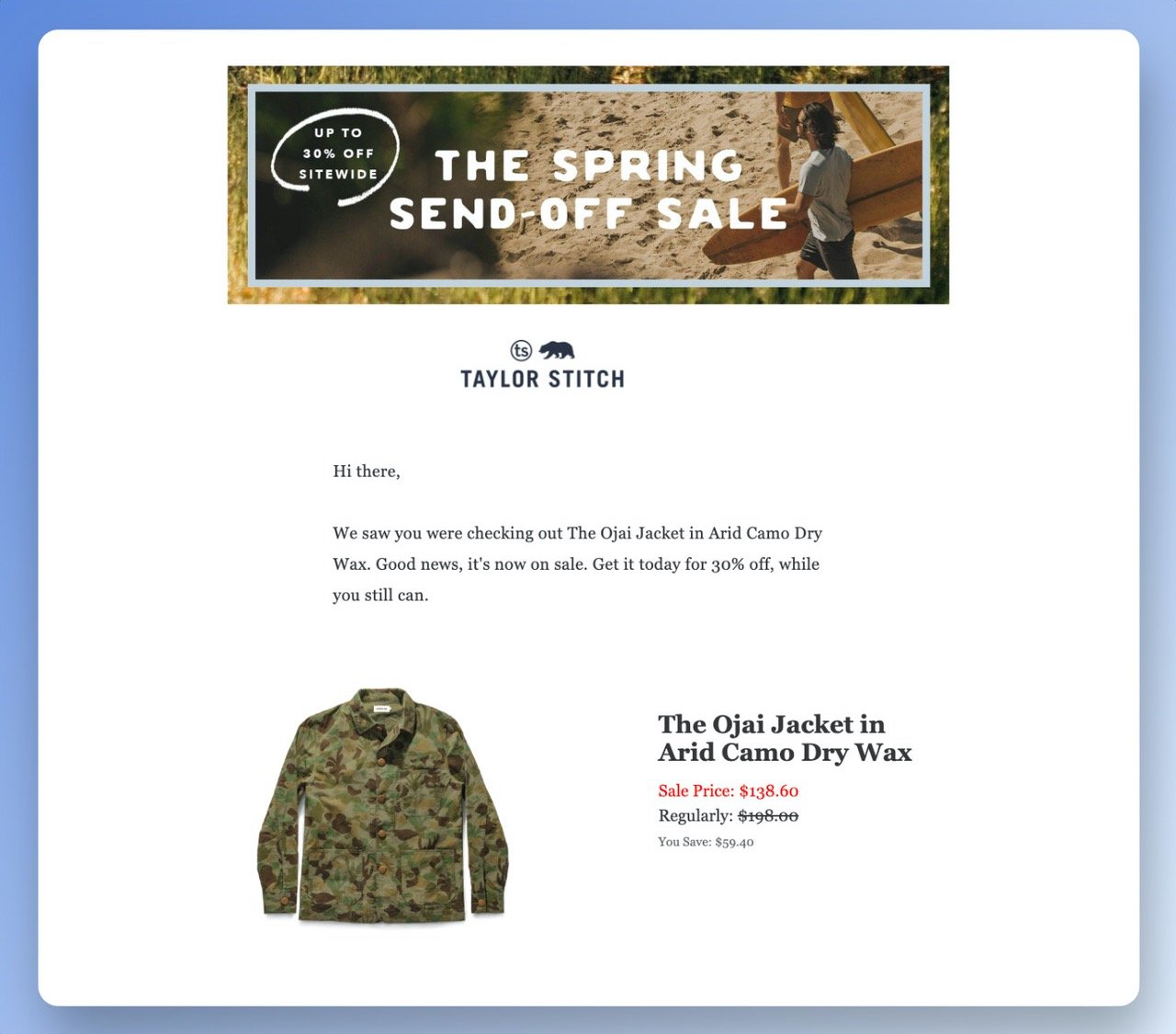
Taylor Stitch's savings-focused layout
What works: Taylor Stitch makes the savings amount the star of the email. The layout shows three numbers: original price, new price, and the exact dollar amount saved ($59.40). For a brand that sells premium basics, this triple-price display acknowledges that their products aren't cheap while showing that the deal makes them accessible.
Why it works: The "you save" figure is the most persuasive number in the email. Showing the original price establishes value. Showing the new price removes the objection. Showing the savings amount provides the emotional reward of getting a deal. It's the same psychology that makes price tags at outlet stores always show the "compare at" price.
Key takeaway: Include a third number in your price drop emails: the exact dollar amount the customer saves. Original price and sale price are standard, but the savings figure is what creates the dopamine hit that drives action.
13. WikiBuy: Daily Deal Digest
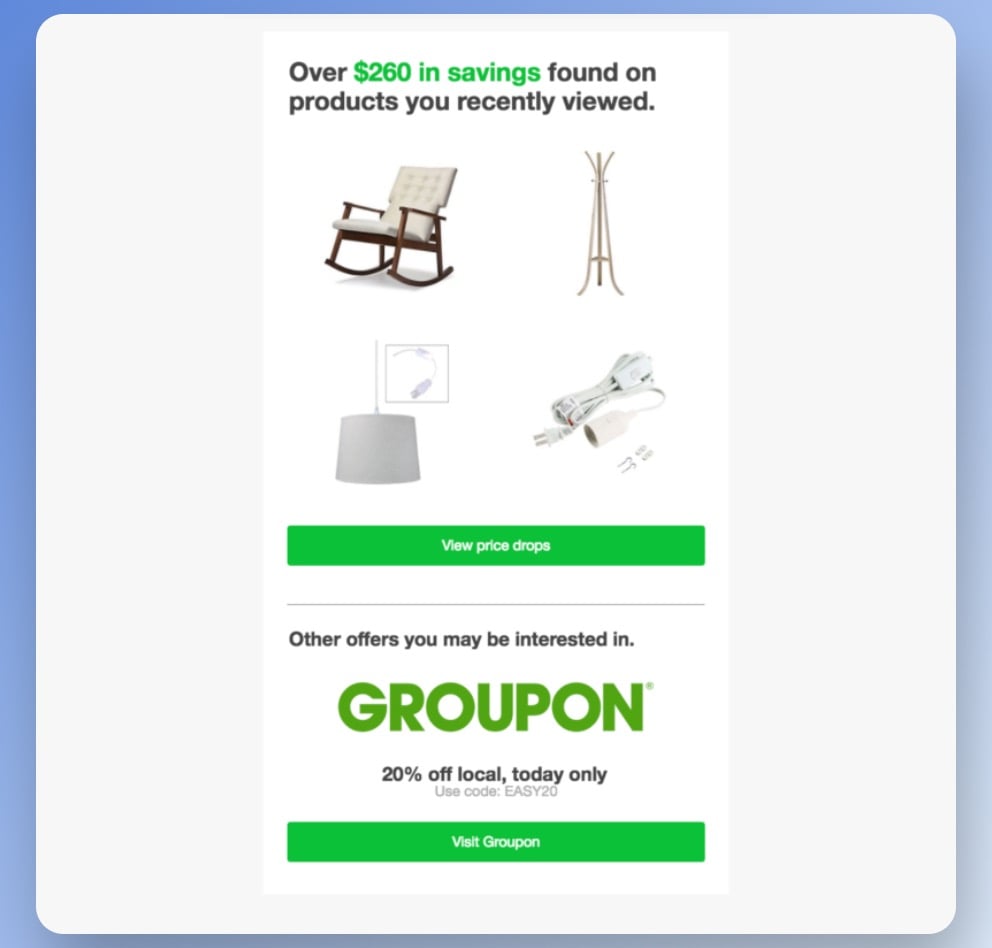
WikiBuy's daily price drop digest
What works: WikiBuy sends daily price drop digests rather than one-off alerts. Like Honey, they monitor user purchases and coupon usage across the web, then compile a personalized daily roundup of price drops. The email format is clean and scannable, with product images, old/new prices, and quick-buy links for each item.
Why it works: Daily emails risk fatigue, but WikiBuy avoids it by making each email genuinely different based on real price changes. The habitual format trains recipients to check their inbox for deals daily, turning the email into a destination rather than an interruption. This frequency works best when every item is personalized to the recipient's browsing history.
Key takeaway: Consider a daily or weekly price drop digest format if your catalog has frequent price changes. The key is that every item must be personalized. A generic daily blast will kill your unsubscribe rate.
14. Target: Low-Anchor Clearance Strategy
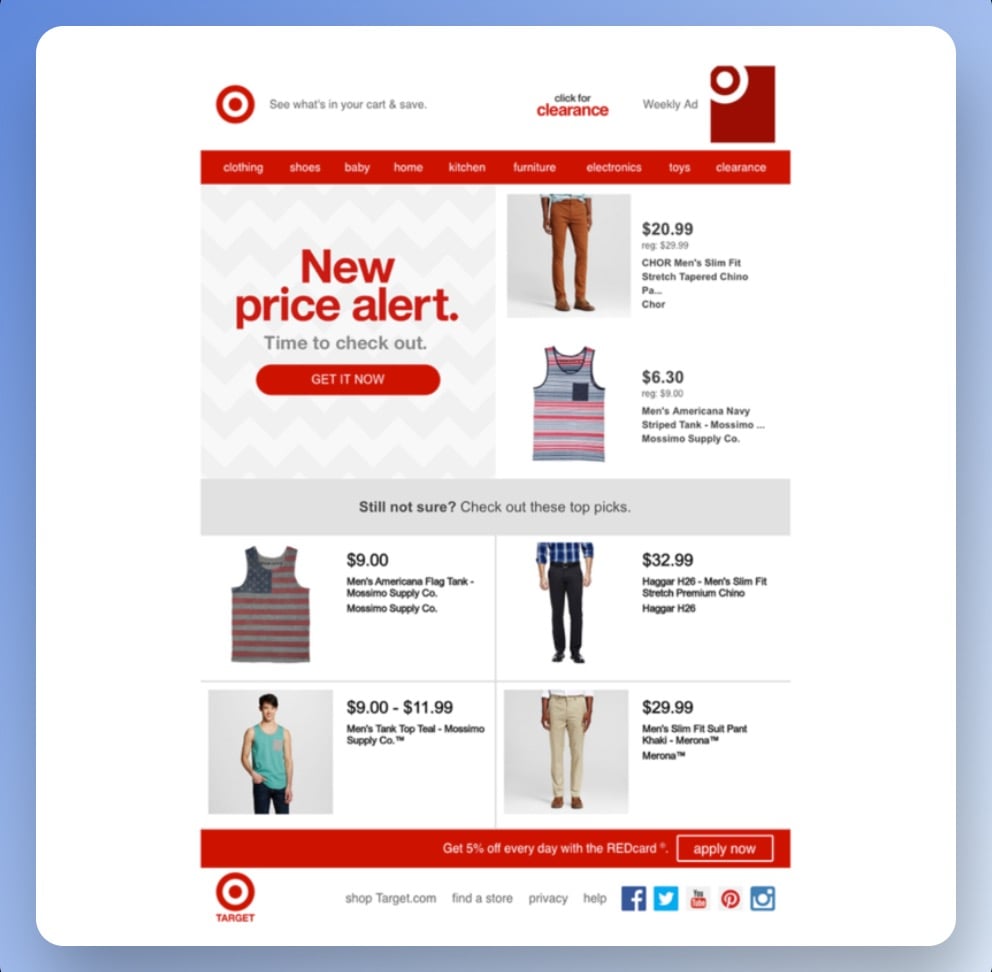
Target's clearance-focused price drop
What works: Target sorts products from cheapest to most expensive, putting a $6.30 item at the top of the email. That impulse-buy price point gets recipients scrolling. The "new price alert" subject line is factual and clean. The email promotes seasonal items on their way out, which aligns the price drop with natural inventory cycles rather than making it feel like a desperate clearance.
Why it works: The cheapest item acts as a psychological door opener. Once a recipient sees $6.30 and thinks "I could just grab that," they're mentally committed to the email. They'll keep scrolling through higher-priced items with their buying mindset already activated. It's the same principle behind loss leaders in retail stores.
Key takeaway: Lead with your cheapest discounted item at the top of the email. A sub-$10 item creates an impulse-buy entry point that pulls recipients deeper into the email and increases their likelihood of adding more items.
15. Academy: Single-Product Focus
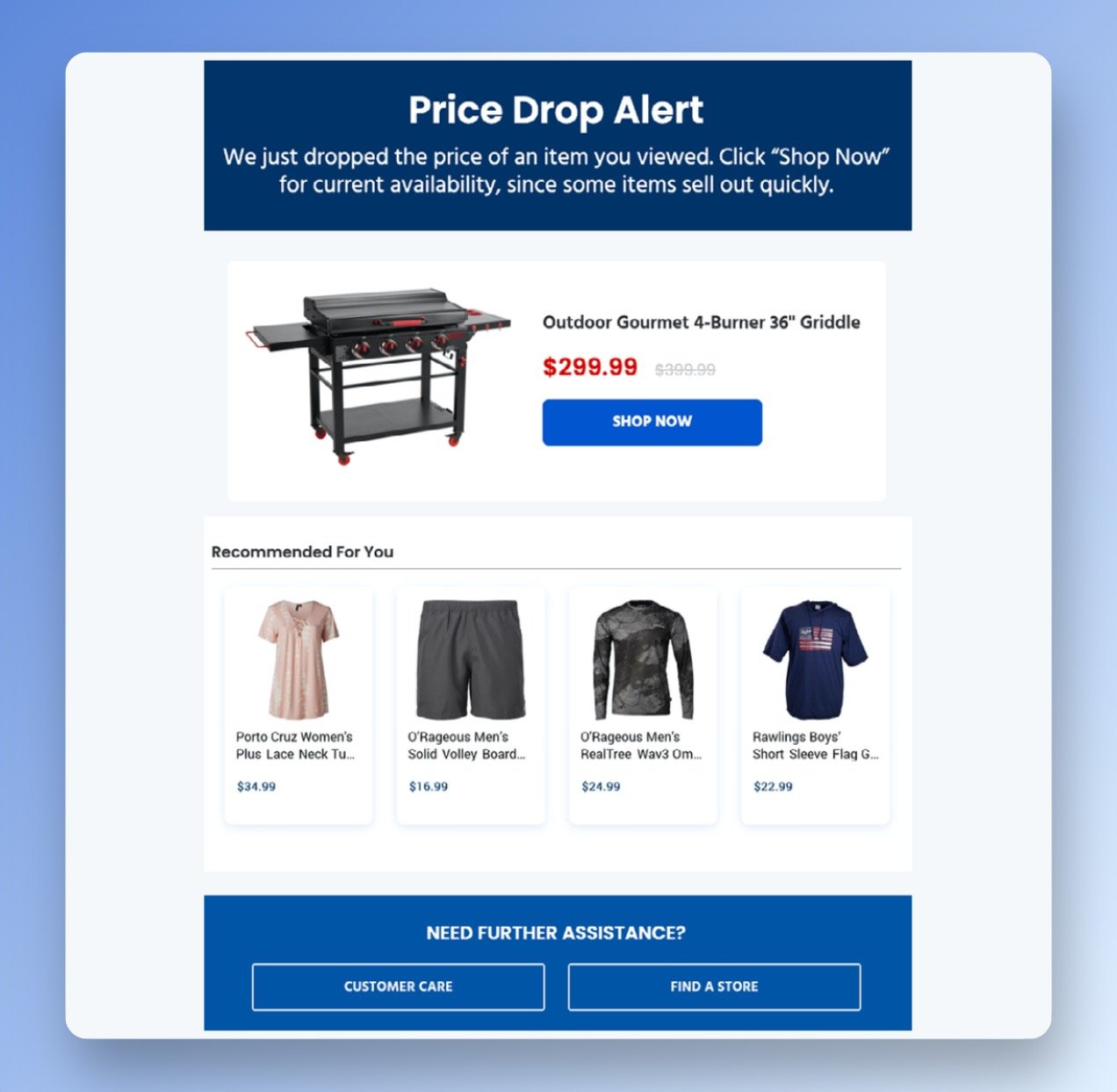
Academy's single-product price drop
What works: Academy sends one product, one discount, one CTA. The Outdoor Gourmet griddle with nearly $100 off is the entire email. No sidebar recommendations, no "you may also like" sections, no competing messages. The simplicity is the strategy.
Why it works: Overchoice (also called the paradox of choice) is real. According to Harvard Business Review research on purchase decisions, brands that simplify the buying journey are 115% more likely to be recommended and 9% more likely to earn repeat purchases. Academy's email eliminates every decision except "buy or don't buy."
Key takeaway: For high-ticket items with significant discounts ($50+), test a single-product email with zero distractions. When the deal is strong enough, choice reduction beats choice abundance every time.
How to Write Price Drop Email Subject Lines That Get Opened
The subject line decides whether your price drop email gets seen or buried. I've found that the best-performing subject lines share three traits: they mention the price drop explicitly, they create urgency, and they stay under 50 characters so they don't get cut off on mobile.
Here are subject line formulas that work, based on the examples above and broader email marketing patterns:
Direct alert style:
• "Price drop alert: [Product Name]"
• "New low price on your [Product]"
• "[Product] just dropped to $[Price]"
Curiosity-driven style:
• "Guess what? Your wishlist item is cheaper"
• "Good news about [Product]"
• "We have some savings for you"
Urgency-driven style:
• "Price drop won't last: [Product Name]"
• "Last chance at this price"
• "Your cart items are now on sale"
Avoid overused words like "AMAZING DEAL" or "HUGE SALE" in all caps. These trigger spam filters and train your audience to ignore your emails. Principles that work for abandoned cart subject lines apply here: be specific, be honest, and be brief.
How to Create a Price Drop Email Campaign
Setting up automated price drop emails requires three components: a product catalog feed, behavior tracking, and an email platform that supports price-based triggers. Here's how to build the workflow from scratch.
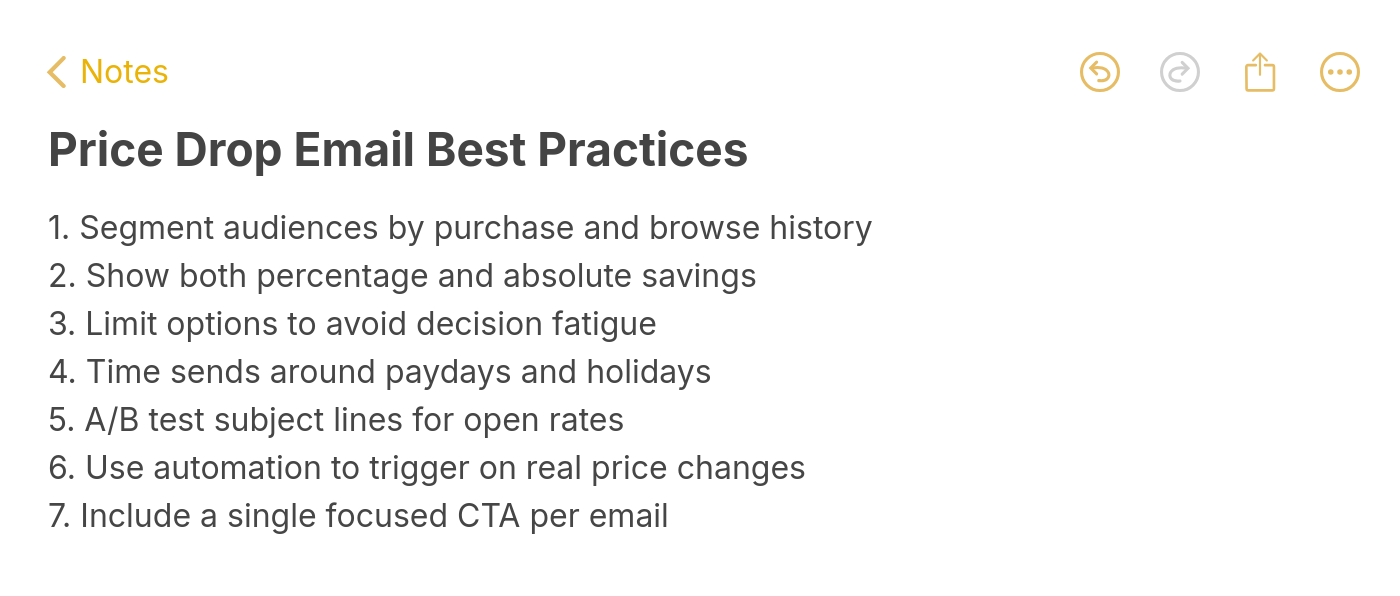
Price drop email best practices
Step 1: Connect your product catalog. Your email platform needs real-time access to product prices. Most platforms (Klaviyo, Omnisend, Bloomreach) integrate with Shopify, WooCommerce, BigCommerce, and Magento. The catalog sync lets the system detect when a product's price changes.
Step 2: Define your trigger conditions. Set the minimum price drop percentage that triggers an email. A 5% discount on a $20 item ($1 off) probably isn't worth an email. I've found that a 10-15% minimum threshold prevents you from sending weak offers that train subscribers to ignore your price drop emails.
Step 3: Build your audience segments. Target subscribers who viewed the product page, added the item to their cart, or saved it to a wishlist. According to Bluecore's analysis of Blue Nile's email strategy, sending price drop emails only to high-intent browsers (product page viewers + cart abandoners) produces far better results than blasting your full list.
Step 4: Design the email template. Keep it focused: product image, old price struck through, new price highlighted, savings amount, and one CTA. Add 2-3 recommended products below the fold. Keep the layout clean and conversion-focused.
Step 5: Set frequency caps. Limit price drop emails to 2-3 per week per subscriber maximum. Even the best deals lose impact if you email too often. If a subscriber is eligible for multiple price drop triggers in a day, bundle them into a single digest email.
Step 6: Build your subscriber list. Price drop emails only work if you have subscribers to send them to. Use shopping deals popups and exit-intent triggers to capture email addresses from browsers who haven't purchased yet. A well-timed popup offering "Get price drop alerts for this product" converts browsing visitors into your remarketing audience.
How to Measure Price Drop Email Performance
Track these five metrics to know whether your price drop emails are actually working.
Open rate: Price drop emails should hit 35-50% open rates, well above the industry average for email marketing. If yours are below 30%, your subject lines need work.
Click-through rate: Aim for 8-15% CTR. According to Sequenzy's email performance data, price drop alert emails typically convert at 5-15%, which means a healthy portion of clickers actually purchase.
Revenue per email: Divide total revenue attributed to price drop sends by the number of emails delivered. This is the metric that matters most for justifying your automation investment.
Unsubscribe rate: Watch this closely if you send frequent price drop digests. If unsubscribes spike above 0.5% per send, reduce frequency or tighten your audience segmentation.
Recovery rate: For cart abandonment-triggered price drops, track what percentage of abandoned carts convert after the price drop email.
Common Mistakes in Price Drop Emails
After reviewing hundreds of price drop campaigns across e-commerce and SaaS, I've noticed the same mistakes repeated across industries. Here are the ones that cost the most revenue.
Sending to your entire list. A price drop email for running shoes sent to someone who only browses kitchen appliances is spam. Always segment by browsing behavior, cart activity, or wishlist data.
Weak discounts that erode trust. Sending a price drop alert for a 3% reduction teaches subscribers that your "deals" aren't worth opening. Set a minimum threshold (I recommend 10-15%) before triggering a send.
No clear price comparison. If recipients have to calculate the savings themselves, you've lost them. Always show the original price, new price, and savings amount in the email body.
Ignoring mobile formatting. More than half of all email opens happen on smartphones. If your product images, prices, and CTAs aren't visible without horizontal scrolling, you're losing conversions from the majority of your audience.
Sending too late after the price change. A price drop email sent 48 hours after the reduction loses its urgency. The best-performing campaigns trigger within 1-4 hours of the price change, especially for competitive products where inventory moves fast.
Forgetting the CTA. Some emails do a great job presenting the deal but bury the purchase button below three paragraphs of copy. Put the CTA within the first scroll on mobile. You can always add a second CTA lower in the email.
Start Sending Price Drop Emails That Convert
Three patterns show up in every high-performing price drop email from this list: they're personalized to the recipient's behavior, they display clear before-and-after pricing, and they keep the path to purchase short with a single prominent CTA.
Whether you send automated alerts triggered by catalog changes or manual campaigns timed to seasonal clearance, the fundamentals don't change: relevance beats reach, clarity beats cleverness, and one strong deal beats ten weak ones.
To make your price drop emails work, you need an email list worth sending to. Growing that list starts with capturing visitors before they leave your site. A popup builder like Popupsmart lets you create targeted email capture campaigns in minutes, so you can build the audience that makes every price drop email more profitable.
Frequently Asked Questions
How Do You Write an Email for a Price Decrease?
Start with a subject line that mentions the price drop directly, like "Price drop on [Product Name]." In the email body, show the product image, display the old price crossed out next to the new price, state the savings amount, and include one clear CTA button. Keep the copy under 100 words. The product and the deal should do the selling, not a wall of text. If you're announcing a site-wide price reduction, lead with the biggest discount to hook the reader, then list secondary deals below.
How Do You Announce a Price Drop?
The most effective price drop announcements combine email with on-site notifications. Send the email to segmented subscribers (based on browsing or cart behavior), and simultaneously display a website popup announcing the sale to active site visitors. For maximum reach, also post on social channels and update your product pages with visible "price reduced" badges. The email handles re-engagement of past visitors; the popup captures current browsers.
How Can You Get Notified of Price Drops?
Consumers can track price drops through browser extensions like PayPal Honey or CamelCamelCamel (for Amazon), by subscribing to retailer email lists with price alert preferences, or by using dedicated price tracking sites. From a business perspective, you can offer price drop notifications as a lead capture tool. Add an option on product pages that says "Notify me when price drops" and use it to build your email list with high-intent subscribers.
What Are the Best Subject Lines for Price Drop Emails?
The best subject lines are specific and short. "Price drop: [Product Name] now $[X]" consistently outperforms vague alternatives like "Big savings inside!" or "Don't miss this deal!" Personalized subject lines that mention the exact product name see 20-30% higher open rates than generic ones. Keep subject lines under 50 characters so they display fully on mobile devices.
How Can You Use FOMO in Price Drop Emails?
Add real scarcity signals: show remaining stock count ("Only 12 left at this price"), include a countdown timer for the deal expiration, or reference dynamic pricing ("Price may change throughout the day"). Avoid fake urgency. If your "limited time" deal runs every week, recipients will catch on and stop engaging. The most effective FOMO comes from truthful scarcity combined with personalization, like telling a subscriber that the specific item they saved is now cheaper but selling fast.
How would you rate your experience with this article? 😊