ChatGPT
 Perplexity
 Claude
 Grok
Grok Google AI Mode
Announcement bars, also known as floating bars, sticky bars, or hello bars, are simple tools that do a lot of work on ecommerce websites.
These 15 announcement bar examples from real ecommerce brands show how a single line of text at the top of your site can drive purchases and build trust. Each example covers free shipping bars, flash sales, social proof, and loyalty nudges with a breakdown of what converts and how to replicate it. After the 15, you'll find Black Friday free shipping bars for 27 November 2026, what a hello bar is, and when Shopify's own announcement bar is enough.
What Makes a Great Announcement Bar? Selection Criteria
These 15 bars come from fashion, food, beauty, and DTC brands, and were selected on four criteria:
• Message clarity: Can a visitor understand the offer within two seconds of landing? Bars with ambiguous copy or multiple competing messages didn't make the cut.
• Design integration: The bar must complement the site's visual identity without clashing or disappearing into the header. Contrast, font weight, and color harmony all factored in.
• Conversion mechanism: Each bar needs a clear path to action, whether that's a CTA button, a coupon code, or a threshold that nudges cart value upward.
• Reproducibility: A marketer with a no-code tool like Popupsmart's popup builder could recreate any of these without a developer.
The screenshots were taken in September 2024, when this post was first published. Stores change their bars every few weeks, so read the prices and thresholds in them as examples of a pattern, not as today's offers.
15 announcement bar examples for ecommerce stores
Each example below names the pattern, shows the bar as it looked in September 2024, and ends with what to copy.
1. Birkenstock: The Seasonal Sale Bar
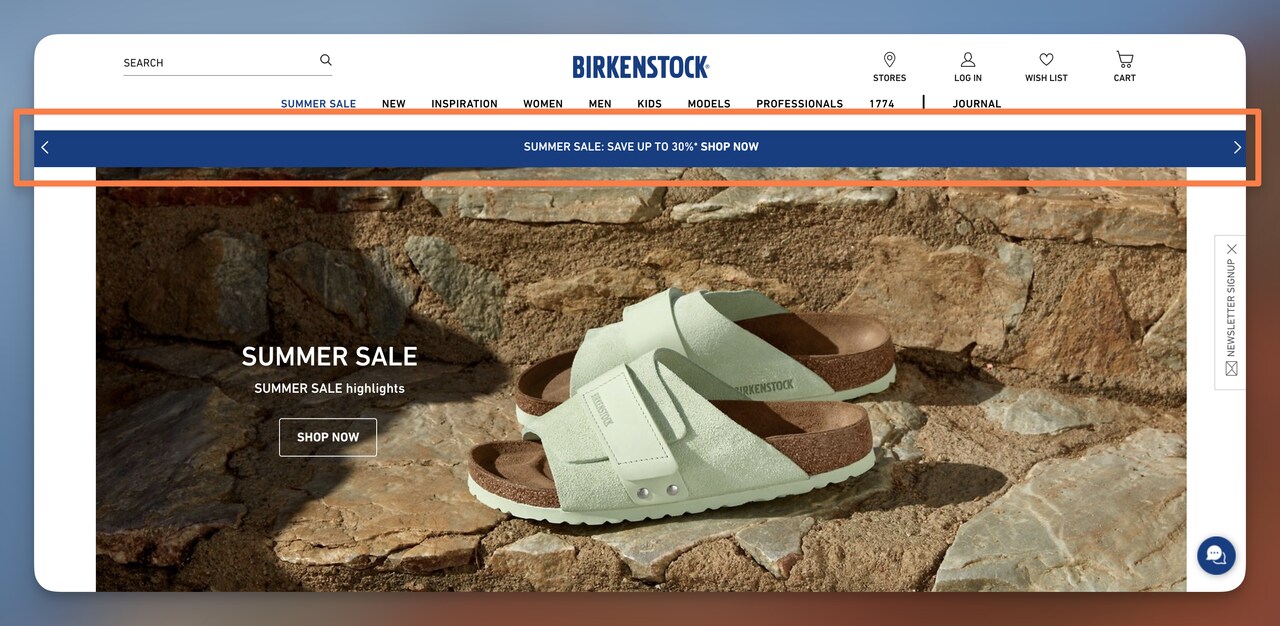
Birkenstock's summer sale announcement bar
What works: Birkenstock's bar delivers a single message in seven words: "SUMMER SALE: SAVE UP TO 30%." White text on the blue background is easy to read at a glance. A "Shop Now" CTA button sits right next to the discount percentage, shortening the cognitive path from awareness to click. There's no secondary message competing for attention.
Why it works: Loss aversion is stronger than gain framing. "SAVE UP TO 30%" frames the discount as money you'd lose by not acting. Birkenstock pairs this with a single CTA (no "Learn More" alternative), which applies Hick's Law to reduce decision time. Fewer choices mean faster clicks.
Key takeaway: Keep your sale bar to one offer and one button. If you're running multiple promotions simultaneously, rotate them on a timer rather than cramming two messages into the same bar.
2. Skims: The Free Shipping Threshold Bar
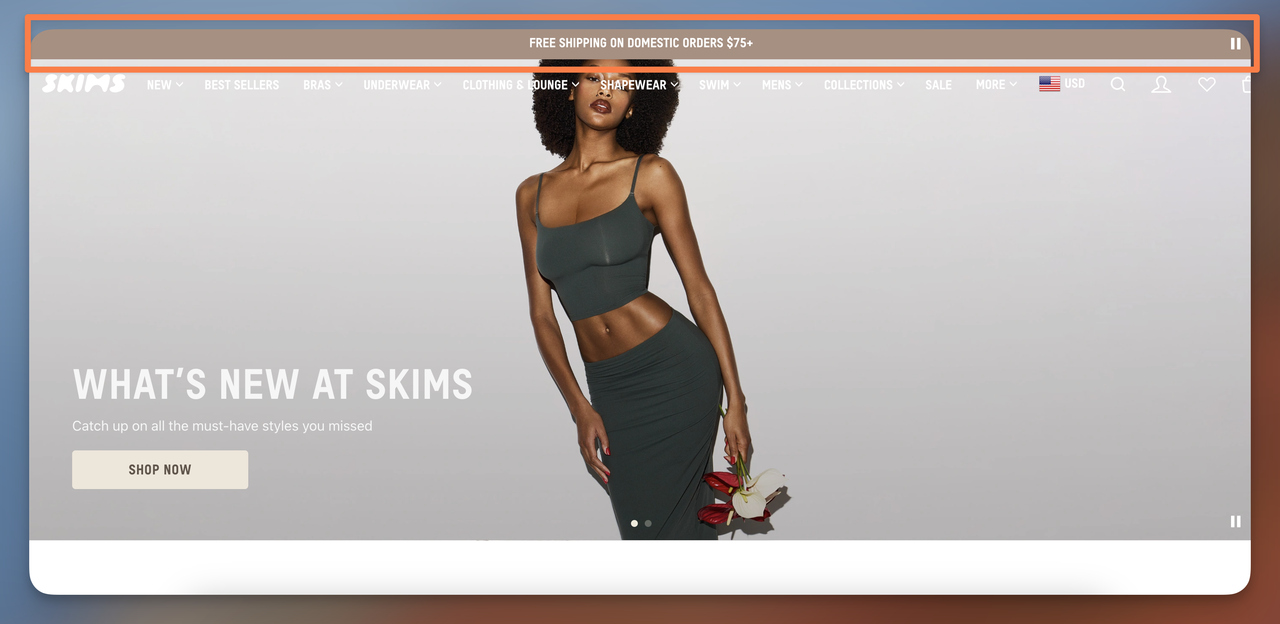
Skims' free shipping threshold bar
What works: "FREE SHIPPING ON DOMESTIC ORDERS $75+" is the entire message. No decorative copy, no brand tagline crowding the bar. The neutral-toned background merges with the site header so it feels native rather than promotional. The $75 threshold is specific and achievable: high enough to push most carts one item higher, and no more.
Why it works: Shipping cost is the first thing that stops a checkout. In Baymard Institute's cart abandonment research (page updated September 2025), 40% of US online shoppers who abandoned a cart for a reason other than just browsing said extra costs such as shipping, tax and fees were too high. Skims puts the free shipping offer on every page instead of burying it in the cart, so it answers that objection before the shopper even adds a first item.
Key takeaway: Set your free shipping threshold a little above your current average order value. That turns the bar into a revenue tool instead of a perk announcement. If you run Shopify, you set the threshold in your Shopify admin under Settings → Shipping and delivery.
3. Haven's Kitchen: The New Product Launch Bar
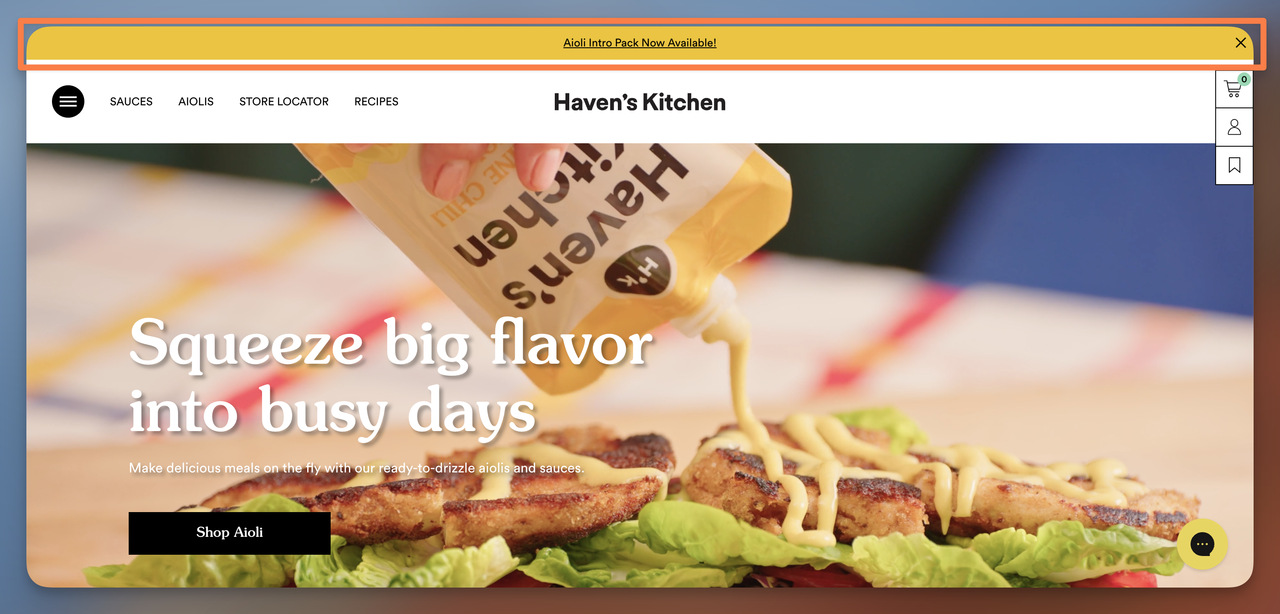
Haven's Kitchen product launch bar
What works: The bright yellow background breaks from Haven's Kitchen's otherwise muted color palette. That contrast is intentional. It forces the eye to the bar before anything else on the page. The close button gives visitors control, which matters because dismissible bars create a sense of agency rather than intrusion. The copy names the exact product (Aioli Intro Pack) instead of a vague "new arrivals" label.
Why it works: The Von Restorff isolation effect says items that visually stand out from their surroundings are remembered better. Haven's Kitchen applies this by choosing a bar color that exists nowhere else on the page. The result: visitors process the product name even if they immediately dismiss the bar.
Key takeaway: For product launches, pick a bar color outside your normal brand palette. The visual disruption signals "this is new" without adding extra copy.
4. Away: The Payment Flexibility Bar
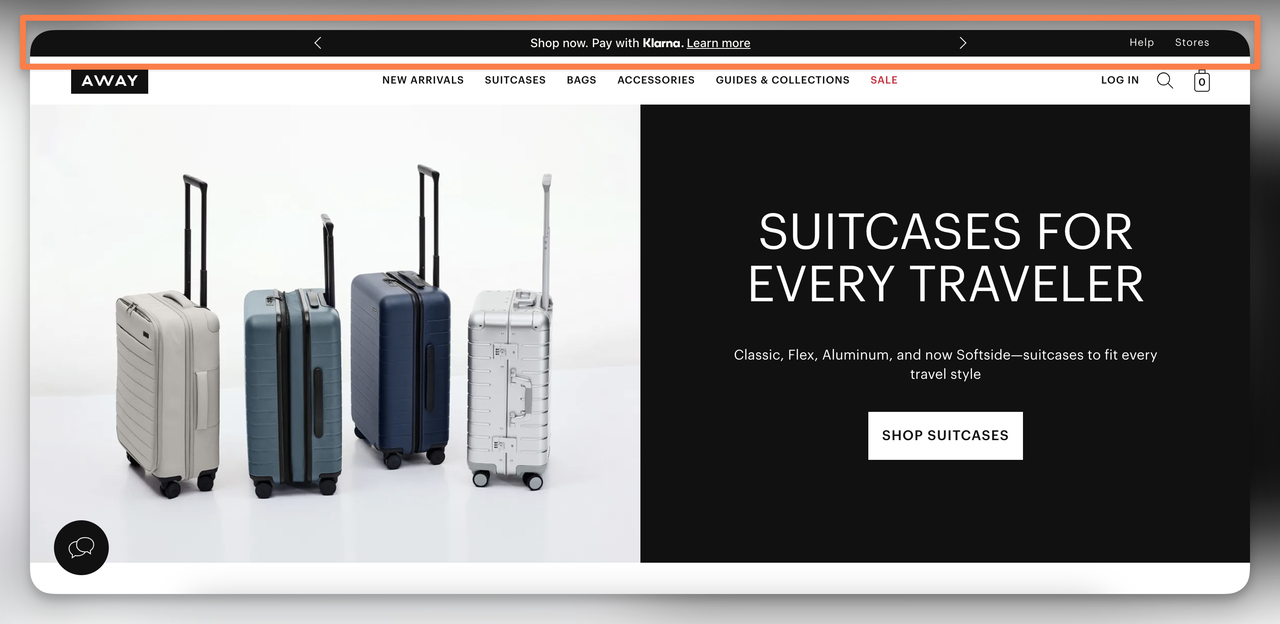
Away's Klarna payment bar
What works: "Shop now. Pay with Klarna." Five words that address the biggest objection for a luggage brand whose suitcases cost hundreds of dollars: price. The slim black bar blends into the site's dark header, so it avoids the promotional "banner ad" look that triggers banner blindness. And Klarna is a brand shoppers already trust. Naming it lets Away borrow credibility from the payment provider.
Why it works: Buy-now-pay-later messaging in the announcement bar pre-qualifies visitors who might otherwise bounce on price. The bar sits above the product imagery, so the payment option registers before sticker shock hits. The same idea works for smaller stores: the online store BellaTentazione used a Popupsmart floating bar to explain paying in installments, shown only on chosen pages and hidden after a set number of visits (BellaTentazione's customer story).
Key takeaway: If your products cost over $100, test a BNPL announcement bar against your standard promo bar. Position it as a payment option, not a financing pitch.
5. Magic Spoon: The Social Proof Bar
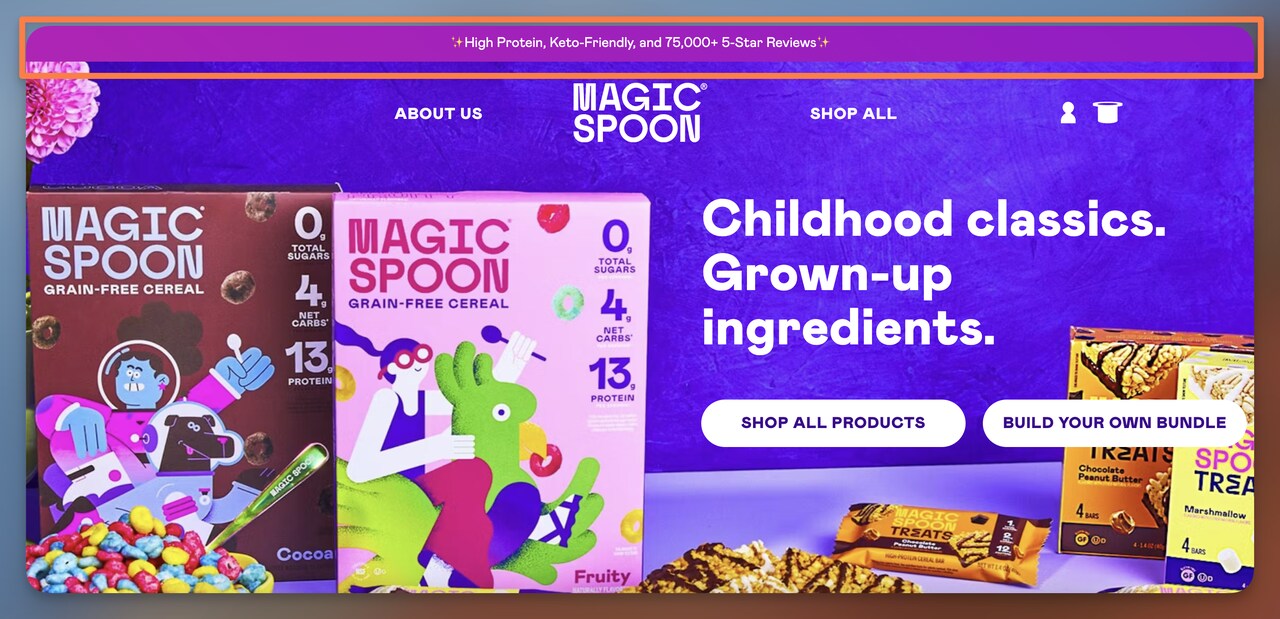
Magic Spoon's social proof announcement bar
What works: Magic Spoon packs three data points into one bar: "High Protein, Keto-Friendly, and 75,000+ 5-Star Reviews." The first two are product attributes that speak to their health-conscious audience. The third one, the review count, is what does the selling. Notice they didn't round down to "thousands of reviews." The specific number 75,000 feels more credible than a vague quantity. The purple background with sparkle emojis matches their brand voice without looking childish.
Why it works: Social proof is the strongest persuasion trigger for DTC brands that lack the physical shelf presence of grocery store competitors. The announcement bar is the first thing visitors see, so a review count there front-loads trust before anyone starts comparing products.
Key takeaway: If you have 1,000+ reviews, put the exact count in your announcement bar. Specific numbers outperform vague claims like "loved by thousands" because they're verifiable.
6. Wellah: The Spending Threshold Bar
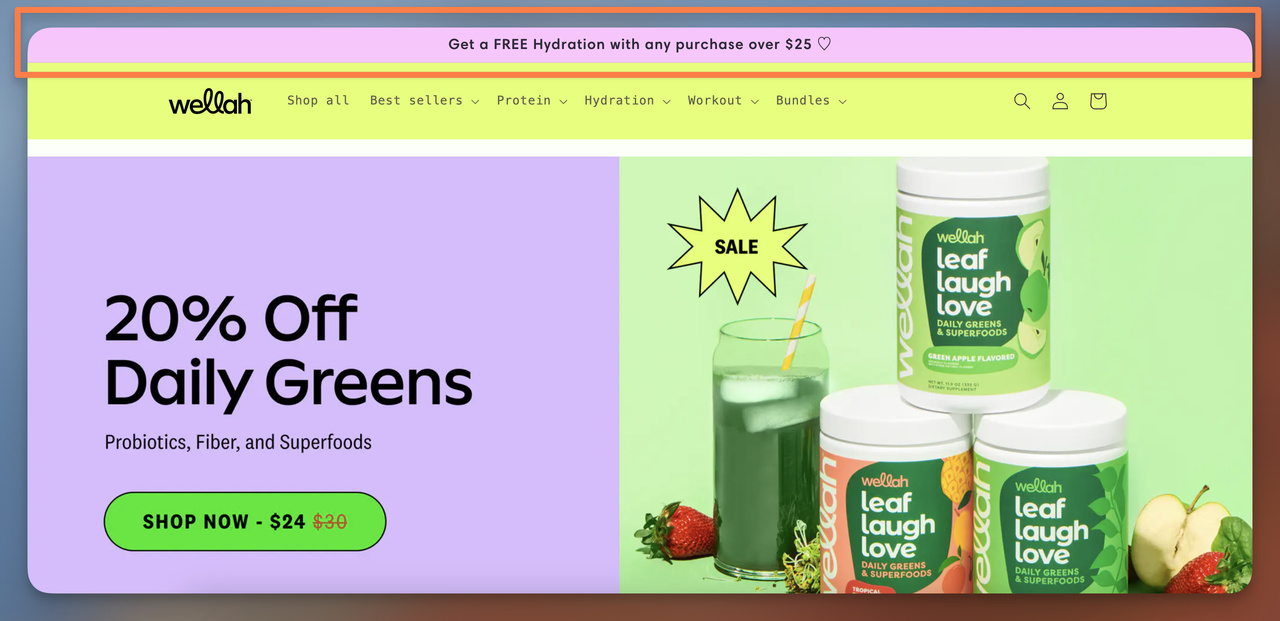
Wellah's cart value threshold bar
What works: Wellah’s announcement bar promotes a gift-with-purchase incentive instead of a standard discount. The message “Get a FREE Hydration with any purchase over $25” instantly communicates both the reward and the spending threshold. This type of offer feels more tangible than a percentage discount because customers clearly understand what they’re getting.
Why it works: Free product incentives trigger the zero-price effect, a well-documented behavioral economics principle showing that people disproportionately value items labeled “free.” Instead of evaluating a discount mathematically, customers focus on the perceived bonus they receive. The $25 threshold also nudges shoppers to slightly increase their cart value to unlock the reward.
Key takeaway: Gift-with-purchase offers are often more persuasive than discounts in announcement bars. A clear threshold plus a tangible reward (“Free product over $X”) increases perceived value and encourages customers to add one more item to qualify.
7. Swoon: The Social Media Follow Bar
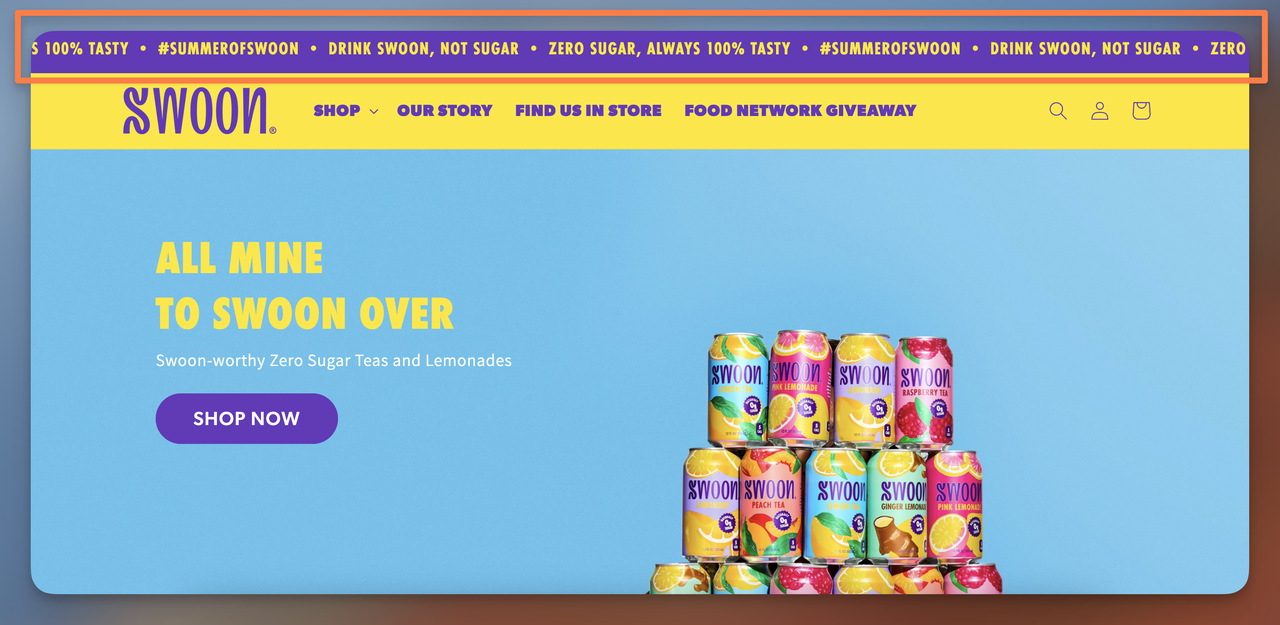
Swoon's social media promotion bar
What works: Most brands reserve announcement bars for sales. Swoon takes a different approach by using theirs to promote social media channels. That makes sense for a brand whose Instagram presence drives discovery: followers on social come back to the site again and again. The bar keeps the ask simple: follow us. No coupon code, no threshold, just a relationship invitation.
Why it works: Not every announcement bar needs to push an immediate transaction. Swoon recognizes that their customer journey starts on social media, so the bar aligns with the actual path to purchase. It's also a rare use of the format, which helps Swoon stand out among above-the-fold examples.
Key takeaway: If a large share of your traffic comes from social media, test a social-follow announcement bar during non-sale periods. It keeps the bar active without discount fatigue.
8. Olaplex: The Product Spotlight Bar
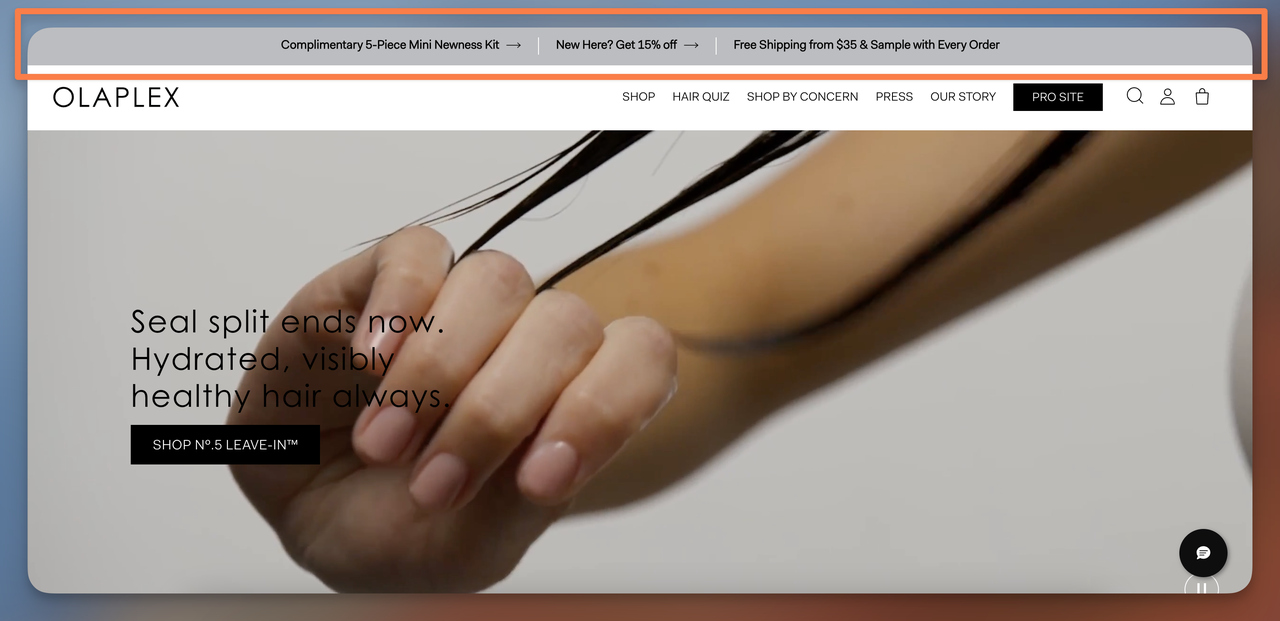
Olaplex's product spotlight bar
What works: Olaplex dedicates their announcement bar to a single hero product rather than a site-wide sale. The bar names the product, includes "Shop Now" as the CTA, and uses minimal copy. This approach works because beauty brands often have large catalogs, and new visitors don't know where to start. The bar reads like an editorial pick: "if you buy one thing, buy this."
Why it works: The paradox of choice, studied by psychologist Barry Schwartz, shows that too many options can paralyze decision-making. By pointing visitors to a specific product, Olaplex reduces the cognitive load of browsing a large catalog. This is especially useful during product launches when the brand wants to concentrate traffic on a single SKU for initial sales velocity.
Key takeaway: Use product spotlight bars during launches or when you want to push a hero SKU. Name the product directly. Don't hide it behind "See what's new."
9. Loisa: The Bundle Discount Announcement
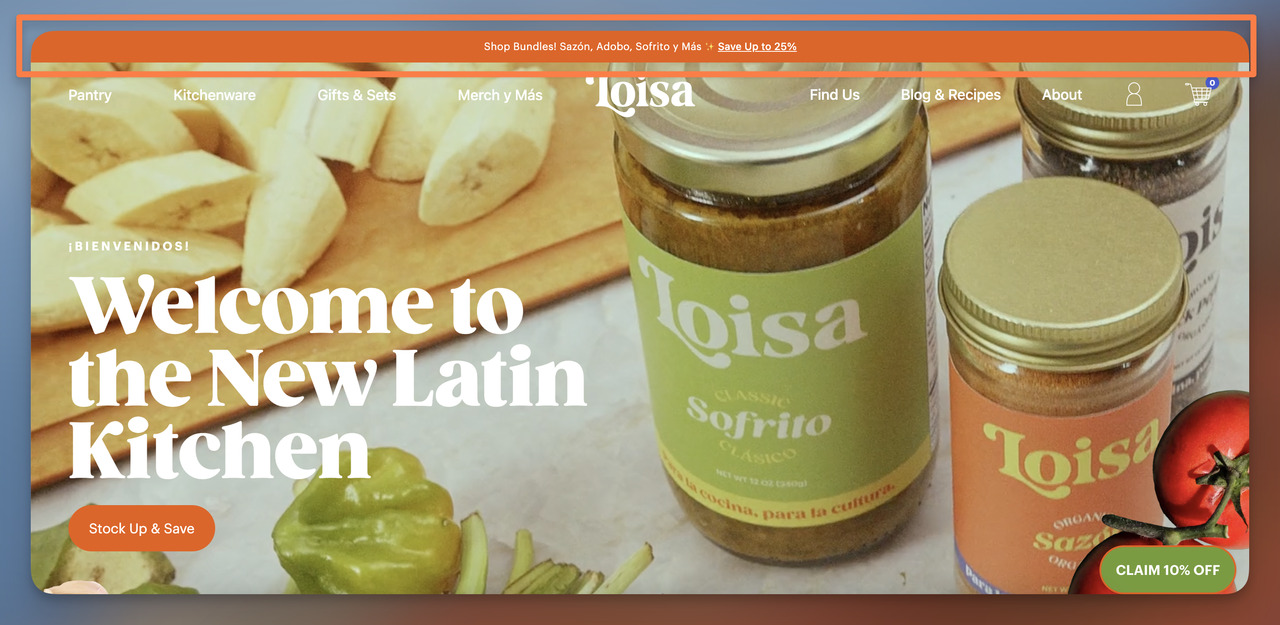
Loisa's bundle discount announcement bar
What works: Loisa uses the announcement bar to highlight bundle offers with a clear savings incentive. The message “Shop Bundles… Save Up to 25%” immediately communicates value while grouping multiple products together. This is especially effective for food brands because bundles encourage customers to explore complementary products rather than purchasing a single item.
Why it works: Bundles reduce decision friction and increase average order value at the same time. Instead of evaluating many individual products, visitors can choose a curated set that already makes sense together (e.g., Sazón, Adobo, Sofrito). The “Save Up to 25%” message reinforces the perception of a smart purchase, which nudges customers toward buying more items in one order.
Key takeaway: Announcement bars are a strong place to promote product bundles instead of single-item discounts. Bundles simplify decisions, increase cart size, and introduce customers to multiple products at once. That's why they work so well for food, skincare, and consumable brands.
10. Bruvi: The Return Policy Confidence Bar
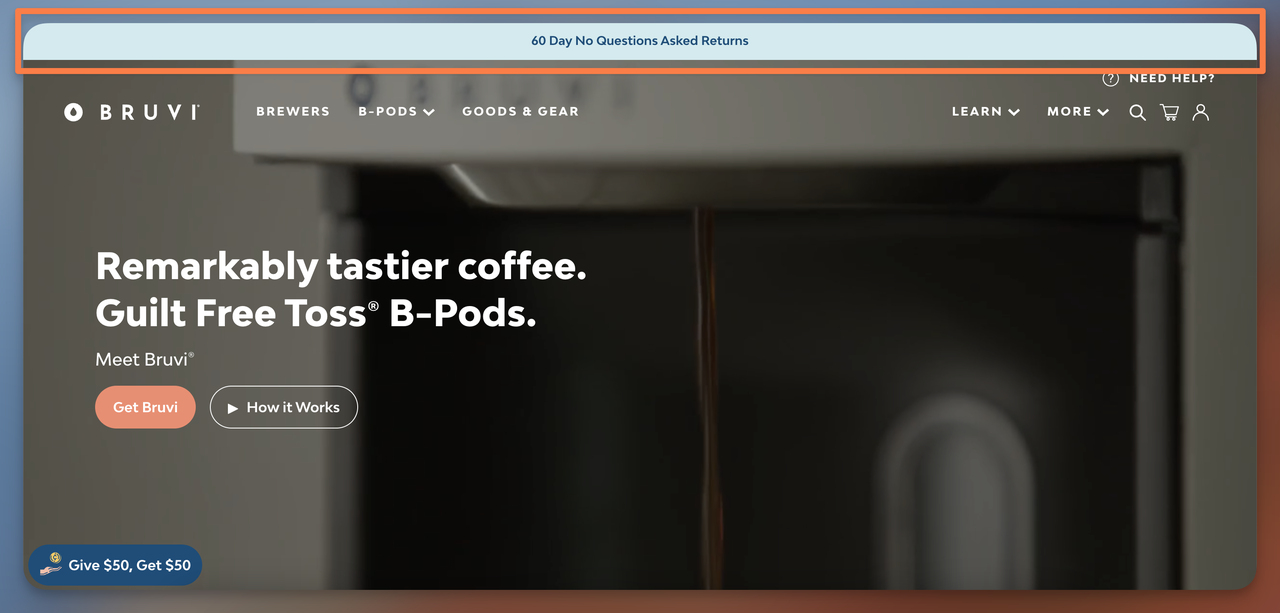
Bruvi's return policy bar
What works: Bruvi skips the typical discount message entirely and uses their bar to highlight a 60-day no-questions-asked return policy. For a single-serve coffee machine that competes against Keurig and Nespresso, this is a smart play. The light blue bar sits quietly at the top, with no flashing and no urgency, because the message carries the weight. "No-questions-asked" does the heavy lifting.
Why it works: Risk reversal removes the primary purchase barrier for high-consideration products. A shopper comparing Bruvi to an established brand like Nespresso is weighing an unknown against a known quantity. The 60-day return policy collapses that risk gap. A discount can signal desperation. A generous return policy says the brand is confident you'll keep the product.
Key takeaway: If your product costs more than $50 and has established competitors, lead with return policy in the announcement bar instead of a discount. Confidence sells better than cheapness.
11. Suta: The Bulk Discount Code Bar
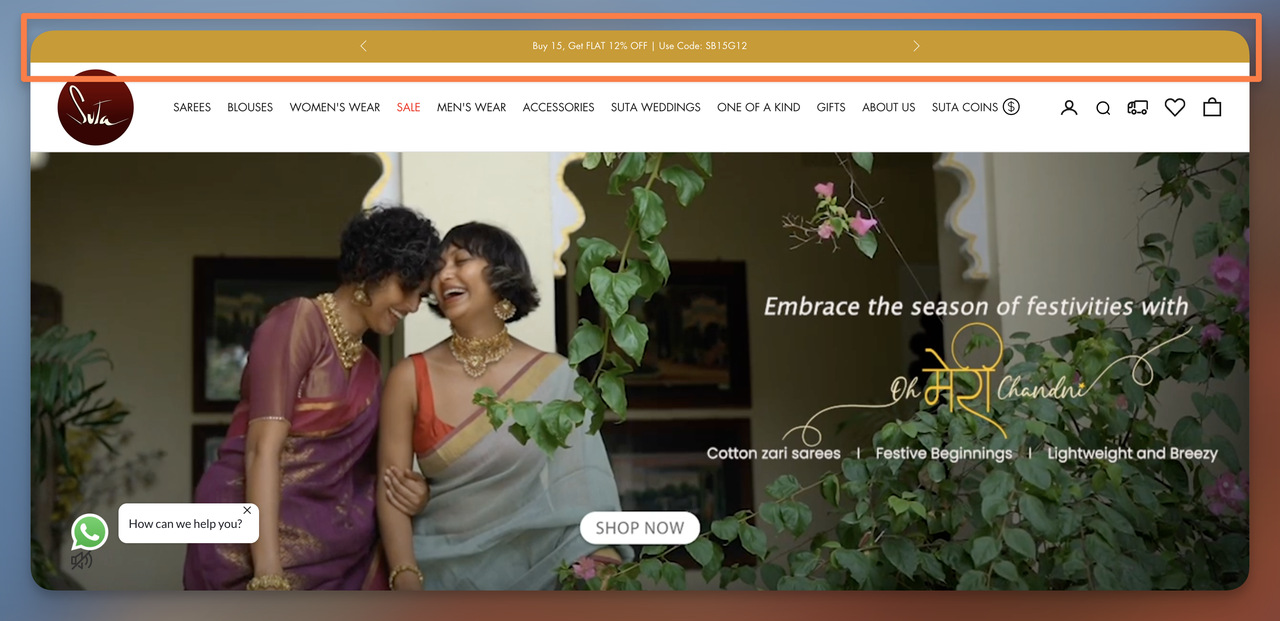
Suta's bulk discount announcement bar
What works: "Buy 15, Get FLAT 12% OFF | Use Code: SB15G12." Suta's bar does something unusual: it puts the coupon code right in the announcement bar, so nobody has to go searching for a promo code at checkout. The 15-item threshold targets their wholesale and gift-buying customers (Suta sells saris, and weddings often require multiple pieces). The code format "SB15G12" is short enough to remember between the bar and the checkout field.
Why it works: A code in plain sight is a code shoppers use, instead of leaving to hunt for one. Suta's approach also works because it targets a specific buying behavior (bulk purchases) rather than offering a blanket discount that erodes margins on single-item orders. If you want the email address as well as the sale, hand the code out through a signup popup instead: in our benchmark, signup popups that offer a discount code convert 1.46% vs 0.75% for signup popups without one (median campaign). Our discount popup examples show how stores deliver the code.
Key takeaway: Display the coupon code in the bar itself rather than hiding it behind a click. If the code is visible, shoppers don't abandon checkout to Google "brand name coupon code."
12. Cowboy: The Community Investment & Rewards Bar
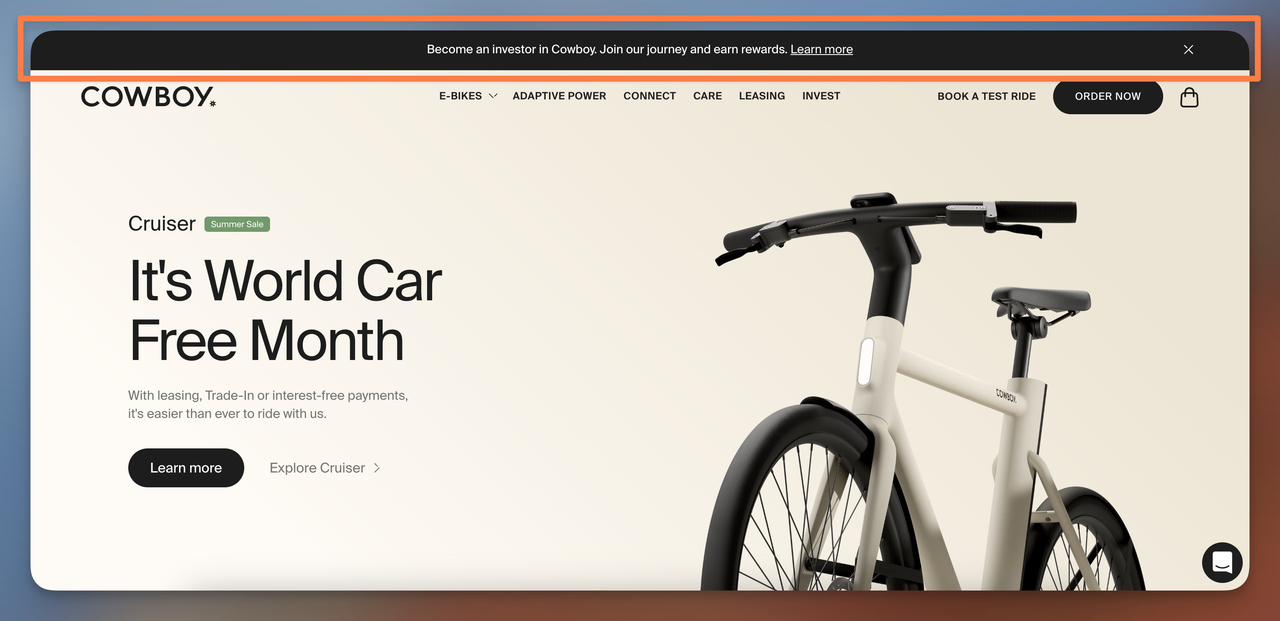
Cowboy's investment-focused announcement bar
What works: Cowboy uses its announcement bar to highlight a community investment opportunity rather than a promotion or discount. The message invites visitors to “Become an investor in Cowboy”, positioning customers as potential stakeholders in the brand’s journey. It signals confidence and openness, and it tells visitors the company thinks it's building something worth investing in.
Why it works: Inviting users to become investors activates psychological ownership. Instead of treating visitors as buyers, Cowboy frames them as potential partners in the company’s future. That builds trust, and it tells shoppers the brand is growing and financially credible. For premium products like e-bikes, signals of long-term stability and ambition can reduce purchase hesitation.
Key takeaway: Announcement bars don’t always need to push promotions. They can highlight credibility signals, company milestones, or community participation opportunities. If your brand has news like a fundraising round, a partnership or a major launch, the announcement bar is a good place to put it.
13. The Honey Pot Company: The Referral Program Bar
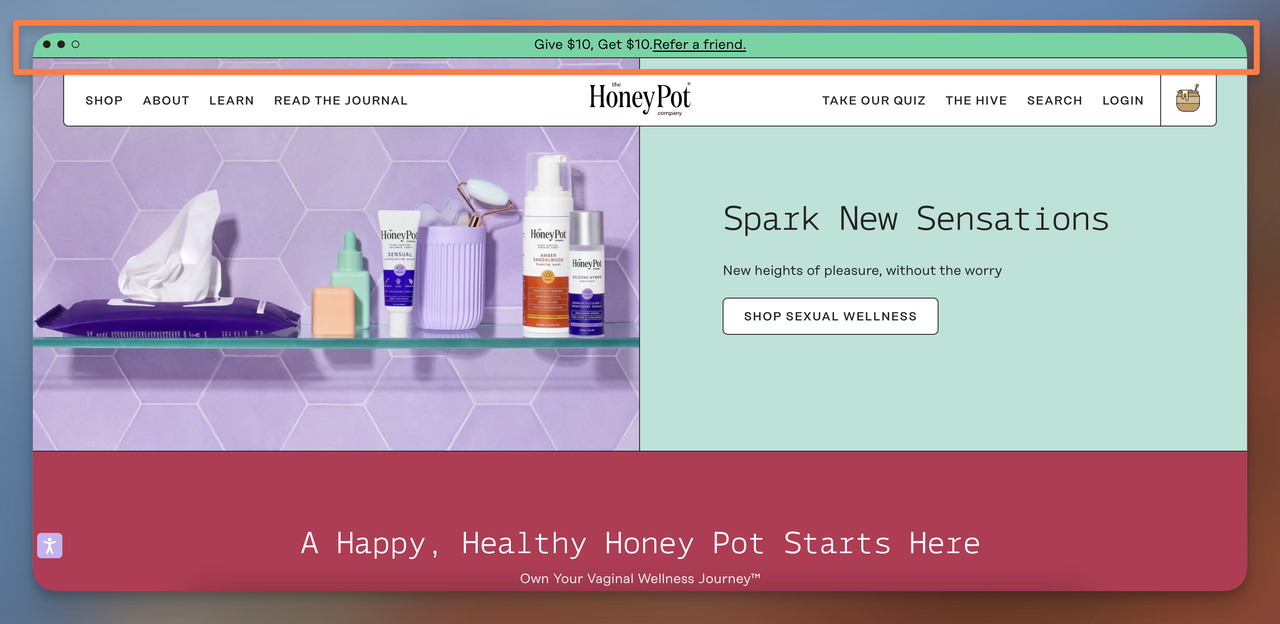
The Honey Pot's referral bar
What works: "Give $10, Get $10. Refer a friend." The copy is symmetrical on purpose: the matching dollar amounts make the deal feel fair to both parties. The Honey Pot doesn't bury this in a footer link or a separate referral page; they put it in the highest-visibility spot on the site. The bar's bright color scheme matches their brand personality and stands out against the product pages below.
Why it works: Dual-sided incentives remove the awkwardness of asking friends to buy something. To the referrer, it feels like handing a friend money off rather than selling for a brand. A referral bar speaks directly to the existing customer's relationship with their network.
Key takeaway: Place your referral program in the announcement bar, not just on a dedicated page. Existing customers need to see the offer repeatedly before they act, and the bar provides that repetition without being pushy.
14. Lulu and Georgia: The Free Service Promotion Bar
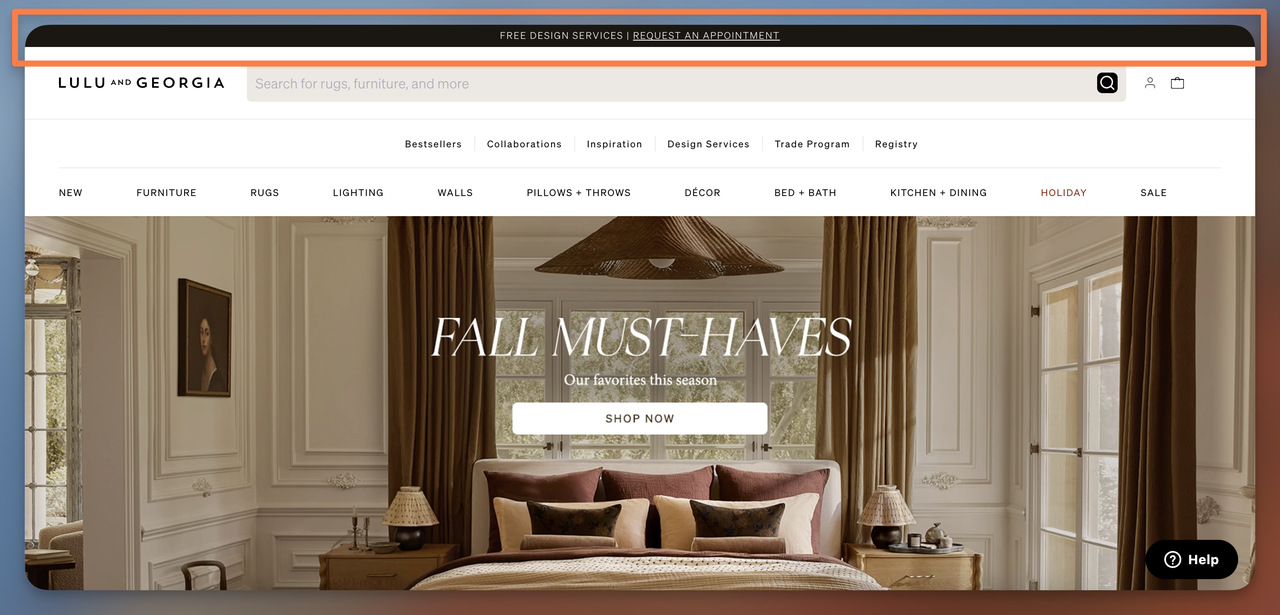
Lulu and Georgia's service promotion bar
What works: Rather than discounting products, Lulu and Georgia promote a free design consultation service in their announcement bar. The black bar with white text feels premium. Nothing about it looks like a clearance sale. The CTA sends visitors to schedule an appointment, which does two jobs: it captures a lead and pre-qualifies them as serious buyers. Furniture shoppers who book a design consultation show far more purchase intent than casual browsers.
Why it works: Service-based bars work well for high-ticket categories like furniture, where the buying decision involves room measurements, color matching, and style coordination. By offering expert help for free, Lulu and Georgia remove the hesitation that comes with an expensive sofa purchase. The bar positions them as a partner in the design process rather than just another retailer. This is similar to how well-designed popups build trust by offering value before asking for a purchase.
Key takeaway: If you sell complex or high-ticket products, test a service-based bar instead of a discount. Free consultations, style guides, or sizing help can do more than percentage-off deals for considered purchases.
15. Rebecca Minkoff: The Loyalty Program Bar
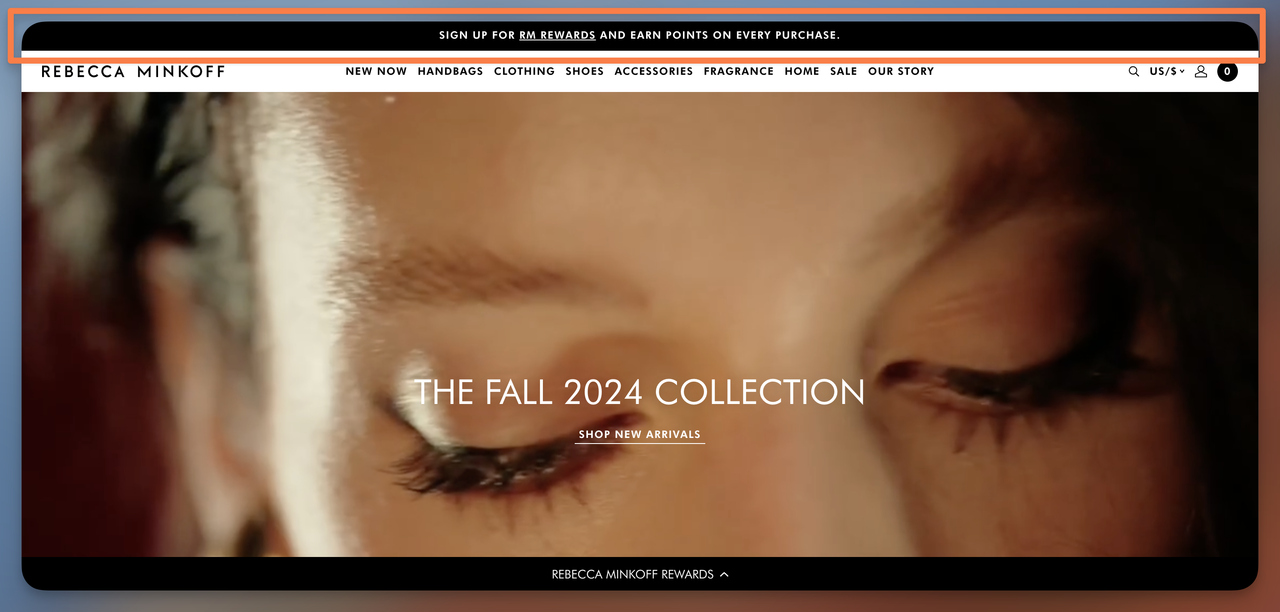
Rebecca Minkoff's loyalty rewards bar
What works: Rebecca Minkoff uses the announcement bar to promote their RM Rewards program with a clear "Sign Up" CTA. The bar doesn't try to explain the whole program. It mentions earning points on every purchase and nudges visitors toward enrollment. This restraint is smart; a full rewards breakdown would clutter the bar. The message targets two audiences: new visitors who haven't joined yet and returning customers who might have forgotten they're not enrolled.
Why it works: Loyalty program bars are long-game conversion tools. They don't generate immediate sales like a discount bar, but they increase lead capture rates by offering ongoing value. The points mechanic creates a sunk-cost dynamic: once a customer has earned points, they're more likely to return to spend them rather than shop elsewhere. Rebecca Minkoff places this at the top of every page so the enrollment prompt becomes part of the browsing experience.
Key takeaway: Run a loyalty program bar as your default announcement during non-sale periods. It builds your customer database without cannibalizing margins, and it pairs well with popup messages that trigger on exit intent.
Black Friday free shipping bar examples
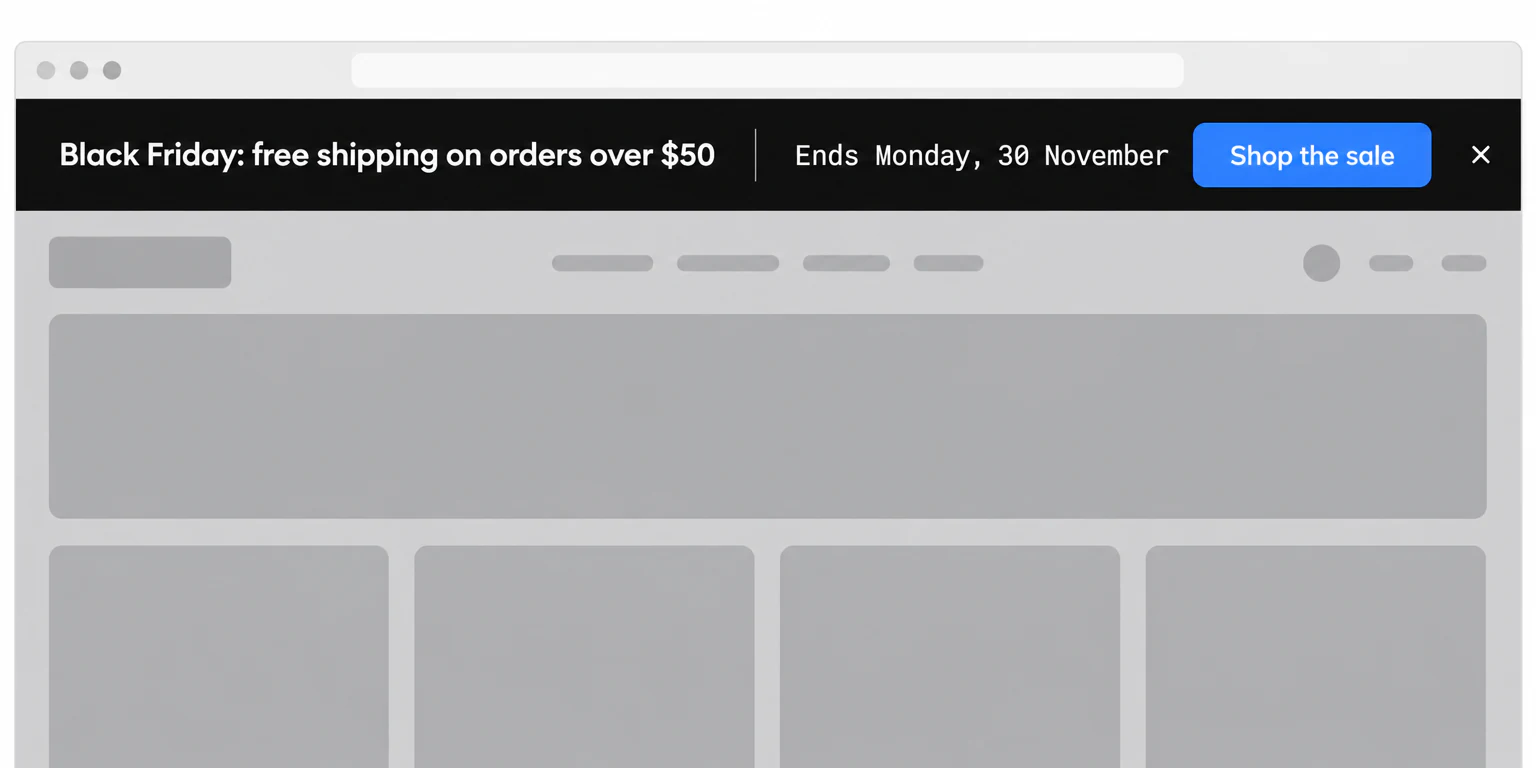
Black Friday 2026 falls on 27 November and Cyber Monday on 30 November. For those four days the announcement bar is the one place every visitor sees the offer on every page, so it should carry the single thing that changes the order: usually free shipping above a threshold. Here are four patterns, drawn as example designs for a fictional store.
1. The deadline bar. State the threshold and the end date, and give it one button. "Ends Monday, 30 November" is clearer than a vague "limited time", and it stays true on every day of the sale.
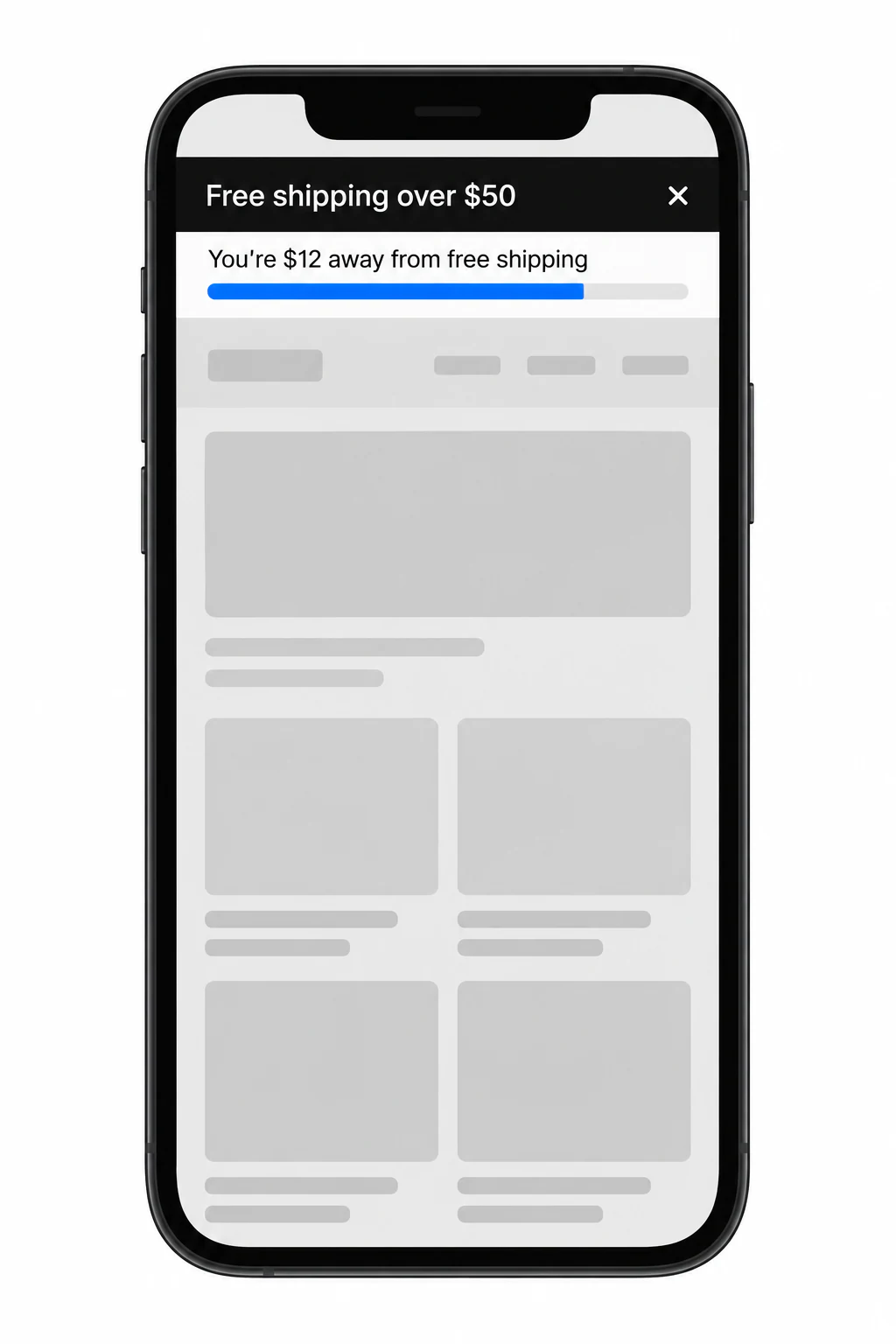
2. The progress bar. Tell shoppers how far they are from the threshold: "You're $12 away from free shipping." On a phone, cut the offer to three or four words so it stays on one line. A progress line needs a tool that reads the cart; a theme's announcement bar shows fixed text only.
3. The countdown bar. A countdown in the bar works when the deadline is real. The Turkish online print store Baskimo ran its "Muhteşem Cuma" (Black Friday) sale as a Popupsmart floating bar with a countdown timer, scheduled with date targeting and shown after 30 seconds on the site; Baskimo's customer story reports a 32.19% conversion rate for it. More layouts are in our countdown timer popup examples.

4. The code bar. Put the code in the bar ("Free shipping, no code needed" is even better) so shoppers don't leave checkout to search for one. How big the discount should be is a separate question, and our data can't name a best size. Popups stating 10% off convert 1.25% vs 0.67% for popups that state no discount. Bigger discounts did not convert measurably better: 10% off converted 1.25%, 20% off 0.91% and 25-30% off 1.33%, but the larger-discount samples are small (78 and 46 campaigns), so the data cannot rule out a real difference either way.
Schedule the bar to switch on and off by itself, so the offer never outlives the sale. For the rest of the season's campaigns, see our Black Friday popups guide, and for the shoppers who still leave with a full cart, our cart abandonment popup examples.
Hello bar examples and the Hello Bar tool
"Hello bar" is another name for an announcement bar. It comes from Hello Bar, a bar and popup builder, and people now use it for any top bar, whatever tool made it. Every one of the 15 examples above is a hello bar in that sense; the Hello Bar site itself opens with one.
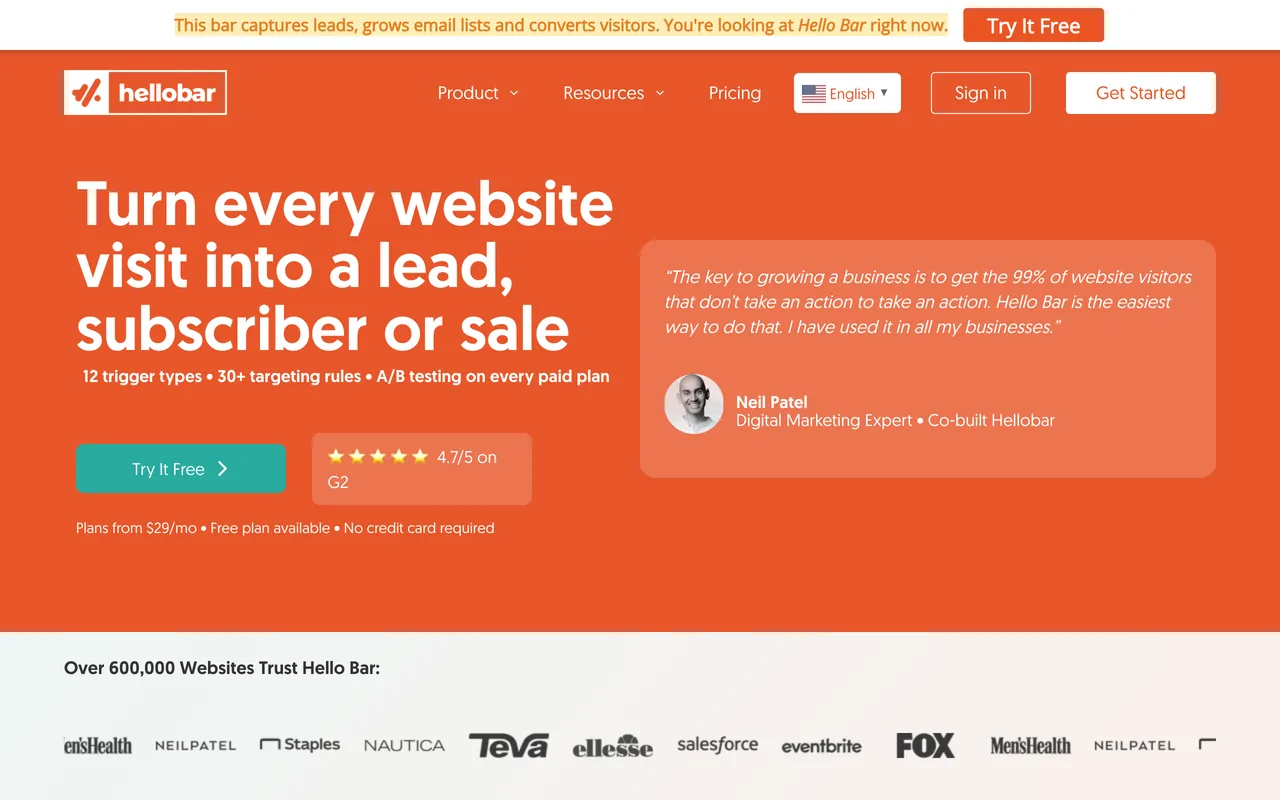
If you came here looking for the tool, these are its facts, read from its pricing page on 22 September 2026:
| Hello Bar (read 2026-09-22) | Popupsmart | |
|---|---|---|
| Priced by | Popup views | Site pageviews |
| Free plan | Starter: up to 5,000 views, counted over the account's lifetime | 5K pageviews a month, one live campaign |
| Entry paid plan | Growth: $29 a month billed annually, up to 50,000 popup views a month | Basic: $39 a month, or $32.50 a month billed annually |
| Other plans | Premium $49 and Elite $99 a month, billed annually | Advanced, Pro and Expert (see pricing) |
| G2 rating | 4.7 from 25 reviews (read 2026-09-22) | 4.5 from 141 reviews |
The two meters count different things: Hello Bar counts each time a bar or popup is shown, and Popupsmart counts the pageviews of the site it runs on. Compare them against your own traffic, not against each other. For the tools teams move to when they outgrow a bar, see Hello Bar alternatives.
Shopify announcement bar: theme bar or an app?
Most Shopify themes ship with an announcement bar. According to the Shopify Help Center (read 1 October 2026), you add one from the theme editor: Online Store, Edit theme, the Announcement bar section, Add Announcement, then text, an optional link, and Save. A theme can have one announcement bar section with up to 12 announcements, and the bar can auto-rotate them.
The theme bar is enough for a single, permanent message such as "Free shipping over $75". Reach for a floating bar from a popup app when you need:
- Start and end dates, so a Black Friday bar appears and disappears on time.
- Targeting by page, device, traffic source or new vs returning visitor.
- A countdown timer or an email field inside the bar.
- Different copy on mobile and desktop.
Popupsmart covers these through Popupsmart's Shopify integration (for different mobile copy, run two bars with device targeting), and our Shopify popup apps comparison covers the others.
How to Create an Announcement Bar with Popupsmart in 5 Minutes
Building a professional announcement bar doesn't require a developer. Here's how to set one up with Popupsmart's floating bar; once you're signed up, most people build and publish a campaign in under 5 minutes, by our own estimate:
1. Log in to your Popupsmart account
Head to your Popupsmart dashboard. If you don't have an account, you can sign up to Popupsmart for free. The free plan includes the floating bar: one live campaign and 5K pageviews a month.
2. Create a new campaign
Click the "+ New Campaign" button in the upper-right corner.
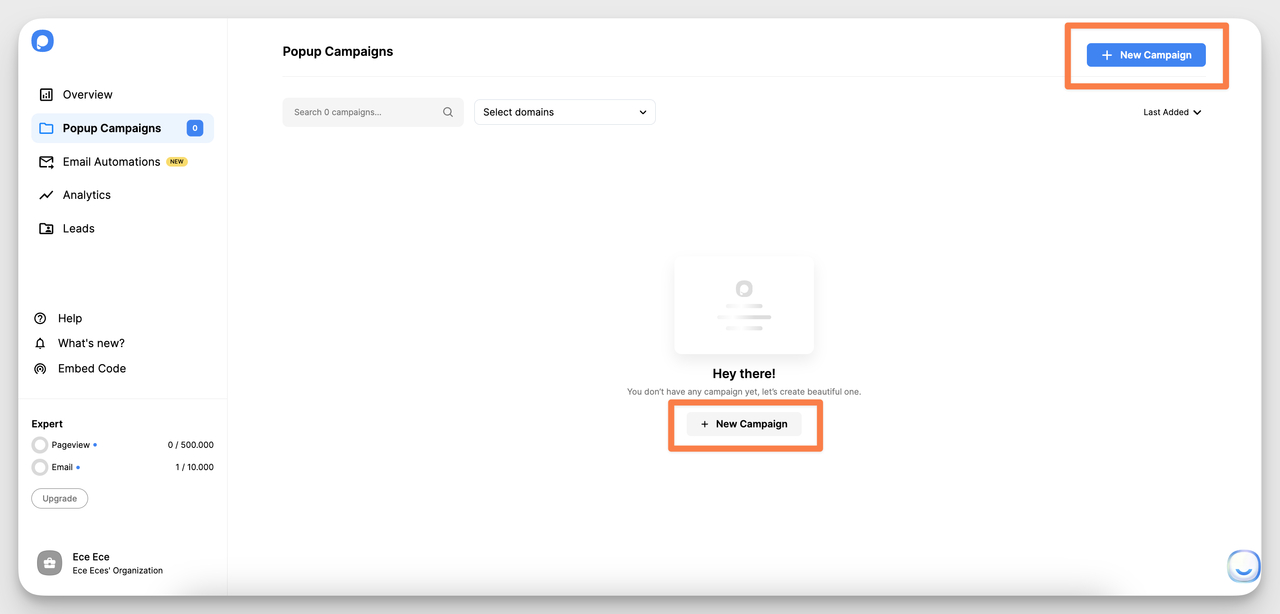
Creating a new campaign in Popupsmart
3. Name your bar and select your domain
Enter a descriptive name (e.g., "Summer Free Shipping Bar") and select your website domain from the dropdown.
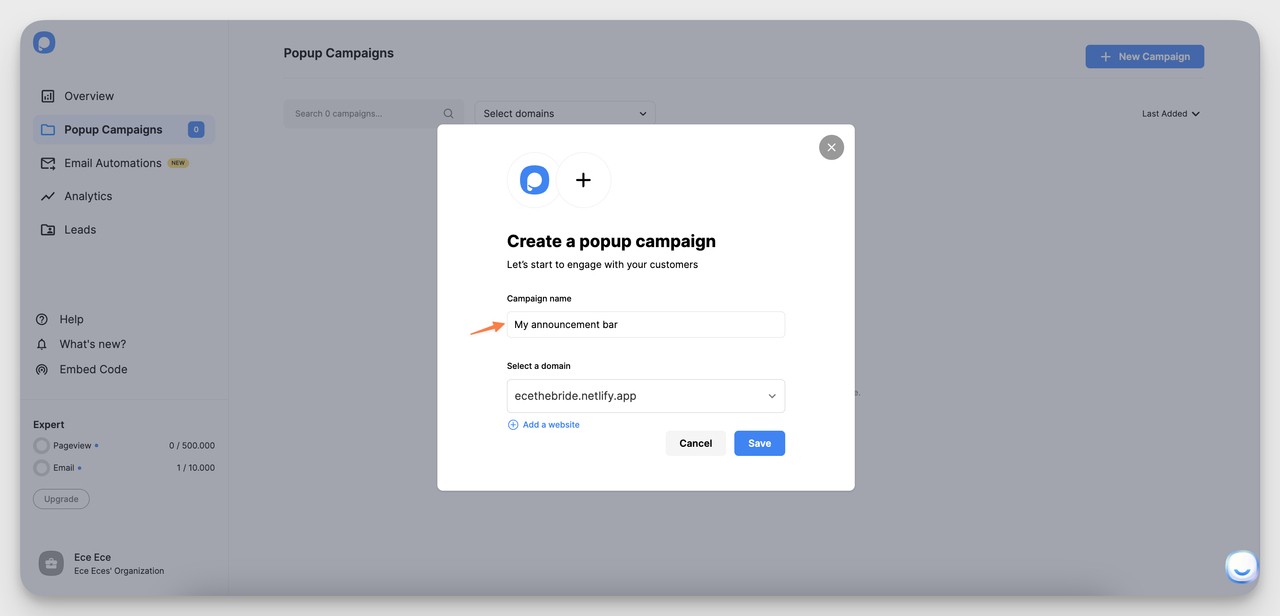
Naming your announcement bar campaign
4. Choose "Show Up Announcement" as your goal
Under the Goals section in the left sidebar, select "Show Up Announcement." This tells Popupsmart you're building a notification bar, not a popup.
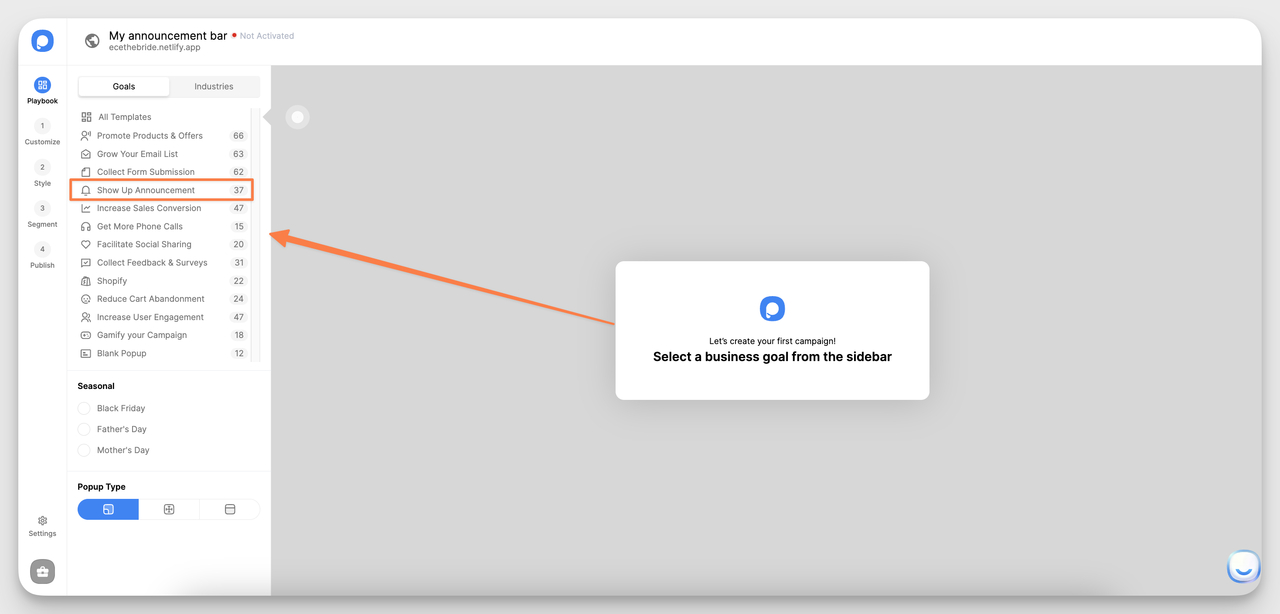
Selecting the announcement business goal
5. Select "Floating Bar" as the popup type
Scroll to the Popup Type options and choose "Floating Bar." This creates a bar that sticks to the top or bottom of the page.
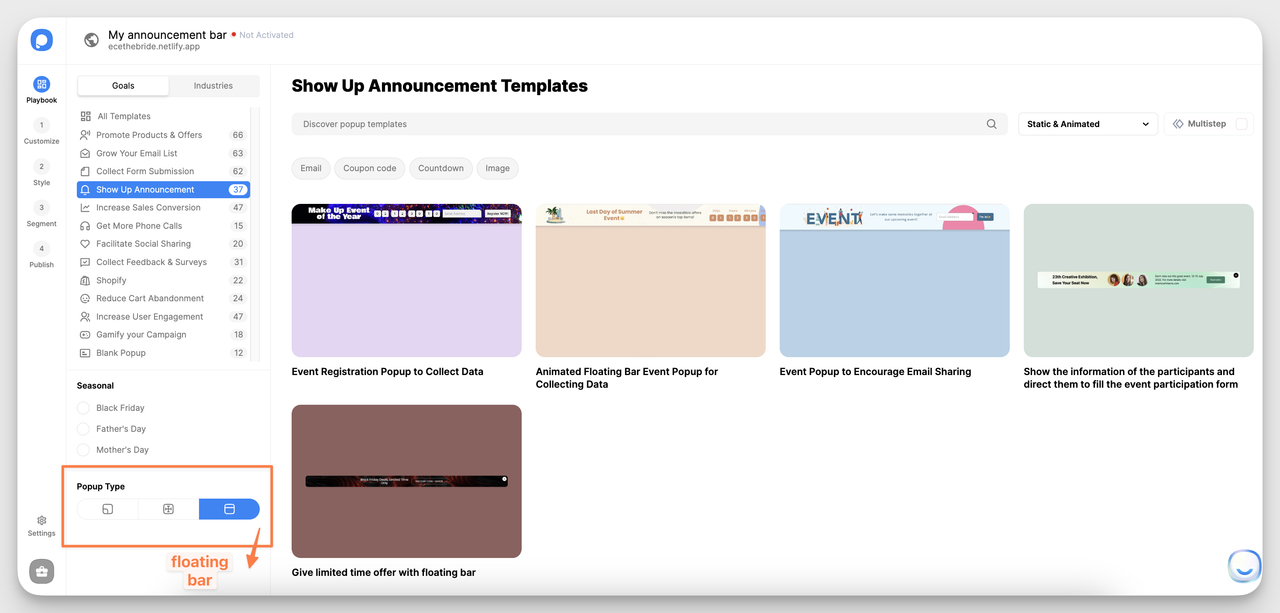
Choosing the floating bar type
6. Pick a template and customize
Browse the announcement bar templates and select one that fits your campaign. Customize the text, colors, CTA button, and optional countdown timer.
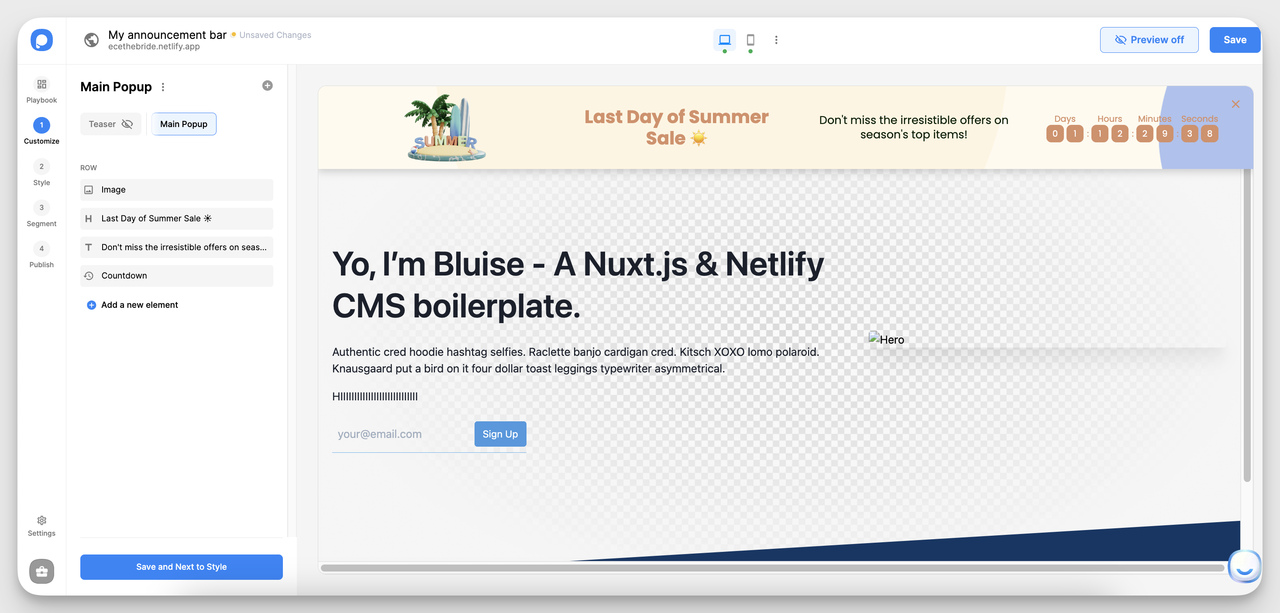
Announcement bar template gallery
7. Set display rules and publish
Configure when and where the bar appears (all pages, specific URLs, device targeting). For a sale, add a start and end date with scheduling. Click "Save" and publish. Your announcement bar is live.
You can also skip the builder: from a chat request, the Popupsmart AI agent builds a whole campaign (template, targeting and triggers, integrations) and publishes it, on every plan, the free plan included.
What Are the Best Practices for Announcement Bar Design?
Across these 15 examples, a few patterns repeat:
- Keep copy under 10 words. The clearest bars in our collection (Birkenstock, Skims, Away) all use fewer than 10 words. Your announcement bar isn't a landing page. It's a headline.
- Use one CTA maximum. Bars with two competing actions (e.g., "Shop Sale" and "Learn More") split attention. Choose one action and make it the only clickable element; every competing click path takes attention from the action your website conversion rate depends on.
- Match or contrast your header color intentionally. Away's black bar blends into their header for a subtle, integrated feel. Haven's Kitchen's yellow bar clashes with everything, on purpose. Both work because the color choice was deliberate. What doesn't work is picking a random brand color without considering how it interacts with your header.
- Make it dismissible. Bars without a close button frustrate visitors, especially on mobile where they consume a larger percentage of screen space. A dismissible bar earns trust; a permanent one earns resentment.
- Rotate messaging, don't stack it. If you have multiple announcements (sale + free shipping + new arrivals), rotate them on a 5-second timer rather than cramming everything into one bar. Shopify's theme bar and Shopify popup apps support this natively.
- Match the message to the visitor. A welcome offer is for first-time visitors, a loyalty nudge for returning ones. In our benchmark, popups targeted at new visitors only convert 1.13% vs 0.77% for popups shown to everyone, and visitors arriving from an email or SMS campaign convert on popups at 1.81% vs 0.74% for visitors from organic search (median campaign). A bar that repeats the email's offer to the people who clicked it is doing the same job.
- Test mobile separately. An announcement bar that looks sharp on desktop can take a large share of a phone screen. Always preview on a real mobile device before publishing. Check that text doesn't wrap awkwardly and that CTA buttons have enough tap target size. Google recommends at least 48x48 pixels for touch targets.
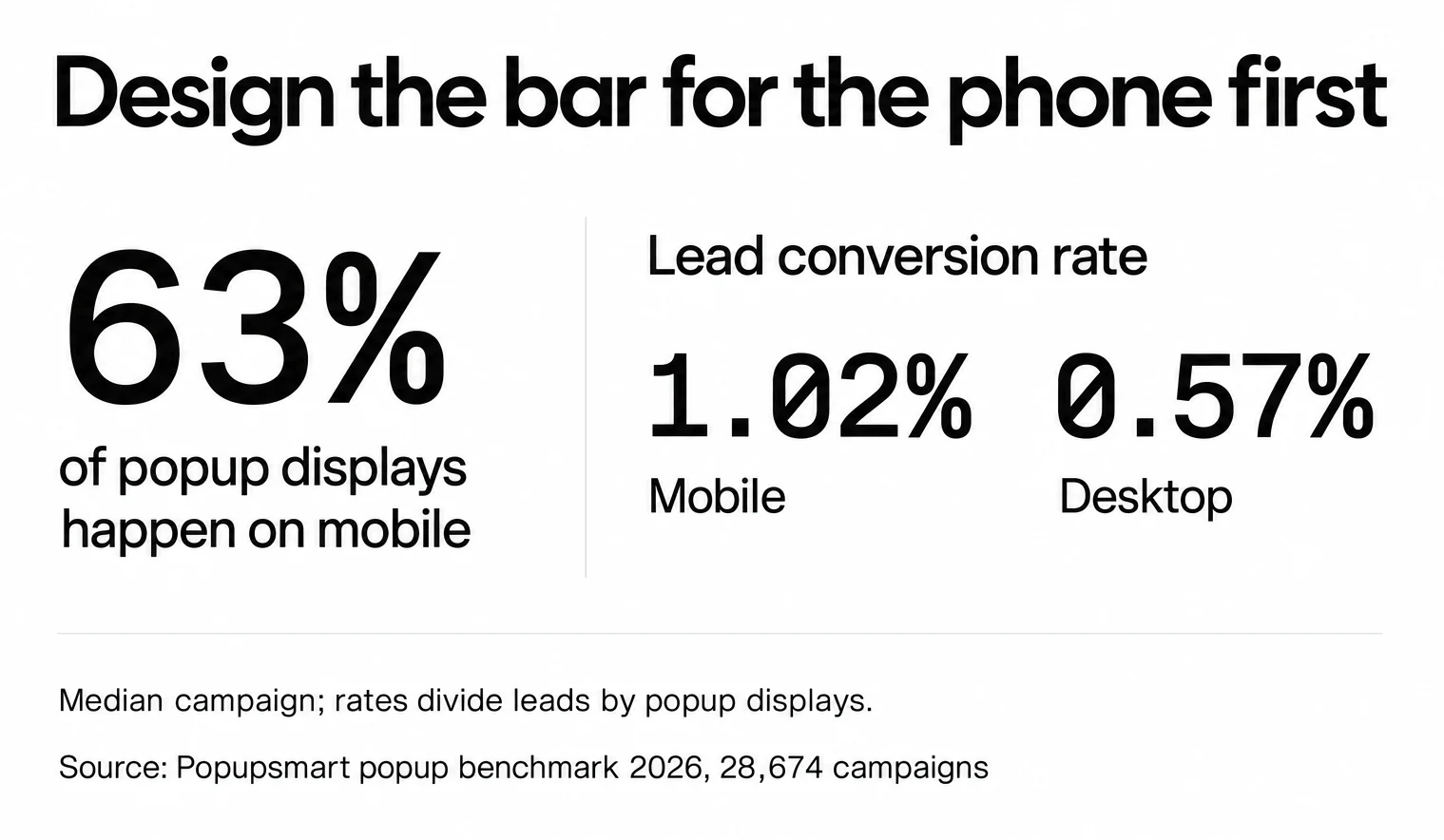
Mobile deserves the extra check. In our benchmark, 63% of popup displays happen on mobile, and mobile visitors convert on popups at 1.02% vs 0.57% on desktop (median campaign). Our mobile popup guide covers the layout rules.
Making Your Announcement Bar Convert
Three patterns in these 15 announcement bar examples separate the bars that convert from the decorative ones.
First, the best bars answer one question: "What do I get?" Birkenstock answers it (30% off), Skims answers it (free shipping), Bruvi answers it (60-day returns). Bars that try to communicate brand values or tell a story in the announcement bar tend to say less than bars with a concrete offer.
Second, the design works for the message. Every color choice, font size, and CTA placement in these examples exists to support the message, not decorate the page. Haven's Kitchen uses yellow to signal newness. Away uses black to signal sophistication. None of these were arbitrary.
Third, the announcement bar is not a standalone tool. It works best next to other on-site elements: lead capture forms, exit-intent triggers, and cart-value rules. Think of the bar as the first touchpoint in a system, not a silver bullet.
If you want to start building your own announcement bars, Popupsmart's popup builder includes floating bars with targeting rules, countdown timers, and mobile-responsive templates, and the free plan lets you publish one. Browse the popup templates for a bar to start from; no code needed.
Frequently Asked Questions
What should you put in an announcement bar?
The most effective announcement bars focus on one message: a free shipping threshold, a limited-time discount, a new product launch, or a loyalty program signup. Keep copy under 10 words and include a single call-to-action. Avoid cramming multiple offers into one bar — it splits attention and reduces click-through rates. If you have several announcements, rotate them on a timer: Shopify's theme announcement bar can auto-rotate up to 12 announcements.
How can announcement bars improve ecommerce conversions?
Announcement bars improve conversions by surfacing relevant offers at the moment visitors arrive, before they start browsing. Free shipping threshold bars increase average order value by anchoring a spending target. Coupon code bars reduce checkout abandonment because shoppers don't leave to search for promo codes. Social proof bars (like a 75K-review count) build trust that shortens the decision cycle. The key is matching the bar message to the visitor's stage: awareness-stage visitors respond to credibility signals, while cart-stage visitors respond to incentives.
What is the difference between a sticky bar, notification bar, and announcement bar?
These terms overlap, but there are practical distinctions. A sticky bar stays fixed on screen as visitors scroll — it never leaves the viewport. A notification bar typically alerts visitors to time-sensitive information (shipping delays, policy changes, maintenance windows) and is usually dismissible. An announcement bar is the broadest term, covering any top-of-page banner used for promotions, launches, or key messages. In practice, most modern implementations combine all three: they stick on scroll, can be dismissed, and carry promotional or informational content. Popupsmart's floating bar handles all three use cases from a single builder.
How to make a catchy announcement bar?
Start with the value proposition, not the product name. "Free shipping over $50" works better than "Check out our shipping policy." Use numbers when possible — "$10 off," "30% savings," "75,000 reviews" — because specific figures process faster than abstract language. Add a single contrasting CTA button ("Shop Now," "Claim Offer") and ensure the bar color creates enough contrast to be noticed without clashing. Add a countdown only when the deadline is real, and say when the offer ends in plain words.
What is a hello bar?
A hello bar is another name for an announcement bar: a thin strip across the top of a website with one message and usually one button. The name comes from Hello Bar, a bar and popup builder, and people now use it for any top bar, whatever tool made it. Every example in this post is a hello bar in that sense.
How do I add an announcement bar on Shopify?
Most Shopify themes have one built in. In your Shopify admin, go to Online Store, click Edit theme, open the Announcement bar section, click Add Announcement, enter your text and an optional link, and save. A theme can have one announcement bar section with up to 12 announcements. For start and end dates, page or device targeting, a countdown or an email field, use a floating bar from a popup app instead.