ChatGPT
 Perplexity
 Claude
 Grok
Grok Google AI Mode

The "average" itself depends on who is counting. Ruler Analytics puts the 2026 cross-industry average at 5.13% across 13 industries, measured on tracked lead-generation conversions. Broader compilations that count purchases across all site traffic land closer to 2.9%. Neither is wrong — they count different denominators, and a lead-gen form will always clear a checkout. Treat 2-5% as the band most sites live in, and read the rest of this page against your own vertical rather than a single global number.
The benchmarks below break down rates by industry, device, and business model so you can see where your site stands.
What is Website Conversion?
A website conversion happens when a visitor completes a specific action you've defined as valuable. That action could be a purchase, a form submission, a newsletter signup, or a demo booking. Every business defines "conversion" differently based on its goals, and that definition directly shapes what your conversion rate means.
I've worked with SaaS companies where a conversion was a free trial signup and ecommerce brands where it was a completed checkout. The number itself doesn't tell you much until you know what's being measured. A 2% purchase rate and a 15% email signup rate can coexist on the same site, and both might be healthy.
Understanding your conversion rate benchmarks starts with clarity on what you're actually tracking. Without that, any comparison to industry averages is meaningless.
Micro vs Macro Conversions
Not all conversions carry the same weight. Micro and macro conversions represent two stages of user commitment, and tracking both gives you a clearer picture of how your funnel performs.
Micro Conversions
Micro conversions are smaller actions that signal interest but don't directly generate revenue. They're steps on the path toward your main goal. Examples include:
- Newsletter signups
- Account creation
- Add-to-cart actions
- Video views
- PDF and resource downloads
- Wishlist adds
- Pricing page visits
According to Smart Insights, sessions with product page views (a common micro conversion) approach 50% in many ecommerce stores. That's a strong engagement signal, even when final purchase rates are much lower.
Macro Conversions
Macro conversions are the end goals: completed purchases, paid subscriptions, signed contracts, booked demos. These directly affect your bottom line.
The gap between micro and macro conversion rates often reveals friction points. If 30% of visitors add items to their cart but only 2% complete checkout, you've got a clear optimization target, and the cart abandonment statistics show how much revenue usually sits in that gap. Tracking both conversion types helps you pinpoint where users drop off and where to focus your conversion rate optimization efforts.
What is a Good Website Conversion Rate in 2026?
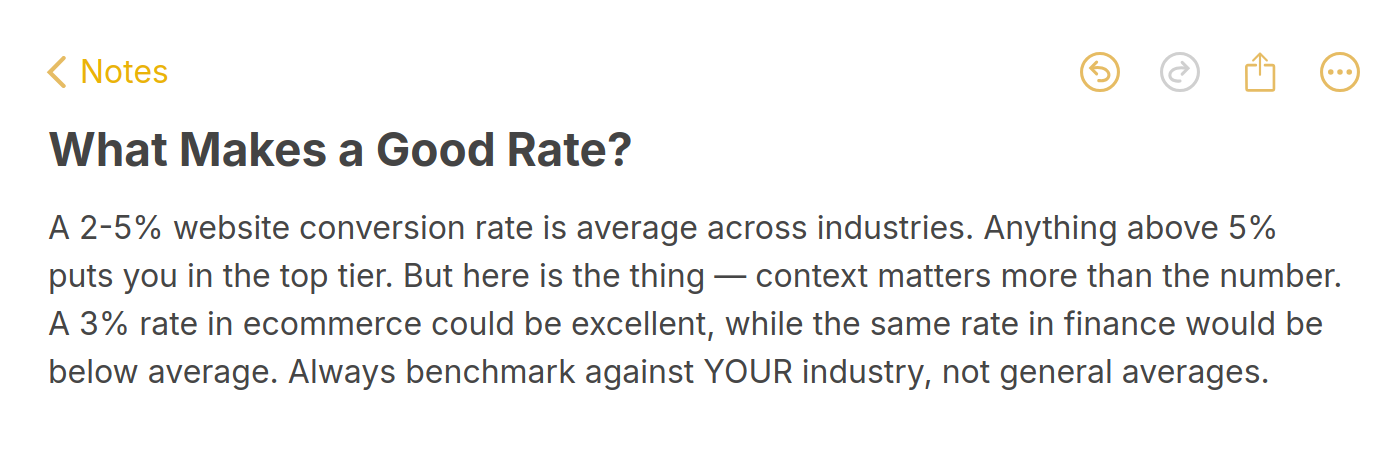
A good website conversion rate in 2026 is anything above 3.5% for most industries. Rates between 2% and 5% are considered average, and anything above 5% puts you in strong territory. But "good" depends heavily on your industry, traffic source, and what you're counting as a conversion.
What Makes a Good Conversion Rate
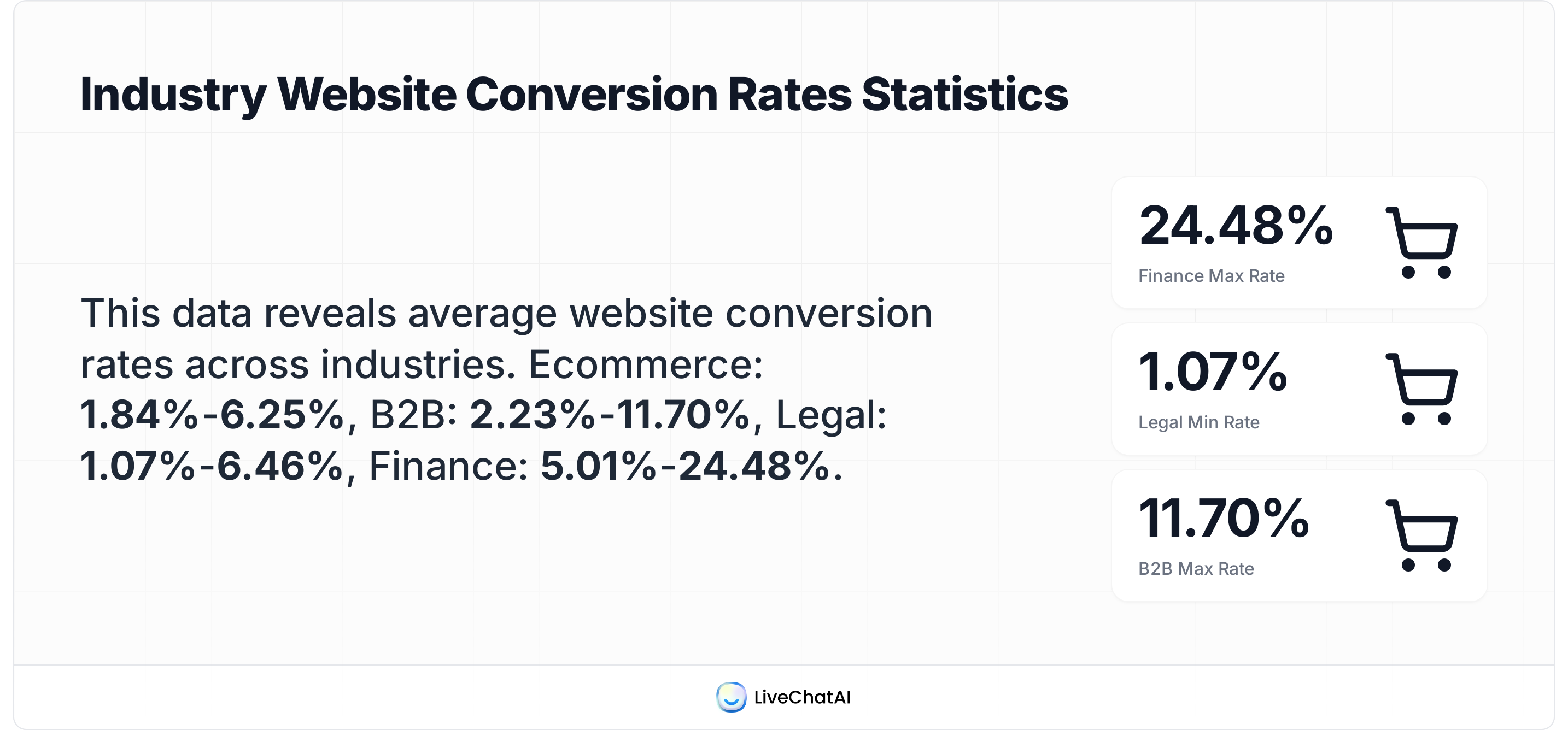
Here's how conversion rates break down by performance tier across major industries:
| Industry | Bottom Tier | Middle Tier | Top Tier |
|---|---|---|---|
| Ecommerce | 1.84% | 3.71% | 6.25% |
| B2B | 2.23% | 4.31% | 11.70% |
| Legal | 1.07% | 4.12% | 6.46% |
| Finance | 5.01% | 11.19% | 24.48% |
| Professional Services | 2.1% | 4.6% | 9.8% |
Finance stands out with a median rate of 11.19%, nearly triple the B2B median. That's partly because finance sites often have high-intent visitors who are actively looking for a specific product (a credit card, a loan, an insurance quote).
One caveat on that finance number. The tier table above reflects earlier multi-year benchmark data; Ruler Analytics' 2026 cut puts finance closer to 6.3%. The ranking holds — finance still converts above most sectors — but if you work in finance, benchmark against the lower, more recent figure rather than the 11.19% median.
According to First Page Sage, the average B2C conversion rate is 3.9%, slightly higher than the B2B average of 3.6%. The gap isn't as wide as many marketers assume.
If you're wondering "is 5% a good website conversion rate?" the answer is yes, for most industries. You'd be outperforming the majority of your competitors. If you're at 2%, you're not failing. You're average. And average is a starting point, not a destination.
Industry Conversion Rate Benchmarks
Factors Influencing Conversion Rates
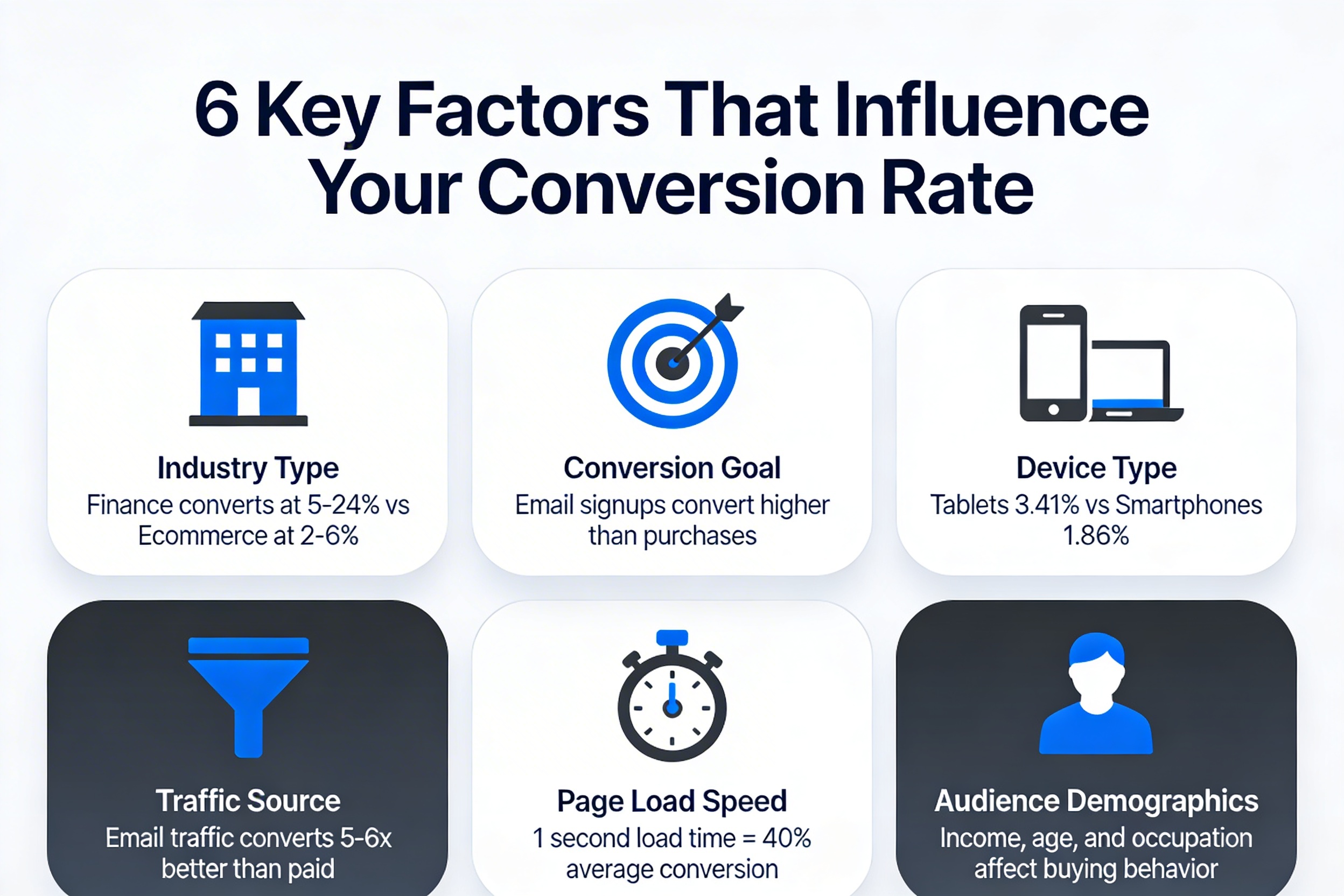
Your conversion rate isn't just about your website's design or copy. Six core factors determine whether visitors convert, and some of them are outside your direct control.
6 Key Factors That Influence Your Conversion Rate
1. Industry and Product Type
A store selling $10 t-shirts will always convert at a higher rate than one selling $2,000 laptops. Higher price points mean longer decision cycles and lower conversion percentages. According to Fyresite, ecommerce conversion rates range from 0.8-1.5% for high-consideration items like furniture to 2.5%+ for everyday consumer goods.
2. Traffic Source
Where your visitors come from dramatically affects how they convert. According to Ruler Analytics, paid search leads the channels it tracks at 5.4%, with email and organic search tied at 4.9% and direct at 4.7%. Social sits well below the rest. The full channel table is further down.
Organic search visitors often convert well because they arrive with intent. Paid traffic can convert higher or lower depending on targeting precision. Social media traffic tends to convert lowest because those visitors are often in browse mode, not buy mode.
3. Device Type
Device matters more than most teams realize. In Statista's data on online shoppers (Q2 2022), conversion was highest on desktop in every region studied, followed by tablets, with smartphones last.
Mobile visitors often research on their phones and complete purchases on desktop later. If you're only tracking last-click conversions, you might undervalue your mobile experience.
4. Page Load Speed
Speed kills conversions when it's slow. According to Conductor, a 100-millisecond delay can reduce conversion rates by 7%. On the positive side, pages loading in 1 second achieve conversion rates close to 40%, per Email Vendor Selection.
5. User Experience and Trust Signals
Clear navigation, visible security badges, transparent pricing, and professional design all affect whether someone trusts your site enough to convert. The Popup Conversion Benchmark Report shows that the top 10% of popups that ask for an email or phone number convert 3.87% or more of their displays.
6. Offer Relevance and CTA Clarity
Your conversion rate reflects how well your offer matches visitor intent. If someone searches "free CRM trial" and lands on a page pushing annual enterprise pricing, they'll bounce. Alignment between search intent, landing page content, and call-to-action determines your ceiling.
Average Website Conversion Rate by Industry
Industry benchmarks give you a reference point, but they aren't targets. Your goal should be to beat your own previous performance, then work toward the top tier for your sector.
Overall Industry Averages
According to Blogging Wizard, the average conversion rate across all industries is 2.9%. The average website conversion rate varies significantly by vertical:
| Industry | Average Conversion Rate |
|---|---|
| Professional Services | 4.6% |
| Finance | 5.01% - 11.19% |
| B2B (overall) | 2.23% - 4.31% |
| Ecommerce (global) | 2.5% - 3% |
| Legal | 1.07% - 4.12% |
| SaaS | 3% - 5% (free-to-paid) |
The range within each industry is wide. That's normal. A well-optimized site in a "low-converting" industry can outperform a neglected site in finance.
Ecommerce Conversion Rates by Sub-Industry
Ecommerce deserves its own breakdown because rates vary sharply by product category. We've compiled the latest ecommerce conversion rate data below:
| Industry | Average conversion rate (Aug 2025 – Jul 2026) |
|---|---|
| Beauty and personal care | 5.39% |
| Food and beverage | 4.80% |
| Pet care and veterinary services | 4.71% |
| Multi-brand retail | 3.01% |
| Fashion, accessories and apparel | 2.77% |
| Consumer goods | 2.47% |
| Home and furniture | 1.22% |
| Luxury and jewelry | 0.72% |
These are Dynamic Yield's twelve-month averages from its customer sites, as compiled by Red Stag Fulfillment; the same sample averages 2.72% across industries. Beauty and food lead because they are lower-priced, repeat purchases with short decision cycles. Home, furniture and jewelry sit at the bottom, where a buyer compares for longer before paying.
If you run a Shopify store, keep in mind that platform-specific benchmarks differ. The typical Shopify store converts 1.4% to 1.8% of visitors, and stores at 4.7% or more are in the top 10%, per Red Stag Fulfillment.
Conversion Rates by Traffic Source
Traffic source benchmarks help you understand which channels deserve more investment:
| Traffic Source | Average Conversion Rate |
|---|---|
| AI referral | 5.8% |
| Paid search | 5.4% |
| 4.9% | |
| Organic search | 4.9% |
| Referral | 4.8% |
| Direct | 4.7% |
| Social (organic) | 2.23% |
| Social (paid) | 2.11% |
All eight figures come from Ruler Analytics' 2026 channel data, tracked across more than 5 million conversions.
Two things changed since the last time I looked at this table. Paid search now tops the owned-and-bought channels at 5.4%, and traffic arriving from AI assistants converts higher than anything else at 5.8%. That second number is new enough that I'd treat it as directional rather than settled, but the direction matches what you'd expect: someone who arrives after asking an assistant a question has already had their options narrowed for them.
Email at 4.9% is the number worth acting on, because it's the highest-converting channel you actually own. You don't bid for it and you don't depend on a model deciding to cite you. If you're not building an email list and optimizing your form conversion rates, you're leaving that channel underused.
What is a good conversion rate by channel?
The traffic-source table shows where converting visitors come from. The questions below are the ones people ask about a single channel, each with the benchmark it should be judged against.
Google Ads and PPC
Paid search is the highest-converting channel in Ruler Analytics' 2026 data, at 5.4% across industries. WordStream's 2026 benchmark for Google and Microsoft Ads reports 8.18% across 23 industries. The two differ partly because an ad platform divides conversions by ad clicks, while a site-level benchmark divides by sessions or visitors. Compare your campaign with the benchmark that counts the way your report does.
Visitors who arrive from email convert at 4.9% in Ruler Analytics' 2026 data, level with organic search. That is the highest rate of any channel you own outright, which is the case for building the list in the first place. Judge a campaign by the conversions from the clicks it sent, not by opens.
Ecommerce and Shopify
Ruler Analytics puts retail and ecommerce at 2.4% in 2026, near the bottom of the 13 industries it tracks, and Dynamic Yield's store sample averages 2.72% (August 2025 to July 2026), partly because a purchase asks more of a visitor than a form does. On Shopify, Red Stag Fulfillment puts the typical store at 1.4% to 1.8% of visitors (2024 to 2025); above 3.2% is the top 20%, and 4.7% or more the top 10%. The sub-industry table above shows how far category moves those numbers.
Sales conversion rate
A sales conversion rate measures something else: the share of leads or opportunities that become customers. Divide customers won by leads worked in the same period and multiply by 100. It describes your sales process, not your website, so track it against your own past quarters instead of a website benchmark.
B2B Conversion Rate Benchmarks
B2B conversion rates follow different patterns than B2C because the buying process involves more stakeholders, longer timelines, and higher stakes. Here's what the data shows for 2026.
B2B Website Conversion Benchmarks
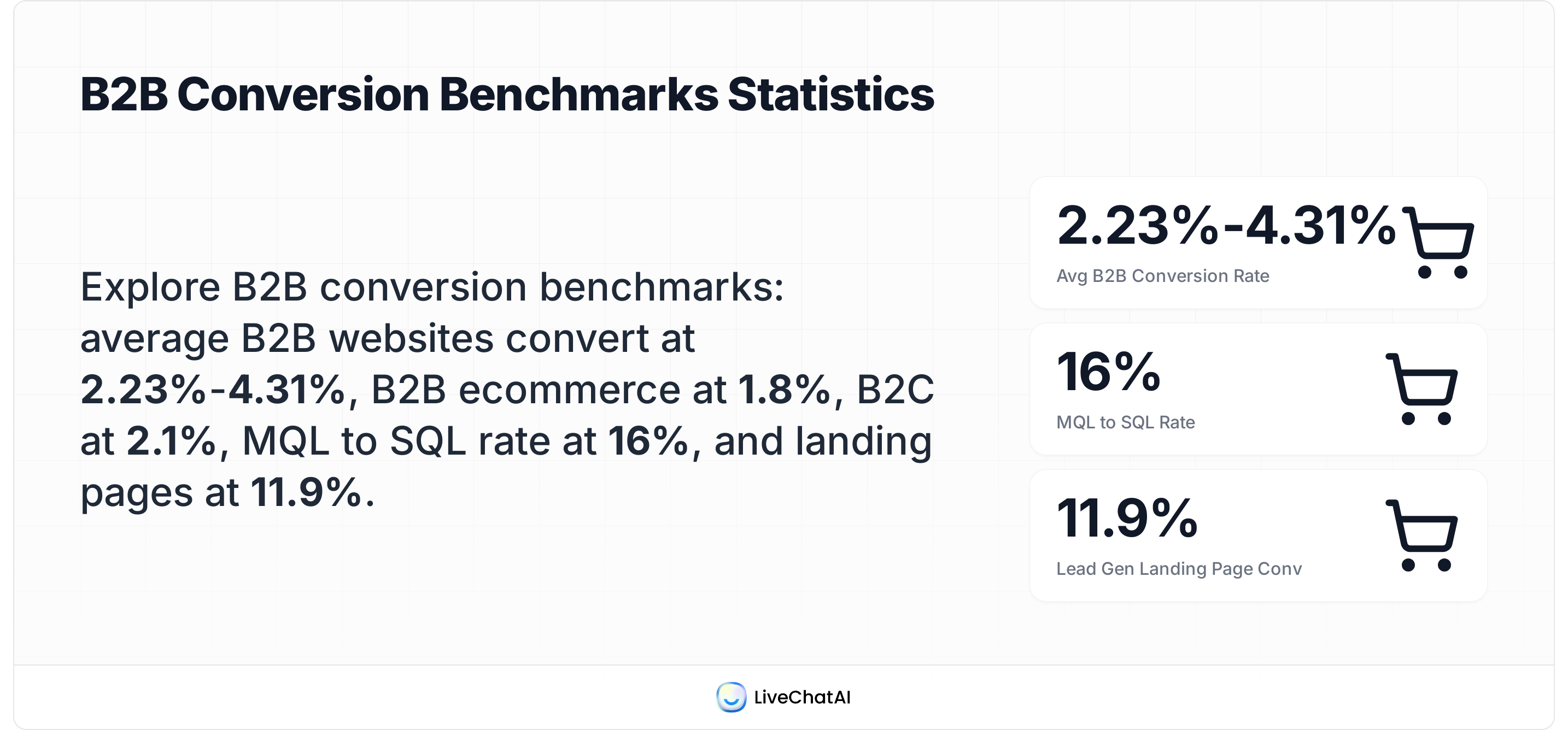
According to Lead Forensics, the average conversion rate for B2B websites falls between 2.23% and 4.31%. That range accounts for differences in how B2B companies define a conversion (demo request vs. contact form vs. free trial).
| B2B Metric | Average Rate | Source |
|---|---|---|
| B2B website overall | 2.23% - 4.31% | Lead Forensics |
| B2B ecommerce | 1.8% | Ruler Analytics |
| B2C websites | 2.1% | The Frank Agency |
| Lead generation landing pages | 11.9% | Blogging Wizard |
| MQL to SQL conversion | 16% | Snov.io |
| SaaS free-to-paid (good) | 3% - 5% | Growth Unhinged |
| SaaS free-to-paid (great) | 8% - 12% | Growth Unhinged |
A few things stand out. B2B ecommerce converts at just 1.8%, per Ruler Analytics. That's lower than most B2C ecommerce because B2B purchases often require procurement approval and involve larger order values.
Lead generation landing pages tell a different story at 11.9%. When you're asking for an email address instead of a credit card, the bar is lower and conversion rates reflect that.
For SaaS companies specifically, Growth Unhinged reports that 3%-5% is a good free-to-paid conversion rate for freemium products, and 8%-12% is great. If you're below 3%, there's a gap between your free product experience and the value perception of your paid tier.
What We Measure Across 28,674 Popup Campaigns
Every table above comes from someone else's dataset. This one is ours.
I founded Popupsmart in 2018, after starting the agency Flatart, and the question I get more than any other is what a popup should actually convert at. Our 2026 benchmark covers 28,674 campaigns from 11,533 businesses that ran a popup with Popupsmart between January 2024 and September 2026: 499.6 million popup displays and 1.84 million leads. Among the 3,034 popups that ask for an email or phone number, the median converts 0.83% of its displays into a lead; the top quarter convert 1.96% or more and the top 10% convert 3.87% or more. The median popup records a click on 2.25% of its displays. The full breakdown is in our popup conversion benchmark report.
Here's the part people get wrong. 0.83% and the sitewide averages further up this page look like the same kind of number. They aren't. A sitewide rate divides conversions by everyone who landed on the site. Our popup rate divides leads by popup displays, the number of times the popup was shown, and only a submission that contains an email address or phone number counts as a lead, so a coupon click or a survey answer doesn't. Different denominators describe different populations. Read the methodology before you borrow anyone's conversion benchmark, including ours.
I've watched teams set a 3% popup target because they read a 3% industry average for whole websites, then feel they've failed at 1.2%. In our data 1.2% is above the median lead-collecting popup, which converts 0.83% of its displays. When a popup sits well below that median, I'd tell you something is broken: wrong audience, wrong moment, or an offer nobody wants. The top quarter of popups convert 1.96% or more, and the top 10% convert 3.87% or more.
Which Popup Setups Convert Best in Our Data
Three settings separate the top of that range from the bottom, and the offer is one of them.
| Setting | Median lead conversion rate | What it means |
|---|---|---|
| Signup popup with a discount code | 1.46% | Against 0.75% for the same kind of popup without one |
| Signup popup without a discount | 0.75% | The baseline |
| Center modal (lightbox) | 0.88% | Against 0.49% for corner and slide-in boxes |
| Corner / slide-in box | 0.49% | |
| 1–2 form fields | 0.88% – 0.94% | Against 0.56% for three fields |
| 3 form fields | 0.56% | |
| Email + name | 1.25% | No reliable effect: the gap reverses among campaigns whose form rarely changed |
| Phone number, no email | 0.46% | Looks weakest, but the gap is not statistically reliable |
Format matters, in the direction you'd expect. A center modal converts 0.88% of its displays against 0.49% for a corner or slide-in box.
Form length behaves the way the advice says it does, up to a point. Popups asking for one field convert 0.88% and two fields 0.94%; three fields drop to 0.56%. Past three the pattern isn't a straight line: four or five fields sit at 0.85%, six or more at 0.57%. Adding a name field alongside the email shows no reliable effect: the overall gap in its favour (1.25% vs 0.88% for email only) reverses among campaigns whose form rarely changed. Asking for a phone number instead of an email looks weakest (0.46%), though that gap is not statistically reliable. Multi-step forms show no measurable advantage once you only count submissions that contain contact details.
| Form fields | Campaigns | Median lead conversion rate |
|---|---|---|
| 1 | 1,224 | 0.88% |
| 2 | 736 | 0.94% |
| 3 | 493 | 0.56% |
| 4–5 | 374 | 0.85% |
| 6+ | 75 | 0.57% |
Timing is the other one. In our 2026 benchmark, popups that wait before appearing convert 0.83% against 0.61% for popups shown the instant the page loads (median campaign), a lean rather than a proven gap, and exit intent shows no statistically reliable advantage. If you change one thing this month, change when your popup fires.
Where Our Data Disagrees With the Industry Benchmark
Contentsquare's Digital Experience Benchmark finds that returning visitors convert better than new ones, 2.9% against 1.7%. Our popup data points the other way: first-time visitors convert better on popups than returning visitors do.
Both findings hold, and the reason is what each one measures. At site level, a returning visitor is further along. They've compared prices, read the reviews, and come back to buy. That's purchase intent, and it builds with every visit. At popup level, the deciding factor is whether the offer is new. A first-time visitor has never seen your 10% welcome discount. A returning visitor has seen it three times and already decided. The same person can be a better site-level converter and a worse popup converter in the same session.
So don't borrow a benchmark from one layer and apply it to the other. If your site-level data says returning visitors are your strongest segment, that's a reason to sell to them harder, not a reason to show them the same popup again.
Device is the second place the two layers part ways. Shopper data puts desktop ahead of phones. In our popup data it runs the other way: the median popup converts 1.02% of its displays on mobile against 0.57% on desktop, and 63% of popup displays happen on mobile. The same visitor can be less likely to check out on a phone and more likely to leave an email there, so read each number on its own layer.
How to Calculate Your Website Conversion Rate
Calculating your website conversion rate takes about 10 seconds once you have the numbers. Here's the formula:
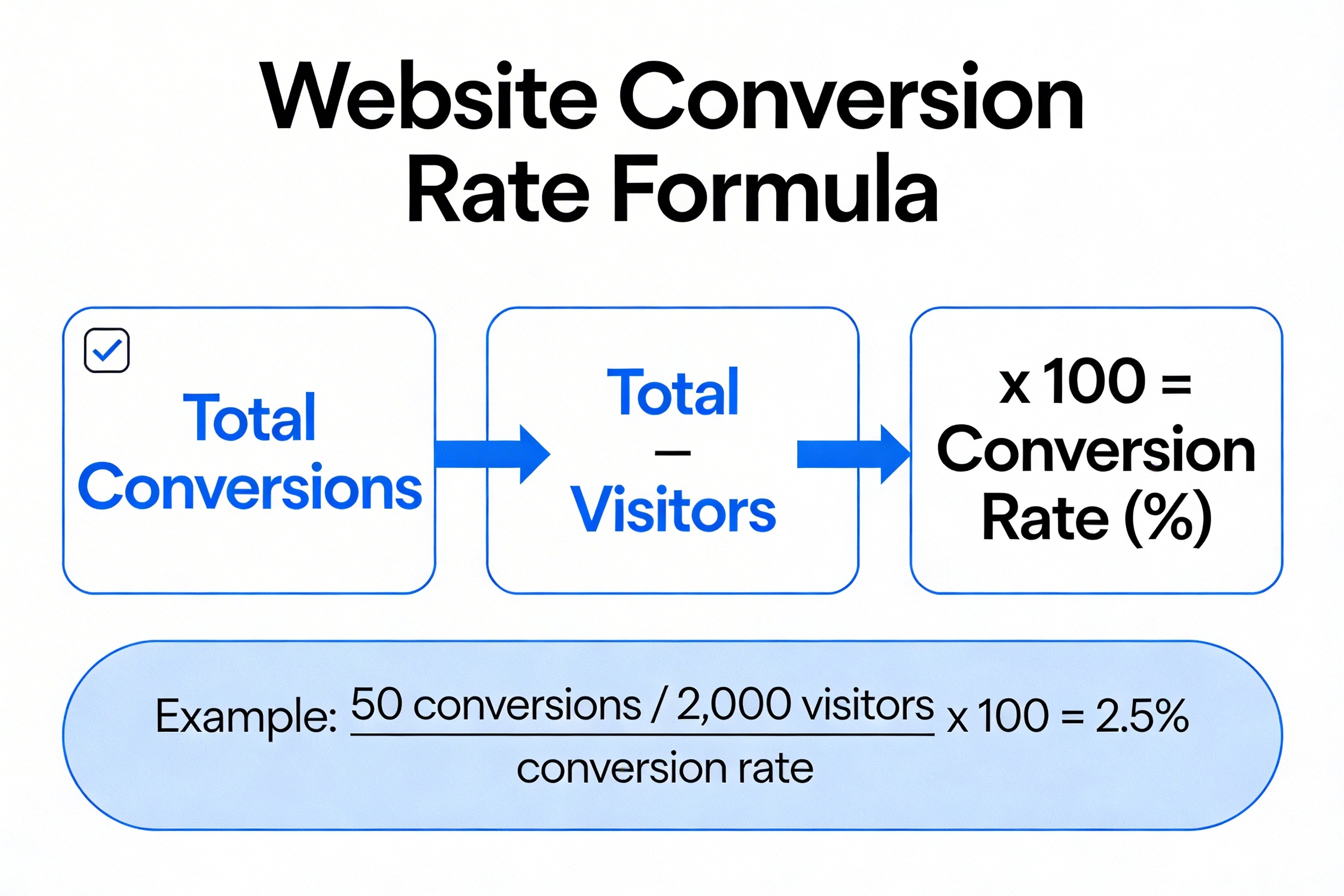
Website Conversion Rate Formula
Say your site had 10,000 visitors last month and 350 of them completed a purchase. Your conversion rate is 350 / 10,000 x 100 = 3.5%.
Two Ways to Calculate
If you have multiple conversion goals on your site (ebook downloads, demo requests, purchases), you can calculate this two ways:
- Per-goal conversion rate. Conversions for one specific goal divided by total visitors. Use it to judge how a single offer or page performs.
- Sitewide conversion rate. All conversions of any type divided by total visitors. Use it to track overall performance over time.
Both approaches have value. Per-goal rates help you optimize specific pages. Sitewide rates help you track overall performance trends and report to leadership.
What Your Rate Tells You
A high conversion rate generally means three things: you're attracting the right audience, your messaging connects with that audience, and you've made it easy to take action. A low rate suggests a breakdown in at least one of those areas.
Don't calculate it once and move on. Track it weekly. Compare month over month. Segment by traffic source, device, and landing page. The number alone is less useful than the trend and the context. You can use Popupsmart's CRO checker to identify what might be dragging your rate down.
Tips to Improve Your Conversion Rate
Improving your conversion rate doesn't require a full site redesign. Based on real case studies and proven benchmarks, here are the highest-impact changes you can make.
1. Speed Up Your Site
Page speed is the foundation. According to Conductor, Vodafone saw 8% more sales after optimizing Core Web Vitals. Yelp boosted conversions by 15% by improving First Contentful Paint. Start with your Core Web Vitals scores and fix the biggest bottlenecks first.
2. Simplify Your Forms
Cut the fields you will never act on. SaaS companies that simplified their signup forms doubled trial signups, per SiteTuners. Our own field-count data above agrees: popups asking for one or two fields convert better than three-field ones. Ask for what you will actually use, and drop the rest. For top-of-funnel offers, an email address is enough. Learn more in our guide on increasing form conversion rates.
3. Use Action-Oriented Headlines and Copy
According to Picreel, switching to action-oriented headlines increased conversion rates by 38.3%. Your headlines should tell visitors what they'll get, not just describe your product. Focus on outcomes, not features.
4. Add Trust Signals Where They Matter
Place trust badges, customer logos, testimonials, and security certifications near your CTAs and checkout. Addressing buyer concerns directly increases conversions by 80%, per Email Vendor Selection.
5. Personalize Your CTAs
Generic CTAs underperform. In HubSpot's analysis of more than 330,000 CTAs, personalized CTAs converted 202% better than basic ones. Wording counts inside a popup too: in our 2026 benchmark, first-person buttons ("Send my code") convert 1.18% against 0.80% for neutral wording (English popups, median campaign). Segment your visitors and show them offers relevant to their behavior, location, or funnel stage. Popupsmart's smart popups let you target specific visitor segments with personalized offers. See what the top CRO experts recommend for personalization strategies.
6. Test One Variable at a Time
A/B testing results compound. CXL documented a case where Truckers Report improved conversions by 79.3% by changing a single word in their headline (CXL). Small, data-driven changes beat big redesigns because you know exactly what caused the lift.
7. Optimize for Mobile Separately
With smartphones converting below desktops and tablets in shopper data, your mobile experience needs its own optimization strategy. Don't just shrink your desktop site. Redesign forms, CTAs, and navigation specifically for thumb-friendly interaction. The same applies to mobile popup design, where a desktop overlay squeezed onto a phone screen is the fastest way to lose the visitor. For Shopify stores, mobile optimization is especially important since most traffic now comes from phones.
8. Use Exit-Intent Popups
Before a visitor leaves, an exit-intent popup can recover a portion of lost conversions. One case study from Conversion Rate Store showed DoYogaWithMe achieved a 173% conversion rate uplift using strategic banners and exit-intent popups. Test it rather than assume it: in our 2026 benchmark, popups on the most sensitive exit-intent setting converted 1.10% against 0.78% without exit intent (median campaign), a gap that could be chance. The key is timing and relevance: offer something valuable, not just another generic discount.
9. Catch cart abandonment where it happens
The cart is where intent is highest and where much of it leaks away. In our 2026 benchmark, popups on cart and checkout pages convert 4.57% of their displays against 1.07% on the home page (median campaign), and blog pages convert 0.23%. Pair a cart-page offer with the basics that remove the reason to leave: guest checkout, a shipping cost the visitor sees before checkout, and trust badges next to the payment button.
Methodology and Sources of Conversion Rate Data
These statistics were compiled from 20+ sources including industry reports from Ruler Analytics, First Page Sage, and Unbounce, company-published benchmarks from Adobe, Forbes, and WordStream, and community data from Reddit and HubSpot. All data points are from 2024-2026 unless otherwise noted.
How we verified: Each statistic was cross-referenced against the original source URL. Where multiple sources reported different figures for the same metric (such as overall average conversion rate), we presented the range rather than choosing one number. Case study data was verified by checking original publisher attribution. Older data points were flagged with their year of origin.
Frequently Asked Questions
What is a good conversion rate for a website?
A good conversion rate for a website is between 2% and 5% for most industries. Anything above 5% is strong, and rates above 10% are exceptional. The specific threshold depends on your industry, traffic source, and what counts as a conversion. Finance websites regularly hit 10%+, while ecommerce sites typically range from 2% to 4%. Rather than chasing a single number, focus on outperforming your own historical average and the median for your specific sector.
What is a good ecommerce conversion rate?
Ruler Analytics puts retail and ecommerce at 2.4% in its 2026 data, near the bottom of the 13 industries it tracks, and Dynamic Yield's store sample averages 2.72% (August 2025 to July 2026). A purchase asks more of a visitor than a form does. Category moves the number more than the average does: a food store and a furniture store should not share a target. Compare yourself with stores that sell what you sell, and treat 3% or more as good for a general store.
What is a good conversion rate for a Shopify store?
Above 2% is good for most Shopify stores. Red Stag Fulfillment puts the typical Shopify store at 1.4% to 1.8% of visitors (2024 to 2025); stores above 3.2% rank in the top 20%, and stores at 4.7% or more in the top 10%. If you are measuring a popup rather than the store, use a popup benchmark instead: in Popupsmart's 2026 data, popups on Shopify stores convert at 1.07% of their displays (median campaign).
What is a good conversion rate for Google Ads and PPC?
Paid search is the highest-converting channel in Ruler Analytics' 2026 data, at 5.4% across industries. WordStream's 2026 benchmark for Google and Microsoft Ads reports 8.18% across 23 industries (April 2025 to March 2026). The two differ partly because an ad platform divides conversions by ad clicks, while a site-level benchmark divides by sessions or visitors, so compare your campaign with the benchmark that counts the way your report does.
What is a good conversion rate for email marketing?
Visitors who arrive from email convert at 4.9% across industries in Ruler Analytics' 2026 data, level with organic search and the highest rate of any channel you own outright. Judge an email campaign by the conversions from the clicks it sent to your site, not by opens, which privacy features in mail apps now inflate.
What is a sales conversion rate?
A sales conversion rate is the share of leads or opportunities that become paying customers: customers won divided by leads worked in the same period, times 100. It describes your sales process, not your website, so track it against your own past quarters rather than against a website conversion benchmark.
Is a 50% conversion rate good?
A 50% conversion rate is extremely unusual for a website's overall traffic. If you're seeing this number, it likely applies to a very narrow funnel, like email subscribers clicking a limited-time offer or returning customers on a reorder page. For a landing page, 50% is outstanding. The social media management platform Later achieved a 60% conversion rate on specific landing pages through heavy optimization, according to Unbounce. For a full-site metric, though, double-check your tracking setup because something may be misconfigured.
Is 20% a good conversion rate?
A 20% conversion rate is exceptional, and at site level it's almost never a real number. When 20% shows up as a whole-site figure, the cause is usually a tracking error: conversions counted against a filtered segment instead of all traffic, or a thank-you page that fires a conversion every time someone reloads it. Check both before you report it upward. Where 20% is genuinely achievable is inside a narrow, high-intent funnel: a branded-search landing page where the visitor typed your company name to get there, a returning-customer reorder flow, or a popup shown only to a segment that has already engaged. Those are real 20% rates. They just aren't your website's conversion rate.
Is a 7% conversion rate good?
Yes, a 7% conversion rate is above average for virtually every industry. It places you well above the 2.9% cross-industry average. For ecommerce, 7% would put you in the top tier. For B2B websites, it's more than double the median. For paid comparison, Google and Microsoft Ads averaged 8.18% across 23 industries between April 2025 and March 2026, according to WordStream, so a 7% organic rate puts you within reach of paid-traffic performance without the ad spend. Keep optimizing, but you're doing well.
Is a 2.5% conversion rate good?
A 2.5% conversion rate is average. It's not bad, and it's not a reason to celebrate. It sits right at the global ecommerce average of 2.5-3% and inside the published cross-industry band of 2.35% to 5.13%, which moves depending on what each source counts as a conversion. If you're in ecommerce, you're right in line with your peers. If you're in finance or professional services, there's room for improvement. The question isn't whether 2.5% is "good" but whether it's where you should be given your industry, traffic quality, and offer strength. An ecommerce CRO audit can help you identify where you're leaving conversions on the table.
How do I calculate the conversion rate of my website?
Divide your conversions by your total visitors for the same period, then multiply by 100. If 8,400 people visited your site last month and 294 of them booked a demo, that's 294 / 8,400 x 100 = 3.5%. The denominator is where most people go wrong. Sessions double-count the same person across repeat visits, which pushes the rate down but matches how most ad platforms report. Unique visitors give you a cleaner per-person rate. Pick one, write it down, and use the same one every month, because comparing a sessions-based rate to last quarter's visitor-based rate tells you nothing.
What is the average B2B website conversion rate in 2026?
The average B2B website conversion rate in 2026 ranges from 2.23% to 4.31%, depending on the source and how "conversion" is defined. B2B ecommerce specifically converts at about 1.8%. Lead generation pages perform much better, with the average lead gen landing page converting at 11.9%. For SaaS specifically, a 3%-5% free-to-paid rate is considered good, and 8%-12% is great. The MQL-to-SQL conversion rate averages 16% across industries.
Is a popup conversion rate the same as a website conversion rate?
No, and comparing them directly is a common mistake. A website conversion rate divides conversions by all site visitors. Popupsmart's popup conversion rate divides leads by popup displays, the number of times the popup was shown, and counts a submission as a lead only when it contains an email address or phone number. Across the 3,034 Popupsmart popups that ask for an email or phone number (January 2024 to September 2026), the median converts 0.83% of its displays and the top 10% convert 3.87% or more. A 3% sitewide rate and a 3% popup rate describe different levels of performance: 3% would put a popup in the top quarter of our data.
How does industry affect website conversion rates?
Industry is one of the strongest predictors of conversion rate. Finance sits at the top of the table with an 11.19% median in earlier multi-year benchmark data, though Ruler Analytics' 2026 cut puts it closer to 6.3%, while ecommerce sites average 3.71%. This gap exists because of buyer intent, product complexity, and purchase price. A visitor comparing mortgage rates is far more motivated than someone browsing t-shirts. Within ecommerce alone, Dynamic Yield's 2025–2026 data runs from 0.72% (luxury and jewelry) to 5.39% (beauty and personal care). Always benchmark against your specific vertical, not generic cross-industry averages.
What Changed in This Post
Our separate post "What Is a Good Conversion Rate?" answered the same question and now redirects here. Its channel questions (Google Ads and PPC, email, ecommerce, Shopify and sales conversion rate) are answered in a new section and five FAQ entries, with current sources in place of its 2017 to 2019 figures; its "average popup conversion rate", a 2016 figure credited to our own post, was not carried over. The title now asks the question directly. Also corrected: the device comparison follows Statista's current ranking (desktop, then tablets, then phones) instead of an unsourced chart that put tablets first; a sentence still quoting the retired 2025 benchmark (time-on-page triggers "up to 25%" better) now quotes the 2026 exit-intent finding; the teaser, fullscreen and sticky-bar findings, which the published benchmark files don't contain, were removed; the ecommerce sub-industry table, which credited Red Stag Fulfillment with a 6.11% figure its page no longer shows, now carries the current Dynamic Yield averages that page publishes, and its chart was removed; the personalized-CTA and Shopify figures now name their sources. Added from the 2026 benchmark: popup rates by page type and by device, and first-person button copy.
Popupsmart's first-party section was rebuilt on the 2026 benchmark (January 2024 to September 2026, 28,674 campaigns, 499.6 million displays). The lead definition changed: a lead is now a submission containing an email address or phone number, divided by popup displays and reported as the median campaign, where the 2025 report divided by interactions and averaged per-campaign rates. The headline rate (0.83% median, 3.87% or more for the top 10%), the setup and form-field tables, the teaser and format findings, the form-length tip, the FAQ answer and the FAQ schema were all replaced. Several 2025 findings reversed: four-field forms no longer come out ahead, and the teaser penalty did not reproduce. The 2025 figures are not comparable and were not retained.
Every headline benchmark was re-checked against its original source. The cross-industry average is no longer quoted as a single number: Ruler Analytics now publishes 5.13% for 2026 where this post previously cited 2.9% to them, so the opening presents the range and names the denominator difference instead. The finance median carries a dated caveat for the same reason. The traffic-source table was rebuilt on Ruler Analytics' 2026 channel data. The paid-search comparison was updated to WordStream's 2026 figure of 8.18%. A first-party section was added with Popupsmart's own conversion data from 10,000+ popup campaigns, including the point where that data disagrees with Contentsquare's site-level benchmark.
That first-party section was then expanded from prose into published tables: popup performance by format and by teaser setting, and the full form-field conversion curve including the 18-field form that converted at 0%. The dataset is now stated in full — 105,277,811 displays, 3,565,403 interactions and 720,189 conversions between January 2024 and September 2025 — and the denominator is named precisely, because Popupsmart measures conversion as leads against interactions rather than against everyone who saw the popup. The corrected finance figure and the cross-industry range were also propagated into the FAQ answers and the FAQ schema, which had still been carrying the superseded single numbers.
Initial publication with industry, device, and traffic-source benchmarks.