ChatGPT
 Perplexity
 Claude
 Grok
Grok Google AI Mode
Strong popup messages pair a benefit-led headline with a single clear action and copy that matches the brand's voice. This guide walks through 10 popup message examples from real brands, the writing patterns that make them work, and a short Popupsmart build-out so you can ship your own version this week. It also folds in fresh 2026 data on which button wording, offers and form lengths actually move that number, copy-ready popup message templates, and answers to the questions readers send us most often.
What is a popup message?
A popup message is the short body of text inside an on-site overlay — headline, supporting line, and call-to-action button copy — that asks a visitor to take a defined action. The overlay itself can be a lightbox, a sticky bar, a slide-in, a full-screen takeover, or a multi-step quiz (our guide to types of popups covers each format). The message is the part visitors actually read.
Outside marketing, "pop-up message" has two other everyday meanings, which is why search results for the term mix them up:
| Meaning | Where it appears | Who writes it | Typical example |
|---|---|---|---|
| Website popup message (this guide) | Over a web page | The site's marketing team | "Get 10% off your first order" with an email field |
| System or app notification | On a phone or computer screen | The operating system or an app | A low-battery warning or a new-message alert |
| Browser dialog | Inside the browser, blocking the page | The page's developer, in JavaScript | An alert box with a single OK button |
MDN's reference for window.alert() describes that last one as a call that tells the browser "to display a dialog with an optional message, and to wait until the user dismisses the dialog." Everything below is about the first meaning.
Three writing choices decide whether a popup feels like an interruption or a useful nudge:
• Tone match: The copy reads in the same voice as the rest of the site. If the brand is playful on its homepage and corporate inside its popup, the popup feels like an ad.
• One job per popup: The headline names a single benefit (10% off, a free guide, a demo). Stacking two offers in one popup asks the visitor for two decisions in the few seconds they give it.
• A button label that finishes the sentence: "Get my 10% off" works because it completes the offer. "Submit" or "Subscribe" makes the visitor do the mental math. This is also the tip our benchmark backs most clearly: first-person buttons beat neutral wording (the numbers are in the data section below).
A well-written popup message turns the overlay from a thing you close into a thing you read. That's the entire game.
Why strong popup messages drive conversions in 2026
Popups have grown up. The 2026 versions on top-tier sites are personalized, behaviorally triggered, and written like product copy rather than ad copy. And the gap between an ordinary popup and a strong one is wide.
The "average popup conversion rate" figures that circulate online are hard to use, because each one divides by something different: all visitors, interactions, or only the people who engaged. Popupsmart's 2026 benchmark uses one definition throughout: leads (popup submissions that contain an email or phone number) divided by popup displays, reported as the median campaign.
The difference between the median and the top 10% is rarely the design tool — it's the message, the trigger, and how well both match the visitor's intent at that exact moment.
What I check first when a popup sits near the median:
• Specific benefit in the headline: "10% off your first order" beats "Subscribe to our newsletter" because the visitor knows immediately what's in it for them. Our data agrees: a discount code is one of the two copy changes with a reliable lift (see the table below).
• A trigger that respects context: Exit intent on a product page is welcome; an entry popup three seconds after page load is not. Our guide to popup timing covers the trigger options in detail.
• Mobile-first copy: Headlines that fit on one line on a 375px screen. Button labels under four words. No cramped form fields. And keep the popup small on phones: Google's guidance on intrusive interstitials and dialogs says not to obscure the entire page.
• Friction-aware forms: Keep popup forms to one or two fields; a third field is where our data shows the drop (see the table below). Adding a name field alongside the email shows no reliable effect: the overall gap in its favour (1.25% vs 0.88% for email only) reverses among campaigns whose form rarely changed (0.74% vs 0.79%). You can always ask for the name in the welcome email.
What does the 2026 data say about popup message copy?
Two copy choices show a reliable lift in Popupsmart's benchmark: a first-person button and a discount code in a signup popup. Several tips repeated across the web, including urgency words, question headlines and button colour, show no measurable effect in our data.
| Copy choice | Median result | Compared with | Reliable gap? |
|---|---|---|---|
| First-person button ("Send my code") | 1.18% of displays | 0.80% for neutral wording | Yes, English popups |
| Value verb on the button ("Get", "Claim", "Unlock") | 1.06% | 0.77% for "Subscribe" / "Join" | No, a lean: the gap is not statistically reliable (English popups) |
| Discount code in a signup popup | 1.46% | 0.75% for signup popups without one | Yes |
| One or two form fields (1,224 and 736 campaigns) | 0.88% and 0.94% | 0.56% for three fields (493 campaigns) | Yes; spin-to-win and other gamified popups counted separately |
| Emoji in the headline or button | 2.76% click rate | 2.20% click rate | No: the click gap is not statistically reliable, and leads show no measurable difference |
| Button colour, dark vs light background, urgency words, question headlines | No measurable effect | n/a | The data are too noisy to rule out modest effects |
How to read the table
I read the first row as the most useful line in this post. The button is the cheapest part of a popup to change, and first-person wording is the change our benchmark backs. The verb row leans the same way, but a lean isn't a reason to rewrite a popup that already works; I'd test it first. The last row matters as much as the wins, because it tells you where not to spend your next A/B test. For more wording to test, our call-to-action examples collect over 100 CTAs.
Does a bigger discount convert better?
Not in our data. Bigger discounts did not convert measurably better: 10% off converted 1.25%, 20% off 0.91% and 25–30% off 1.33%, but the larger-discount samples are small (78 and 46 campaigns), so the data cannot rule out a real difference either way. I read that as: having an offer is the proven part, and its size isn't proven either way. For offer ideas by store type, see these discount popup examples.
How I picked these popup message examples
I evaluated dozens of popups across e-commerce, SaaS, and DTC sites when I first put this list together, and selected these 10 based on four criteria:
• Voice alignment: The popup reads like the brand, not like a generic "sign up for our newsletter" template.
• Single clear action: One offer, one button, no decision fatigue.
• Copy that does work: Every word earns its place. If you can delete it without changing the meaning, the popup is bloated.
• Reproducibility: Any team using a no-code popup builder (Popupsmart included) can recreate the pattern in under 30 minutes.
The selection skews toward email capture popups because that's where most teams are starting in 2026, but the writing principles transfer to exit-intent offers, cart-recovery popups, and SaaS demo prompts. For a broader showcase by use case, our website popup examples roundup covers a wider range of formats.
Here are the 10 at a glance, with the copy taken from each screenshot:
| # | Brand | Popup job | Headline or lead line | Button |
|---|---|---|---|---|
| 1 | Co-Schedule | Exit-intent demo offer (SaaS) | "Before you go..." | "Schedule A Demo" |
| 2 | Frank Body | Email signup, 10% off | "Pants off, 10% off your first purchase." | "Subscribe" |
| 3 | Lego | Wayfinding, no form | "You are about to enter LEGO.com." | "Continue" / "Start playing" |
| 4 | MeUndies | Email signup, 15% off | "How's About 15% Off?" | "Sign Me Up!" |
| 5 | Old Navy | Email signup, 20% off | "20% off in-store and online, you've earned it" | "Get 20% off" |
| 6 | Pitviper | Email signup | "We really shouldn't be doing this..." | "Join us" |
| 7 | The Pool Factory | Email signup | "Sign up & save" | "Submit" |
| 8 | Revolve | Email signup, 10% off | "Get 10% off" | "Get My Coupon" |
| 9 | Tsuno | Monthly newsletter | "Let's stay in touch" | "Subscribe" |
| 10 | Woven Store | Email signup, 10% off as a gift | An invitation to read the store's journals | "OK" |
Look down the button column before you read the teardowns. Only two of the ten buttons speak in the visitor's first person, MeUndies' "Sign Me Up!" and Revolve's "Get My Coupon," and first-person wording is the change our benchmark backs most clearly. Four use a generic label: "Subscribe" twice, "Submit" and "OK."
1. Co-Schedule: The honest-friction exit popup
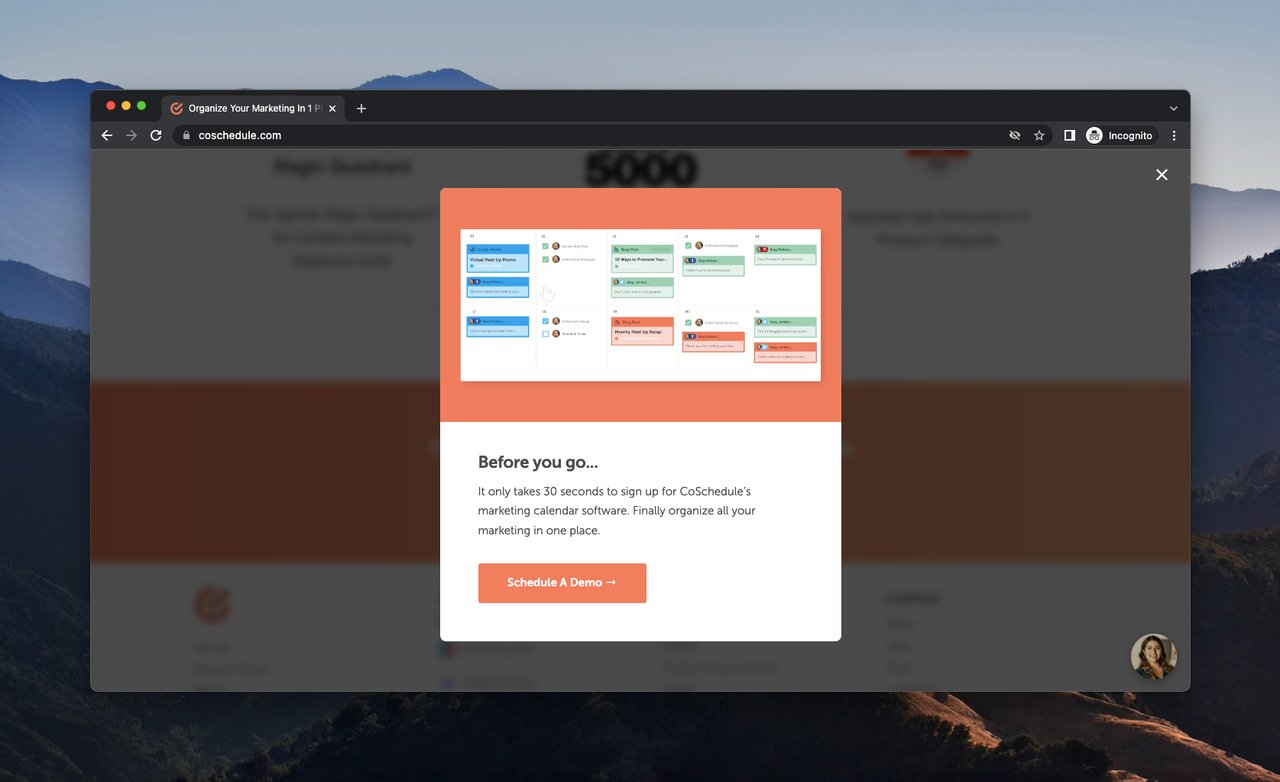
Co-Schedule uses an exit-intent popup headed "Before you go..." whose first line is "It only takes 30 seconds to sign up." Most SaaS popups try to hide the friction; this one names it directly. The body line — "Finally organize all your marketing in one place" — names the outcome the visitor was already there for, and the CTA is "Schedule A Demo" rather than the generic "Sign Up."
What works: The first line pre-empts the most common objection to SaaS sign-ups (time cost). Naming the 30-second window calibrates the visitor's expectations and reduces hesitation. The CTA jumps the visitor past the form and straight to a demo booking, which is the right next step for a B2B marketing tool.
Why it works: Behavioral economists call this "objection inoculation" — surface the visitor's resistance before they consciously form it, and you defang it. The demo-first CTA also matches the buying behavior of marketers evaluating tools: they want to see it, not configure it.
Key takeaway: If your popup asks for a sign-up, tell the visitor exactly how long it'll take. "30 seconds" beats vague promises. Then route them to the highest-intent action — demo, not free trial, not newsletter.
2. Frank Body: The voice-led email popup
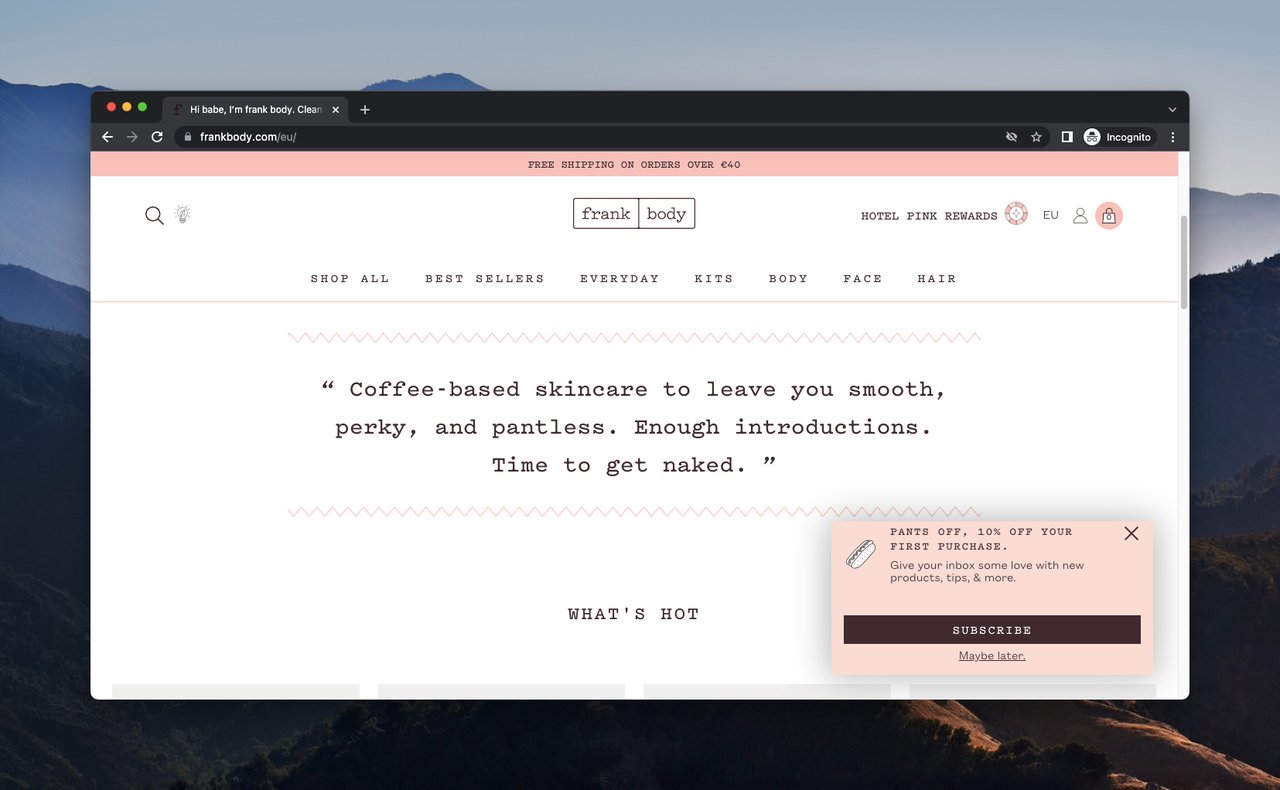
Frank Body is a skincare brand built on a flirty, irreverent voice, and the popup commits to it fully. The headline is "Pants off, 10% off your first purchase." The body copy ("Give your inbox some love with new products, tips, & more") makes the email signup feel like a wink rather than a transaction, and the site's own browser-tab title opens with "Hi babe."
What works: Every word reads like the brand's product copy and Instagram captions. The 10% discount is there, but it's not the lead — the voice is. The one place the voice drops is the button, a plain "Subscribe," softened by a "Maybe later." close link.
Why it works: Voice consistency is a trust signal. When the popup sounds like the rest of the site, the visitor's brain processes it as content rather than as advertising. It's the mere-exposure effect at work: readers who already enjoyed the homepage tone get more of what they liked.
Key takeaway: Write your popup in the same voice as your three best-performing product descriptions, button included. If the popup sounds noticeably different from the rest of the site, rewrite it until it doesn't.
3. Lego: The wayfinding popup that asks for nothing
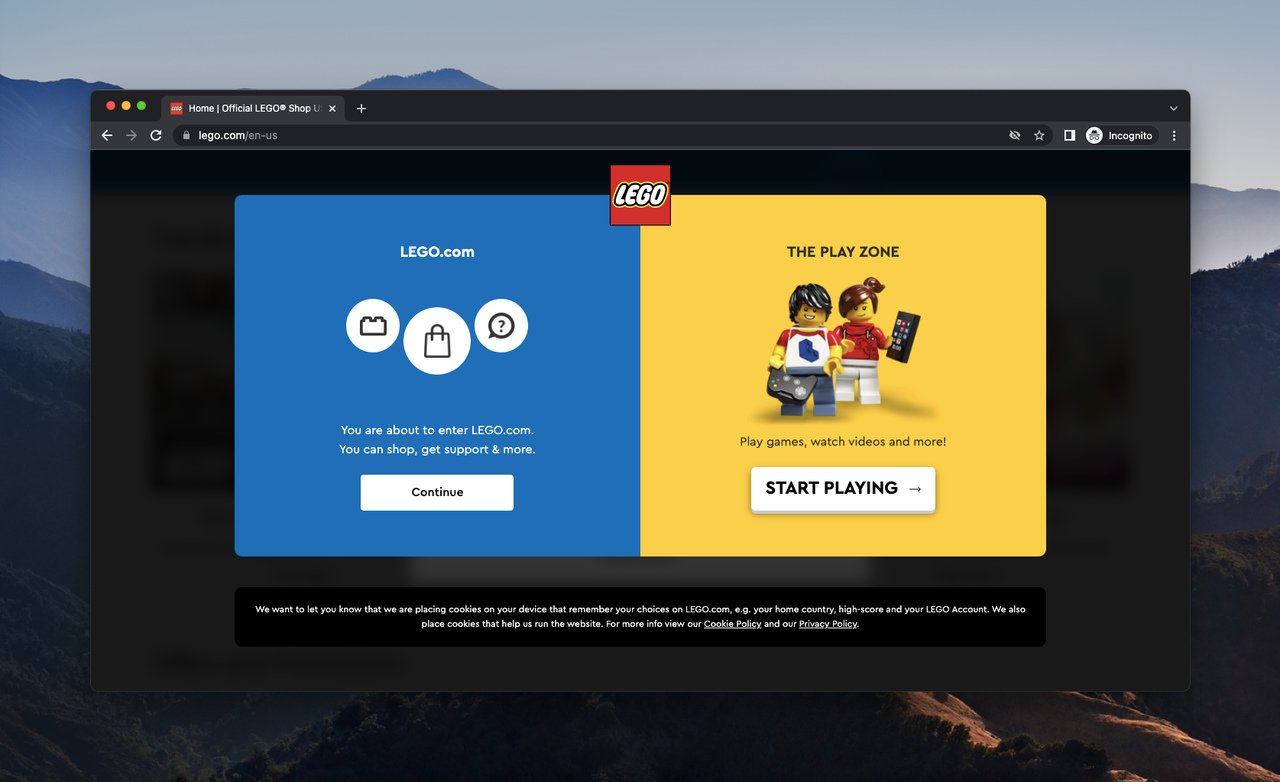
Lego's popup isn't trying to capture an email at all. It's a minimal informational overlay that points visitors toward the home page and play zone. The word "more" is the only repeated element, and the popup leans on Lego characters and the brand color palette to do the work.
What works: No form. No discount. No "subscribe" pressure. The popup acknowledges that some visitors land on the wrong page and gives them two clear paths forward. It uses the brand's design system instead of a generic popup template, so it doesn't feel grafted onto the site.
Why it works: Not every popup needs to be a capture popup. For high-traffic sites with multiple audience segments (parents, kids, collectors), a wayfinding popup reduces bounce by routing visitors to the right experience before they have to navigate themselves.
Key takeaway: If your homepage serves multiple audiences, test a no-form, no-discount popup that helps visitors self-segment. Send them to the section that fits their intent, then capture later in the funnel.
4. MeUndies: The one-line offer popup
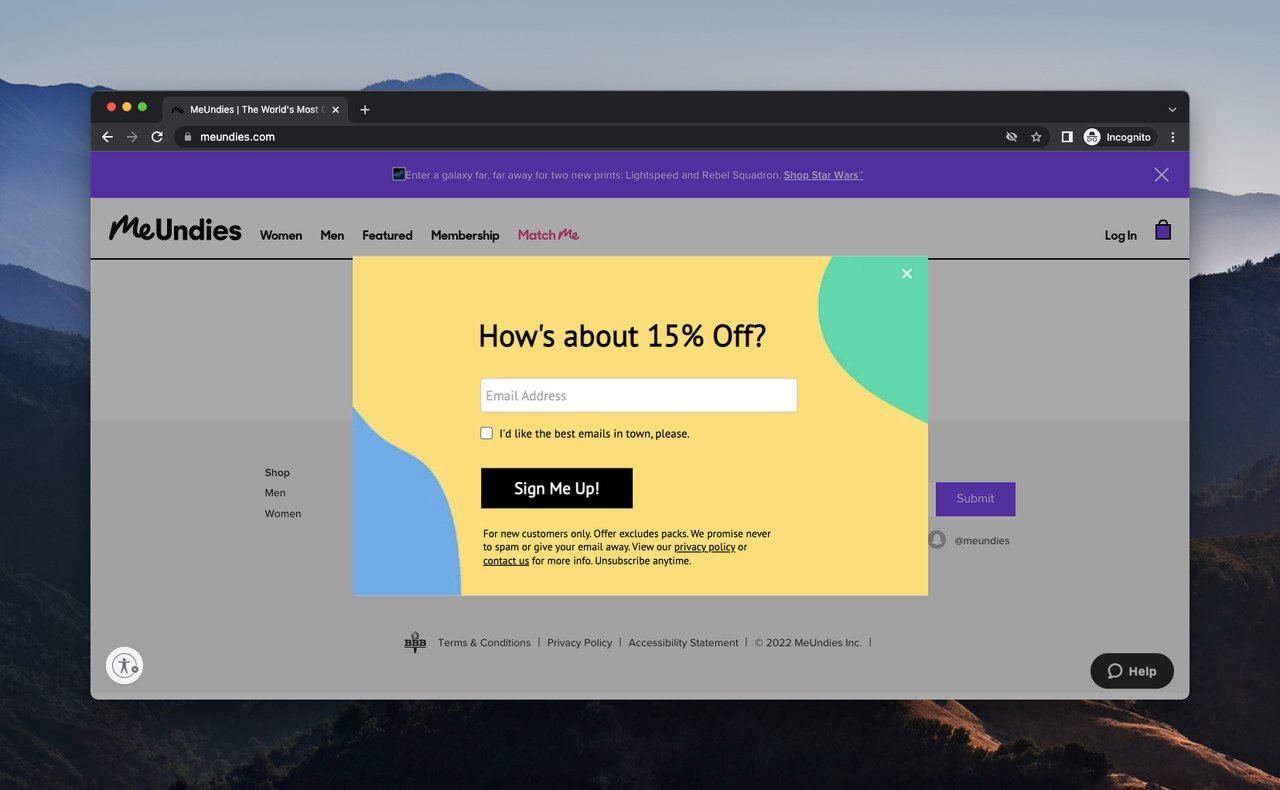
MeUndies uses a stripped-down email popup with a single line of copy: "How's About 15% Off?" The button reads "Sign Me Up!", and the opt-in checkbox under the email field says "I'd like the best emails in town, please" — a conversational line that's almost a complete sentence. Form is email-only.
What works: The popup commits to brevity. No headline, sub-headline, body line, and CTA stack — just an offer phrased as a question and a button that answers it. The checkbox copy positions the brand's emails as the reward, not the chore, and the button speaks in the visitor's first person.
Why it works: Every additional sentence in a popup is one more thing to process before the visitor decides. By reducing the popup to one offer and one branded button label, MeUndies asks the visitor to make exactly one decision. That maps to how visitors actually scan popups in 2026 — they read the headline, skim the button, and either close or click. The question mark isn't the lever, by the way: question headlines showed no measurable effect in our benchmark. The offer does the heavy lifting.
Key takeaway: Audit your popup copy this week. If you can delete a sentence and the offer still makes sense, delete it. Then test the trimmed version against the original.
5. Old Navy: The power-word popup
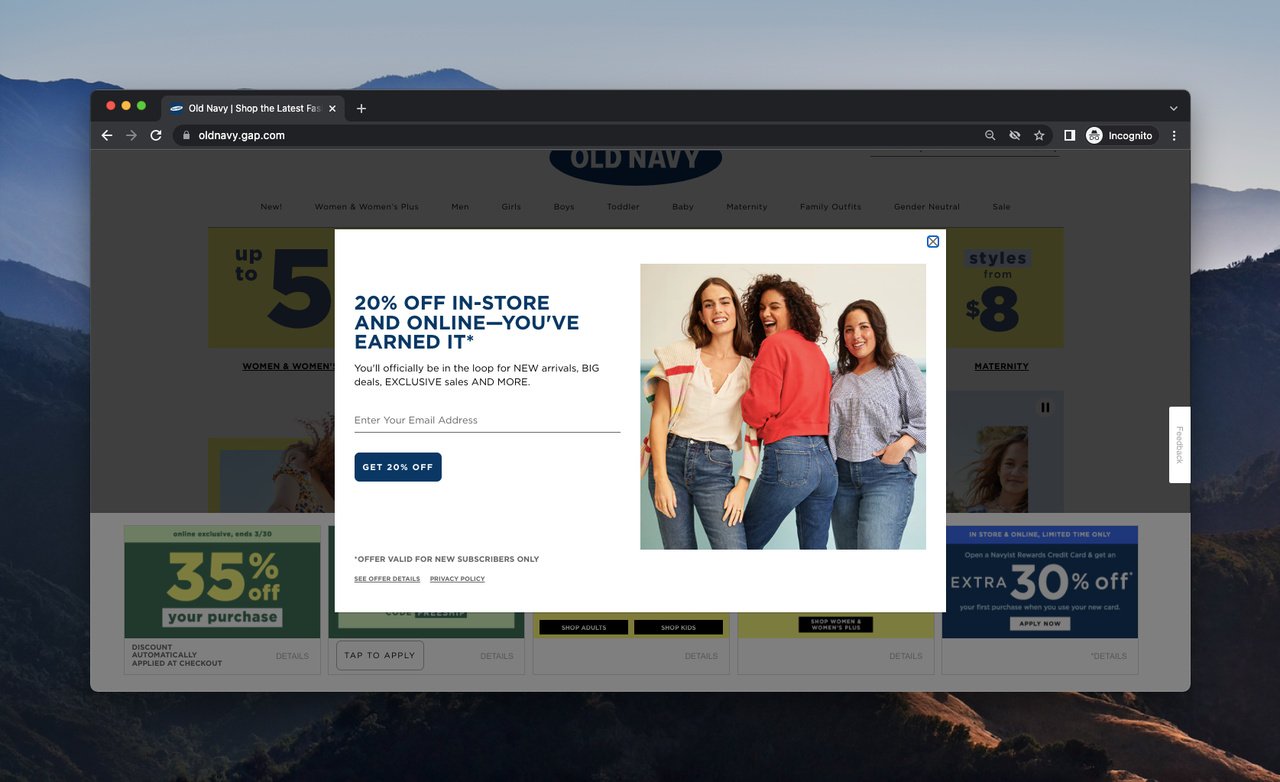
Old Navy leads with a 20% off discount and a "You've earned it" tagline. The interesting writing choice is in the body: "You'll officially be in the loop for NEW arrivals, BIG deals, EXCLUSIVE sales AND MORE." The selective capitalization functions like a highlighter, telling the eye where to land first.
What works: The popup uses typographic emphasis where a static popup can't use animation. Capitalizing NEW, BIG, EXCLUSIVE, and MORE creates four mini-headlines inside the body line — the visitor gets the value proposition even on a fast skim. The "You've earned it" framing flips the script from "give us your email" to "you've already qualified." The button, "Get 20% off," repeats the offer instead of saying "Submit."
Why it works: Nielsen Norman Group's eye-tracking research found that people often scan web text in an F-shaped pattern: first lines get more gazes than later ones, and the first few words of each line get more fixations than the rest. Capitalizing the value words inside the body copy gives the skimmer something to grab onto even when they don't read the full sentence.
Key takeaway: If your body line has four or more benefits, capitalize the two highest-impact ones. Don't capitalize more than that — at that point you're shouting, and the technique stops working.
6. Pitviper: The popup that doesn't look like a popup
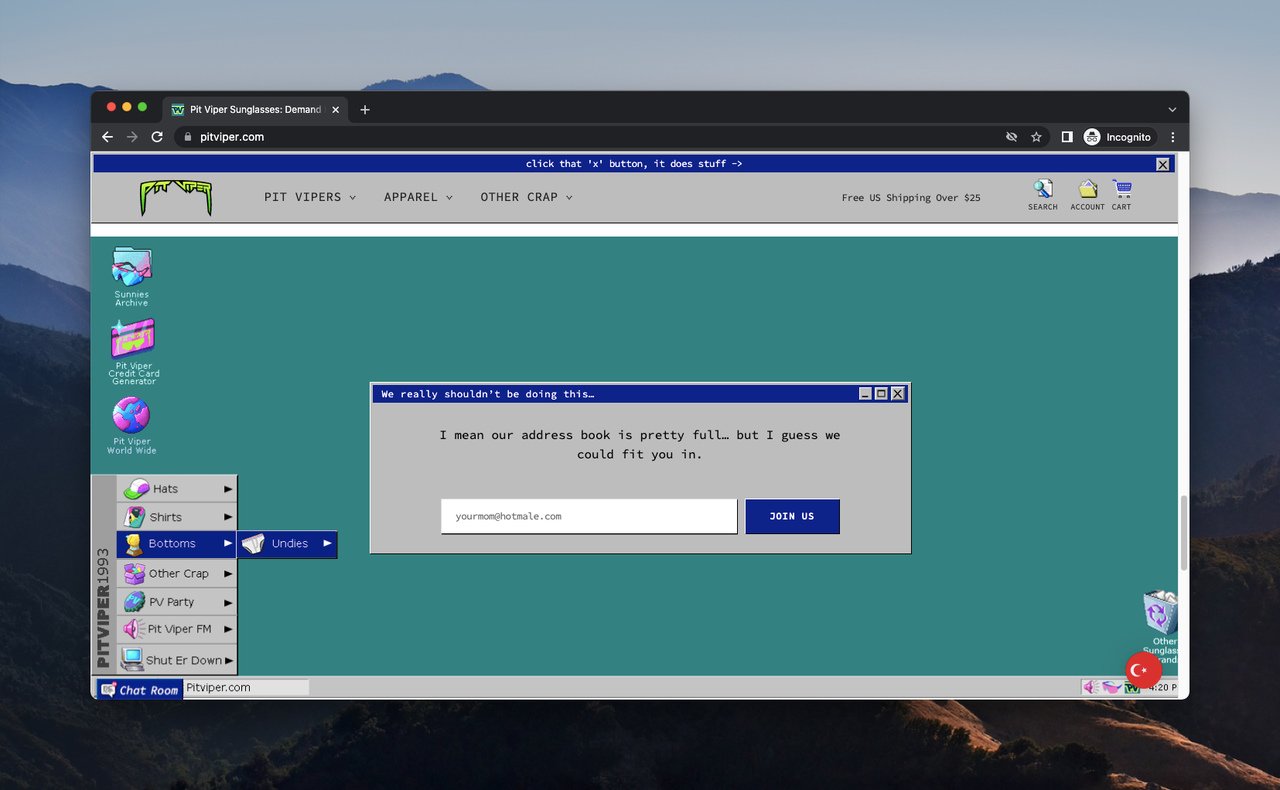
Pitviper (styled "Pit Viper" on its own site) ships a popup styled like an old-fashioned Windows 95 dialog box, which matches the brand's retro design system. The headline — "We really shouldn't be doing this..." — frames the offer as a guilty secret, and the body line plays up scarcity ("I mean our address book is pretty full… but I guess we could fit you in"). The button just says "Join us."
What works: The popup is designed as a feature of the site, not as an overlay grafted on top. Visitors don't read it as "a popup interrupting me" — they read it as "another playful element of this weird, fun brand." The scarcity framing does the persuading, but it lands because the voice already earned trust. The line has outlived the popup, too: when we re-checked on 29 September 2026, Pitviper was running the same "address book" copy in its footer email signup.
Why it works: When the popup design is indistinguishable from the rest of the site's aesthetic, it bypasses the visitor's mental "close this ad" reflex. The retro frame is a Trojan horse — it makes the visitor curious instead of defensive.
Key takeaway: Build your popup with the same components, fonts, and tone as your homepage. If a designer could mistake the popup for a site section, you've nailed it.
7. The Pool Factory: The design-led popup
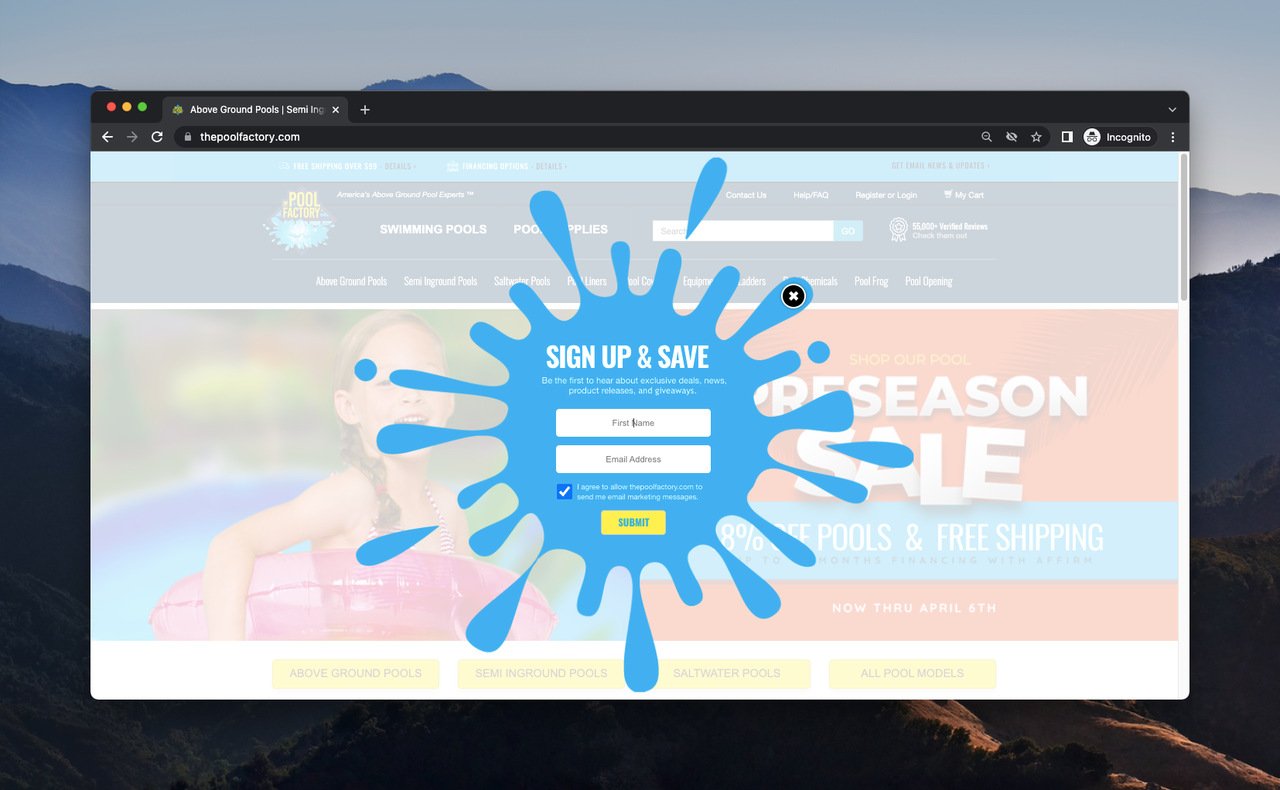
The Pool Factory takes the opposite approach to MeUndies — minimal copy, but with a custom illustration that resembles a pool splash. The headline is just "SIGN UP & SAVE." The body line lists the perks: "Be the first to hear about exclusive deals, news, product releases, and giveaways." The button is a plain "Submit"; here the illustration does the persuading.
What works: The illustration carries the brand signal. Pool brands selling above-ground pools have a strong visual category (water, summer, splashes), and the popup uses that immediately so the reader knows what site they're on. The copy then handles the rational side — what the visitor gets in exchange for the email.
Why it works: Visual-first popups make sense when the brand has a recognizable category aesthetic. For a niche e-commerce store, leaning on category imagery does the work of three sentences of body copy. What the design can't do is convert on colour alone: in our benchmark, dark vs light popup backgrounds and button colour showed no measurable effect, so the splash earns its place by signalling relevance fast.
Key takeaway: If your brand has a strong visual category (food, fashion, outdoors), let the design carry the message. Use the copy for the offer details, not for proving you're a real brand.
8. Revolve: The compliment popup with a friendly opt-out
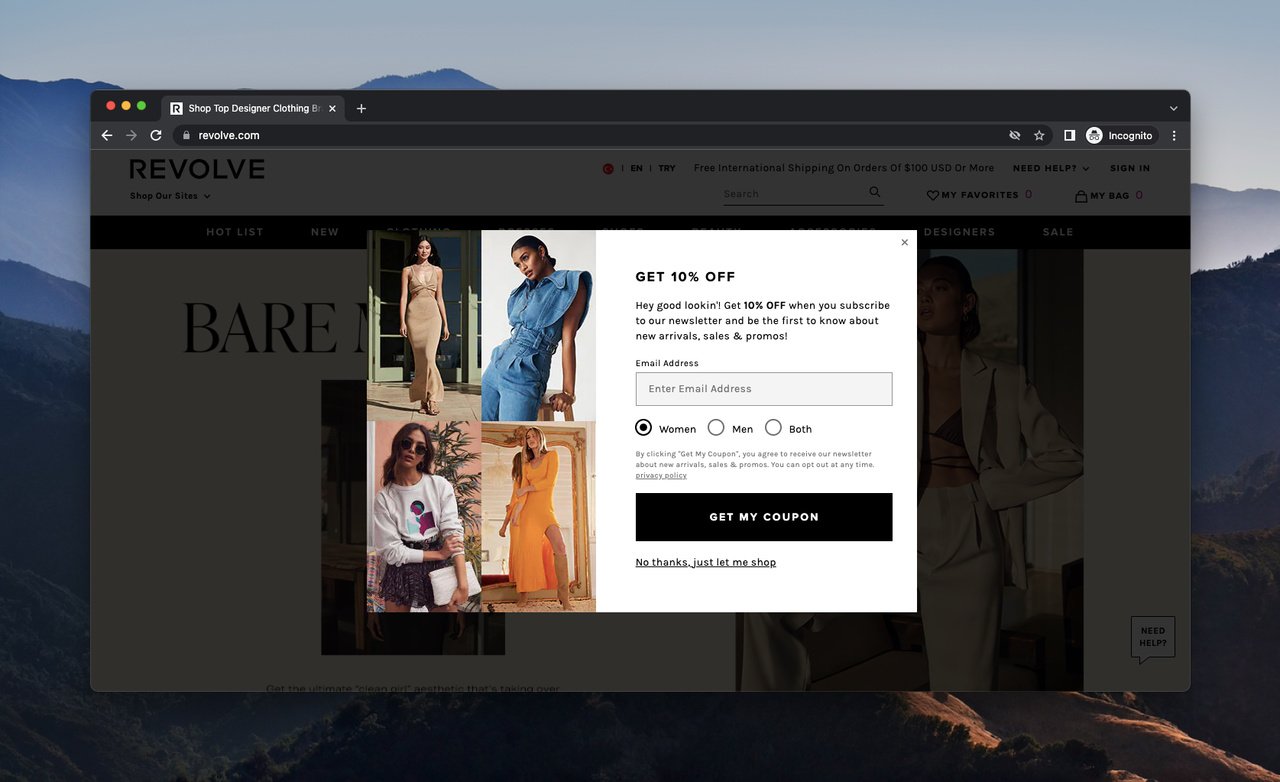
Designer brand Revolve opens its popup with a 10% off headline, but the writing choice that matters is the body line: "Hey, good lookin'!" followed by "be the first to know about new arrivals, sales & promos!" The button, "Get My Coupon," is first-person and names the reward. The opt-out link at the bottom reads "No thanks, just let me shop" — and that's the move worth studying.
What works: The opt-out copy preserves the popup's friendly voice instead of using the default "X close" or a guilt-trip "No thanks, I don't want to save money." Visitors who close the popup leave with a slightly positive impression of the brand rather than feeling like they dodged a sales pitch.
Why it works: Most teams optimize the click path; few optimize the close path. A friendly opt-out is a small detail, but it matters because 40.5% of popup displays end with the visitor closing the popup (Popupsmart 2026 benchmark, all displays pooled, February 2025 to September 2026, since close tracking began). If those visitors leave with goodwill instead of irritation, your brand metrics improve even when the popup conversion stays flat.
Key takeaway: Rewrite your popup's close link. Replace "No thanks" or a bare "X" with a one-line opt-out that matches your brand voice. Test for branded search and direct-traffic lift, not just popup conversion.
9. Tsuno: The community-first popup
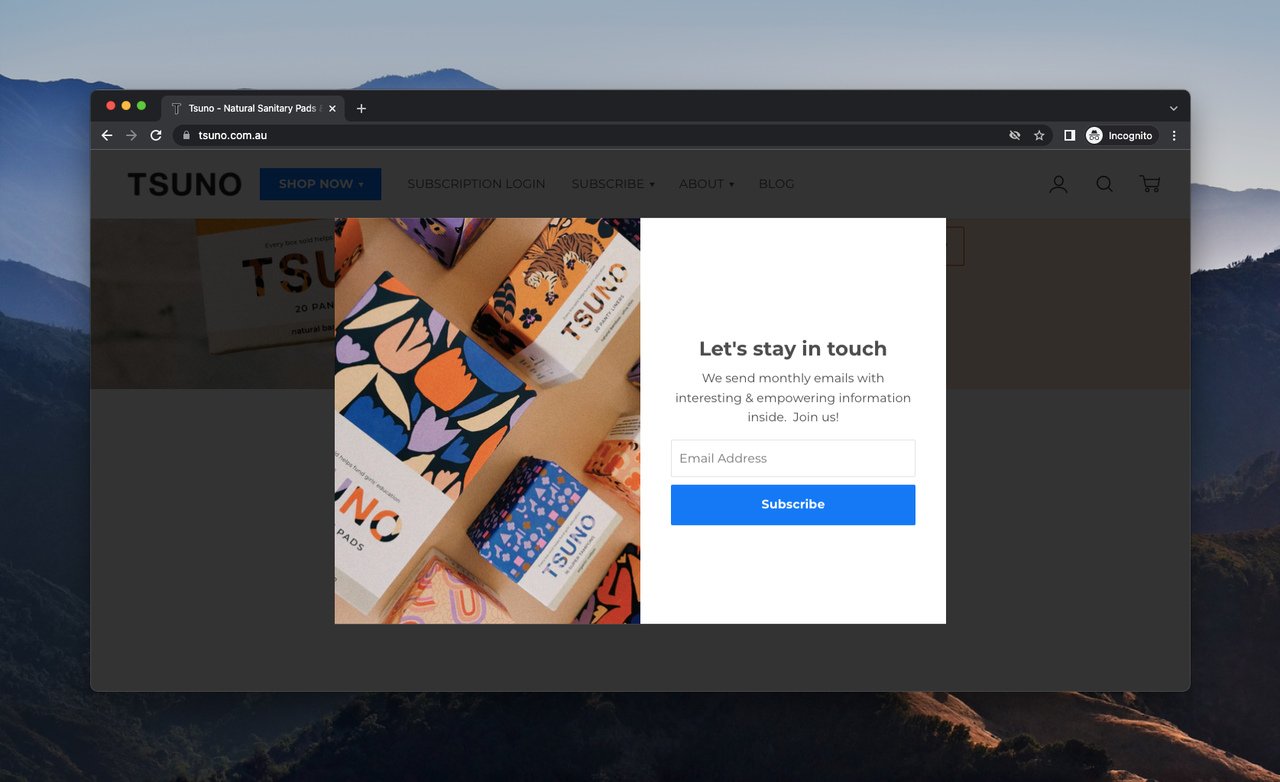
Tsuno sells natural sanitary products, and its popup leans into community language rather than discount language. The headline is "Let's stay in touch." The body line — "We send monthly emails with interesting & empowering information inside. Join us!" — sets clear expectations (monthly, informational, empowering) and ends on "Join us!" rather than a sales line (the button itself still reads "Subscribe").
What works: In the version captured here, Tsuno doesn't lead with a discount. The popup instead pre-qualifies subscribers by telling them what the newsletter actually contains. The bet is that this filtering reduces unsubscribes downstream — fewer people sign up, but the ones who do know what they signed up for.
Tsuno has since changed course. Its current signup popup (checked 29 September 2026) is headed "Join us" and reads "Sign up with your email and get a welcome 10% discount code for your first order," with a "Get offer" button, while its footer form still promises monthly updates "on your impact, donations and other interesting period things." That's the direction our data points (see the discount row in the data table above).
Why it works: For mission-driven or values-led brands, identity-based copy ("Join us") sets expectations that transactional copy ("Get 10% off") can't. It doesn't win on raw signups in our data, though: "Subscribe" / "Join" buttons look weaker than value verbs like "Get" (a lean, not a reliable gap), and a discount code is a reliable lift. Visitors who sign up are buying into the brand's worldview, not just into a discount, which is why keeping the identity line while adding a code is a sensible middle path. For more on this pattern, our welcome popup guide covers identity-led capture flows in depth.
Key takeaway: If your brand has a clear mission or values position, lead with identity, then decide deliberately about the discount. "Join us" pre-qualifies subscribers; a first-order code is what our data says lifts the raw signup rate.
10. Woven Store: The "gift" framing popup
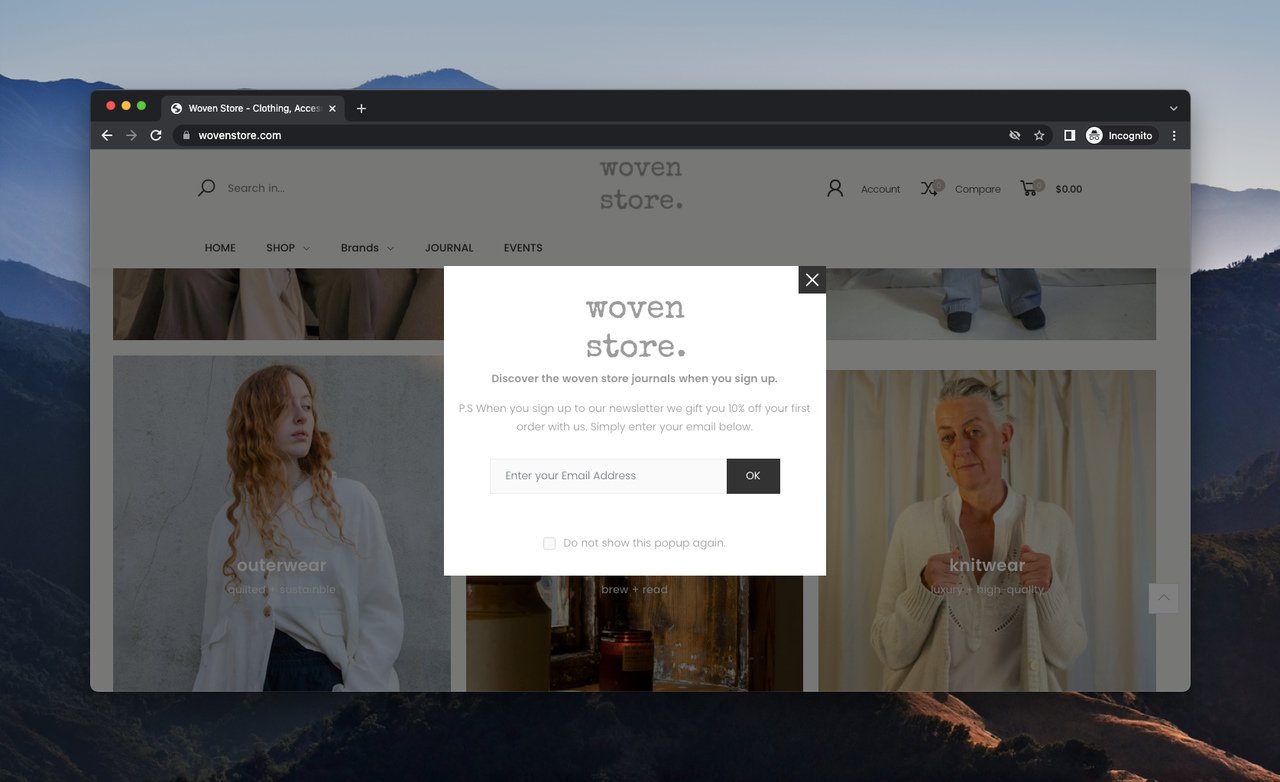
Clothing store Woven Store opens with a headline inviting visitors to read the brand's journals once they sign up. The popup's footnote — "P.S When you sign up to our newsletter we gift you 10% off your first order with us. Simply enter your email below." — is where the word choice matters: "gift" instead of "give" or "send."
What works: Reframing a discount as a gift changes the psychological transaction. A discount feels like a coupon; a gift feels like a relationship gesture. The "P.S." format also feels less like an ad and more like a personal note — the same trick direct-response copywriters have used in sales letters for decades. The weak spot is the button: a bare "OK" after all that careful wording.
Why it works: Gift framing triggers reciprocity. The visitor receives something framed as generosity, and their default response is to reciprocate (in this case, by handing over an email address and opening future emails). The P.S. format adds a second layer: sales-letter writers have long leaned on the P.S. because readers' eyes tend to jump to the end of a block of copy.
Key takeaway: Swap "Get 10% off" for "We'll gift you 10% off your first order" in the body line, and give the button first-person words ("Send my code") instead of "OK." The gift wording is untested in our data, so treat it as an A/B test — it's free to run.
Key takeaways from these popup message examples
The 10 popups above teach 10 different lessons, but five patterns repeat:
• Voice match beats clever copy. Frank Body, Pitviper, and Revolve all stand out by sounding exactly like their brand. None of them wrote a "popup voice" — they used the homepage voice.
• One offer per popup. Every example commits to a single ask. The two popups that mix offers (discount + content) handle it by sequencing — they lead with one and tuck the other into a P.S. or footnote.
• Button labels should finish the sentence. "Get My Coupon," "Sign Me Up!" and "Schedule A Demo" all complete the offer instead of restating it. The generic labels on this list ("Subscribe," "Submit," "OK") are the cheapest fix on those popups.
• The close path matters too. Revolve's "No thanks, just let me shop" preserves voice on the way out. Designing the opt-out is a small detail that compounds across every display that ends in a close.
• Visual identity does heavy lifting. The Pool Factory's splash, Pitviper's retro window, and Lego's color palette all communicate brand before any word is read.
A practical note on where this is going in 2026: mobile popup conversion outpaces desktop. In Popupsmart's benchmark, the median popup converts 1.02% of its displays on mobile vs 0.57% on desktop; our mobile vs desktop popup data breaks that down further. That's a meaningful inversion of the desktop-first thinking most teams still use when writing popup copy.
Popup message templates you can copy
Each template below gives you a headline, a body line, a button and a close link. Swap in your own offer and your brand's voice (the lesson of Frank Body and Pitviper). Every button is written in the first person because that's the wording our benchmark backs, and a discount appears where a store can offer one, because a discount code is the other copy change with a reliable lift.
1. Welcome discount (email signup)
- Headline: Your first order, 10% off
- Body: Join the list and we'll email your code right away. [One email a week], unsubscribe anytime.
- Button: Send my 10% code
- Close link: No thanks, just browsing
2. Newsletter without a discount
- Headline: The [topic] notes our readers actually open
- Body: One email a [month] with [what's inside]. No sales blasts.
- Button: Send me the next issue
- Close link: Not today
3. Lead magnet (guide, checklist or template)
- Headline: Get the [guide name], free
- Body: [The one outcome it delivers]. We'll email it to you now.
- Button: Email me the guide
- Close link: No thanks
4. Cart save (exit intent)
- Headline: Your cart is saved
- Body: Leave your email and we'll send you a link back to it [plus a code for X% off, if you offer one].
- Button: Save my cart
- Close link: I'll come back later
5. Demo request (SaaS)
- Headline: See [product] on your own [site or data]
- Body: A [20]-minute walkthrough with our team, at a time that suits you. Booking takes [30 seconds].
- Button: Book my demo
- Close link: Not yet
6. Wayfinding (no form)
- Headline: Two ways into [brand]
- Body: Shop the full range, or head to [section] for [audience].
- Buttons: Take me to the shop / Show me [section]
- Close link: Just browsing
If you want phone numbers for SMS, collect the email first. Forms that ask for a phone number instead of an email look weakest in our data (0.46% vs 0.88% for email only), though that gap is not statistically reliable.
How to implement these popup ideas on your site
Translating an example into a live popup takes more than copy-paste. Here's the order I'd run it in.
1. Audit your current popup copy
Print out (yes, on paper) the headline, body, and button copy of your live popup. Read it aloud. If it sounds like a stranger reading from a script, the voice is off.
2. Pick the one pattern that fits your brand
Voice-led (Frank Body), trim (MeUndies), gift framing (Woven Store), community (Tsuno), or visual-led (Pool Factory). Don't try to apply all five.
3. Rewrite the button label first
The button is the highest-impact word change on most popups, and first-person wording is the button change our benchmark backs. Replace "Subscribe" or "Submit" with a sentence-completing CTA in your brand voice.
4. Test mobile before desktop
Most teams design popups on a 1440px screen and then check mobile. Reverse it — write and design for 375px first, and the copy will naturally tighten.
5. Match the trigger to the intent
Entry popups for first-time visitors getting a content offer, exit-intent for cart abandoners, scroll-triggered for engaged readers. Mismatched triggers kill conversion no matter how good the copy is.
6. A/B test one variable at a time
Headline OR offer OR CTA — not all three. You can't learn anything from a three-variable test on popup traffic unless you're running enterprise volume. Our guide to A/B testing for popups covers the setup.
One important caveat: top-10% results don't show up on day one. The first version of any popup is rarely the winner — it's the baseline.
Tools to build high-converting popups
The tooling decision matters less than the copy decision, but it matters. Three things to look for in a popup builder:
• No-code editor with brand-system support: You should be able to import your fonts, colors, and button styles without a developer. If you're rebuilding your brand inside the popup tool, the tool is wrong.
• Targeting at the page-and-segment level: Triggering a popup site-wide is the fastest way to burn out your audience. Look for tools that target by URL, traffic source, device, return visit count, and behavior.
• Honest analytics: Some tools report "views" as anyone who loaded the page, which inflates the denominator. The number you want is "shown vs. converted," not "loaded vs. converted." It's the same reason every rate in this post divides by popup displays.
The walkthrough below is the same one I run new team members through — it's intentionally short.
For a longer reading list before you build, the 2026 email popup guide covers high-converting email-capture patterns specifically, and the Shopify newsletter popup walkthrough covers the Shopify-specific integration steps. For B2B teams, the B2B popup examples roundup is closer to your use case than the e-commerce examples above.
One real-world data point worth grounding all of this in: Hustler Marketing's welcome flow case study, the agency's write-up of eight e-commerce stores it worked with, reports a 5.3% average conversion rate for email inputs in their popups and 782% growth in email revenue for seven of those stores by their third month with the agency. That's the kind of compounding effect that makes popup work pay off — the popup itself converts a small share of visitors, but the downstream email program built on those captures is where the revenue shows up. (The 5.3% is the agency's own average across eight stores, so it isn't comparable with the benchmark medians in this post.)
How to create a popup message in Popupsmart
Building popups with Popupsmart is straightforward, and Popupsmart has a free plan. By Popupsmart's own account, most customers build and publish a campaign in under 5 minutes once they're signed up; the first one can take longer, because it includes installing the embed code on your site. Here's the exact build flow, screenshot by screenshot (captured in early 2024, so a few labels may differ in today's app).
1. Sign up if you haven't already and click the "+New Campaign" button on the dashboard.
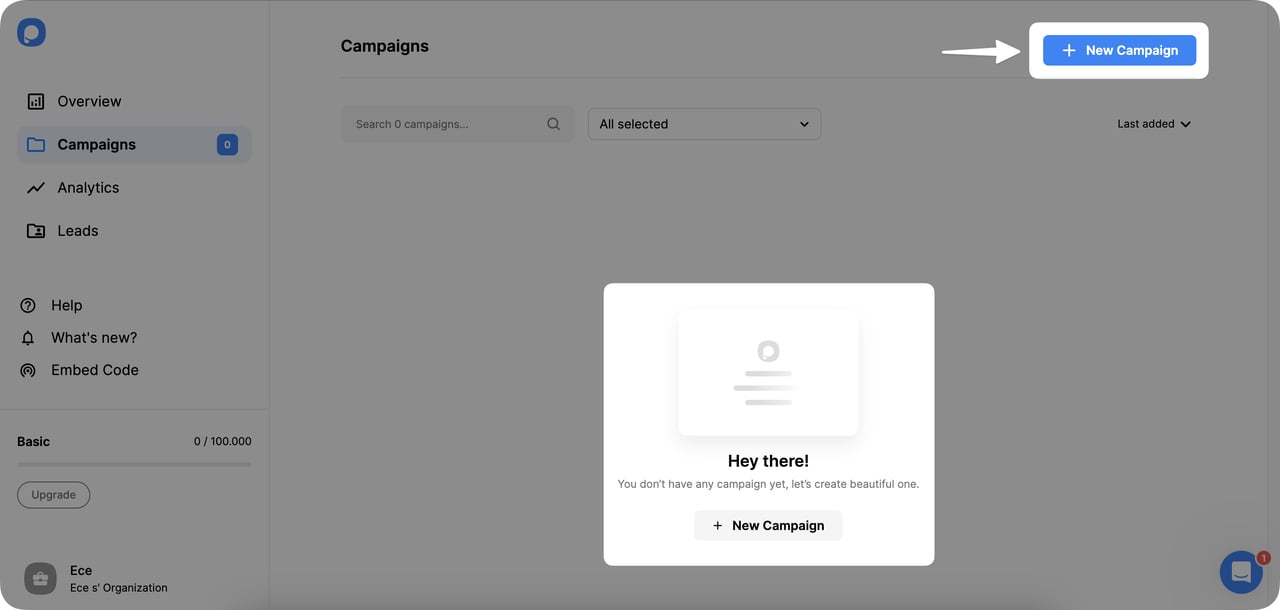
Step 1: Start a new campaign from the dashboard.
2. Name your campaign, choose a domain from the dropdown, and click Save to move to the builder.
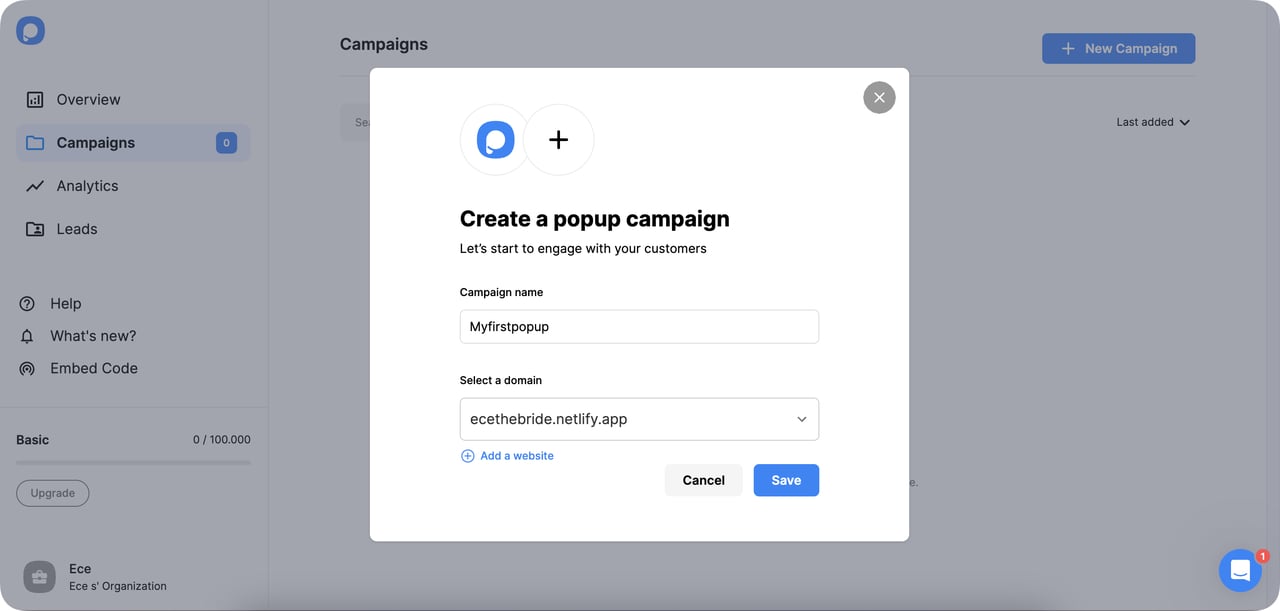
Step 2: Name the campaign and pick the domain.
3. Pick your business goal. Popupsmart has goal templates for the most common popup use cases.
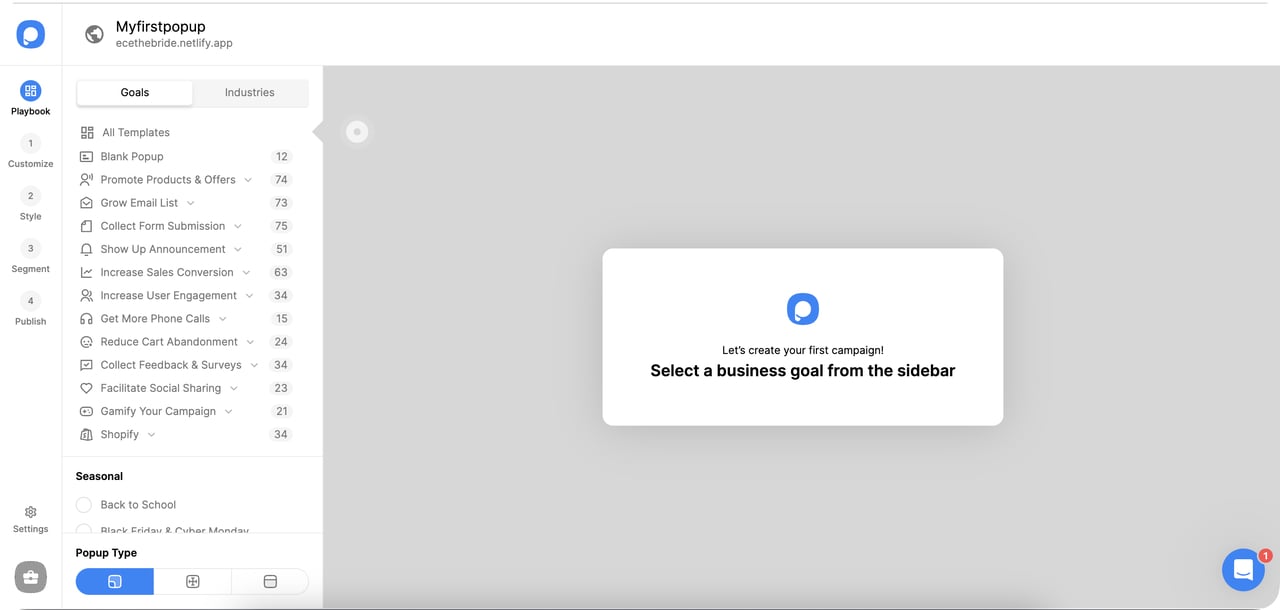
Step 3: Choose a business goal template.
You can promote products, make announcements, grow your email list, or increase phone calls. You can also collect form submissions or capture cookie consent. Pick the goal that fits your campaign.
4. Select a template from the gallery. Filter by popup type (light popup, full-screen, floating bar) or by animated and multistep options.
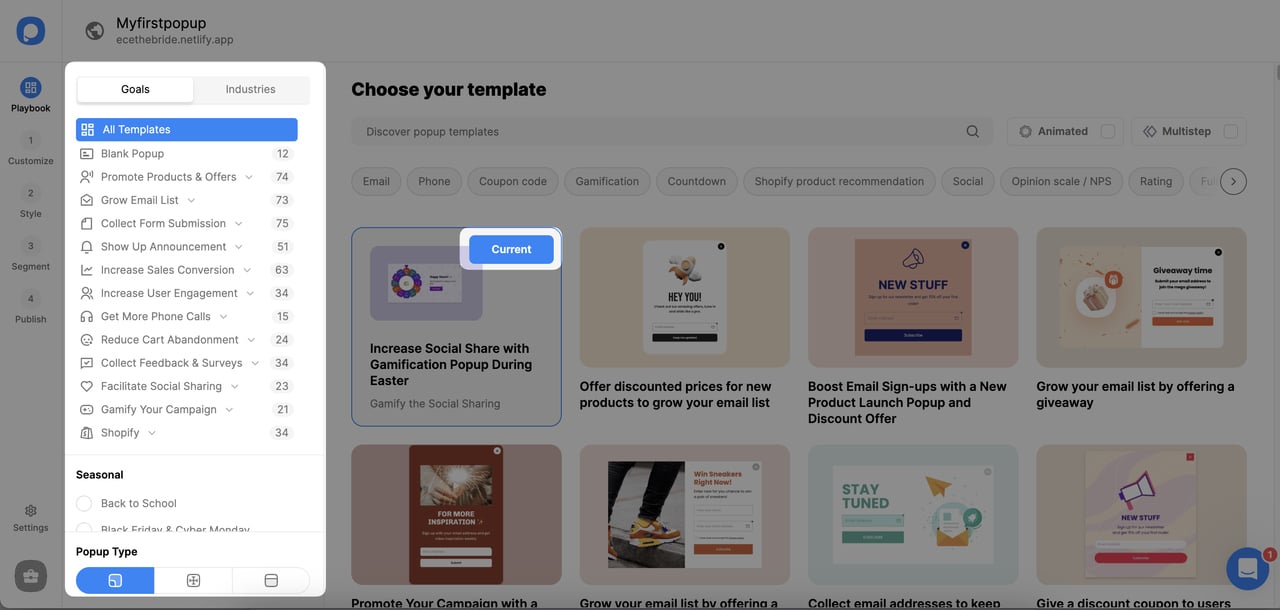
Step 4: Pick a starting template.
5. Add elements in the "Customize" step — text, image, button, form fields, countdown timer.
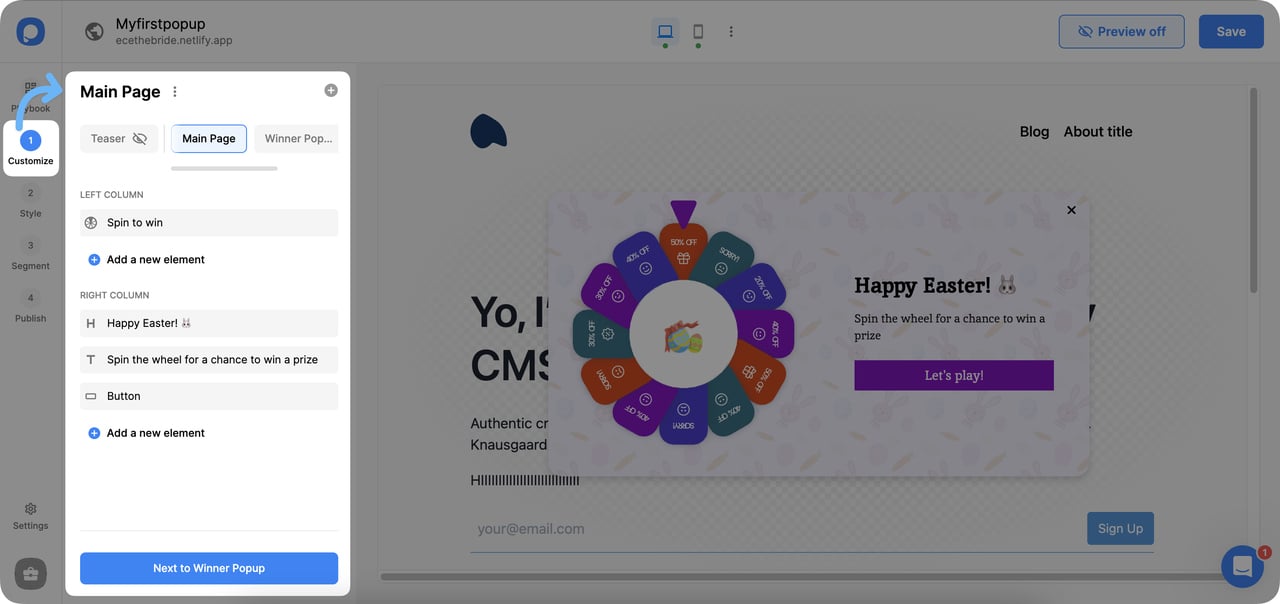
Step 5: Add and arrange popup elements.
6. Adjust design in the Style step — size, colors, font, spacing.
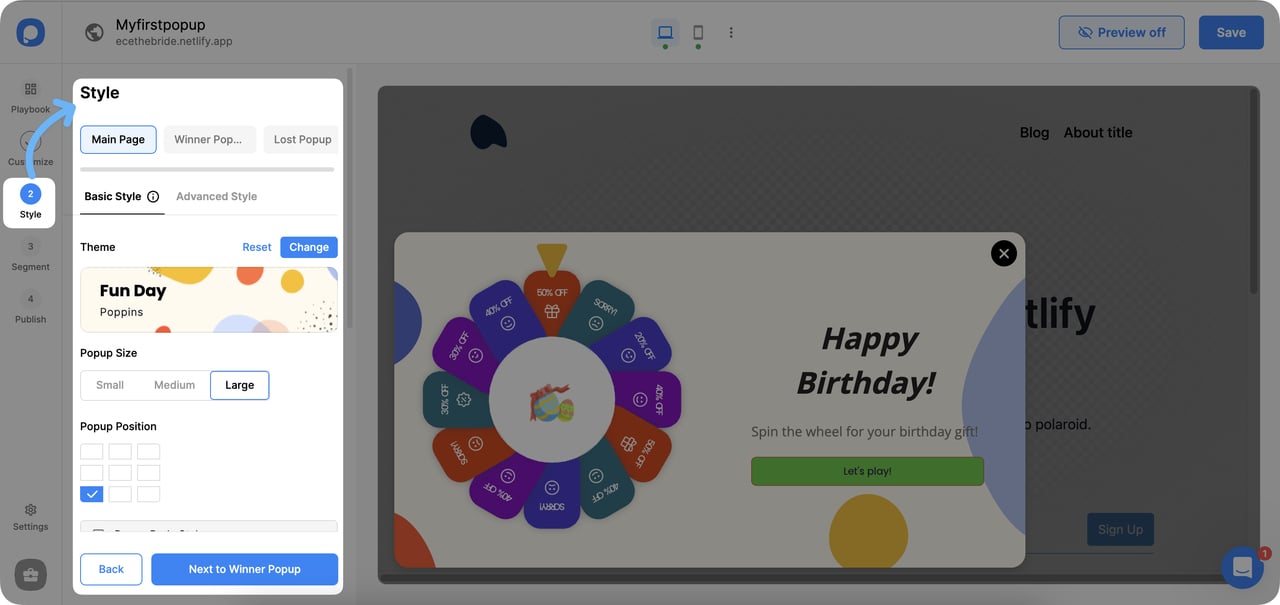
Step 6: Style the popup to match the brand.
7. Open the Segment section from the left sidebar to use a predefined audience segment.
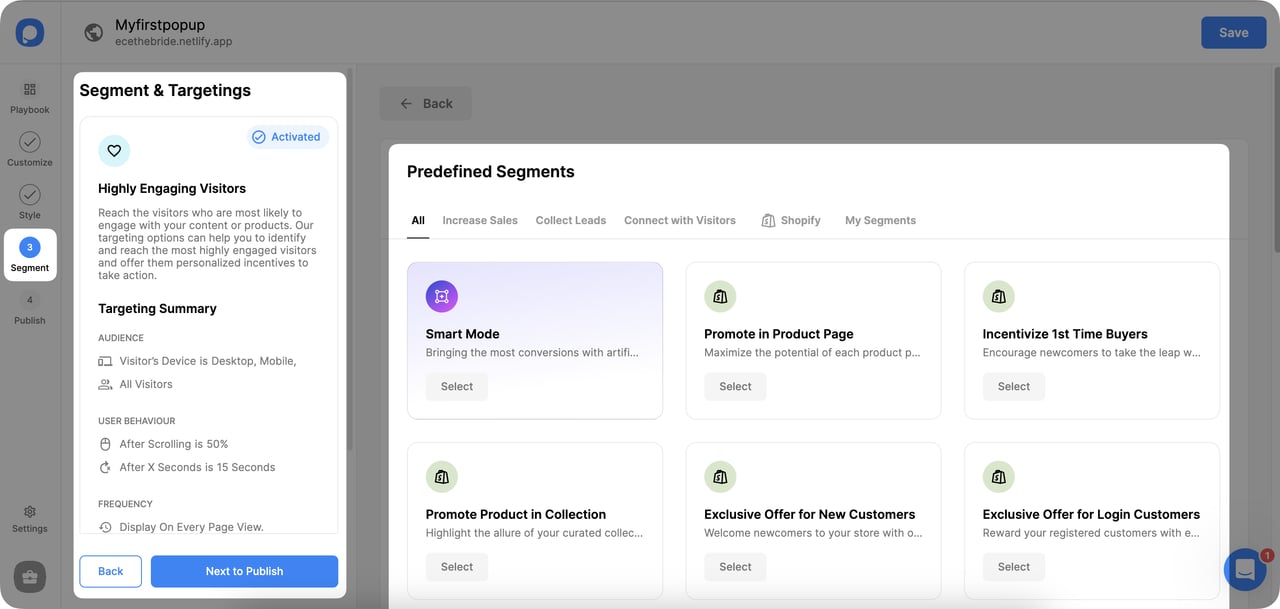
Step 7: Pick a predefined visitor segment.
8. Or build custom segmentation rules from scratch — URL targeting, device, traffic source, return-visit logic.
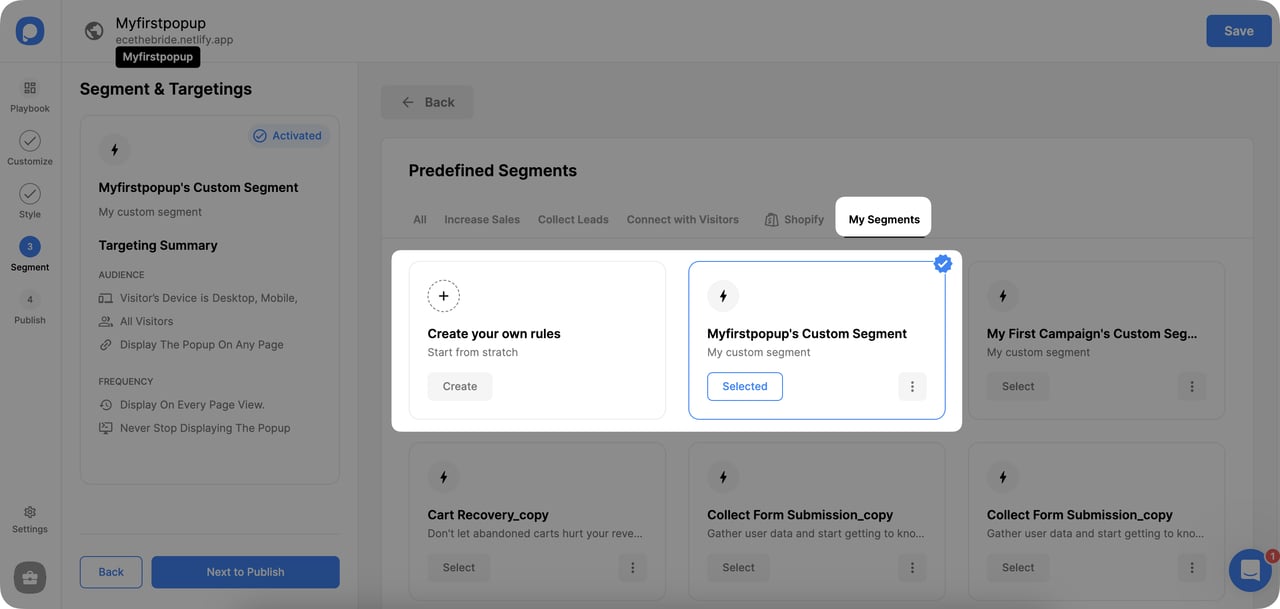
Step 8: Build custom segmentation rules.
9. When the popup looks right, jump to the Target section to set trigger behavior, scheduling, and view frequency.
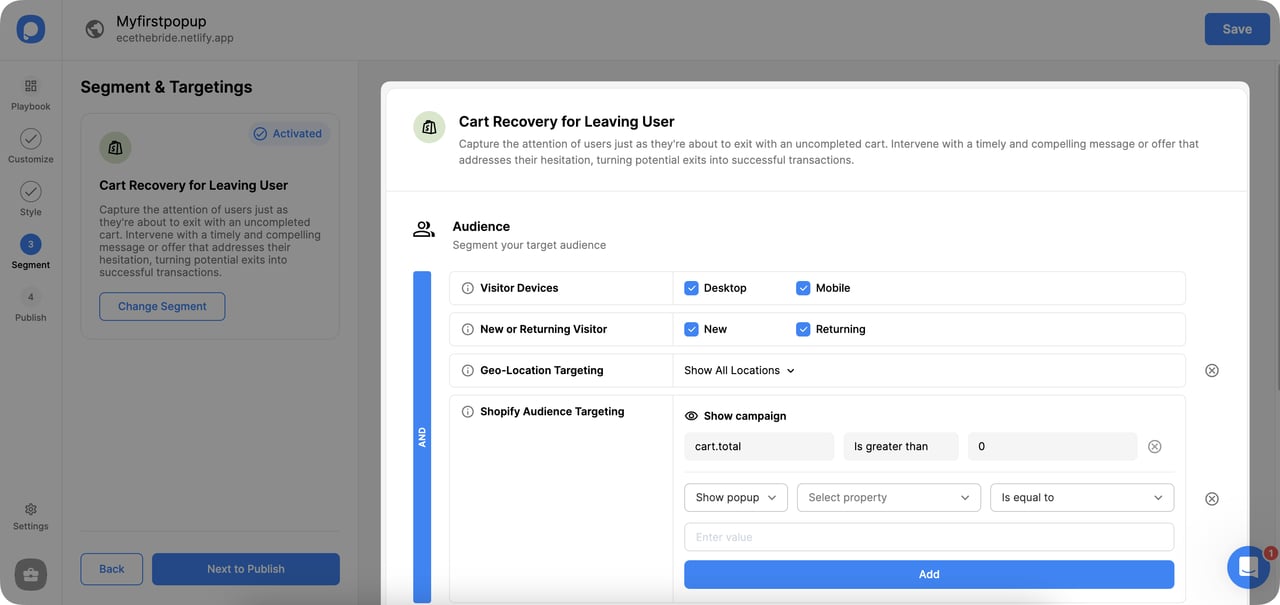
Step 9: Configure triggers, schedule, and frequency.
Choose the trigger behavior (entry, exit, scroll, click, time delay), set the schedule, and tune the view frequency so visitors don't see the same popup ten times in a session. Then click "Next to Publish."
10. Click Publish and the popup is live.
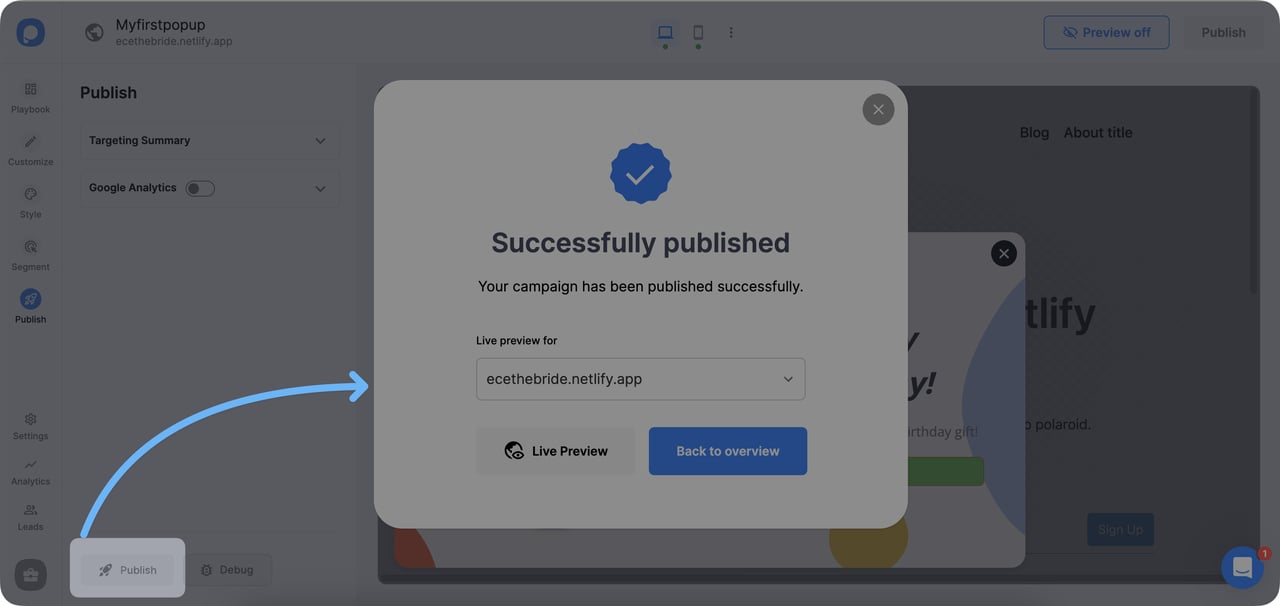
Step 10: Publish the campaign.
A note on verification: every domain on your account needs to be verified before popups will display. Verification works when the Popupsmart installation code is embedded correctly on the site — for most platforms (Shopify, WordPress, Webflow), this is a one-line snippet in the theme header.
If you'd rather hand the build to an AI agent, Popupsmart also has an MCP server and CLI: an agent can generate a popup from a template, set targeting and triggers, connect integrations and publish, on every plan including the free plan.
Useful tips to write conversion-ready popup messages
A short field guide, checked against Popupsmart's 2026 benchmark wherever the data covers the tip:
• Put a CTA word inside the popup body, not just the button. "Save 10% on your first order" inside the body line reinforces the action even before the visitor reads the button.
• Don't count on urgency words. "Limited time," "today only," and "for a while" are the classic FOMO lines, but urgency words showed no measurable effect on conversion in our benchmark (the data can't rule out a modest one). Save urgency for genuinely time-limited offers, where it's simply accurate.
• Write the button in the first person. "Send my code" over "Submit." Of the wording tips on this list, it's the one with a reliable result in our data.
• Skip the button-colour debate. Button colour, dark vs light backgrounds and question headlines showed no measurable effect either. Spend that test on the offer or the button words.
• Use emoji for voice, not for leads. Emoji came with a slightly higher click rate, but that click gap isn't statistically reliable and leads showed no measurable difference.
• Skip spammy phrasing. Don't beg ("Please subscribe!"), don't hard-sell ("You can't afford to miss this!"). Simple, clear language consistently outperforms hype.
• Use power words that earn their place. "Simple," "affordable," "free to try," "sustainable," "approved," "cancel anytime," "bestselling," "no questions asked." One per popup is enough — stacking them makes the popup feel like a late-night infomercial.
• Add personality, but don't overcook it. A small dose of humor or warmth works — visible effort to be funny doesn't. If you're not sure, default to clear over clever.
• Match the message to the moment. A welcome popup for a first-time visitor reads differently from a cart-abandonment popup. Don't reuse the same copy across triggers.
Ship your first conversion-ready popup this week
Popup messages are one of the highest-ROI writing exercises a marketing team can do. Across the 10 examples above, the writing patterns that show up most are voice consistency, one-offer simplicity, sentence-completing CTAs, and a friendly close path. None of those require a redesign — they're rewrites you can ship today.
If you're starting from scratch, pick the brand from this list that most resembles your voice (Frank Body for playful, Tsuno for mission-led, MeUndies for stripped-down, Co-Schedule for SaaS) and copy the structure, not the words. Then test it against your current popup, one change at a time, and judge the result by leads per display.
The hardest part isn't the copy — it's the discipline of writing it like a human and not like a marketer.
Frequently asked questions about popup messages
What does pop up message mean?
A pop-up message is a short piece of text that appears in a small window on top of whatever you're viewing. On a website, it's usually a marketing popup: a headline, a line of copy and a button asking you to subscribe, claim an offer or book a demo. On a phone or computer, the term also covers system and app notifications, and in a browser it can mean a JavaScript alert dialog that waits for you to click OK.
What is an example of a pop-up message?
A typical website example reads: headline "Get 10% off your first order," body "Join the list and we'll email your code," button "Send my code." Real examples in this guide include MeUndies ("How's About 15% Off?" with a "Sign Me Up!" button), Revolve ("Get 10% off" with a "Get My Coupon" button and a "No thanks, just let me shop" opt-out) and Pitviper's retro dialog ("We really shouldn't be doing this...").
What makes an effective popup message?
An effective popup message has three traits: it names a single, specific benefit in the headline ("10% off your first order," not "subscribe"); it uses the brand's voice consistently across headline, body, and button; and it asks for one piece of information (usually email) instead of three. The most common failure mode is generic copy paired with a long form: in Popupsmart's 2026 benchmark, three-field popups convert measurably worse than one- or two-field popups, while first-person button wording converts measurably better than neutral wording.
How do I create HTML popup messages?
You have two paths. The developer path is to write a modal in HTML and CSS, then trigger it with JavaScript — usually a display: none div that flips to display: block on a timer, exit intent, or button click. The faster path is to use a no-code popup builder that handles the targeting, A/B testing, and analytics for you. For most marketing teams, the no-code path saves the build and upkeep time and gives you reporting the hand-coded version doesn't include. Our walkthrough above covers the Popupsmart path; for technical implementation details, W3Schools' modal box tutorial covers vanilla JS modal patterns.
Where are pop-ups located in settings?
This question usually comes from people trying to turn off browser-level popup blockers, not site popups. On Chrome: Settings → Privacy and security → Site Settings → Pop-ups and redirects. On Safari: Safari → Settings → Websites → Pop-up Windows. On Firefox: Settings → Privacy & Security → Permissions → Block pop-up windows. For mobile, the path is similar: browser app settings → site permissions → pop-ups.
How do I turn off popup messages on my phone?
Two layers to disable. App-level notifications: Settings → Apps → [App name] → Notifications → toggle off. Browser-level pop-ups: Chrome on Android (Settings → Site settings → Pop-ups and redirects) or Safari on iOS (Settings → Safari → Block Pop-ups). If a popup keeps appearing on a specific site, that's usually a site-level popup (not a browser one) and clearing the site's cookies will reset the popup frequency.
What's the difference between a popup and a sticky bar?
A popup is an overlay that interrupts the page — the visitor has to acknowledge it (close it or interact with it) to continue. A sticky bar is a non-interrupting strip at the top or bottom of the page that stays visible while the visitor scrolls. A sticky bar trades some visibility for not disrupting the page. Our benchmark doesn't break out sticky bars, but it shows the same trade-off one step over: center modal popups convert 0.88% of their displays vs 0.49% for corner and slide-in boxes (median campaign). Many sites use both — sticky bars for ongoing offers, popups for time-sensitive captures.
How often should a popup show to the same visitor?
A common starting point is once per session, with a cooldown of 7-14 days before showing the same popup again to the same visitor. Showing the same popup on every page view caps your conversion rate fast — visitors who saw it once and didn't convert aren't more likely to convert on the fifth view. Frequency capping is a setting in any modern popup builder; if your current tool doesn't have it, that's a sign to switch.
How long should a popup message be?
Short enough to take in at a glance. A workable rule is a headline that fits on one line of a 375px phone screen, one supporting sentence, a button label of a few words and a one-line close link. MeUndies shows how far you can cut: one offer line, one email field and a "Sign Me Up!" button.
Articles you might like: