Countdown Timer Popups: How to Create One in 2026 (+5 Examples)
A countdown timer popup is a website popup with a live clock that ends at a real deadline, such as a sale's end or a code's expiry. Build one in Popupsmart in five steps: create a campaign, add the countdown element, set its duration and style, add an optional form, then schedule and publish. Black Friday 2026 is 27 November.
AI summarygeneral summary
Countdown timer popups show a ticking deadline next to a real offer. The guide builds one in Popupsmart in five steps, shows five campaign formats, plans the timers for Black Friday (27 November) and Cyber Monday (30 November) 2026, and uses Popupsmart's 2026 benchmark on offers, targeting and frequency.
A countdown timer popup is a small overlay that appears on your website with a clock counting down to a deadline: the end of a sale, a product drop, the close of a registration window, or the moment a discount code expires. The clock is the whole point. Without the ticking numbers, you have a regular promo popup. With them, you have a deadline a visitor can see, and that changes behavior.
This guide is about that marketing popup on your own site, not a floating stopwatch app or a browser extension that pops a timer over your screen. If you searched for one of those, the Chrome Web Store and your phone's clock app are the places to look.
The pattern behind the marketing version is simple: a static "Sale ends Friday" line is easy to ignore. The same offer with a live timer ticking down pulls clicks. People do not want to do the math themselves. The timer does it for them.
Three things make a countdown popup different from a normal popup. First, the timer must be tied to a real deadline. A returning visitor who sees the same "2 hours left" tomorrow loses trust on the spot. Second, the offer behind the timer has to be worth the urgency. A 5% off code with a 24-hour clock feels manipulative. A 25% off code with a 6-hour clock feels like a deal. Third, the popup needs a clear next action (claim the code, add to cart, sign up), not a bare "got it" dismiss button.
This format works for both e-commerce and SaaS. E-commerce uses it for flash sales, Black Friday, and abandoned cart recovery. SaaS uses it for trial extension offers, webinar registration windows, and annual-plan discount cutoffs. The mechanics are identical: the deadline drives the click.
Why countdown timer popups work in 2026
A countdown popup is two things at once: an offer and a deadline. Our own data says the offer carries more weight than the urgency. In our 2026 popup benchmark, signup popups that offer a discount code convert 1.46% vs 0.75% for signup popups without one, and popups stating 10% off convert 1.25% vs 0.67% for popups that state no discount. Urgency words on their own show no measurable effect on conversion; the data are too noisy to rule out modest effects.
Info
By the Numbers: In Popupsmart's 2026 benchmark (28,674 campaigns, January 2024 - September 2026), signup popups that offer a discount code convert 1.46% vs 0.75% for signup popups without one. Urgency words alone show no measurable effect on conversion.
I read that as a rule for this format: the timer is the frame, not the picture. It makes a real deadline visible, so a visitor who already wants the offer acts now instead of "later". It can't rescue an offer nobody wants. Most countdown guides get this part backwards.
So why a countdown, specifically? Three reasons:
• Deadlines beat discounts. A visitor who sees a 20% code with no expiration thinks "I'll come back." A visitor who sees the same code with 03:42:18 ticking down acts now. The timer reframes the decision from "do I want this?" to "do I want this before it disappears?"
• FOMO is measurable, not just emotional. The fear-of-missing-out research is consistent: people overweight imminent loss. A countdown makes the loss visible. You're not telling them to hurry; the clock is.
• Timers travel well across mobile and desktop. A ticking clock reads the same on a 6-inch phone screen as it does on a 27-inch monitor. That matters, because 63% of popup displays happen on mobile in our benchmark.
The catch is that countdown popups punish lazy implementation harder than standard popups. A fake timer (one that resets every visit) gets noticed within a week and your bounce rate jumps. The mistakes section below shows the fix.
How to create a countdown timer popup in 5 steps
This is the build process inside Popupsmart, end to end. Popupsmart says most customers build and publish a campaign in under 5 minutes once signed up; give your first countdown campaign a little longer, because the deadline and targeting need thought. Once you've built one, most of the work is reusable.
What you'll need:
• A Popupsmart account (the free plan works for the first campaign)
• A real deadline tied to a real offer (a discount code, product drop date, or registration cutoff)
• A little time for your first build, and much less for every campaign after
Step 1: Create a new campaign in your Popupsmart dashboard
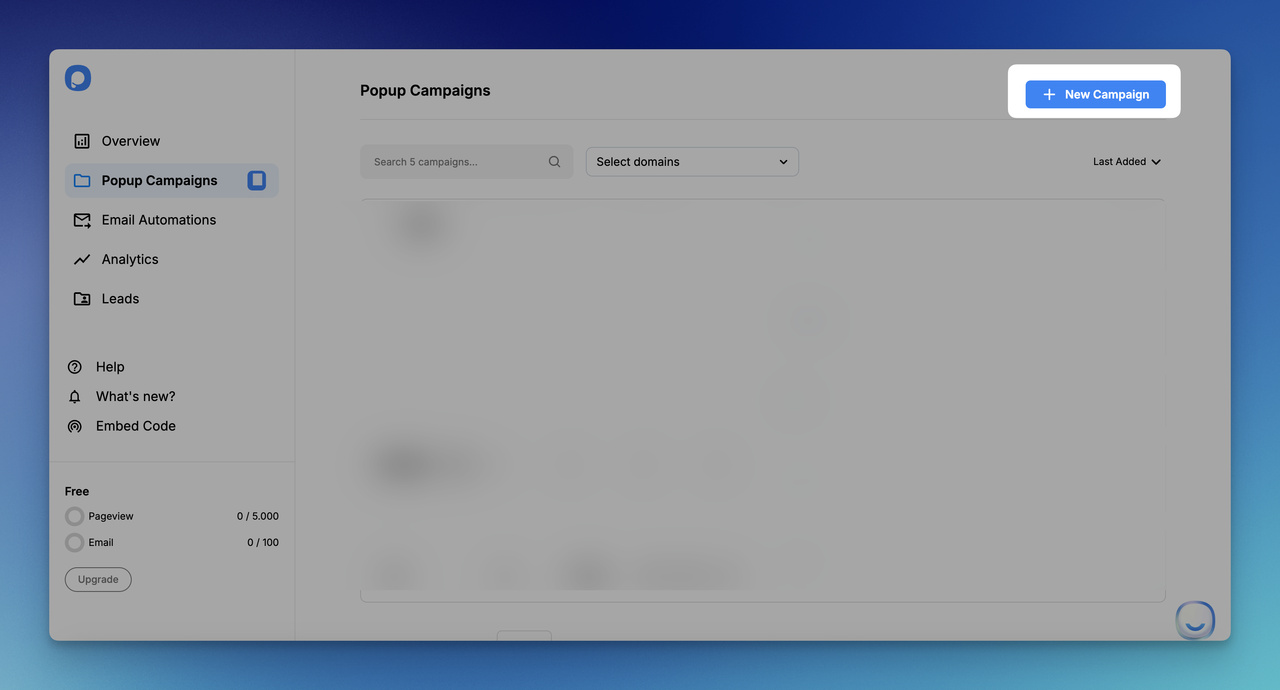
Start by clicking New Campaign from the Popupsmart dashboard.
Log into your Popupsmart account and click the New Campaign button at the top right of the dashboard. If you don't have an account yet, you can sign up for a free Popupsmart account. No credit card required, and the free plan covers your first campaign.
Name the campaign something specific, not "Countdown Test 1." Use a format like BlackFriday-25off-Nov27 or FlashSale-30off-3hour. Three months from now when you're cloning a campaign for a new sale, the name should tell you exactly what the offer was without opening the editor.
Pick the website you want the campaign to run on from the domain dropdown. If this is your first campaign, you'll be prompted to add your domain and install the Popupsmart script. Paste the one-line embed before the closing
tag and you're done. The script loads asynchronously so it does not block your page render.
You'll know it's working when: Your domain appears in the domain dropdown, and you see your new campaign listed on the Popup Campaigns page.
Watch out for:
• Naming campaigns generically: "Test" or "New campaign 3" makes it impossible to find the right one in 6 months. Use offer + discount + duration in the name.
• Forgetting to install the embed: The campaign will save and look fine in preview, but it will not fire on your live site. Always check the connection status before moving on.
Pro tip:If you run multiple stores or multi-region campaigns, use a slug suffix like-USor-EUin the campaign name. A region suffix is the cheapest way to avoid showing US shoppers a EUR-priced offer during a Cyber Monday push.
Step 2: Add the countdown element from the playbook
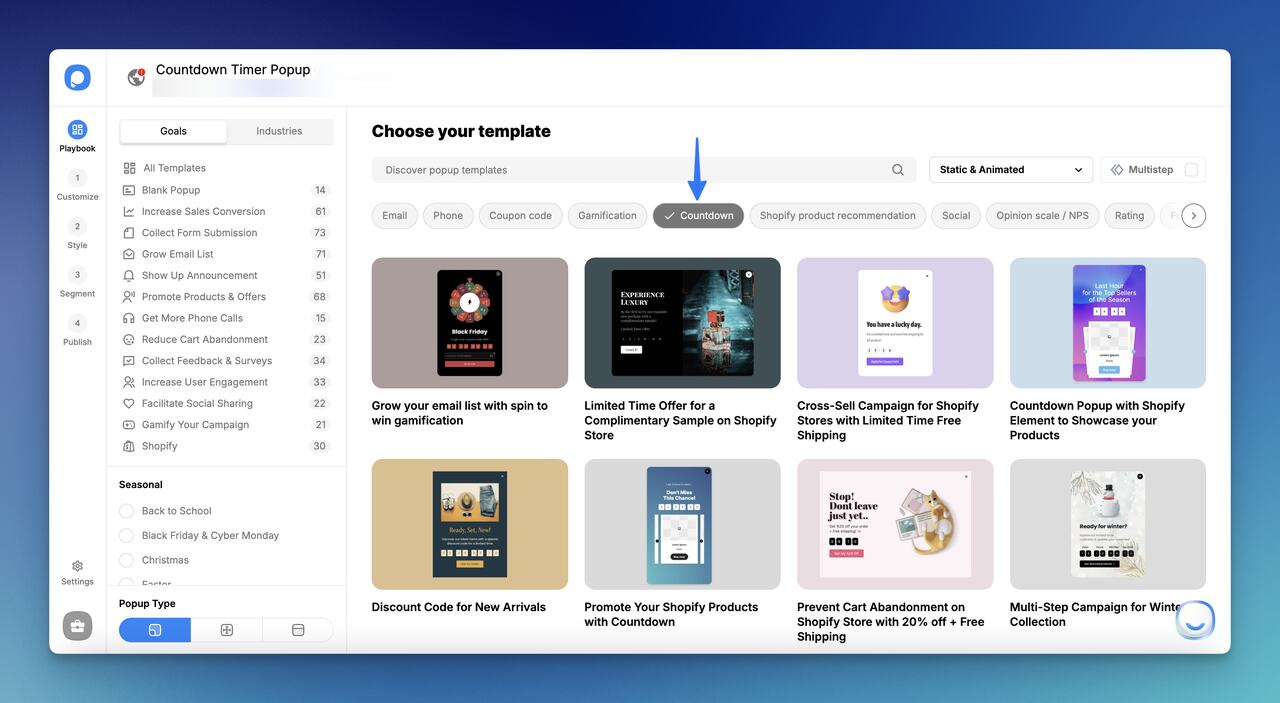
The Countdown filter in the Popupsmart Playbook shows the templates that already carry a timer.
Inside the campaign editor, you'll see two paths. The faster path: pick a pre-built countdown template from the Popupsmart Playbook (filter by Countdown, or open the Black Friday & Cyber Monday seasonal group). The flexible path: start from a blank popup and add the countdown element yourself in the Customize step.
For the blank-canvas path, click Add a new element on the left sidebar, then select Countdown from the element picker. Drag and drop the countdown block into the position you want, typically center-top of the popup, so it's the first thing the eye lands on.
If you're modifying a template, you can keep the existing copy and styling and swap only the countdown's duration and target offer. For recurring campaigns, duplicate last quarter's flash sale campaign from the campaign list, change the dates, change the discount code, and ship it.
You'll know it's working when: A live countdown block appears on your popup canvas with the default time units (days, hours, minutes, seconds) showing.
Watch out for:
• Adding the countdown but no clear offer text: A timer floating above an empty popup makes no sense. Always add a headline ("10% off ends in") and a CTA button before previewing.
• Picking a template with copy that doesn't fit your offer: If you grab the Black Friday template for a regular flash sale, change every line. Leftover seasonal copy is the easiest way to look amateurish.
Pro tip:Keep one finished countdown campaign per format (flash sale, cart recovery, product launch) and duplicate it for each new sale. You change the dates, the code and the copy; the design and targeting you've already checked stay as they are.
Step 3: Configure the timer (duration, units, and design)
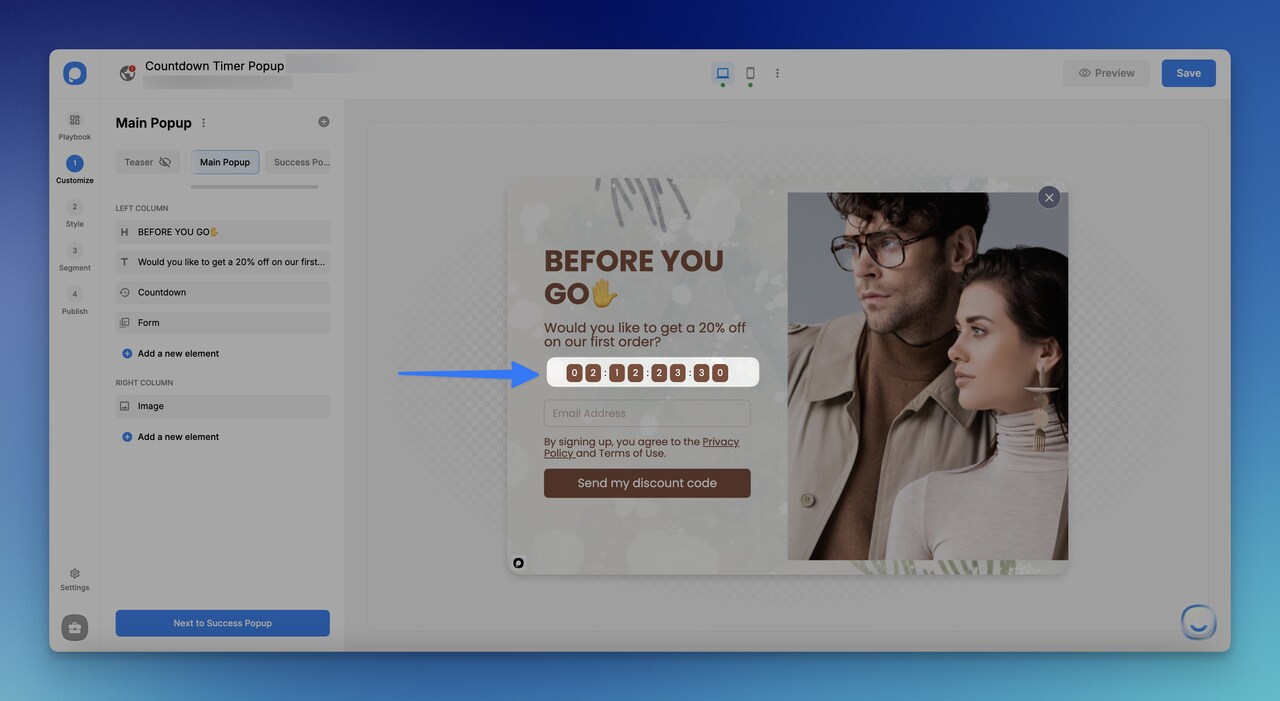
Click the countdown element to open its settings in the left panel.
Click on the countdown element to open its settings. You'll see five settings that matter:
1. Duration: Set the days, hours, minutes and seconds the timer counts down. The countdown element takes a duration, not a calendar date, so the calendar deadline comes from the campaign schedule you set in Step 5. For flash sales, 6-12 hours is long enough to catch a daily wave of traffic and short enough to feel urgent. Avoid timers longer than 24 hours; we'll cover why in the mistakes section.
2. Time units: Choose which units to show. For a sale ending in 36 hours, show days/hours/minutes/seconds. For a 4-hour flash sale, hide the days unit. Showing "00 days" wastes attention. For deadlines under an hour, hide both days and hours; minutes/seconds creates the highest urgency density.
3. Labels: Toggle the small "DAYS / HOURS / MINUTES / SECONDS" labels under the numbers. For a clean, modern look on a small popup, hide them. For a desktop popup with more real estate, leave them on so the timer is unambiguous at a glance.
4. Action: Choose what happens when the timer reaches zero, for example closing the popup. A popup that shows 00:00:00 and stays open tells the visitor the deadline was never real.
5. Style: In the Style step, pick a shape (rounded, square or circle), set the background color, and match the font to your brand. The timer is the focal point, so make it at least 2x larger than your body copy.
You'll know it's working when: The numbers in the canvas tick down in real time as you preview.
Watch out for:
• A timer longer than the time left: If the sale ends at midnight and a visitor arrives at 10 p.m., an 8-hour timer promises time the offer doesn't have. Keep the duration no longer than the shortest time left in the campaign window, and let the schedule close the campaign at the real deadline.
• Tiny timer numbers: If the timer is the same size as your body text, it disappears. The timer should be the largest visual element on the popup, period.
Pro tip:On mobile, a center modal can cover the product photo. Popupsmart also has floating bar templates that keep the product visible while the timer stays on screen. Don't assume the smaller format wins, though: in our 2026 benchmark, center modal popups convert 0.88% vs 0.49% for corner/slide-in boxes (median campaign). Test the two against each other on your mobile traffic.
Step 4: Add an optional email capture form
Pair the countdown with a short form to combine urgency with lead capture.
Many countdown campaigns combine the timer with a lead capture form. The pattern: "Sale ends in 03:42:18. Drop your email to get the code." This works because the timer pre-qualifies the visitor before you ask for anything.
To add the form, click Add a new element and select Form. Drag the form below the countdown. Configure one field (email) and set the submit button copy to match the offer ("Send my code", "Reserve my spot", "Lock in my discount").
Connect the form to your email tool from the Integrations section of the Publish step. Popupsmart integrates with major email and CRM platforms. Pick yours from the list, connect your account, and choose the list or tag the new emails should land in.
If you don't need lead capture and want the timer to push direct purchases, skip this step entirely. A countdown popup with a single CTA button (no form) and a coupon code element visitors can copy on click also converts well. Fewer fields means faster action.
You'll know it's working when: A test submit on the preview shows up in your connected email tool within a few seconds.
Watch out for:
• Asking for too many fields: Email only, or email plus one. In our benchmark, popups asking for one or two fields convert 0.88% and 0.94%, against 0.56% for three fields (median campaign; spin-to-win and other gamified popups are counted separately). You can collect the rest later in the welcome flow.
• Generic submit button copy: "Submit" and "Sign up" leave money on the table. First-person buttons ("Send my code") convert 1.18% vs 0.80% for neutral wording (English popups, median campaign).
Pro tip:Use the form's success message to immediately reinforce the deadline. Instead of "Thanks for subscribing!", set the success message to "Code: SAVE10. Use it at checkout before the sale ends." That keeps the urgency alive after submission.
Step 5: Set targeting and publish the campaign
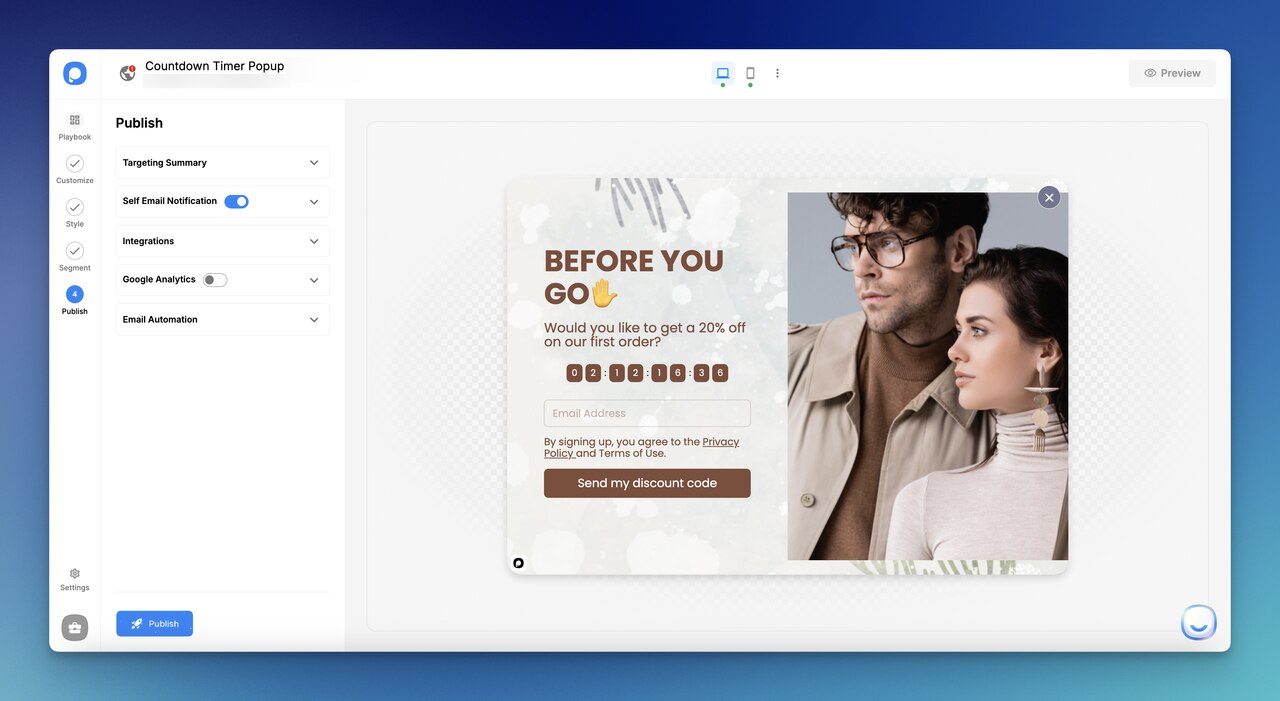
The Publish step shows the targeting summary and pushes the campaign live.
Before you publish, open the Segment step. This is where you decide who sees the popup and when. The defaults are sensible, but the tweaks make a big difference:
Schedule: Under audience targeting, add Schedule Date and Time and set the campaign to end at the real deadline, in the time zone your buyers shop in. This is what makes the countdown honest: the timer frames the offer, and the schedule takes the popup down when the offer ends.
Page targeting: Show the popup only on pages that match the offer. A countdown popup pushing a sitewide sale belongs on the homepage and category pages. A cart abandonment countdown belongs on the cart page only, never the homepage. Page choice matters: in our benchmark, popups on cart and checkout pages convert 4.57% vs 1.07% on the home page (median campaign).
Trigger: Time-on-page (5-15 seconds) for sitewide promos works well. Exit-intent for cart abandonment. Scroll depth (50% reached) for blog content offers. Popups that wait before appearing convert 0.83% vs 0.61% for popups shown the instant the page loads (median campaign), but the difference is not statistically reliable, so treat it as a lean, not a rule. The exact delay length makes no measurable difference, and exit intent shows no statistically reliable advantage either (1.10% vs 0.78%, a gap that could be chance). More on that in our exit-intent analysis.
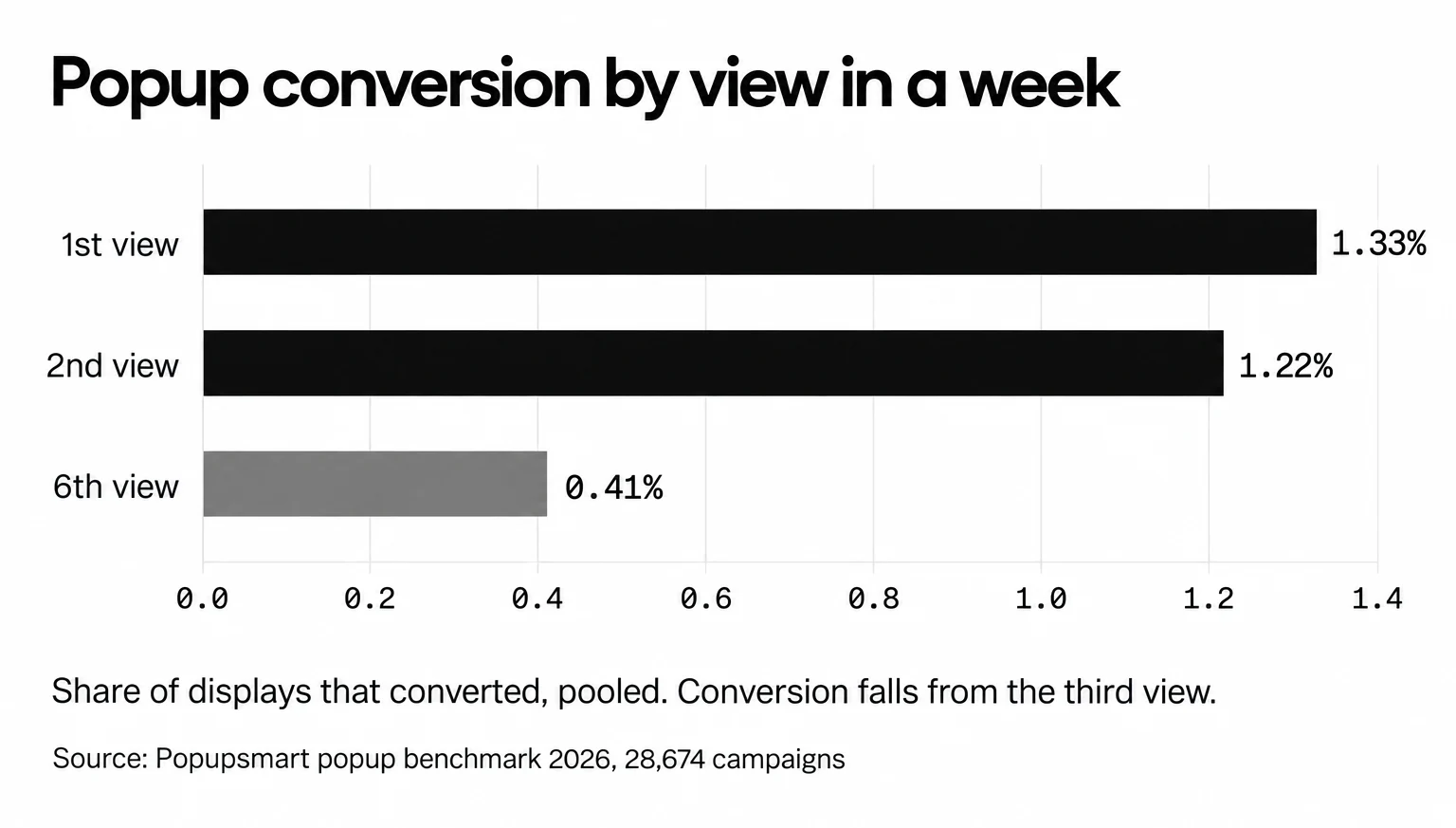
Frequency: Show once per session, max twice per visitor. A returning visitor who sees the same countdown three days in a row is a churned customer, not an active one. In our benchmark, the first two times a visitor sees a popup in a week convert at similar rates (1.33% and 1.22% of displays, pooled); from the third view conversion falls, and from the sixth view it is 0.41%.
Share of popup displays that converted, pooled; conversion falls from the third view. Source: Popupsmart popup benchmark 2026, January 2024 - September 2026.
Audience: Filter out logged-in customers, completed purchasers (last 30 days), and traffic sources where the offer doesn't apply (e.g., paid traffic landing on a dedicated promo page that already shows the offer). Popups targeted at new visitors only convert 1.13% vs 0.77% for popups shown to everyone.
Hit Save, then Publish. The campaign goes live within seconds. Open your website in an incognito window and trigger the popup to confirm it fires correctly on your live site.
You'll know it's working when: The popup appears in your incognito test, and within an hour you see impressions ticking up in the Popupsmart analytics dashboard.
Watch out for:
• Forgetting to filter logged-in users: Showing a "first-time buyer 25% off" popup to a customer who's bought from you four times burns trust. Always exclude logged-in users from acquisition-style campaigns.
• Publishing without testing the live site: The preview can pass and the live popup can still misfire because of theme conflicts. Always check incognito on the actual domain.
Pro tip:Set the schedule's end to the exact moment the offer ends. Popupsmart then stops showing the popup on its own. No manual cleanup, no expired countdown sitting on your site Sunday morning after a sale that ended on Friday.
Warning
Red Flag: A countdown with no schedule behind it keeps running after the sale is over. Every visitor who clicks "Get my code" on Saturday for a sale that ended on Friday is a support ticket and a broken promise.
5 countdown timer popup examples that convert
These five countdown popup formats come from the Popupsmart template library, and they've worked across e-commerce and SaaS. Each one fits a different job. Copy the structure, swap your offer in, ship it.
1. Black Friday countdown popup
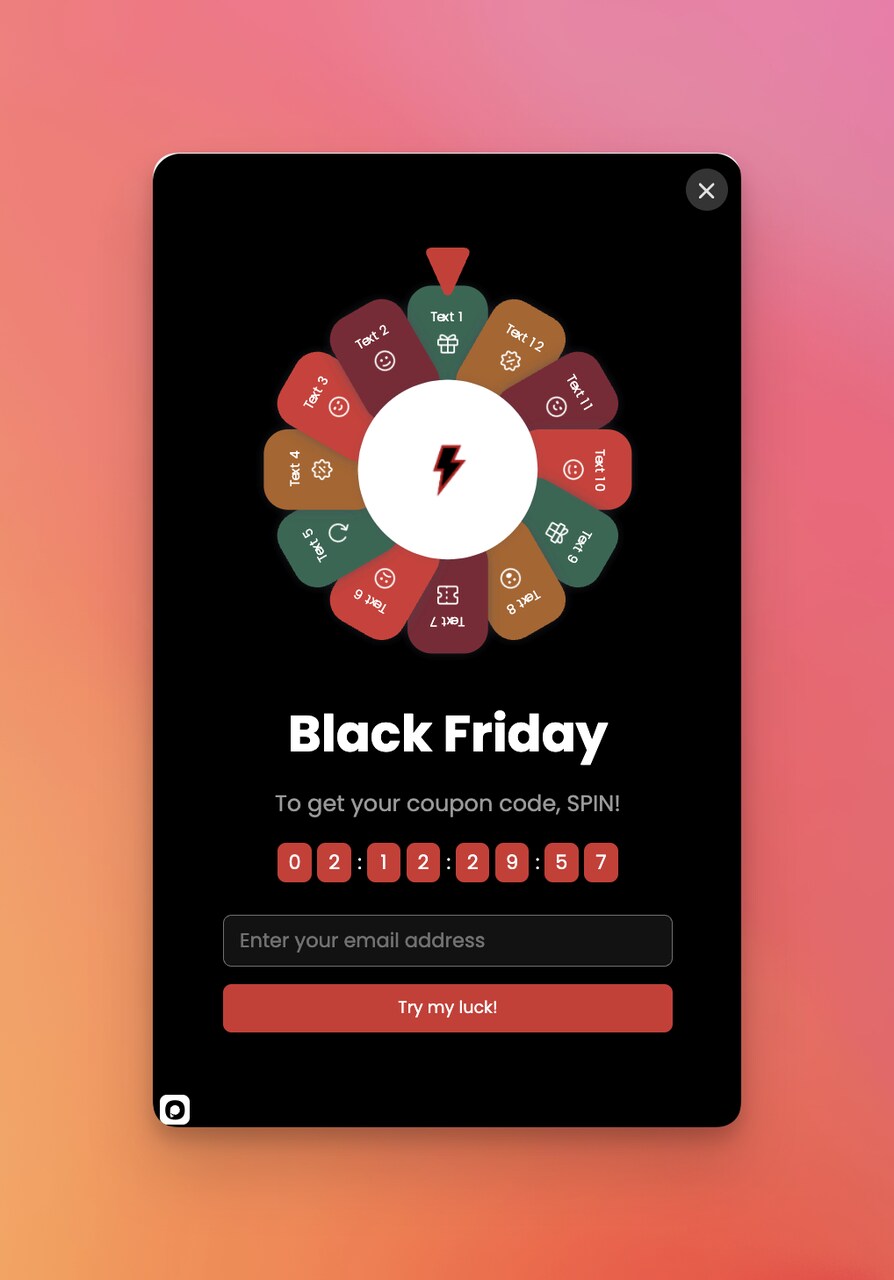
Bold type, dark background, single CTA: Black Friday popups should look like the deal feels.
The Black Friday format leans on visual loudness: black or deep red backgrounds, oversized typography, and a single CTA. The timer should count down in days/hours/minutes for the lead-up week, then switch to hours/minutes/seconds in the final 24 hours. Use this on the homepage, category pages, and product pages. Keep the offer dead simple: a sitewide percentage discount or a flat dollar threshold ("free shipping over $50"). For the lead-up phase, swap the CTA from "Shop now" to "Get early access" and pair it with email capture so you build a list to email when the sale opens. The full 2026 schedule is in the Black Friday section below.
The template above pairs the timer with a spin-to-win wheel. Know what that buys you: gamified popups get far more clicks (7.33% vs 1.87% of displays, median campaign; the spin itself counts as a click), but do not collect measurably more email or phone leads than plain signup popups.
2. Product launch countdown popup
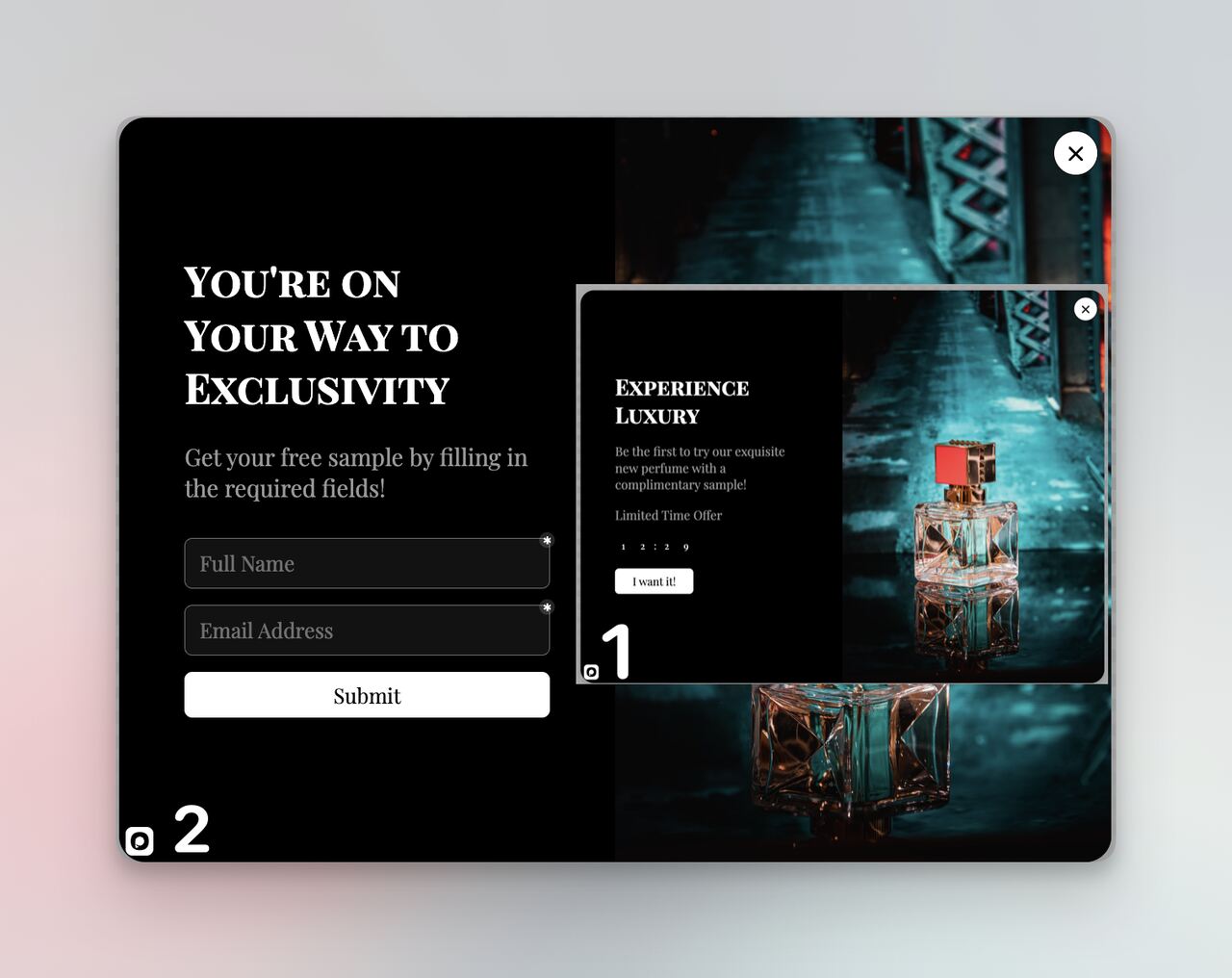
Build anticipation with a clean countdown to the drop time and an early-access email signup.
Product launch popups have a different goal: build a launch-day audience, not push immediate purchases. The countdown anchors to the drop time. The CTA is "Notify me" or "Get early access", paired with a one-field email form. Apple does this with teaser pages weeks in advance, and the same psychology works at any scale. Show this popup on your homepage and on the category page where the product will live. Skip targeting on cart and checkout pages. After the launch fires, swap the campaign to a follow-up "now live: shop the drop" popup automatically.
3. Flash sale countdown popup
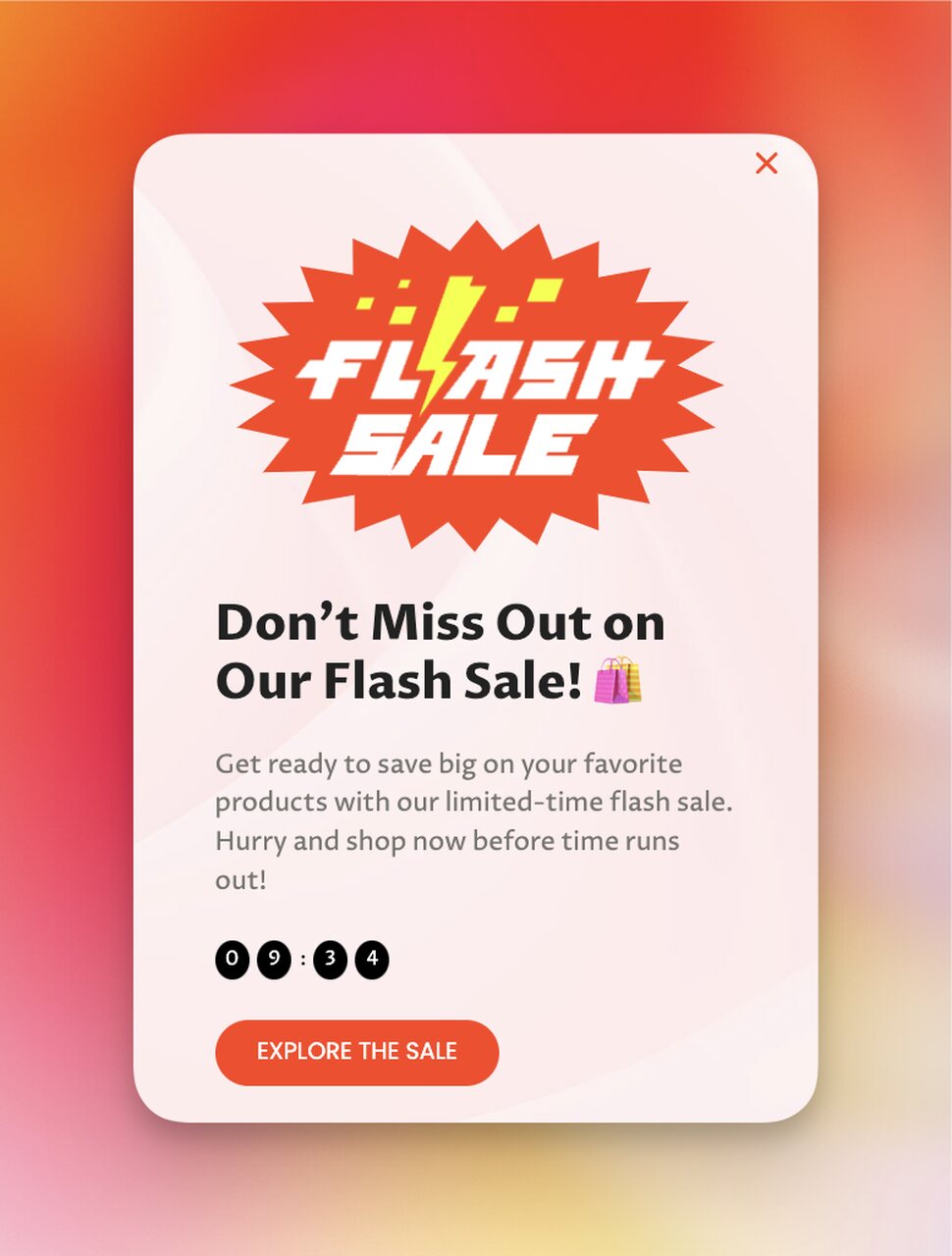
Short windows (4-12 hours) and a discount code create the tightest urgency loop.
Flash sale popups use the shortest timer windows (typically 4 to 12 hours) and a percentage discount code. Hide the days unit; show only hours/minutes/seconds. Add a coupon code element so the visitor can copy the discount and paste it at checkout without leaving the page. For timing, our benchmark shows popups convert better in the morning (06:00-11:59 visitor time) than at night or in the evening: the same popup converts better in the morning than between midnight and 6 a.m. in 69% of campaigns, while weekend visitors show no measurable difference from weekday visitors once each popup is compared with itself (2,333 campaigns). A flash sale pairs a short deadline with a discount, so both kinds of scarcity are in play. See our guide to limited-time offers for offer formats that suit a short timer.
4. Cart abandonment countdown popup
An exit-intent timer reminds shoppers their cart contents won't be reserved forever.
Cart abandonment popups trigger on exit-intent from the cart or checkout page. The timer shows how long the cart contents are reserved, typically 15 minutes to 1 hour. The offer is usually a small discount (5-10%) or free shipping if the cart is below your free-ship threshold. Critical: only show this to visitors with items in their cart. Showing a generic abandonment popup to everyone is an annoying interruption. The visitor has already shown purchase intent; the timer removes their excuse to delay. This format sits on the page type that converts best in our data: cart and checkout pages, at 4.57% vs 1.07% on the home page (median campaign). For more layouts, see our cart abandonment popup examples.
5. Last 2 hours / final call countdown popup
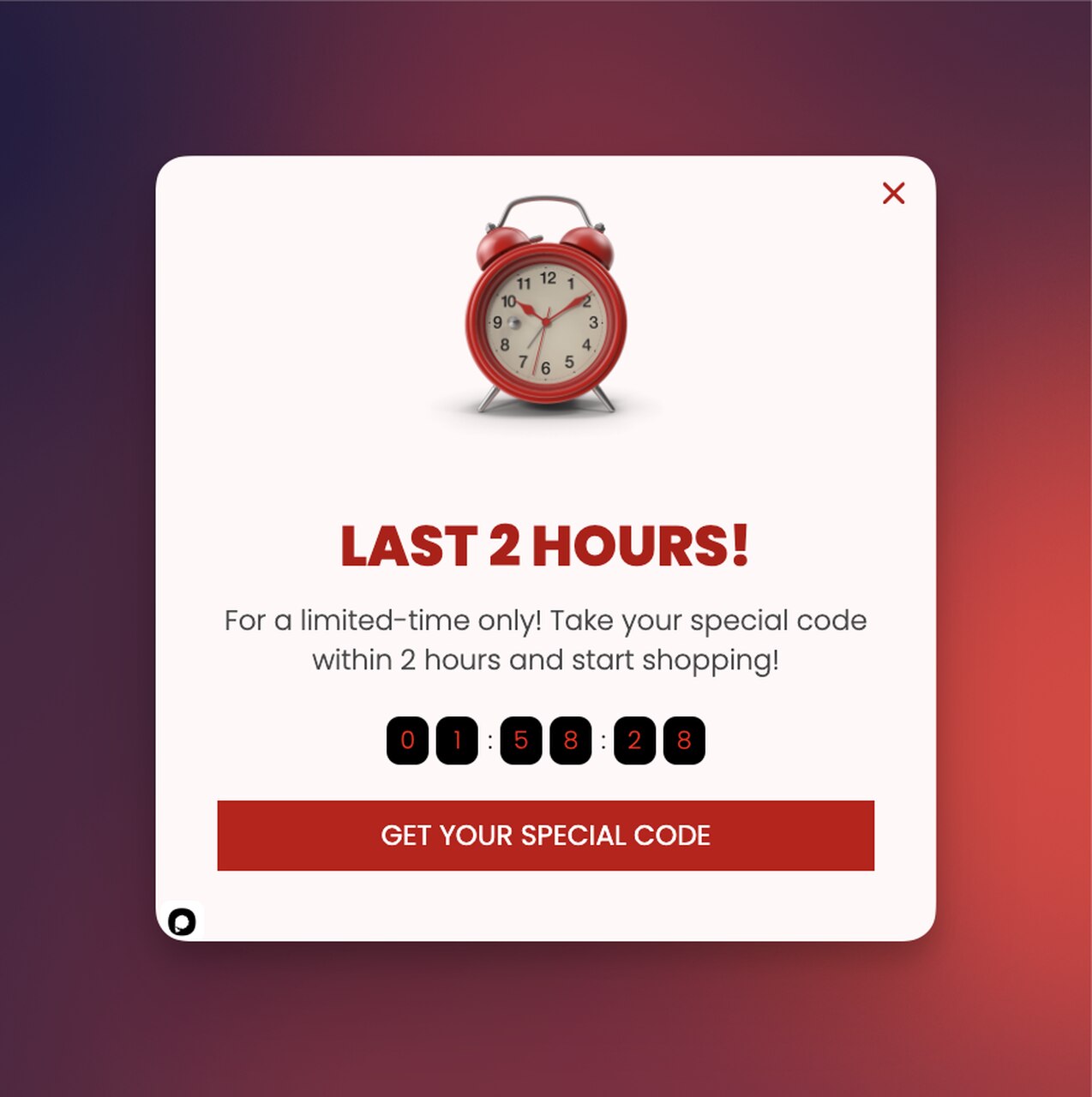
The closing-window popup catches the last wave of buyers in the final hours of any sale.
This is the cleanup campaign. It fires only in the final 2-4 hours of a longer promotion. Hide days and hours; show only minutes/seconds for maximum urgency density. The headline is explicit: "Last 2 hours" or "Final call." The CTA is the same code or offer the original campaign was running, but the messaging shifts from "save 25%" to "don't miss out." Set this as a separate campaign, scheduled to start 4 hours before the main sale ends and to end with it.
Countdown popups for Black Friday and Cyber Monday 2026
Black Friday 2026 is Friday, 27 November, and Cyber Monday is Monday, 30 November. That weekend is the one time of year when nearly every store runs a real deadline, so it's where countdown popups earn their keep. It's also where fake ones get noticed fastest, because shoppers see dozens of timers in a day.
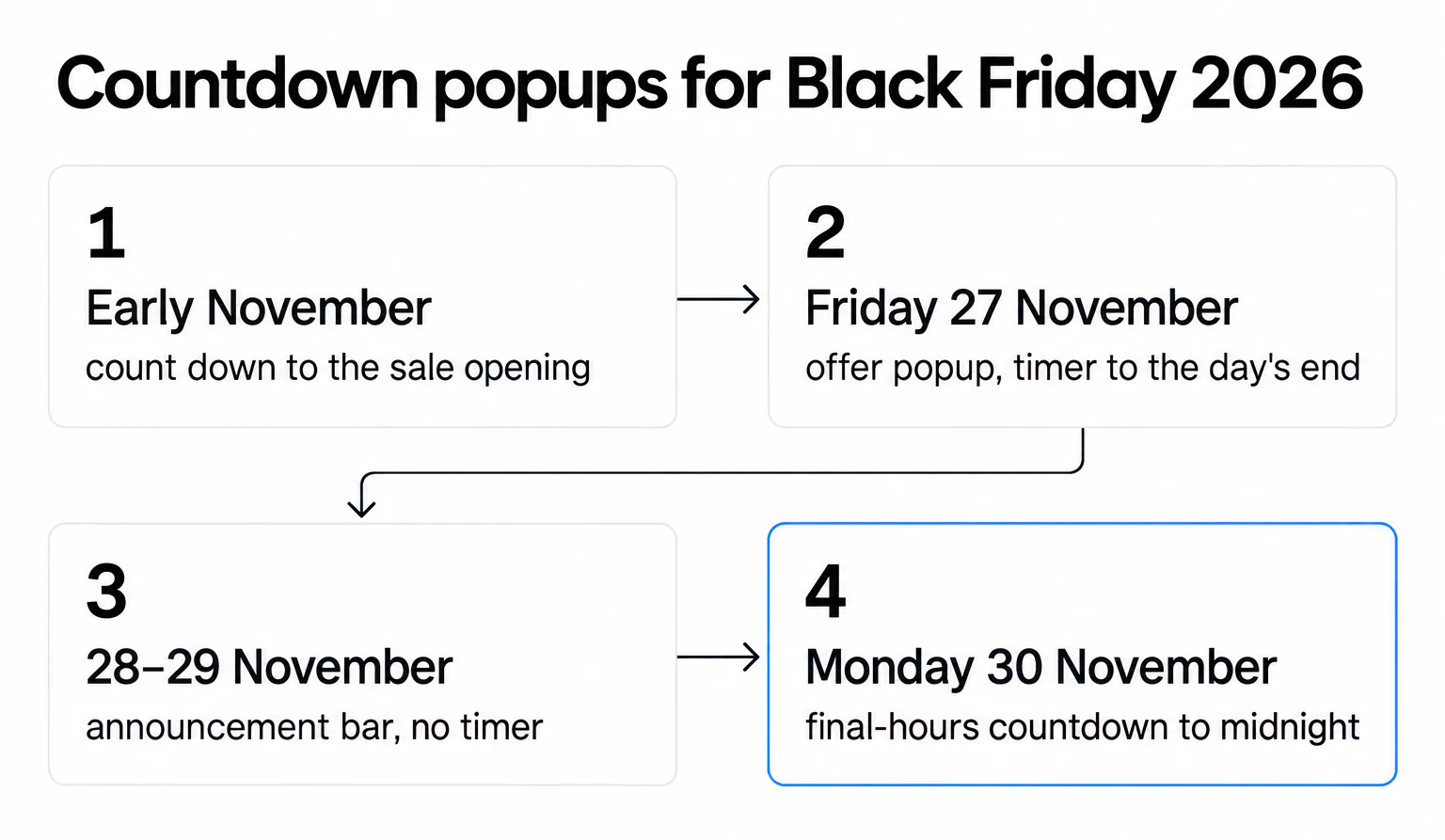
A suggested order for Black Friday 2026 countdown popups, each timer ending at a real deadline.
Plan four moments, each with its own campaign and its own schedule:
Early November: an early-access popup that counts down to the moment the sale opens. The deadline is real (the sale starts then) and the CTA is an email signup, so you have a list to email on the morning of 27 November.
Friday 27 November: the offer popup, with a timer to the end of the day's offer. State the discount in the headline; popups stating 10% off convert 1.25% vs 0.67% for popups that state no discount.
28 and 29 November: switch to an announcement bar with no timer. A weekend of ticking clocks wears thin, and a bar keeps the offer visible without interrupting.
Monday 30 November: a final-hours countdown to midnight, the "last call" format from example 5.
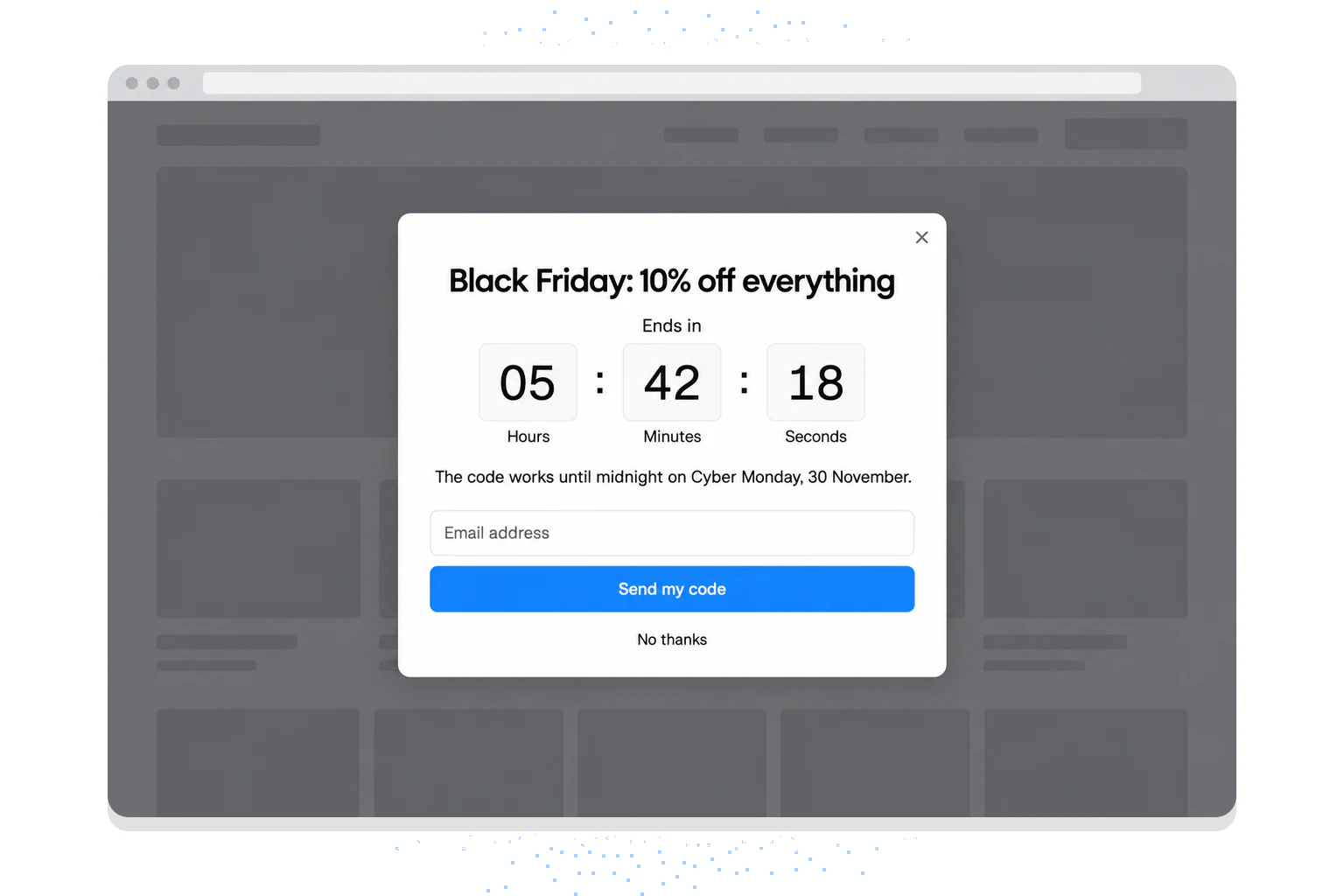
Here is what the Black Friday offer popup can look like:
Example design: a Black Friday countdown popup for a fictional store, with a stated discount and a first-person button.
Info
Pro Tip: Set each campaign's schedule before the rush, not during it. Four campaigns with four end dates is easy to build in October and easy to get wrong at 11 p.m. on Black Friday.
For the rest of the season's popups (cart recovery, upsells, welcome offers), see our Black Friday popup use cases. For choosing the discount itself, our guide to discount popups covers what the 2026 data says about offer size.
Best practices for countdown timer popups
Building the popup is the easy part. Making it convert without burning trust is where most teams trip. Here are the rules that hold up across SaaS and e-commerce clients.
Careful
Common Mistake: Running a countdown popup longer than 24 hours. Returning visitors notice when the timer starts over, and the urgency dies. Real urgency expires.
Match the timer length to the decision the buyer is making. A $20 impulse purchase can handle a 4-hour timer. A $400 considered purchase needs at least 24-48 hours so the buyer has time to compare and come back. Mismatching this is a common reason countdown campaigns flop: short timers on expensive products feel manipulative, and long timers on cheap products feel pointless.
Keep the offer behind the timer worth the urgency. A 5% discount with a 6-hour timer is insulting. A 25% discount with a 6-hour timer feels like a real deal. Calibrate the discount to the urgency. The steeper the deadline, the steeper the offer needs to be. Steeper isn't automatically better, though. In our benchmark, bigger discounts did not convert measurably better: 10% off converted 1.25%, 20% off 0.91% and 25-30% off 1.33%, but the larger-discount samples are small (78 and 46 campaigns), so the data cannot rule out a real difference either way. If you can't justify a meaningful discount, use the timer for non-discount offers instead: free shipping cutoff, bonus item with purchase, early access to a drop.
Write copy that names the deadline, not the timer. "Sale ends in 03:42:18" is fine. "Time is running out" with the same timer underneath is weaker. The headline should describe what happens at zero, not just say "hurry." A returning visitor reads the headline first, the timer second, so the headline has to do the persuading.
Design for the timer first, everything else second. The numbers should be the largest visual element on the popup. If your headline is competing for attention with the timer, shrink the headline. The timer is what sets this format apart. The rest is supporting copy. On mobile, this matters even more: a small timer on a small popup gets ignored.
Test the timer length before the timer copy. Timer duration is the variable most specific to this format, so test it first. Run a 6-hour version vs a 24-hour version on the same offer, compare leads or orders per display, then move to copy and design.
Match popup placement to device. Center modals on desktop; on mobile, test bottom or top sticky bars against the modal. A center modal on a phone covers the product photo, which is exactly the wrong outcome on a product page. Sticky bars keep the timer visible while the visitor scrolls, which helps on product pages where the buy button is below the fold.
Pair countdown popups with seasonal traffic spikes. Countdown formats compound on holiday and seasonal traffic, because the deadlines are real and shoppers expect them. Black Friday and Cyber Monday are the obvious ones; see the 2026 schedule above.
Tip
Key Takeaway: The timer makes a deadline visible; the offer and the targeting decide the result. In Popupsmart's 2026 benchmark, popups targeted at new visitors only convert 1.13% vs 0.77% for popups shown to everyone.
Common mistakes to avoid while creating countdown timer popups
Four mistakes cause most countdown campaign failures. Avoid them and you're already ahead of a lot of the timers your shoppers see elsewhere.
Mistake 1: Fake or resetting timers. The single fastest way to destroy your brand's credibility is a timer that resets every visit. Returning visitors notice within two sessions. They tell other people. They post about it on Reddit. The fix: tie the campaign to a real, calendar-anchored deadline with Popupsmart's schedule setting, cap how often each visitor sees it, and let it expire when it expires. If you want recurring urgency, run new campaigns with new offers. Never reset the same timer.
Mistake 2: Running the same countdown popup to everyone. A first-time visitor, a 5-time customer, and a cart-abandoner are not the same audience. They should not see the same popup. Segment by visit count, purchase history, and current page intent. New visitors convert on popups more often than visitors who were on the site in the previous 7 days: the same popup converts better for new visitors in 75% of campaigns (median gap 0.30 percentage points). A returning customer who's purchased twice should see a loyalty-tier countdown ("Members-only early access ends in"), not the same first-time buyer discount as everyone else. Failing to segment makes the popup feel like spam.
Mistake 3: Timers longer than 24 hours. A 7-day countdown is not urgent. A 3-day countdown is barely urgent. The psychological impact of a timer drops off past 24 hours. The buyer's internal narrative shifts from "I should act now" to "I have time, I'll come back." If your sale lasts a week, run a soft "sale is live" popup or bar for the first 5 days, then switch to a sharp countdown popup for the final 24 hours. The timer does its actual work in that last day.
Mistake 4: Forgetting mobile entirely. Most popup builders default to desktop-first design. The result is countdown popups that look great on a 27-inch monitor and unreadable on a phone. Test every campaign on a real phone, not just the browser dev tools mobile preview. Adjust font sizes, test a floating bar, and confirm the CTA button is tappable with a thumb. In our benchmark, 63% of popup displays happen on mobile, and mobile visitors convert on popups at 1.02% vs 0.57% on desktop (median campaign). If the popup fails there, the campaign fails.
Ship your first countdown popup this week
The fastest way to know whether countdown popups work for your store is to ship one and read the data. Pick your next promotion (a flash sale, a launch, a cart recovery push, or Black Friday on 27 November) and build the campaign in Popupsmart this week. Use a real deadline, keep the timer under 24 hours, match the offer to the urgency, and segment away from existing customers.
You'll have your first set of data within 48 hours. From there, A/B test timer length first, then headline, then design. The format compounds: every campaign you ship makes the next one faster to build and easier to optimize. Once the first one is live, our roundup of website popup examples and our gallery of popup message ideas have more layouts and copy to borrow for the next campaign.
Are countdown timer popups effective for all types of businesses?
Countdown popups work best for businesses with a clear deadline-driven offer — e-commerce sales, SaaS trial cutoffs, event registrations, course enrollment windows. They work less well for businesses with no natural deadline, like always-on services or evergreen subscriptions. If you can't tie the timer to something real, the format won't help you. The format amplifies whatever urgency was already there — it doesn't manufacture it from nothing, and the offer behind the timer does most of the work.
How do I measure the effectiveness of countdown timer popups?
Track three metrics in your Popupsmart analytics: impressions (how many visitors saw it), conversion rate (clicks or form submissions divided by impressions), and revenue attributed to the campaign (track via UTM tags on the CTA link or a unique discount code per campaign). The conversion rate is the headline number, but revenue per impression is the truer measure: a high conversion rate on a small offer can earn less than a lower rate on a bigger one. Also watch your bounce rate on pages where the popup fires; if it climbs after launch, the popup is too aggressive.
Can countdown timer popups create negative customer experiences?
Yes — if overused, mis-targeted, or backed by fake urgency. The negative experience pattern is consistent: visitor sees the popup, dismisses it, comes back the next day, sees the same "ending soon" timer, realizes it's fake, never trusts the brand again. Avoid this by capping frequency (once per session, max twice per visitor), segmenting away from existing customers, and using only real deadlines. Done well, a countdown popup feels like a helpful nudge ("Hey, this code expires tonight"). Done badly, it feels like a pushy salesperson. The difference is in the targeting, not the format.
How long should a countdown timer popup run?
Under 24 hours for the timer itself, ideally 4-12 hours for flash promotions and 24 hours for sitewide sales. The campaign overall — meaning the popup's active period, not the timer length — should match the underlying promo. A weeklong sale can run a "sale is on" popup for the first 5-6 days, then switch to a sharp countdown popup with a sub-24-hour timer for the final stretch. Past the 24-hour mark on the timer itself, the urgency effect drops off significantly. Anything past 72 hours is just a banner with extra steps.
Do countdown popups work on mobile?
They work on mobile if you design for mobile from the start. In Popupsmart's 2026 benchmark, 63% of popup displays happen on mobile, and mobile visitors convert on popups at 1.02% vs 0.57% on desktop (median campaign). Bump font sizes up so the timer is readable at arm's length and make the CTA button tappable with a thumb. A center modal can cover the product photo on a phone, so test a floating bar against it rather than assuming either one wins.
Can I use a countdown timer popup on Shopify or WordPress?
Yes — Popupsmart works on any website with a one-line embed script, including Shopify, WordPress, Wix, Squarespace, Webflow, and custom builds. For Shopify specifically, see our walkthrough on adding a Shopify countdown timer. The setup process is the same across platforms — paste the embed in your theme, build the campaign in the Popupsmart dashboard, publish — so you can use the same campaign across stores on different platforms without rebuilding.
When are Black Friday and Cyber Monday 2026?
Black Friday 2026 is Friday, 27 November, and Cyber Monday is Monday, 30 November. For countdown popups, that gives four moments: an early-access popup that counts down to the sale opening in early November, an offer popup with a timer to the end of Black Friday, an announcement bar without a timer over the weekend, and a final-hours countdown to midnight on Cyber Monday.
Does a countdown timer make a popup convert better?
The timer makes a real deadline visible; the offer is what converts. In Popupsmart's 2026 benchmark, urgency words show no measurable effect on conversion (the data are too noisy to rule out modest effects), while signup popups that offer a discount code convert 1.46% vs 0.75% for signup popups without one. Put the timer on an offer worth acting on, and end it when the offer ends.
 ChatGPT
 Perplexity
 Claude
 Grok
Grok Google AI Mode