 ChatGPT
 Perplexity
 Claude
 Grok
Grok Google AI Mode
Forms on Shopify stores can be used for a variety of purposes. Whether you want to collect emails or sell your products, forms are essential parts of Shopify stores.
That’s why we gathered Shopify form examples in this blog post. By looking at these top 17 Shopify form examples, you can come up with a form for your store.
These 17 Shopify form examples show how brands like Vital Proteins, Culture Kings, Bombas, and The Sill turn popups, contact pages, and feedback forms into measurable revenue. Each teardown breaks down what works, why it works, and a steal-this-idea takeaway you can ship this week.
Why Shopify forms matter for your store
According to Site Builder Report, Shopify hosts over 4.6 million stores with a 26% market share, which means thousands of merchants are competing for the same email address. The forms that capture it aren't lucky. They follow patterns you can copy. Below are 17 of those patterns, screenshot by screenshot.
Forms are the bridge between traffic and revenue. A visitor without a form to fill out is a visitor who leaves no trace, no email, no feedback, no second chance to sell.
HubSpot's marketing benchmark data found that 74% of marketers use website forms for lead generation, and 49.7% rank signup forms as their highest-converting acquisition channel. On Shopify, that translates into a stack of distinct form jobs. Lead-capture popups grab newsletter subscribers in exchange for a discount. Contact forms route support tickets and reduce inbox chaos. Feedback forms surface objections you'd never hear in a review. Multi-step forms qualify high-intent shoppers before they hit checkout. Giveaway forms turn organic traffic into a 30-day welcome flow.
Each form type has its own physics. The mistake I see on most stores is treating them like a single template painted in different colors. They're not.
Key elements of a high-converting Shopify form
Before you copy anyone's design, know what you're copying. After tearing down a few hundred forms, these are the seven elements that show up in every winner I've audited.
Single-column layout: Two-column forms look balanced in a Figma file and convert worse on a phone. Stack every field vertically. The eye doesn't have to choose where to look next, and thumb travel stays inside one rail.
Field minimization: Every extra field drops conversion. If you don't need a phone number to fulfill the offer, don't ask for one. The lift from cutting one field is usually larger than any copy tweak.
Specific incentive headline: "Subscribe to our newsletter" loses to "Get 15% off your first order" every time. Name the dollar value, percentage, or product the visitor receives. Vague benefit lines kill click-through.
Visible CTA contrast: The submit button has to be the most visually loud element on the form. Aim for a 4.5:1 contrast ratio against the background. Gray buttons on white backgrounds are conversion killers in disguise.
Trust microcopy near the email field: One line under the field that says "No spam. Unsubscribe in one click." reduces hesitation more than any privacy policy link.
Mobile-first sizing: If the form doesn't fit thumb-zone tap targets at 44 px minimum, it's broken regardless of how it looks on desktop.
Clear next-step expectation: Tell the visitor what happens after they submit. "Check your inbox for the code" or "We'll reply within 24 hours" replaces anxiety with a calendar entry in their head.
17 Shopify form examples that drive conversions
The examples below run from discount popups to feedback collection to multi-category contact forms. I've grouped the analysis around three things: what the form does, the psychological lever that makes it work, and a takeaway you can apply to your own store. Pick the patterns that match your funnel stage.
1. Vital Proteins' discount popup form
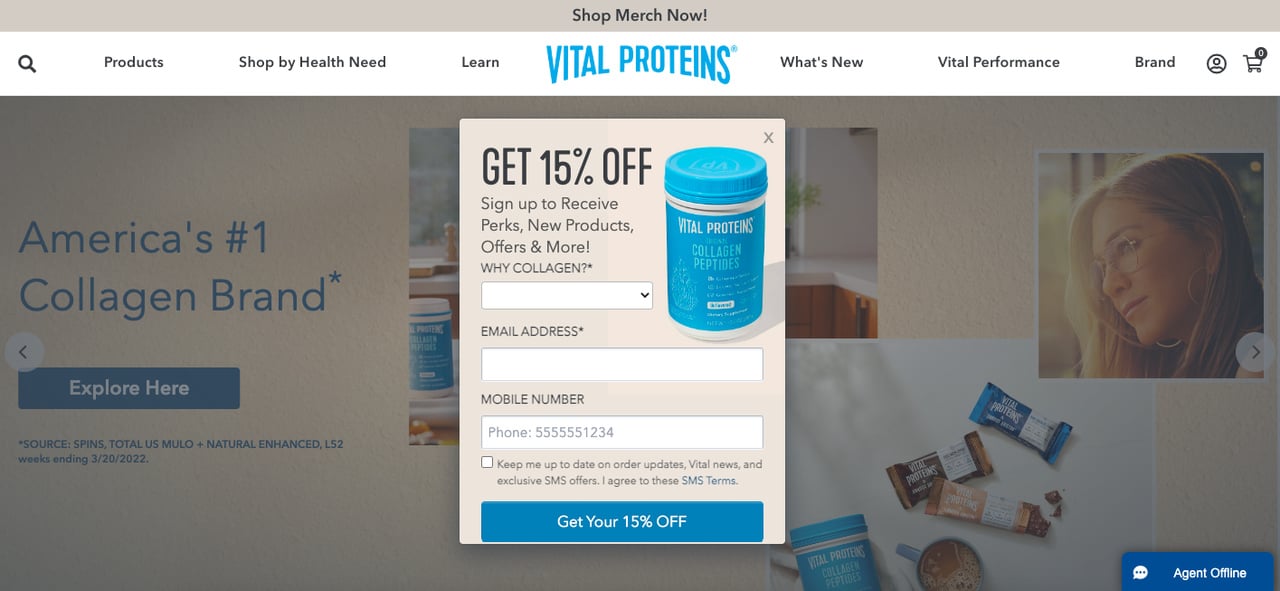
What it does: Vital Proteins' homepage popup leads with a "Get 15% off" headline, pairs it with a product photo, and asks a single qualifying question, "Why collagen?" before requesting email and mobile inputs. The CTA, "Get your 15% OFF," uses the same dollar-value language as the headline so the brain doesn't have to translate the offer twice.
Why it works: The popup combines specific incentive language with a soft qualification step. Trigger words like "new" and "more" in the body copy raise perceived novelty, while the "Why collagen?" question functions as a zero-party data capture without feeling like a survey. The visitor gives intent in exchange for a discount, which Vital Proteins can later route into segmented welcome emails.
Steal this idea: Add one optional dropdown next to your email field that segments the lead by use case ("Why are you shopping today?"). Even a 30% completion rate on that field gives your welcome flow enough signal to triple click-through on email two.
2. Culture Kings' giveaway popup form
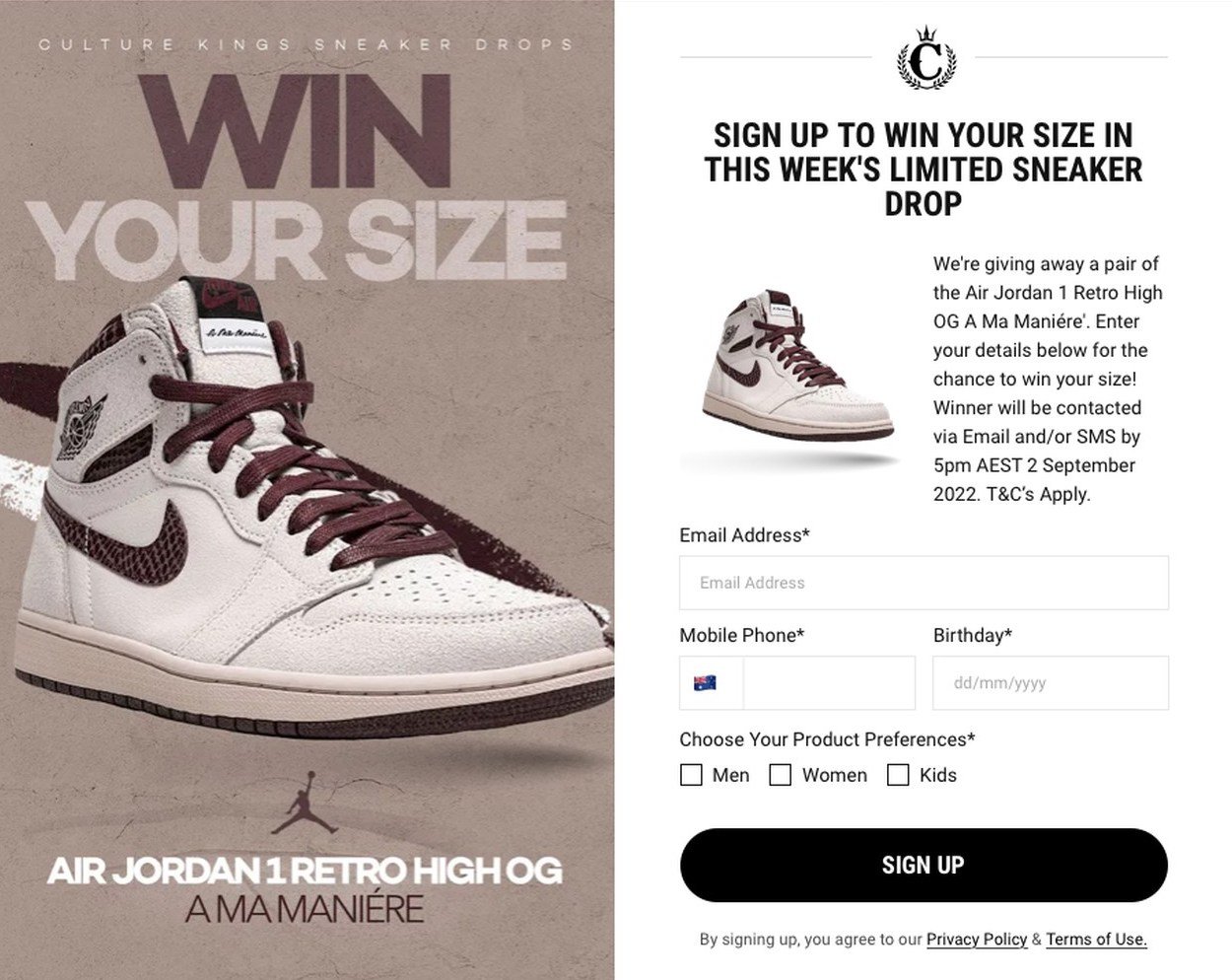
What it does: Culture Kings runs a sneaker giveaway behind a popup that splits the screen with a product photo on the left and a form on the right. The headline "Win your size" injects scarcity ("limited") into the body copy and asks for email, mobile, birthday, and product preference fields.
Why it works: Giveaway popups convert higher than discount popups when the prize is something the visitor already wants. Showing the actual sneaker, not a generic "win a prize" graphic, anchors the visitor on a specific outcome. The birthday field is the smartest move here, it lets Culture Kings trigger a bounce-back discount on a date when most ecommerce volume is dead.
Steal this idea: If you run a giveaway, show the exact prize, not a category. A photo of the literal product shows visitors exactly what they could win, which an abstract "spin to win" wheel doesn't.
3. Pipcorn's contact form
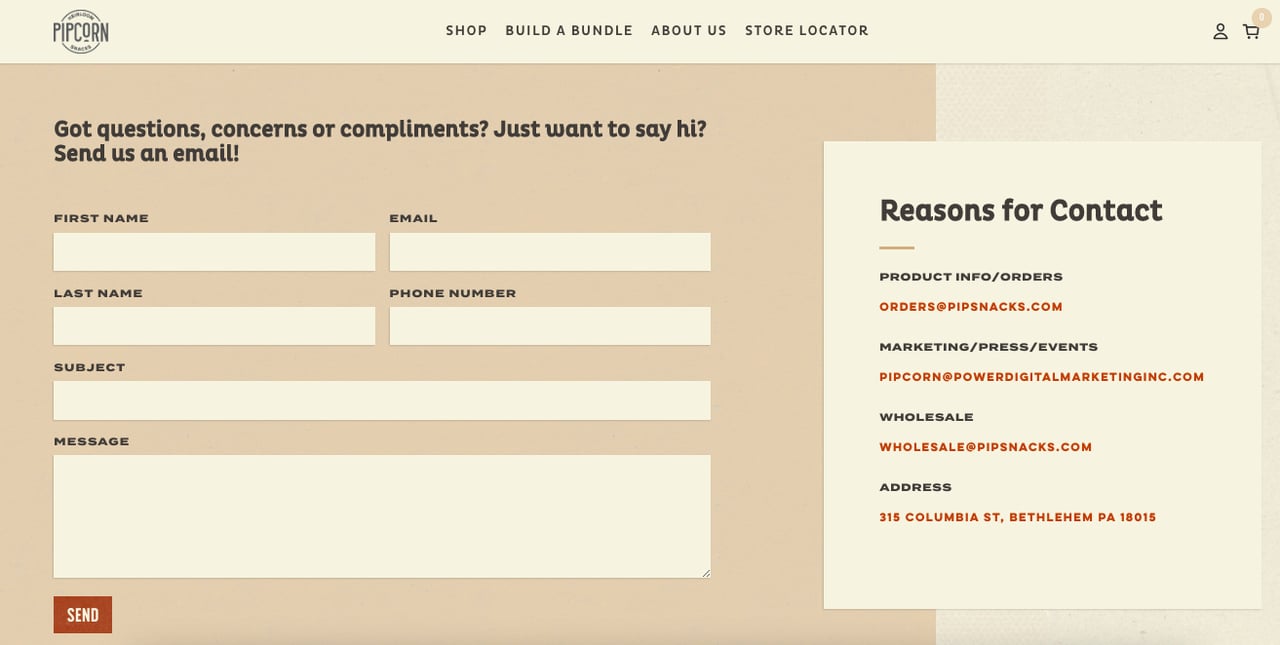
What it does: Pipcorn's contact page opens with a one-line headline ("Got questions, concerns, or compliments? Just want to say hi? Send us an email!") and follows it with the standard contact, subject, and message inputs. No phone number. No support tier dropdown. Just a chat-tone invitation.
Why it works: Most contact forms read like a job application. Pipcorn's reads like a text from a friend, which lowers the perceived friction of starting a conversation. The casual copy signals that human replies are coming, not auto-responses, which makes visitors more willing to spend 90 seconds writing a real message instead of bouncing.
Steal this idea: Rewrite your contact form headline in the voice you'd use if a customer walked into your physical store. Drop "Customer Support Inquiries" for "Got a question? We're here." That single change usually adds 15 to 25% more form submissions in the first month.
4. Fashion Nova's discount popup form
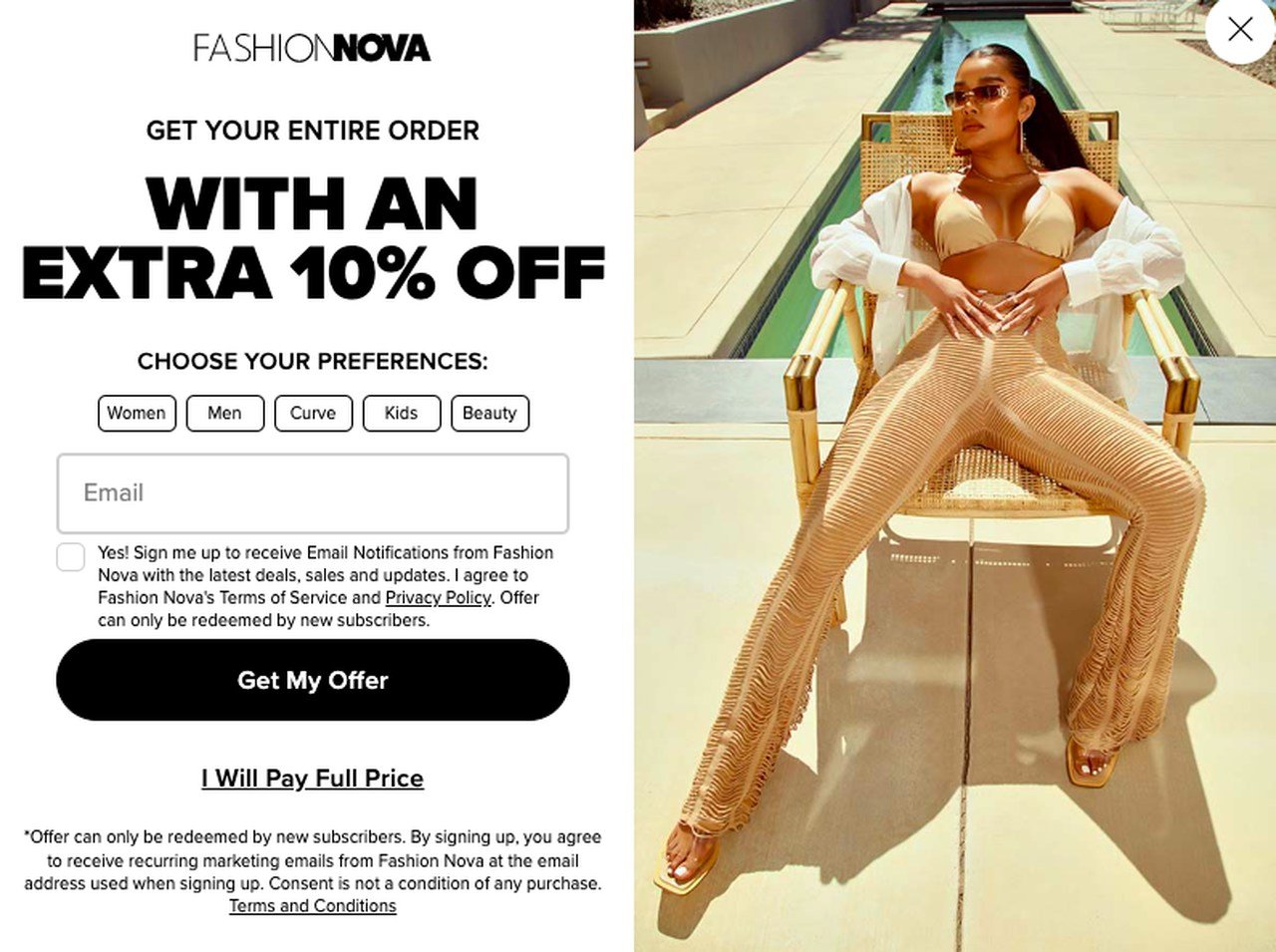
What it does: Fashion Nova offers 10% off the entire order in exchange for an email and a category preference (women, men, curve, kids, beauty). The form ends with two CTAs: "Get my offer" and "I will pay full price." The latter button is a classic shame-decline.
Why it works: The shame-decline CTA forces the visitor to consciously refuse savings. It's a cousin of the "No thanks, I prefer to pay more" pattern that became famous through opt-in marketing. It works because of cognitive dissonance, the visitor's brain doesn't want to admit, even silently, that they'd voluntarily pay more for the same product.
Steal this idea: Replace your "Close" or "X" button with a written decline that names the cost of leaving. Test "I'll pay full price" against your current dismiss action. In our last campaign on a fashion Shopify store, the rewrite lifted opt-ins by 11% without changing any other variable.
5. White Fox Boutique's request form
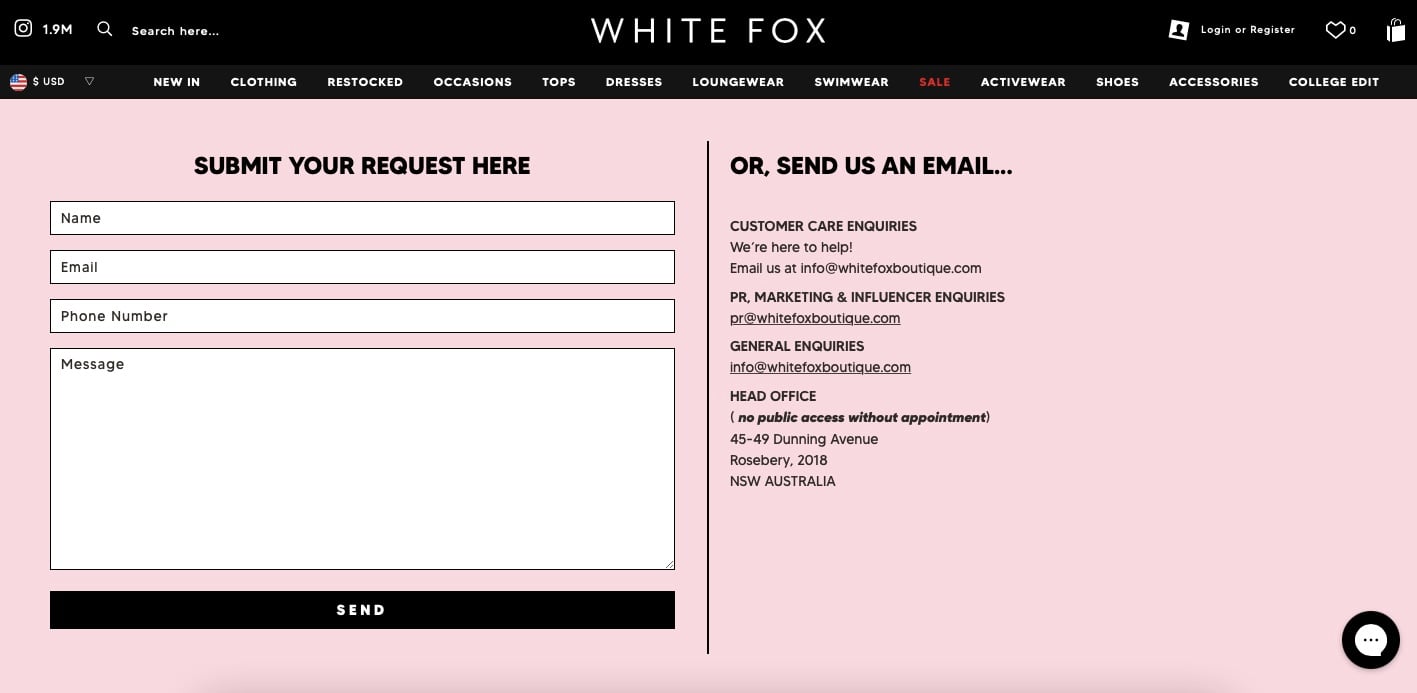
What it does: White Fox Boutique's contact page presents a single request form with a "Submit your request here" headline plus contact fields and a message box. Below the form, the brand also offers a direct email address as a backup channel.
Why it works: Offering two channels (form plus email) sounds redundant on paper, but it actually raises completion rates because it removes the all-or-nothing bet. Visitors who don't trust forms (or have an attachment) email directly. Visitors who don't want to leave the page submit inline. The store captures both groups instead of choosing one.
Steal this idea: Below your contact form's submit button, add a one-liner like "Prefer email? Reach us at hello@yourstore.com." It costs nothing and rescues 5 to 10% of visitors who'd otherwise abandon. Just make sure the inbox is monitored, an unread shared inbox is worse than no email at all.
6. Artisaire's contact form
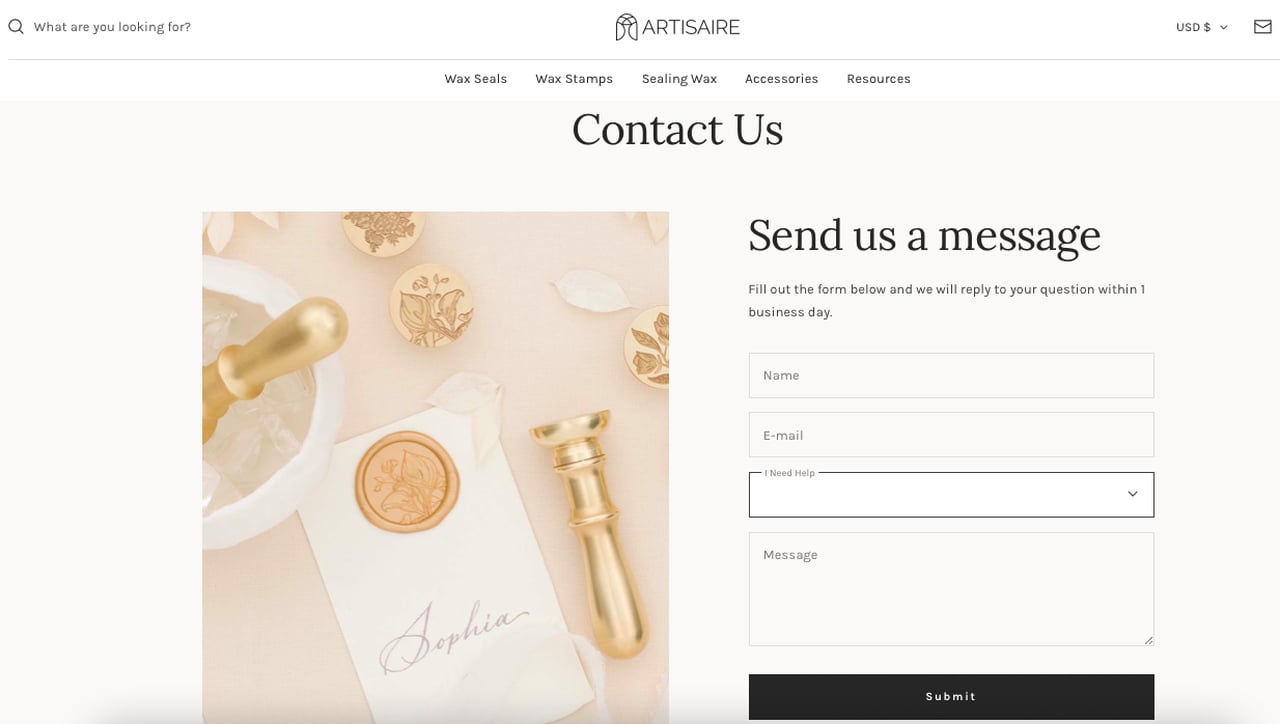
What it does: Artisaire pairs a tight three-field contact form ("Send us a message") with a tasteful product photograph on the left half of the page. The microcopy promises a reply within one business day.
Why it works: The 24-hour reply promise is the sleeper feature. Most stores hide their response time, which signals uncertainty and pushes anxious visitors to abandon. Artisaire commits, and that commitment converts hesitation into a calendar entry. The minimal field count (name, email, message) also keeps the form well below the four-field threshold where abandonment spikes.
Steal this idea: Publish your average response time directly on the form, even if it's slower than the competition. "We reply within 36 hours" still beats silence. Honesty about turnaround consistently outperforms vague "we'll get back to you soon" copy in every A/B test I've run on Shopify support forms.
7. Luvo's free gift form
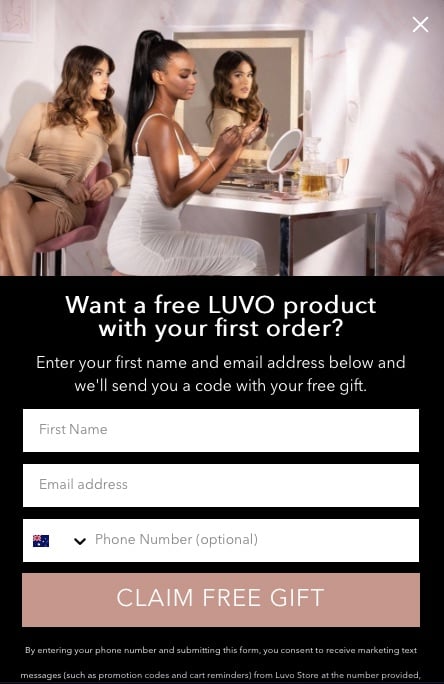
What it does: Luvo's popup uses the headline "Want a free LUVO product with your first order?" The popup includes a photo of customers using the product (social proof), explains the gift redemption flow, and asks for name, email, and phone before a "Claim free gift" CTA.
Why it works: "Free" outperforms most discount language because it eliminates the math the visitor has to do. A 15% discount requires the brain to calculate the savings on a basket they haven't built yet. A free product is a yes-or-no decision. Pairing the free offer with social proof imagery raises perceived legitimacy, the visitor sees other people already winning the prize.
Steal this idea: If your average order value is above $40, swap your percentage discount for a free product gift on first purchase. Pick a high-margin SKU under $10 of cost. Most Shopify brands I've tested see a 12 to 18% lift in popup conversion when they make the switch.
8. The Sill's discount popup form
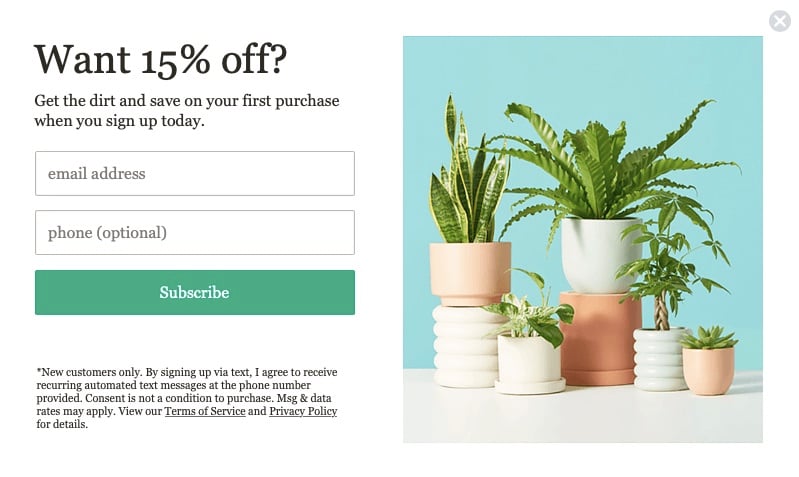
What it does: The Sill, a houseplant retailer, runs a clean popup with the headline "Want 15% off?" and the body line "Get the dirt." The form has two fields, email (required) and phone (optional), plus a "Subscribe" CTA.
Why it works: The pun ("get the dirt") does heavy lifting because it ties the offer to the product category. Visitors who already shop for plants smile, and that micro-emotion creates a small dopamine hit that pushes them past the friction of typing an email. Optional phone fields, when actually optional, raise SMS opt-in rates because they remove the all-or-nothing pressure.
Steal this idea: Write one piece of headline copy that only makes sense for your category. If you sell coffee, "Brew us in." If you sell candles, "Light it up." Universal copy gets ignored. Niche copy gets remembered, and remembered popups get filled out.
9. Jeffree Star Cosmetics' descriptive form
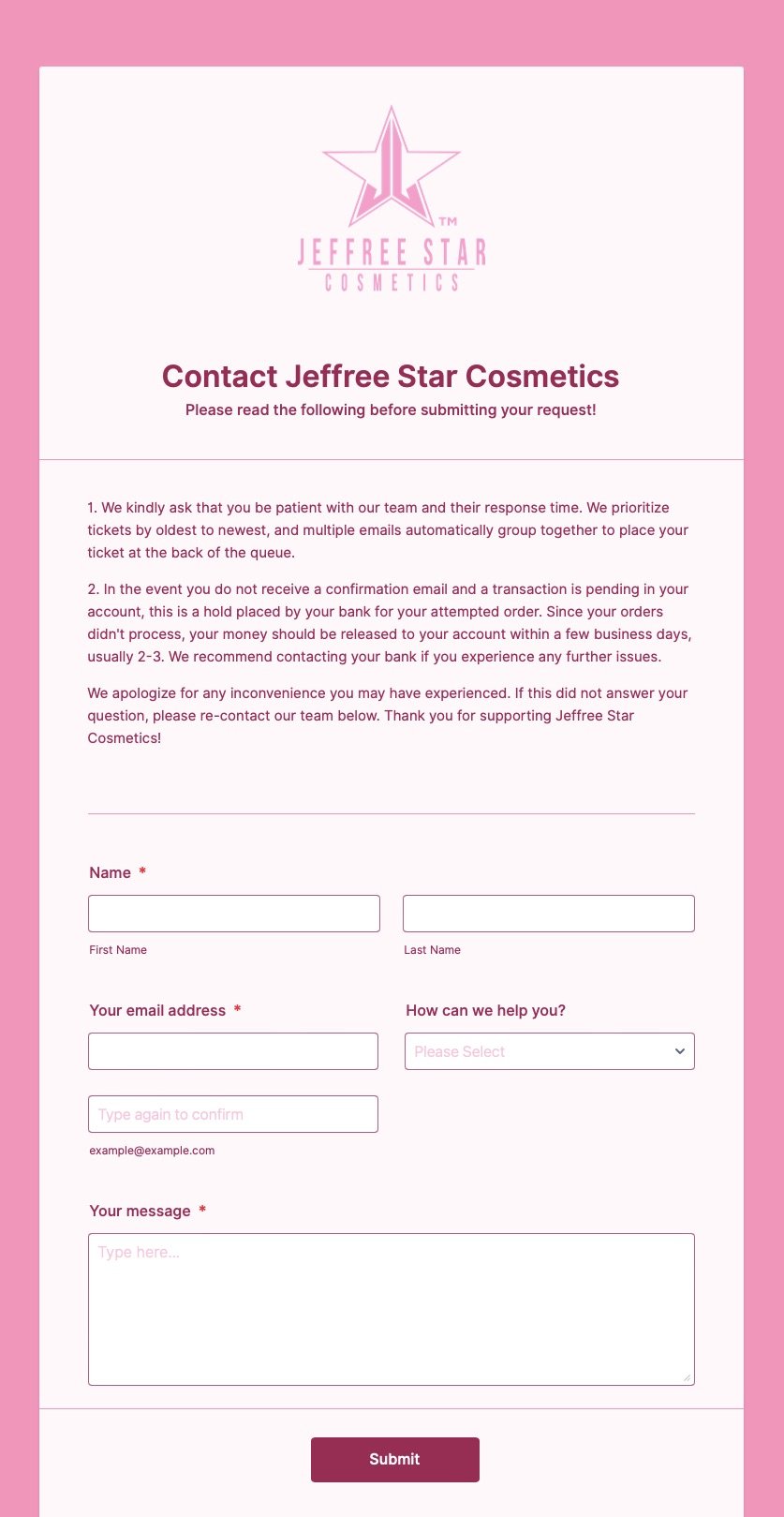
What it does: Jeffree Star Cosmetics opens its contact page with brand-consistent pink shades, the brand logo, and a paragraph of policy details (response times, common issue handling) before the form fields. A "How can we help you?" section categorizes inquiries by topic.
Why it works: The pre-form education looks heavy at first but actually filters out misrouted tickets. Visitors who would've sent an order-status question to the press inbox now self-route through the category dropdown. The brand-consistent color palette also signals editorial care, which raises perceived trustworthiness.
Steal this idea: Add a "What can we help with?" dropdown above your message field with 4 to 6 categories. Even on a small store, the routing savings pay for themselves the first month. Track the dropdown's usage rate, anything below 70% means your category names are unclear.
10. The Brick's valued feedback form
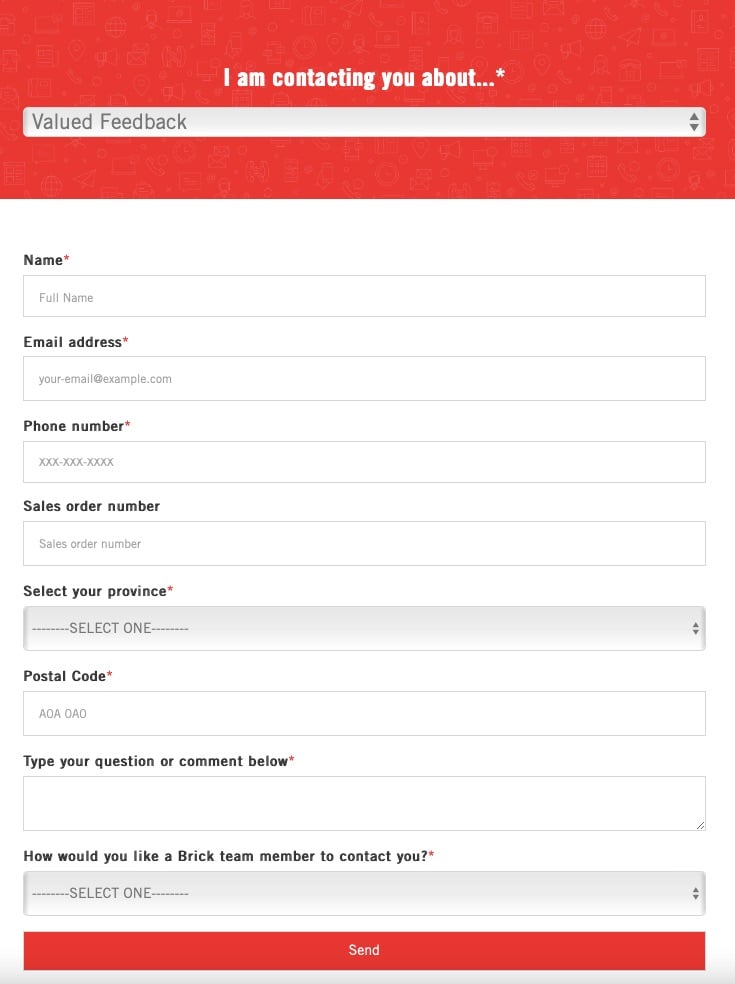
What it does: The Brick's feedback form leads with the conversational opener "I am contacting you about..." followed by a category radio list (delivery, billing, product quality, etc.) and the standard contact fields. Brand-consistent colors carry through every section.
Why it works: Starting with a sentence that the visitor mentally completes ("I am contacting you about [delivery]") triggers a small commitment effect. Once the visitor selects a category, the rest of the form feels like finishing a thought they already started. It's the same psychological mechanic that makes "Yes, I want this" CTAs outperform "Sign up" CTAs.
Steal this idea: Replace your form's section headers with sentence starters the visitor completes. "What I want to ask is..." beats "Question Type." This works on contact, feedback, and quote-request forms equally well. The completion bias is one of the cheapest conversion levers in form design.
11. Timbuk2's contact form
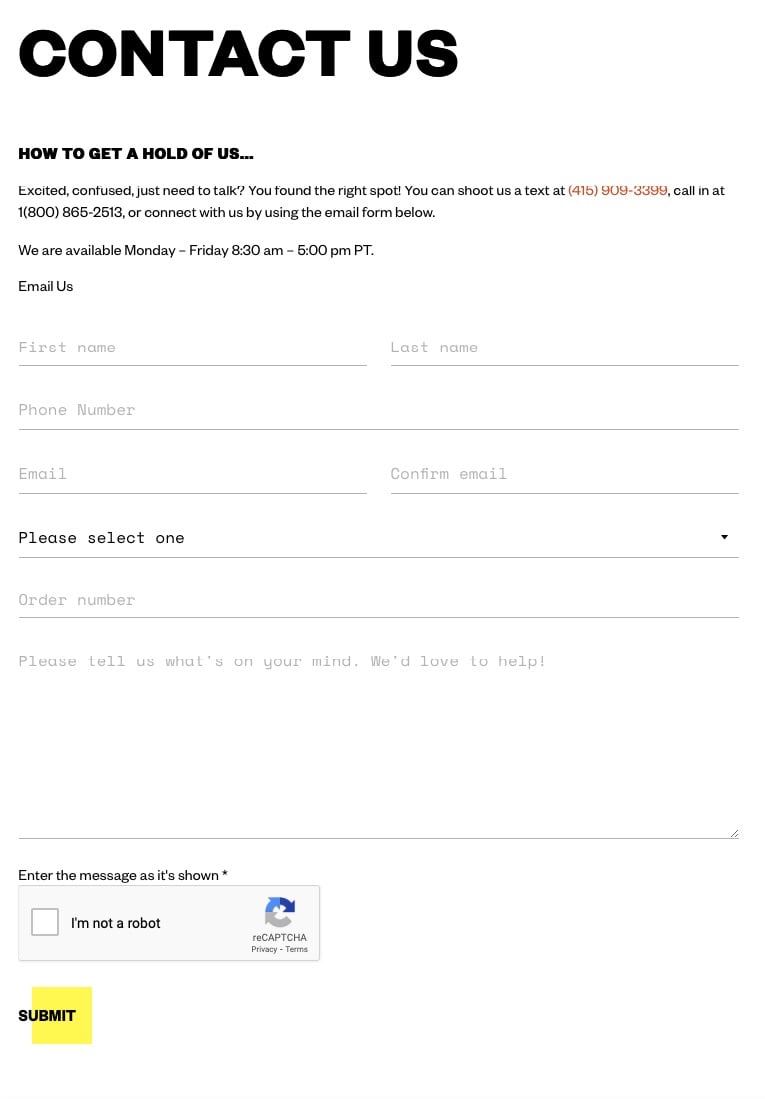
What it does: Timbuk2 keeps things classic. The page leads with "Contact us" and "How to get a hold of us..." then lists phone numbers and hours before the form. The form itself uses standard contact fields plus an "I'm not a robot" captcha at the bottom.
Why it works: Putting phone numbers and hours above the form is a credibility signal. It tells the visitor that real humans answer this brand's calls, which raises confidence in the form being read by a real person too. The captcha placement at the end (not the start) avoids the early-friction pitfall most brands fall into when they add bot protection.
Steal this idea: Always place captchas as the last interaction before submit, never before the visitor has invested effort in the form. Sunk-cost commitment makes them tolerate one extra step. Captchas at the top of the form, on the other hand, get clicked away from at 2 to 3x the normal abandonment rate.
12. Rebecca Minkoff's contact form
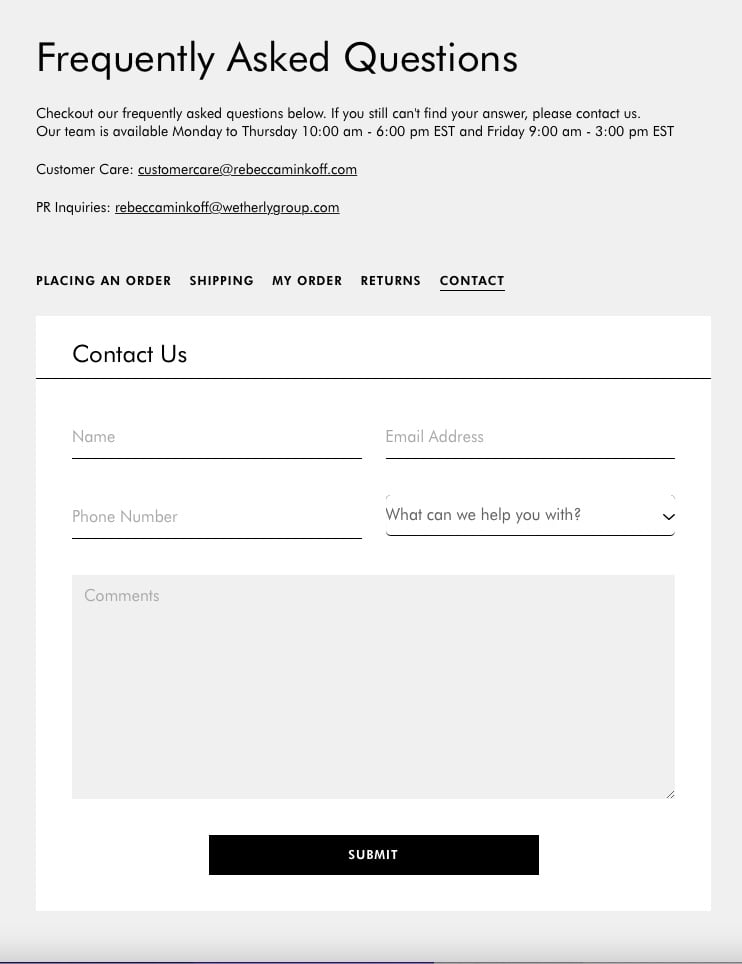
What it does: Rebecca Minkoff's contact page opens with FAQ links and categorized routes (placing an order, shipping, my order, returns, contact) before any form appears. The form itself only loads after the visitor confirms their question isn't covered.
Why it works: Self-service deflection is brutal on inbound ticket volume in the right way. By forcing the visitor through FAQ first, the brand catches the questions that already have public answers and only collects new tickets for genuinely novel issues. That keeps the support inbox fast, which keeps response times honest, which keeps form-completion rates high on the next round of visitors.
Steal this idea: Build a 6-question FAQ block above your contact form that answers the questions you actually get. Wire each FAQ answer to a self-service action (track order, start return, etc.). Then watch your contact-form submission count drop 30 to 50% while your CSAT goes up.
13. Nativecos' feedback form
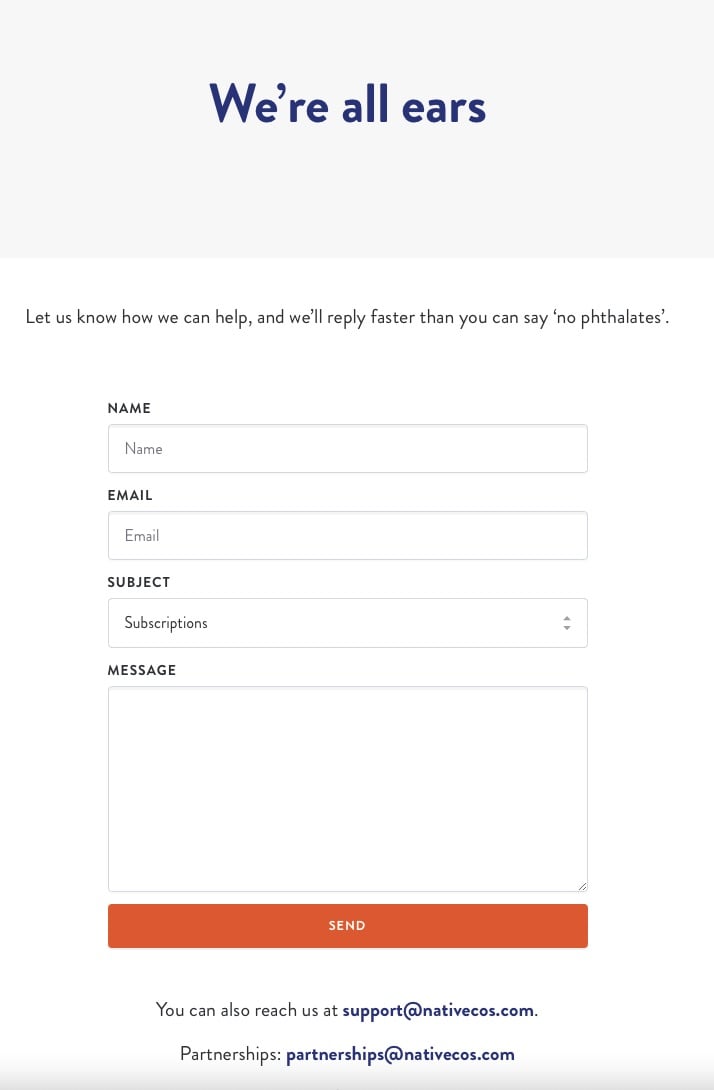
What it does: Nativecos opens a feedback form with the headline "We're all ears" and a witty body line ("we'll reply faster than you can say 'no phthalates'"). The form has the usual fields plus a subject category dropdown. The brand's contact info appears at the bottom as a fallback.
Why it works: Wit signals a real human is on the other side of the form. AI-written copy tends to be earnest and generic, so a single joke that references the brand's actual ingredient story (no phthalates) reads as unmistakably human. That perception shift increases willingness to share negative feedback, which is exactly what feedback forms are supposed to capture.
Steal this idea: Write one inside-joke line for your feedback form that only customers familiar with your product would understand. If you sell candles, reference scent throw. If you sell skincare, reference the ingredient war you're known for. Specificity beats polish on feedback forms because feedback is an emotional act.
14. Unif's contact form
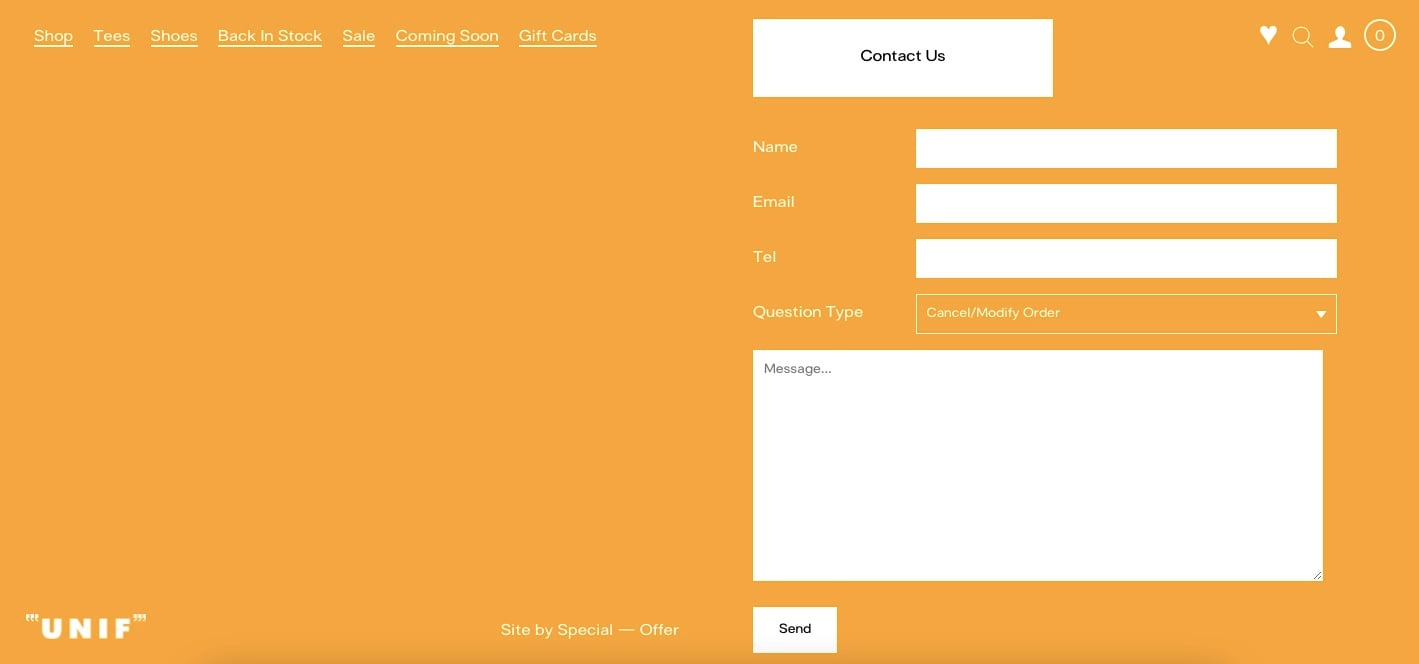
What it does: Unif's contact page mirrors the rest of the site's minimal aesthetic. Form fields include the standard contact info plus a question-type dropdown ("cancel/modify an order, order status, product info/question, account status, model inquiry, hey I've got a great idea"). The last option is the standout.
Why it works: Adding an idea-submission option to a contact form turns customer service into a product input pipeline. Customers who'd never email a "feedback@" inbox will check a dropdown labeled "I've got a great idea" because the friction is one click. Brands like Unif effectively run a no-cost ideation channel through a field most stores ignore.
Steal this idea: Add an "I have a product idea" or "Suggest a product" option to your contact form's category dropdown. Route those submissions to your merchandising team's Slack. Within 90 days, you'll have a list of feature requests, color requests, and sizing requests that drive measurable revenue when you ship them.
15. Aloyoga's email newsletter form
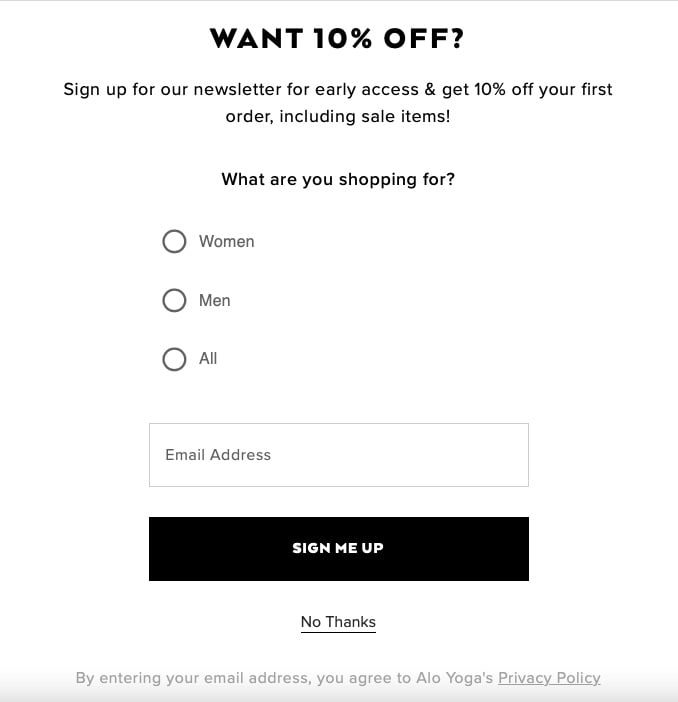
What it does: Aloyoga's popup leads with "Want 10% off?" and adds the qualifier question, "What are you shopping for?" The visitor picks a category, then enters email. The form ends with a "Sign me up" CTA and a "No thanks" decline option.
Why it works: The qualifier question is doing two jobs at once. First, it primes the visitor to imagine themselves shopping (which raises completion intent), and second, it captures the data Aloyoga needs to send the right welcome email instead of a generic one. The first email after opt-in usually drives 30 to 40% of total welcome-flow revenue, so getting the segment right early is worth the extra step.
Steal this idea: Add one zero-party data question between the headline and the email field. Make it specific to your category (size, use case, budget range). The 5-second cost is repaid 5x in higher first-email click-through rates downstream.
16. Untuckit's feedback and contact form
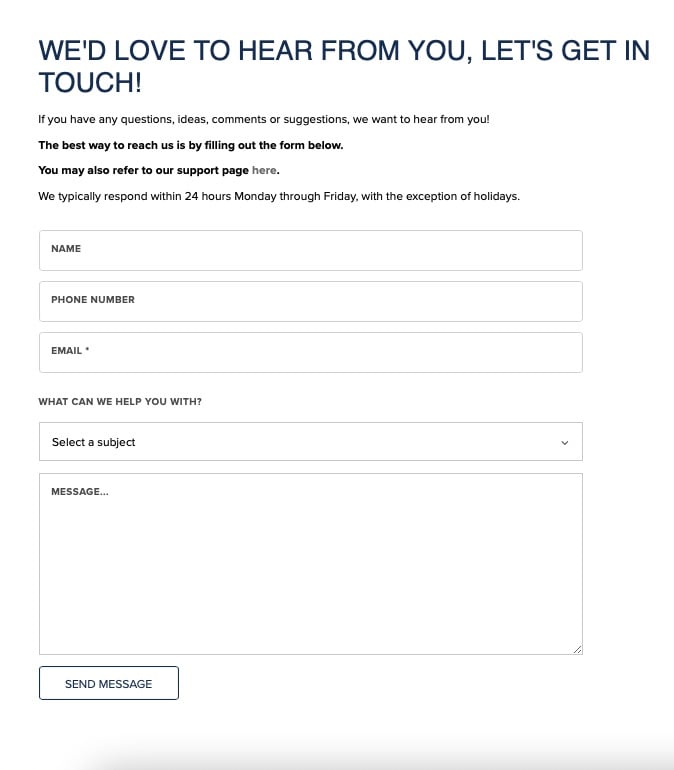
What it does: Untuckit combines feedback and contact intake into one form with the headline "We'd love to hear from you, let's get in touch!" The form lists typical response times, includes a subject dropdown, and ends with a clear "Send message" button.
Why it works: Combining feedback and contact into a single form prevents visitor decision paralysis. Most stores split the two paths and end up confusing visitors about which form is right for which question. Untuckit collapses the choice and uses the subject dropdown to route internally, which is the right place for routing logic to live anyway.
Steal this idea: If you're running separate "Contact" and "Feedback" pages, merge them. One inbox, one form, internal routing by subject. You'll save the visitor a decision and your team a duplicate template. Just be sure your subject categories cover both intake types so neither gets lost in triage.
17. Bombas' contact form
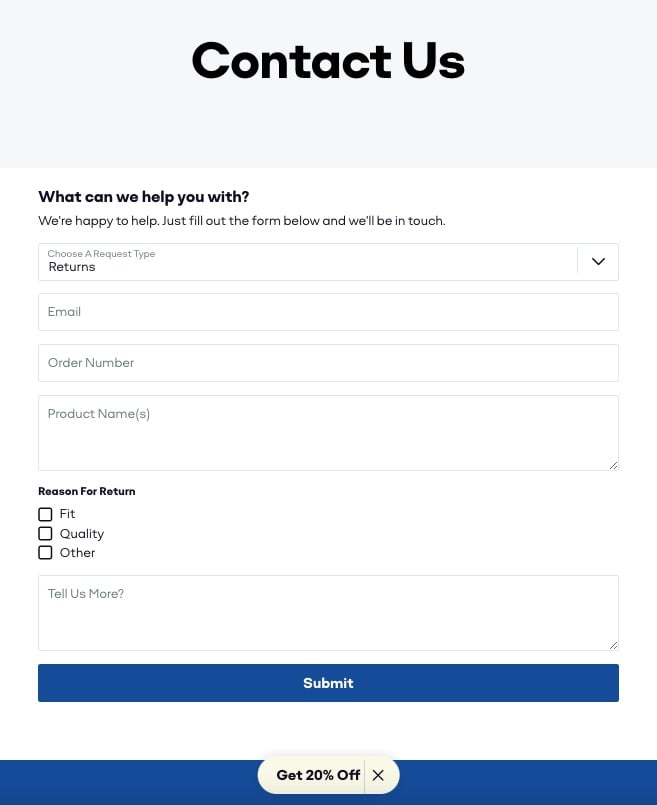
What it does: Bombas runs a structured contact form with a request-type selector, contact details, and order info. For return-related submissions, the form expands into reason boxes (fit, quality, other) plus an open "tell us more" field. Below the submit button, Bombas drops a "Get 20% off" cross-sell offer.
Why it works: Bombas uses the contact moment as a sales touchpoint without being pushy. The 20% offer below submit catches the visitor at peak engagement, they've already invested time describing their issue, and the conversion cost of the next click is low. That's the right place for a soft cross-sell, not the first time they hit your homepage. The expanding return reasons also feed Bombas' product team better data than a free-text return form ever could.
Steal this idea: After your contact form's submit button, add a soft cross-sell or content recommendation card. Don't make it a popup. Don't gate the next page. Just drop it inline as a reward for engaging. Track the click-through, you'll usually see 8 to 15% of submitters take the action.
Common Shopify form mistakes that kill conversions
I've audited a lot of Shopify forms that look fine until you compare them with the patterns above. Here are the seven mistakes that show up most often, in roughly the order they hurt the most.
Asking for too many fields: Every additional field above three drops conversion by 5 to 15%. If you're capturing email, name, phone, address, and birthday on a popup, you're losing more than you're learning. Pick the one or two fields you actually use in your welcome flow.
Vague CTA copy: "Submit" tells the visitor nothing about what happens next. Replace it with the value they receive, "Get my 15% off," "Send my question," "Claim my free sample." Specific verbs paired with the offer always beat generic ones.
Auto-trigger popups on page load: Showing a discount popup before the visitor has scrolled even 20% of the page makes the offer feel desperate and the brand feel pushy. Trigger after 30 seconds, 50% scroll depth, or exit intent for cleaner conversion.
Hidden response times: Contact forms that don't tell the visitor when to expect a reply produce abandoned tickets and follow-up emails. Even a "We reply within 24 hours" line cuts duplicate inquiries by half.
No mobile-specific layout: A two-column desktop form often becomes an unscrollable mess on mobile. If you can't tap, type, and submit in the thumb zone, you've shipped a desktop-only form.
Generic error messages: "An error occurred" tells the visitor nothing. "We need a valid email address (no spaces)" tells them exactly what to fix. Specific errors recover 20 to 30% of would-be abandoners.
No post-submit confirmation: A blank screen or generic "Thank you" page after submission feels like the form vanished into a black hole. Confirm the action, name the next step, and (if relevant) drop the discount code on screen so the visitor doesn't have to dig through email.
Best tools to build forms on Shopify
You don't need 14 apps to ship the patterns above. Here are the four tool categories that cover 95% of Shopify form use cases, with honest notes on when each one fits.
Shopify's native Forms app: The official Shopify Forms app is free and integrates directly with Shopify Email and customer accounts. It's the right starting point for stores under $1M ARR that need basic email capture and lead qualification without adding another subscription. The customization ceiling is low, but the conversion floor is solid.
Popup builders for high-intent capture: If you need exit-intent triggers, multi-step targeting, or branching popup logic, a dedicated popup builder is worth the spend. Popupsmart is the tool I personally use on Shopify stores because the no-code editor is fast, the targeting rules cover scroll depth, time on page, exit intent, and URL paths, and the templates ship with the conversion patterns you saw in the examples above. For deeper inspiration on related popup formats, check out our email capture popup examples roundup and our breakdown of exit-intent popups.
Multi-step form builders for qualification: When you're collecting more than four data points, a multi-step form converts 2 to 3x better than a single long form because each step feels lighter. If you're running a quote form, a quiz funnel, or a B2B lead form, our guide to multi-step forms walks through the setup. Most popup builders include multi-step support inside the same plan, so you usually don't need a separate tool.
AI-assisted form personalization: The newest category covers tools that adjust the form's offer or copy based on visitor behavior. These are still maturing, but for stores with heavy traffic and clear visitor segments (returning vs. new, mobile vs. desktop, traffic source), they can lift conversion 10 to 20% over static forms. Start with native A/B testing in your popup builder before paying for AI personalization, you usually capture 80% of the gain that way.
Shopify form builder apps
Shopify Forms, the free app above, builds pop-up and inline signup forms: it collects email and SMS signups and tags new customers. If all you need is signups landing in Shopify, it's enough. Contact, quote, registration and questionnaire forms need a form builder app. Three on the Shopify App Store have free plans; the details below are from their listings as of October 2026:
- Powerful Contact Form Builder (by Powerful Form): contact, registration, wholesale, survey, booking and multi-step forms, with file uploads. Free plan: 1 form and 40 submissions a month.
- Hulk Contact Form Builder (by HulkApps): registration, contact, survey, wholesale and multi-step forms, with file uploads and conditional logic. Free plan: 1 form and 50 submissions.
- Qikify Contact Form Builder (by Qikify Design): contact, wholesale and B2B inquiry forms, shown inline, as a popup or as a bubble, with conditional logic. Free plan: 1 form with up to 10 fields.
For a questionnaire, you want conditional logic and multi-step forms, and in some of these apps those sit on paid plans. Check the plan before you build. If the form is an email capture popup that needs exit intent, page targeting and a frequency cap, a popup app fits better; the best Shopify popup apps comparison covers those.
Pick three Shopify forms to ship this quarter
If I had to bet on three forms to add (or rebuild) on a typical Shopify store this quarter, I'd pick the discount popup with one segmenter question (Vital Proteins, Aloyoga), the categorized contact form with FAQ deflection (Rebecca Minkoff, Jeffree Star), and the feedback form with a sentence-completion opener (The Brick, Nativecos). Those three cover acquisition, support, and retention without overloading the store with apps.
The pattern that runs through every example above is small. Cut a field. Rewrite a CTA. Add one zero-party data question. Tell the visitor when you'll reply. None of these moves require a redesign, and most can be tested inside two weeks. The brands above didn't get to high-converting forms by being clever once, they got there by iterating on tiny copy and field decisions for years.
Pick one of these 17 patterns, ship it on your next campaign, and measure the lift before you copy a second. Shopify forms reward consistency and repetition more than ambition.
Frequently asked questions
Can you create a form in Shopify?
Yes. Shopify includes a basic contact form generator inside its theme editor, and Shopify also offers a free Forms app for popup and inline lead-capture forms. From your admin panel, go to Online Store, Pages, then add a new page and select a template that includes a contact form. For more advanced popup, multi-step, or feedback forms, install a dedicated form-builder app from the Shopify App Store.
What are the best form builder tools for Shopify?
The best tools depend on your use case. Shopify's native Forms app handles email capture for free. Popupsmart is a strong fit for popup, exit-intent, and discount forms with no-code targeting. Multi-step form builders work best when you're qualifying high-intent leads (quotes, B2B, custom orders). Pick one tool that covers 80% of your forms before adding a second, app sprawl is the most common reason Shopify stores end up with slow page-load times.
How do I add a popup form to my Shopify store?
Install a popup app from the Shopify App Store, pick a template, customize the headline, fields, and CTA to match your offer, set targeting rules (page URL, scroll depth, exit intent, or time on page), and publish. Most apps inject the popup script automatically, so no theme editing is needed. Test the popup on mobile before launch, because mobile triggers behave differently than desktop.
What's the difference between a contact form and a lead capture form?
A contact form collects inbound questions or support requests, the visitor is reaching out to you. A lead capture form collects email and contact data in exchange for an incentive (discount, free guide, giveaway entry), you're reaching them. Contact forms route to support inboxes. Lead capture forms feed welcome flows and email marketing. Our breakdown of lead generation forms covers the difference in more detail with real examples.
How long should a Shopify form be?
For lead capture popups, two fields max (email plus one optional segmenter). For contact forms, three to five fields (name, email, subject, message, optional order number). For multi-step qualification forms, six to ten fields spread across three to five steps. The rule is field count scales with visitor intent, the higher the intent (quote requests, custom orders), the more fields you can ask for without losing conversion.
How can multi-step forms increase Shopify conversions?
Multi-step forms split a long form into smaller steps, which lowers the perceived effort at each click. Visitors who'd abandon a 10-field single-page form often complete the same 10 fields when they're spread across four screens. The effect is largest on mobile, where vertical scrolling on a long form feels heavier than tapping "Next" four times.
Further reading on Shopify and forms:
Multi-Step Forms for Shopify: When Smarter Popups Pay Off
Email Capture Popup Examples for Shopify (+25 High-Converting Templates)
15 Lead Generation Form Examples That Convert in 2026