ChatGPT
 Perplexity
 Claude
 Grok
Grok Google AI Mode
Discount popups show online store owners what customers respond to, and they can win back buyers who were about to leave without making a purchase.
Below are 21 real-world examples of discount popups to borrow from. At the end, we'll create one discount popup for your website, for free.
What is a Discount Popup?
A discount popup is a tool online stores use to nudge shoppers toward a purchase. When the offer is a code the shopper copies at checkout, many stores call it a coupon popup; the mechanics are the same.
These popups can appear as soon as a visitor lands on your store, after they've been browsing for a while, or even when they're about to leave without making a purchase.
The offer itself can be a percentage discount, a buy-one-get-one-free deal, or even free shipping.
There's a second payoff. Ask for the visitor's email in return for the discount, and you're also building your email list.
That list is how you reach interested customers again with newsletters, updates and the next promotion, long after the first visit.
Do discount popups work? What our 2026 data says
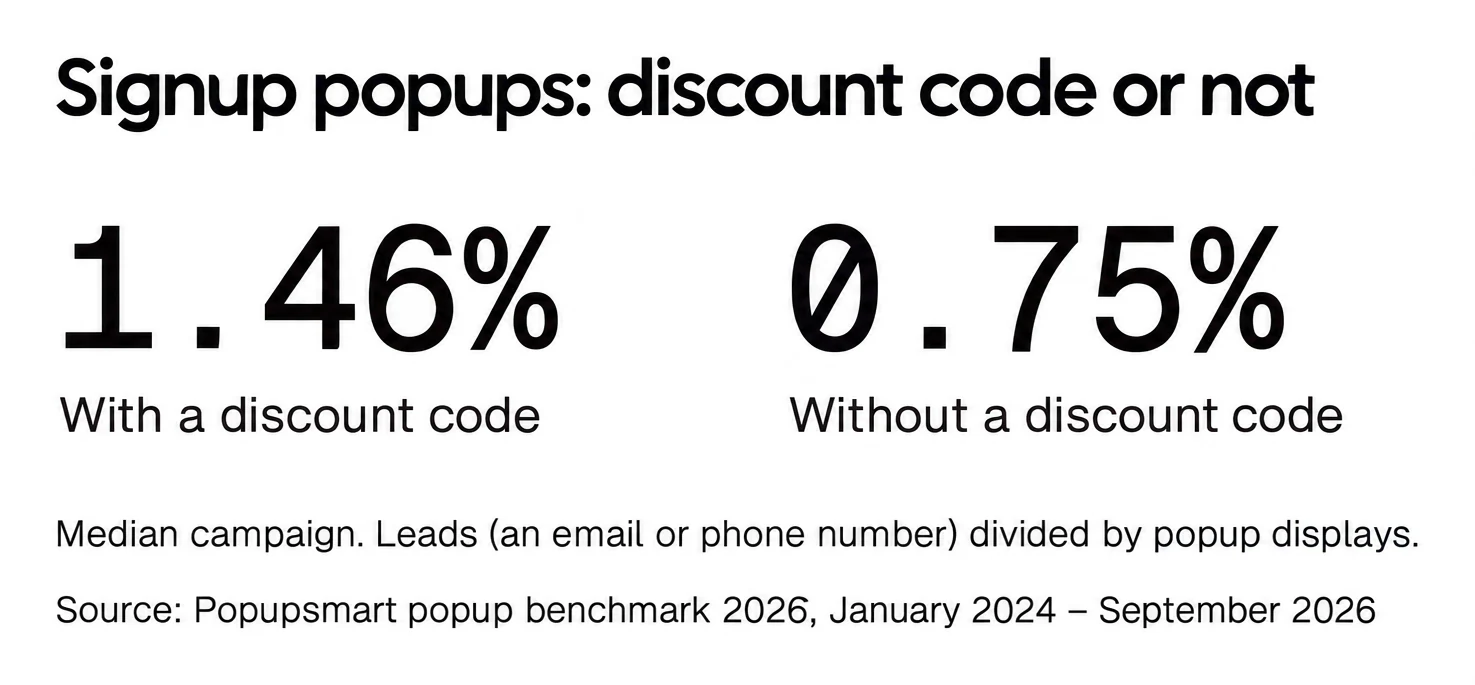
First, what our own numbers say about discount offers. The figures come from our 2026 popup benchmark: Popupsmart campaigns between January 2024 and September 2026. Each rate is leads (a popup submission that contains an email address or phone number) divided by popup displays, for the median campaign.
| What the popup offers | Lead conversion rate (median campaign) |
|---|---|
| Signup popup with a discount code | 1.46% |
| Signup popup without a discount code | 0.75% |
| Popup stating 10% off | 1.25% |
| Popup stating no discount | 0.67% |
Signup popups that offer a discount code convert 1.46% vs 0.75% for signup popups without one. Popups stating 10% off convert 1.25% vs 0.67% for popups that state no discount. So a concrete offer, stated in the popup, is the part of a discount popup our data backs most clearly.
How big should the discount be?
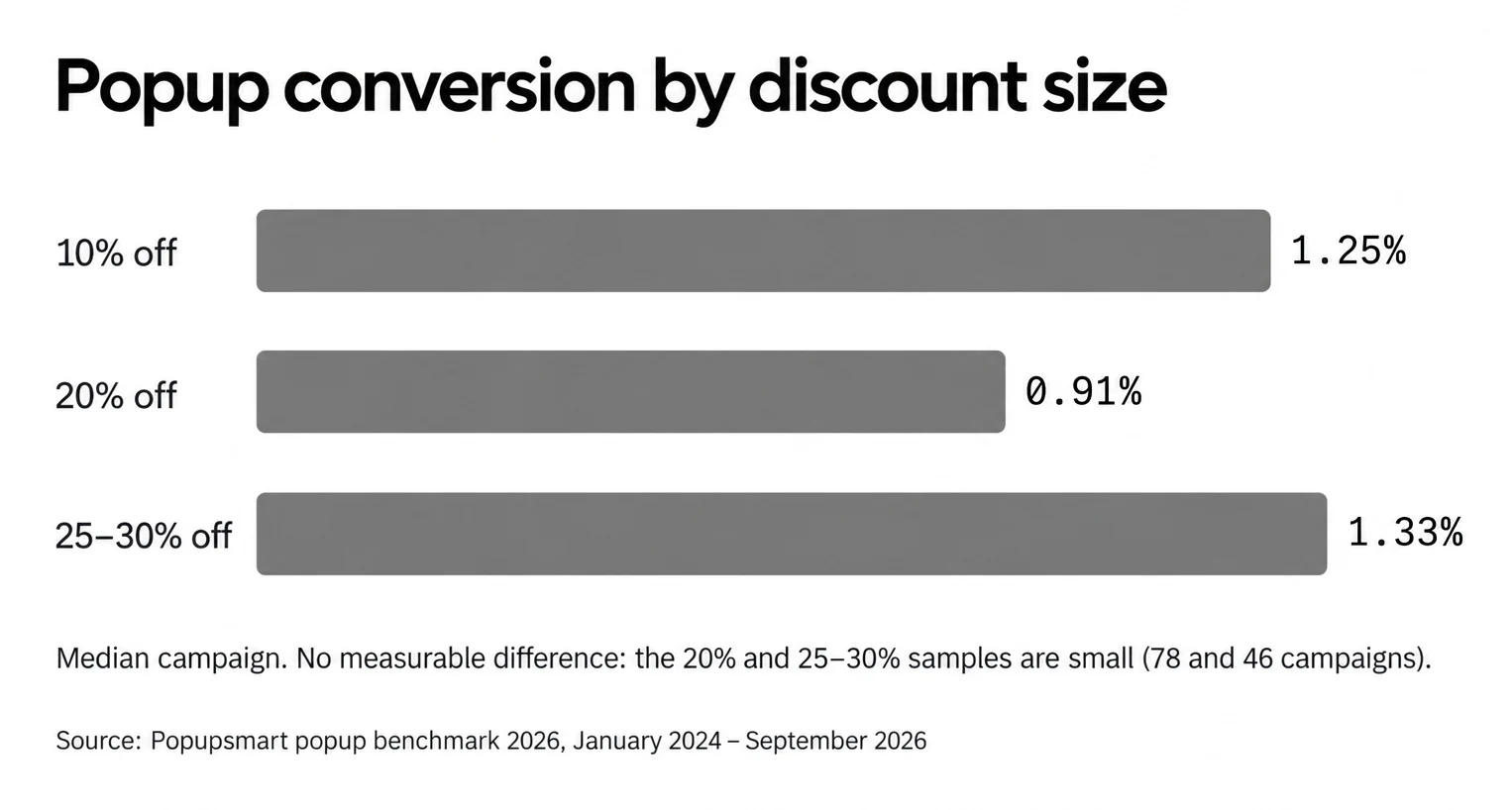
Our data can't name a best percentage. Bigger discounts did not convert measurably better: 10% off converted 1.25%, 20% off 0.91% and 25-30% off 1.33%, but the larger-discount samples are small (78 and 46 campaigns), so the data cannot rule out a real difference either way.
The same reading holds in peak season: our Black Friday popups guide builds its offer section on these numbers.
When a discount popup isn't the right offer
A discount trains some shoppers to wait for the next code, and it costs margin on orders that would have happened anyway. If that's a worry for your store, the popup can still offer something concrete without a percentage: free shipping, a gift with the order, early access to a sale, or a bundle price.
21 Discount Popup Examples for Ecommerce Stores
Each type of discount popup has a distinct purpose, so knowing the differences helps you choose the right ones for your store. The store examples below were captured in May 2024; stores change their popups often, so read them as patterns rather than as what each site shows today.
The types covered below:
- First-Time Visitor / Welcome Discount Popups
- Exit-Intent Discount Popups
- Time-Sensitive Discount Popups
- Seasonal or Event-Based Discount Popups
- Spin-to-Win (Gamification) Discount Popups
- Mystery Discount Popups
- Survey Discount Popups
- Loyalty and Referral-Based Discount Popups
First-Time Visitor / Welcome Discount Popups
Aimed at new visitors, these popups offer a discount on the first purchase in exchange for an email signup or account creation. Each signup adds to your customer database.
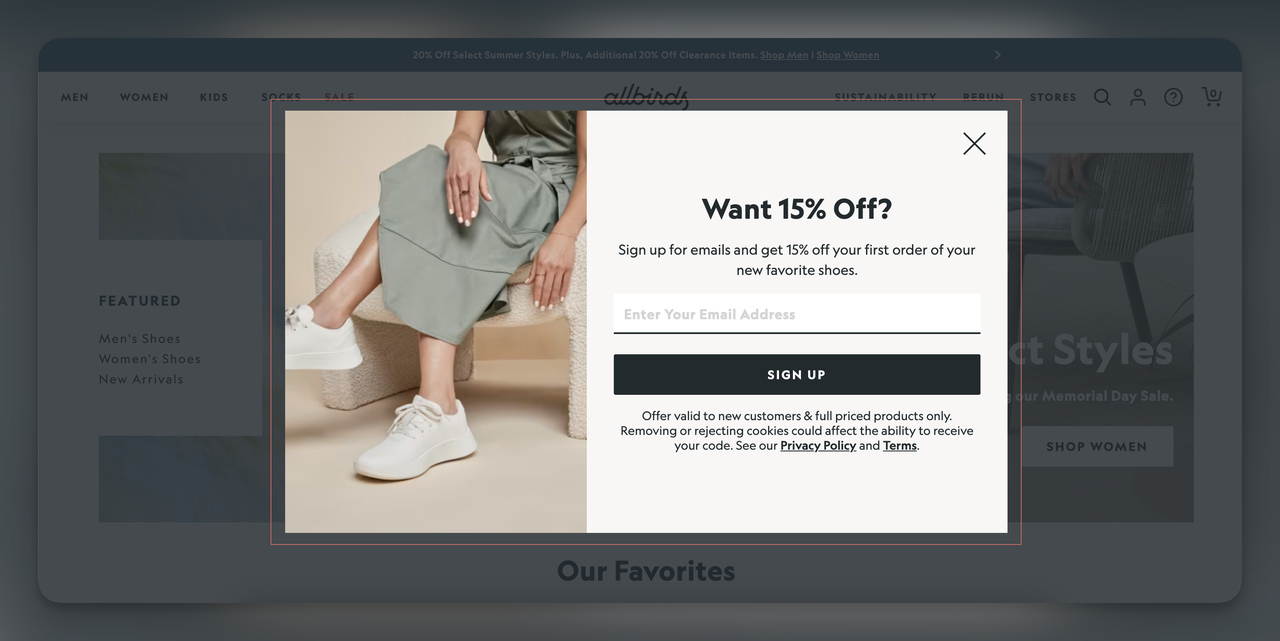
A first-time visitor discount popup from Allbirds:
What's Working & What Could Be Better?
- The chosen image shows the product in use, which can build a stronger connection with visitors.
- The headline question, "Want 15% Off?" does a good job directing their interest towards the discount.
- Changing the CTA from "SIGN UP" to "Get Discount" can improve clarity and reduce hesitation. "Sign up" may imply a longer commitment, while "Get Discount" names the immediate benefit.
- Stating discount validity below the CTA sets the right expectations and helps avoid any confusion later on.
Here is another first-time visitor discount popup from Parachute:
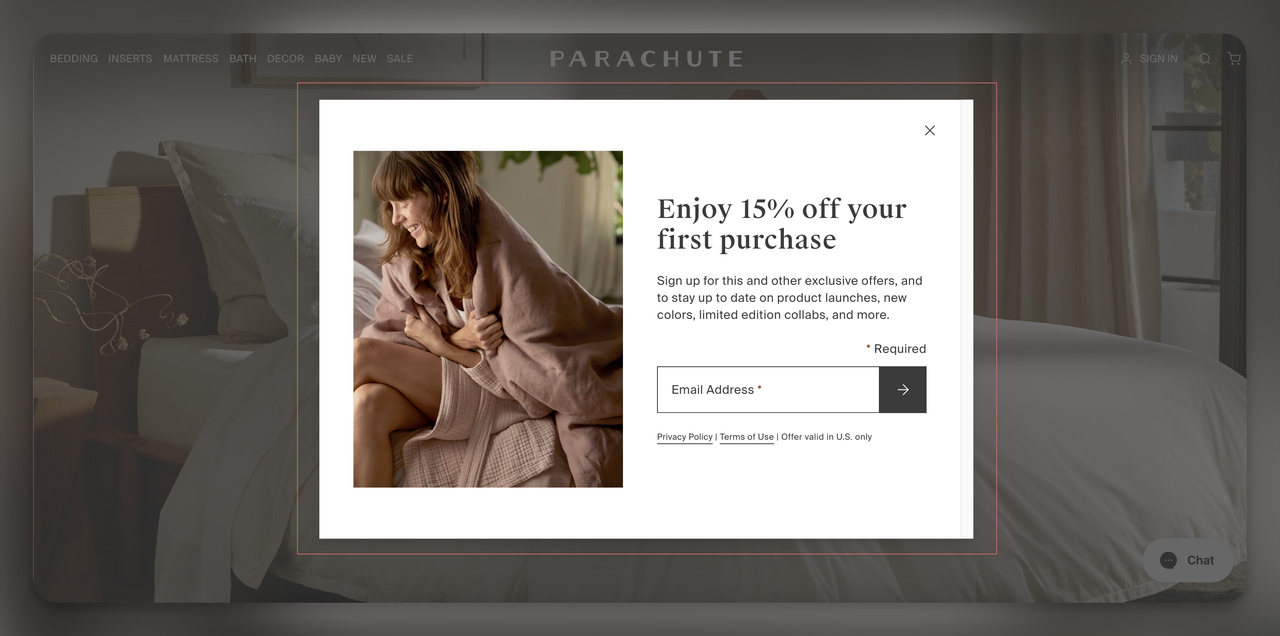
What's Working & What Could Be Better?
- The image shows how comfortable the Parachute bathrobe is, and it reads as a quality lifestyle product.
- The headline offers a clear and attractive offer, such as 15% off your first purchase.
- The call to action (CTA) needs to be emphasized more strongly with a clear button and phrases such as ‘Get Discount’.
- The extra benefits of signing up are mentioned below the headline, which should encourage visitors to subscribe. Keeping that text short stops it from overwhelming the visitor.
- Clearly stating the offer validity period and geographical limitation (e.g., ‘Offer valid only in the USA’) close to the headline can help to set the right expectations and avoid any confusion at the checkout stage.
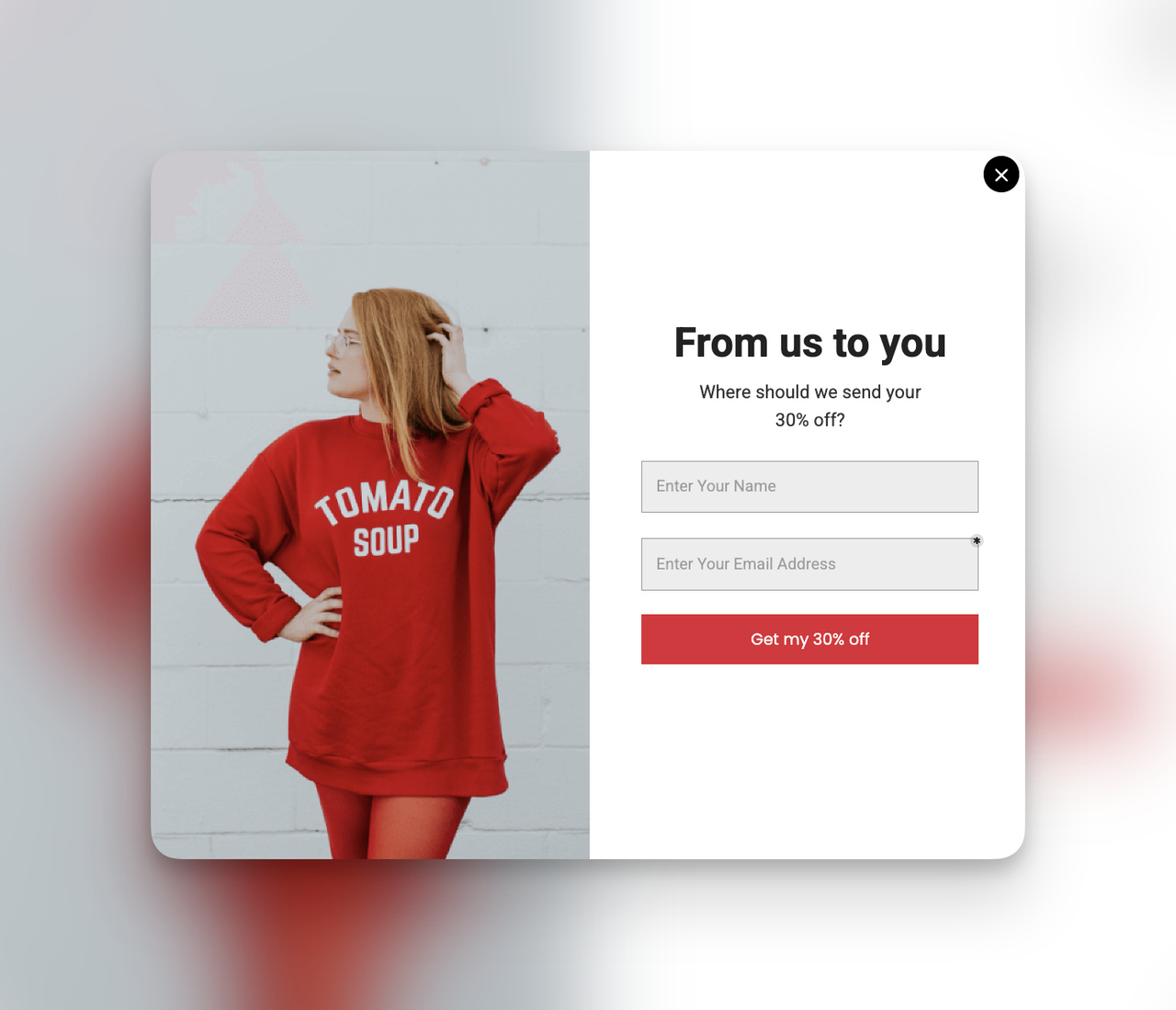
If you'd like to create a popup like the examples above, you can freely clone the popup below:
Exit-Intent Discount Popups
Triggered when a user is about to leave the site, these popups offer a discount to try to convert the user into a customer before they exit, potentially reducing cart abandonment rates.
Here is an exit-intent discount popup example from Art of Play:
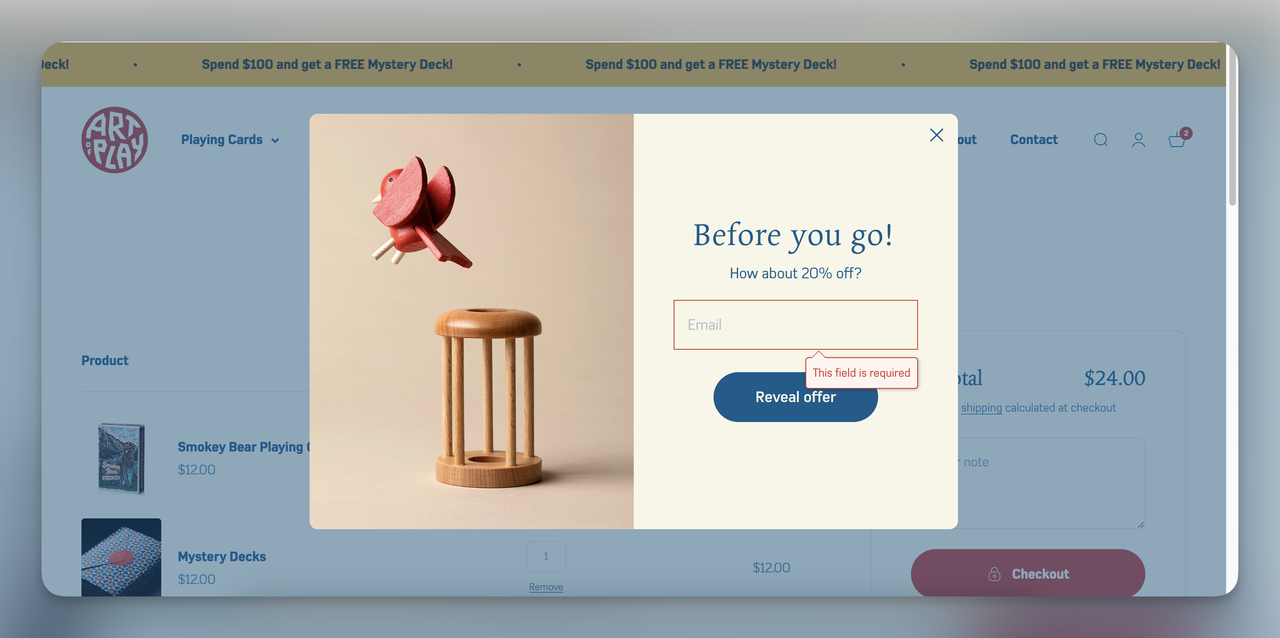
What's Working & What Could Be Better?
- The image is interesting, but it doesn't highlight Art of Play's core products, such as playing cards, which could confuse new customers. Don't forget to put images of the products on sale in your discount popup.
- The headline stands out with a 20% discount offer before users leave.
- The “Reveal offer” CTA makes people curious enough to click.
- While the simplicity of the popup directs the focus to the offer, adding details about the applicability or terms of the discount can provide greater clarity.
Cupshe takes a more direct line at checkout:
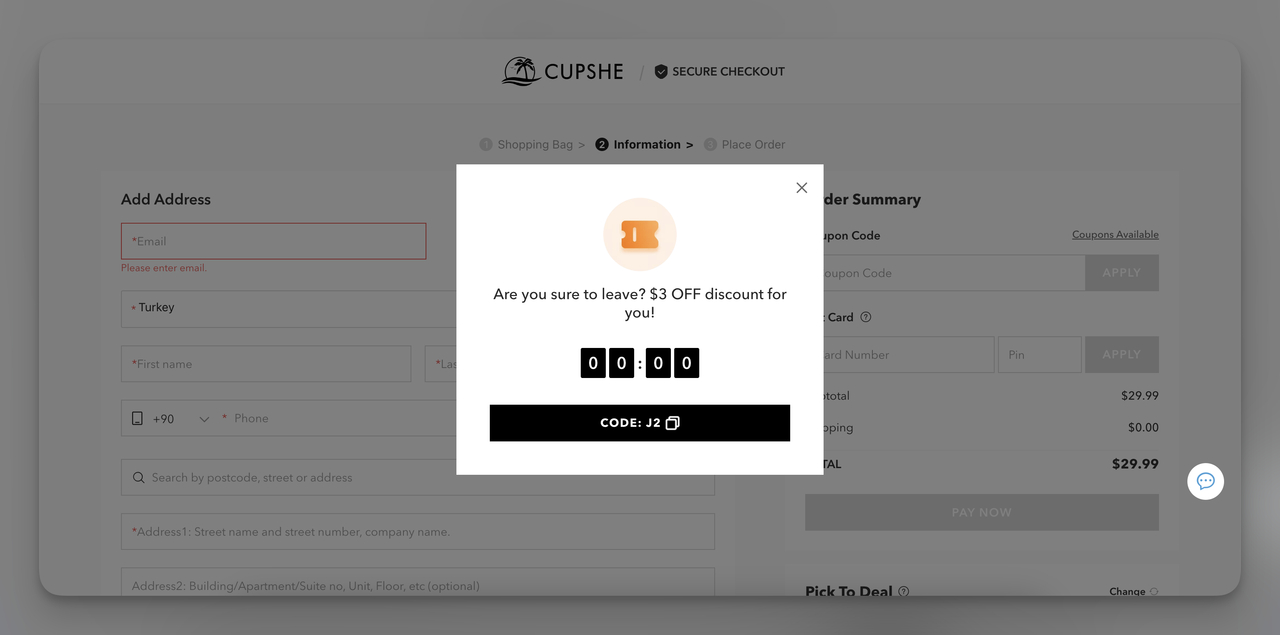
What's Working & What Could Be Better?
- The popup's minimalistic design has a bold timer for urgency. Without product images, though, it's harder to tie to the brand or product line.
- The headline directly reads, “Are you sure to leave? $3 OFF discount for you!” It speaks straight to the visitor's plan to leave.
- The code button shows the code right in the popup with a copy icon, so the shopper can paste it into the coupon field on the same checkout page.
- Using a countdown timer popup adds urgency and pushes the user to act fast. Make sure it doesn't tip into a high-pressure sales tactic.
- Including more discount details, like minimum spend requirements or product exclusions, would make the terms clearer and head off unhappy customers at checkout.
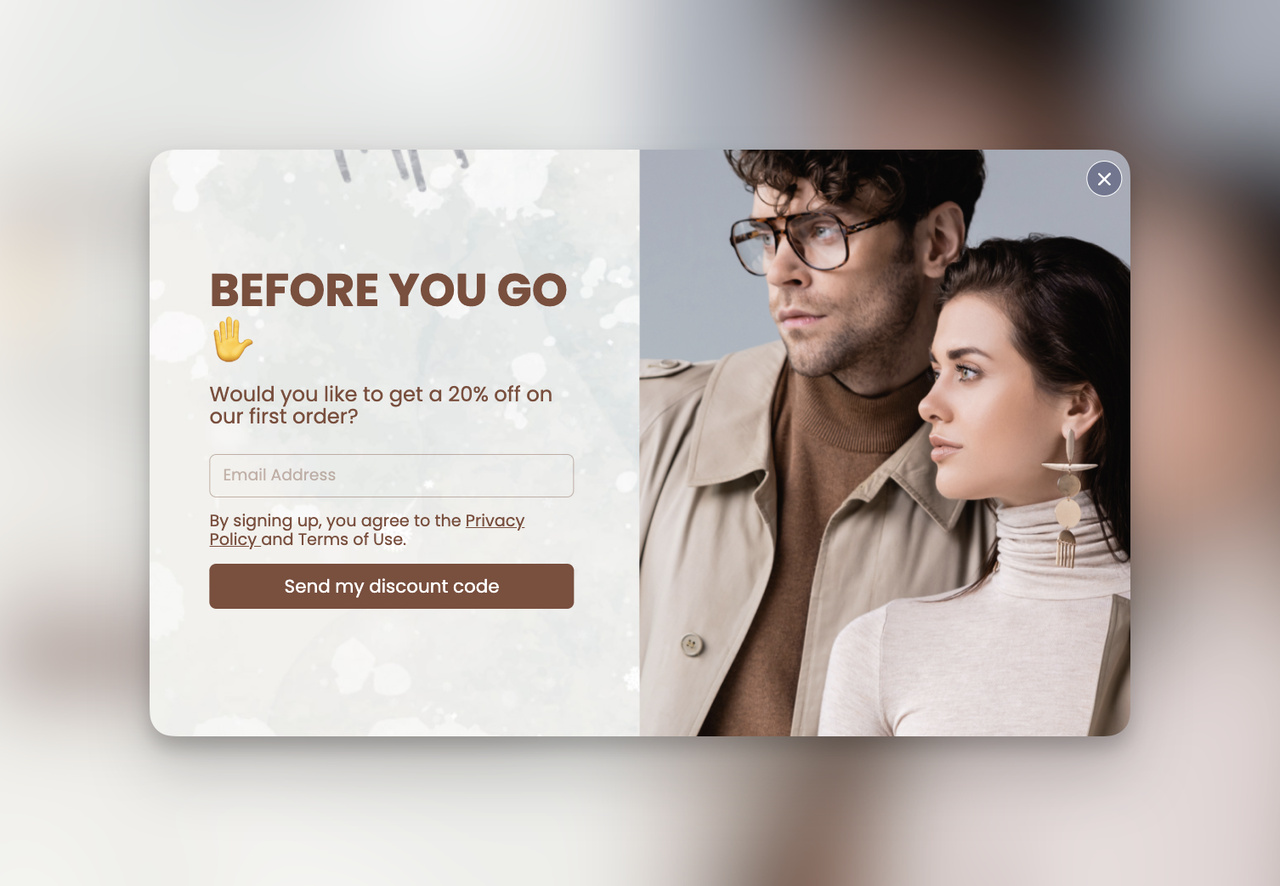
Feel free to use the following exit-intent popup as a template to create your own!
🌟 Bonus: For more exit-intent popup examples, see 55 Exit Intent Popup Examples to Increase Conversions
Exit intent is a courtesy more than a conversion trick. In our 2026 benchmark, exit intent shows no statistically reliable advantage: popups on the most sensitive exit-intent setting converted 1.10% vs 0.78% without exit intent (median campaign), a gap that could be chance. We cover the full test in do exit-intent popups work?
Time-Sensitive Discount Popups
These popups create a sense of urgency by offering a discount for a limited time. Most use a countdown timer to get the visitor to act.
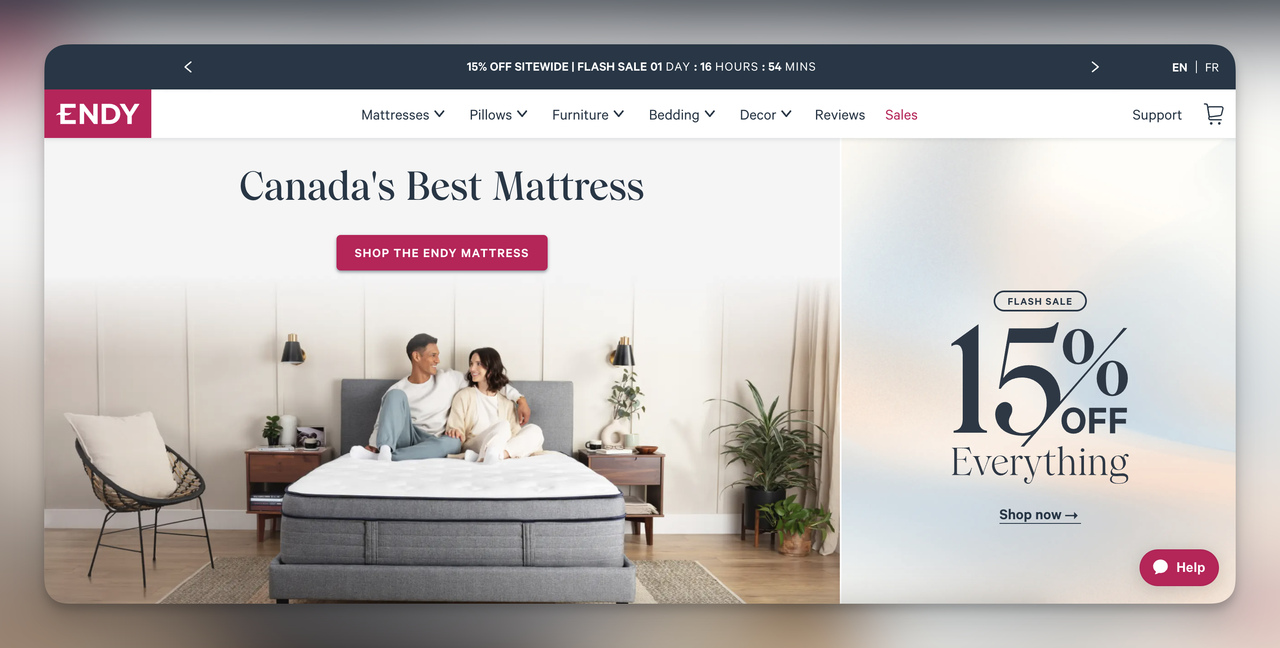
Here is a time-sensitive discount popup example from Endy:
What's Working & What Could Be Better?
- The floating bar blends into the site's design.
- The prominent countdown timer is a smart move: it gives the visitor a deadline.
- The CTA "Shop now" is direct and easy to find.
- The concise discount message can be taken in at a glance.
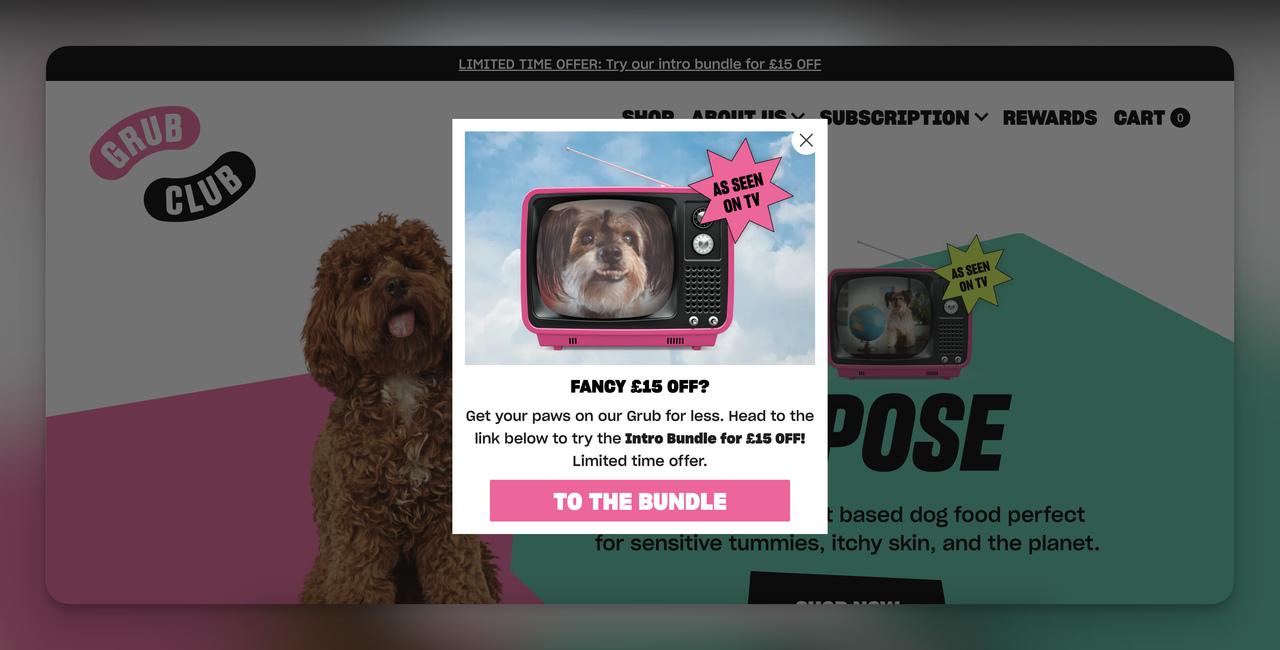
Here is a time-sensitive discount popup example from Grub Club:
What's Working & What Could Be Better?
- The popup shows eye-catching images linking well to the pet food product.
- The headline is fun and clear, immediately telling customers about the saving.
- The brightly colored "TO THE BUNDLE" button is easy to spot, guiding users towards the deal.
- Adding "Limited time offer" to the message makes people act quickly to get the deal.
- Though the popup is fun and clear, a countdown timer might increase urgency and speed up customer action.
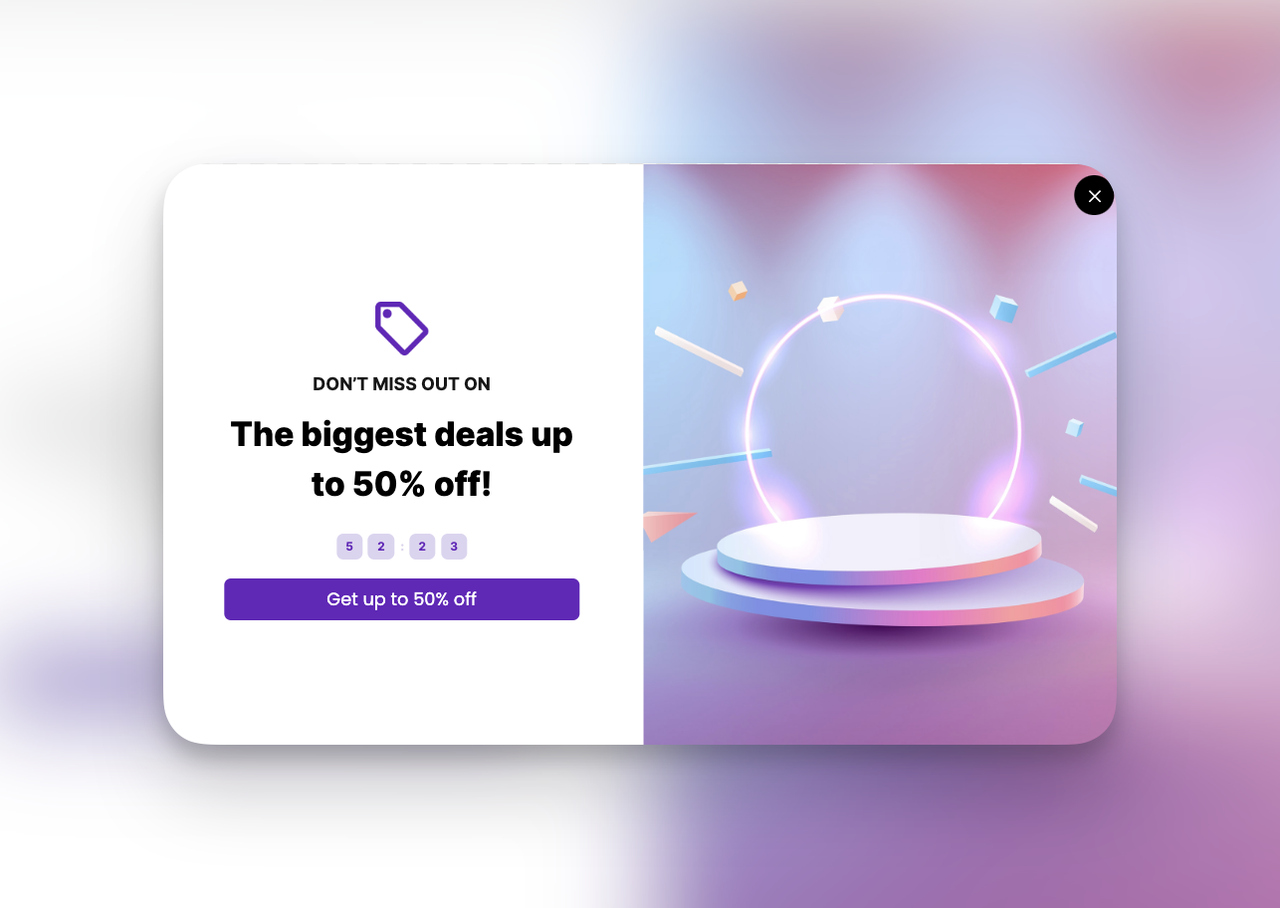
Want a similar popup? Use this one as a duplicate and tweak it as needed:
🌟 Bonus: For more ideas on limited-time offers, check out the blog 'Limited-Time Offers: 7 Examples To Increase Your Conversions'. It goes further into urgency.
Seasonal or Event-Based Discount Popups
These seasonal campaigns are timed around events or seasons like Black Friday or Christmas. The discount is themed to match, and it reaches shoppers who are already in a buying mood.
A seasonal discount popup from Ana Luisa:
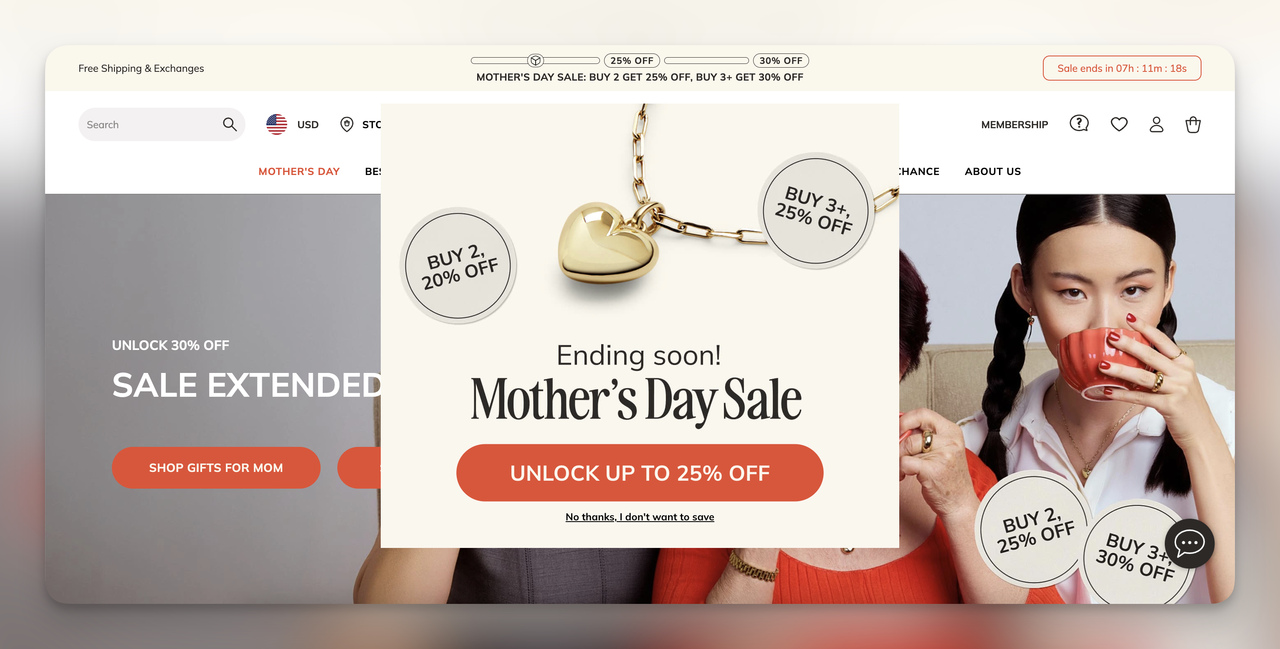
What's Working & What Could Be Better?
- The popup features clear, attractive visuals of the product on sale, which show the items clearly and tie into the Mother’s Day theme.
- The headline and subtext "Ending soon! Mother's Day Sale" pair urgency with a discount that grows as the shopper buys more items.
- The “UNLOCK UP TO 25% OFF” CTA is prominently displayed and stands out with color contrast.
- The tiered discount structure is a good strategy to encourage larger purchases.
- Adding the line “No thanks, I don't want to save” gives users the freedom to refuse the offer. They can say no without feeling cornered, and the wording still reminds them they're passing up a chance at "saving."
Check out this discount popup example from Cupshe:
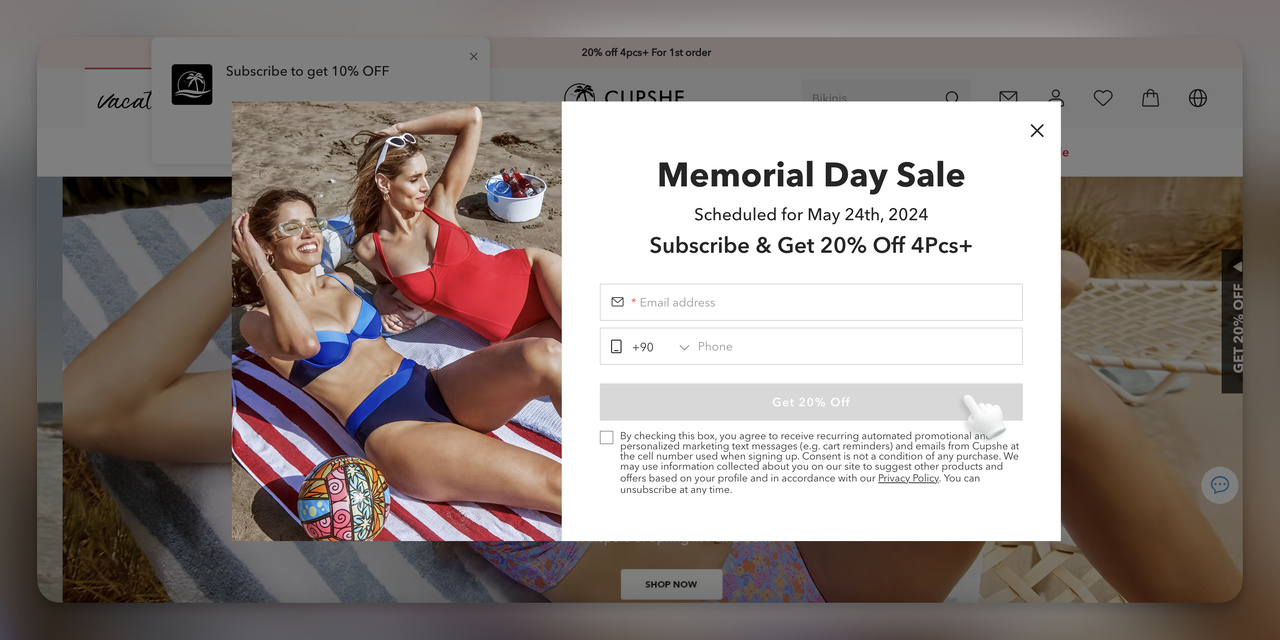
What's Working & What Could Be Better?
- The popup uses eye-catching summer images that fit Memorial Day and the start of summer.
- The "Memorial Day Sale" headline combined with "Subscribe & Get 20% Off 4Pcs+" explains the deal and how to get it. The holiday and the benefit both come through.
- The "Get 20% Off" button ties directly to the subscription action, clearly telling the user how to get the deal.
- The offer's conditions require buying four items or more, which can drive bigger purchases but may not appeal to those wanting less.
- The popup asks users to agree to marketing messages. This is honest but may turn off some people who don't want promotional content.
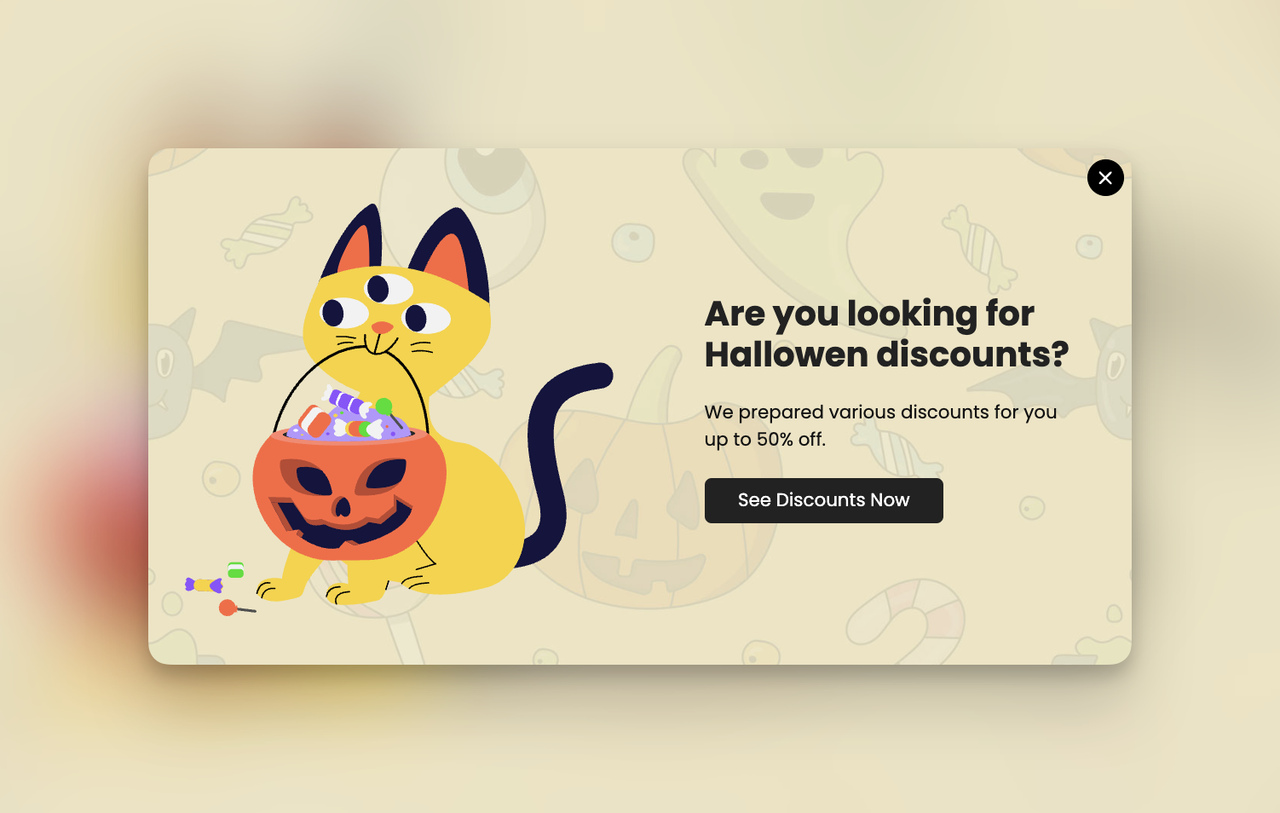
Need a starting point? This seasonal popup can be cloned for your own use:
Spin-to-Win (Gamification) Popups
Interactive and game-like, these popups invite visitors to spin a virtual wheel to win a discount or a special offer. This can increase engagement and make the shopping experience more fun.
Engagement is the right word for what our data shows. Spin-to-win and other gamified popups get far more clicks (7.33% vs 1.87% of displays, median campaign; the spin itself counts as a click), but do not collect measurably more email or phone leads than plain signup popups.
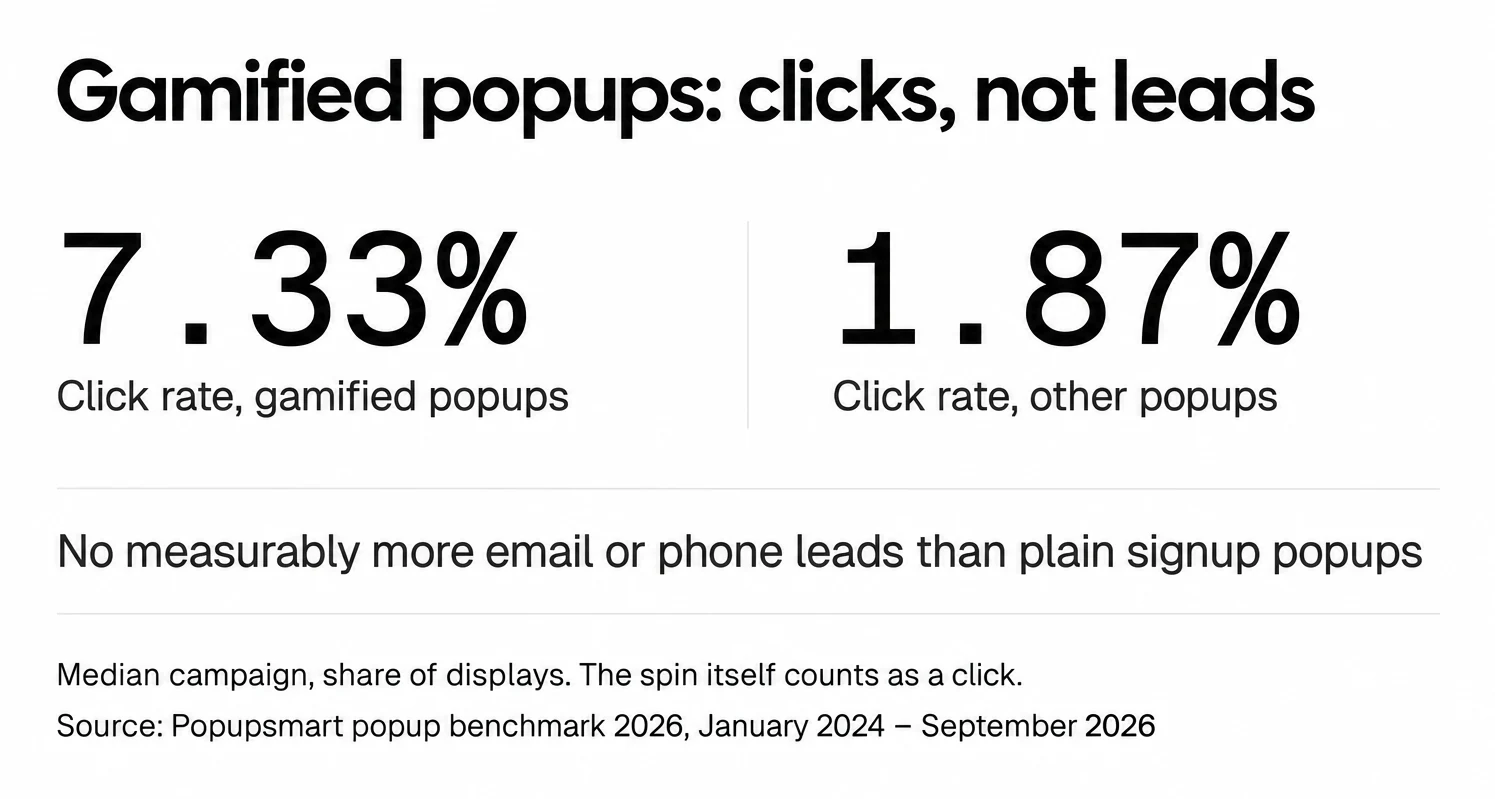
So pick a wheel when you want the fun and the engagement, not because you expect more signups than a plain offer. Our spin-to-win popup guide covers how to set one up.
Here's a spin-to-win popup from Ana Luisa:
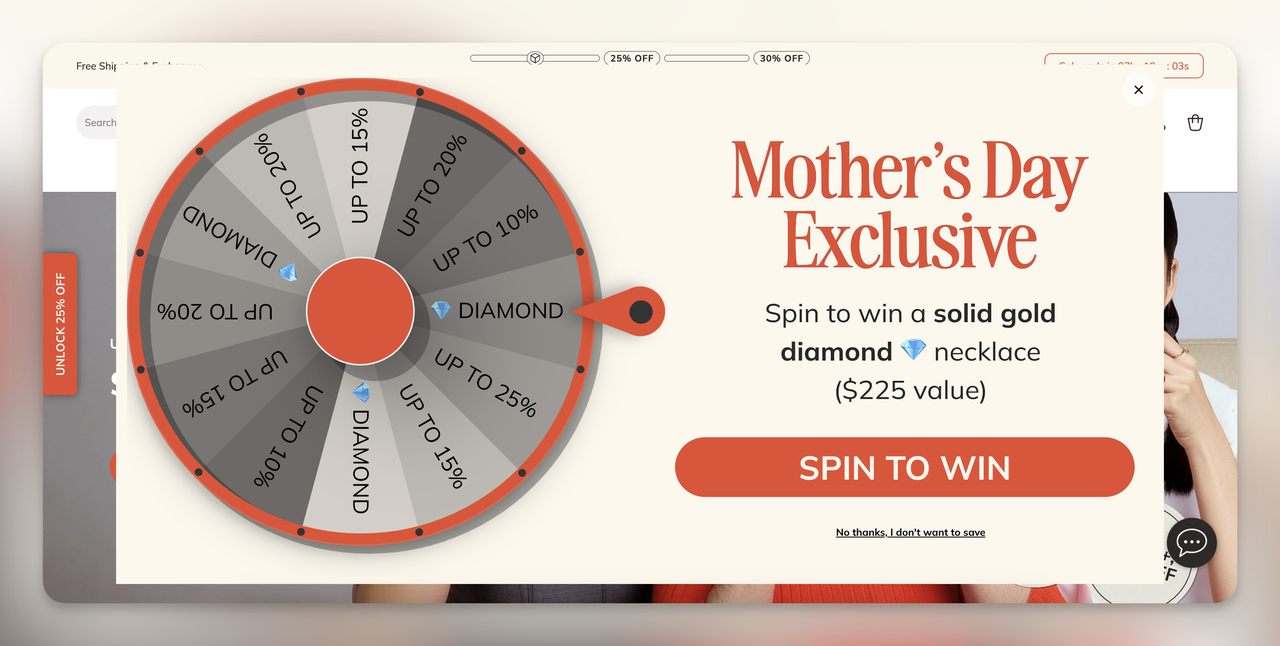
What's Working & What Could Be Better?
- The bright and fun spinning wheel makes the popup stand out, inviting users to take part.
- The headline with a chance to "Spin to win a solid gold diamond necklace" ties a big prize to the event.
- The "SPIN TO WIN" CTA is lively and straightforward, encouraging people to get involved.
- Showing the possible prizes (discounts and a grand gift) gives users a reason to play.
- Including "No thanks, I don't want to save" lets users say no easily, respecting their choice.
Darn Good Yarn runs a spin-to-win discount popup too:
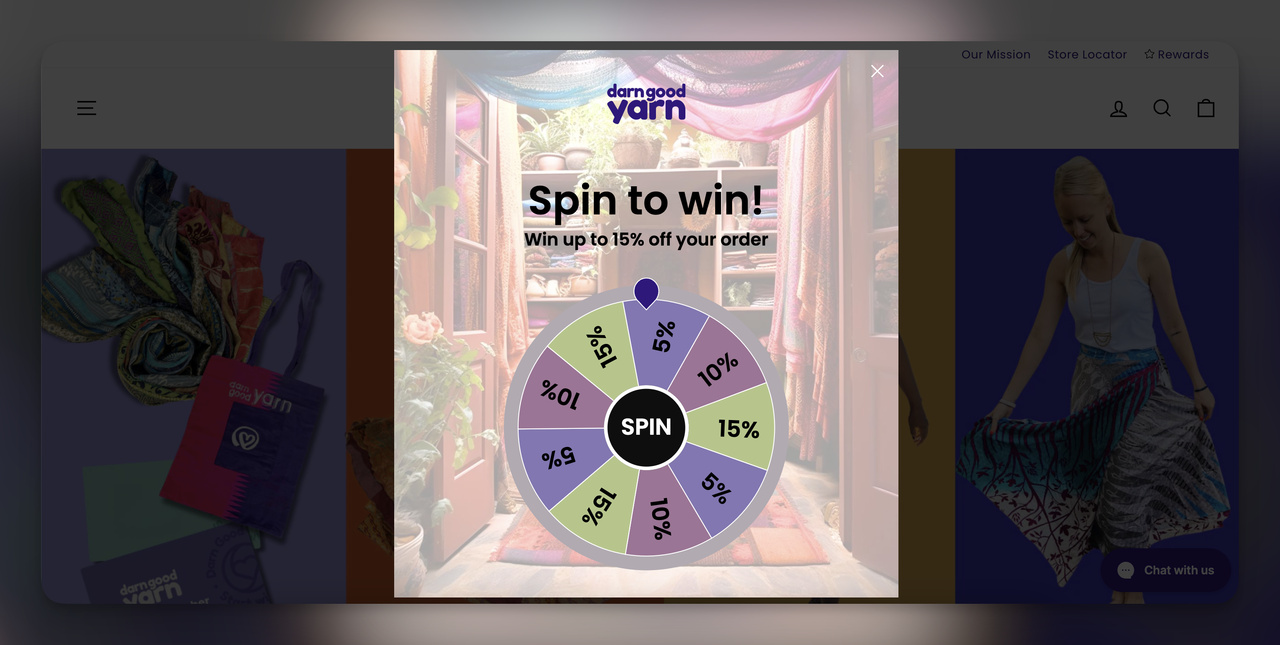
What's Working & What Could Be Better?
- The colorful wheel design in the popup looks fun and matches Darn Good Yarn’s crafty spirit.
- "Spin to win! Win up to 15% off your order" tells users what they can win, making it appealing and clear.
- The big “SPIN” CTA grabs attention and invites users to play the game.
- Turning shopping into a game makes visiting the site more fun and engaging.
- Potential discounts are easy to see on the wheel, letting users know what they could win.
If you'd like to create a discount popup like the examples above, you can freely clone the popup below:
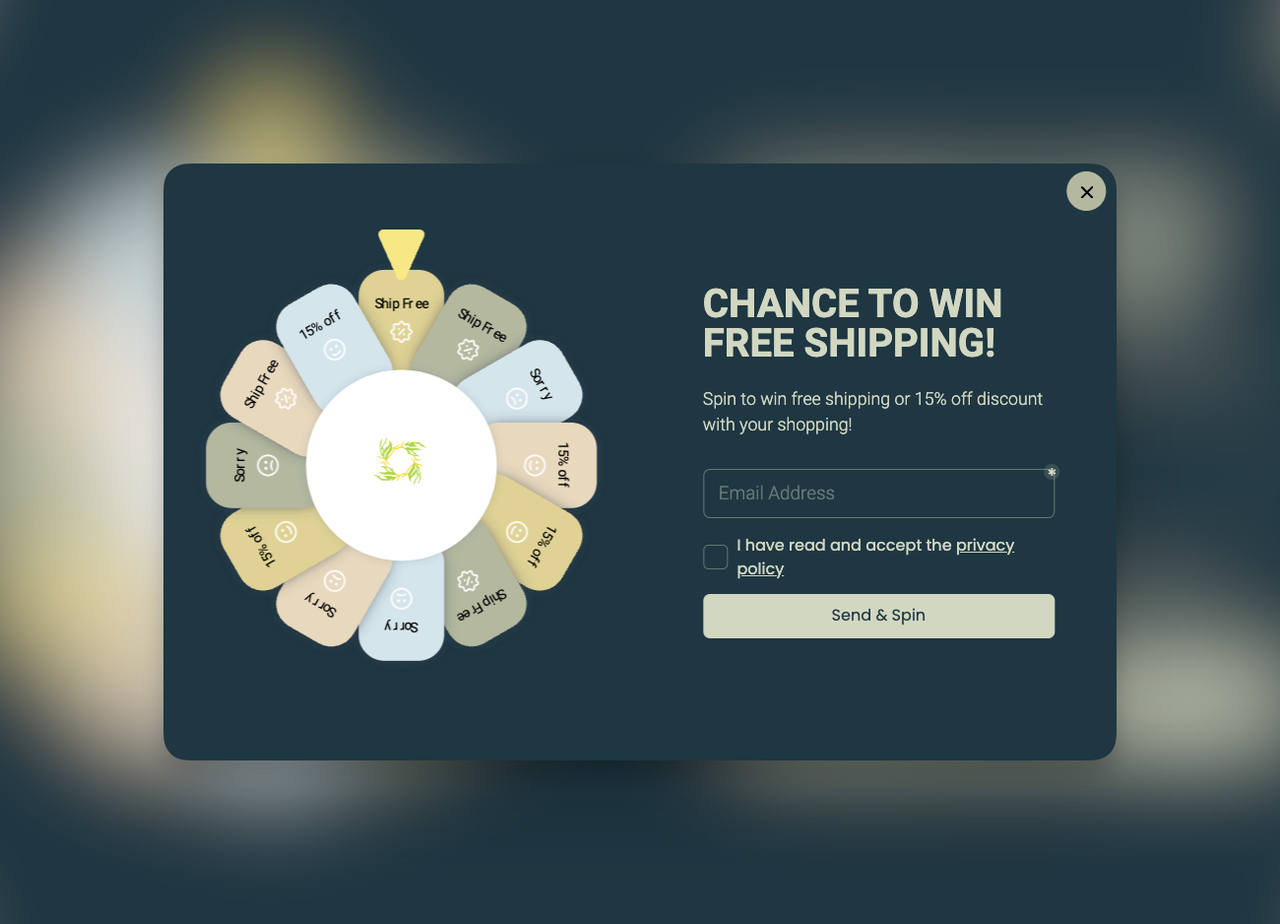
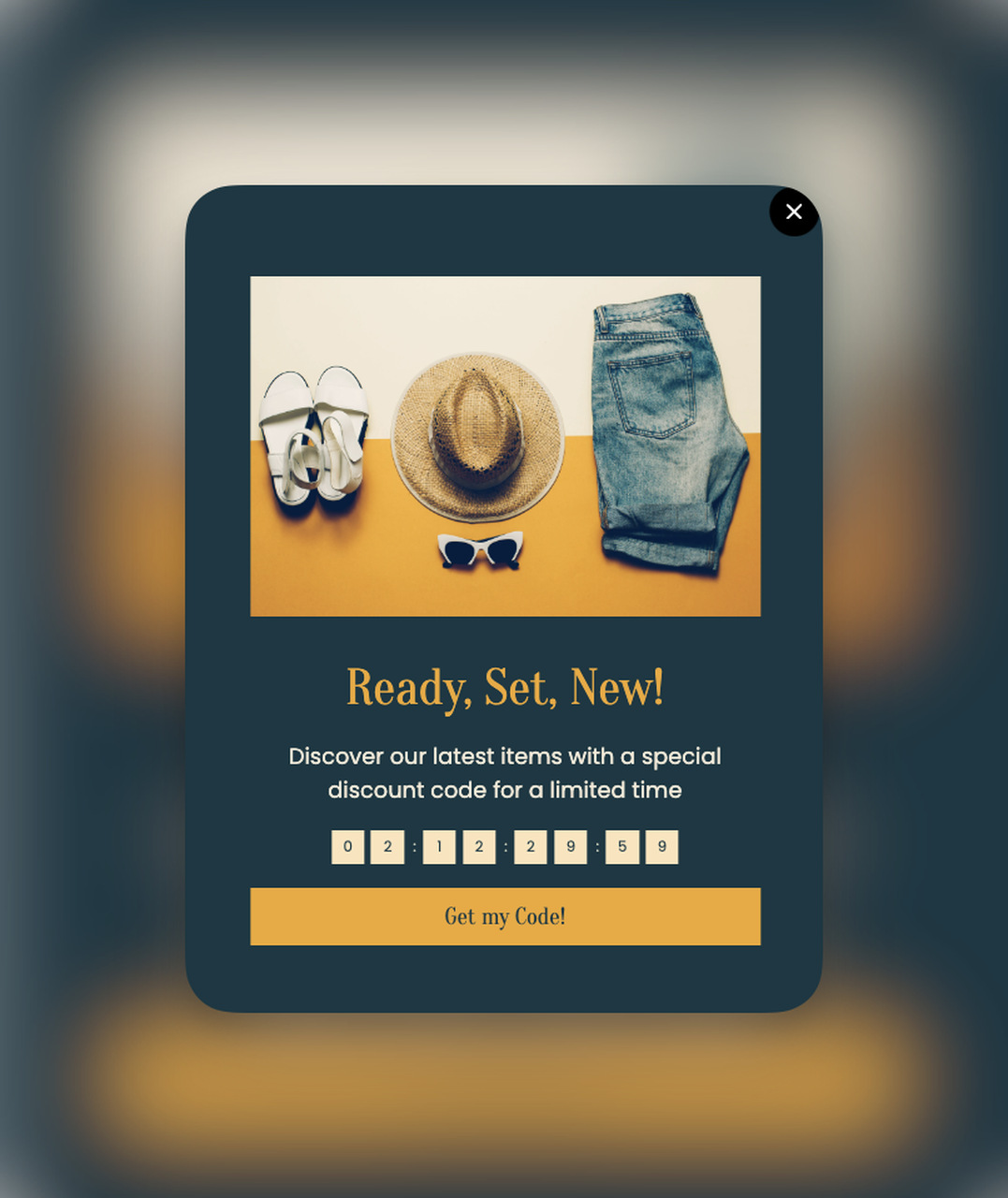
Mystery Discount Popups
Mystery discount popups get shoppers to buy or subscribe by hiding the size of the discount. Users don't know how much they'll get until they interact with the popup, and that curiosity can increase form conversion rates as people click to see their offer.
One catch: a surprise only works if it's worth having, so make sure every possible offer is.
Here is a mystery discount popup example from Blume:
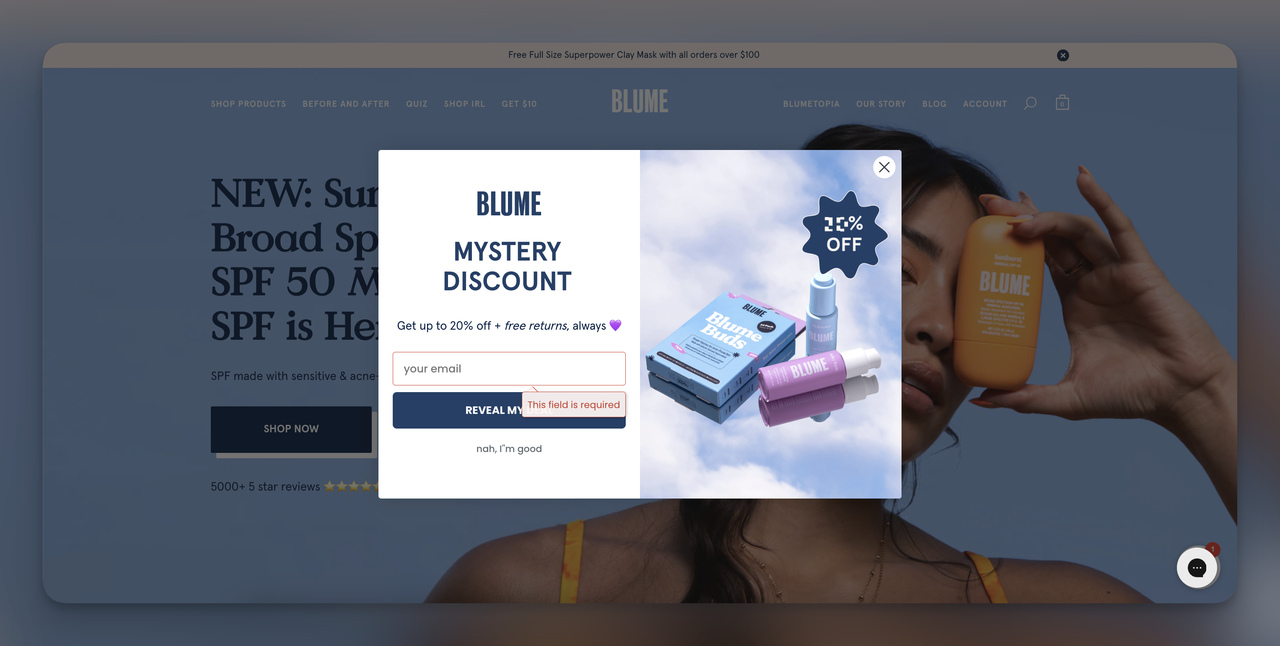
What's Working & What Could Be Better?
- The selected image fits Blume's brand: the products on sale, the display and background, the discount code and the design all match.
- Since this is a mystery discount, using “reveal my discount” as a CTA is a good idea. Words such as unlock or uncover also work.
- The "nah, I'm good" option sounds like a brand that knows how its audience talks. The casual tone suits the young, informal Blume customer base, and it still reminds users what they're passing up.
Need a starting point? This mystery discount popup can be cloned for your own use:
Survey Discount Popups
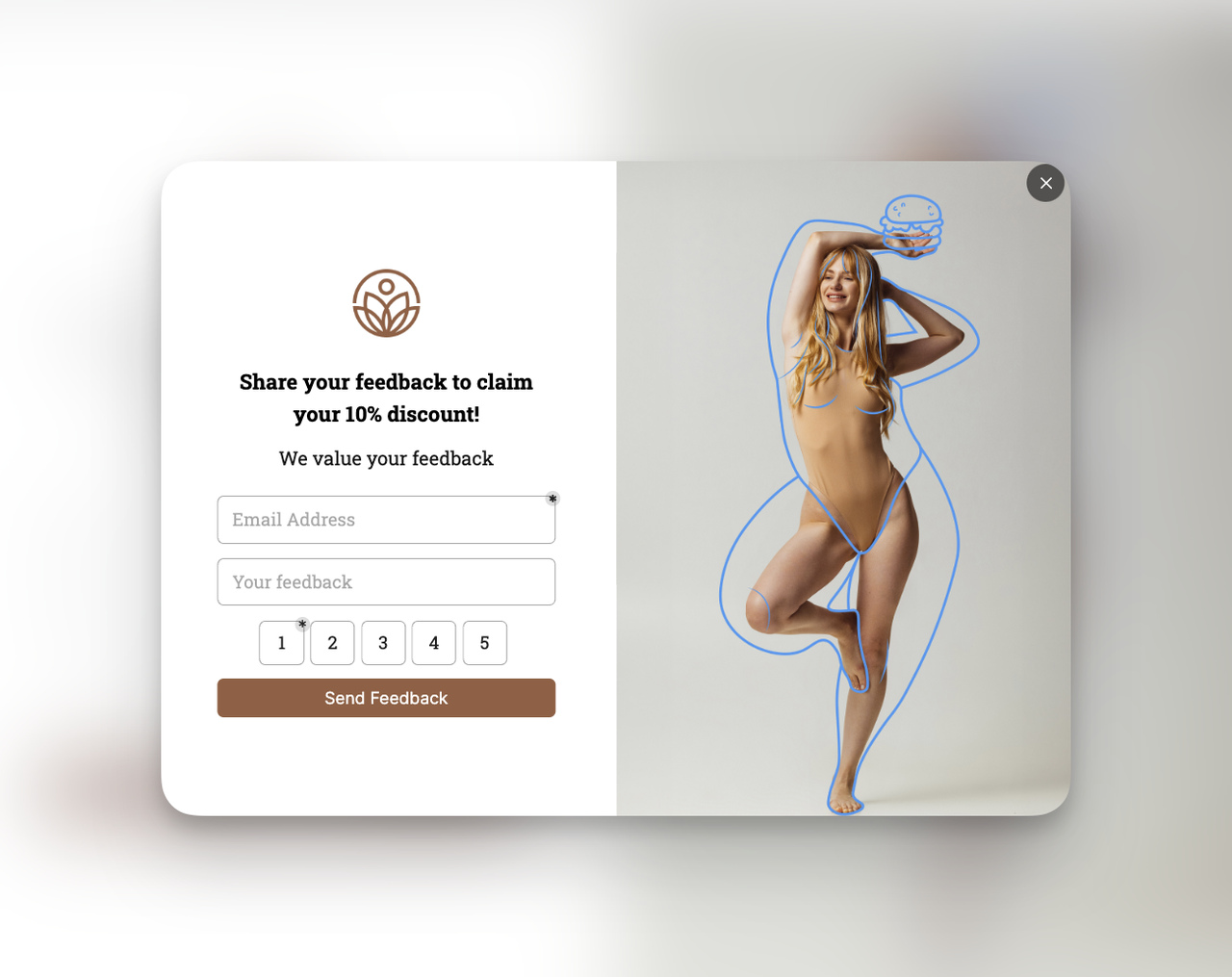
These popups trade a discount for the user's input or feedback. You get engagement, and a way of gathering valuable data from your customers.
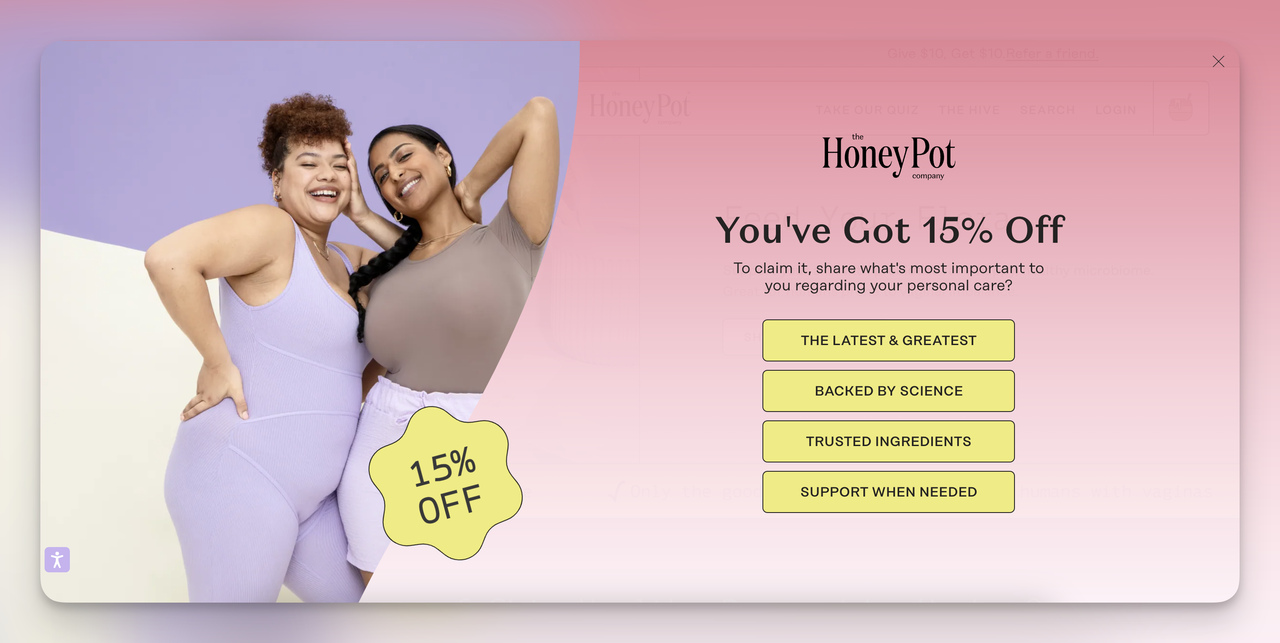
Here is a survey popup example from The Honey Pot:
What's Working & What Could Be Better?
- The popup takes the full screen, so nothing distracts from the questions, which likely helps more people finish.
- A 15% discount is clearly displayed and gives users a reason to take part.
- Clearly labeled buttons guide users through the survey.
- The popup needs explicit details about the survey, such as the number of questions or estimated time to complete. If you want to use this kind of popup, you should add a progress bar; this could help increase survey completion rates.
Feel free to use the following survey popup as a template to create your own!
Loyalty and Referral-Based Discount Popups
Loyalty popups reward repeat customers with discounts, which helps keep them coming back. Referral popups give customers a reason to bring in others, so your customer base grows.
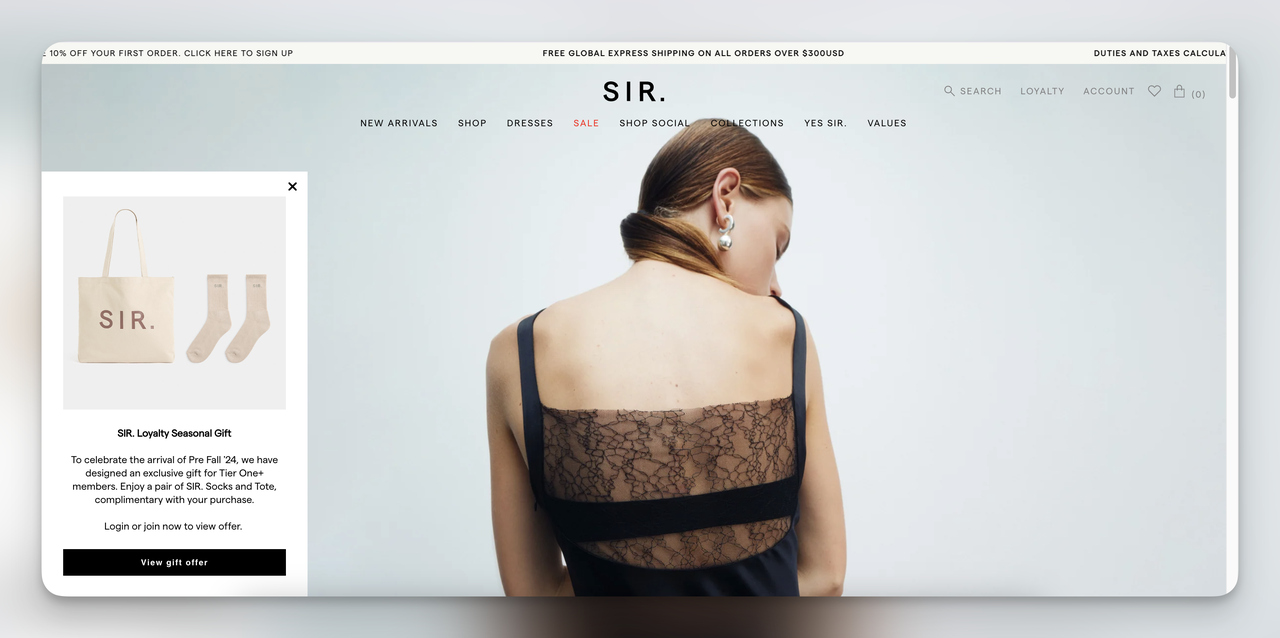
A loyalty discount popup from SIR.:
What's Working & What Could Be Better?
- The popup promotes an exclusive seasonal gift for their plus members, a good way to reward loyalty and bring members back. An exclusive gift also makes the membership itself feel worth more.
- The design is clean and sophisticated, matching SIR.'s overall aesthetic. The product images (tote and socks) show exactly what members get, so the offer feels real.
- The "View gift offer" button is prominent and plain, and it tells members how to claim their reward.
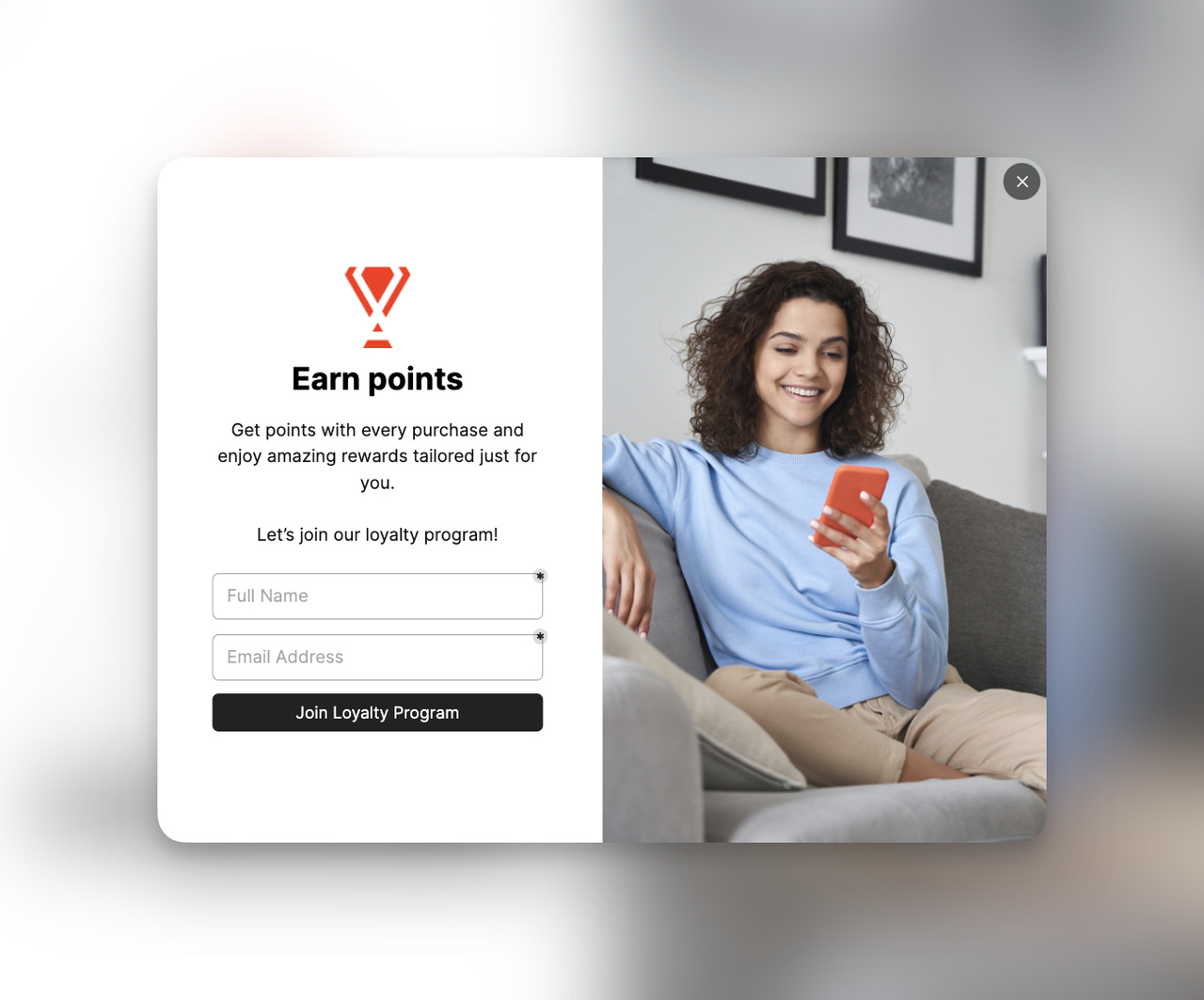
This loyalty and referral-based discount popup can be cloned for your own use:
How to Create Discount Popup?
You can create a discount popup, also known as a sales promotion popup, in several ways, depending on the platform your website runs on. The methods fall into these groups:
1. Shopify's own app: If your ecommerce store is on Shopify, the free Shopify Forms app, made by Shopify, can show a signup form with a discount and a trigger (its App Store listing, read on 1 October 2026). You create and manage the discount code itself in Shopify's Discounts section.
2. WordPress Popup Plugins: For websites built on WordPress, plenty of plugins can create sales promotion popups. Plugins like Popup Maker and OptinMonster allow you to customize according to your needs; see how they compare in Popupsmart vs Popup Maker and Popupsmart vs OptinMonster.
3. Ecommerce Platforms: Many other ecommerce platforms like WooCommerce, BigCommerce, and Magento offer options and extensions for creating custom popups.
4. Marketing Automation Tools: Email tools like HubSpot and Mailchimp also offer popup forms as a part of their marketing tool suite.
So why would I pick Popupsmart from these options?
Popupsmart is a no-code popup builder that works on almost any website platform. My reasons:
- User-Friendly: Even with zero design or programming skills, you can build a popup from a template, or ask the Popupsmart AI agent in the app to build and publish the whole campaign from a chat request.
- Versatile: Popupsmart is not limited to Shopify or WordPress only; one snippet installs it on Shopify, WordPress, Webflow, Wix, Squarespace or a custom site.
- Advanced Targeting: Popupsmart offers 18+ targeting and trigger options by its own count, so you can decide when your popup appears, on which device, and to which audience.
- Coupon codes built in: the Coupon Code element shows a fixed code, an existing Shopify discount, unique codes from a list, or a unique Shopify code created for each visitor.
That's why I'd use Popupsmart for sales promotion popups. On to the steps. The app screenshots below are from May 2024, so a few labels may look different in today's app.
Step 1: Choose a popup builder & sign up
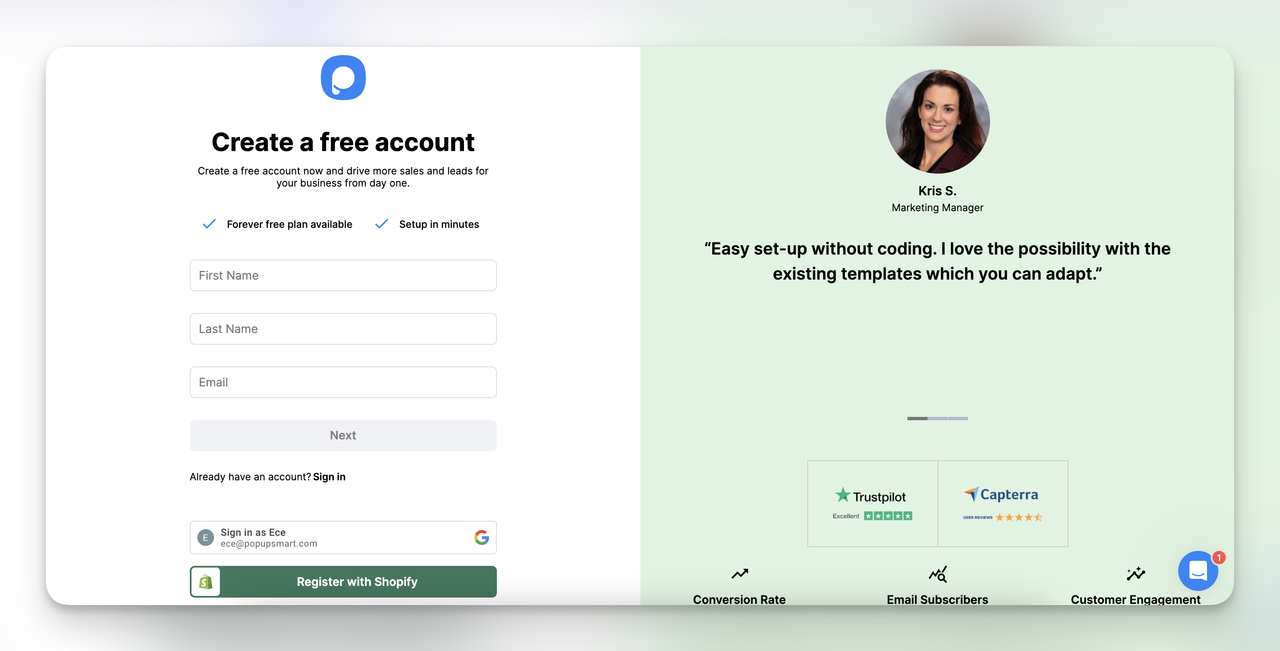
We'll use Popupsmart from here on. Follow the steps and you'll have a discount popup running on your website. The free plan is permanent, not a trial: one website, one live campaign and 5K pageviews a month.
Sign up for Popupsmart to use its free plan.
Step 2: Connect your website and start creating your first popup.
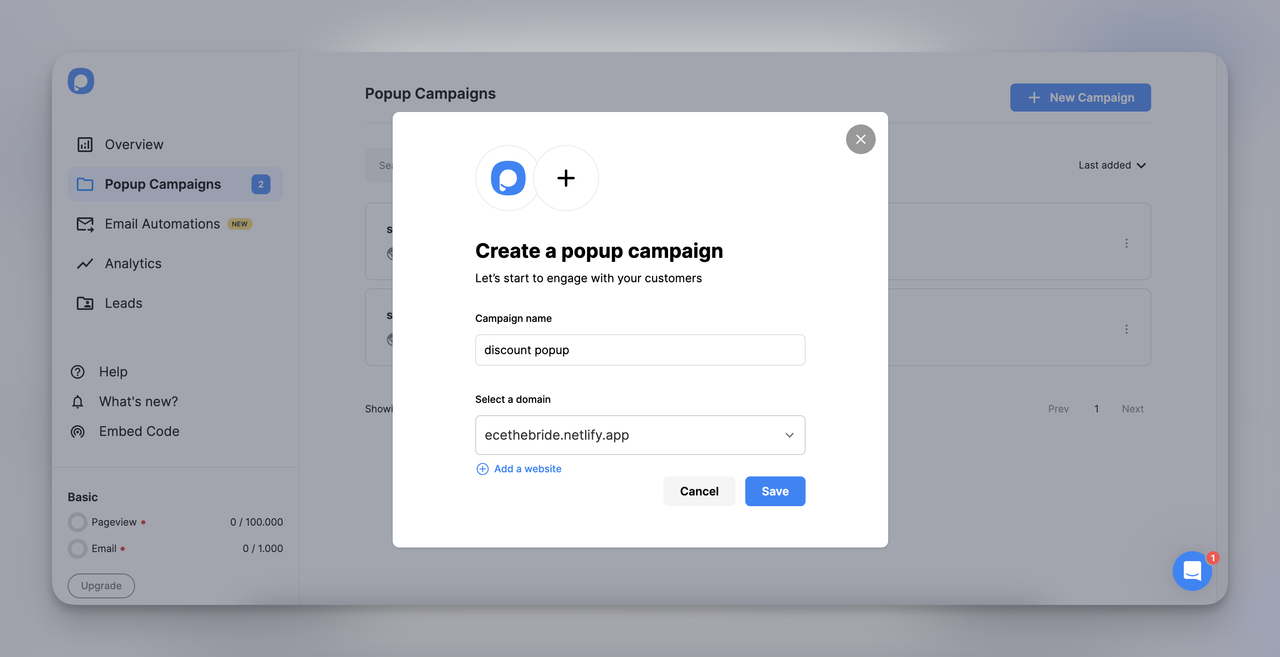
Paste Popupsmart's embed code between the
tags in your site's template file to connect your website.To see this step in more detail, go to the help center guide how to embed the code on your site and return here to create a discount popup.
Click “+New Campaign” at the top right and choose your website.
Step 3: Choose your template
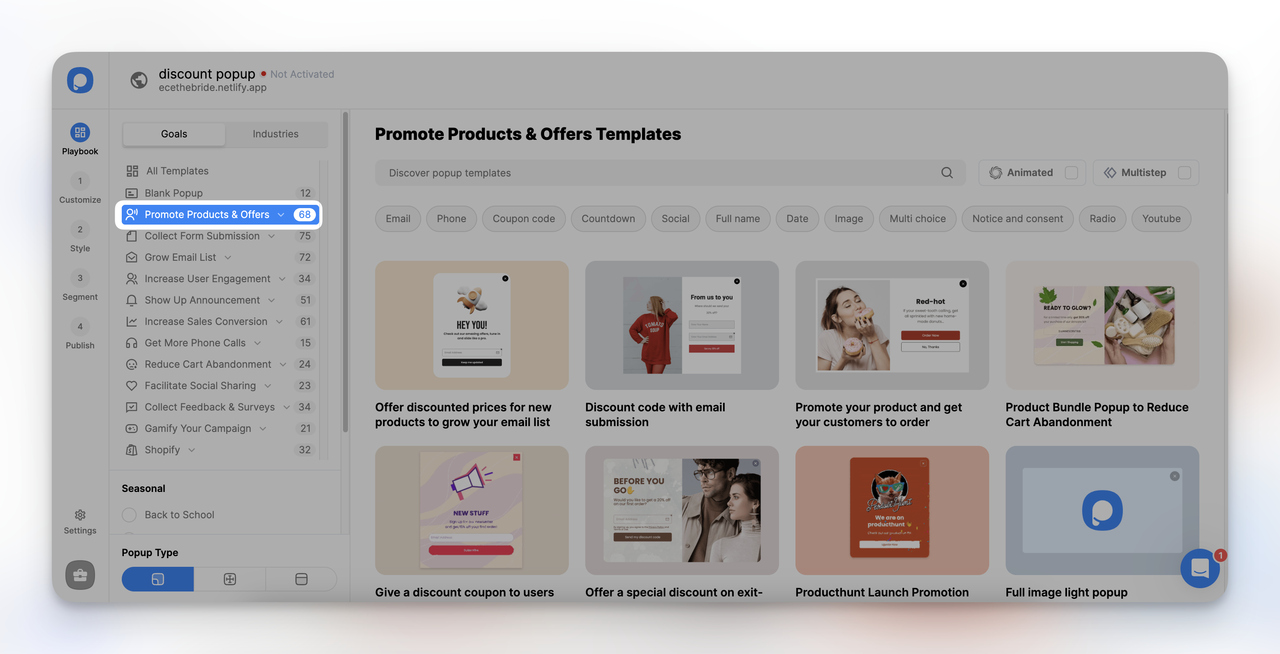
Popupsmart lists 500+ ready-made templates. To skip the hassle, choose the "promote products & offers" goal and pick a template that you like, or browse the popup template library first.
Step 4: Customize your discount popup
You can change anything in the template you picked: swap the image, and drag and drop the text where you want it.
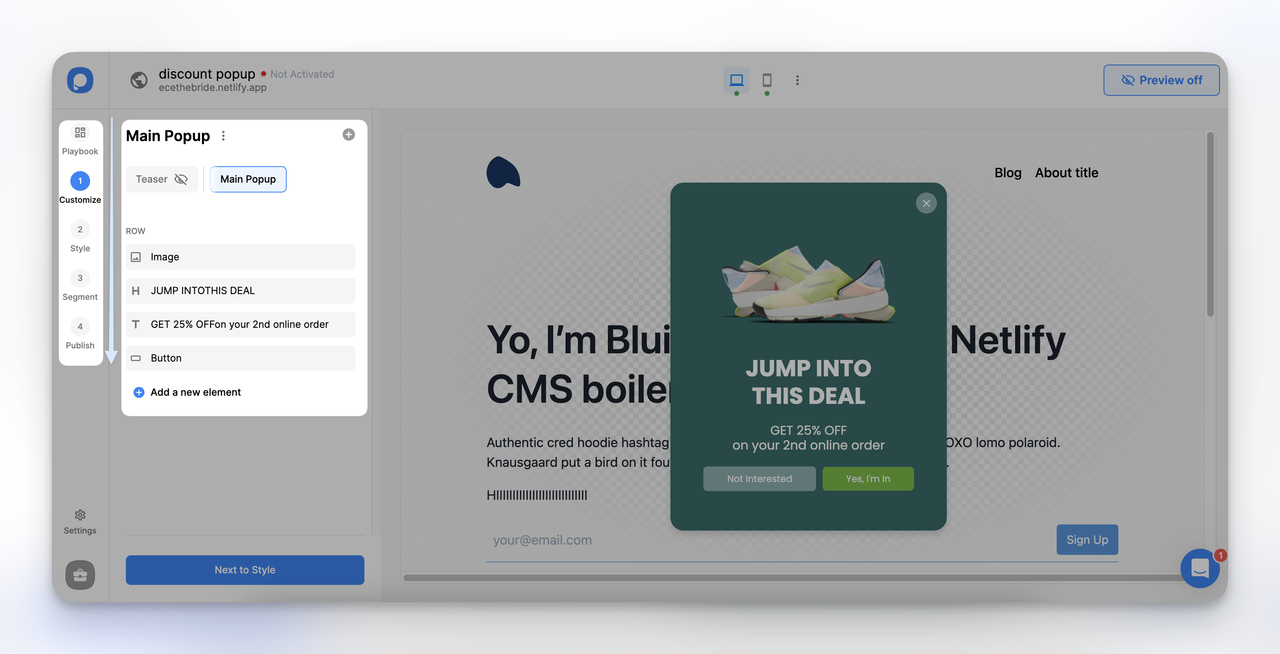
You can also add new elements, such as a countdown timer, a coupon code or anything else that comes to mind. The full list:
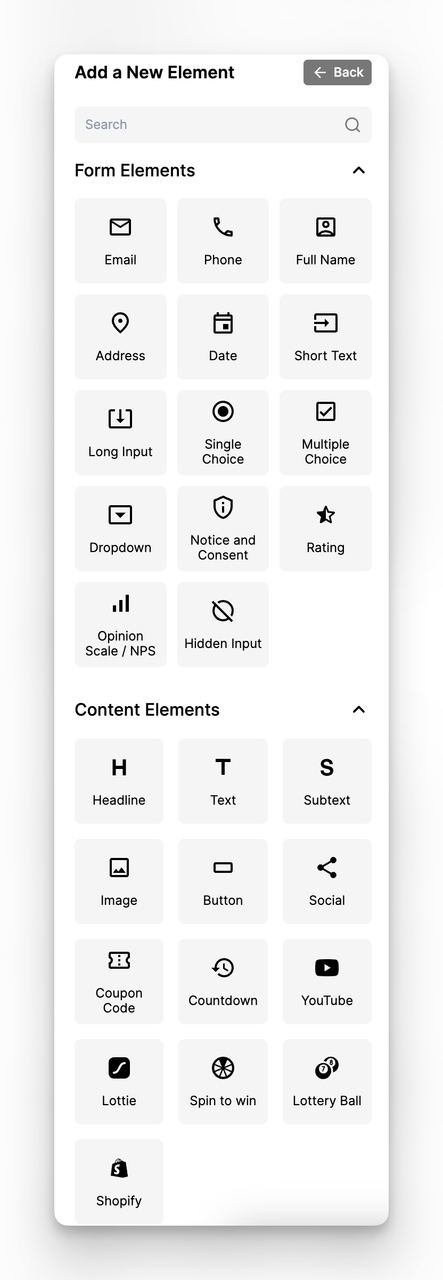
To turn it into a coupon popup, add the Coupon Code element (Customize > Add a new element > Coupon Code). Popupsmart's help center lists four types: a fix coupon (the same code for everyone), existing discount coupons (an active Shopify code), unique coupons (a list or CSV of codes, which must also exist in Shopify) and dynamic unique coupons (a unique Shopify code created for each visitor; the same email gets the same code again). The steps are in how to add a coupon code to your popup.
Step 5: Style your popup
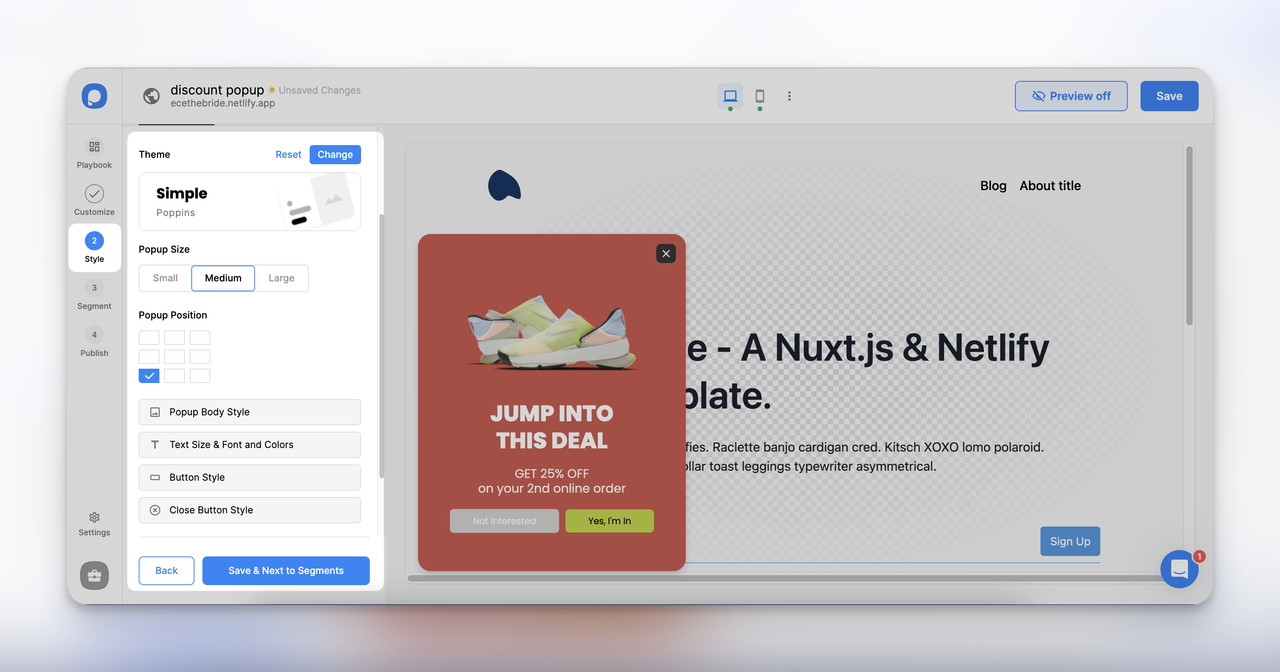
This is where you can decide how and where (small, medium, large) your popup is positioned, change the background as you wish, decide on button style, close button style, and many other things.
Step 6: Target the right visitor at the right time
This step matters most. Popupsmart offers 18+ targeting and trigger options by Popupsmart's own count, so your discount reaches an audience ready to see it instead of everyone, including the visitors it would only annoy.
With targeting options such as exit-intent targeting, after-scrolling, and sitedata targeting, you decide who sees the popup and when.
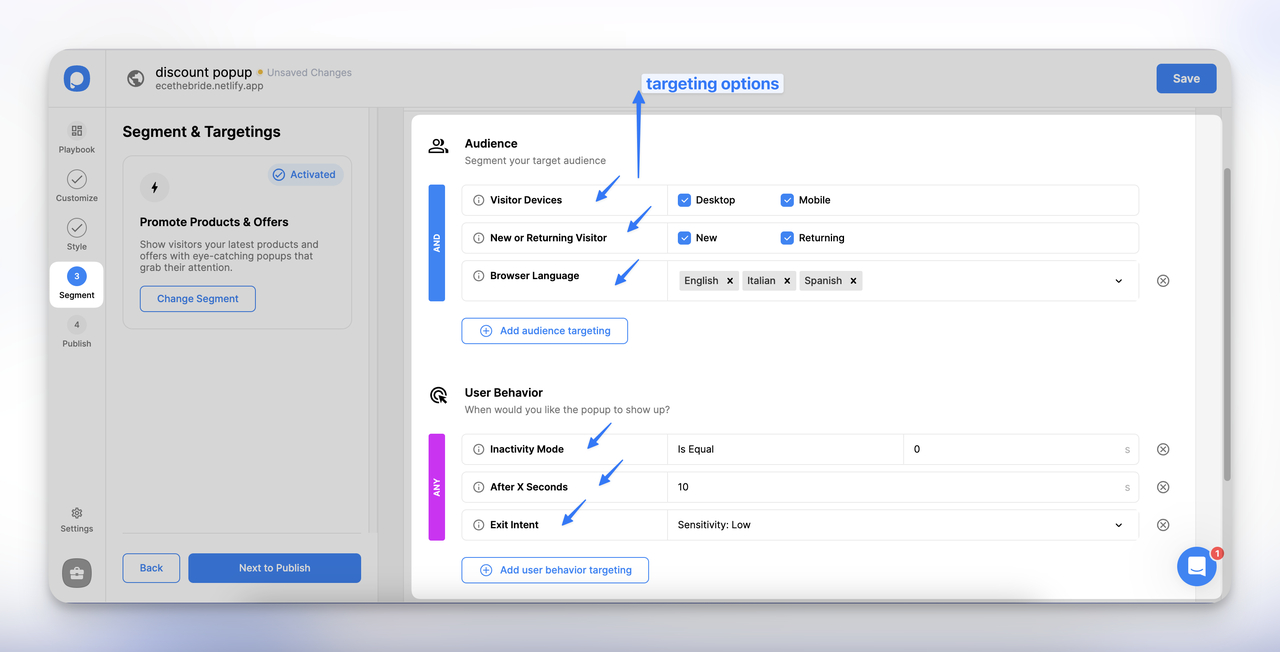
Two targeting choices matter most for a welcome discount, according to our 2026 benchmark:
- Show it to new visitors. New visitors convert on popups more often than visitors who were on the site in the previous 7 days: the same popup converts better for new visitors in 75% of campaigns (median gap 0.30 percentage points; pooled 1.28% vs 0.54% of displays).
- Cap how often it shows. The first two times a visitor sees a popup in a week convert at similar rates (1.33% and 1.22% of displays, pooled); from the third view conversion falls, and from the sixth view it is 0.41%, 31% of the first-view rate.
Step 7: Publish your discount popup
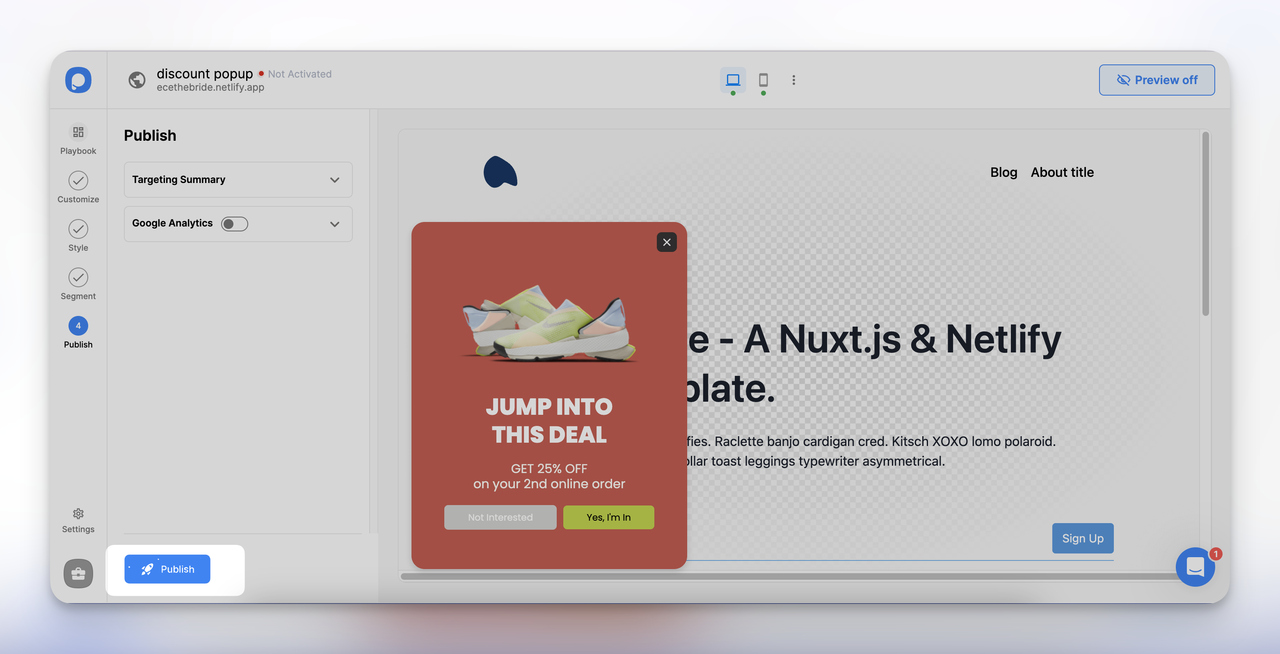
That's everything. Click "publish" and the popup starts offering your discount to visitors.
Wrap-Up: Best Practices for Discount Popups
Discount popups help online stores attract customers and grow their email lists. How well they do it comes down to the details below.
⌛ Timing and Triggering
- Don't show the discount popup the instant someone lands on your site. Popups that wait before appearing convert 0.83% vs 0.61% for popups shown the instant the page loads (median campaign); the direction holds in every year of data but the difference is not statistically reliable, so treat it as a lean, not a rule. The exact delay length (0-5 seconds vs 21-60 seconds) makes no measurable difference to conversion, so a short delay is enough.
- Use exit-intent popups to catch shoppers on their way out with one last offer. Treat it as a courtesy: our data shows no statistically reliable advantage for exit intent.
- Trigger popups based on user actions, like scrolling to a certain point on a page or spending a specific amount of time on a product category, so the offer arrives when it's relevant.
🖼️ Design and Layout
- Keep your popup design simple and uncluttered. Use bold colors and clear fonts to make the offer stand out, but make sure it matches your brand's aesthetics.
- Design popups that look good on all devices, especially on mobile, since many people shop online using their smartphones and tablets.
- Use high-quality images that are relevant and eye-catching. For example, if the discount applies to a specific item, show it being used.
✍️ Content and Messaging
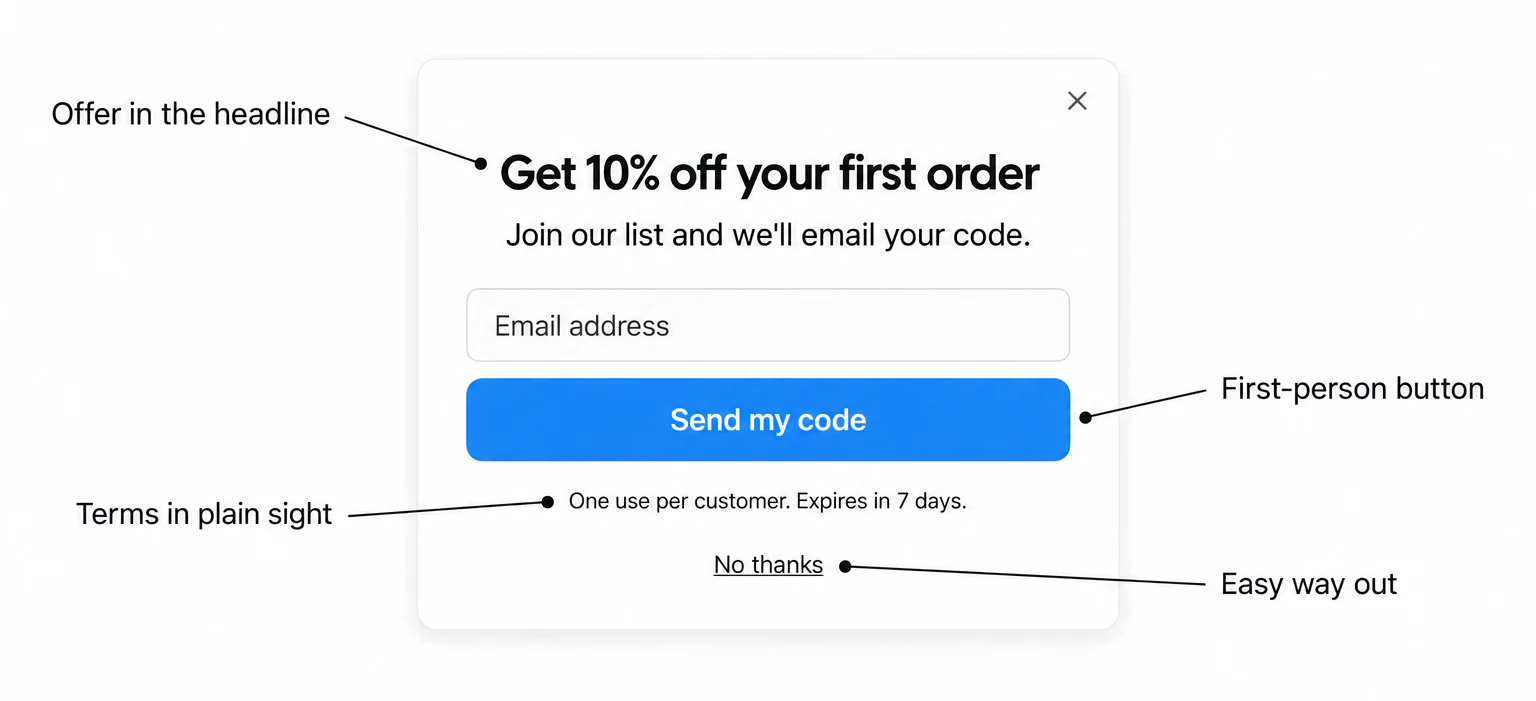
- Use direct headlines like "Get 20% Off Your First Order!" to let visitors know the value of the offer immediately.
- Make your call-to-action buttons large and easy to click, and use action-oriented text like "Claim Your Discount" or "Get My Coupon." First-person buttons ("Send my code") convert 1.18% vs 0.80% for neutral wording (English popups, median campaign). Buttons that promise value ("Get", "Claim", "Unlock") look stronger than "Subscribe" / "Join" buttons (1.06% vs 0.77%), but the gap is not statistically reliable.
- Say what the visitor gets for interacting with the popup: a discount, free shipping, or a gift on their next purchase.
🪟 Offer Transparency
- Clearly explain the terms of the discount, including any minimum purchase required, the offer's expiration date, and which products or categories it applies to.
- Use elements like customer testimonials or a counter showing how many people have used the offer successfully to build trust.
🛣️ Compliance and User Experience
- Always provide an easy way for users to dismiss the popup if they're not interested, like a simple "No thanks" link or a visible close button.
- Make sure your popup strategy complies with legal requirements, such as the GDPR, especially if you're collecting email addresses or personal information.
🎯 Personalization
- Use customer data to create more personalized popup offers. For instance, returning visitors could receive a different message from first-time visitors.
- Change the popup's content based on behavior or demographics so the offer fits the visitor.
Build the popup for the shopper first. A clear offer, sensible timing and an easy way out give your discount its best chance of converting without hurting your brand. For more code ideas to put in the popup, see our list of coupon code ideas.
Frequently Asked Questions
How to Write a Discount Offer Message for a Discount Popup?
Writing a discount offer message requires clarity, conciseness, and a compelling call-to-action. Your message should clearly state the discount being offered, the terms of the discount, and how to redeem it.
Make it as concise as possible; avoid overly complex language or terms. Your call-to-action should tell visitors what they get when they click. Use phrases like "Claim Your Discount Now" or "Send my code". In Popupsmart's 2026 benchmark, first-person buttons ("Send my code") convert 1.18% vs 0.80% for neutral wording (English popups, median campaign).
How to Personalize Discount Popups?
Personalizing discount popups can significantly increase their effectiveness by making them more relevant to the individual user. Here are strategies to personalize your popups:
- Segment Your Audience: Use data to segment your audience based on their behavior, purchase history, or demographics. Tailor the popup message according to these segments, such as targeting first-time visitors with a welcome discount or returning customers with a loyalty bonus.
- Utilize Behavioral Triggers: Customize popups based on user behavior on your site. For example, display a specific discount popup when a visitor spends a certain amount of time on a particular product page or is about to exit after adding items to their cart.
- Dynamic Content: Implement dynamic content in your popups that changes based on the data you have about the visitor. This could include their name if known, their location, or even the weather in their area.
- Retargeting: Use retargeting tools to show personalized popups based on the user’s previous interactions with your site. For example, offer a specific product discount to someone who viewed that product but left the site without purchasing.
- Integrate with CRM: Connect your popup tool with your Customer Relationship Management (CRM) system to use existing customer data for personalized offers. This can include previous purchase behavior, loyalty status, or birthday discounts.
Do discount popups work?
In Popupsmart's 2026 benchmark (January 2024 to September 2026), signup popups that offer a discount code convert 1.46% vs 0.75% for signup popups without one, and popups stating 10% off convert 1.25% vs 0.67% for popups that state no discount. Each rate is leads divided by popup displays, for the median campaign.
What discount percentage works best in a popup?
Our data can't name a best percentage. Bigger discounts did not convert measurably better: 10% off converted 1.25%, 20% off 0.91% and 25-30% off 1.33%, but the larger-discount samples are small (78 and 46 campaigns), so the data cannot rule out a real difference either way. Pick the discount your margins can carry.
How do I add a discount popup on Shopify?
Shopify's free Shopify Forms app can show a signup form with a discount. For more control over targeting and codes, add a popup builder such as Popupsmart: pick a discount template, add a Coupon Code element (a fixed code, an existing Shopify discount, unique codes from a list, or a unique Shopify code created for each visitor), choose who sees it and when, and publish.