
85 Funny Email Subject Lines That Work Like a Charm


 ChatGPT
 Perplexity
 Claude
 Grok
Grok Google AI Mode
Humorous subject lines can boost opens and reduce spam reports by sparking curiosity while fitting your brand voice. The post shares 85 examples (including promos and apology emails) and tips like mild humor, wordplay, clear CTAs, and not being too vague.
Table of contents (25)
Funny email subject lines cut through inbox noise by triggering curiosity and an emotional response that plain promotional copy can't match. According to The Loop Marketing, 47% of email recipients open messages based solely on the subject line. The 10 real-brand examples below show exactly how humor drives opens across e-commerce, SaaS, and DTC campaigns. We also added 75 additional funny email subject lines you can adapt for your email campaigns.
What Makes a Funny Email Subject Line Actually Work?
I've reviewed hundreds of email campaigns, and the subject lines that earn laughs (and clicks) share a few common traits. Not every attempt at humor lands, though. Some brands try too hard and come off as awkward. Others nail it because they follow a pattern, even if they don't realize it.
Here's what separates the winners from the cringe-worthy attempts:
• Unexpected twist: The subject line sets up one expectation, then breaks it. Smartwool's underwear email (below) does this perfectly.
• Brand-appropriate tone: Who Gives A Crap can make toilet jokes. A B2B invoicing tool probably shouldn't. The humor has to match the brand voice your audience already knows.
• Curiosity gap: The best funny subject lines don't give away the punchline. They make you click to get the full joke.
• Brevity: According to Porch Group Media, the average email subject line is 43.85 characters. Funny ones that go shorter tend to hit harder because the reader processes the joke instantly.
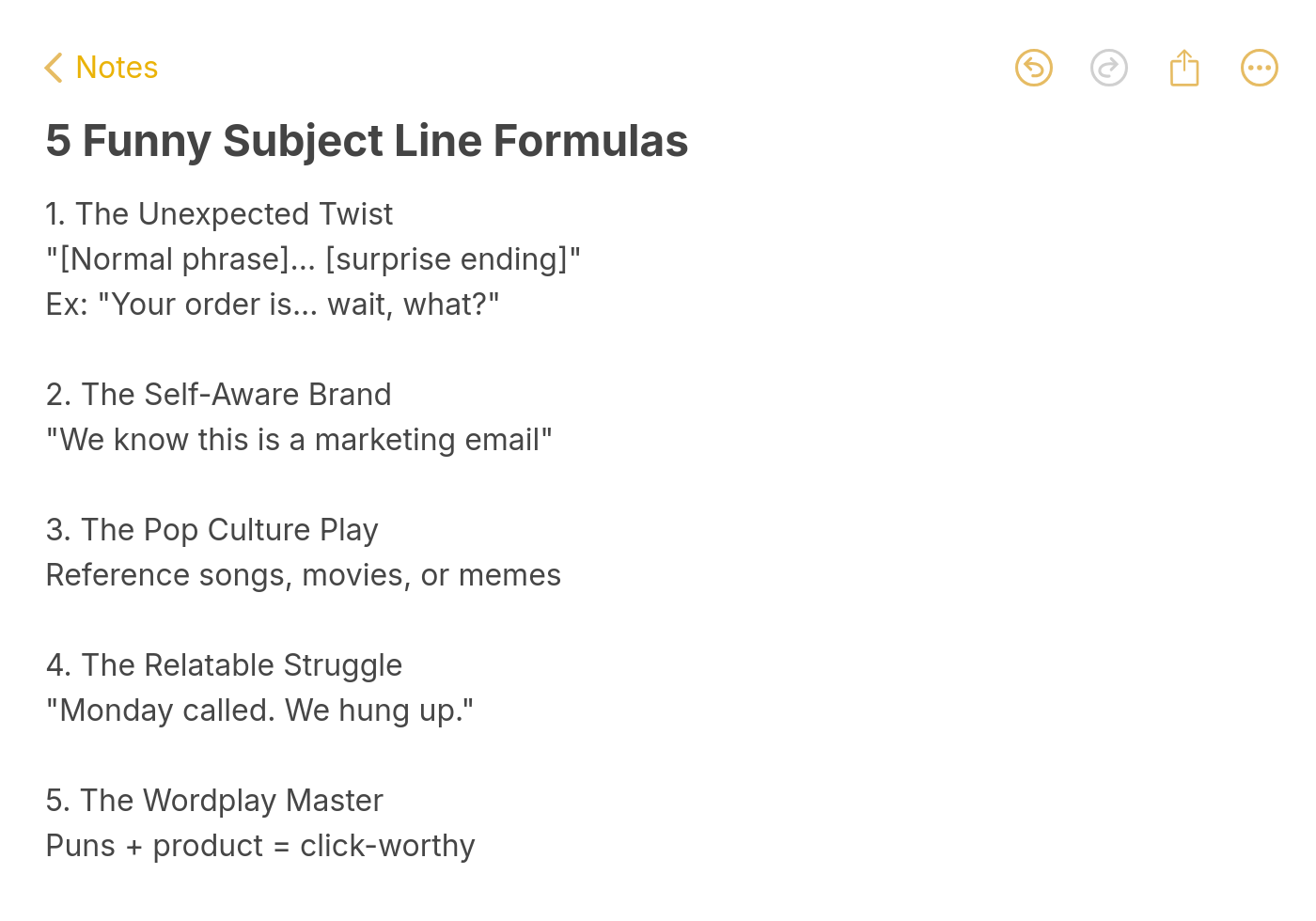
• Emotional trigger: Wordplay, self-deprecation, pop culture references, or relatable struggles all work because they spark a micro-emotion before the recipient decides to scroll past.
Five humor formulas that drive email opens
Why Does Humor Boost Email Open Rates?
Humor works in email subject lines for the same reason it works in conversation: it disarms people. When your inbox is stacked with promotional noise, a subject line that makes you smile earns a second look.
According to Sequenzy, funny subject lines can boost open rates by 15-30% and make brands 40% more memorable compared to straightforward alternatives. That memorability compounds over time. Subscribers start looking forward to your emails instead of auto-archiving them.
There's a psychological angle too. According to Drip, citing Psychology Today, laughter reduces pain, improves oxygen flow to the heart and brain, and helps people tolerate discomfort. In email terms, that discomfort is the mental friction of deciding whether to open yet another marketing message. Humor lowers the barrier.
Yet most brands don't even try. According to Prospeo, 69% of people say they'd open brand emails more often if subject lines were funnier, but only 24% of business leaders actually use humor in their email marketing. That gap is your opportunity.
Quick Look at 10 Funny Email Subject Lines That Actually Drove Opens
| # | Brand | Subject Line | Why It Works |
|---|---|---|---|
| 1 | Smartwool | "The underwear you didn't know you needed." | Curiosity gap + absurdity |
| 2 | TicTail | "Boom shakalak! Let's get started." | Unexpected energy for onboarding |
| 3 | GOBE | "Oops, we got a bit excited" | Self-deprecating apology humor |
| 4 | Chili Sleep | "It's a ruff life" | Wordplay targeting pet owners |
| 5 | Who Gives A Crap | "It's pronounced 'craptcha'" | On-brand wordplay |
| 6 | Koala | "Fall in love (without the risk)." | Emotional misdirection |
| 7 | Cowboy | "Forget your keys." | Relatable problem, clever payoff |
| 8 | 1973 Ltd | "Should you be afraid of the Dark (Mode)?" | Double meaning + trending topic |
| 9 | Pop culture | "Is It Too Late Now to Say Sorry?" | Bieber lyric for re-engagement |
| 10 | FilterEasy | "Oops: Someone Hadn't Had Their Coffee Yet" | Relatable, low-stakes apology |
1. Smartwool: The Curiosity-Driven Product Tease
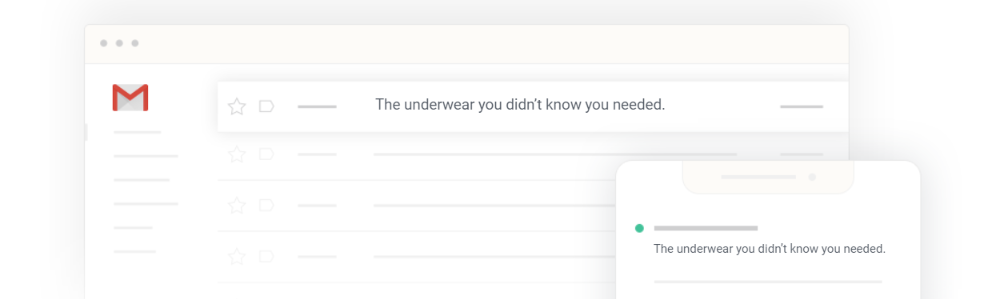
Subject line: "The underwear you didn't know you needed."
Smartwool's inbox-stopping subject line
What works: Smartwool sells merino wool socks and base layers. Not exactly a category where people expect comedy. That mismatch is the whole point. "The underwear you didn't know you needed" pairs a mundane product (underwear) with an absurd premise (you don't know about your own wardrobe needs?). The vagueness forces the open. What underwear? Why do I need it? The recipient clicks to resolve the gap.
The email body continues the humorous tone
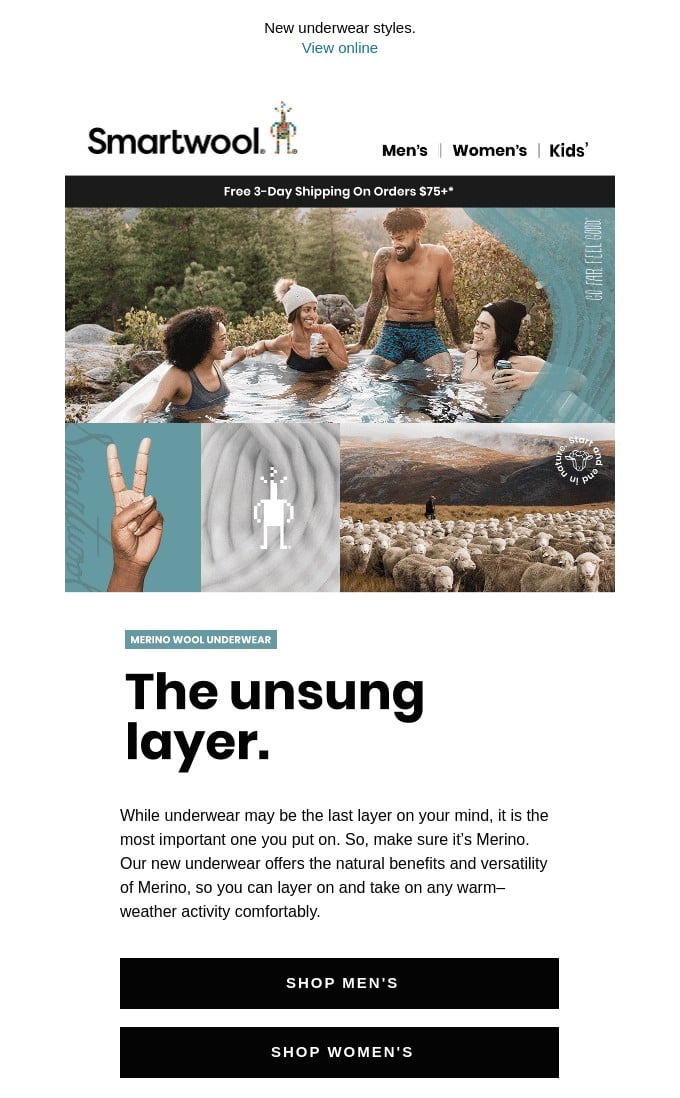
Why it works: This taps into what psychologists call the "information gap theory." When there's a gap between what we know and what we want to know, curiosity drives us to close it. Smartwool creates that gap in seven words. The humor continues inside the email with copy calling underwear "the unsung layer," keeping the tone consistent through to the Shop CTAs.
Key takeaway: Pair a boring product category with an unexpected claim. The contrast between mundane and absurd creates a curiosity gap that practically forces the open. Keep the humor going inside the email so the click feels rewarded.
2. TicTail: High-Energy Onboarding That Skips the Corporate Script
Subject line: "Boom shakalak! Let's get started."
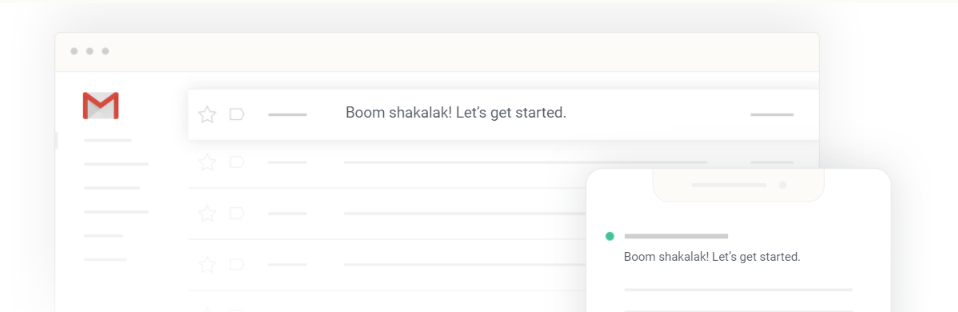
TicTail's energetic welcome email
What works: TicTail (now part of Shopify) sent this as a welcome email to new users. Most onboarding emails say "Welcome to [Brand]!" or "Get started with your account." TicTail replaced that template with a nonsensical exclamation. "Boom shakalak" has zero informational content, and that's precisely why it works. It signals personality immediately.
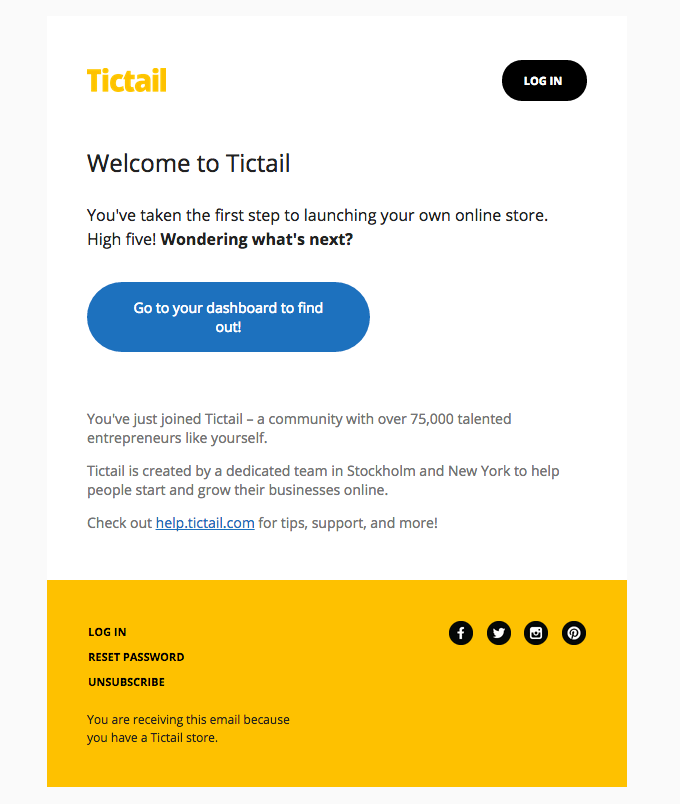
Clean email body with a single CTA
Why it works: Onboarding emails have a specific job: get the user to take a first action. The conventional approach (formal welcome, feature list, multiple CTAs) creates decision fatigue. TicTail's approach uses what behavioral economists call an "affect heuristic," where the positive emotional state created by the subject line carries into the email, making the single CTA ("Get started") feel easier and more inviting. This is a safe humor play because there's no joke to misinterpret. It's just energy.
Key takeaway: For onboarding or welcome sequences, swap the corporate greeting for something unexpected. You don't need a punchline. An unusual expression that matches your brand energy can outperform a polished but forgettable "Welcome aboard."
3. GOBE: Turning an Email Mistake into a Brand Moment
Subject line: "Oops, we got a bit excited"
What works: GOBE sent the wrong email to their list after launching a new website with a rebranded name. Instead of a stiff corporate apology, they leaned into the mistake with self-deprecating humor. "We got a bit excited" frames the error as enthusiasm rather than incompetence. The recipient thinks: excited about what? That drives the open.
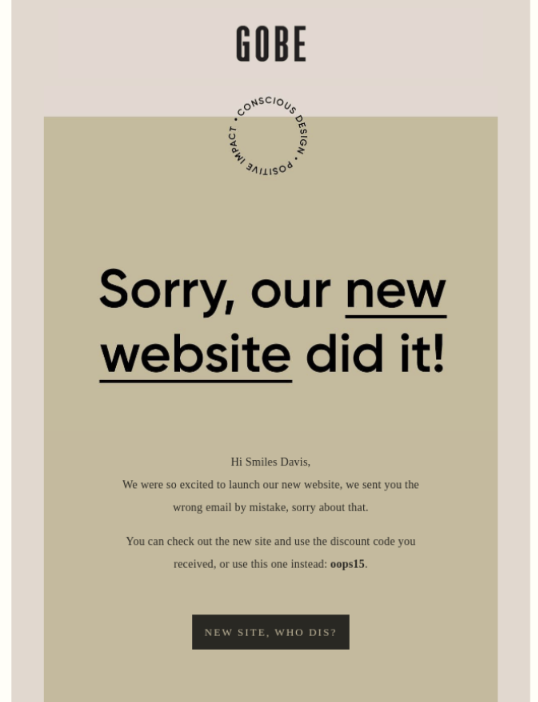
GOBE's apology email with a discount code recovery
Why it works: Apology emails are a category where humor is risky but rewarding. The email body says "Our website did it!" which shifts blame to the technology in a playful way. Then GOBE closes with a discount code, turning the mistake into a retention tool. This works because the email opening line sets a tone of honesty, and the discount reframes the error as a benefit to the customer. According to Quikly's analysis, self-deprecating humor aligns with benign violation theory, where a norm is violated (a brand admitting failure) but in a harmless way.
Key takeaway: When you make an email mistake, don't hide behind a formal apology. Own it with humor, explain briefly what happened, and offer something tangible (a discount, free shipping) to turn the error into a positive touchpoint.
4. Chili Sleep: Wordplay That Targets a Specific Audience
Subject line: "It's a ruff life"
What works: Chili Sleep sells temperature-regulating mattress systems. This email targeted pet owners who share their bed with dogs. The subject line uses "ruff" instead of "rough," a simple pun paired with a paw emoji in the original send. It's not trying to be stand-up comedy. It's trying to be relatable, and that's enough.
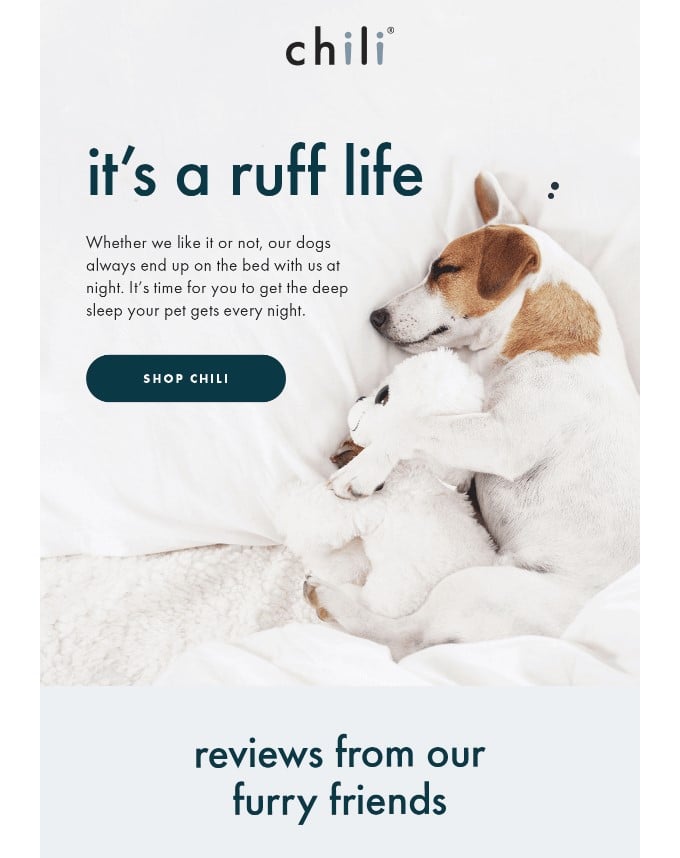
Chili Sleep's pet-owner targeted email
Why it works: This email works because it does three things that catchy email subject lines should always do. First, it identifies a specific audience segment (pet owners). Second, it acknowledges a shared experience (dogs hogging the bed). Third, it positions the product as the solution without saying "Buy our mattress pad." The wordplay is the hook, but the audience targeting is what makes it convert. Generic puns fall flat. Puns that make a specific group feel seen get clicks.
Key takeaway: Wordplay works best when it's tied to a segment-specific pain point. "Ruff life" lands because pet owners already use this phrase. Find the inside joke your audience already shares, then put it in a subject line.
5. Who Gives A Crap: Brand Voice Humor Taken to Its Logical Extreme
Subject line: "It's pronounced 'craptcha'"
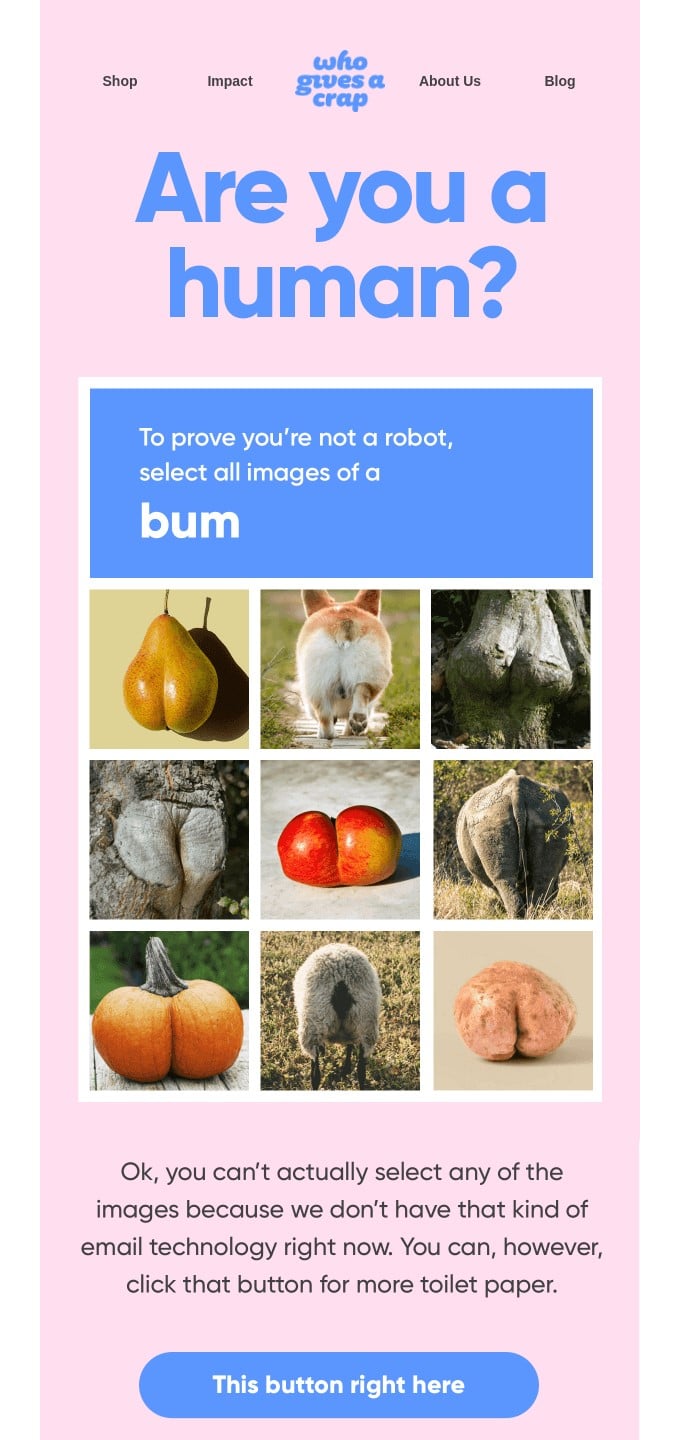
On-brand humor from Who Gives A Crap
What works: Who Gives A Crap sells eco-friendly toilet paper. Their entire brand is built on bathroom humor, and this subject line stays perfectly on-brand by turning "CAPTCHA" into "craptcha." Subscribers who signed up for a toilet paper company with this name already opted into this style of humor, so the subject line feels like a continuation of the brand promise rather than a random joke.
Why it works: Brand voice consistency is the key here. Contrast this with a fintech company or insurance brand trying the same joke. It would bomb. Who Gives A Crap can push boundaries because they established the tone from the brand name forward. Every touchpoint (website, packaging, email) reinforces it. When your professional email subject lines and your humorous ones both feel like they come from the same voice, subscribers develop trust in your brand personality.
Key takeaway: Humor in email subject lines works best when it's an extension of your existing brand voice, not a one-off experiment. If your brand isn't naturally funny, start small with light wordplay and test audience response before going full comedy.
6. Koala: Emotional Misdirection for a Boring Category
Subject line: "Fall in love (without the risk)."
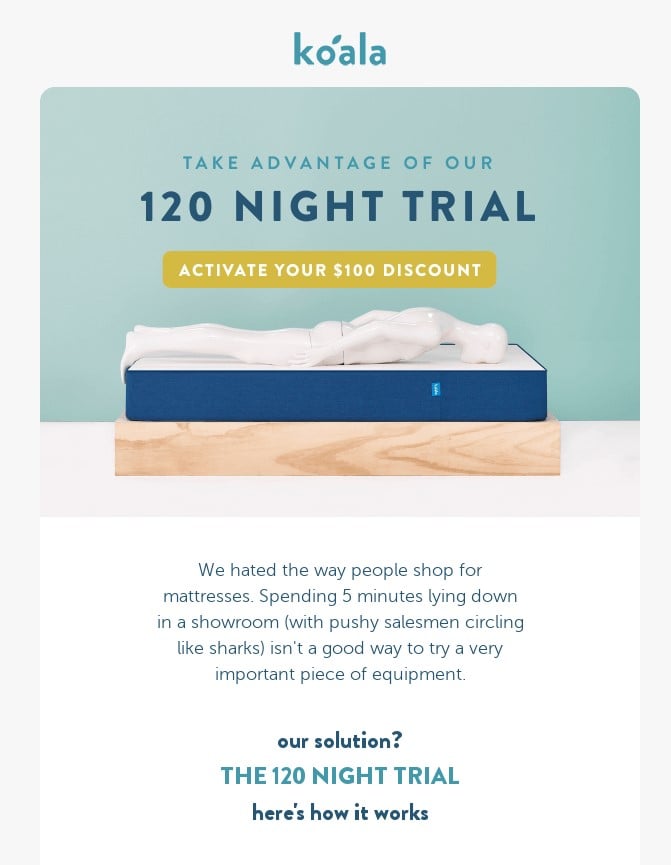
Koala's emotionally charged mattress promo
What works: Koala sells beds and mattresses. Not exactly a romantic product. The subject line borrows the emotional weight of "fall in love" and applies it to a mattress purchase, then adds "(without the risk)" as the twist. The parenthetical does double duty: it references the emotional risk of love AND the financial risk of buying a mattress online. The email inside reveals their 120-night trial as the "risk-free" hook.
Why it works: Emotional misdirection grabs attention because the brain processes emotional language faster than logical language. "Fall in love" triggers an emotional response before the reader consciously evaluates whether to open the email. The parenthetical adds a second curiosity layer. If you're selling something that isn't naturally exciting (mattresses, review request emails, SaaS renewals), borrowing emotion from a different context can make the subject line feel fresh.
Key takeaway: Borrow emotional language from unrelated contexts and apply it to your product. The gap between what the reader expects ("a romantic email?") and what they get ("a mattress ad") creates both humor and memorability. Use the parenthetical format to add a second hook.
7. Cowboy: Solving a Universal Problem with Three Words
Subject line: "Forget your keys."
What works: Cowboy sells electric bikes with an auto-lock feature that senses when you're nearby. The subject line sounds like a command. "Forget your keys" initially reads as a mistake or a warning, and that ambiguity is what makes it brilliant. Most people have experienced the panic of forgetting their keys. The subject line weaponizes that feeling, then flips it into a product benefit once you open the email.
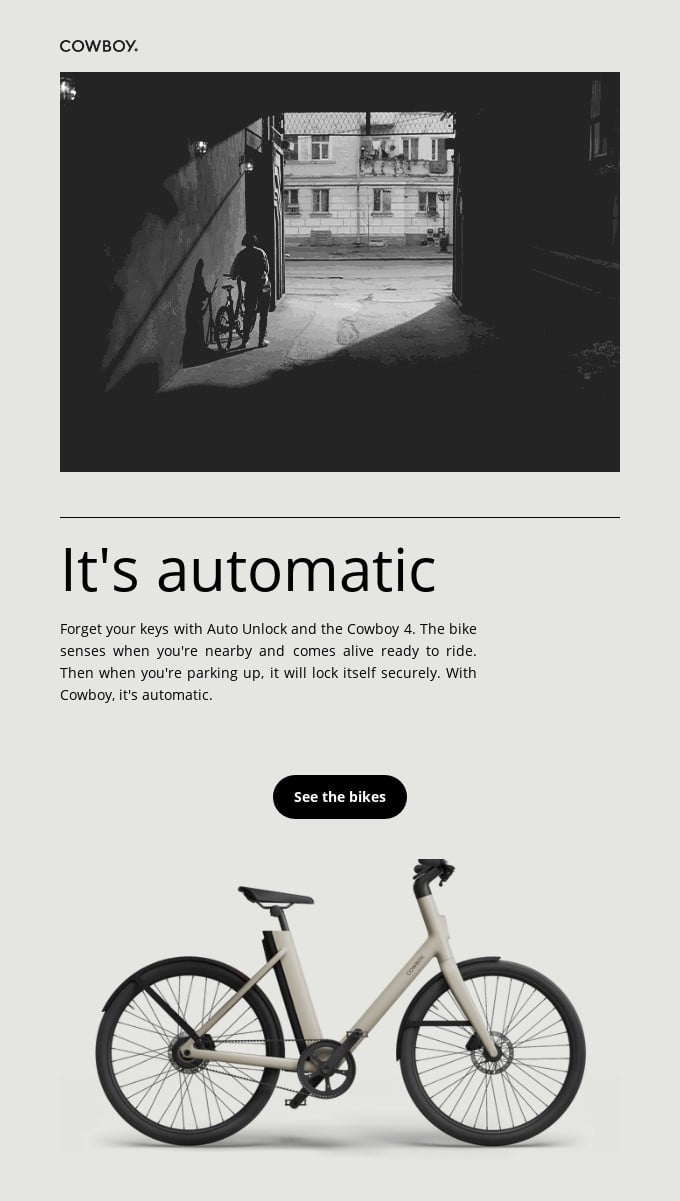
Cowboy turns a pain point into a feature pitch
Why it works: Three words. That's it. In a world where the average B2B email subject line tries to cram in a value proposition, a benefit, and a CTA, Cowboy's brevity stands out. The subject line uses imperative mood ("Forget"), which feels direct and personal. It also employs what copywriters call "pattern interrupt." Your brain expects subject lines to sell you something. A command to forget something breaks that pattern and demands attention.
Key takeaway: Short imperative subject lines can outperform longer descriptive ones. If your product solves a common frustration, state the frustration as a command (like "Forget your keys") and let the email reveal how you solved it.
8. 1973 Ltd: Double Meanings That Reward the Click
Subject line: "Should you be afraid of the Dark (Mode)?"
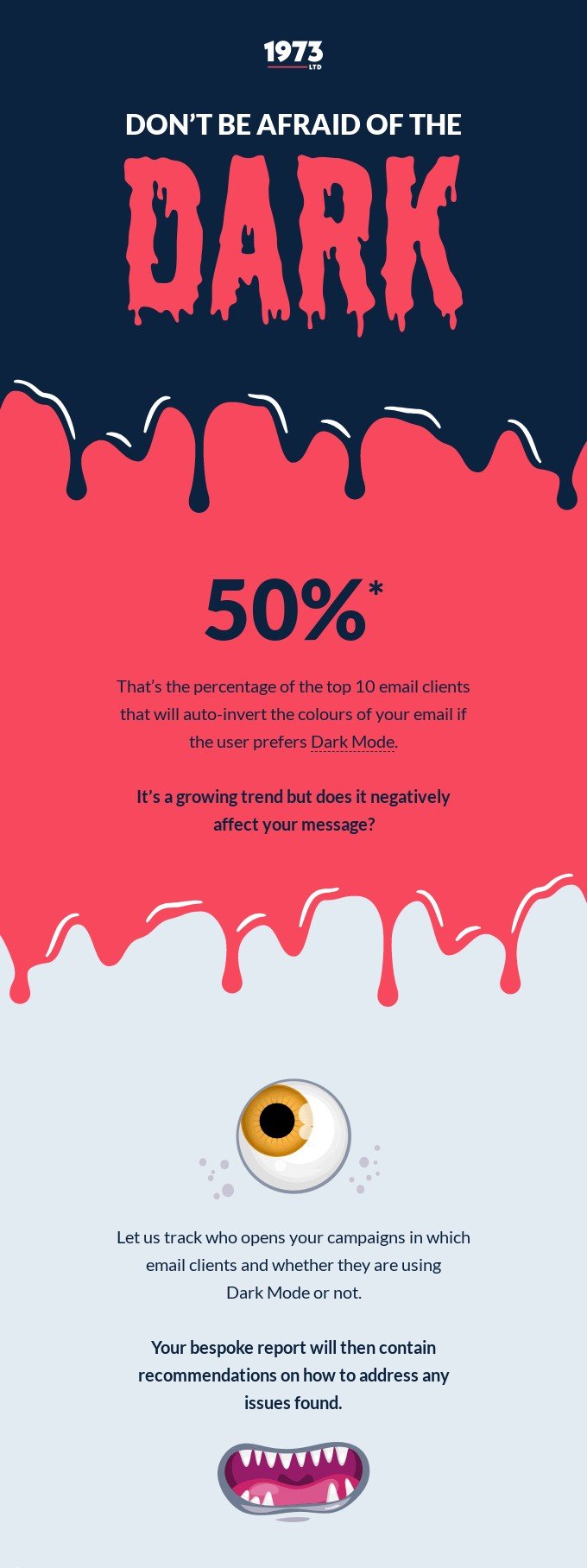
1973 Ltd's dark-themed email design
What works: 1973 Ltd, a marketing agency, uses a question format with a double meaning. "Afraid of the dark" triggers a childhood association. Adding "(Mode)" pivots it to a tech/design topic. The email design commits to the joke with dark backgrounds and horror-style typography, proving the humor wasn't just a subject line gimmick but a full creative concept.
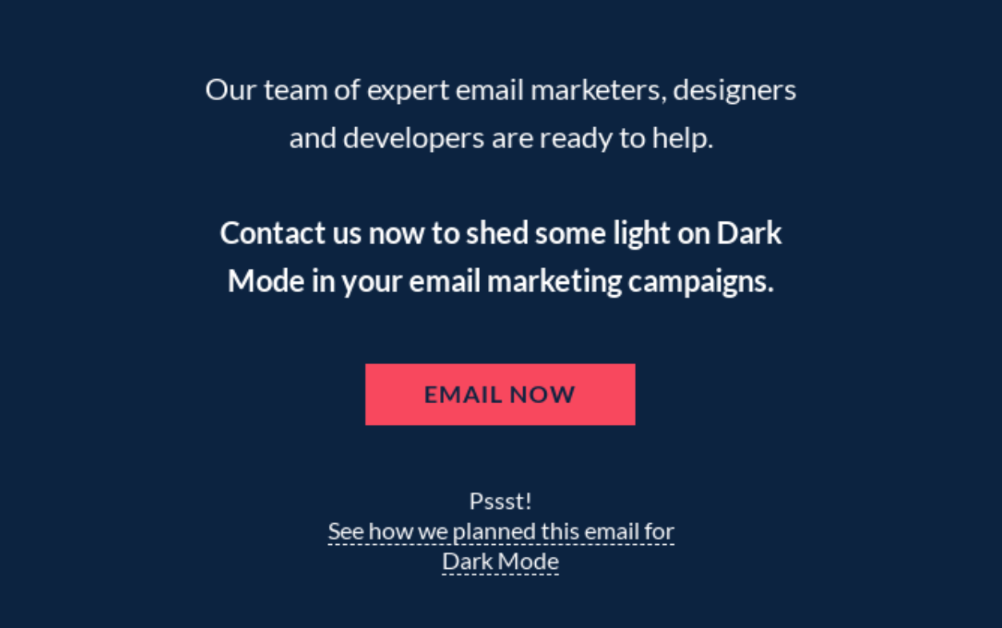
High-contrast CTA button against the dark theme
Why it works: Question-format subject lines perform well because they create an open loop the reader wants to close. The double meaning adds a layer of cleverness that makes the reader feel smart for catching it. But the real lesson here is the follow-through. The email design matches the subject line's dark/horror theme, creating a cohesive experience. A funny subject line followed by a generic email body wastes the momentum. 1973 Ltd's approach shows that humor should carry through the entire email experience, not just the subject.
Key takeaway: If your subject line sets up a creative concept, commit to it inside the email. Match your design, copy, and CTA to the tone of the subject line. Half-committed humor feels worse than no humor at all.
9. Pop Culture Reference: Borrowing Familiarity for Re-Engagement
Subject line: "Is It Too Late Now to Say Sorry?"
What works: This subject line borrows a lyric from Justin Bieber's "Sorry" and repurposes it for a re-engagement scenario. Whether you're reaching out to a colleague after dropping the ball or re-engaging a cold lead, the song reference does the heavy lifting. Almost everyone recognizes the line, which means the humor is pre-loaded. No explanation needed.
Why it works: Pop culture references work as subject line hooks because they piggyback on existing neural pathways. The reader doesn't need to process a new joke. They just recognize a familiar phrase in an unexpected context, and that mismatch creates a small dopamine hit. The risk? Pop culture references have a shelf life, and they don't translate across all demographics. A Bieber lyric lands differently with Gen Z than with C-suite executives in their 50s. Know your audience before borrowing from pop culture.
Key takeaway: Pop culture references can shortcut the humor-building process, but only if your audience recognizes the reference. Test these with a segment before rolling them out to your full list. Timeless references (movies, classic songs) age better than trending memes.
10. FilterEasy: The Relatable Coffee Apology
Subject line: "Oops: Someone Hadn't Had Their Coffee Yet This Morning."
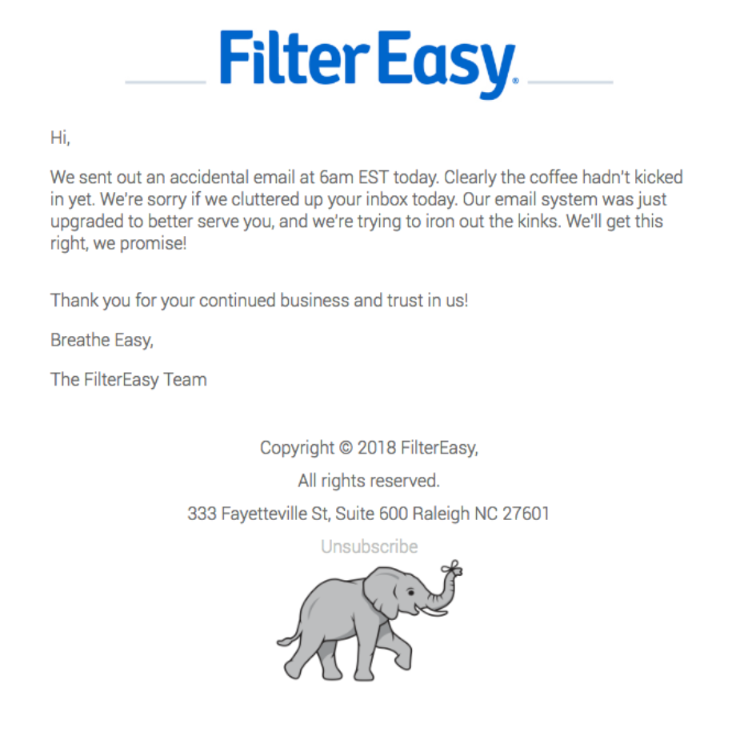
FilterEasy's lighthearted apology for a sending error
What works: FilterEasy sent the wrong email and needed to apologize. Instead of a corporate "We sincerely apologize for any inconvenience," they blamed it on coffee deprivation. Almost everyone has had a pre-coffee blunder at work. The subject line makes the company feel human because the "someone" implies a real person made a real mistake, not a faceless system.
Why it works: This is the second apology email on our list (along with GOBE at #3), and both outperform standard apology formats for the same reason: they reduce perceived severity. When a brand says "someone hadn't had their coffee," the reader's mental response is empathy, not irritation. The email treats the mistake as low-stakes, and that framing transfers to the reader. Humor in error-recovery emails can actually increase subscriber retention because it shows the brand doesn't take itself too seriously.
Key takeaway: For apology emails, blame a universally relatable cause (coffee, Monday mornings, an overeager intern) instead of using corporate language. Humanizing the mistake makes forgiveness easier and can even boost brand affinity.
75 More Funny Email Subject Lines
Need more inspiration beyond the 10 analyzed examples above? Here are 75 additional funny email subject lines you can copy and adapt for your next campaign:
1. "We need to talk" (it's about our sale)
2. Your cart is judging you
3. We're not mad, just disappointed in your inbox
4. This email will self-destruct in 24 hours
5. You look like you could use 20% off
6. Open this or we'll send another one
7. Our warehouse elves are getting restless
8. Plot twist: you actually want to read this
9. Sorry, we ate all the donuts. But here's a coupon
10. Don't tell your wallet about this deal
11. We promise this isn't another "touching base" email
12. Your future self will thank you for opening this
13. We put pants on for this email
14. This email is more interesting than your meeting
15. Stop scrolling. We have snacks (and deals)
16. Warning: opening this email may cause impulse buying
17. Your inbox called. It misses us
18. We wrote this subject line 47 times. You're welcome
19. No, we didn't forget about you. We were just dramatic about it
20. The sale your credit card hoped you'd miss
21. Our CEO made us send this (just kidding, we wanted to)
22. You've been selected! (to read a really good email)
23. Is it us or is it hot in your inbox?
24. We stalked your wishlist (in a non-creepy way)
25. This email pairs well with coffee
26. Our lawyers said we can't call this "the best email ever" so...
27. You had me at "unsubscribe." Wait, come back
28. This email is officially procrastination-approved
29. We made this deal so good it made our accountant cry
30. Your competitors opened this email. Just saying
31. An email shorter than your attention sp—
32. Treat yourself (your therapist said it's fine)
33. Important: this email contains zero attachments
34. Our intern wrote this subject line (they nailed it)
35. This email is cheaper than therapy
36. We'd send a carrier pigeon but this seemed faster
37. Your Monday just got 30% less terrible
38. Not to be dramatic, but this sale changes everything
39. We googled "funny email subject line" and gave up. Here's a discount
40. The email equivalent of finding cash in your jacket pocket
41. Spoiler alert: there's a coupon at the end
42. Our marketing team needs a win today. Please open this
43. This subject line passed the sniff test (barely)
44. 3 reasons to open this email (reason 2 will bore you)
45. We're breaking up with full price
46. Your dog would open this email
47. Congratulations! You've won... our attention
48. The one where we accidentally gave you too big a discount
49. This email was written by a human. Shocking, right?
50. We promise this is more fun than doing your taxes
51. Our spam folder is offended you haven't opened this yet
52. You miss 100% of the deals you don't open
53. Hi, it's us. The brand you forgot you subscribed to
54. We could've sent a boring email. We chose chaos
55. Your couch called. It wants you to shop from home
56. This deal walks into a bar...
57. We put the "fun" in "refund policy" (just kidding, you won't need it)
58. New stuff dropped. Your wallet fainted
59. Roses are red, this sale is true, open this email, we made it for you
60. The FYI email you'll actually care about
61. PSA: your cart items are forming a support group
62. Before you delete this, just know there's free shipping inside
63. This email was focus-grouped by exactly zero people
64. Our new arrivals are here and they're overdressed
65. We asked ChatGPT to write this. Then we ignored it
66. Reminder: retail therapy is still therapy
67. Your inbox is 99% boring. We're the 1%
68. We were going to send flowers but settled for free shipping
69. This email is your sign to treat yourself
70. Good news: we lowered the prices. Bad news: your excuses are gone
71. We timed this email to arrive during your lunch break. You're welcome
72. Open if you love deals. Ignore if you enjoy paying full price
73. We're not saying this email will change your life, but also we're not NOT saying that
74. Last chance to pretend you don't check email on weekends
75. If you only open one email today, make it this one (no pressure)
How to Write Your Own Funny Email Subject Lines
Pulling humor from the examples above is a start, but you'll get better results building your own. Here's a framework based on what the 10 brands above have in common.
1. Start with your audience's pain points. Chili Sleep used "ruff life" because they knew pet owners share beds with dogs. Cowboy used "Forget your keys" because cyclists lose keys. The humor came from the audience's world, not the brand's.
2. Pick a humor formula. The five patterns that showed up most across these examples:
• Unexpected twist: Set up one expectation, deliver something different (Smartwool, Koala)
• Self-deprecation: Admit a flaw or mistake playfully (GOBE, FilterEasy)
• Wordplay: Puns or double meanings tied to your product (Chili Sleep, Who Gives A Crap, 1973 Ltd)
• Pop culture borrowing: Reference a song, movie, or meme your audience knows (Bieber example)
• Absurd command: Tell the reader to do something counterintuitive (Cowboy)
3. Keep it under 50 characters. Shorter subject lines leave more to the imagination. Cowboy's "Forget your keys" is 17 characters. Smartwool's is 45. Both outperform the average.
4. Test with a small segment first. Humor is subjective. What makes your marketing team laugh might confuse your audience. A/B test the funny version against a straight version with 10-15% of your list before sending to everyone.
5. Match the email body. Every successful example above carried the humor into the email content. If the subject line promises personality and the email delivers a template, you've broken the promise. Your seasonal email campaigns and year-round sends both benefit from this consistency.
Common Mistakes That Kill Funny Subject Lines
I've also seen plenty of humor attempts that backfire. These are the patterns to avoid:
Forcing humor where it doesn't belong. Billing disputes, security alerts, and account termination emails are not the place for jokes. Read the room. If the recipient might be stressed or angry when they see your email, humor will feel tone-deaf.
Inside jokes nobody gets. Your team might think a reference to your company mascot is hilarious. Your subscriber who joined the list three days ago has no idea what you're talking about. Test for recognition, not just amusement.
Going offensive to stand out. Edgy humor gets clicks, but it also gets unsubscribes. If you have to debate whether a joke crosses the line, it probably does. The brands that succeed with humor (like Who Gives A Crap) keep it playful, never mean.
Clickbait without payoff. A funny subject line creates expectations. If the email inside is a generic promotion with no connection to the subject, the reader feels tricked. That erodes trust across every future send.
Ignoring your data. Open rates tell you whether the subject line worked. Click-through rates tell you whether the email delivered on the promise. Track both. If your funny subject lines get high opens but low clicks, the humor isn't carrying through.
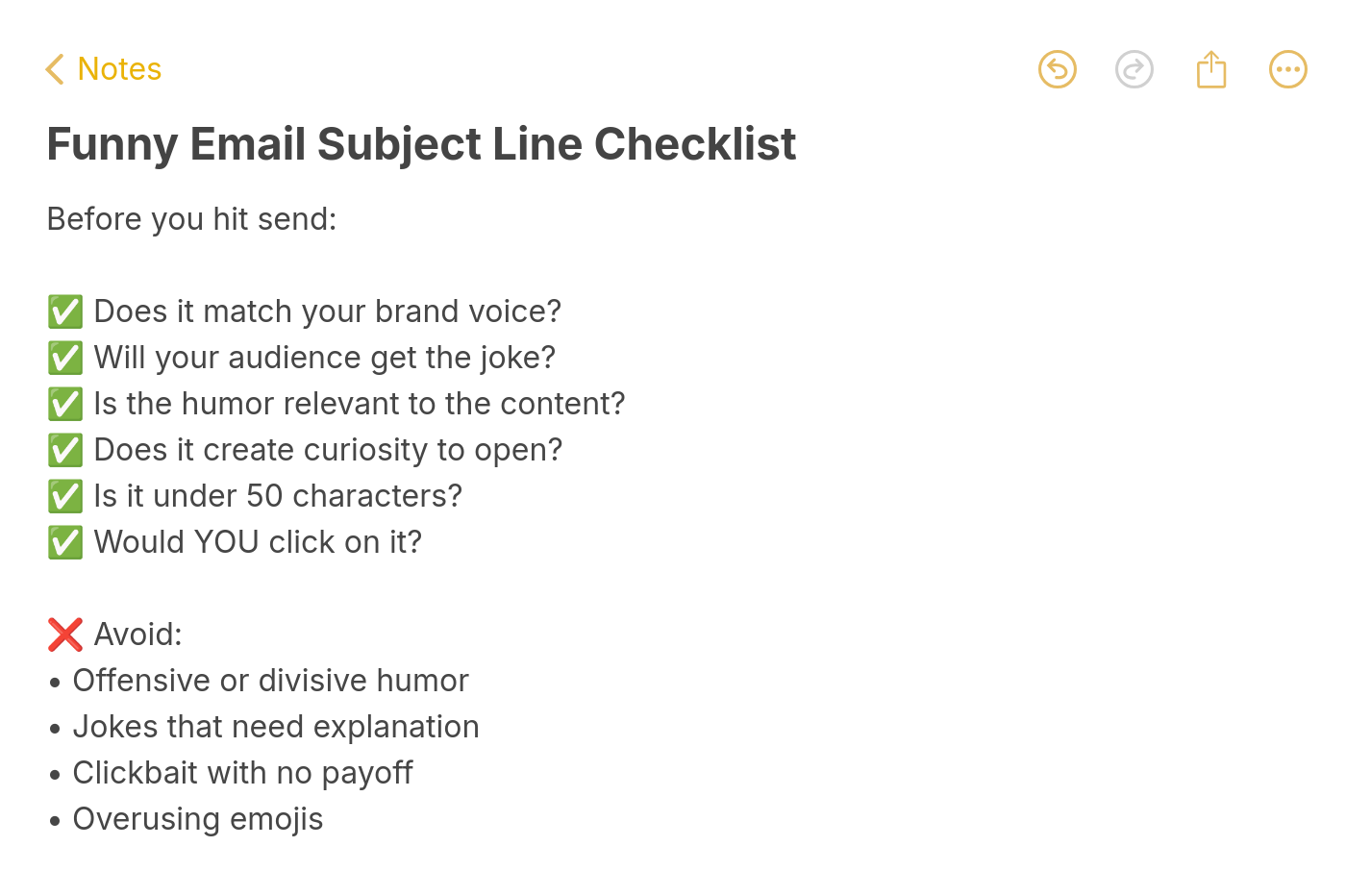
Humor dos and don'ts for email
Funny Subject Line Ideas for Specific Scenarios
The 10 examples above cover product launches, onboarding, and apologies. But humor works across other email types too. Here are scenario-specific ideas you can adapt:
Funny Email Subject Lines for Work and Colleagues
Internal emails don't need to be boring. Try: "This meeting could've been a Slack message" or "Reply all? Brave choice." These work because they reference shared workplace frustrations. Keep them lighthearted since you still have to sit next to these people tomorrow.
Funny Email Subject Lines for Your Boss
Tread carefully, but personality pays off here too. "Bad news: I have an idea" or "Quick question (it's not about a raise... this time)" can break the monotony of formal emails. Match the humor to your relationship, though. If your boss prefers formal communication, a joke might not land the way you hope.
Funny Email Subject Lines to Introduce Yourself
Cold introductions benefit from humor because they need to overcome the "who is this person?" barrier. "Not spam, I promise" or "The email you'll actually want to read" use meta-humor about the email format itself. For seasonal introductions, tie the humor to the time of year.
Funny Email Subject Lines for Business Outreach
B2B cold emails have notoriously low open rates. According to Instantly.ai, average B2B cold email open rates dropped to 27.7% in 2024. Humor can help close that gap, but it needs to be relevant to the recipient's industry. "Your [competitor] just did something brilliant" works because it triggers competitive curiosity, not because it's funny in a traditional sense. That subtle overlap between humor and intrigue is where B2B witty subject lines thrive.
What's a Good Cold Email Subject Line?
Good cold email subject lines feel personal and create enough intrigue to earn the open. Humor can help, but relevance matters more. "Saw your [recent achievement], had a quick thought" performs well because it signals research. For a funnier angle, "[First name], this is either genius or insane" creates curiosity. The average open rate for cold emails sits around 27.7%, so anything that breaks the "generic outreach" pattern gives you an edge. Test funny versions against straightforward ones with small batches before scaling.
Funny email subject lines aren't about being a comedian. They're about being human in a channel that's overrun with automated, template-driven messages. The 10 examples in this post all share one trait: they made the recipient feel something before asking for anything.
Whether you're sending testimonial request emails, onboarding sequences, or promotional blasts, a well-placed bit of humor can be the difference between an open and an archive. Start with one formula from this list, test it with a segment, and track the results. Your inbox metrics will tell you what your audience actually finds funny.
Frequently Asked Questions
How Do You Create Humorous Email Subject Lines for Better Engagement?
Start with your audience's daily frustrations, then find the funny angle. Use one of the five formulas from this post: unexpected twist, self-deprecation, wordplay, pop culture reference, or absurd command. Keep it under 50 characters, A/B test against a non-humorous version, and make sure the email body delivers on the tone the subject line sets. Avoid humor that requires context your audience might not have, and never joke about sensitive topics.
What Are Funny Email Subject Lines for Onboarding New Users?
Onboarding emails benefit from energy and personality over traditional humor. TicTail's "Boom shakalak! Let's get started" is a strong template. Other approaches: "You're in. Now the fun starts." or "Welcome to [Brand]. We promise not to be boring." The goal isn't to tell a joke. It's to signal that your brand has personality and that the user made a good choice signing up. Keep the email body focused on a single action (complete profile, try a feature, watch a video) so the positive energy translates into engagement.
How would you rate your experience with this article? 😊