How to add a popup on Shopify
 By Mert Özeren
To add a pop up on Shopify, install the Popupsmart app from the Shopify App Store, build the popup in Popupsmart, publish it and switch on the app embed in your theme editor. Popupsmart then runs every popup from its own dashboard, so you can target and change popups without editing your theme again.
If you'd rather not install an app, one line of embed code in theme.liquid does the same job.


Setup at a glance
- Runs on
- Shopify
- Where the code goes
Online Store → Themes → Edit theme → App embeds- Add-on
- App optional
Before you start
You need admin access to the store and a Popupsmart account; a developer isn't on the list.
- Access to your Shopify admin with permission to install apps and edit themes.
- A free Popupsmart account, or one you create while installing the app. The free plan covers one website and one live popup, so you can finish this guide without paying.
- The address your visitors use for the store: your own domain if you have one, or the
myshopify.comaddress if you don't.
How to add a pop up on Shopify with the Popupsmart app
The Popupsmart Shopify app connects your store to your Popupsmart account and adds the code through a Shopify app embed, so you never open a theme file. A Shopify App Store review of Popupsmart from 8 July 2025 puts it this way: "The setup was quick and straightforward, and I didn't need any technical skills to get started."
Step 1: Install the Popupsmart app
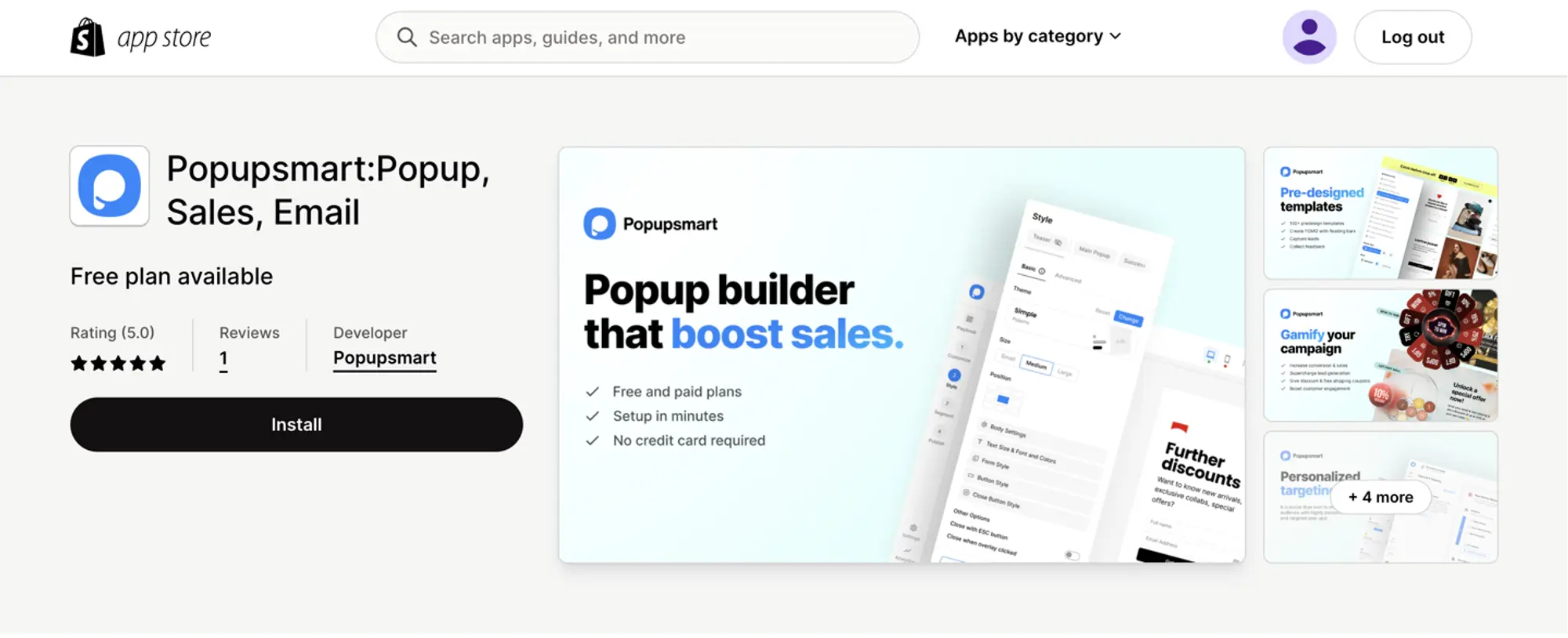
Open Popupsmart's Shopify app in the Shopify App Store and click Install.
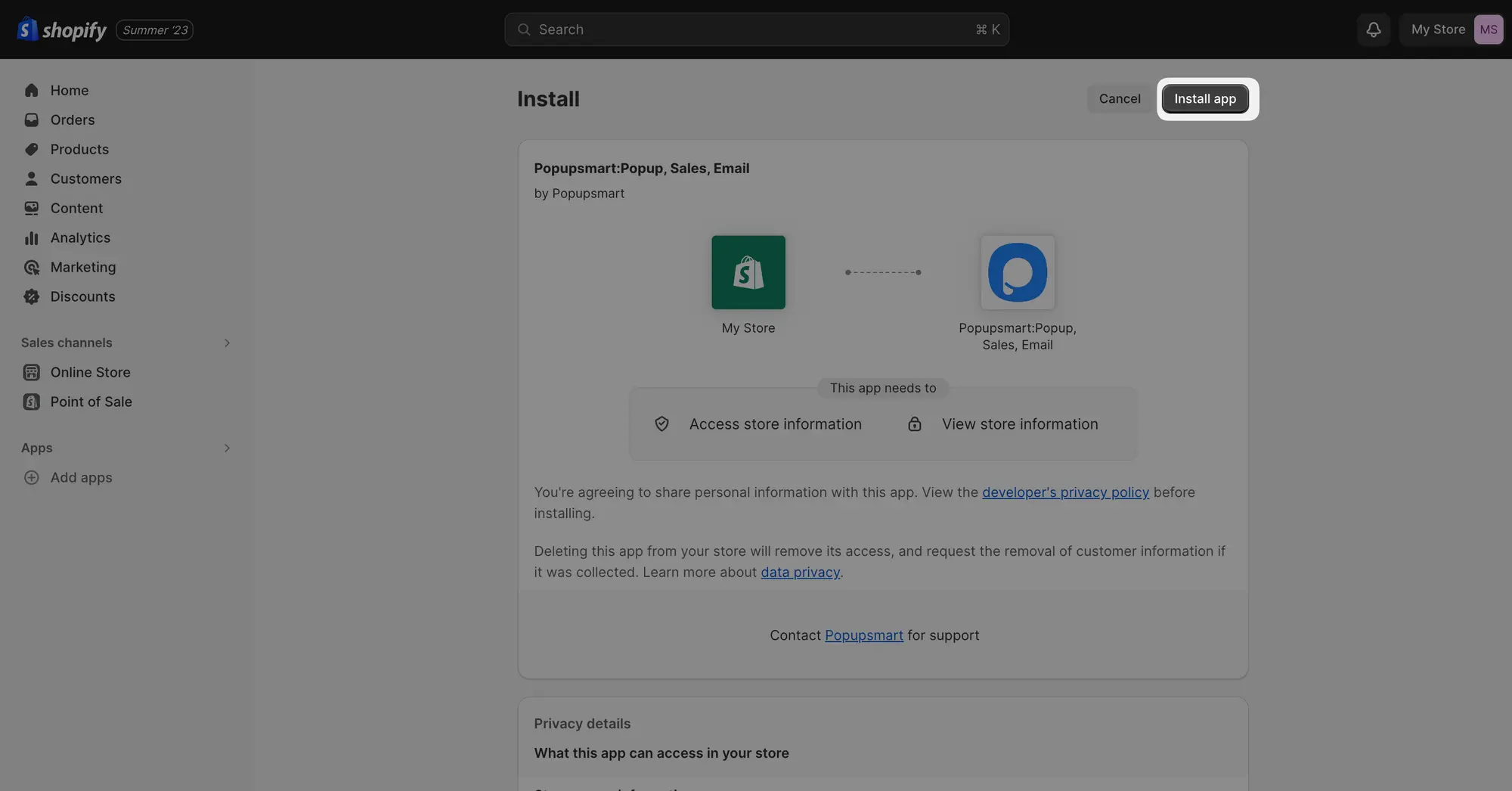
Shopify takes you to your store's admin. Confirm the install there.
Step 2: Connect your Popupsmart account
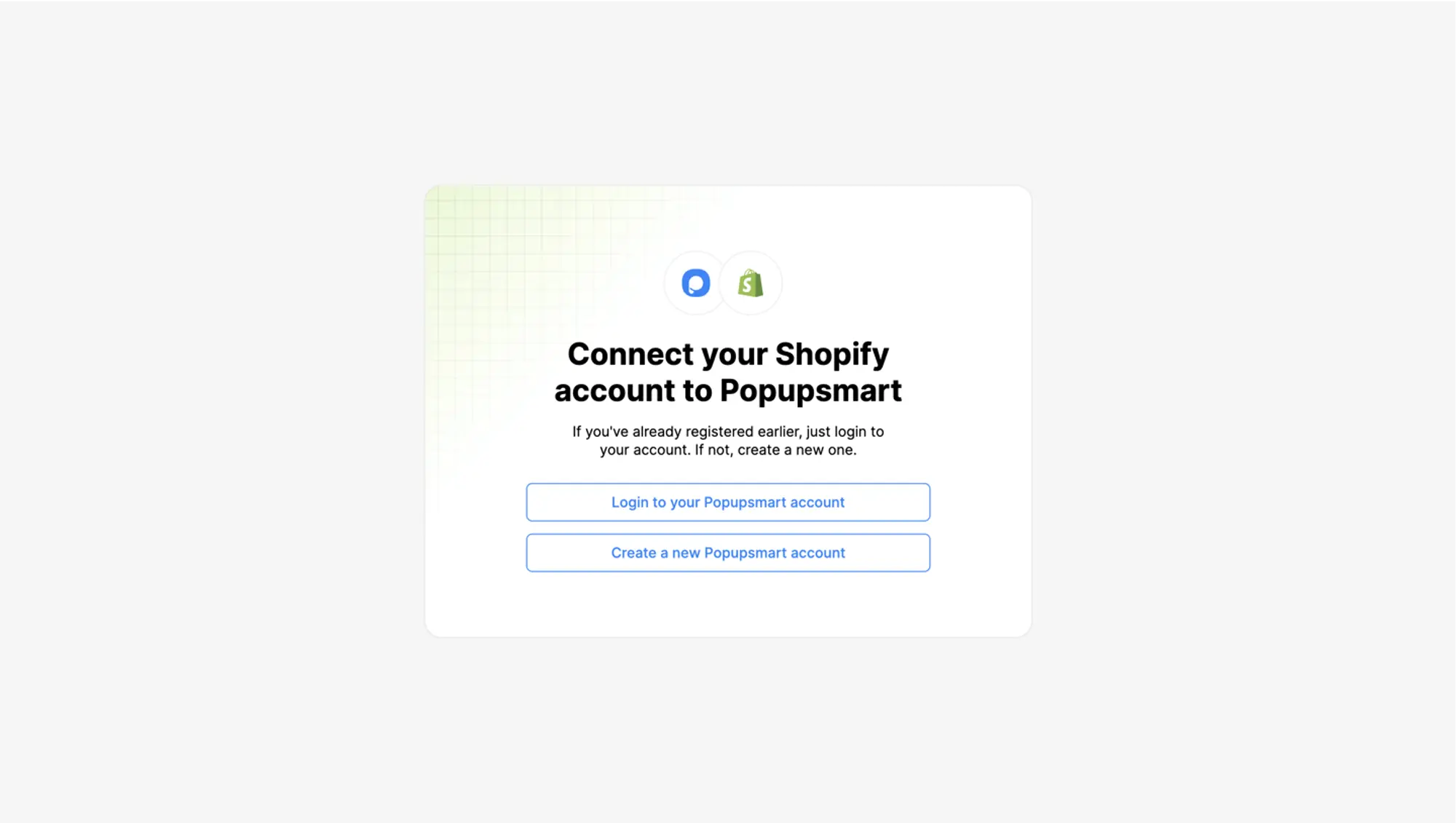
After the install, Popupsmart opens. Click Login to your Popupsmart account if you already have one, or Create a new Popupsmart account.
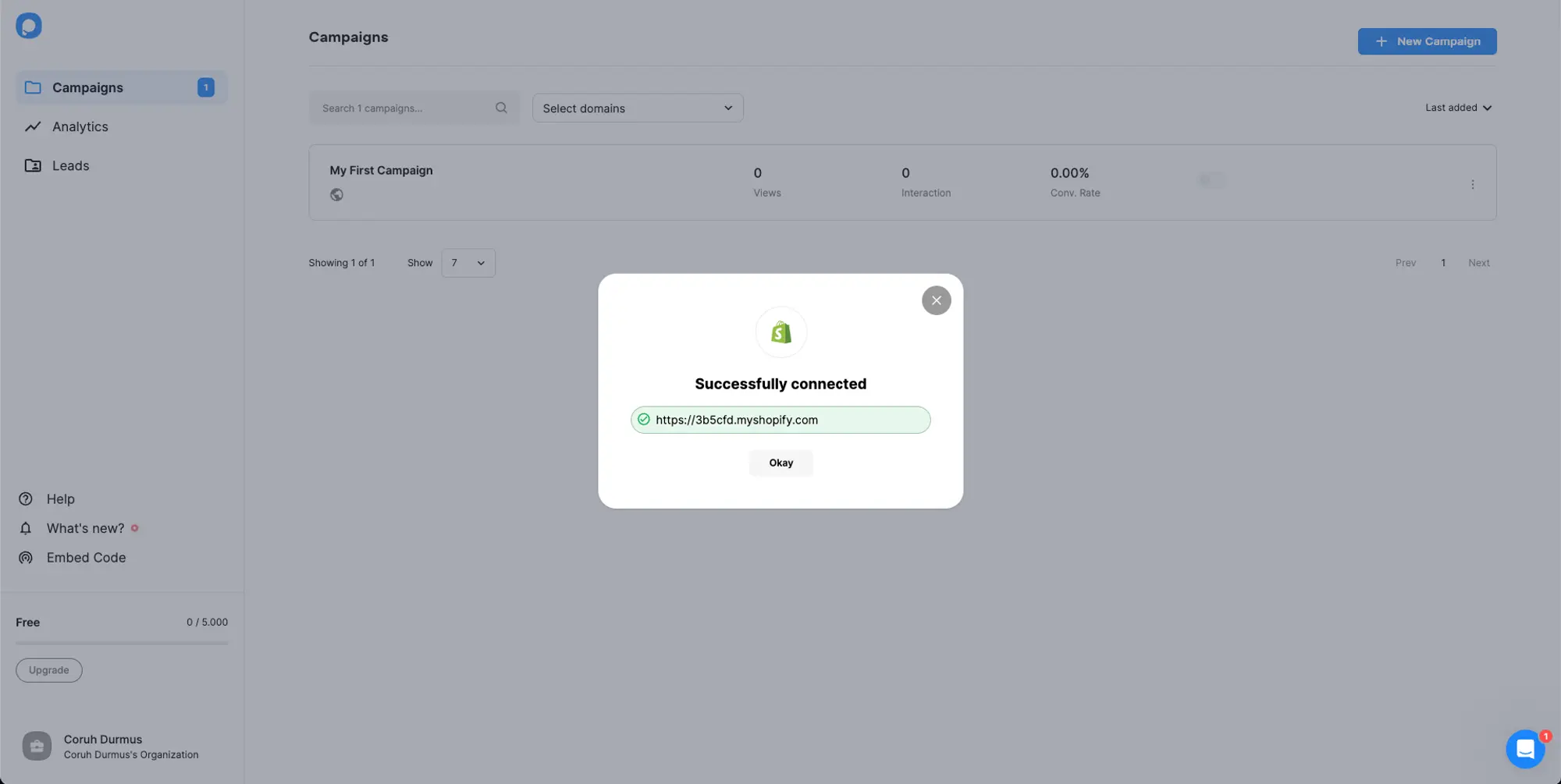
Your store is added to your Popupsmart account and a confirmation appears.
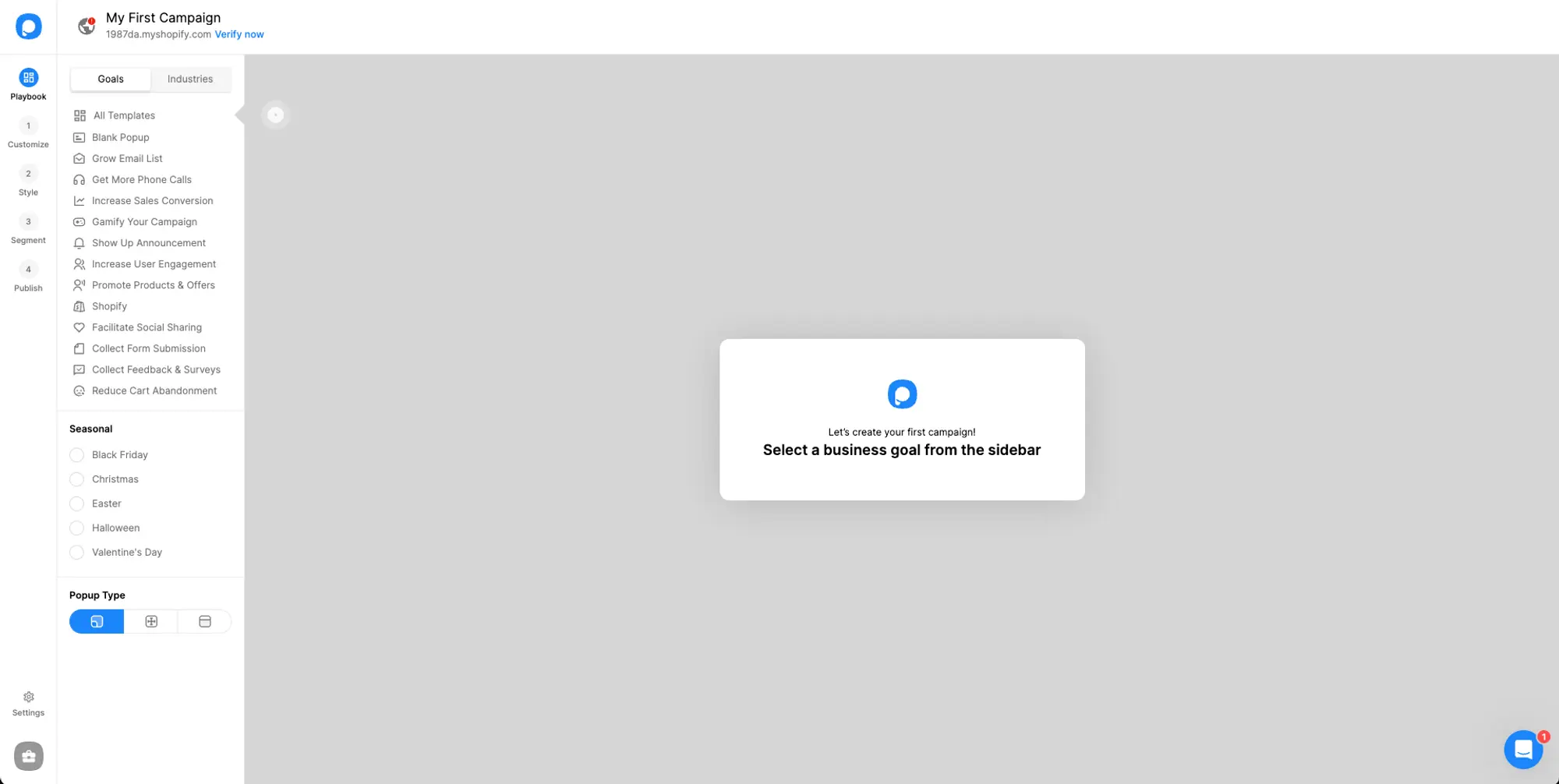
Step 3: Create your popup
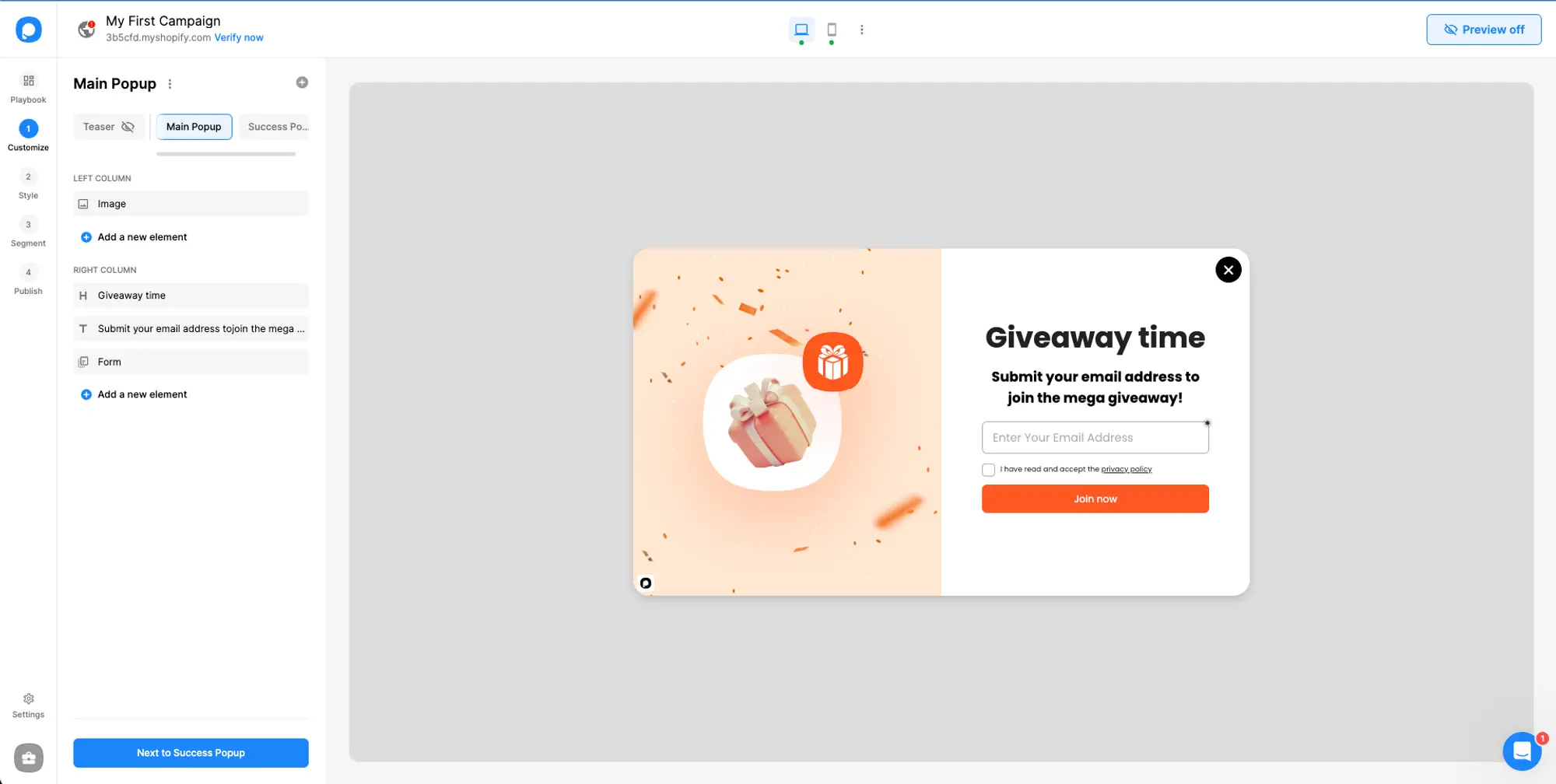
Popupsmart then opens the first step of a new campaign. Choose a goal in the left-hand menu to filter the templates.
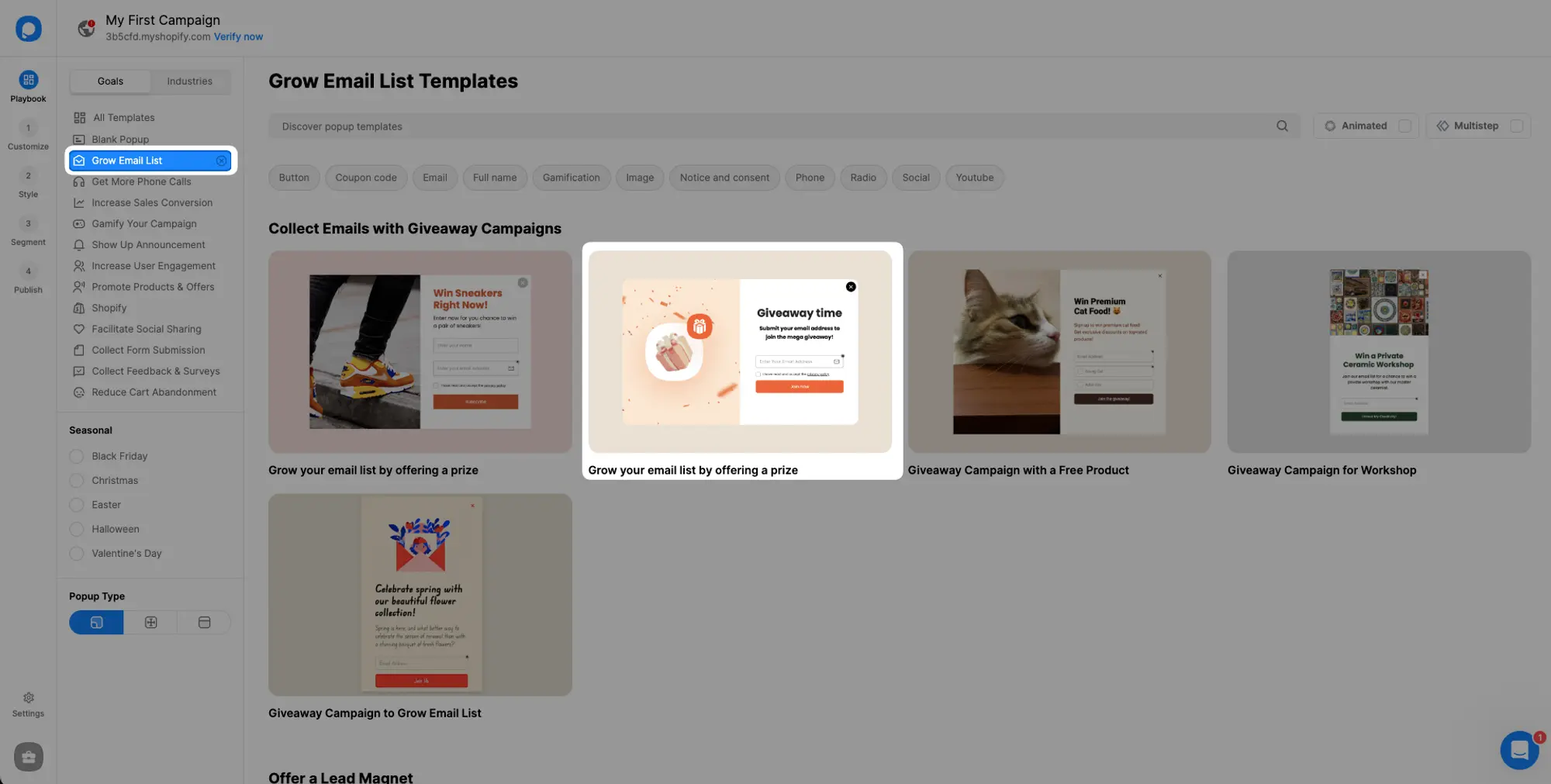
To collect emails, choose Grow Email List and pick a template.
Change the copy, colours and form fields in the Customize step, adjust the look in the Style step, and choose who sees the popup and when in the Segment step. The help center covers how to customize your popup, how to adjust the popup style and Popupsmart's targeting options.
Step 4: Publish the popup
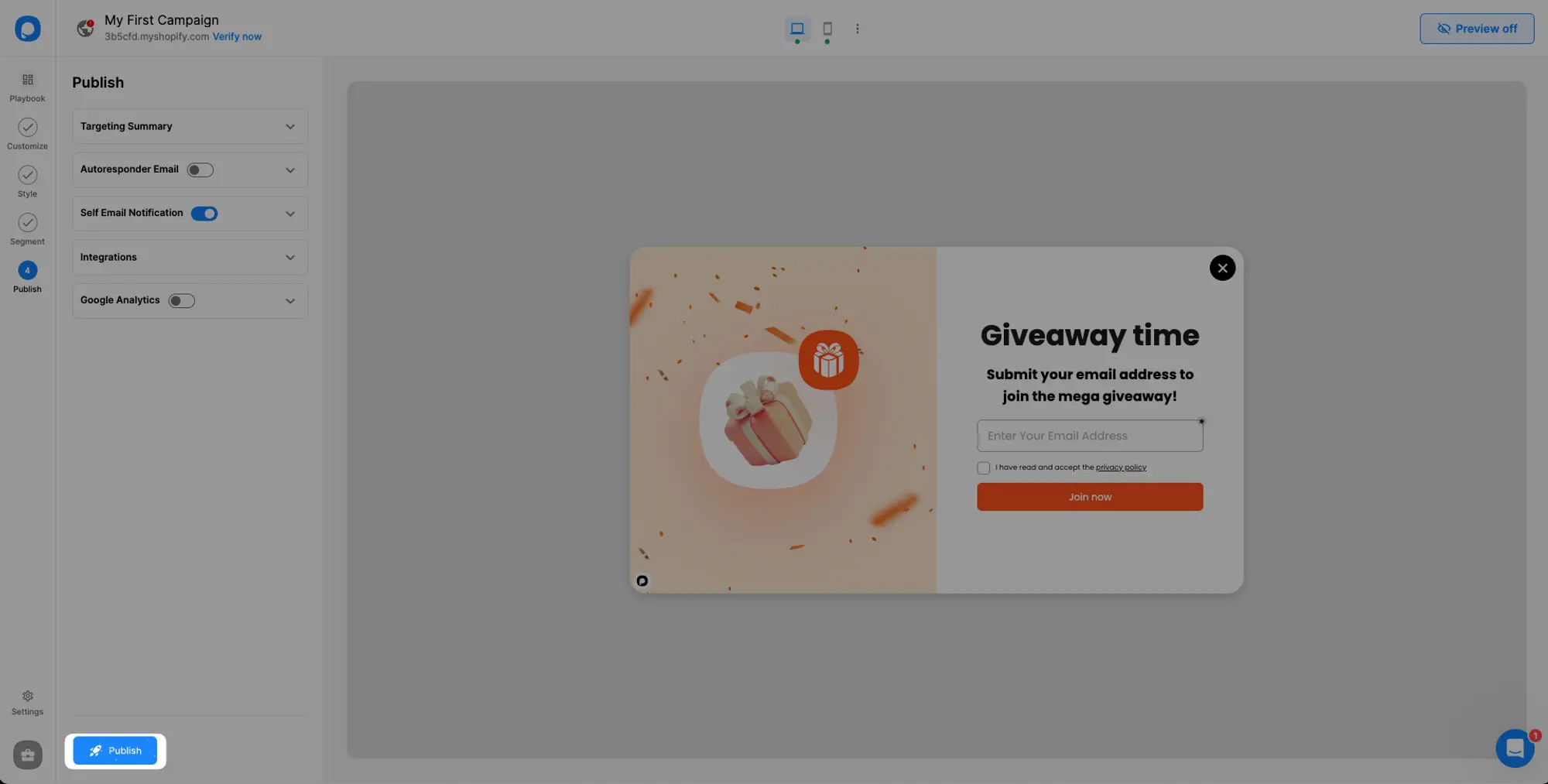
The Publish step has four settings to switch on before going live:
- Autoresponder Email for people who fill in the popup's form.
- Self Email Notification, an email to you for every submission.
- Integrations, which send form data to your email tool or CRM.
- Google Analytics, which sends popup events to your GA account.
Then click Publish.
Step 5: Turn on the Popupsmart app embed
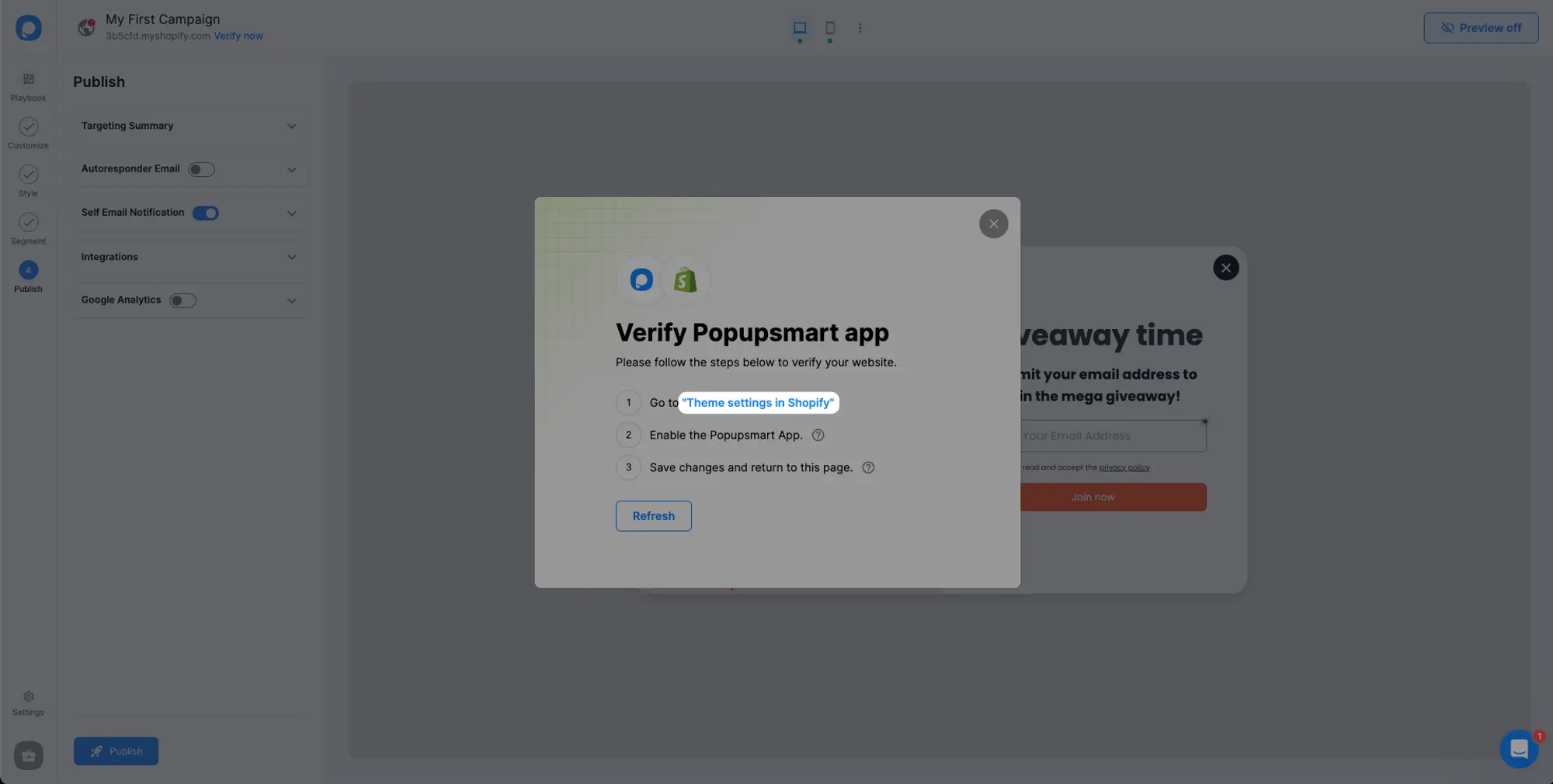
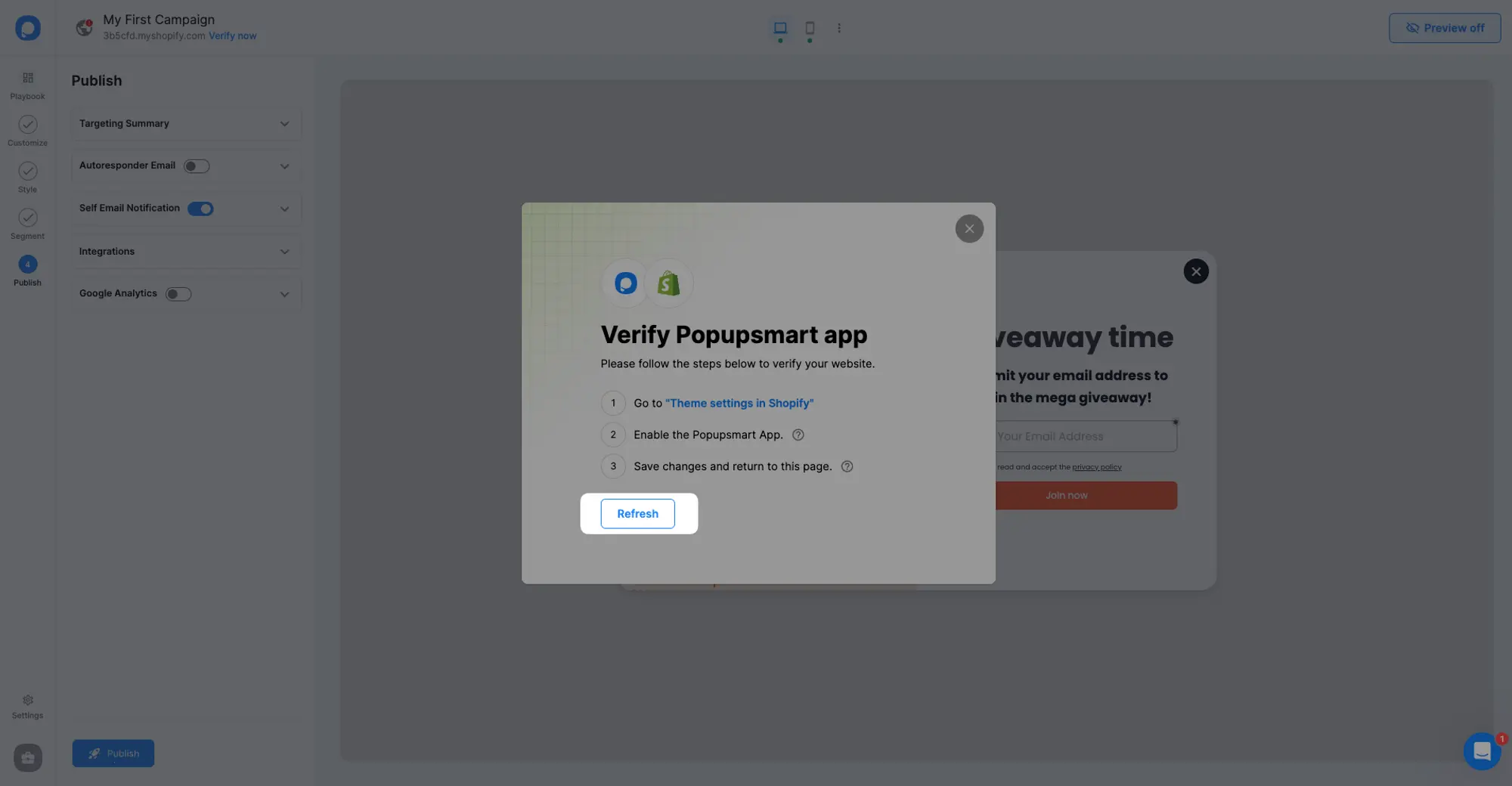
If the app embed isn't on in your theme yet, a Verify Popupsmart app window opens. Click "Theme settings in Shopify" to open your theme editor.
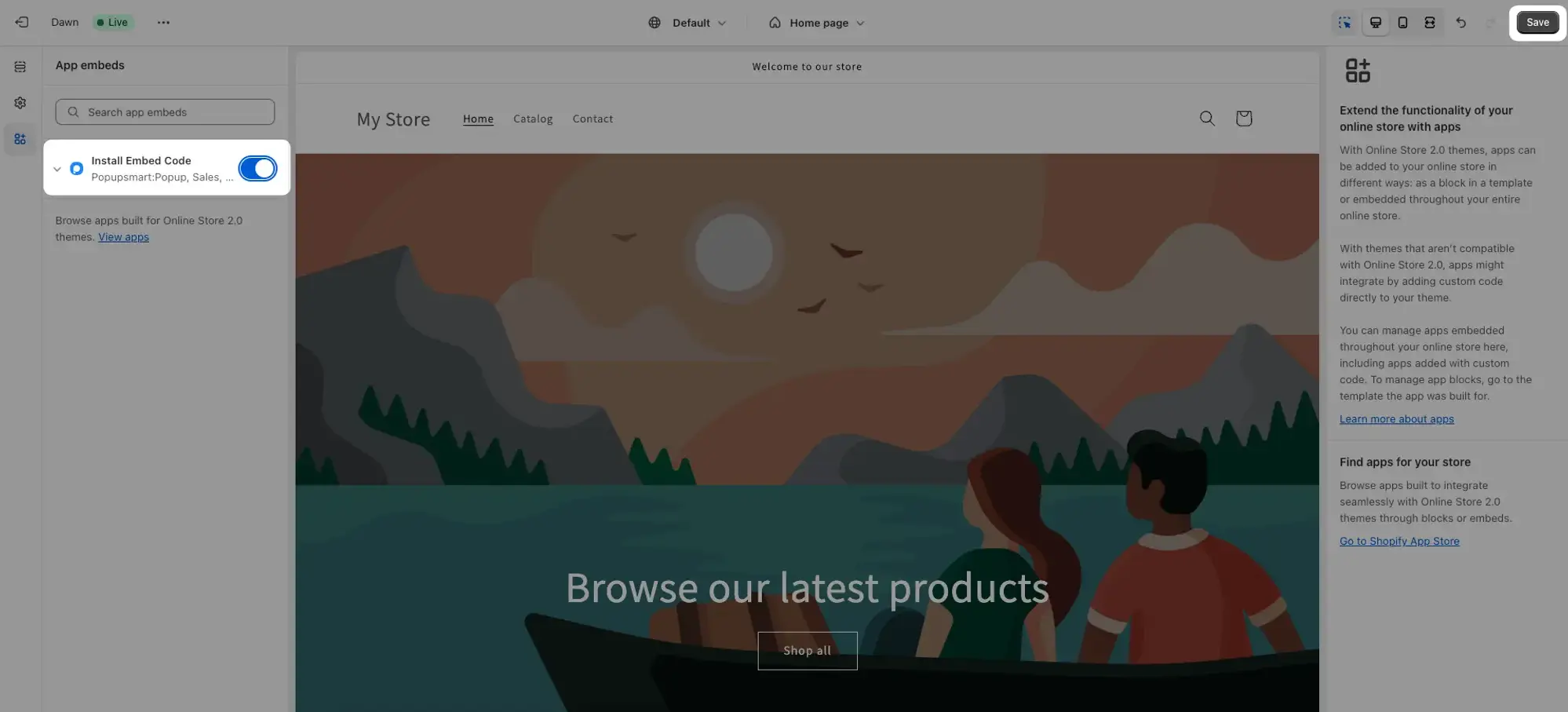
In the theme editor, open App embeds, switch on Popupsmart's Install Embed Code and click Save.
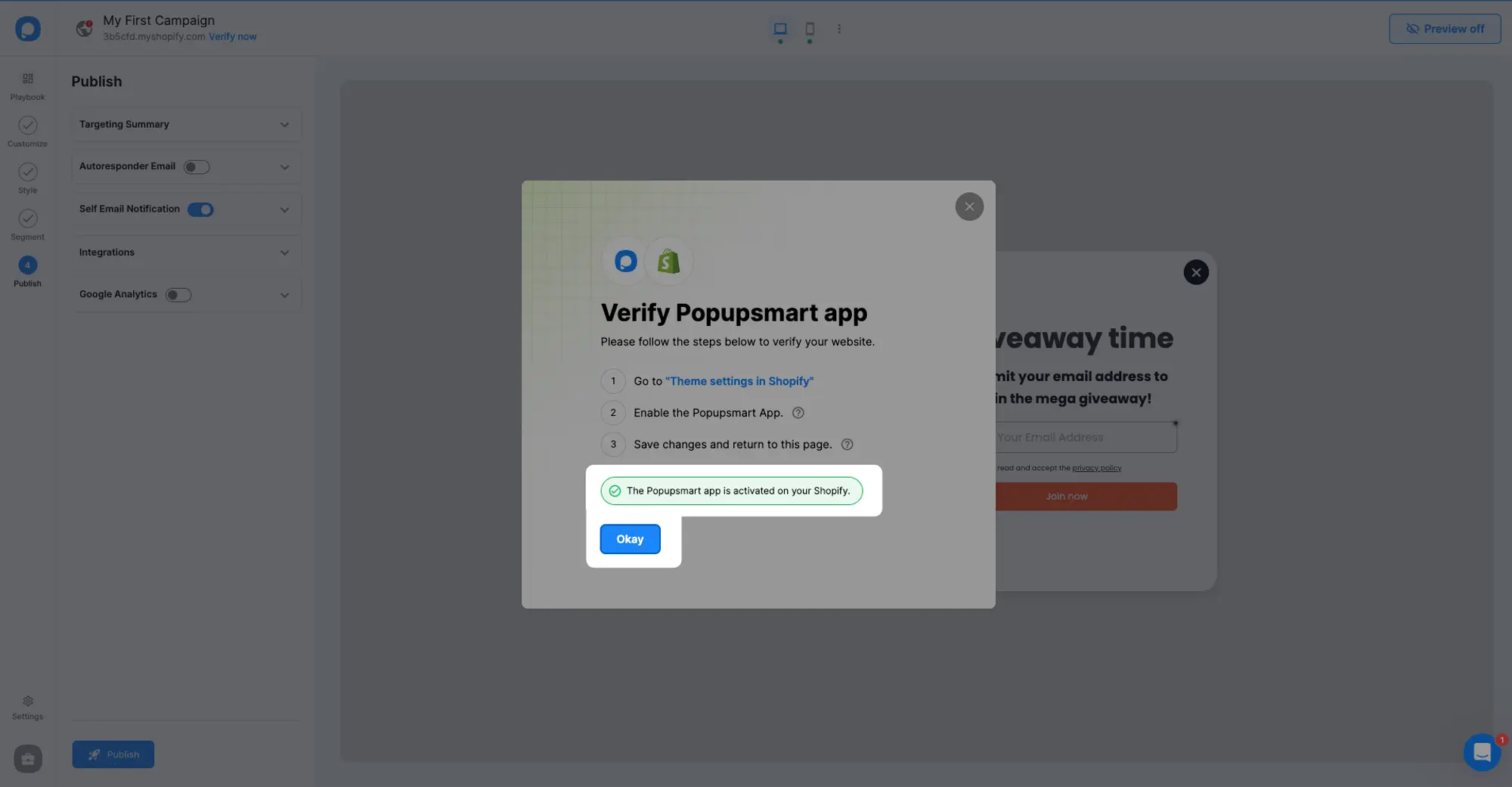
Go back to Popupsmart and click Refresh.
When the window says the Popupsmart app is activated on your Shopify store, click Okay.
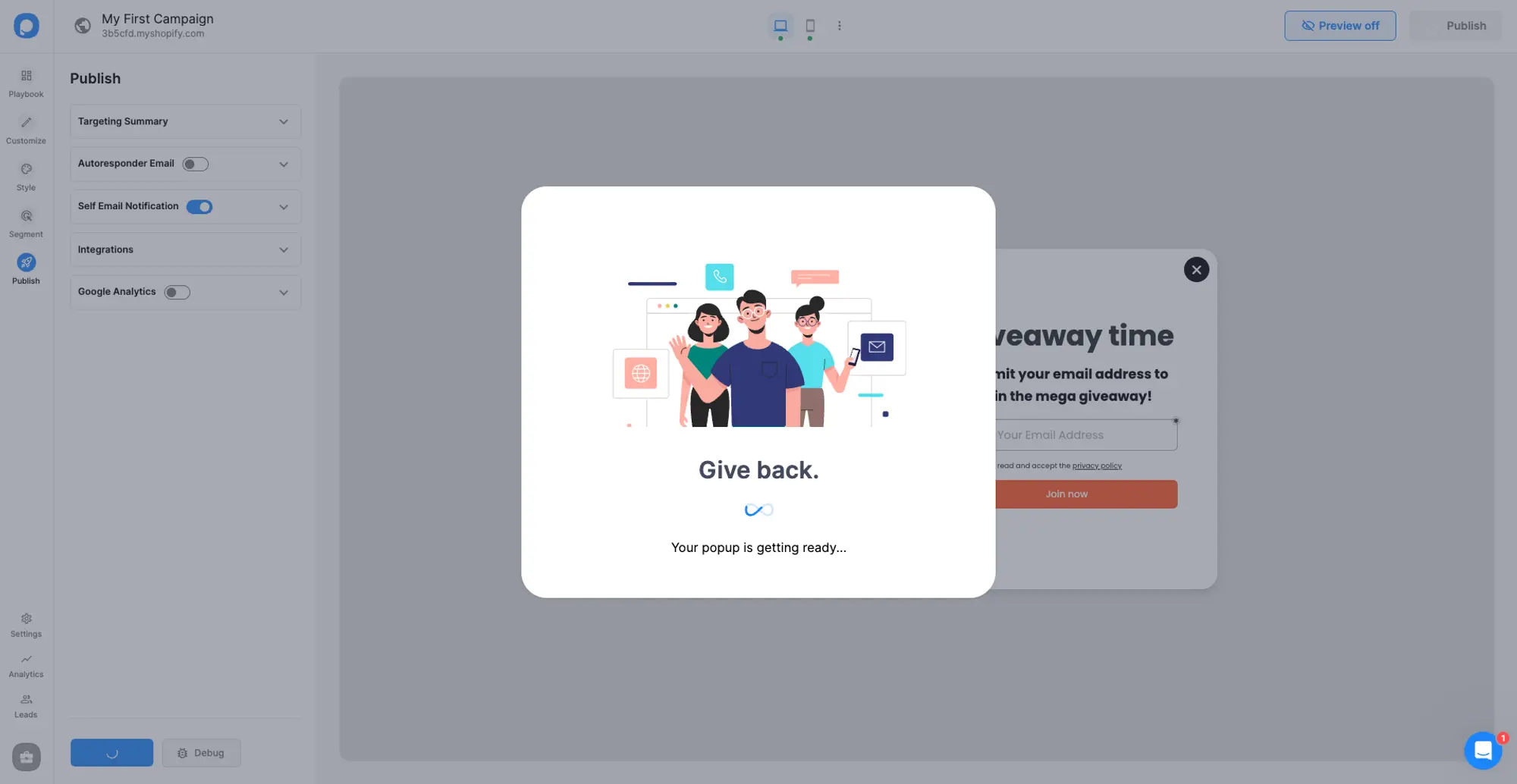
Step 6: Check the popup on your store
Open your store in a private window and load a page the popup targets; it appears when its trigger fires.
Or add the embed code to theme.liquid
The embed code suits a store the app can't verify, or a theme you manage in code. Use one method, not both: the help center warns that adding the code to the same site twice can make it malfunction. Shopify recommends duplicating your theme before you edit its code.
Copy your embed code
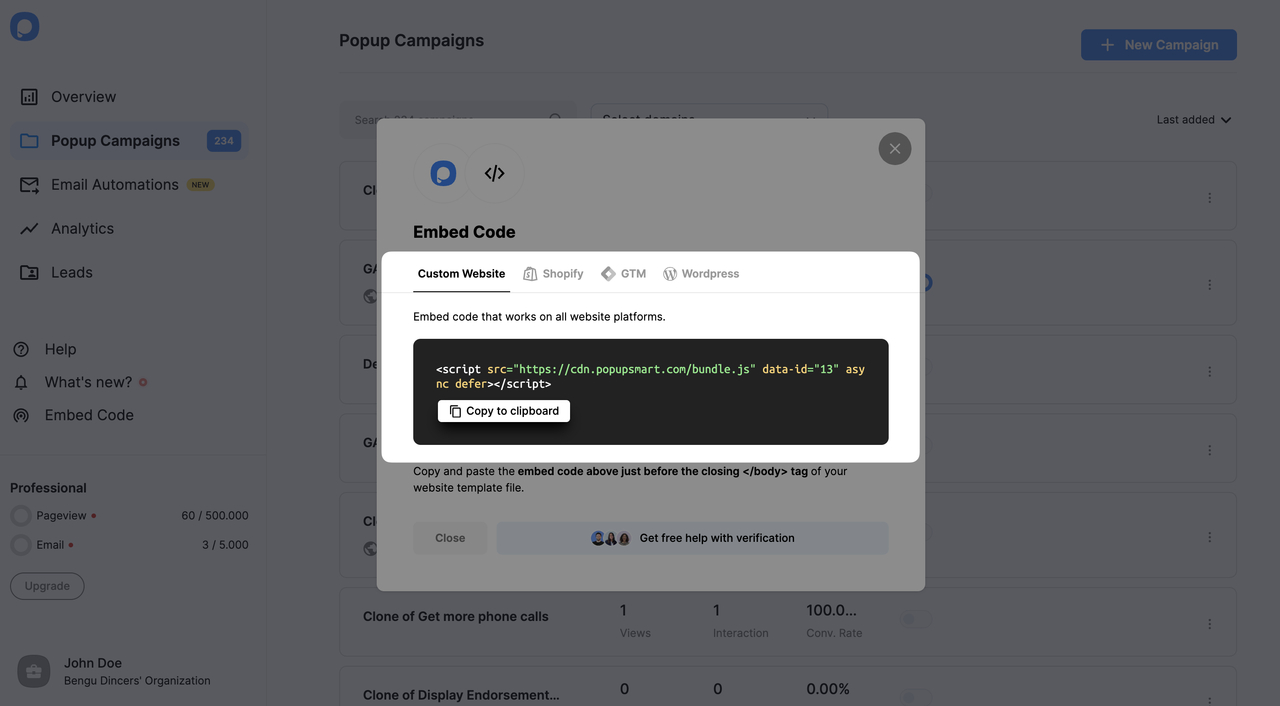
Sign in to your Popupsmart account and click Embed Code in the left-hand menu.
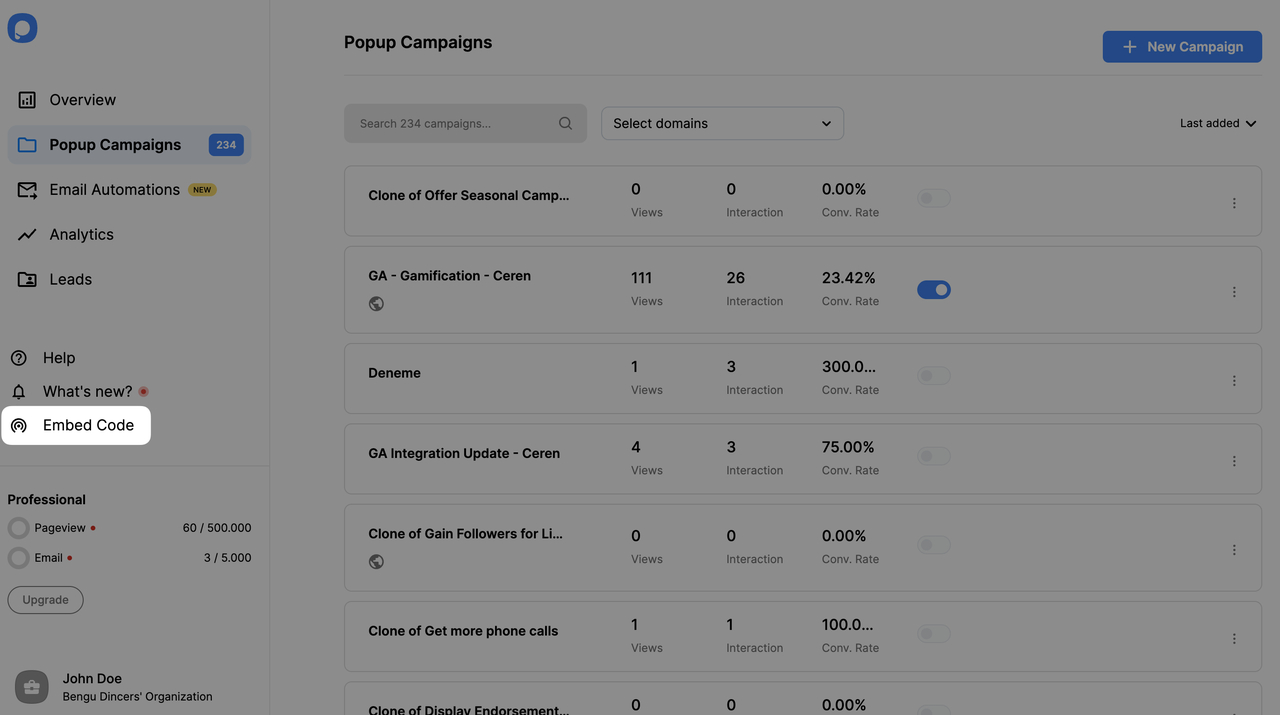
A window opens with your embed code. Click Copy to clipboard.
Paste the code into theme.liquid
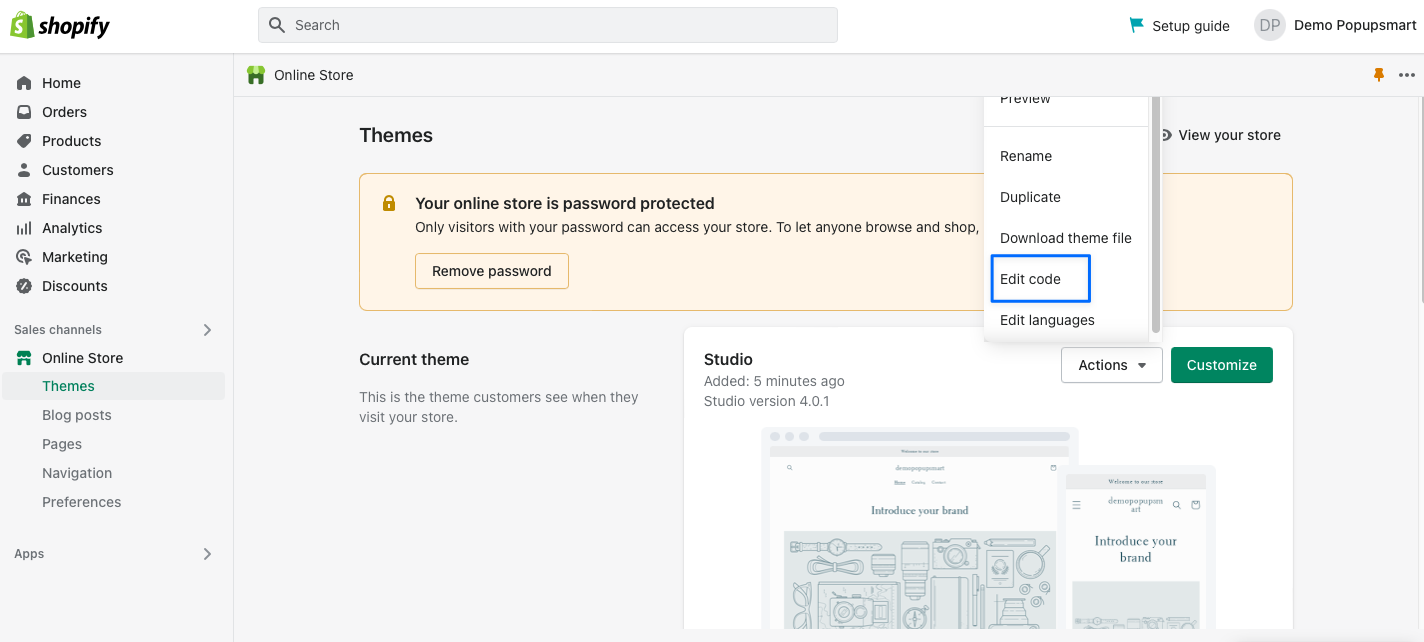
In your Shopify admin, open Online Store, then Themes. Open the … menu next to your current theme (the older admin in the screenshot calls it Actions) and click Edit code.
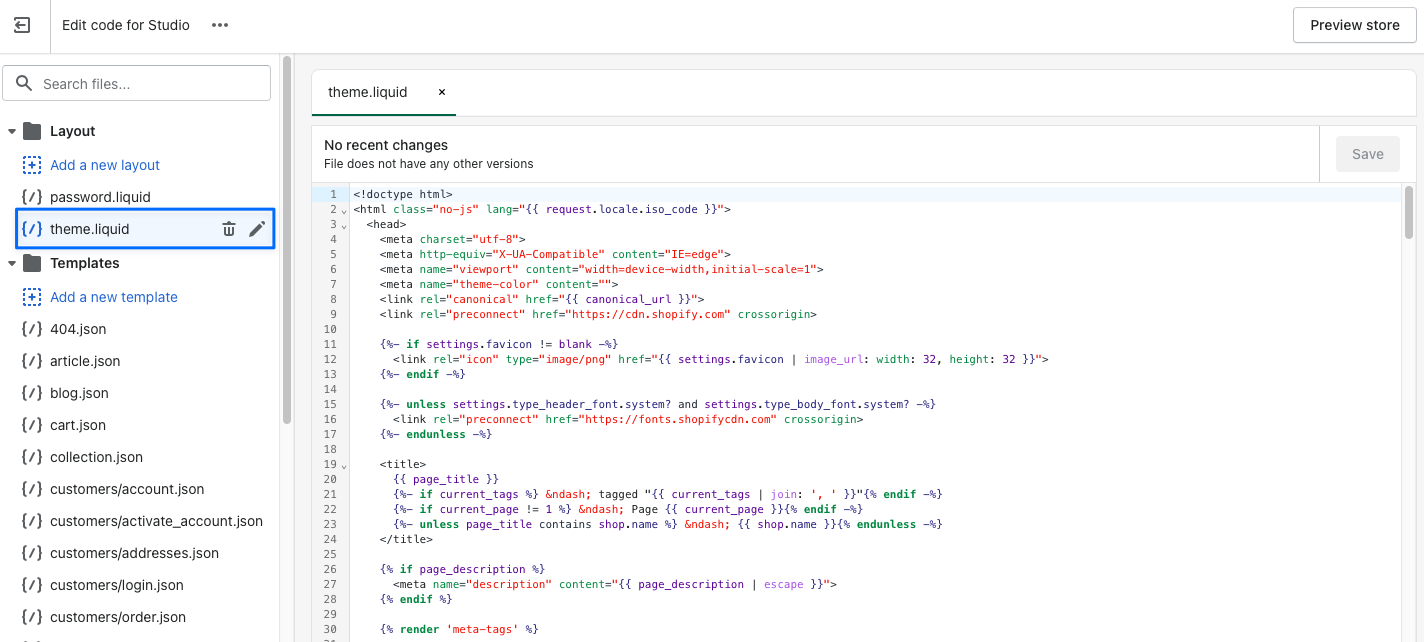
Under Layout, open theme.liquid.
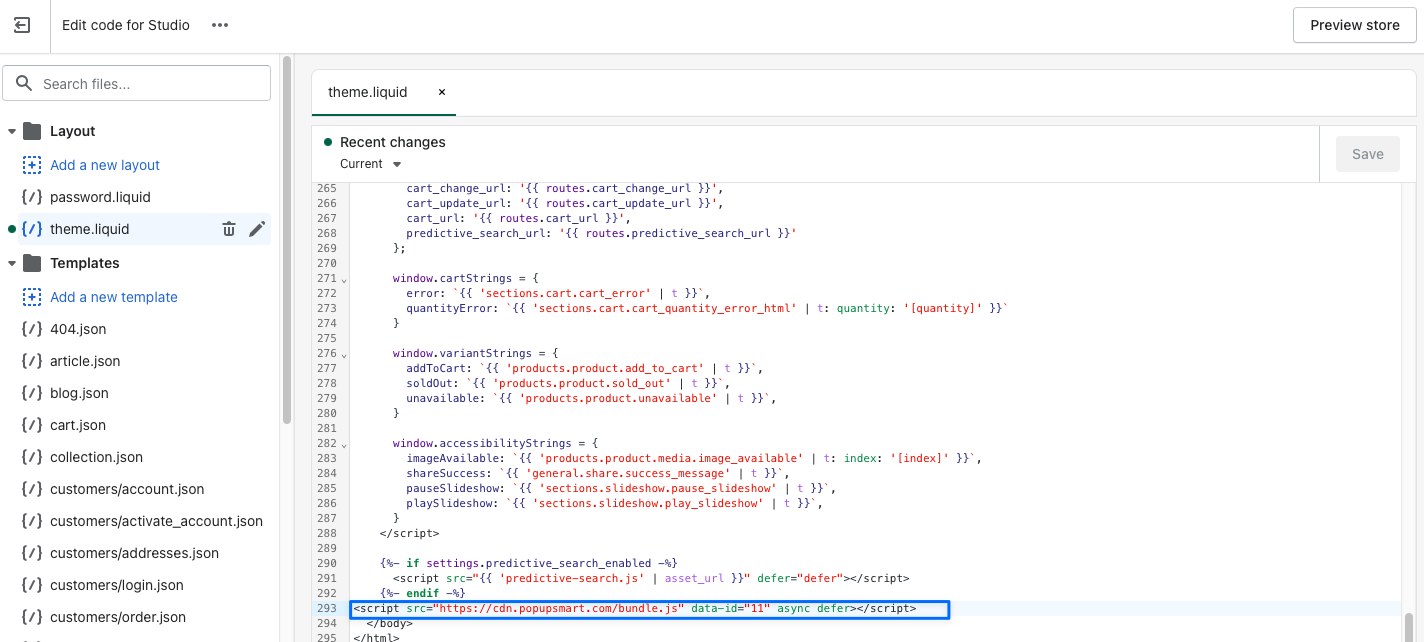
Paste the embed code just before the closing </body> tag and click Save.
Add your store to Popupsmart and publish
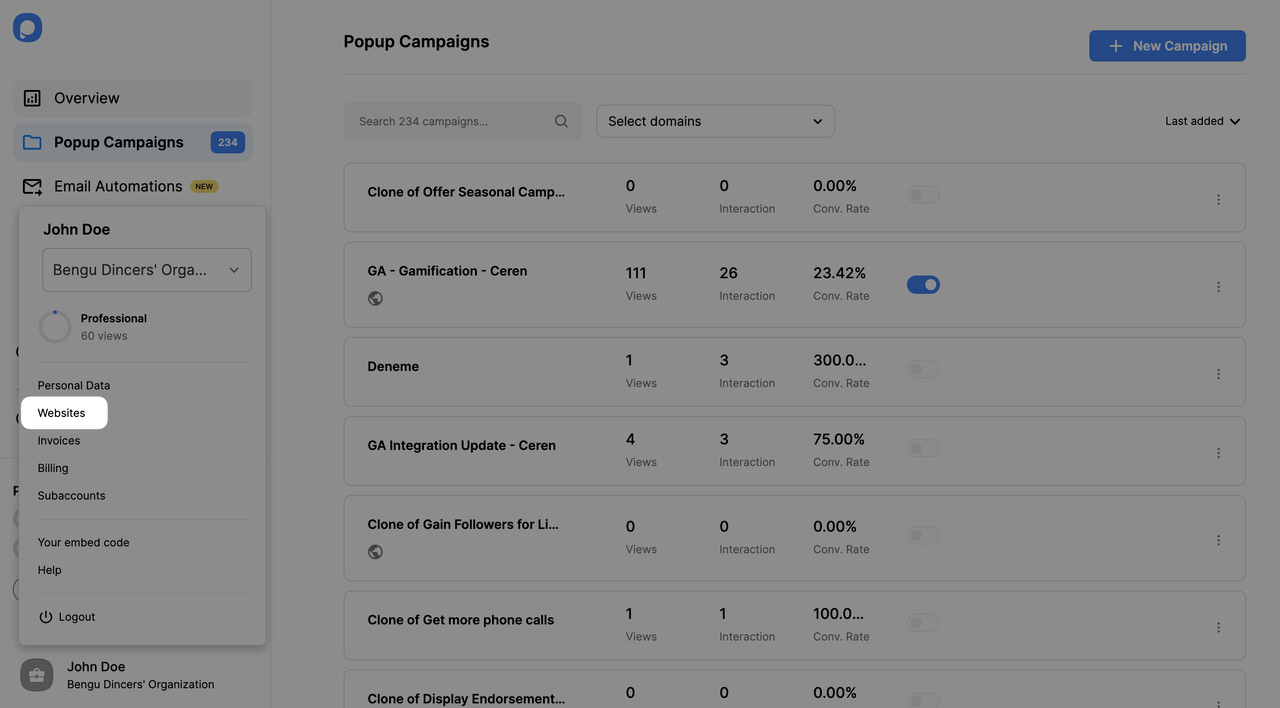
In Popupsmart, open the profile menu and click Websites.
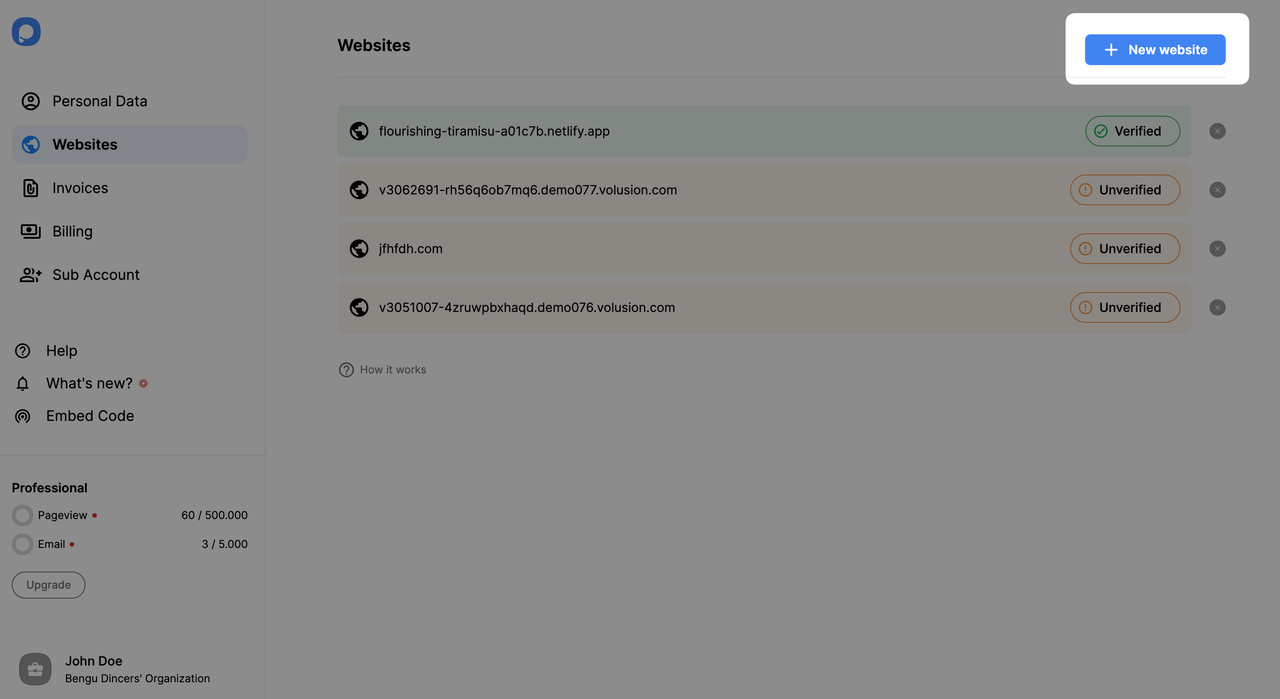
Click New website, enter your store's address and click Save. If the store shows as Unverified, click Unverified, then Verify website, and refresh the dashboard. The guide to verifying your website covers the other cases.
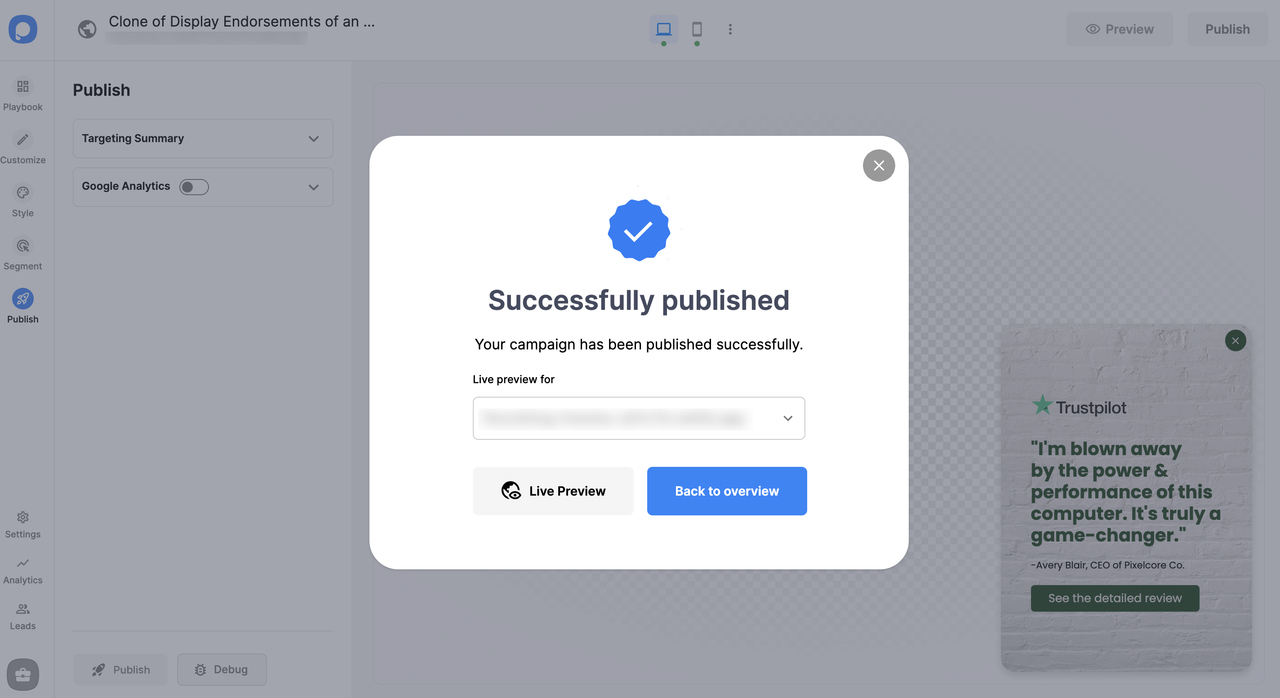
Build your campaign as in Step 3, then click Save and Publish. A confirmation appears when the campaign is live.
Does Shopify have a built-in popup?
Shopify's built-in popup is Shopify Forms, a free app from Shopify that shows signup forms as popups or inline sections and saves each subscriber as a Shopify customer. According to Shopify's help center, the app doesn't come installed with any Shopify plan, but it's free to install and use. As of September 2026, a popup form needs the Forms theme app embed switched on in your theme, and Shopify's guide to creating forms lists its limits: 25 forms per store, no multi-step forms and no conditional logic.
Side by side, from Shopify's popup form settings and Popupsmart's plans:
| Shopify Forms popup | Popupsmart | |
|---|---|---|
| Where it runs | Your Shopify online store, through the Forms theme app embed | Your Shopify store and any other website: 3 websites on Basic, up to unlimited on Expert |
| How many popups | Up to 25 forms per store; how many popups can be on at once isn't documented | One live popup on the free plan, unlimited on paid plans |
| When it shows | On the first, second or third page view, at once or after a delay; exit intent on desktop only | Exit intent, scroll depth, time on page, inactivity or a button click |
| Where and to whom | All pages or page types such as collections and products; all devices, desktop or mobile | URL rules, device, new or returning visitors, traffic source, location, and Shopify cart and customer conditions |
| Where the leads go | Shopify customer profiles, with email, SMS or WhatsApp marketing consent | Shopify Customers, or Klaviyo, Mailchimp, HubSpot and the rest of the 19 destinations the help center lists |
| A/B testing | Not documented | From the Advanced plan |
| Price | Free to install and use | Free plan; paid web plans from $39 a month |
Shopify Forms is enough when one signup popup with a discount code is the whole plan: it's free, it lives in your Shopify admin, and subscribers land in Shopify with their marketing consent. A second tool earns its install when you need a trigger beyond page views, a delay and desktop exit intent, a popup aimed at a cart total or a returning customer, an A/B test, or the same popups on a site that isn't on Shopify.
How do you show a popup only on some Shopify pages?
A Shopify popup shows on the pages its campaign targets, not the pages you paste code into. Popupsmart loads on the whole store once, and each campaign's Segment step decides where, when and for whom it appears:
- URL targeting shows or hides a campaign on pages whose address contains or matches a keyword, such as
/collections/sale. - Shopify Audience Targeting adds store conditions: cart properties such as the cart total and the products in the cart, and customer properties such as tags, orders count and total spent. It works only on stores built with Shopify, and the Shopify Audience Targeting guide lists every property.
- Triggers decide the moment: exit intent, scroll depth, time on page or inactivity.
What I check first on a new Shopify campaign is the trigger, before the design. In Popupsmart's 2026 benchmark, popups that wait before appearing convert 0.83% against 0.61% for popups shown the instant the page loads (median campaign), a lean rather than a proven gap, and exit intent shows no statistically reliable advantage.
How to create a pop up discount on Shopify
A Shopify discount popup is a Popupsmart campaign with a Coupon Code element, which shows a code inside the popup and lets the visitor copy it. Add it in the Customize step under Add a new element → Coupon Code, then choose where the code comes from:
- Fix coupon: the same code for every visitor.
- Existing discount: a discount code that already exists in Shopify.
- Unique coupons: different codes from a list you provide.
- Dynamic unique coupons: Popupsmart creates a unique Shopify discount code for each visitor.
I'd start with Existing discount: the code, its usage limits and its end date stay in Shopify, where you already manage discounts. The help center covers adding a coupon code to your popup. Ways to increase average order value shows the code only when the cart passes an amount, and cart abandonment popup examples makes a last offer to shoppers about to leave.
How to add an email pop up on Shopify
A Shopify email pop up is a Popupsmart campaign built from the Grow Email List goal: a template with an email field, an offer in exchange for the address, and a connection that sends each signup where you keep your list. Build it as in Step 3, then switch on a destination in the Integrations section of the Publish step:
- Shopify Customers adds each email, name and phone number to Customers in your Shopify admin; the help center shows how in sending leads to Shopify Customers.
- Your email tool. The Klaviyo popup guide and the Mailchimp popup guide walk through a connection; phone numbers and SMS consent can go to Klaviyo, Mailchimp and HubSpot. The help center lists 19 destinations; a webhook, Zapier or Make covers a tool that isn't one of them.
For the offer, email popup examples trades shipping for an email address, and countdown timer popup examples pairs a signup with a product launch.
Does a popup slow down a Shopify store?
A Popupsmart popup doesn't hold up your Shopify pages: the embed code loads asynchronously (async defer), so the browser finishes building the page before it fetches Popupsmart.
Popup not showing on Shopify? Check these
When a Shopify popup doesn't appear, check the theme first, then the store's verification and the trigger:
- The app embed is off. Open the theme editor, go to App embeds and check that Install Embed Code is on and saved. After you publish a different theme, switch it on in that theme too.
- The code is in another theme. A
theme.liquidedit lives in one theme. If you published a copy or a new theme, paste the code into it. - The code is installed twice. Keep the app embed or the
theme.liquidcode, not both. - The store isn't verified. A campaign runs only on a verified website; see Step 5, or the verification steps in the embed-code section.
- The address doesn't match. Your own domain and the
myshopify.comaddress are different sites to a browser. Add the address your visitors actually use. - The trigger hasn't fired yet. An exit-intent or scroll trigger waits for the visitor to leave or scroll; test in a private window and behave like a visitor.
Still stuck? Contact Popupsmart support with your store's address and the campaign name.
Shopify popup FAQ
Is there a free way to add a pop up on Shopify?
Yes. Popupsmart's free plan is permanent, not a trial: one website, one live popup and 5,000 pageviews a month, with Popupsmart branding. The Popupsmart Shopify app is free to install, so one store and your first popup cost nothing, whichever install method you use.
The Popupsmart pricing page compares it with the paid plans.
What is the best pop-up app for Shopify?
The best pop-up app for Shopify depends on what the popup has to do. Shopify Forms is free and enough for one signup form. A dedicated app such as Popupsmart adds behaviour triggers, cart and customer targeting, A/B testing and several websites on one plan.
The comparison of Shopify popup apps lays the options side by side.
Can you A/B test a Shopify popup?
Yes, with Popupsmart. A/B testing is included from the Advanced plan: you split traffic between two or more versions of a popup, then pick the winner yourself or let Popupsmart choose it by leads or interactions. Shopify's documentation for Shopify Forms doesn't mention A/B testing.
Will the popup work with any Shopify theme?
Yes. According to Shopify's help center, app embeds can be used with any theme version, so the Popupsmart app embed works on older themes too. Every Shopify theme also has a theme.liquid layout with a closing body tag where the embed code can go.
How long does it take to set up a Shopify popup?
Popupsmart's own product data gives a benchmark. Among people who published a campaign in the 90 days to 16 September 2026, the median time from signup to the first published campaign was 32.5 minutes, and 287 of 332 published within a day. That figure covers every platform, not Shopify alone.
Do Popupsmart popups work on mobile Shopify stores?
Yes. Popupsmart popups are responsive, and you can switch the editor to the mobile view to check and adjust how a popup looks on a phone before you publish it. Device targeting lets a campaign show on phones only, desktops only, or both.