MailerLite popup: build one and connect it to your MailerLite group
 By Mert Özeren
To add a MailerLite popup, use MailerLite's own pop-up forms, which count toward its active-form limit (3 on the Free plan), or build the popup in Popupsmart and connect it with a MailerLite API token. Popupsmart then adds every signup the popup collects to the MailerLite group you choose, ready for your campaigns and automations.


Connection at a glance
- Sends leads to
- MailerLite
- What you need
- A MailerLite API tokenA group in MailerLite
- Fields sent
- EmailAny form field


What the MailerLite connection does
The MailerLite connection adds everyone who submits your popup to one MailerLite group, with the fields you choose. You pick the group per campaign and match each popup input to a MailerLite field, so the email lands in the email field and any other input in the field you pick for it.
The token is saved once as a connection, and your next campaign picks it from a dropdown. The connection starts switched on and you can pause it at any time.
Popupsmart is not an email marketing platform. It captures contacts and hands them to an email service provider; it does not send campaigns or run drip sequences. MailerLite keeps sending your emails as before.
Does MailerLite have its own pop-up forms?
Yes. MailerLite builds pop-ups on its Forms page, under the Pop-ups tab, in five layouts: lightbox, floating bar, slide-in, full screen and big sidebar. According to MailerLite's guide to creating a pop-up form, each pop-up gets a trigger, a frequency, a schedule and visibility rules, and it runs from a JavaScript snippet placed before the closing head tag on every page. As of September 2026, MailerLite's plan limits allow 3 active forms on the Free plan, 10 on Comfort and unlimited on Power.
| MailerLite's built-in popup | Popupsmart | |
|---|---|---|
| Where it runs | Any site with MailerLite's JavaScript snippet on every page, plus MailerLite websites and landing pages | Any website that accepts the Popupsmart embed code, plus a Shopify app and an optional WordPress plugin |
| How many popups | Within MailerLite's active-form limits: 3 on Free, 10 on Comfort, unlimited on Power | One live popup on the free plan; unlimited on paid plans |
| Triggers and targeting | Time on page, scroll depth, exit intent or a click; frequency and schedule; hide on chosen devices; show or hide on listed pages | Exit intent, scroll, time on page, URL and device targeting |
| Where the leads go | One or more MailerLite groups | MailerLite, or any of the 19 destinations the help center lists |
| A/B testing | Not documented | From the Advanced plan |
| Price | Included in MailerLite's plans, within those form limits | Free plan: one website, one live popup, 5,000 pageviews a month; paid plans from $39 a month |
For one or two signup pop-ups on one site, MailerLite's own pop-ups are already in your account and need no second tool. Popupsmart earns its install when you've run into MailerLite's active-form limit, when the same popups have to run on several websites (3 on the Basic plan, up to unlimited on Expert), or when you want popups for other jobs, such as discounts, announcements and surveys, beside your list growth.
Does MailerLite use groups or lists?
MailerLite uses groups where most email tools use lists. According to MailerLite's guide to groups, other platforms call them tags, lists or audiences, and a subscriber can belong to several groups while counting only once toward your plan's limit.
That shapes how a MailerLite popup is set up. Popupsmart sends each campaign's signups to the group you choose for it, so a blog newsletter popup and an exit-intent offer can fill different groups without anyone being counted twice. When I set up several popups for one MailerLite account, I give each popup its own group, so the group alone shows which popup a subscriber came from.
Before you start
- An active MailerLite account.
- A group in MailerLite. Create one under Subscribers → Groups if you haven't already; the connection can't be finished without one.
- A verified website on your Popupsmart account.
Among people who published a campaign in the 90 days to 16 September 2026, the median time from signup to the first published campaign was 32.5 minutes, and 287 of 332 published within a day, according to Popupsmart's own product data. It covers every platform and tool, so treat it as a guide, not a MailerLite promise.
How to create a MailerLite popup in Popupsmart
Popupsmart builds the popup in its own editor, with no plugin, developer or code. Build the popup first; the next section connects it to MailerLite.
Step 1: Create your account and verify your website
Create your free Popupsmart account and add the website your popup will run on. Verify it with the website verification guide: a campaign only runs on a verified website.
Step 2: Start a campaign with a form
Click New Campaign and choose a template with a form input element, or add one to the popup in the Customize step. The form is what collects the data MailerLite receives.
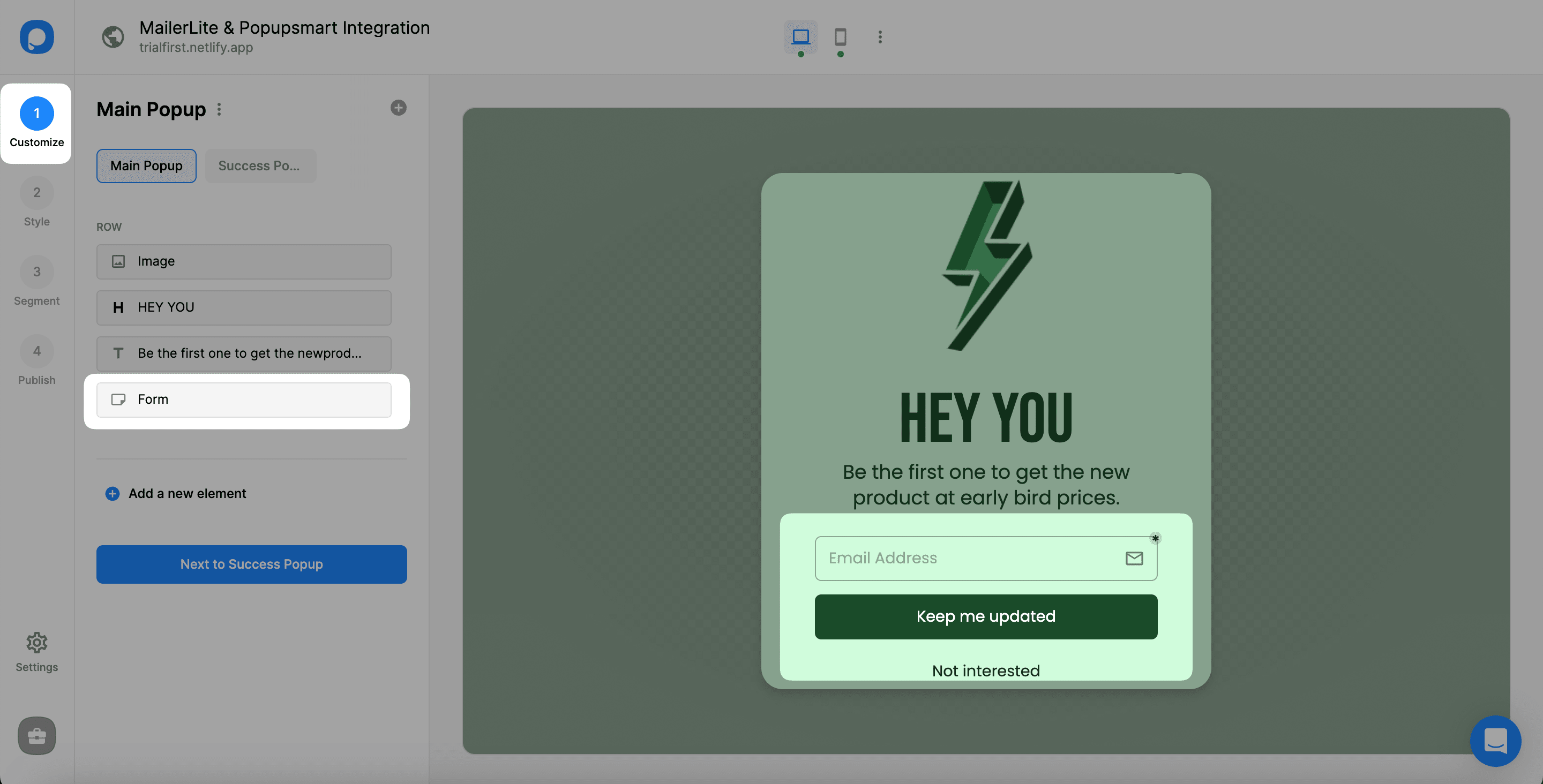
Newsletter and discount templates are the usual starting points for list growth. Change the copy, colours and button to match your site.
Step 3: Choose who sees it and when
Set the targeting and trigger rules: exit intent, scroll depth, time on page, new or returning visitors, device, location or specific URLs, alone or combined. A signup offer on the blog and a discount at checkout can run side by side, each with its own rule. In Popupsmart's 2026 benchmark, popups that wait before appearing convert 0.83% against 0.61% for popups shown the instant the page loads (median campaign), a lean rather than a proven gap, and exit intent shows no statistically reliable advantage.
Step 4: Publish and add the embed code
Connect the popup to MailerLite first (next section). Then publish it from the Publish step and paste the Popupsmart embed code into your site once; every campaign you build later runs from the same line. The WordPress popup guide and the Squarespace popup guide show where the code goes on those platforms.
MailerLite popup types that work well
- Newsletter signup on blog and content pages: the email popup guide.
- A last offer for visitors about to leave: exit-intent popup examples.
- Webinar or event signups: B2B lead generation popups.
How to connect Popupsmart to MailerLite
The MailerLite connection needs one API token and one group. You set it up inside the campaign, from the popup's form element.
Add MailerLite to your campaign
In the Customize step, click the form element, open Integration and click Add integration.
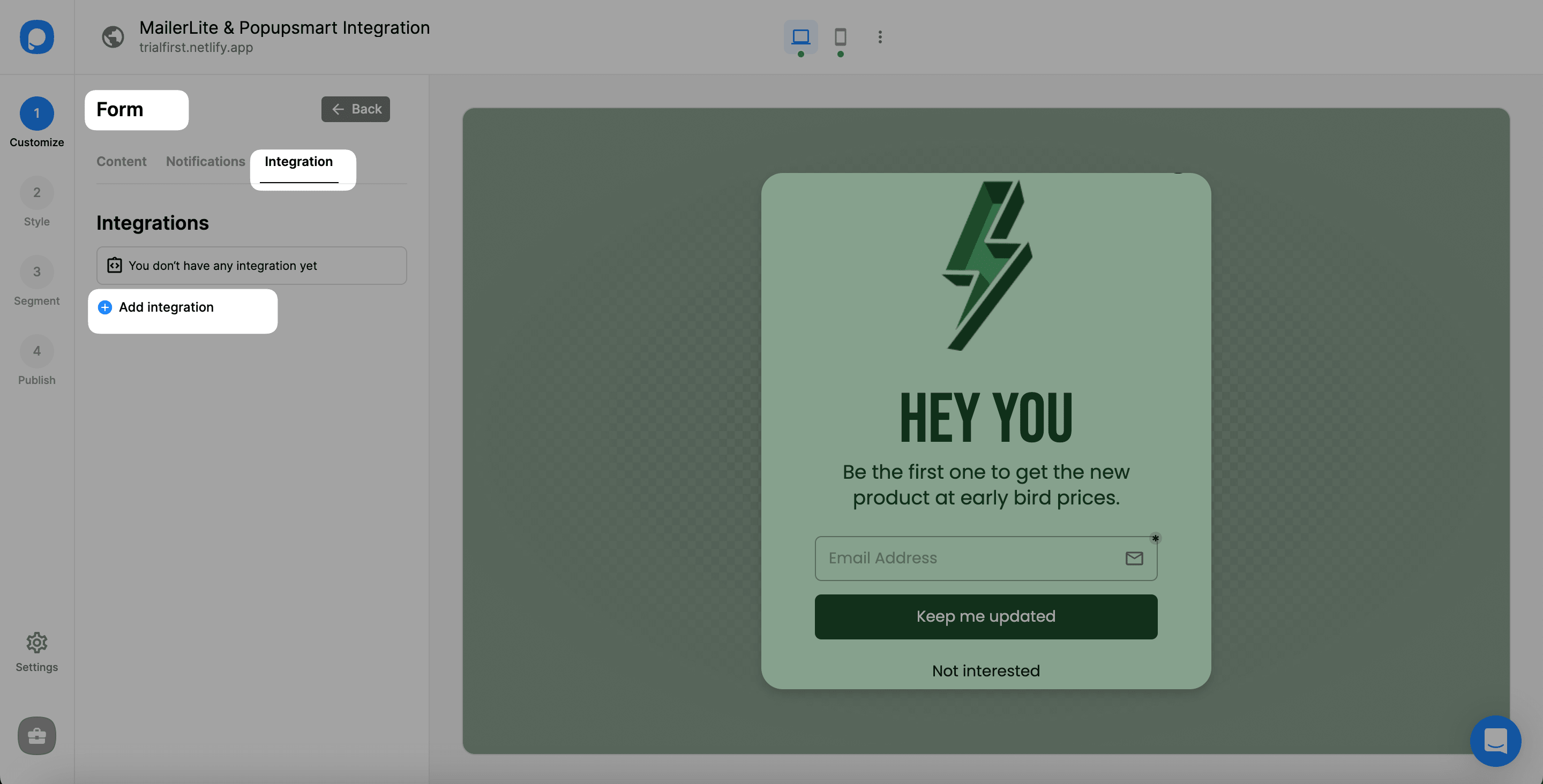
Find MailerLite and click Connect.
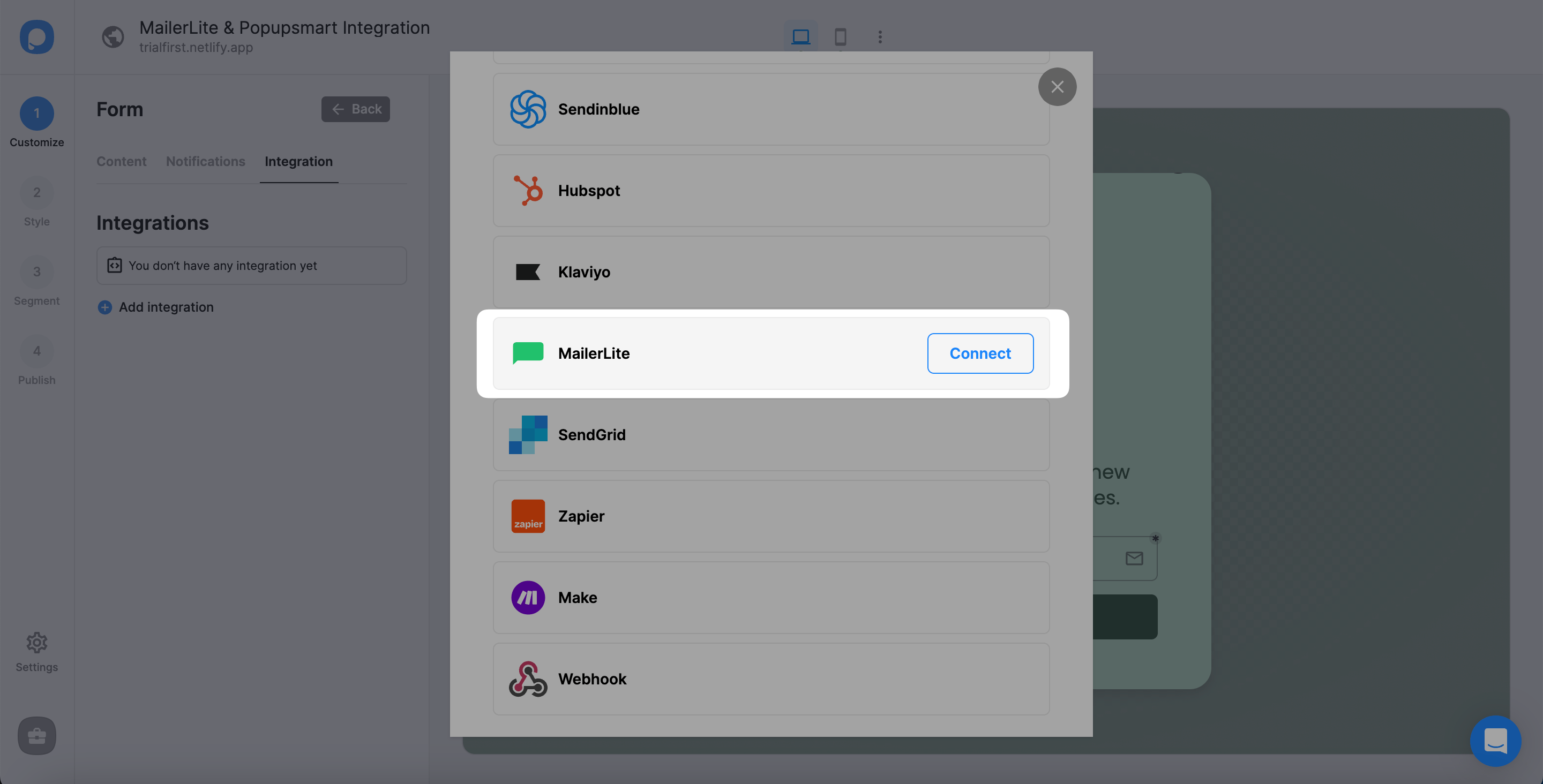
Under Setup, pick a saved MailerLite connection from the dropdown, or click Add new MailerLite API for your first one.
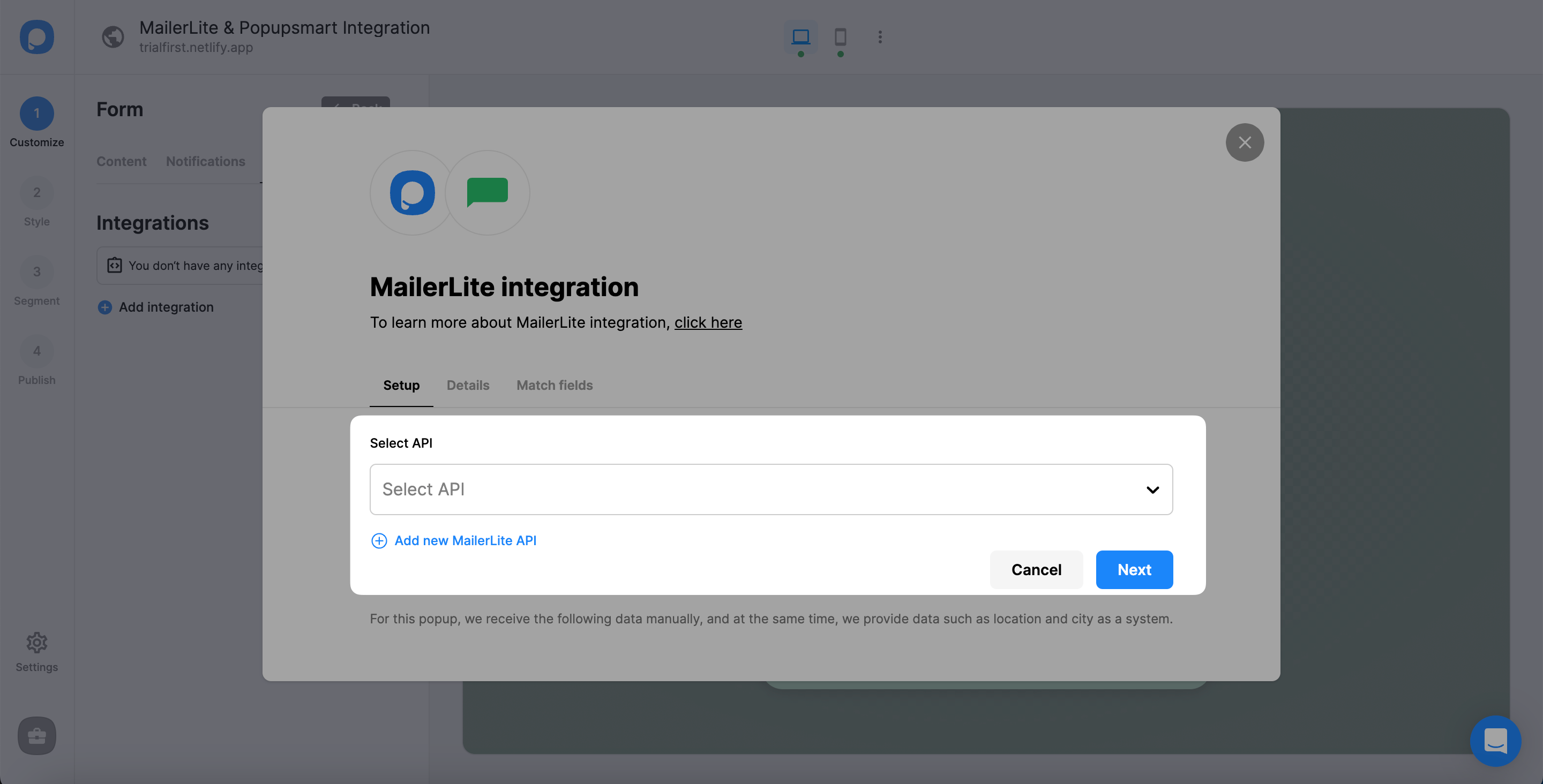
Where to find your MailerLite API token
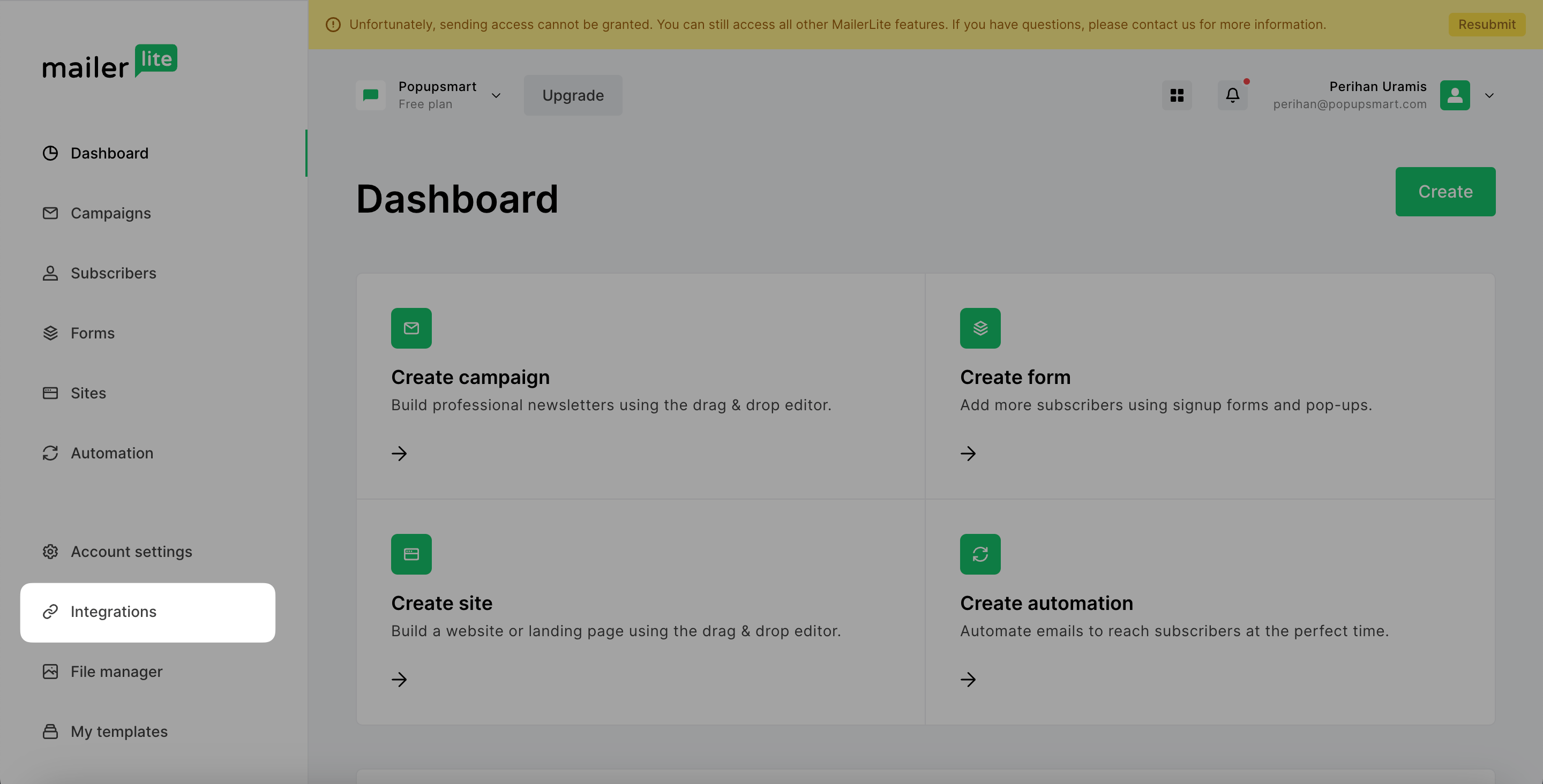
MailerLite calls its API key a token, and you create it from the Integrations page. Log in to MailerLite and click Integrations in the left-hand menu.
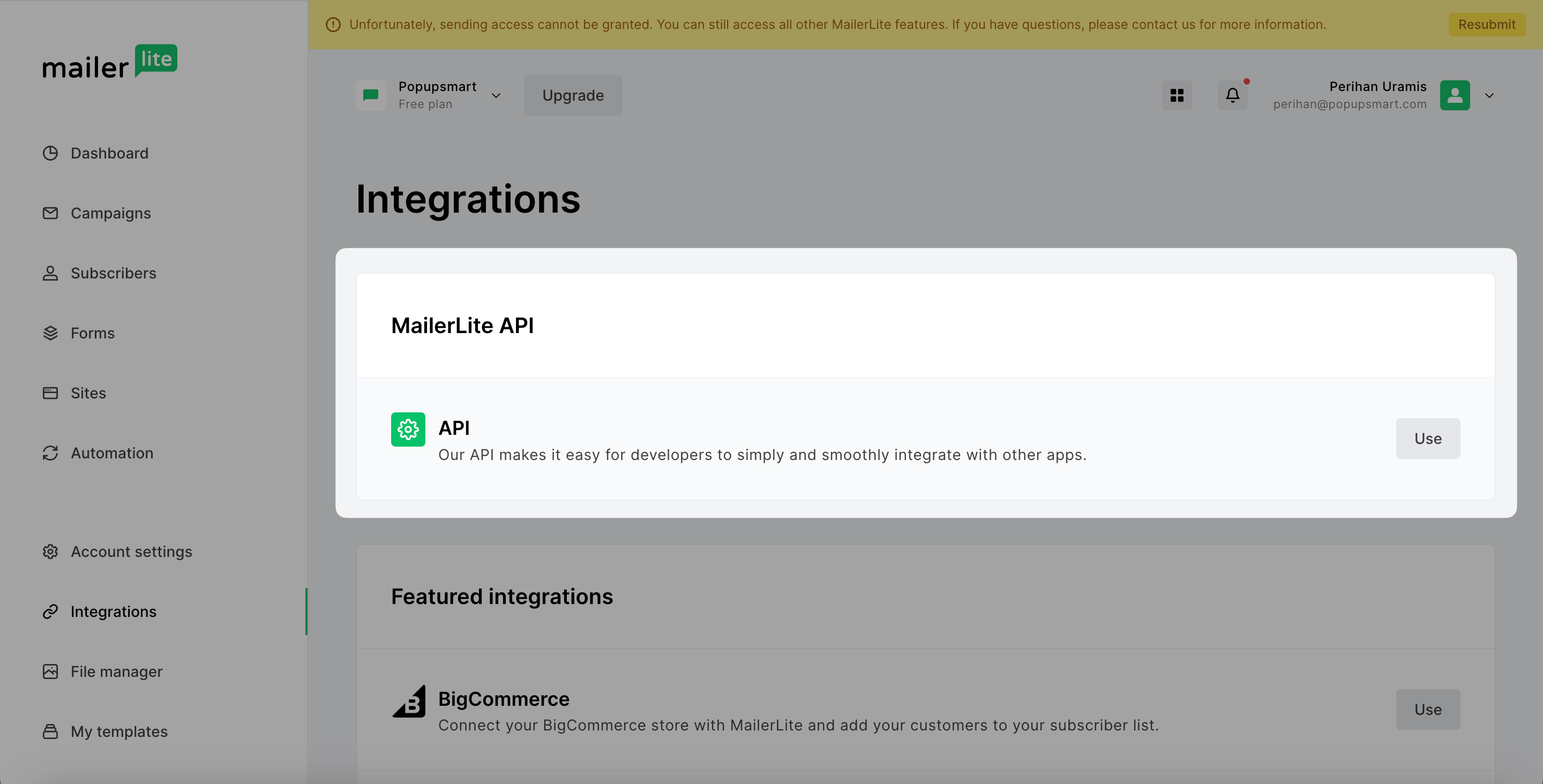
In the MailerLite API section, click Use.
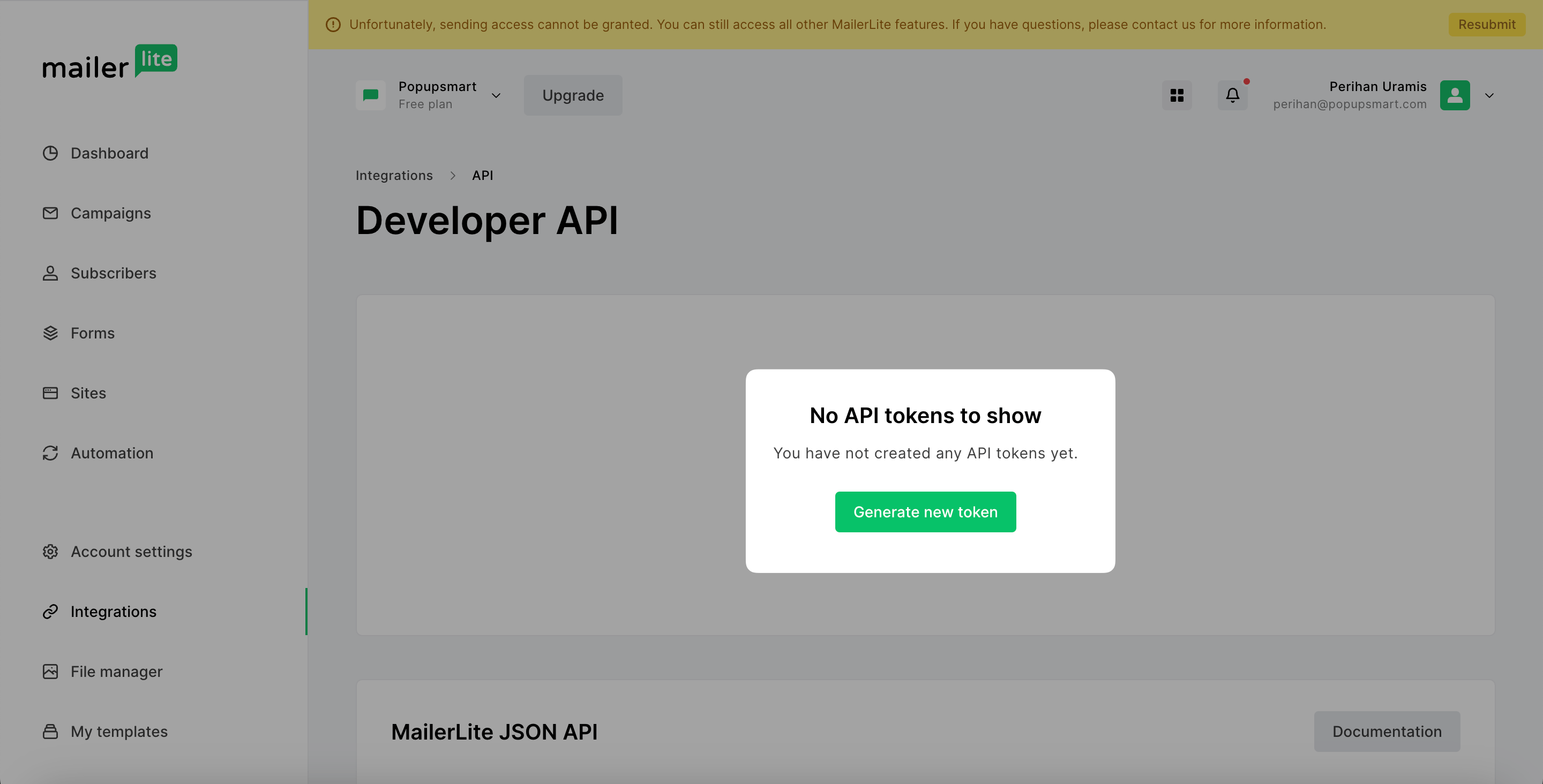
Click Generate new token.
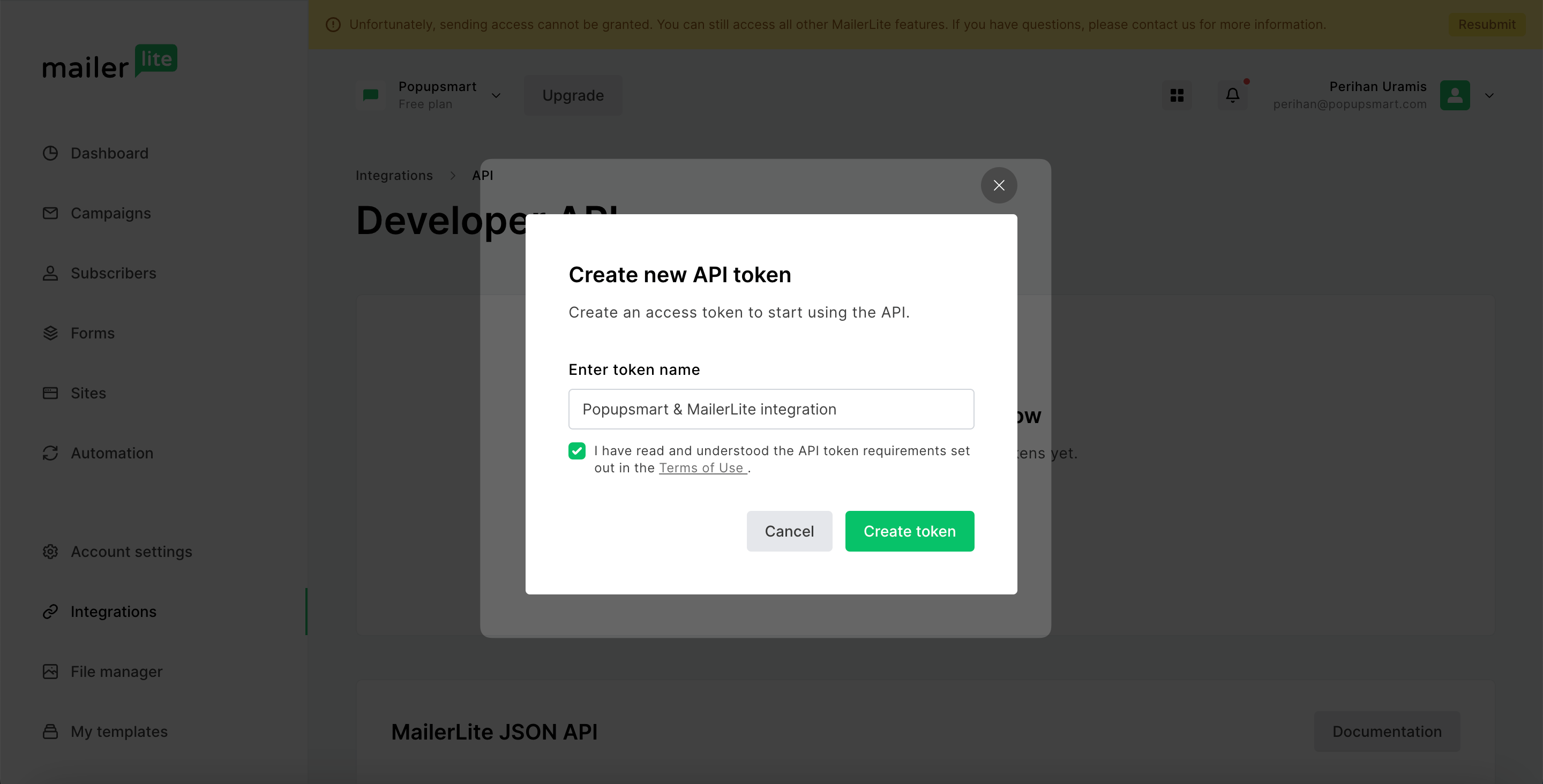
Name the token after what uses it, for example "Popupsmart". If MailerLite asks which IP addresses may use the token, allow any IP address: with an allowlist, MailerLite accepts requests only from the addresses on it. Accept the terms of use if they're shown, then click Create token.
Copy the token, then return to Popupsmart.
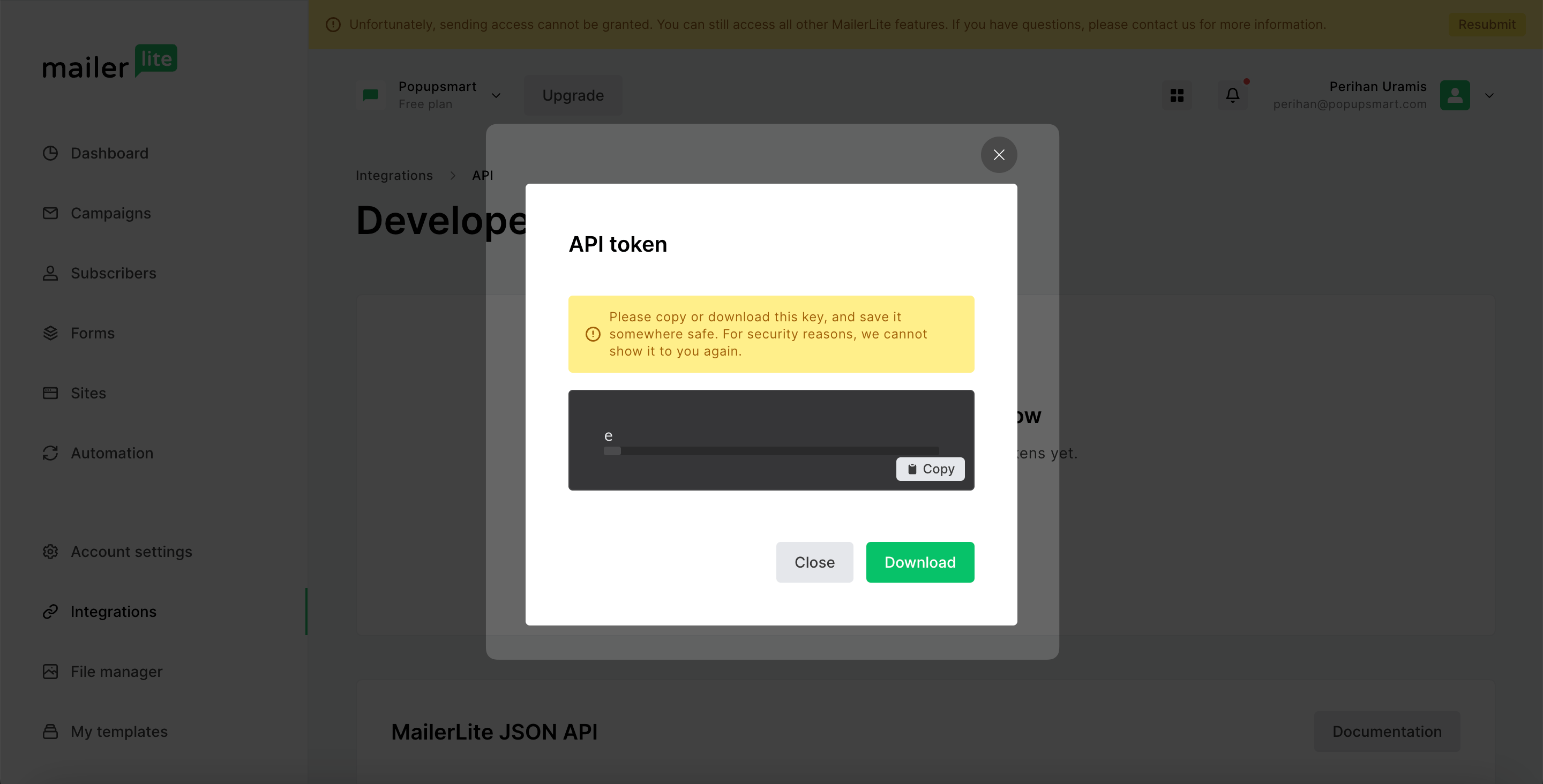
MailerLite's own guide to finding your MailerLite API key covers the same steps from its side.
Save the connection and choose your group
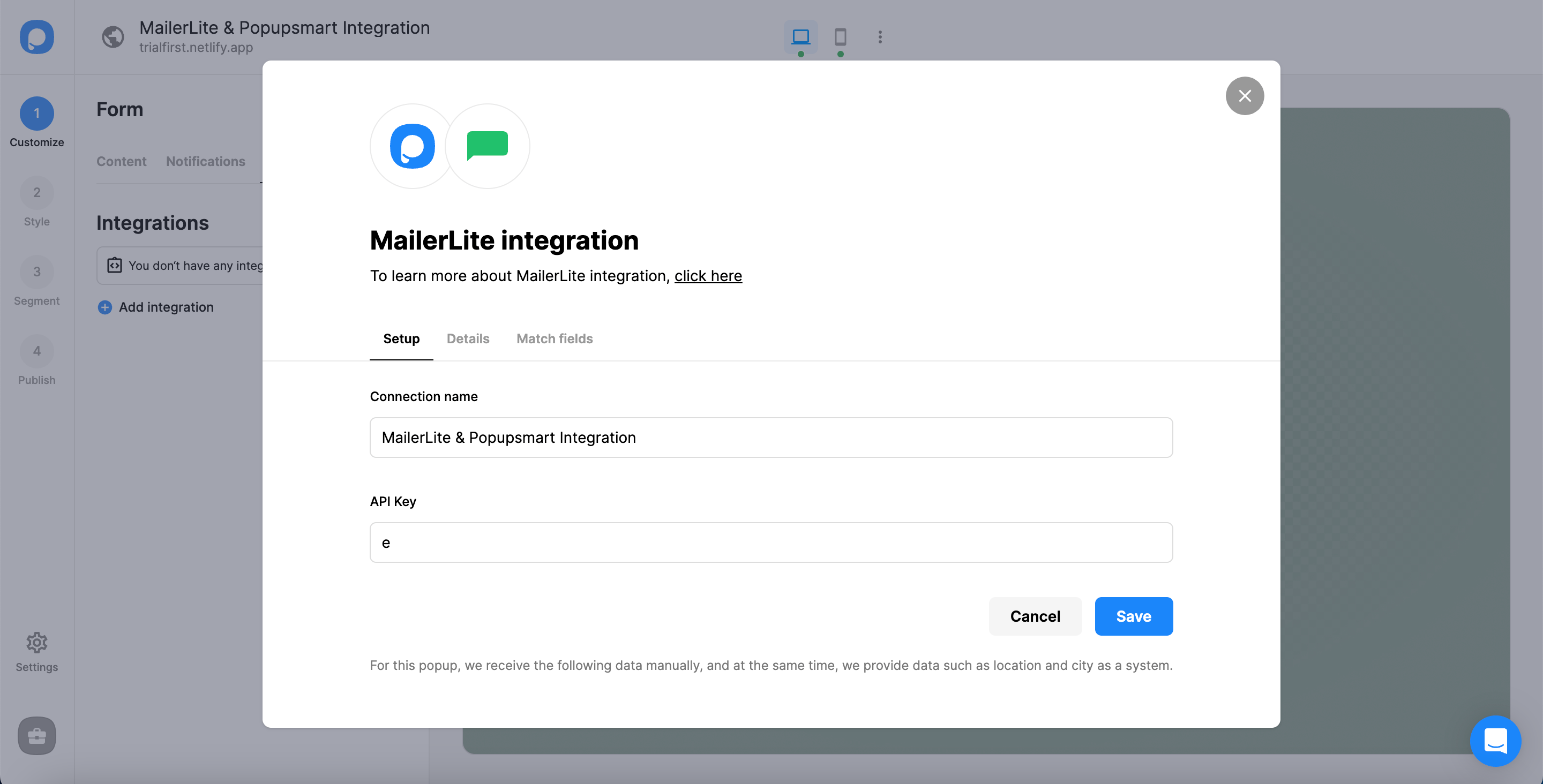
Name the connection, paste the token and click Save.
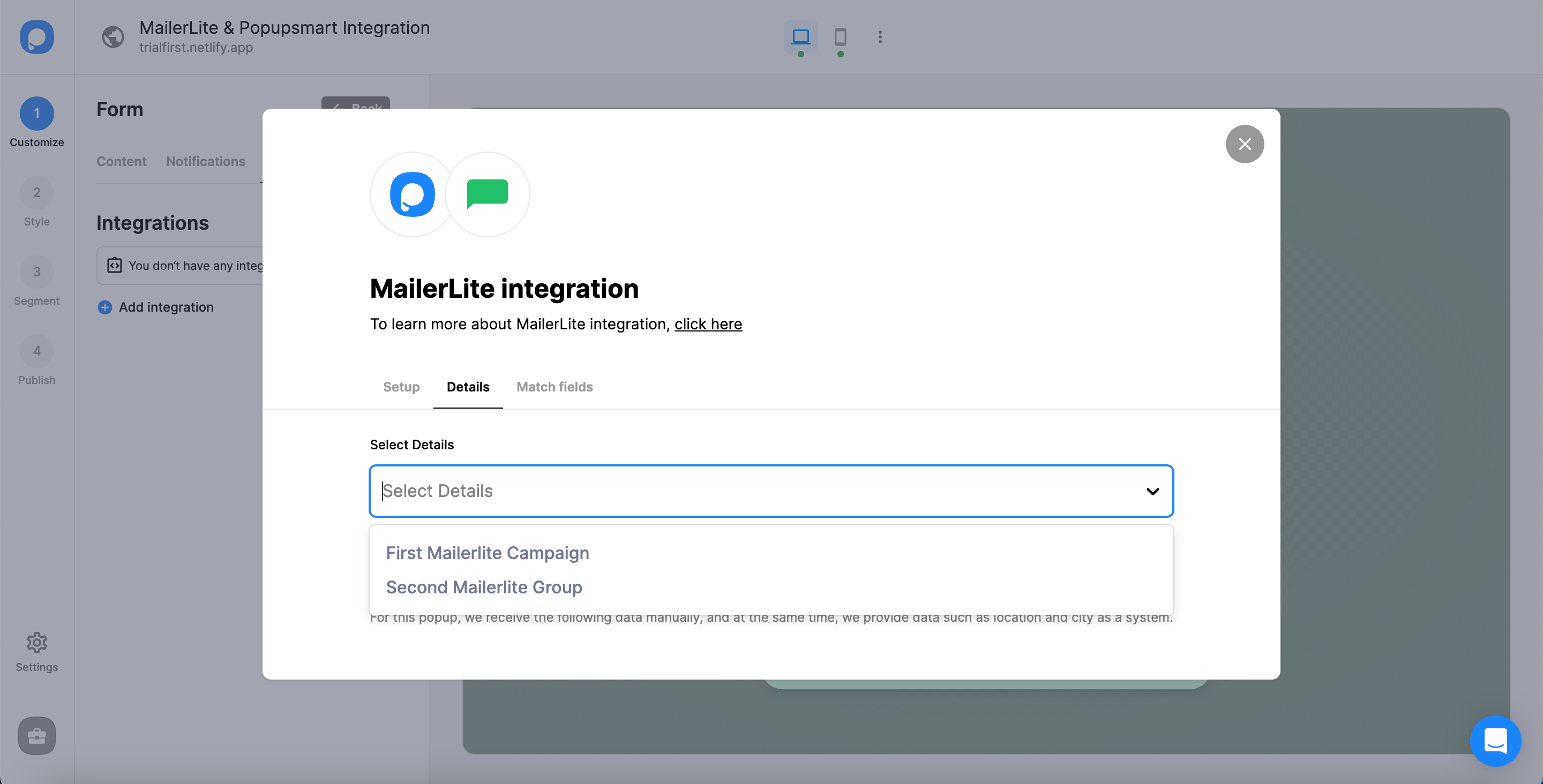
In Details, choose the MailerLite group your subscribers should join and click Next.
Match popup fields to MailerLite fields
Match each popup input to the MailerLite field it should fill, then click Save.
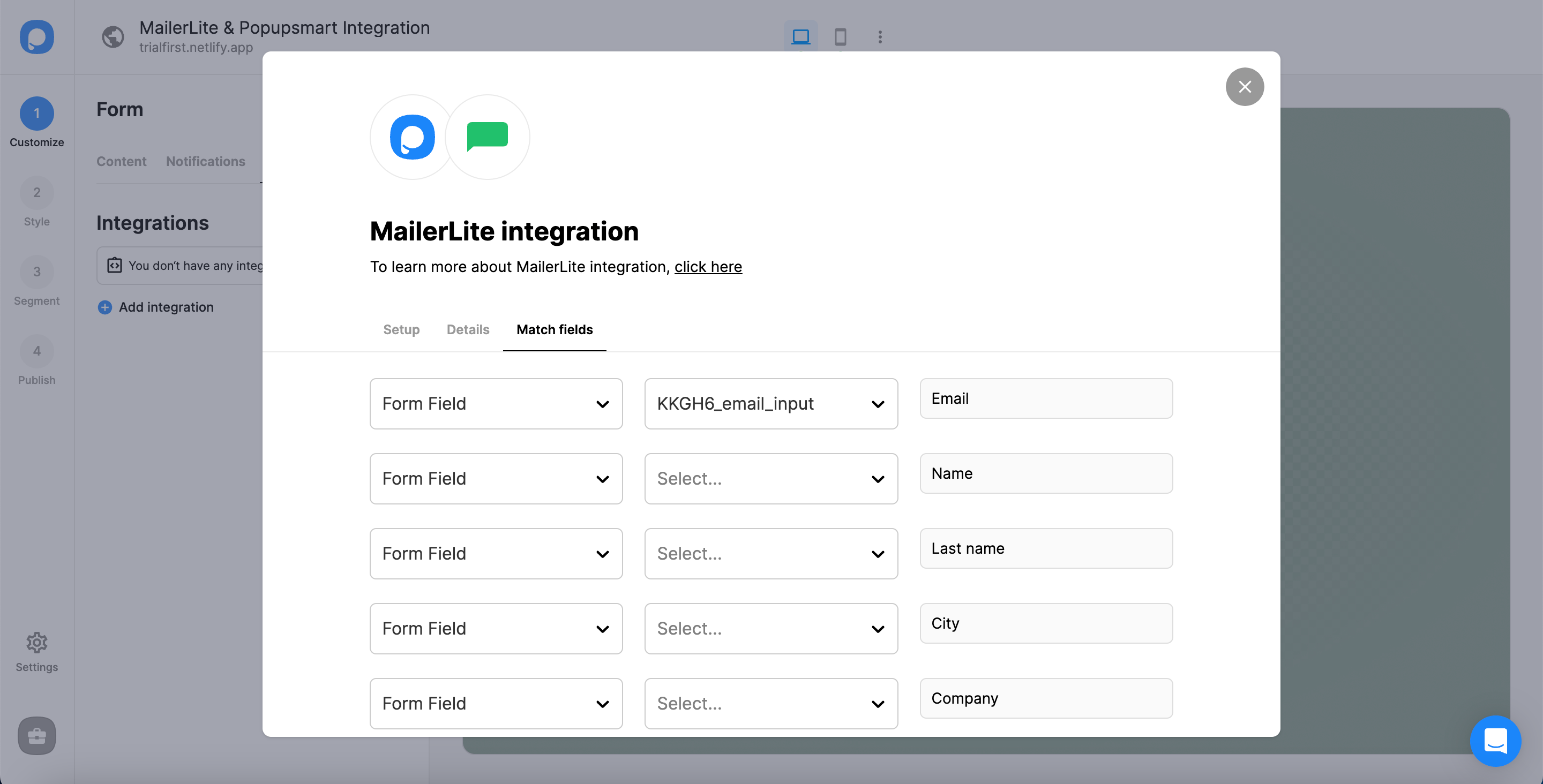
The fields on offer depend on the elements in your popup:
- Form field: an input in your popup. If the popup has none, the dropdown shows "No options".
- System field: data Popupsmart records on its own, such as the browser or device of the person who filled in the popup.
- API field: data you pass to the Popupsmart JS API, sent on to MailerLite with the rest of the submission.
- Static field: a fixed value you type yourself, handy for tagging where a subscriber came from, such as "sales" or "exit-intent".
Match the email input to MailerLite's email field; the rest is up to you.
The connection is on by default. Pause or edit it from the three-dot menu, and manage every connection from the Settings section of your Popupsmart dashboard, where you can also set one up outside a campaign.
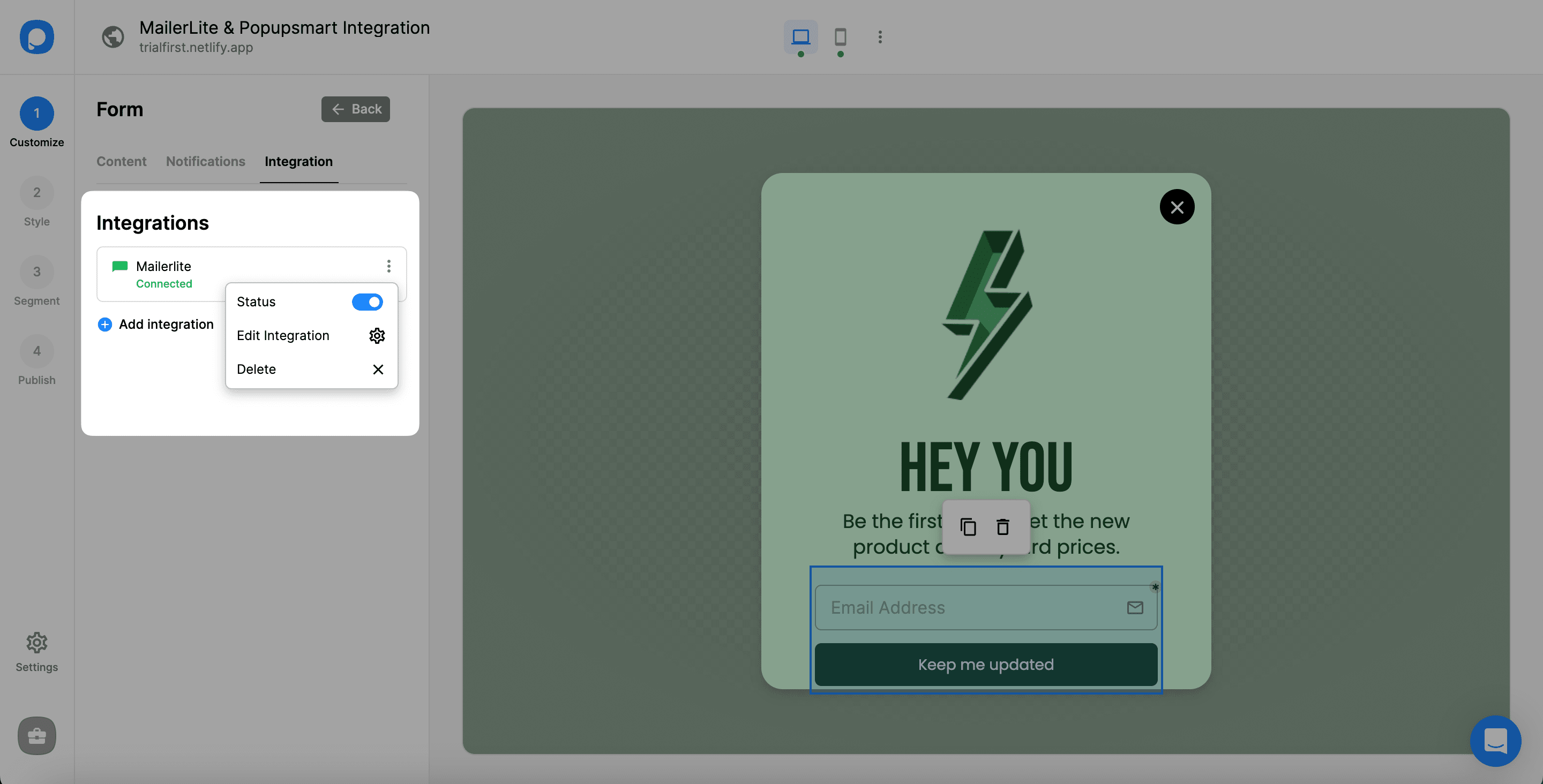
Test the connection before you publish
A test submission is the only proof that the MailerLite connection works. Publish the campaign to a page you control, fill in the popup with an address you own, then open Subscribers in MailerLite, search for it and check that it joined your group with the fields you matched. Delete the test subscriber afterwards.
Why are MailerLite popup subscribers unconfirmed?
MailerLite popup subscribers show as unconfirmed when your account has double opt-in switched on for integrations. The setting is Double opt-in for API and integrations, under Account settings → Subscribe settings, and it's separate from the one for MailerLite's own forms. With it on, MailerLite emails each new subscriber from your popup a confirmation link, and they stay unconfirmed until they click it. With it off, they join the group straight away.
Where your visitors' law asks for explicit consent, add a consent checkbox to the popup's form and match it to a MailerLite field, so each subscriber shows what the person agreed to.
Subscribers not reaching MailerLite? Check these
- The token only accepts listed IP addresses. Create a token that allows any IP address and update the connection in Settings.
- The token was deleted. Generate a new one and paste it into the connection.
- No group is chosen, or the group was deleted in MailerLite. Choose one again in the Details section.
- The email input isn't matched. Match it to MailerLite's email field.
- Double opt-in for API and integrations is on. The subscriber appears as unconfirmed until they click the confirmation link.
- The connection is paused or the campaign isn't live. Switch the connection back on from the three-dot menu, and check that the campaign is published on a verified website.
Still stuck? Contact Popupsmart support with the campaign name and we'll look at the connection with you.
MailerLite popup FAQ
Where do I find my MailerLite API key?
MailerLite calls it an API token. Open Integrations in MailerLite's left-hand menu, click Use next to MailerLite API, then click Generate new token, name the token and click Create token.
The step-by-step version has a screenshot for each click.
Can I create free MailerLite popups with Popupsmart?
Yes. Popupsmart's free plan is permanent, not a trial: one website, one live popup and 5,000 pageviews a month, with Popupsmart branding. The MailerLite connection is included on it.
The Popupsmart pricing page compares it with the paid plans.
Can I use MailerLite's pop-up and a Popupsmart popup on the same site?
Yes, but keep them off the same pages so no visitor gets two popups at once. MailerLite's pop-up can be shown or hidden on listed pages, and Popupsmart's URL targeting does the same on its side.
Can I show a MailerLite popup on WordPress or Weebly?
Yes. Add the Popupsmart embed code to the site, or on WordPress use the optional Popupsmart plugin, and the MailerLite connection works the same way on either platform.
The WordPress popup guide covers the install.
Does a MailerLite popup slow down my website?
No. Popupsmart loads through a single asynchronous embed code, so your pages render normally while the popup waits for its trigger.